
Rays Activate Tyler Glasnow, Transfer Brandon Lowe To 60-Day Injured List
The Rays announced Wednesday that righty Tyler Glasnow has been reinstated from the 60-day injured list. Brandon Lowe, already known to be out for the season due to a back injury, was transferred from the 10-day IL to the 60-day IL to open a spot on the 40-man roster. The Rays optioned righty Cristofer Ogando to Triple-A Durham to create a spot on the active roster.
Glasnow’s return gives the Rays a high-octane arm to add to the rotation mix both down the stretch and, more pivotally, in the postseason. Glasnow, who tossed seven minor league rehab innings prior to today’s activation, will be capped at two or three in his first start back from last summer’s Tommy John surgery. He could feasibly build up to a larger, less-restricted workload if Tampa Bay can put together a deep playoff run.
A healthy Glasnow unequivocally improves the Rays’ odds of doing just that, as he’d broken out following a trade from the Pirates, finally developing into the front-of-the-rotation talent he was billed as during his top prospect days. The 6’8″ righty started 37 games for Tampa Bay from 2019-21, pitching to a 2.80 ERA with a massive 35.9% strikeout rate and solid 7.8% walk rate over the life of 206 innings. The only pitchers in baseball with a higher strikeout rate during that three-year stretch were Gerrit Cole and Jacob deGrom, and only Shane Bieber had a higher percentage of combined called and swinging strikes than Glasnow’s 32.9%.
The Rays and Glasnow came to terms on a somewhat surprising two-year, $30.35MM extension earlier this summer — one that’s reflective both of Glasnow’s injury/missed time and his Cy Young-caliber upside. Glasnow will $5.35MM in 2023, which would’ve been his final arbitration year, representing a modest increase over this season’s $5.1MM salary. He’ll then be guaranteed a $25MM salary in 2024 — what would’ve otherwise been his first free-agent season. It’s the most the perennially cost-conscious Rays have ever paid for a single season of a player, so there’s surely a bit of trepidation on their end of things. At the same time, it’s rare for any player with Glasnow’s service time –and particularly one of Glasnow’s caliber — to sign away just one free-agent year, even on the heels of an injury-wrecked season. There’s some compromise from both parties, and Glasnow said after the contract that he’s “exactly where I want to be.”
The returning Glasnow will now join Shane McClanahan, Corey Kluber, Drew Rasmussen and Jeffrey Springs in a formidable rotation. Each of McClanahan, Rasmussen and Springs will be options alongside Glasnow through at least the 2024 season, and the Rays will have several impressive young hurlers to vie for the fifth starting spot next season (barring a free-agent or trade addition). Luis Patino, Yonny Chirinos, Josh Fleming and prospect Taj Bradley will all be in the mix, though their most touted arm, righty Shane Baz, will likely miss all of the 2023 season following his recent Tommy John surgery.
Braves Select Silvino Bracho
The Braves announced Wednesday that they’ve selected the contract of righty Silvino Bracho from Triple-A Gwinnett. Atlanta created roster space by optioning lefty Kyle Muller to Gwinnett and by recalling righty Huascar Ynoa and placing him directly on the 60-day injured list. Ynoa had Tommy John surgery earlier this summer.
It’ll be Bracho’s second stint of the season with the Braves. The former D-backs right-hander opened the year in the Red Sox organization but was traded to Atlanta for cash back in June just hours after Boston had designated him for assignment. Bracho tossed a scoreless inning with Atlanta before being designated for assignment a second time and successfully passed through outright waivers, at which point he accepted an assignment to Triple-A and remained with the organization.
Despite not getting much of a look in Boston or Atlanta this season, Bracho has had a strong season in Triple-A. Through 57 1/3 innings, he’s pitched to a sharp 2.67 ERA with an excellent 30.4% strikeout rate against a tiny 4.3% walk rate. During his lone inning with the Braves earlier this summer, Bracho’s heater sat at 94.1 mph, which is a hair above his career 93.4 mph mark.
From 2015-20, Bracho was an up-and-down member of Arizona’s relief corps, showing promise on multiple occasions but never quite displaying the consistency required to stick on the big league staff. He looked to have turned a corner in 2018 when he logged 31 innings of 3.19 ERA ball with an above-average 26.4% strikeout rate, but Bracho tore the ulnar collateral ligament in his pitching elbow during Spring Training 2019 and underwent Tommy John surgery.
The Braves can technically control Bracho for another three years if they choose to keep him on the 40-man roster, but it’s likelier that this will be a short-term addition that’ll give Bracho another chance or two to square off against big league hitters. In the likely event that he’s removed from the 40-man roster, he’ll be able to become a free agent this offseason — fresh off a health and successful showing in Triple-A.
Angels To Promote Logan O’Hoppe, Designate Magneuris Sierra
The Angels are selecting the contract of top catching prospect Logan O’Hoppe to the big leagues and designating outfielder Magneuris Sierra for assignment in a corresponding move, per MLB.com’s Rhett Bollinger (Twitter link). O’Hoppe will start behind the plate for the Halos today in his MLB debut.
O’Hoppe, 22, was acquired in the swap that sent center fielder Brandon Marsh to the Phillies prior to the trade deadline. The former 23rd-round find immediately became the Angels’ top-ranked prospect, thanks to a meteoric rise through the minors in 2021-22. O’Hoppe opened the season with the Phillies’ Double-A affiliate and hit .275/.392/.496 with 15 homers through 316 plate appearances in that pitcher-friendly environment, but he’s been even better with the Halos’ Double-A club: .306/.473/.673 and 11 homers in 131 plate appearances. Currently, O’Hoppe is ranked as baseball’s No. 50 prospect at FanGraphs, No. 66 at MLB.com and No. 77 at Baseball America.
Strikeouts were an issue for O’Hoppe early in his minor league career, but he’s curbed those tendencies quite well, going from a 27.7% strikeout rate in 2019 to just a 16.6% clip in Double-A this season. That improved discipline is also made apparent by a huge 15.7% walk rate. He’s walked nearly as often this season (70 times) as he’s punched out (74). The improved approach has perhaps helped O’Hoppe tap into more power, as this year’s 26 long balls and .261 isolated power (slugging percentage minus batting average) are career-highs by a wide margin. In fact, this year’s 26 homers are more than O’Hoppe had tallied in his combined professional career heading into the season (24).
Defensively, the aforementioned scouting reports tout O’Hoppe’s receiving skills, ability to block pitches in the dirt, accurate arm and quick release, calling him a potential everyday option behind the plate. With just a week of games left, it’ll be a brief cup of coffee for O’Hoppe. But the Angels would’ve needed to add him to the 40-man roster over the winter in order to protect him from the Rule 5 Draft anyhow, so they’ll now take the final few games of the season to take a look at a promising prospect they hope can be a foundational piece in the coming years.
O’Hoppe’s acquisition and quick rise to the Majors comes just six months into a three-year, $17.5MM extension signed by Max Stassi. The extension looked sensible enough for both parties back in March, as Stassi had long been a top-tier defender who looked to have had a late-blooming breakout at the plate when he hit .250/.333/.452 with the Angels in 2020-21. The 2022 season has been a nightmare for Stassi, though, as he’s slumped to a .182/.268/.298 output in 365 trips to the plate and seen his typically sky-high defensive marks dip to about league average.
The Angels still have Stassi signed at $7MM in each of the next two seasons, and a $500K buyout on a 2025 club option brings the total commitment to him to $14.5MM beyond the current campaign. That’ll make him a pricey backup if O’Hoppe indeed emerges as the starter, though it’s important to note that O’Hoppe still has just six career games in Triple-A — all coming late last season. It’s possible O’Hoppe will begin next season in Triple-A Salt Lake, while the Angels subsequently hope for a Stassi rebound that would give them a pair of quality options. However, it’s just as feasible that O’Hoppe unseats Stassi as the starter, and the Angels eventually look to get out from underneath the remainder of Stassi’s contract.
As for the present-day corresponding move, Sierra’s DFA comes on the heels of a .165/.200/.242 showing in 96 trips to the plate. Once a prospect of note himself, Sierra is among the game’s fastest players but has never produced enough with the bat to capitalize on his prodigious wheels. In 636 career plate appearances between the Cardinals, Marlins and Angels, he’s a .228/.273/.272 hitter. He’ll be placed on outright waivers or release waivers within the next couple of days and can become a minor league free agent at season’s end either way.
Carlos Correa Is Making His Opt-Out Decision Even Easier
The Twins’ surprise signing of Carlos Correa to a three-year, $105.3MM contract was supposed to be the signature free-agent addition that washed away the lingering distaste of an awful 2021 campaign pushed them toward an AL Central crown. Instead, the Twins have wildly unperformed expectations for a second straight season, due in large part a once-again disastrous level of injury. Minnesota has had more IL days accrued than any team in the American League and trails only Cincinnati for the MLB lead in that odious category. (The Athletic’s Aaron Gleeman took a player-by-player look at the Twins’ staggering injury woes just this morning.)
Very little has gone right in Minnesota this year, but with all the woes they’ve incurred in their catastrophic second half, Correa’s monstrous finish to the season has flown somewhat under the radar. As the team has crumbled around him, Correa has enjoyed just the type of sprint to the finish line the team had hoped for at the time of the contract.
Correa struggled in April and in July, sandwiching a paid of outstanding months between two below-average months at the plate. His bat picked up in late July, however, and he’s finishing out what could well be his only season with his strongest production of the year. Since Aug. 1, Correa is hitting .323/.405/.505 with eight homers, nine doubles and a triple in 222 plate appearances. Both his walk rate (11.7%) and strikeout rate (19.4%) during that stretch of 222 plate appearances are about two percentage points better than the levels Correa carried through the end of July.
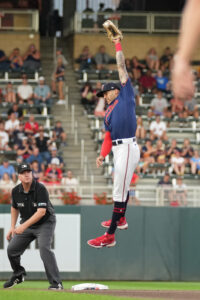
Since Aug. 1, Correa ranks 10th in the Majors in batting average, ninth in on-base percentage and 25th in slugging percentage. His 162 wRC+ (indicating he’s been 62% better than the league-average hitter) in that time is tied with J.T. Realmuto for 13th in all of baseball. If you really want to cherry-pick, Correa’s ridiculous .386/.432/.670 slash over 95 plate appearances since Sept. 4 give him the fifth-best wRC+ in baseball during that time (216).
There’s no denying that Correa’s counting stats will be down from their 2021 levels when the season draws to a close. It’s at least possible that he swats another five homers and ends up tying last year’s mark off 26 long balls, though with nine games to play, it’s also unlikely. He’s not going to drive in as many runs as he did in ’21, and some of that is due to a curious power outage with runners in scoring position this season. It’s also due, however, to the simple fact that with Houston in 2021, Correa came to the plate 187 times with runners in scoring position and 304 times with men on base. This season, those numbers are currently at 116 and 248. He hasn’t been as good in big spots as he was a year ago, but also simply hasn’t had as many big spots, thanks to a Twins lineup that has routinely relied on minor league placeholders to fill in for injured regulars.
On the whole, aside from a slight dip in power (which correlates with the league-wide drop in power this season), Correa’s production at the plate in 2022 looks quite similar to in 2021. He’s hitting .289/.365/.468 as a Twin and hit .279/.366/.485 in his final season as an Astro. This year’s 89.9 mph average exit velocity is just barely shy of last year’s 90.2 mph exit velocity. He’s barreling balls more often this year than last (11.5% to 9.4%), and his overall hard-hit rate (43.8%) is a bit better than his 2021 level as well (42.5%). Essentially, Statcast feels he’s been almost the same hitter in Minneapolis as he was in Houston.
The biggest change in Correa’s valuations this season has been on the defensive side of things. His defensive ratings are down across the board, although Defensive Runs Saved and Ultimate Zone Rating still peg him as a clearly above-average shortstop — just not the all-world, best-in-MLB-regardless-of-position defender he was in 2021. Statcast feels differently, dinging Correa at four outs below average — his first negative OAA mark since 2016.
Having just celebrated his 28th birthday last week, it seems unlikely Correa’s defensive skills have simply eroded. Repeating last year’s career-best 20 Defensive Runs Saved and massive 12 Outs Above Average was always going to be a challenge; defensive stats often oscillate just like their offensive counterparts, and the likely bet is that he’ll again be above-average across the board in 2023. He’s only made eight errors this season, six of which have been of the throwing variety. That only tells the tales of the balls Correa has gotten to, of course — hence the pitfalls of raw fielding percentage — but it does illustrate that Correa hasn’t become a clumsy-handed butcher who’s booting the routine plays.
Overall, Correa has been worth 5.0 wins above replacement, per Baseball-Reference, and 4.2 WAR per FanGraphs. His .289/.365/.468 batting line is 40% better than league-average after adjusting for league and home park, by measure of wRC+, and he’s been lauded throughout the season by teammates, coaches and the front office staff alike for his influence leadership and influence in the clubhouse. It’s not necessarily the best-case outcome the Twins might’ve hoped for when signing him, but a strong four-to-five win season and positive off-the-field impact is a strong outcome all the same.
Correa has said at multiple times this season that he and his family feel at home in Minnesota and that he’s open to, if not hopeful for a long-term offer to stay with the Twins long term. That, of course, is a sensible thing for any pending free agent to say, and the fact that he’s open to a long-term deal (presumably at top-of-the-market dollars) shouldn’t be a surprise. It’s moderately notable that he’s chosen to publicly state his hope for a long-term arrangement rather than demur and say that contract talk is for the offseason, but public comments from Correa — as with most pending free agents — can be taken with a grain of salt.
The reality is that while Correa might never find the ten-year deal and $35MM-ish annual value he was likely seeking last offseason, he can absolutely find a long-term pact that will trounce the remaining two years and $70.2MM on his current contract with the Twins. Correa can very realistically command more than $30MM per year over a long term — likely with additional opt-out opportunities baked into the deal. Because of his age, even a ten-year deal would still only run through his age-37 season. Opting out has long seemed to be the likeliest outcome for Correa, as noted on last month’s update to MLBTR’s Free Agent Power Rankings (where Correa placed fourth).
Correa’s torrid production has only improved his stock since that time. The Phillies, Cubs and Giants are reported to be among the teams that will look at free-agent shortstops. The Twins have already expressed public interest in extending the relationship. The Braves, Red Sox and Dodgers will all have their own star shortstops reach the market, creating potential openings for all three (in-house options notwithstanding). The Cardinals and Angels could need shortstops. The Orioles could theoretically be lurking and have already signaled that their payroll will increase.
The free-agent market for shortstops should be strong, and Correa’s standing among the 15 most-productive hitters in the sport over the final two months of the season has likely silenced any inkling of a doubt regarding his opt-out clause. The Twins shocked baseball in March when they signed Correa in the first place. It would register as an even bigger shock if Correa now forgoes his opportunity to return to the market on the heels of a season — and a finish — this strong.
MLBTR Chat Transcript
Click here to read a transcript of Tuesday’s chat with Steve Adams.
Injury Notes: Carpenter, Larnach, Brault
Matt Carpenter was putting together a comeback season for the ages with the Yankees, hitting .305/.412/.727 with 15 home runs in 154 plate appearances before suffering a broken bone when fouling a ball into his foot. The foot fracture didn’t require surgery, but the timing of the injury placed Carpenter’s season in jeopardy. Manager Aaron Boone said yesterday that the Yankees are now hopeful that the 36-year-old Carpenter will be able to return for the final series of the regular season (Twitter link via Bryan Hoch of MLB.com). It’s not a given, but it’d be a nice bonus for both the Yankees and Carpenter himself to get a look at his swing in a game setting before the postseason rolls around.
A couple more injury updates from around the game…
- The Twins added another name to their ever-growing list of season-ending injuries, as outfielder Trevor Larnach will not return before the end of the 2022 season, per Phil Miller of the Minneapolis Star Tribune. Larnach underwent core muscle surgery early in the summer and was all but finished with a rehab assignment last week, when he sustained a wrist injury during one of the final plate appearances of his rehab assignment. The 25-year-old tells Miller that he wasn’t even able to hold a bat the day after incurring the injury. Larnach got out to a solid start in 2022, hitting .258/.331/.477 with five homers and 13 doubles through his first 145 plate appearances. He collected just four hits in 35 plate appearances before undergoing surgery, however, and now won’t return to the field this year. Larnach and teammate Alex Kirilloff are both former first-rounders who’ve been touted among the game’s 50 best prospects at multiple points in the past, but injuries have prevented them from establishing themselves as lineup fixtures at Target Field.
- Left-hander Steven Brault‘s shoulder hasn’t responded as hoped during his minor league rehab assignment, Cubs skipper David Ross said yesterday (via Maddie Lee of the Chicago Sun-Times, on Twitter). He’s headed back to Chicago to be further evaluated and won’t return to the mound this season. The longtime Pirates lefty originally inked a Major League deal with the Cubs in the offseason but had it restructured as a minor league contract due to an injury setback. The 30-year-old Brault didn’t pitch, even in the minors, until July 1 this season. He made his way to the big league roster two weeks later and tossed nine innings with a 3.00 ERA and an 8-to-5 K/BB ratio before a shoulder strain sent him back to the injured list in mid-August. Brault also missed significant time in 2019 due to a shoulder strain and missed much of the 2021 campaign due to a lat strain. Brault will be a free agent at season’s end.
Poll: National League Rookie Of The Year
This year’s National League Rookie of the Year voting will be a particularly fun one because the two front-runners happen to be teammates. Braves right-hander Spencer Strider and center fielder Michael Harris II both burst onto the scene in 2022 and both cemented themselves as building blocks in Atlanta. Wins above replacement is far, far from the be-all and end-all in ascertaining player value, but it’s still telling that Strider and Harris are both north of four WAR on the season (per both Baseball-Reference and FanGraphs), while no other NL rookie has even three wins above replacement per either version of the metric.
Harris and Strider have both played at an All-Star level this season, though neither actually made the All-Star team this summer. That’s due largely to the fact that Strider began the season in the bullpen and Harris didn’t make his debut until late May. Given their play in 2022, that could change as early as next summer.
There’s still a bit of time for the bottom line to change, although with Strider on the 15-day injured list due to an oblique strain, his regular season is likely over. Harris will have another nine games to build his case, pending any off-days or an untimely injury of his own. Let’s take a quick look at each player’s candidacy.
A Quick Case for Strider
Dominant this season as both a reliever (2.22 ERA in 24 1/3 innings) and a starter (2.77 ERA, 107 1/3 innings), Strider leads all National League rookies with 131 2/3 innings pitched. Cincinnati’s Hunter Greene, a popular ROY pick prior to the season, is a distant second place at 113 2/3 innings. Strider’s gaudy 38.3% strikeout rate isn’t just the best among rookie pitchers in 2022 — it’s the best among all Major League pitchers who have thrown at least 100 innings. Shane McClanahan is the only pitcher in Major League Baseball (again, min. 100 innings pitched) who has induced swinging strikes at a higher clip than Strider’s 15.5%.
Strider’s overall numbers — 131 2/3 innings, 2.67 ERA, 38.3% strikeout rate, 8.5% walk rate — are so dominant that if he had a few more innings on his resume, he’d be in the mix for some down-ballot Cy Young votes. (He may still get a handful, but he’s not going to stack up alongside the current leaders.)
A common argument against Strider is that he shouldn’t be favored because he plays less often than an everyday player (e.g. Harris). Firstly, unlike most of even the fringe ROY candidates, Strider broke camp with the Braves this year. He’s been on the roster since Opening Day, which Harris and others can’t claim.
Secondly, Strider has faced 528 batters this season and, were it not for the oblique injury, would’ve pushed that number close to 600. Even that 528 mark is greater than the total number of plate appearances for any National League rookie hitter. Strider (and pitchers in general) may appear in a fewer number of their team’s overall games, but as a pitcher, he has more direct influence on the outcome of every single plate appearance than any of the defenders behind him. On average, he faced 21.7 hitters per start. That’s nearly a week’s worth of plate appearances for a position player.
Put more succinctly, the counter-argument to that common knock on Strider is that hitters play a smaller role in determining the outcome of a large number of their team’s games; pitchers play a larger role in determining the outcome of a small number of their team’s games.
A Quick Case for Harris
In terms of wins above replacement, Harris trails only Julio Rodriguez for the rookie lead, per FanGraphs (4.8), and only Rodriguez and Cleveland’ Steven Kwan, per Baseball-Reference (5.1). He’s a dynamic player in all facets of the game, hitting .305/.346/.535 with 19 home runs and 19 steals apiece. Harris doesn’t walk much (4.7%) and strikes out a bit more than average (23.8%), but that hasn’t stopped him from being 43% better than the average hitter, by measure of wRC+ (or 42%, per OPS+).
Defensively, Harris looks like a future Gold Glover. He might not win one this season, as his cumulative defensive contributions are impacted by the fact that he spent nearly two months in the minors, but every publicly available metric is in agreement that he’s a plus, if not elite defender. In 949 innings of center field work, Harris has received standout marks from Defensive Runs Saved (7), Ultimate Zone Rating (3.9) and Statcast (6 Outs Above Average, 5 Runs Above Average), to name a few. Harris ranks in the 92nd percentile of Statcast’s Outs Above Average, the 87th percentile for his jumps on balls hit to the outfield, and in 94th percentile for pure sprint speed.
It’s true that Strider has more batters faced than Harris has plate appearances, but Harris has fielded far more balls in play in center field than Strider has on the mound. His value as a defensive player is far superior, particularly given his elite results in 2022. Harris also provides baserunning value that Strider doesn’t have the ability (or even the opportunity) to match. Despite appearing in just 106 games so far, Harris ranks 17th among all big leaguers in baserunning runs above average, per FanGraphs’ — a cumulative stat that incorporates more than just his impressive 19-for-21 showing in stolen bases.
—
There’s really no wrong answer; both players have had sensational starts to their career and both have been absolutely vital pieces of a Braves team that trails the Mets by 1.5 games for the National League East lead. Still, only one of the two is going to take home Rookie of the Year honors in November. Who should it be?
Who should win National League Rookie of the Year honors?
-
Spencer Strider 50% (4,563)
-
Michael Harris II 44% (3,954)
-
Someone else (specify in comments) 6% (547)
Total votes: 9,064
Outrighted: Herget, Neuse, Sanchez
A few updates on some recently DFA’ed players who passed through waivers, per the league’s transactions log at MLB.com…
- Righty Kevin Herget, designated for for assignment Friday by the Rays, went unclaimed on waivers and has been assigned outright to Triple-A Durham. Herget made his big league debut as a 31-year-old rookie this season after grinding through the minor leagues and independent baseball for more than nine years. He tossed just 2 2/3 frames and yielded a pair of runs in that time but also recorded his first big league strikeout. Even if Herget doesn’t get another look with the Rays in 2022, his excellent work in Triple-A this year should generate interest in minor league free agency this winter. In 93 2/3 frames, he’s pitched to a 2.98 ERA with a strong 24.9% strikeout rate and an outstanding 3.9% walk rate.
- Athletics infielder Sheldon Neuse cleared outright waivers and has been assigned to Triple-A Las Vegas. The 27-year-old logged a career-high 293 plate appearances in 2022 but recorded just a .214/.273/.288 slash with four homers, four doubles and a pair of triples in that time. Neuse has consistently produced at the Triple-A level, where he’s slashed .299/.353/.471 in 1559 plate appearances, but he’s only managed a .212/.262/.296 slash in 420 Major League trips to the plate. Neuse has spent the bulk of his pro career playing third base, but he does have just over 750 innings of experience at second base and at shortstop — in addition to brief cameos at first base and in the outfield corners.
- Veteran right-hander Aaron Sanchez, whom the Twins designated for assignment Friday, remains in the organization after clearing waivers and being assigned outright to Triple-A St. Paul. Injuries, most notably shoulder surgery, have blown up the once-promising career of Sanchez, formerly the No. 34 overall draft pick by the Blue Jays and the 2016 American League ERA leader. Since tossing 192 innings with a flat 3.00 ERA in ’16, Sanchez has thrown just 524 1/3 Major League innings (plus another 103 minor league innings) in a span of six seasons. Still just 30, Sanchez has pitched decently in Minnesota this season, tossing 27 innings with a 4.00 ERA, 25-to-7 K/BB ratio and 53.8% ground-ball rate.
Rays Outright Dusten Knight
Sep. 25: Knight has cleared waivers and accepted an outright assignment to Triple-A Durham, reports Marc Topkin of the Tampa Bay Times.
Sep. 23: The Rays announced a series of roster moves Friday, with right-hander Dusten Knight being designated for assignment and lefty Ryan Yarbrough hitting the 15-day injured list due to a strained right oblique. In their place, the Rays have selected the contract of righty Cristofer Ogando from Triple-A Durham and recalled righty Calvin Faucher.
Knight, who turned 32 earlier this month, has tossed 11 innings out of the Tampa Bay bullpen in 2022, yielding seven earned runs on 11 hits and four walks with nine strikeouts. Four of those hits have left the yard, contributing to Knight’s 5.73 ERA on the season. He’s had better results in Durham where he’s notched a 3.48 ERA in 54 1/3 innings with a 27.3% strikeout rate — albeit with an unsightly 13.7% walk rate. Knight, who made his MLB debut with the 2021 Orioles, has a 3.23 ERA in parts of four Triple-A seasons.
Yarbrough’s injury will bring his regular season to an end. A fixture on the Rays’ staff from 2018-21, he’s been shuttled back and forth between the big leagues and Durham this season, tossing a total of 80 innings of 4.50 ERA ball in the Majors. Given the up-and-down nature of his 2022 season and the fact that he’ll be owed a raise on this year’s $3.85MM salary, it’s feasible that the Rays could look to either move Yarbrough in the winter or decline to tender him a contract. For now, he’ll hope to rehab and contribute to the Rays in the postseason.
Ogando, 28, made his big league debut as a replacement player with the Rays during their series in Toronto earlier this season. He was optioned to Durham following that series but stuck on the 40-man roster for a few weeks after that debut before being designated for assignment and outrighted in late July. The former Marlins and D-backs farmhand has pitched to a 4.56 ERA with a 23.5% strikeout rate and 11.5% walk rate in 54 1/3 innings with the Rays’ Durham affiliate this season.
Pirates Select Ji-Hwan Bae
3:27pm: Pittsburgh formally selected Bae’s contract. Catcher Tyler Heineman has been placed on the seven-day concussion injured list to clear an active roster spot. The Pirates 40-man tally now sits at 39.
8:51am: The Pirates are set to promote infield prospect Ji-hwan Bae, as first reported by Ryan Palencer of PiratesProspects.com (Twitter link). He’ll need to have his contract formally selected to the 40-man roster, though the Pirates currently have two vacancies in that regard, so Bae’s promotion will only require a corresponding 28-man roster move.
Now 23, Bae originally planned to sign with the Braves as an international amateur in 2017, but his agreement was dissolved when the Braves were penalized in 2017 for a bevy of rule violations ono the international market. The South Korean-born Bae instead signed a $1.25MM bonus with the Pirates a year later.
Bae currently ranks 11th among Pittsburgh farmhands at MLB.com and sits 23rd on Baseball America’s midseason ranking of the system. He’s spent the entire season with the team’s Triple-A affiliate in Indianapolis, batting .289/.362/.430 with eight home runs, 23 doubles, six triples and 30 stolen bases (in 38 attempts). Bae has fanned in 16.9% of his plate appearances while walking at a 10.1% clip.
Scouting reports on Bae tout his 70-grade speed (on the 20-80 scale) and his above-average contact skills, though his eventual defensive home is rather unsettled. After spending much of his early pro career at shortstop, he’s played more second base in recent seasons and now begun to add further positions to his repertoire. The Bucs have played him primarily at second base (457 innings), shortstop (177) and in center field (161) in 2022, but he’s also had briefer looks in left field and at third base.
Bae was found guilty by a South Korean court in 2018 of assaulting his former girlfriend, and was subsequently ordered to pay a trivial sum to the victim (about $1,750 U.S. dollars, which she donated to charity). Major League Baseball conducted its own investigation into the matter, ultimately suspending Bae for 30 games of the 2019 season under the joint domestic violence, sexual assault and child abuse policy.