
Reds Place Mike Minor On Injured List
The Reds announced Friday that left-hander Mike Minor has been placed on the 15-day injured list due to soreness in his left shoulder. Cincinnati also reinstated righty Connor Overton from the 60-day injured list and, in order to make room for him on the 40-man roster, transferred outfielder Nick Senzel to the 60-day IL. Senzel suffered a fractured toe earlier in the week, which was already known to be a season-ending injury, given the timing.
Minor’s placement on the injured list essentially ends his season and quite likely ends his time as a member of the Reds organization. Acquired from the Royals prior to the 2022 season, the veteran southpaw began the season on the injured list due to problems in that same left shoulder. The Reds initially suggested Minor’s shoulder issue would not keep him out long, but he suffered an April setback and wound up missing the first two months of the season. He’ll now miss the final couple weeks as well.
All told, Minor’s potentially lone season in Cincinnati lasted 19 starts and 98 innings, during which time he struggled to a 6.06 ERA with a 16.7% strikeout rate and 8.8% walk rate. Home runs have increasingly become a problem for Minor in recent years, and the move to the Great American Ball Park — one of the game’s most homer-happy venues — unsurprisingly exacerbated the issue. Minor yielded a hefty 24 home runs in those 98 innings — 15 of them coming at home — for an average of 2.20 HR/9.
The Reds technically hold a $13MM club option over Minor for the 2023 season, though given this year’s struggles, they’ll surely pay the $1MM buyout on that option. It’s always possible the two parties could seek to renegotiate a new contract, but that net $12MM price tag for the Reds seems particularly steep for Minor, given that his struggles extend well beyond the 2022 season. Minor’s last healthy, productive season came in 2019, when he tossed 208 1/3 innings of 3.59 ERA ball for the Rangers. Since that time, he’s pitched 313 1/3 innings of 5.46 ERA ball across parts of three seasons.
As for Overton, his return from a stress reaction in his lower back will give the Reds a late look at a journeyman right-hander who enjoyed solid results early in the season, albeit with questionable underlying numbers. Overton, 29, pitched 24 2/3 innings out of the Cincinnati rotation earlier this year, logging a pristine 1.82 ERA but with just an 11.2% strikeout rate against a 7.9% walk rate. Opponents recorded an average exit velocity of 91 mph against him, and 44.4% of the balls hit against him were at 95mph or greater.
The Reds are Overton’s sixth MLB organization (to say nothing of a stint on the independent circuit) in what’s now a nine-year professional career. Selected by the Marlins in the 15th round of the 2014 draft, Overton has pitched in the minors with Miami, Washington, San Francisco, Pittsburgh, Toronto and now Cincinnati. He made his big league debut in 2021, pitching to a 4.70 ERA in 15 1/3 innings between the Pirates and Blue Jays. In parts of seven minor league seasons, Overton has a 3.98 ERA with a 21.4% strikeout rate and 7.7% walk rate.
Twins Designate Aaron Sanchez For Assignment
The Twins announced Friday that they’ve recalled right-hander Louie Varland from Triple-A St. Paul and designated fellow righty Aaron Sanchez for assignment in order to open a spot on the roster.
Sanchez, 30, has appeared in seven games with the Twins this season and pitched to a 4.00 ERA with a 21.6% strikeout rate and 6% walk rate in 27 innings. The right-hander was an All-Star in 2016 and led the American League with a 3.00 ERA that season but has seen that promising career derailed by a series of injuries, most notably including 2019 shoulder surgery.
Sanchez logged a career-high 192 innings back in that 2016 season, but he’s only managed 366 big league innings since that time, pitching to a 5.24 ERA along the way. The Twins will place him on outright waivers or release waivers in the next few days.
Varland, 24, will get the start for the Twins in tonight’s game. It’ll be the third of his career, as he made a pair of appearances earlier this month, pitching well through 5 1/3 innings at Yankee Stadium in his MLB debut before struggling in a five-inning outing in Cleveland.
A Minnesota native whom the Twins selected in the 15th round of the 2019 draft out of Division-II Concordia University in St. Paul, Varland skyrocketed through the system in 2021. He’s had a strong followup showing between Double-A and Triple-A this year, logging a combined 3.06 ERA in 126 1/3 frames. He’ll be in the mix for a rotation spot for a pitching-needy Twins club next year, making his late-season audition well worth monitoring for Twins fans.
Rays Designate Kevin Herget For Assignment
The Rays announced Thursday that they’ve designated righty Kevin Herget for assignment. His spot on the 40-man roster will go to infielder/outfielder Miles Mastrobuoni, whose selection to the Major League roster (covered here this morning) is now official. Catcher Rene Pinto was optioned to Triple-A Durham, as expected.
It’s the second DFA of the season for the 31-year-old Herget, although unlike his first stint on the big league roster earlier this summer, Herget actually got into a pair of games and made his MLB debut this time around. That marked the culmination of an arduous, nearly decade-long grind through both the minor leagues and the independent circuit for Herget — a 39th-round pick out of Division-III Kean University by the Cardinals back in 2013.
Herget’s pair of calls to the big leagues this season have been well-earned. In his first year with the Rays organization, he’s logged 93 2/3 innings in Durham while pitching to a sharp 2.98 ERA with a solid 24.9% strikeout rate and a pristine 3.9% walk rate. It’s by far the most success Herget has enjoyed in parts of five seasons at the Triple-A level, where he has a lifetime 4.16 ERA, 22.7% strikeout rate and 5.8% walk rate in 376 1/3 innings. Herget’s brief MLB experience during this most recent stint saw him yield a pair of runs on two hits and no walks with one strikeout in 2 2/3 innings.
With the trade deadline squarely in the rear-view mirror at this point in the season, the Rays’ only real choices with Herget are to place him on outright waivers or release waivers. He went unclaimed and was outrighted to Durham last time around, so Herget would have the option to reject an outright assignment in favor of free agency if he passes through waivers a second time. However, with just a couple weeks left in the season, it seems likelier that he’d accept and head back to Durham — particularly since he’ll be a minor league free agent this winter anyway.
Giants Select Shelby Miller
12:23pm: The Giants formally announced that Miller has been selected from Sacramento and Waites has been optioned there in his place.
12:21pm: The Giants are selecting the contract of veteran right-hander Shelby Miller from Triple-A Sacramento prior to Thursday’s game against the Rockies. Susan Slusser of the San Francisco Chronicle tweeted earlier that Miller was in the clubhouse, and Andrew Baggarly of The Athletic now adds that Miller has been informed he’ll be active for today’s game (and not simply on the taxi squad). The Giants designated outfielder Lewis Brinson for assignment yesterday, so they already have an open spot on the 40-man. Slusser adds that righty Cole Waites looks to have been optioned to Sacramento to open a spot for Miller on the active roster.
San Francisco will be the seventh Major League team for Miller, once one of the game’s brightest young arms but now a journeyman who’s found himself closing games for the Giants’ top minor league affiliate in 2022. Still just 31 years old, Miller opened the year with the Yankees’ Triple-A club but opted out of that deal early in the season and signed with the Giants in June. He’s logged a combined 2.87 ERA between the two Triple-A clubs this season, punching out 31.2% of his opponents against a 9.5% walk rate. He’s also picked up a dozen saves (eight with the Giants organization) and five holds out of the bullpen this year.
A former first-round pick who was regarded as one of the sport’s premier pitching prospects, Miller debuted with the Cardinals as a 21-year-old in 2012 and spent the two subsequent seasons as a mainstay in the St. Louis rotation. The Cards parted with Miller in a trade that sent then-star outfielder Jason Heyward from Atlanta to St. Louis, and Miller made the All-Star team in his lone season as a Brave (despite an MLB-worst 17 losses, which were the result of a dismal team surrounding him).
Despite Miller’s sterling 3.02 ERA in his first season with the Braves, Atlanta couldn’t resist when the D-backs offered up Dansby Swanson, Ender Inciarte and then-top pitching prospect Aaron Blair in return for Miller — just six months after Swanson had been drafted with the No. 1 overall pick. It’s gone down as one of the most lopsided swaps in recent memory, as Swanson has blossomed from steady everyday shortstop into one of the NL’s top all-around players in 2022. Inciarte, meanwhile, had several seasons as a strong everyday center fielder in Atlanta.
Miller, meanwhile, struggled immediately with Arizona and wound up limping through a trio of injury-plagued seasons in Phoenix. He’s since pitched in the Majors with the Rangers (2019), Cubs (2021) and Pirates (2021), but Miller has just a 7.04 ERA in 195 2/3 frames since being traded by the Braves nearly seven years ago.
There’s little denying, however, that he’s been impressive in a bullpen role with the top affiliates for the Yankees and Giants in 2022. Whether that leads to an eventual early-30s renaissance for Miller remains to be seen, but this is the healthiest and most effective he’s been in years. And with his 32nd birthday not yet having taken place, there’s still plenty of time for the once-vaunted righty to be reborn as a quality big league reliever. Both Miller and the Giants surely hope that today’s promotion can be the first step toward just such an outcome. He’ll be a free agent at season’s end, and a strong couple weeks to close out the season could make him an interesting, low-cost target for clubs over the winter.
Rays To Select Miles Mastrobuoni
The Rays appear set to select the contract of infielder/outfielder Miles Mastrobuoni and option catcher Rene Pinto to Triple-A Durham. Former big league outfielder Denard Span, now a special assistant with the Rays’ baseball operations department, tweeted that Mastrobuoni has been informed he’s going to the big leagues. Marc Topkin of the Tampa Bay Times reported that Pinto was likely to be sent back down to Durham. The Rays still need to make a corresponding 40-man roster move.
It’ll be the first call to the big leagues for Mastrobuoni, whom the Rays selected with their 14th-round pick back in 2016. The now-26-year-old Mastrobuoni has never garnered much prospect fanfare despite consistently producing at an above-average level in the minors. Baseball America ranked him 20th among Tampa Bay farmhands on their midseason update of the Rays’ system — the first time he’s ever appeared among their top 30 prospects there. FanGraphs listed him 37th among Rays prospects back in March.
The increased attention on the lefty-swinging utilityman is understandable, given his output in recent seasons. Mastrobuoni split the 2021 season between Double-A and Triple-A, hitting at a combined .298/.376/.424 clip in 434 plate appearances. This year in Triple-A, he’s continued to hit for average and draw walks at a high clip but has also lowered his strikeout rate and displayed previously unseen power. In 573 plate appearances, Mastrobuoni has slashed .300/.377/.469 with more home runs (16) than he’d hit in his entire career prior to the 2022 season (13). He’s also turned in a career-high 32 doubles and swiped a career-best 23 stolen bases (in 26 attempts).
As with so many players who come up through the Rays’ system, Mastrobuoni is accustomed to playing multiple positions. He’s logged 463 innings at second base this season but also seen action in right field (201 innings), left field (147 innings), center field (123 innings), at shortstop (96 innings) and at third base (17 innings). That defensive versatility isn’t a newfound trait, either; Mastrobuoni has at least 42 career games at all six of those positions, though second base has been his most frequent spot on the diamond.
Now that he’s on the 40-man roster, Mastrobuoni can serve as a flexible depth piece in Tampa Bay for the foreseeable future. He’ll be under club control through at least the 2028 season and will be optionable for the next three years.
Nick Martinez’s Looming Opt-Out Decision
When the 2021-22 offseason commenced, Nick Martinez wasn’t even on the radar for most MLB fans. The right-hander had stumbled through an uninspiring four-year run with the Rangers from 2014-17, and while a big showing in Japan put him back on the radar of MLB clubs, it was still a shock to see him sign the 14th-largest contract of any pitcher last offseason. Martinez not only secured an eye-opening four-year term and $25.5MM guarantee from the Padres — he was also promised the opportunity to opt out of his contract after each season of the deal.
It’s an upside-laden contract for the player. Annual opt-outs of that nature tend to go to coveted free agents settling for shorter-term deals than they might otherwise prefer (e.g. Carlos Correa in Minnesota). It’s not an entirely new concept — Scott Kazmir got that treatment from the Dodgers as far back as 2015 when signing his three-year, $48MM deal — and it’s one that Padres president of baseball ops has now used to lure in a pair of players he played a role in signing and developing during his time with Texas; Jurickson Profar‘s three-year, $21MM contract also contained an opt-out after each of the first two seasons.
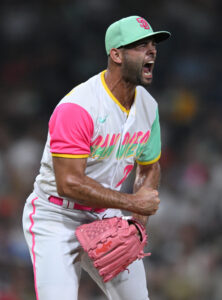
Martinez’s four-year deal pays him a $2MM signing bonus and a $4MM salary in 2022. All three of his player options are valued at $6.5MM, and he’d receive a $1.5MM buyout if he decided to turn an option down and test free agency. In other words, Martinez’s upcoming option effectively is a net $18MM decision. The signing bonus, 2022 salary and option buyout are all but banked. The question for him is one of whether he can top $18MM in free agency this winter.
It’s fair to question whether that can be called a given. On the surface, Martinez’s 3.22 ERA in 100 1/3 innings has to be considered a roaring success. He entered the 2022 season with a career 4.77 ERA in 415 1/3 innings, all coming in that prior run with the Rangers — one that concluded with consecutive ERAs north of 5.50.
At the same time, Martinez hasn’t exactly dominated opponents. His 20.9% strikeout rate is below the 22.3% league average, while his 8.6% walk rate is ever so slightly higher than the 8.2% league average. Martinez induces grounders at an above-average clip (46.7% compared to 42.2%) but also surrenders home runs more frequently than the average pitcher (1.25 HR/9 compared to 1.10 HR/9).
The role — or rather, the roles — that Martinez has filled this year don’t necessarily help his cause, either. He opened the year as the Padres’ fifth starter but was part of a six-man rotation by May and was moved to the bullpen full-time in mid-June, after 10 solid but unspectacular starts (52 1/3 innings, 4.30 ERA, 20.4 K%, 11.7 BB%).
In the bullpen, things have gone better. Martinez has tallied 48 1/3 innings in relief and worked to a 2.05 ERA. His 21.5% strikeout rate in the ‘pen is only moderately higher than it was out of the rotation, but to his credit, Martinez’s 4.7% walk rate as a reliever is miles better than it was coming out of the rotation. (Whether teams deem that to be sustainable is another open question.) He’s picked up eight saves and six holds for the Friars, but early on, the majority of his work came in lower-leverage situations. Even three of those eight saves were of the three-inning variety in long relief. He’s been used in later, higher-leverage spots as the summer has worn on, but Martinez will likely finish the season having spent only a couple months working in the critical leverage spots for which teams tend to pay top dollar.
There are other elements to consider, too. Martinez rates well in terms of his overall average exit velocity, yielding just an 86.6 mph average to his opponents. That checks into the 87th percentile among MLB pitchers. He also boasts above-average spin on his fastball and curveball alike, and Martinez has excelled at inducing chases on pitches off the plate. However, Martinez’s 37.2% hard-hit rate is barely better than the league-average, and the 8.2% barrel rate he’s yielded is well shy of league average (32nd percentile). Basically, when he does allow contact, he’s been much more prone to loud contact than one would expect when looking the mean results.
Martinez’s case is an interesting one. He didn’t thrive in a rotation role, even when facing hitters the first time through the order (.282/.311/.447). As is typically the case, those numbers worsened the second and third time he faced an opponent in a game. He’s been excellent the first trip through the lineup as a reliever, however (.201/.261/.289), even though he didn’t completely overhaul his pitch arsenal when shifting to bullpen work. At a time when relievers and even some starters are gravitating toward focusing on two plus pitches, Martinez’s approach is uncommon: he’s the rare reliever who deploys a five-pitch mix (four-seamer, cutter, sinker, curve, changeup).
MLBTR’s Anthony Franco wrote a few weeks ago that Martinez appears unlikely to opt out of the remaining three years on his contract, as it’s a stretch to envision him topping that remaining guarantee. There’s merit to that line of thinking. Martinez was unexciting in a brief run as a starter, has impressed but not dominated as a reliever, and doesn’t have the type of elite velocity, spin rate or whiff rate that serve as the portent to a breakout.
On the spectrum of outcomes, his 2022 season hasn’t been a best-case scenario but has been better than average. A 90th percentile outcome or better might have seen Martinez play a prominent role and pitch toward the top of the San Diego rotation; giving 10 serviceable starts before moving to the ‘pen and slowly climbing into a leverage role has to rank somewhere in the 60th to 75th percentile of outcomes. The Padres are surely happy with the year-one results.
Martinez’s decision is made difficult because the very nature of the contract he signed sat outside the norms of conventional contract structures for typical MLB free agents. Generally speaking, free agents very rarely sign three- and four-year deals with average annual values in the $6-7MM range. Even back-end starters will crack the $8-10MM range on one- and two-year deals. It’s not uncommon to see a setup reliever sign a multi-year deal in this AAV range, but most recent examples have been of the two-year variety.
If Martinez hopes to beat the net $18MM on his contract, he’d need a team to value him in the $10MM range over a two-year span or an $8-9MM range over a three-year span. In the case of the former, that’d likely mean a team believing he can function as a starter on a full-time basis. The latter structure is typically reserved for some of the market’s most highly desirable relievers (e.g. Kendall Graveman‘s three-year deal with the White Sox, Joe Kelly‘s three-year deal with the Dodgers). It’s hard to include Martinez in that same category.
Still, there’s a logical disconnect between the idea that the market produced a $25.5MM guarantee for Martinez a year ago, when he was a total wild card, but might not produce better than an $18MM guarantee now that he’s proven himself capable of providing legitimate value to a contending MLB club. The source of that disconnect may simply be the allure of the unknown. There may yet be room for Martinez to take his game to another level, but some of the perceived upside stemming from the 1.60 ERA, 25% strikeout rate and 6.9% walk rate he posted in his final NPB campaign has perhaps dwindled. That’s not to say he’s not a valuable big league pitcher — he certainly has been — but now that he’s more of an established commodity, that same upside might not be baked into a potential new contract.
Suffice it to say, Martinez’s opt-out looks like something of a borderline case. He can fill multiple roles, has shined out of the ‘pen, held his own in the rotation but hasn’t dominated opponents at any step along the way. He’d need to be confident teams will view him as at least $9-10MM per year pitcher in order to opt out, because even though a $7-8MM AAV over a three-year term would be a win for him, that’s tougher to come by when you’re selling your age-32 through age-34 seasons.
If he sticks with the Padres, they’ll be happy to have him. Mike Clevinger and Sean Manaea are free agents at season’s end, and the Friars traded MacKenzie Gore to the Nationals in the Juan Soto deal. Their 2023 rotation depth is not as sound as this year’s was and is. In the bullpen, each of Robert Suarez, Pierce Johnson and Craig Stammen can become a free agent. Martinez provides some valuable substance to both groups. The $18MM question is whether that value is significant enough that he’ll again test his luck on the open market.
We can close this one out with a poll…
Will Nick Martinez opt out of his contract with the Padres?
-
No, he'll stay. He can always consider opting out again next winter. 78% (1,197)
-
Yes, he should be able to expect better offers in free agency. 22% (346)
Total votes: 1,543
Six Teams Set To Pay Luxury Tax In 2022
Six teams are set to pay penalties under the newly restructured competitive balance/luxury tax for their 2022 payrolls, per a report from the Associated Press. Each of the Mets, Dodgers, Yankees, Phillies, Padres and Red Sox is currently over the threshold. That marks just the second time since the luxury tax’s inception that six teams will pay the tax.
This will be the second straight year paying the tax for both Los Angeles and San Diego. Each of the other four clubs was under the threshold in 2021 and thus counts as a first-time luxury tax offender.
The 2022-26 collective bargaining agreement not only saw the tax thresholds increase by a relatively significant margin — it also implemented a newly created fourth tier of penalization. For a reminder, the new thresholds are as follows:
- Tier One: $230-250MM (teams pay a 20% overage)
- Tier Two: $250-270MM (32%)
- Tier Three: $270-290MM (62.5% for first-time payors; 65% thereafter)
- Tier Four: $290MM+ (80%)
For second-time payors (i.e. Dodgers, Padres), those rates jump to 30%, 42%, 75% and 90%, respectively.
While those sound like substantial penalties at first glance, the actual amounts to be paid by most teams in excess of the luxury tax is relatively minimal. Those clubs are only taxed on dollars over the threshold, leading to often trivial sums of money (by the standards of a Major League franchise, anyhow). The Padres, for instance, are less than $3MM over the threshold, per the AP, so even with an increased 30% tax rate they’re only set to pay a bit more than $800K. The Red Sox are roughly $4.5MM over the threshold, putting them in line to pay about $900K in fees. The Phillies ($2.6MM) and even the Yankees ($9.4MM) are also looking at generally small sums, relative to their annual payroll marks.
The only two teams set to pay substantial sums are the Dodgers, who fall just shy of the fourth tier of penalization, and the Mets, who exceeded that tier by nearly $9MM. The Mets are in line to pay as much as $29.9MM in taxes, per the AP, while the Dodgers check in just slightly behind that sum at $29.4MM.
What the AP’s report does not delve into, however, are the other penalties associated with the luxury tax — which some teams view as more detrimental than the fiscal penalizations. Any club that exceeds the first tax threshold by $40MM or more will see its top pick in the following year’s draft pushed back 10 slots, for instance. With regard to the 2023 draft, that applies to both the Mets and the Dodgers.
Tax payors are also subject to stiffer slaps on the wrist when signing free agents who have rejected a qualifying offer and to diminished returns when losing such free agents. CBT payors who sign a “qualified” free agent stand to lose their second- and fifth-highest selections in the draft as well as $1MM from their league-allotted bonus pool for international free agency (which typically represents anywhere from roughly one-sixth to one-quarter of the total pool). That’s in contrast to revenue-sharing recipients, who forfeit only their third-highest pick, and to non-revenue sharing recipients/non-CBT-paying teams, who lose their second pick and $500K from that international pool.
More interesting with respect to this year’s group of luxury payors is the fact that a CBT-paying club who extends a qualifying offer to a free agent only stands to gain a compensatory pick after the fourth round of the 2023 draft. For a team that does not receive revenue sharing and does not pay the CBT, that pick would fall after Competitive Balance Round B — roughly 60 picks higher.
For a team like the Red Sox, who exceeded the tax by just $4.5MM, that means they’ll see their potential compensation for Xander Bogaerts — a lock to receive and reject a qualifying offer — shrink considerably. It also lessens the incentive to extend a qualifying offer to a more borderline candidate like Nathan Eovaldi, who’s been shelved for more than a month due to shoulder inflammation.
It also further welcomes scrutiny of Boston’s decision to hang onto veterans such as Eovaldi, Rich Hill and J.D. Martinez at the trade deadline. It’s certainly commendable that the club sought to remain in the Wild Card mix, but the Sox sent some mixed signals by trading Christian Vazquez (and to a much lesser extent, Jake Diekman) while simultaneously acquiring Tommy Pham and a paid-down-to-league-minimum Eric Hosmer. The Red Sox didn’t really commit to shattering the threshold in the name of an all-out postseason push in 2022 but also didn’t take the necessary steps to maximize their return in the event that Bogaerts departs in free agency. The result could be that their compensation for losing Bogaerts, a four-time All-Star who’s received MVP votes in four different seasons, will be a single draft pick somewhere in the 135 to 140 vicinity next summer. That’s not necessarily a franchise-altering outcome, but it’s also far from ideal.
At one point, the Padres might have faced similar considerations with regard to their own free agents, although they’ve sorted themselves out more organically. Joe Musgrove‘s extension keeps him in San Diego and renders moot any considerations regarding a qualifying offer, though. Meanwhile, fellow starters Mike Clevinger and Sean Manaea looked like potential QO candidates at the time of the trade deadline but have struggled considerably in the second half, lessening the likelihood they’d receive a QO in the first place.
That diminished draft compensation, while not a deterrent for the Mets with regard to their roster construction, will be a reality they face this winter. With as many as four potential QO recipients — Jacob deGrom, Edwin Diaz, Chris Bassitt and Brandon Nimmo — they stand to see the return for those potential departures undercut in a meaningful way. Ditto the Dodgers, who’ll assuredly make a QO to Trea Turner and could at least ponder one for Tyler Anderson. The Yankees, too, have a slam-dunk QO recipient in their lineup (Aaron Judge) and borderline call in their rotation (Jameson Taillon). The Phillies don’t have much to consider with regard to potential qualifying offers.
All told, the six teams in question will pay a combined total of about $73MM in luxury fees, with the Mets and Dodgers accounting for the vast majority of that sum. The luxury tax will hit the Mets the hardest both in terms of actual dollars paid and in terms of return for recipients of the qualifying offer. Both the Padres and Dodgers were content to pay the tax in consecutive seasons, and given the extent by which the Mets exceeded the threshold this year, that’ll likely be the case for them in 2023 as well. Time will tell whether San Diego and Los Angeles are willing to incur an even steeper set of tax penalties as a third-time offender, and it’s certainly plausible that any of the Red Sox, Yankees and/or Phillies could look to dip back under the first tier of penalization next season, when the first-tier threshold increases to $233MM.
MLBTR Chat Transcript
Click here to read a transcript of Tuesday’s chat with MLBTR’s Steve Adams.
Cardinals Option Nolan Gorman
The Cardinals announced late last night that infielder Nolan Gorman has been optioned to Triple-A Memphis. Fellow infielder Juan Yepez was recalled from Memphis in his place.
It’s the first trip back to the minors for Gorman, who entered the season ranked among the sport’s top 50 prospects heading into the 2022 season. Gorman captivated Cards fans with a Herculean run through Triple-A prior to his initial promotion, raking at a .308/.367/.677 clip and belting 15 home runs in just 147 plate appearances. Upon his initial promotion, he delivered on the considerable hype surrounding his bat, slugging three homers in his first 11 games and carrying an OPS north of 1.100 in that time. Gorman cooled but was solid through the All-Star break.
It’s been a struggle for the 22-year-old as the season has worn on, however. He’s hit just .207/.273/.388 in the second half — including a grisly .150/.227/.250 with a 39.4% strikeout rate over the past month. Gorman has long been considered a bat-first prospect, and it’s worth noting that he moved from third base to second base once the Cardinals acquired Nolan Arenado, so Gorman’s current position is still relatively new to him. That said, both Defensive Runs Saved (-5) and Outs Above Average (-11) are quite down on his glovework through the first 549 innings of his career there.
Some early struggles in the career of a 22-year-old isn’t any great surprise, and Gorman still figures to be a key part of the Cardinals’ future moving forward. For now, he’ll be in Triple-A for at least 10 days, as he can only return sooner than that if he’s replacing an injured player. From a service time vantage point, Gorman won’t finish the current season with a full year (nor would he have even if he’d remained on the roster through season’s end). He’ll still be controllable for at least the 2028 season, though with 122 days of service under his belt, he could wind up reaching arbitration a year early as a Super Two player, if he accrues full years of service time in 2023-24. The more pressing short-term question is simply one of whether he’ll return this season and whether he’ll be a part of the team’s postseason roster.
With Gorman optioned out, second base seems likely to belong to Brendan Donovan for the time being. A rookie himself, the 25-year-old Donovan never generated the same prospect fanfare as Gorman but has nonetheless turned in a strong .282/.391/.373 batting line through 418 plate appearances to begin his big league career. Donovan has nowhere near the same level of power (or much power at all), but he’s walked at a hearty 12.4% clip while showing good bat-to-ball skills and proving to be a tough strikeout (15.6%).
In the long-term outlook, Donovan profiles best as a Swiss army knife who can play nearly any position at a capable level. He’s already logged time at all four infield spots and in both outfield corners this year, drawing particularly strong marks in small samples at the hot corner. Like Gorman, he’s controllable another six seasons, as he’ll finish the 2022 campaign about a week shy of a full year of service time. That’ll make him a slam-dunk Super Two player, barring future optional assignments, placing him on pace for arbitration following the 2024 season.
Tigers To Hire Scott Harris As President Of Baseball Operations
The Tigers’ search for a new front office leader has reached its conclusion, as they’re set to hire Giants general manager Scott Harris as their new president of baseball operations, per ESPN’s Jeff Passan (Twitter link). Tigers owner Chris Ilitch fired Al Avila from his post as general manager back on Aug. 10.
Harris spent three seasons as the Giants’ general manager, working in that role under San Francisco president of baseball operations Farhan Zaidi. He’d previously spent eight seasons with the Cubs (2012-19), rising from director of baseball operations to the title of assistant general manager. Prior to that, he worked for Major League Baseball as the league’s coordinator of Major League operations. Harris, who graduated from UCLA with a Bachelor’s Degree in Economics in 2009 and got his MBA from Northwestern’s Kellogg School of Management in 2015, has also spent time with the Nationals (2008) and Reds (2010).
A key lieutenant to baseball ops leaders Theo Epstein and Jed Hoyer during the Cubs’ most recent run of prominence, Harris was hired away by San Francisco in Nov. 2019 and played an even larger role with the Giants as they authored an MLB-best 107-win season in 2021. The Giants nonetheless fell to the archrival Dodgers in the National League Division Series, however, and the 2022 season has been every bit as disappointing as the 2021 campaign was heartening in San Francisco. This year’s Giants have, to date, faceplanted with a 69-77 record and have been out of the postseason picture for the majority of the summer. They’ll look to reload for the 2023 season, but they may be in the market for a new general manager to work under Zaidi.
Harris will now step into the spotlight for an organization that’s had an even more disheartening 2022 season than the one he’s leaving behind. The Tigers, encouraged by a 69-66 post-April showing in 2021, expected 2022 to be a turning point at the end of a nearly half-decade rebuilding effort. Detroit had gone to great lengths to build out its research and analytics department, and the hiring of A.J. Hinch as manager prior to the 2021 season represented a clear “win-now” mindset. Heading into 2022, top prospects Spencer Torkelson and Riley Greene were on the cusp of joining touted young pitchers Casey Mize, Tarik Skubal and Matt Manning on the big league roster, and Detroit had enjoyed strong 2021 showings from Jeimer Candelario, Rule 5 pickup Akil Baddoo and veteran second baseman Jonathan Schoop, among others.
An active offseason brought free agents Javier Baez, Eduardo Rodriguez and Andrew Chafin to Detroit, where they were joined by trade acquisitions Austin Meadows and Tucker Barnhart. Unfortunately, nearly every single one of those acquisitions (save for Chafin) has flopped to date, owing to a combination of poor health, off-the-field issues and simple poor performance. Their lack of production has been compounded by an overwhelming rash of injuries, most notably Mize requiring Tommy John surgery and Skubal undergoing flexor surgery. Manning is healthy now but missed most of the year due to shoulder trouble. Beyond that, key 2021 performers like Baddoo, Schoop and Candelario have struggled immensely.
It was a catastrophic season that cost Avila his job and now places Harris squarely in the midst of his own conundrum. The Tigers have Rodriguez signed for another four years and Baez for another five, pending future opt-out clauses that, at present, appear unlikely to be exercised. Meanwhile, Torkelson and Greene, expected to be key cogs that drive the engine of a more competitive lineup, have often looked overmatched in their debut efforts. Mize will miss a substantial portion of the 2023 season, and the same could be true of Skubal. The young core that served as such a source of optimism is at least temporarily in tatters.
Enough went wrong in 2022 that the Tigers reportedly at least pondered listening to offers on Skubal at the trade deadline, before his injury troubles flared up. A swap always seemed unlikely, but the very fact that such a possibility even merited consideration is emblematic of the stalled rebuilding efforts and the challenges that Harris will now face.
It seems unlikely that ownership will green-light yet another arduous rebuilding effort, but at the same time, there’s no easy fix in store. The Tigers appear further from contending than they did a year ago at this time — certainly more than just one or two acquisitions away from righting the ship. Meanwhile, last winter’s additions of Baez and Rodriguez have added some notable heft to future payrolls, and injuries have at least temporarily thinned out the promising young core.
There are some parallels between the current Tigers and the 2020-22 Giants that Harris helped to overhaul. No one pegged the Giants as anywhere close to the best team in baseball heading into the 2021 season, and even the 29-31 showing by the 2020 Giants exceeded some expectations after a run of three seasons that saw the club play at a 214-272 pace. Both play in cavernous home parks that could appeal to pitchers looking to rebuild their stock after tough seasons and/or injuries.
The Giants, under Harris and Zaidi, developed a reputation as one of the best teams in baseball (if not the best team) at revitalizing the careers of pitchers. Kevin Gausman, Anthony DeSclafani, Alex Wood, Drew Smyly, Tyler Anderson and Jakob Junis are just some of the names who’ve gone to San Francisco in the past few years and significantly improved their stock. They also showed a knack for unearthing quality hitters in little-noticed moves (e.g. Mike Yastrzemski, Donovan Solano, Darin Ruf). Surely, Ilitch hopes that Harris can bring some of that success to his new home in Detroit.
Harris is jumping into a situation that’s less common — albeit certainly not unheard of — for newly hired baseball ops leaders. Many owners cut bait on a GM or president and bring in a new voice and perspective to help guide the club through a rebuild, but what was supposed to be the heavy lifting of the rebuild has already been performed in Detroit. It’ll now be incumbent upon Harris to find a way to further build out the organization’s infrastructure, add some new faces to the roster and get more out of current underperformers (e.g. Baez, Torkelson) without completely tearing things back down to the studs.
If there’s a small silver lining, it’s perhaps that the Tigers play in a fairly weak American League Central division. There’s no Dodgers-esque juggernaut looming atop the standings. That bodes well for a return to contention sooner than some critics may expect, but a lot will need to go right for the Tigers to prevent their current eight-year playoff drought from ballooning to a decade.