
Nationals To Place Keibert Ruiz On Injured List, Select Israel Pineda
The Nationals will place catcher Keibert Ruiz on the 10-day injured list Friday and select the contract of fellow catcher Israel Pineda from Triple-A Rochester, as first reported by TalkNats (Twitter links). They’ll also recall righty Jordan Weems from Rochester. The team hasn’t formally announced the moves, though Pineda’s reps at PNY Sports have announced his promotion to the big leagues (Twitter link).
Ruiz was injured behind the plate yesterday when he took a foul ball off his groin. While he initially remained in the game for a few innings, he was eventually lifted and replaced by Riley Adams. Manager Dave Martinez told reporters after the game that Ruiz was headed to a hospital for further evaluation due to swelling in his testicles.
The 24-year-old Ruiz was widely considered one of the top prospects in all of baseball prior to his arrival on the big league scene, and he was one of the headline talents acquired in the blockbuster deal that sent Max Scherzer and Trea Turner from D.C. to L.A. at the 2021 trade deadline. He’s had a solid but unspectacular showing at the plate in his first full year with the Nats, batting .251/.313/.360. That’s 11% worse than the league-average hitter, by measure of wRC+, but right in line with the average production among big league catchers.
The Nats didn’t necessarily need to replace Ruiz with another catcher, as they were already carrying three, with both Adams and Tres Barrera on the big league roster. They’ll stick with that three-catcher arrangement for now, though, and in doing so will get their first look at the 22-year-old Pineda, who’s had a breakout season across three minor league levels.
Pineda hit just .208/.260/.389 in High-A last year but has soared from that level all the way to Triple-A in 2022. He followed up a solid .264/.325/.443 showing in 67 High-A games with an excellent .280/.340/.538 output in 26 games at the Double-A level. He’s just 2-for-21 in his first six Triple-A contests, but Pineda’s combined .258/.325/.458 batting line this year is plenty productive — particularly for a catcher. Pineda has nabbed an impressive 41% of runners who’ve attempted to steal against him in parts of five professional seasons.
Pineda currently checks in as the No. 22 prospect at FanGraphs, No. 23 at Baseball America and No. 26 at MLB.com in what’s obviously considered a much-improved farm system following the complete roster tear-down in Washington. Given his performance in 2022, Pineda would likely have been added to the 40-man roster this winter anyhow, as the Nats would’ve needed to protect him from being selected in the Rule 5 Draft. They’ll now get an early look at him, at least for the next few days.
The Changing Landscape Of The AL Cy Young Race
Two weeks ago, the Cy Young race in the American League looked like a two-horse race, with both Houston’s Justin Verlander and Tampa Bay’s Shane McClanahan hovering at or below the 2.00 ERA mark and racking up innings atop their teams’ respective rotations. McClanahan has the larger strikeout percentage and subsequently superior marks from fielding-independent metrics that some voters increasingly weigh. Verlander was averaging one extra out recorded per start prior to being lifted early his last time out, and his 16-3 win-loss record might hold some sway with traditionalist voters.
Or, all of that could be rendered moot.
Both Verlander and McClanahan are on the 15-day injured list, and Verlander, who had been improbably leading the Majors in ERA as a 39-year-old in his first season back from Tommy John surgery, sounds as though he’ll miss several weeks rather than just the 15-day minimum. McClanahan, a late scratch from his last start, is already throwing and seems likelier to make a quick return. However, the Rays could very well take a cautious approach and limit his innings after a two-week absence due to a shoulder impingement.
At the very least, the door is now open for further competition in Cy Young voting, ostensibly setting the stage for the closest AL vote we’ve seen since 2019, when Verlander and then-teammate Gerrit Cole finished in the top two positions on the ballot. Last year’s NL Cy Young voting sparked plenty of controversy and debate as well, and as things currently stand, we could get an encore of that scene in the AL this year.
If not Verlander or McClanahan, who are the top names to consider? Let’s dive in.
Dylan Cease, RHP, White Sox
Cease, following a near-no-hitter against the Twins that saw him go 8 2/3 before Luis Arraez cracked a ninth-inning single, may have leapfrogged both Verlander and McClanahan as the odds-on favorite in the American League. He’s sitting on MLB’s third-lowest ERA — sandwiched right between Verlander and McClanahan, no less — and that 2.13 mark is complemented by a 31.4% strikeout rate that ranks as the fourth-highest of any qualified starting pitcher in baseball.
At 5.5 wins above replacement (per Baseball Reference), Cease already leads American League pitchers — even over Verlander and McClanahan. That’d due largely to the fact that Cease is putting up these numbers in front of one of the game’s bottom-10 defenses.
It’s not all roses, as Cease has a 10.4% walk rate that sits dead last among qualified starters. He hasn’t been terribly efficient, either; where both Verlander and McClanahan have averaged comfortably more than six innings per start, Cease has averaged 5.77 innings per appearance this year.
Still, Chicagoans can no doubt see the parallels between Cease’s 2022 showing and the 2016 performance of another Chicago hurler — crosstown righty Jake Arrieta, when he rode a historic summer surge to Cy Young honors. Over his past 15 starts, Cease has tallied 93 innings of 1.45 ERA ball and held opponents to one or zero runs on a dozen occasions. Cease isn’t quite in Arrieta territory (0.86 ERA in his final 147 innings), but he’s not terribly far off, either. If he can sustain anything close to this pace, Cease will finish the season at or near the top of the AL in terms of innings pitched, ERA, total strikeouts and strikeout rate.
Alek Manoah, RHP, Blue Jays
Manoah looked borderline unhittable for the season’s first two months, carrying a 1.67 ERA in that time and allowing just 55 hits and a 0.59 HR/9 mark through June 13 (75 2/3 innings). He had a solid but closer-to-average run for much of the summer but has now yielded just three runs in his past 28 1/3 innings.
At 171 innings of 2.42 ERA ball on the year, the 24-year-old is on the periphery of the race at present. He ranks fourth in American League ERA but trails McClanahan, Cease and especially Verlander in that department. He lacks the gaudy strikeout ratios boasted by both Cease and McClanahan but limits hard contact better than any non-McClanahan pitcher in the AL, evidenced by a 31.3% hard-hit rate. (McClanahan leads qualified AL starters at 30.1%.)
However, Manoah’s 171 are second-most in the American League, and if he continues this hot streak, there’s a chance he could wind up among the league leaders in ERA, innings pitched and other key categories. In terms of wins and losses, everyone’s trailing Verlander’s 16 victories, but Manoah’s 14 are tied with Framber Valdez for second in the league. Speaking of which…
Framber Valdez, LHP, Astros
It’s easy to be overshadowed by the season Verlander is enjoying, but we should all probably be discussing Valdez’s outstanding year more than we are. The 28-year-old southpaw is just one-third of an inning behind Manoah at 170 2/3, and he also sits sixth in ERA (2.64) and ninth in bWAR (3.4).
Valdez has emerged as baseball’s preeminent ground-ball starting pitcher, and it’s not close; he leads all qualified pitchers in ground-ball rate at 66.7%, and Logan Webb‘s 57.5% rate is second-best. Even dropping the minimum to 50 innings as a starter, he still leads Alex Cobb (61.9%) and Andre Pallante (61.4%) by a wide margin.
In an age where starters are yanked from the game earlier than ever before, Valdez is a throwback. He’s worked at least six innings in every one of his starts since April 25, completing seven or more innings on 11 occasions and twice going the distance with a complete game. Over his past five starts, Valdez has 35 2/3 innings of 1.77 ERA ball. It’ll be a challenge for him to drop his ERA into the low 2.00s, and he can’t match Cease or McClanahan in terms of strikeouts, but Valdez will likely be the American League innings leader and finish with a mid-2.00s ERA and MLB-leading ground-ball rate.
Shohei Ohtani, RHP, Angels
When Ohtani pitched to a 3.99 ERA through the first six weeks of the season, it looked as if we were in for an (almost) mortal season out of the two-way phenom. He averaged just over five innings per start, and while the strikeouts were still there in droves, he was also unusually homer-prone. A Cy Young pursuit did not appear to be on the horizon.
In 88 2/3 innings since that time? Ohtani has a 1.83 ERA with fewer homers allowed (six) than in his first 47 1/3 innings (seven). He at one point rattled off six consecutive starts with double-digit strikeout totals, and opponents have batted .199/.249/.301 against him during this stretch.
Ohtani’s 33% strikeout rate on the season leads qualified starting pitchers (though would trail Braves phenom Spencer Strider by a good margin if Strider had a few more innings), and while many fans and Ohtani detractors bristle at the notion, it’s hard not to consider that he does all this while also serving as a middle-of-the-order slugger who ranks among the league’s top power threats.
Ultimately, with just 136 innings pitched this season, it’s hard to imagine that Ohtani will actually garner many (if any) first-place Cy Young votes. Yes, he’s sporting a 2.58 ERA, leading the league with a 33% strikeout rate and sitting second among AL starters with 4.7 bWAR. But Ohtani is ultimately going to be up against multiple starters with better bottom-line run prevention numbers and as many as 40 to 50 additional innings pitched. Corbin Burnes won an NL Cy Young last year with just 167 frames, but the top names in the American League this year have had better seasons.
Kevin Gausman, RHP, Blue Jays
Gausman will be the analytic darling in this year’s field. I debated whether to mention him at all for this breakdown, as he’d need a pretty dominant finish to push his way in among the leaders in more traditional categories, but the right-hander is second in the American League at FanGraphs with 5.2 wins above replacement. fWAR is based on fielding-independent pitching rather than actual runs allowed, and Gausman has been quite good this season — 3.12 ERA in 147 innings — despite being one of the game’s least-fortunate pitchers in terms of balls in play. He’s lugging around an MLB-worst .368 BABIP, and the next-highest mark (Jordan Lyles at .323) isn’t even close.
There’s perhaps some temptation to think that Gausman is then yielding far too much hard contact, but that’s not necessarily the case. He’s not managing contact as well as any of the others profiled here, but his 89 mph average exit velocity and 39% hard-hit rate are barely north of the respective 88.6 mph and 38.3% league averages in those regards.
Gausman has the game’s third-best walk rate (3.8%), the tenth-best strikeout rate (27.9%) and is sixth-best in the differential between those two (24.1 K-BB%). He’s averaging just 5 2/3 innings per start, however, and isn’t particularly helping his cause down the stretch (3.99 ERA over his past five outings… again, with a .370 BABIP).
—
A lot can (and will) change between now and season’s end, but since this is all just for debate anyhow, I’ll include a poll to close this out:
Who will win the American League Cy Young Award?
-
Justin Verlander 36% (657)
-
Dylan Cease 26% (472)
-
Alek Manoah 14% (250)
-
Shane McClanahan 10% (177)
-
Shohei Ohtani 9% (170)
-
Framber Valdez 3% (46)
-
Other (specify in comments) 2% (31)
-
Kevin Gausman 1% (17)
Total votes: 1,820
Two Minor Leaguers File Lawsuit Against Angels In Dominican Court
A pair of minor league players have filed suit against the Angels for allegedly reneging on verbal agreements made back in 2019, ESPN’s Jeff Passan reports. Outfielder Willy Fañas, now with the Mets, and infielder Keiderson Pavon, now with the Rangers, claim that the Angels verbally agreed to respective signing bonuses of $1.8MM and $425K in 2019. The Dominican Prospect League shared a video of former Angels director of international scouting Carlos Gomez (not the former player) informing Pavon the team plans to sign him, at which point a then 15-year-old Pavon breaks down in tears of joy (YouTube link).
Fañas and Pavon allege that those agreements, which came more than a year in advance of the players’ eligibility to sign under Major League Baseball’s rules — international amateurs can sign beginning on their 16th birthdays — were withdrawn in 2020, less than one month before the international signing period was set to commence. Fañas had been 14 at the time of his agreement; Pavon was 15. As Passan points out, the Covid-19 pandemic pushed the July 2, 2020 signing eligibility date back to January of 2021, and by that point, the Halos had fired then-GM Billy Eppler and replaced him with current GM Perry Minasian. With that change came alterations in the international scouting department; Minasian hired Brian Parker to oversee the team’s international operations.
Both players have since signed with new clubs, though Fañas waited until the following signing period to put pen to paper on a contract with a new team. Because early deals just such as these are so common throughout the industry, neither player was able to find a team able to immediately commit a substantial bonus; like the Angels, other teams had already verbally committed the majority of resources in their hard-capped signing pools to other amateurs well in advance of those teenage prospects reaching actual signing eligibility. Fañas, perhaps unsurprisingly, ultimately inked a $1.5MM bonus with the Mets, where Eppler is now GM. Pavon signed for $150K with the Rangers.
While both players eventually found organizations with which to sign, albeit at reduced rates, they’re still seeking damages from the Angels. Fañas is seeking $17MM, while Pavon seeks $4.25MM.
Those figures represent roughly ten times what the Angels had initially promised, though the representatives for Fañas and Pavon could cite multiple factors in seeking such weighty sums. It’s common for players, upon reaching a verbal agreement with a team, to take out loans with exorbitant interest rates, with the intent that the eventual signing bonus will allow those players to pay back that loan. The team withdrawing an offer obviously creates complications in such instances. Speculatively, it’s also plausible that the Fañas and Pavon camps could claim the players’ delayed paths to potential arbitration and free-agent paydays were delayed by the alleged Angels actions. There’s no guarantee they’d ever reach those milestones, of course, and quantifying the exact amount that delay cost either player is impossible.
Whether the suit is successful carries long-term ramifications with regard to the broader international market. Because the league and players association were unable to come to terms on an agreement regarding an international draft, the status quo system that permits this level of largely unregulated advance agreements is likely to remain in place until 2026, when the current collective bargaining agreement expires. If Fañas and Pavon are successful in demonstrating that there are repercussions for teams pursuing premature verbal agreements that flout the rules put into place by MLB, it stands to reason that they may be more reluctant to barter such deals.
The sword cuts both ways, it should be noted. It’s also not uncommon for a player and his trainer and representation to back out of an agreement with a team if he elevates his profile considerably between the time that agreement is reached and the time he’s actually eligible to sign. The rampant disregard for rules prompted agent Ulises Cabrera, who helped establish the Dominican Prospect League and who works with dozens of Latin American players, to refer to the entire system as “the wild, wild West” when speaking to ESPN.
Although the suit was initially filed in May, any ruling on the litigation will wait until months down the road. Passan adds that a Dominican judge recently moved to postpone the appearance of witnesses until late November. And while many American fans may wonder whether there’s any real chance that a court of law would agree to uphold a verbal agreement as a binding contract, Passan quotes several Dominican lawyers and legal professionals who emphasize that the Dominican justice system places greater emphasis on verbal declarations than the United States court system does. The report features lengthy quotes from Cabrera, from the lawyers representing Fañas and Pavon, from third-party legal professionals in the Dominican and from the plaintiffs themselves, so those with interest will want to check it out in its entirety to grasp the full scope of the controversy.
The D-backs’ Promising Outfield Gives Them Plenty Of Offseason Flexibility
Diamondbacks catcher/outfielder Daulton Varsho has impressed so much in the outfield this season that his days behind the plate could be drawing to a close, writes Nick Piecoro of the Arizona Republic. Varsho tells Piecoro that he’s even surprised himself with how well he’s taken to the outfield.
A former top-100 prospect, the 26-year-old former top prospect has drawn immaculate grades for his outfield defense in 2022, tallying 14 Defensive Runs Saved and, according to Statcast, 13 Outs Above Average and 12 Runs Above Average. Those are cumulative totals, so it’s worth noting that Varsho has also spent 175 innings behind the plate this year; had he been a full-time outfielder, those defensive marks would’ve likely been even more eye-catching.
Varsho, who says it’s a personal goal of his to win a Gold Glove, added that he’s not content with his current level of outfield play, citing a few near-catches he missed (on what would’ve been highlight-reel efforts). Varsho labeled himself a perfectionist and spoke of small, incremental gains he could still make in his defensive game — “…[I]f I can add an extra inch by not having to look at the wall and understanding what I can do to get better…” — as part of his hopeful evolution.
Of course, Varsho is far more than just a strong glove in the outfield. He’s built on a solid showing at the plate last summer and turned in a .243/.311/.457 batting line this season, swatting 23 home runs, 20 doubles and three triples while chipping in eight stolen bases (albeit in 14 attempts). It’s a solid, well-round skill set that could leave him as a fixture in center or right field, depending on how the remainder of the Diamondbacks’ young outfield pans out.
Corbin Carroll, regarded as one of the sport’s top prospects — if not the top prospect — prior to his promotion earlier this month, gives Arizona a potential high-impact talent to pair with Varsho in the long term. He’s followed up a combined .307/.425/.611 batting line in the minors this year with a .281/.324/.469 showing through his first eight big league games and now has 24 home runs and 31 steals between the minors and big leagues combined.
Add in the likes of Alek Thomas, himself a top-100 prospect prior to this season’s debut, and 25-year-old Jake McCarthy, who has surpassed all expectations with a strong debut campaign of his own, and the outfield group in Phoenix looks particularly promising. The 22-year-old Thomas has cooled after a solid start and is batting .249/.295/.373 on the season but has turned in plus defensive marks in center. McCarthy, meanwhile, is batting .288/.348/.455 with seven homers, 14 doubles, two triples and a 15-for-16 showing in stolen bases.
It’s a talented, albeit entirely left-handed, group of outfielders around which to build. That there are four players for three spots might make it tempting to continue deploying Varsho behind the dish at times, but his elite play in the outfield would be lost in that scenario. Manager Torey Lovullo told Piecoro that there are no plans for Varsho to start behind the plate for the remainder of the season, further pointing to a long-term move away from the position.
It’s a bit early to label the quartet of lefty-hitting outfielders a true “surplus.” Thomas’ offense has been below average, and it’s fair to wonder whether McCarthy can sustain production that’s been bolstered by a .347 average on balls in play — particularly when he’s making hard contact at a below-average clip. Statcast pegs his “expected” batting average and slugging percentage at .259 and .367 — both well shy of his current marks. Carroll is a top-five prospect in baseball, but he also just turned 22 in late August, so it’s not a given that he’ll immediately break out into stardom.
Still, Ken Rosenthal of The Athletic wonders about the possibility of the Diamondbacks utilizing this group of outfielders to bolster the rotation over the winter. There are plenty of teams with outfield needs who’d love to acquire a controllable long-term player to step right onto the 2023 roster. Varsho is controlled through 2026, McCarthy through 2027 and both Thomas and Carroll through at least 2028. Speculating a bit, the Marlins are known to still be looking for their center fielder of the future and have plenty of pitching to dangle in talks with the D-backs. Arizona and Miami previously lined up on a Zac Gallen-for-Jazz Chisholm swap that has benefited both clubs, though the Marlins’ front office has turned over a good bit since that time.
Trading from that quartet of outfielders would thin out the Diamondbacks’ outfield depth, quite likely in a significant way, but they do have some other options on the 40-man roster, including the right-handed-hitting Stone Garrett, who’s out to a blistering MLB debut himself after a nice showing in Triple-A. The free-agent market would also present several affordable, short-term options to plug into the outfield mix, and finding a useful complementary outfielder on the open market is quite a bit easier than finding the type of potentially impact arm that a trade of someone like Thomas could bring.
However general manager Mike Hazen and his staff choose to proceed this winter, the play of the team’s young outfielders will give them plenty of options. And with a lot clicking elsewhere on the roster — Arizona is 26-19 since the All-Star break, a .578 winning percentage — the D-backs could be a shrewd offseason move or two away from reasserting themselves in the National League West more quickly than most would anticipate.
Yankees Designate Luke Bard For Assignment
11:43AM: The Yankees have made their host of moves official, including Rizzo’s IL placement, Bard’s DFA, and Guzman’s selection to the active roster. In addition, third baseman Josh Donaldson was placed on the paternity list, right-hander Deivi Garcia was called up from Triple-A, and Miguel Andujar was called up as the 29th man for today’s doubleheader.
8:02AM: The Yankees have designated right-hander Luke Bard for assignment, as first indicated on the team’s transaction log at MLB.com. Presumably, his 40-man spot will go to first baseman Ronald Guzman, who was in the clubhouse yesterday and is set to be selected to the big league roster to fill the spot of the injured Anthony Rizzo. However, the Yankees have yet to formally announce the move, so it remains to be seen whether there are additional transactions on the horizon.
Bard, 31, was a waiver claim out of the Rays organization a month ago but has appeared in just one game with the Yankees (during which he tossed a shutout inning). He’s spent the rest of his stint with the organization in Triple-A Scranton/Wilkes-Barre, where he’s yielded four earned runs on nine hits and four walks with eight punchouts in eight innings of work.
Overall, Bard carries a 1.80 ERA in 15 big league frames and a 4.78 mark in 32 Triple-A innings. The 2022 season as marked Bard’s first game action since 2020, as he missed the entire 2021 campaign while rehabbing from April hip surgery — an injury that ultimately ended a four-year stint in the Angels organization.
Bard has now appeared in parts of four minor league seasons and between the Halos, Rays and Yankees, recording a 4.44 ERA in 81 innings. This year’s 94.1 mph average on his fastball is right in line with previous seasons, as is his top-of-the-charts spin rate on the pitch; Bard led the Majors in four-seam spin in 2018-19 and is in the 99th percentile this season. That trait alone obviously isn’t going to lead to instant success, but it’s been appealing enough to keep Bard on 40-man rosters for the bulk of the past several years.
At this point in the season, the Yankees won’t have any choices with Bard other than to place him on outright waivers or release waivers. Either way, he’ll be made available to the 29 other clubs. He’s been outrighted once in the past, when he cleared waivers last October while still on the mend from that hip procedure. As such, even if he goes unclaimed on waivers, he’d have the ability to reject an outright assignment to Scranton in favor of free agency.
Twins Select Louie Varland, Designate Jake Jewell
TODAY: The Twins designated right-hander Jake Jewell for assignment, as Varland’s selection is now official. Jewell had just been claimed off waivers from the Guardians three weeks ago,
SEPTEMBER 6: The Twins are calling up one of the top pitching prospects in their system, as they’ll select the contract of right-hander Louie Varland to make his big league debut Wednesday night at Yankee Stadium, per Patrick Reusse of the Minneapolis Star-Tribune (Twitter link).
Varland’s call to the Majors continues a nice development story for a North St. Paul native who’ll now suit up for his hometown club. He’s one of just four players ever to be drafted out of Division-II Concordia University in St. Paul — older brother Gus Varland, currently in the Dodgers’ system, is another — and the Twins grabbed him well down the board, in the 15th round. (The Varland brothers, just one year apart in age, faced off against one another earlier this season, when both started the same game for their respective teams’ Double-A affiliates.) The younger Varland pitched just 8 2/3 innings in the Twins organization in 2019 after being drafted and didn’t pitch in 2020, when there was no minor league season.
A D-II 15th-round pick with 8 2/3 professional innings (all coming in Rookie ball) obviously isn’t going to carry much prospect fanfare, but Varland erupted with a 2021 breakout that saw him named the Twins organization’s minor league pitcher of the year. Beginning the season in Class-A Fort Myers, Varland came roaring out of the gates with a 2.09 ERA and a massive 38% strikeout rate before being promoted to High-A Cedar Rapids, where he largely repeated that success. In 55 2/3 frames with the Kernels, he posted a 2.10 ERA with a 29.9% strikeout rate. Varland walked just 7.1% of his opponents between the two levels, and by the conclusion of the ’21 season, he featured prominently among Twins prospect rankings.
It’s been more of the same for Varland in 2022 — this time between Double-A (105 innings, 3.34 ERA, 26.4% strikeout rate) and Triple-A (21 1/3 innings, 1.69 ERA, 32.1% strikeout rate). The right-hander explained to FanGraphs’ David Laurila this time last year that despite throwing just 90-92 mph during his college days, he’s now sitting 94-95 mph and peaking in the upper 90s after working with the Twins’ development staff.
“I would put it to our pitching coordinators and the pitching coaches with my teams,” Varland told Laurila. “But also Martijn [Verhoeven], our [motion performance] coach. He really cleaned up my mechanics so that I could pitch with an efficient arm path. That was really the root of it all; everything has stemmed from that.”
The results speak for themselves, as Varland has ascended from obscurity to the Major Leagues in short order — and with a career 2.61 ERA, 30% strikeout rate and 7.6% walk rate in the minor leagues. MLB.com ranks him 10th among Twins prospects, while Baseball America has him listed 16th and FanGraphs at No. 25. Varland complements a high-spin four-seamer that now draws plus grades with a trio of offspeed offerings: a changeup, a slider and a seldom-used curveball. Both the changeup and slider have potential to be above-average pitches, per that group of scouting reports, with MLB.com suggesting the changeup is already there. He’ll be controllable through at least the 2028 season.
Once he’s formally selected to the roster — which may not happen until tomorrow, if he is indeed slated for a Wednesday debut — Varland will immediately join the Twins’ rotation mix for the remainder of the season and for the 2023 campaign as well. He’ll have a full slate of three minor league option years, meaning he could be moved up and down on an as-needed basis for awhile he doesn’t immediately seize a starting job. And, with the reworked arm slot and mechanics unlocking some additional velocity, it remains possible that Varland could eventually end up a hard-throwing bullpen piece, should a role in the rotation not pan out.
Mets Place Max Scherzer On 15-Day Injured List
10:12AM: Scherzer has been officially placed on the IL, retroactive to September 4.
8:58AM: The Mets are placing ace Max Scherzer on the 15-day injured list, manager Buck Showalter announced to reporters Wednesday morning (Twitter link via Newsday’s Tim Healey). The team is hopeful that he’ll return after a minimum stint on the shelf. Scherzer departed his most recent start due to “fatigue” in the same left oblique muscle he strained earlier in the season — an injury that kept him sidelined for nearly two months.
Scherzer, 38, has been sensational for the Mets when healthy enough to take the mound. The three-time Cy Young winner has logged a 2.26 ERA while striking out 30.6% of his opponents against just a 4.6% walk rate. He’s averaged 6 1/3 innings per outing, even with a pair of early exits due to an increasingly problematic left oblique. Scherzer had been slated to start this Friday in Miami.
The injury to Scherzer comes in conjunction with a sequence of brutal losses to the last-place Pirates and Nationals. The Mets have dropped three in row while watching the Braves cruise to six straight victories, culminating in the evaporation of what was once a whopping 10.5-game lead in the NL East for the Mets; the two teams are currently tied with identical 85-51 records.
Even with Scherzer sidelined, the Mets have a strong top four in the rotation, with Jacob deGrom, Carlos Carrasco, Chris Bassitt and Taijuan Walker all active. Walker has struggled of late, with a 6.25 ERA since the All-Star break, although the majority of the damage against him came in one appearance: an eight-run meltdown against Atlanta. Both David Peterson and Trevor Williams are stretched out enough to make starts in place of Scherzer. Peterson started for the Mets both on Aug. 27 and Sept. 2, working a combined 11 1/3 innings, so he’d certainly be an option to step in for Scherzer on Friday against the Marlins.
MLBPA Receives Majority Support To Represent Minor Leaguers, Requests Recognition From MLB
The Major League Baseball Players Association announced Tuesday morning that a “significant” majority of minor leaguers have signed authorization cards in favor of the MLBPA creating a minor league bargaining unit. The MLBPA has formally requested that MLB recognize its new effort to represent minor leaguers. Evan Drellich of The Athletic first reported that the union had received majority support from minor leaguers on the matter and requested voluntary recognition from MLB.
The MLBPA first sent authorization cards to minor league players last week — a first step toward unionizing minor league players who have previously lacked the representation and collective bargaining capabilities enjoyed by Major League players. If MLB chooses not to acknowledge the the MLBPA as the new bargaining unit for minor league players, the MLBPA can (and surely will) file a motion with the federal National Labor Relations Board (NLRB). That will prompt an election among the minor league players, and if there’s a majority among those who vote in that election, the NLRB would subsequently require Major League Baseball to recognize the MLBPA as the bargaining unit of minor league players.
It’s another notable step in what appears to be a fast-moving process. MLB has yet to comment on the unionization effort whatsoever, so it remains wholly unclear when or whether the league will provide a response. The MLBPA can push forward and pursue an NLRB-prompted election at any time, so if commissioner Rob Manfred and his team continue to remain silent on the matter, the union can still advance the process. An MLBPA official told MLBTR last week that the proposed unionization efforts would give minor leaguers their own separate bargaining unit under the MLBPA umbrella, adding that any minor league CBA would be negotiated independently of the Major League CBA that was completed earlier this year.
“Minor league Players have made it unmistakably clear they want the MLBPA to represent them and are ready to begin collective bargaining in order to positively affect the upcoming season,” MLBPA executive director Tony Clark said in a statement released Tuesday morning.
Drellich’s piece contains quotes from several minor league players on the matter and notes that there would still be some hurdles regarding the Rookie-level Dominican Summer League, as the league is not based in the United States. Still, Drellich emphasizes that the players union has told minor leaguers that it plans to attempt to bargain over the working conditions of DSL players as well.
The move to add the majority of minor league players to the MLBPA ranks would see union membership skyrocket from 1,200 — the 40 players on the 40-man rosters of all 30 MLB teams — to more than 5,000. The MLBPA has already bulked up its staff in preparation for the move, announcing last week that it had hired every employee from Advocates for Minor Leaguers as a new full-time employee of the MLBPA.
Currently, neither the salaries nor benefits of minor league players are collectively bargained. Minor league players are only paid during the season, and their minimum salaries range from $400 per week in the lower levels — where seasons are only three months long — to $700 per week in Triple-A (via the Associated Press).
The Rangers’ Breakout Slugger
The Rangers’ shift from a rebuilding mindset into a win-now mode began in the offseason with a combined $556MM spent on Corey Seager, Marcus Semien and Jon Gray. It continued over the summer when Texas held onto several trade candidates of note (e.g. Martin Perez, Matt Moore) and overhauled their leadership; gone were manager Chris Woodward and longtime president of baseball operations Jon Daniels, leaving the team likely to conduct a managerial search this winter and leaving third-year GM Chris Young with full baseball operations autonomy.
Another aggressive winter seems likely, as the Rangers still have plenty of work to do on an improved but flawed roster. There’s been talk of a new contract with lefty Martin Perez, following his breakout in a return to his Rangers roots, but that’d only be one piece of the puzzle. There’s hope that Josh Jung will solidify third base, but there are questions behind the plate, in the outfield and on the pitching staff.
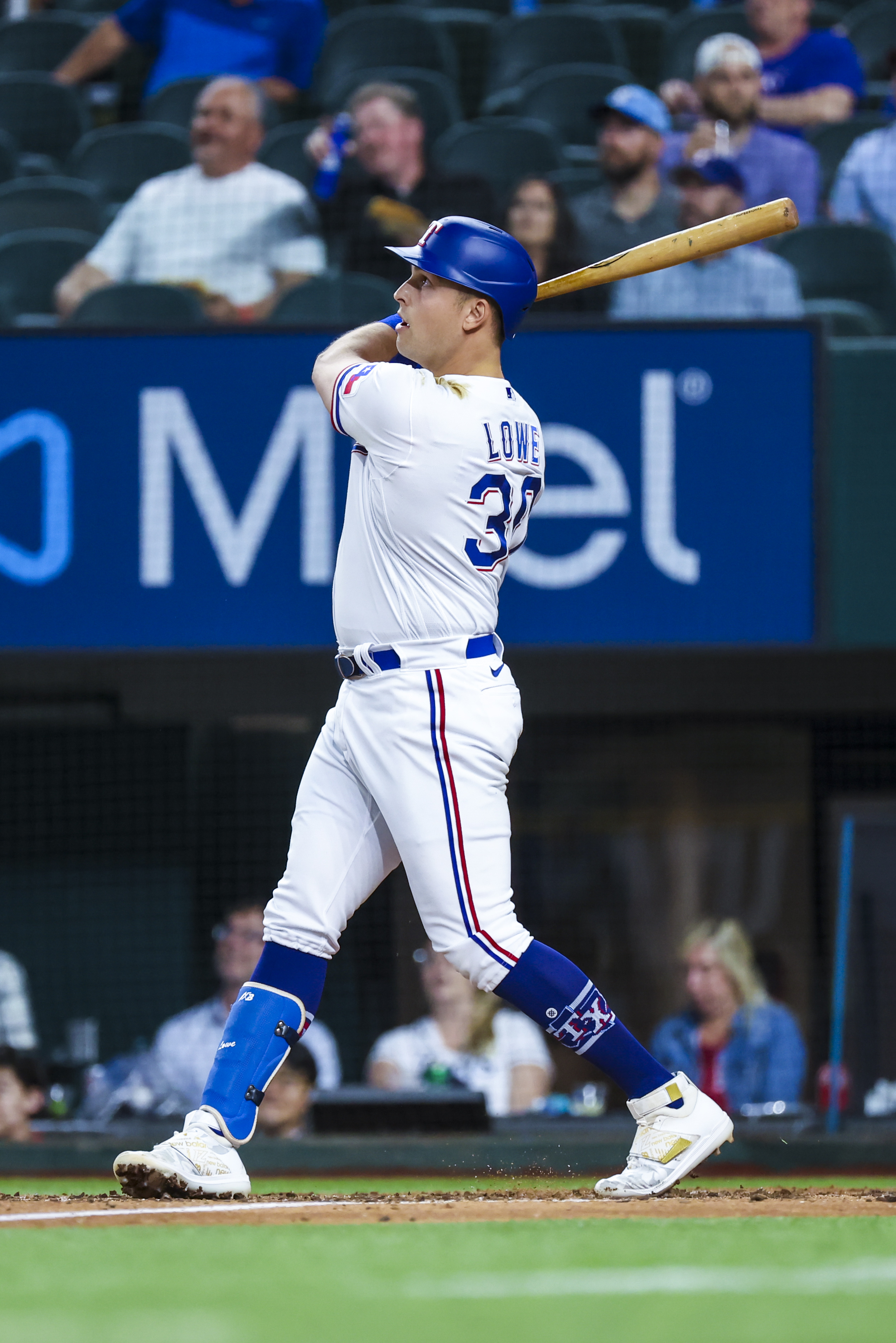
Texas has currently dropped nine games in a row, erasing any delusions that perhaps this team may be turning the corner right now, but that doesn’t mean there aren’t bright spots to the season. Seager has hit well. Semien has shaken off a disastrous start and, since mid-May, looked quite strong. Gray has lived up to his own multi-year deal. Perhaps the brightest spot of all, however, has come in the form of a breakout for slugger Nathaniel Lowe.
Acquired in a Dec. 2020 trade that sent three minor leaguers to the Rays, the now-27-year-old Lowe had a solid but uneven first year in Texas. He homered six times in his first 22 games (98 plate appearances) as a Ranger before settling in at a more modest, but still productive pace. Lowe continued hitting well but “only” chipped in another 12 home runs over his next 544 plate appearances. He finished the year as a .264/.357/.415 hitter — 14% better than league average, by measure of wRC+.
For much of the 2022 season, Lowe looked quite similar; he posted a 115 wRC+ in the season’s first half slashing .270/.323/.429. Since the All-Star break, however, Lowe has been not only the Rangers’ best hitter, but one of the best hitters in Major League Baseball. He’s slashing an absurd .363/.414/.632 with 11 homers, nine doubles and two triples in just 186 plate appearances. In that time, 52.3% of the balls off his bat have been hit 95 mph or greater; his average exit velocity has spiked from 89.3 mph to 91.3 mph, and he’s gone from barreling 7.9% of the balls he puts into play to a much heftier 12.9%.
This torrid six-week stretch has bolstered Lowe’s season line to a robust .302/.355/.500, and he’s hitting .282/.356/.455 in a total of 1172 plate appearances since being traded to Texas in the first place.
This is probably the best stretch of Lowe’s big league career, but he’s been quietly productive from the day he got to the big leagues in 2019 and increasingly looks the part of a bona fide middle-of-the-order hitter. Skeptics will point to this year’s .358 average on balls in play and wonder when he might regress, but it’s not a given, or even likely, that he will. Lowe touts a .346 BABIP in 1417 career plate appearances, suggesting that he’s capable of sustaining a mark well north of the league average (.291 this season).
Unlike many players who keep their BABIP figures high, Lowe isn’t beating close grounders and getting there via his wheels; rather, he does so by effectively spitting on any shifts against him. Lowe leads the Majors in opposite-field hits dating back to 2021, and he’s tied with Giancarlo Stanton for the game’s third-base wRC+ mark when hitting to the ball the opposite way during that time (only Tim Anderson and Aaron Judge have been better).
Lowe has only been shifted in 20.1% of his plate appearances this season, which isn’t among the very lowest rates in the league but is well below the league average. Moreover, the only lefties who rank below him (min. 250 plate appearances) are Raimel Tapia, Nicky Lopez, Luis Arraez, Steven Kwan, Luis Guillorme, Luis Gonzalez, Joey Wendle, Michael Harris II, Adam Frazier, Eric Hosmer, Riley Greene, Brandon Nimmo, Brendan Donovan and J.P. Crawford. There are some good hitters in that bunch (Kwan, Arraez, Nimmo and Harris in particular), but it’s mostly a list of contact-oriented hitters who don’t pose much of a power threat. With the exception of Harris, there’s no lefty-swinging slugger in MLB who is shifted less frequently than Lowe.
Similarly, Lowe isn’t fazed by left-handed pitching. His 141 wRC+ mark against lefties over the past two seasons is 26th among qualified hitters and trails only Matt Olson, Yordan Alvarez and Anthony Rizzo for the top mark among left-handed hitters in that time. Again, it’s tempting to say there’s just been some small-sample, BABIP-related luck in play, but in 2022 Lowe has punched out less against fellow lefties and hit for more power than against southpaws than when holding the platoon advantage. It’s not a simple case of some bloop singles falling in and inflating his stat line; he’s genuinely been a better hitter against lefties this year.
If there’s a knock on Lowe’s game, it has nothing to do with his work at the plate. His defense, however, is quite suspect by most public measures. Defensive Runs Saved (-7) and Statcast (11 outs and 8 runs below average) feel he’s been among the game’s worst defenders at his position (or at any position, for that matter). No player in the Majors has made more errors at first since the start of the 2021 season than Lowe’s 20. (Miguel Sano is close, in far fewer innings, but the point stands.)
Even if there’s a move to more designated hitter work in Lowe’s future, though, his bat should more than carry him at that position. He doesn’t draw many walks but has above-average contact skills, even when chasing pitches off the plate, and his ability to flip balls out to left field (or, in some instances, crush them into the left-field seats) should serve him well in that capacity even if he never pares back his higher-than-average chase rate.
Although Lowe has now played in parts of four Major League seasons, he’ll finish out the 2022 campaign shy of three years of Major League service time. At two years, 145 days he’ll be a lock for Super Two status and reach arbitration this winter, where his power numbers and durability will serve him well. That shouldn’t matter much for a Rangers club that spent more than a half billion dollars in free agency that winter, and finishing at two-plus years of service means Lowe will be controllable for another four seasons, through his age-30 campaign.
The Rays deservedly have a reputation for being a risky team with which to trade, and there’s plenty of time for any of Heriberto Hernandez, Osleivis Basabe or Alexander Ovalles to make the trade look more palatable from their vantage point. All three are having strong seasons, and Hernandez in particular is ranked anywhere from 23rd (Baseball America) to eighth (FanGraphs) among Tampa Bay farmhands. But as things stand right now, the Rangers have a middle-of-the-order complement to Semien and Seager for the next four years, and they’re not desperately missing any of the players they surrendered to acquire him.
MLBTR Chat Transcript
Click here to read a transcript of Tuesday’s chat with MLBTR’s Steve Adams.