
Mets Hoping To Retain Brandon Nimmo
The Mets’ roster is facing a good bit of potential turnover this winter, with Jacob deGrom, Edwin Diaz, Chris Bassitt, Brandon Nimmo, Taijuan Walker, Seth Lugo and Trevor May among the many names able to reach free agency. DeGrom has an opt-out he’s said he plans to exercise even after missing time due to injury. Bassitt has a mutual option, which are very rarely exercised by both parties. Walker has a player option he should be able to easily surpass on the open market.
The 29-year-old Nimmo (30 next March) is a pure free agent at season’s end, but he tells Mike Puma of the New York Post that the Mets informed him as recently as the All-Star break that they’re hopeful of retaining him beyond the current season. There’s no indication the two have engaged in meaningful extension talks, but teams have a five-day exclusive negotiating window with their own free agents following the conclusion of the World Series. Failing to reach a new deal in that window — or sooner, as nothing’s technically preventing the two sides from speaking now — will prompt the team to make a decision on a potential qualifying offer for Nimmo.
Nimmo is a somewhat under-the-radar QO candidate, even with the hefty price point somewhere in the $18-19MM range. He’s been a bargain playing on a $7MM salary this season, hitting .269/.355/.421 with 10 homers, 21 doubles, five triples and anywhere from average to plus defensive marks in center field (-1 DRS, 2.7 Ultimate Zone Rating, 5 Outs Above Average). Opinions on the overall quality of his glovework may vary, but Nimmo has at the very least made himself into a passable defender who’s nowhere near the liability in center field he was just a few years ago.
On a rate basis, Nimmo has quietly been one of the league’s most-productive offensive players over the past several years. Dating back to 2018, he’s a .267/.387/.448 hitter in 1861 plate appearances. Out of 295 qualified hitters in that time, he’s tied with Mookie Betts and Alex Bregman for the sixth-best on-base percentage in baseball, and he has the game’s 15th-highest walk rate (13.7%). Nimmo’s brand of OBP-driven value at the plate may not hold the same appeal to fans as that of a prototypical .290-.310 hitter or 30-homer slugger, but it’s one that MLB front offices have proven to value nonetheless — particularly in center field, a premium position on the defensive spectrum (see: Dexter Fowler, Lorenzo Cain). By measure of wRC+, Nimmo has been 36% better than league average at the plate since 2018.
The elephant in the room, of course, is the necessity of specifying “on a rate basis.” Nimmo is a very good or even great offensive contributor when he’s been on the field … but health issues have hampered him immensely throughout the years. In his Major League career, Nimmo has been on the injured list for a hamstring strain, a partially collapsed lung, a finger contusion, a neck injury (which kept him out more than three months), a bone bruise in his hand and another hamstring strain. Even prior to his MLB days, Nimmo suffered a torn ACL (playing high school football), a strain in his other ACL (in the minors) and a torn tendon in his left foot. It is a long list of injuries. Since 2018, he’s played in 69.7% of possible games with the Mets.
Notably, Nimmo has been healthy for the bulk of the 2022 season. He spent four days on the Covid-related injured list earlier this season but has otherwise been a mainstay in the lineup and in center field. His walk rate is “down” to 9.1% (still above the league average), but he’s also striking out in a career-low 16.7% of his plate appearances.
When looking at a player’s free agency, age and market context also matter greatly. Nimmo will turn 30 on March 27 next year, which makes him on the younger end what’s typical for free agents. He’s also one of very few everyday center field options on the 2022-23 free agent market. Fellow free agent Kevin Kiermaier has an even longer list of injury troubles, with multiple surgeries on his track record — including a recent season-ending hip surgery from which he’s currently rehabbing. Enrique Hernandez could arguably be included as a true center field option, but he’s about to turn 31 and has hit .209/.273/.340 — his third well below-average offensive season in the past four years — in a year that has also seen him miss more than two months with a strained hip flexor.
Add up Nimmo’s production on a rate basis, his vastly improved defense in center, his age and the generally thin market for center-field help, and he probably has a stronger free-agent case than some would give him credit for. He placed as an honorable mention on MLBTR’s recently updated Free Agent Power Rankings, but Nimmo was No. 11 on our list, sitting just behind his teammate, Diaz.
Coming off a (so far) healthy and productive season, he should be in a good spot to cash in on a multi-year deal that’ll probably exceed the expectations of many onlookers. Nimmo likely didn’t hire the Boras Corporation back in January in hopes of negotiating a team-friendly extension, after all. The aforementioned Cain/Fowler contracts ($80MM and $82.5MM, respectively) figure to be benchmarks Nimmo’s camp will look to exceed.
Ricketts: Cubs “Making Progress” In Rebuild, Plan To Be “Active” In Free Agency
After a confounding trade deadline in which the Cubs held onto catcher Willson Contreras and (less surprisingly) outfielder Ian Happ, they’re currently 15 games out of first place in the NL Central 19 games under .500 and 23rd in the Majors with a -74 run differential. It’s a 67-win pace that puts them on course for an even worse finish than in 2021, when they went 71-91.
Despite the poor results and a farm system ranked 18th by ESPN’s Kiley McDaniel in his post-trade-deadline update, Cubs owner Tom Ricketts declared in a statement to the Chicago Tribune that the Cubs are “making progress” on their “plan to return to championship contention.”
As one would expect, Ricketts’ comments were vague and lacking in detail. He praised manager David Ross’ ability to keep the roster “playing hard,” lamented some injuries on the pitching staff that have rendered the rotation less competitive than hoped, and cited the number of one- and two-run games in which the Cubs have been involved as evidence of how close his club is to competing. Of course, Ricketts did not address the lack of pitching depth that made those rotation injuries so problematic (and necessitated the glut of one-year stopgaps in the first place), nor did he make mention of the 19 times the Cubs have lost by five or more runs this season.
More broadly, Ricketts vowed to be “very active again” with regard to the free-agent market. There’s no denying that the Cubs, who inked a dozen players to Major League contracts last winter, were indeed “active” in free agency, but the vast majority of their signings were small-scale transactions that hardly moved the needle for the organization. The Cubs opportunistically signed Marcus Stroman to a deal that fell shy of expectations after his market didn’t develop as strongly as hoped and, in a more aggressive play, outbid the field for Nippon Professional Baseball star Seiya Suzuki.
Faced with other needs up and down the roster, however, the Cubs went with placeholders. There were plenty of rumors regarding Carlos Correa, but Correa told Gordon Wittenmyer of NBC Sports Chicago last month that the Cubs never made an actual offer and that their purported interest amounted to little more than “checking in” on his status. “They were more in that rebuilding process,” Correa told Wittenmyer. The Cubs ultimately signed Andrelton Simmons for a year and $4MM, pairing him with Jonathan Villar (one year, $6MM) in the infield.
Beyond Stroman’s three-year deal, which allows him to opt out after the 2023 season, the Cubs addressed their pitching staff by claiming Wade Miley off waivers from the payroll-slashing Reds and signing Drew Smyly to a one-year, $4.25MM deal. Relievers David Robertson, Mychal Givens, Chris Martin and Daniel Norris were signed to one-year deals with the clear intent of flipping them at the deadline, and to the credit of president of baseball operations Jed Hoyer, the Cubs succeeded in three of those four endeavors. (Norris struggled and was released last month.)
The Cubs’ only other moves of real note were a one-year, $1.5MM deal with former Yankees prospect Clint Frazier and a two-year, $13MM pact with veteran catcher Yan Gomes, the latter spurring speculation about an offseason deal involving Contreras. However, it’s mid-August and Contreras is still in Chicago, likely to net the team a compensatory draft pick in the 75 to 80 range once he rejects a qualifying offer and signs elsewhere. Frazier, meanwhile, went unclaimed on waivers back in June.
Unless Ricketts’ use of “very active again” is a reference to several years ago, when the Cubs routinely flexed their big-market muscle, it’s a bit misleading. The Cubs took a quantity-over-quality approach to the market last year, and even their big-ticket items, Stroman and Suzuki, were value plays to an extent — Stroman because of the unexpectedly short-term nature of his deal and Suzuki because the price for a potentially prime-aged, high-end right fielder was weighed down by the inherent uncertainty tied to all NPB/KBO stars who’ve yet to face MLB opposition.
There has again been speculation about the Cubs diving headlong into this offseason’s market and signing one of the premier free-agent shortstops available: Correa, Trea Turner, Xander Bogaerts or Dansby Swanson. The last time the Cubs spent anywhere near that level was when they inked the since-traded Yu Darvish for $126MM, however, and it’d be more accurate to say they haven’t truly gone to that level for a free agent since the ill-fated Jason Heyward signing.
Obviously, no team is going to be constructed primarily through free agency. History will tell us that efforts to do so are generally a fool’s errand. But the the Cubs also don’t have much in the way of locked in, long-term core pieces under club control. There’s been no indication they’ve made serious efforts to extend Contreras, who appears likely to sign elsewhere this winter. That leaves Nico Hoerner, Christopher Morel, Justin Steele, Keegan Thompson and (if he pans out) Suzuki as the closest things resembling long-term options on the roster. Happ will be a free agent after the 2023 season. Nick Madrigal has struggled immensely since returning from last year’s season-ending hamstring tear. Much of the remaining roster is comprised of journeymen already in their 30s (e.g. Patrick Wisdom, Rafael Ortega, Adrian Sampson, Mark Leiter Jr.).
Hoyer, by all accounts, did well at the 2021 trade deadline working to move short-term rentals everyone expected to move. Outfielder Pete Crow-Armstrong, in particular, was a nice pull from the Mets organization and now ranks prominently among the sport’s top 50 prospects at Baseball America and at FanGraphs. The attrition rate among prospects is enormous, however, and the Cubs don’t have the type of bustling farm system that affords them too many opportunities to miss. The system is also thin on high-end pitching prospects, which is problematic — particularly when considering the organization’s general struggles to develop pitchers; in the past decade, the only pitchers drafted by the Cubs with at least 1 WAR in the Majors are Zack Godley (1.4), Dylan Cease (7.4), Steele (1.9) and Thompson (2.5). Steele and Thompson are the only ones to find success wearing a Cubs uniform.
None of this is to say the Cubs are somehow doomed. The front office and player development staff has turned over, to varying extents, following Hoyer’s ascension to head of baseball operations. The farm system is undeniably better off than when the Cubs set out into this rebuild. Hoyer and his staff deserve credit for the prospects reeled in at the ’21 trade deadline, and the recent decision to deal Scott Effross with another five years of club control remaining netted them a pitcher (Hayden Wesneski) who is arguably the organization’s top arm now.
Ownership talk of “progress” and being “very active,” however, is undoubtedly an effort to boost fan interest for the 2023 season, but with so much work yet to be done, it’s hard to imagine the Cubs turning things around and competing as early as next season. Even if they were to add a marquee shortstop this winter, they’d likely be doing so while simultaneously bidding farewell to one of the game’s better catchers, rendering a theoretical new addition closer to a break-even proposition than it’d appear at first glance (from an overall team value perspective).
If anything, the biggest factor in the Cubs’ “progress” seems to just be the passing of time. They’re one year closer to being out from under Heyward’s contract and shedding smaller but unpalatable contractual commitments (e.g. David Bote, the money being paid to the Padres under the Darvish trade). By the time the 2023-24 offseason rolls around, the Cubs will be down to $50MM in guaranteed money on the following season’s books — or just $29MM if Stroman opts out. That 2024 season feels like a more realistic target for a truly competitive roster.
Tigers To Select Daniel Norris
Left-hander Daniel Norris is returning for a second big league stint with the Tigers, the team announced to reporters Thursday. Norris, who signed a minor league deal after being cut loose by the Cubs, will start tomorrow’s game for the Tigers. He’ll make at least two starts, tweets Evan Woodbery of MLive.com. The Tigers will need to make a corresponding 40-man roster move before tomorrow’s game.
Further opportunities beyond these two scheduled outings for Norris will be dependent on the lefty’s performance and the health of the other options on the roster. Chris McCosky of the Detroit News tweets that veteran Michael Pineda is headed out on a rehab assignment and could only need two starts himself, for instance, so there’s likely some correlation there.
Norris, 29, was one of three lefties the Tigers acquired in the 2015 trade that sent David Price to the Blue Jays. (Matthew Boyd and Jairo Labourt also went to Detroit in that swap.) He spent the 2015-21 seasons with the Tigers organization, working as both a starter and reliever while batting a lengthy run of health issues — most notably a frightening bout with thyroid cancer which he thankfully overcame.
The Tigers flipped a then-struggling Norris to the Brewers for minor league righty Reese Olson last summer on July 30, and his results didn’t improve following the swap. He became a free agent after the season and inked a one-year, $1.75MM deal with the Cubs that didn’t pan out as hoped; in 30 innings with Chicago, Norris logged an unsightly 6.90 ERA with a career-best 32.1% strikeout rate but also career-worst marks in walk rate (15.7%) and home run rate (2.10 HR/9).
Since returning to the Tigers organization, Norris has made three starts in Triple-A and allowed a total of two runs on five hits and two walks with five strikeouts. He spent the season in the Cubs’ bullpen and thus wasn’t stretched out much at the time he re-upped with the Tigers, but he did toss four shutout innings with one hit, no walks and three strikeouts in his most recent outing (against the Cubs’ Triple-A affiliate, coincidentally enough).
This could prove to be a short stint on the roster for Norris. However, with each of Pineda, Tarik Skubal, Casey Mize, Beau Brieske, Rony Garcia and Spencer Turnbull all on the injured list — plus Eduardo Rodriguez still working his way back from the restricted list — there’s enough uncertainty on the staff that Norris could earn himself a longer leash if he shows well in his first couple outings.
Latest On Shane Baz, J.P. Feyereisen
A 2022 return for Shane Baz is looking increasingly doubtful, writes Marc Topkin of the Tampa Bay Times. Rays skipper Kevin Cash told the Rays beat this week that a recent scan of Baz’s right elbow went “well,” but Baz still won’t begin even light throwing for at least another two weeks.
That timetable would give Baz, who’s been out since July 14 due to an elbow sprain, six weeks to go from playing catch, to throwing bullpen sessions, to facing live hitters, to a minor league rehab assignment and eventual reinstatement from the injured list. Baz was moved to the 60-day IL just two days after the team placed him on the 15-day IL and announced a four-week shutdown, so they’ve clearly been expecting a lengthy absence all along.
That 60-day period would allow Baz to be activated in mid-September, although following this latest update, it sounds as though a late-September or early October return is a best-case scenario. In theory anyway, that could set the stage for a postseason return, particularly if the Rays make a deep run, though both Baz and the team have several hurdles yet to clear before that’s an earnest consideration.
Ranked by Baseball America earlier this season as the top pitching prospect in the entire sport, the 23-year-old Baz has been limited to just six appearances on the season — the final of which saw him surrender seven runs in 2 1/3 frames before heading to the injured list. The 6’2″ righty has overwhelmed Triple-A lineups, pitching to a 1.58 ERA in parts of two seasons, and carries a 4.02 ERA in a smaller sample of 40 2/3 big league innings.
Baz has been one of several notable arms absent from the Rays’ rotation for much of the season. Also on the shelf for a notable portion of the season thus far have been Tyler Glasnow, Luis Patino, Brendan McKay, Yonny Chirinos and Josh Fleming (all of which have come in addition to briefer IL stints for righty Drew Rasmussen and breakout lefty Jeffrey Springs).
Beyond the continued no-throw period for Baz, there’s ominous news regarding reliever J.P. Feyereisen; Topkin further reports he’ll head for an MRI after experiencing shoulder discomfort while playing catch. That scan will take place today.
Acquired from the Brewers in the trade that sent Willy Adames to Milwaukee last year, Feyereisen has been one of baseball’s best relievers since coming to Tampa Bay. Already a solid member of the Milwaukee relief corps, he’s broken out with a 1.48 ERA in 61 innings since the trade — including a staggering 24 1/3 innings of shutout baseball to begin the 2022 season. Feyereisen punched out 29.1% of his opponents this season against a 5.8% walk rate before hitting the injured list due to an impingement in his right shoulder. Presumably, a potential timetable for Feyereisen’s return will become clearer following today’s imaging, but he’s already missed more than two months on the injured list.
In more positive news on the injury front, the Rays announced this week that outfielder Manuel Margot, who’s been out since mid-June with a sprained patellar tendon in his knee, has been cleared for a rehab assignment. Margot went 0-for-3 with the Rays’ Rookie-level Florida Complex League affiliate last night and figures to move up the ladder over the next couple weeks. He’s been on the injured list since June 21 and is eligible to be reinstated from the 60-day IL on Aug. 20.
Reds Select Chuckie Robinson
The Reds have selected the contract of catcher Chuckie Robinson from Triple-A Louisville, per a club announcement. Fellow backstop Aramis Garcia was transferred to the 60-day injured list to open a spot on the 40-man roster.
Robinson, 27, will be making his Major League debut if he gets into tonight’s Field of Dreams game against the Cubs. That’s far from a given, as Cincinnati has a pair of catchers on the roster already: rookie Michael Papierski and veteran Austin Romine. Robinson has been tabbed as the Reds’ 27th man for tonight’s game — both teams are permitted one extra player — so it could be a brief stay on the roster for him.
Originally selected by the Astros in the 21st round of the 2016 draft, Robinson made his way to the Reds organization in the minor league phase of the 2020 Rule 5 Draft. Robinson posted solid numbers at the Double-A level in 2021-22 and ascended to the Triple-A ranks for the first time in his career earlier this summer. Overall, he’s hitting a combined .263/.318/.403 in 201 plate appearances this season. He’s connected on five homers, nine doubles and a triple while also going 4-for-6 in stolen base attempts. Defensively, he’s caught 26% of runners who’ve attempted to steal against him this season and carries a hefty 34% caught-stealing rate across parts of six minor league seasons.
Garcia landed on the injured list last month with a finger injury, and while x-rays initially came back negative, an additional set of scans eventually revealed a fracture. He could technically still return in the middle of next month — his original IL placement came on July 7 — but the team has yet to provide a formal timetable or say whether he’s expected to make it back this season.
Braves Select Top Prospect Vaughn Grissom, Activate Kirby Yates
The Braves announced Wednesday that they’ve selected the contract of top infield prospect Vaughn Grissom from Double-A Mississippi and activated right-hander Kirby Yates from the 60-day injured list.
To open space on the 40-man roster, Atlanta activated first baseman Mike Ford from the 10-day IL and designated him for assignment and also transferred outfielder Adam Duvall from the 10-day IL to the 60-day IL. Atlanta also announced that infielder Orlando Arcia is headed to the 10-day IL with a hamstring strain and that righty Huascar Ynoa has been optioned to Triple-A. That frees up a pair of spots on the 26-man roster for Grissom and Yates.
Still just 21 years old, Grissom was an 11th-round pick in 2019 who has skyrocketed through the minors, culminating in a .363/.408/.516 slash through his first 98 plate appearances in Double-A. That’s his only experience above A-ball, though this year’s .312/.404/.487 output in 344 plate appearances at High-A bear mention as well. It’s the second time this season that the Braves have aggressively promoted a top prospect directly from the Double-A ranks, and it’s easy to imagine that the major success of Michael Harris II may have emboldened the front office to go back to the well a second time.
Despite that humble draft status, Grissom has ascended to the No. 77 spot on Baseball America’s latest top-100 prospect ranking and No. 98 over at MLB.com. He’s cracked 14 home run, 20 doubles and two triples across those two minor league levels this season, all while going 27-for-32 in stolen base attempts. Grissom doesn’t walk much (8.1% on the season but just four walks in 98 Double-A plate appearances), but he’s also fanned in only 12.2% of his plate appearances this season.
Grissom has been primarily a shortstop this season and throughout his minor league career, but the Braves have given him seven starts at second base and six at third base so far in the minors this year. Scouting reports at BA. MLB.com and FanGraphs question his ability to remain at shortstop in the long run, but his bat is thought to be solid enough to profile at second, third or even in the outfield (though he’s played infield exclusively to this point in his pro career). In the short term, with Arcia headed to the IL and Ozzie Albies still mending a broken foot, it seems likely that Grissom will be ticketed for work at second base.
Starting Grissom’s service clock now sets him up for a potential trip to free agency in the 2028-29 offseason, although plenty can change that trajectory along the way. Albies and third baseman Austin Riley are signed long-term in the infield, and it’s not yet known whether the Braves will be able to retain free-agent-to-be Dansby Swanson beyond the current season. Even if Swanson were to depart, Grissom wouldn’t be a lock to step right into the fray. He’s largely untested above Class-A, and while Harris’ success story is encouraging, it’s more common for players — even top prospects — to struggle following such aggressive promotions. Regardless, he’ll earn some big league service time this season, and his placement on the 40-man roster a year sooner than was required will accelerate his minor league option schedule.
Turning to the veteran Yates, he’ll add yet another high-profile, potentially dominant arm to an Atlanta bullpen that is hardly short on such commodities. The 35-year-old inked a two-year, $8.25MM deal this winter — a backloaded contract that pays him just $1MM in 2022 due to the fact that Yates has been shelved for the entire season to this point while rehabbing from last year’s Tommy John surgery. When healthy most recently, in 2018-19, he was an All-Star closer with the Padres, pitching to a combined 1.67 ERA with 53 saves, a huge 38.7% strikeout rate and a tiny 6.1% walk rate.
It remains to be seen whether Yates can recapture that form, but his work on a minor league rehab assignment thus far certainly creates some optimism. Across three Braves affiliates, Yates logged a combined 8 1/3 innings of one-run ball with just four hits allowed and a 10-to-2 K/BB ratio. He’ll join Kenley Jansen, Raisel Iglesias, A.J. Minter, Tyler Matzek and Collin McHugh near the back of an outstanding bullpen.
As for the 30-year-old Ford, he’s gone hitless in eight big league plate appearances with the Braves this season and logged a combined .150/.320/.175 batting line in 50 plate appearances between Atlanta, Seattle and San Francisco. The former Yankees minor leaguer was never considered among the top prospects in the New York organization but does carry a .258/.355/.481 batting line and 61 homers through 1294 career plate appearances in Triple-A. With trades of players who’ve been on Major League rosters this season now prohibited after the Aug. 2 deadline, Ford will be placed on waivers within the next week and be made available to all 29 other clubs.
Cubs Notes: Free Agency, Hendricks, Reyes
Although the Cubs generally sat out last winter’s star-studded free agent market for shortstops, there’s already been ample speculation that they’ll be more aggressive on that front in the 2022-23 offseason. Ken Rosenthal of The Athletic added to that this week in his podcast, voicing a belief that the Cubs “will get” one of the marquee shortstops on this year’s market. As profiled in our latest Free Agent Power Rankings here at MLBTR yesterday, the class includes Trea Turner, Carlos Correa (who’s expected to opt out of the final two years and $70.7MM of his Twins deal this winter), Xander Bogaerts (who’ll opt out of the final three years and $60MM on his Red Sox deal) and Dansby Swanson.
It’s obviously far too early to make any definitive statements regarding who’ll sign where over the winter, and it bears emphasizing that speculation this time of year often doesn’t align with reality when the offseason dust settles. (A year ago this time, the common speculation was that Correa would reunite with former Astros skipper AJ Hinch in Detroit. A few years back, Patrick Corbin and the Yankees were linked to one another just about every week.) Signing one of the “big” shortstops would likely require the largest commitment the Cubs have made since signing Yu Darvish to a six-year, $126MM contract in free agency — and each of the four can be reasonably expected to clear that sum on the open market this year.
Correa was reported to be a target of the Cubs last winter, but he revealed in a July interview with Gordon Wittenmyer that in spite of some conversation, he never received an actual offer. The Cubs ultimately signed the recently released Andrelton Simmons to a one-year, $4MM deal.
More from Wrigley…
- The Cubs aren’t certain whether they’ll get Kyle Hendricks back this season, although manager David Ross tells reporters that the right-hander’s latest MRI revealed only continued inflammation and some indications that the 32-year-old is “getting better” (link via Tim Stebbins of NBC Sports Chicago). Hendricks, who hasn’t pitched since July 5, will be shut down for an additional week, at which point the Cubs’ medical staff will reevaluate him. Hendricks, who’s in the third season of a four-year, $55.5MM contract extension, posted a 4.80 ERA through 16 starts when healthy enough to pitch. For the time being, the team’s focus is solely on getting Hendricks healthy and not necessarily on getting him back into game shape, Ross suggested, which makes sense for a player who’s signed for $14MM next season on a team with no postseason hopes. “I don’t think getting him back in games is a top priority for everyone,” said Ross. “But if he is able to get to that space, I think that’s a win for everyone.”
- “Cubs bench coach Andy Green and assistant hitting coach know recently claimed slugger Franmil Reyes quite well from the trio’s time together in San Diego, Maddie Lee of the Chicago Sun-Times points out. Green admitted to “fist pumping” when he learned the club had been awarded the waiver claim on Reyes, and both he and Washington effused praise for Reyes’ clubhouse demeanor and energy. As Lee explores, the Cubs’ decision to option Frank Schwindel following the Reyes claim — much like the decision to option David Bote after acquiring Zach McKinstry — signal a shift to beginning to evaluate newly acquired and/or untested players over the season’s final few months rather than sticking with struggling veterans whom the club knows a bit better.
Giants Outright Dixon Machado
Infielder Dixon Machado went unclaimed on outright waivers and has been assigned to Triple-A Sacramento by the Giants, tweets Evan Webeck of the San Jose Mercury News. The Giants designated Machado for assignment just a week after acquiring him from the Cubs in a minor swap that sent 30-year-old righty Raynel Espinal to Chicago. Machado’s acquisition helped the Giants to patch a brief infield need with Thairo Estrada in concussion protocol and veterans Brandon Crawford (knee inflammation) and Evan Longoria (minor oblique strain) all on the injured list. That trio has since been reinstated, pushing Machado from the roster.
It’s uncommon to see a team give up a player in move designed as only a short-term stopgap, but Espinal is a 30-year-old right-hander who’d signed as a minor league free agent, pitched to a 5.29 ERA with San Francisco’s top affiliate in Sacramento, and can again become a minor league free agent at season’s end. Viewed through that lens, the Giants didn’t exactly surrender any potential long-term value in the swap, which will simply provide the Cubs with a bit of rotation depth in the final couple months.
Machado, also 30, appeared in five games and took 17 plate appearances with the Giants, hitting .200/.294/.200 in that tiny sample. He’s had a nice season in the upper minors, batting .312/.402/.394 in 391 plate appearances during his first season back in North American ball after a nice showing in the Korea Baseball Organization. Machado spent the 2020-21 campaigns with the KBO’s Lotte Giants and turned in a .280/.359/.393 in 1095 plate appearances. His power and prowess on the basepaths both faded in his second KBO season, but Machado posted nearly identical batting averages (.280, .281) and on-base percentages (.356, .361) in two otherwise consistent seasons abroad.
Because he’s been outrighted in the past, Machado will have the opportunity to reject this assignment in favor of free agency. There’s been no indication to this point that he plans to do so, however. Assuming he indeed sticks with the Giants for the remainder of the season, he’ll give them some depth behind veterans Longoria, Crawford, Estrada, Wilmer Flores and Tommy La Stella over the final couple months. He can again be a free agent at season’s end.
2022-23 MLB Free Agent Power Rankings: August Edition
A lot has changed since the last edition of MLBTR’s Free Agent Power Rankings. Joe Musgrove, formerly the No. 5 entrant on the list, has since signed a five-year extension with his hometown Padres, keeping him from reaching the market. Willson Contreras, the No. 9 entrant on that edition of the list, was somewhat stunningly not traded at the deadline, meaning he’ll be subject to draft-pick compensation. Jacob deGrom had yet to pitch at that point in the season but has now made a dominant pair of outings in his 2022 debut. More broadly, several players on the list or on the “honorable mention” portion of the list have altered their stock with strong play or faded.
Here’s a look at where things stand, with a reminder that this list is based on what the MLBTR team believes to be each player’s earning power in free agency — not necessarily a ranking of the “best” free agents or who’ll hold up the best over the life of a major free-agent contract.
1. Aaron Judge, OF, Yankees (Last ranked: 1): While plenty has changed since the May 25 version of these rankings, it’s business as usual for Judge, who boldly turned down a seven-year, $213.5MM extension offer back in Spring Training and now looks prescient for doing so. Judge was hitting .314/.386/.692 at the time of our last rankings and has followed that with a remarkably consistent .292/.390/.654 line in 64 games since. Judge is on pace to top Roger Maris’ 61 home runs from the 1961 season, leading the Majors not only in long balls (44) but also runs scored (93), RBIs (98), slugging percentage (.677), OPS (1.068) and wRC+ (196). He’s leading the AL with 122 hits and has even stolen a career-high 11 bases (without being caught).
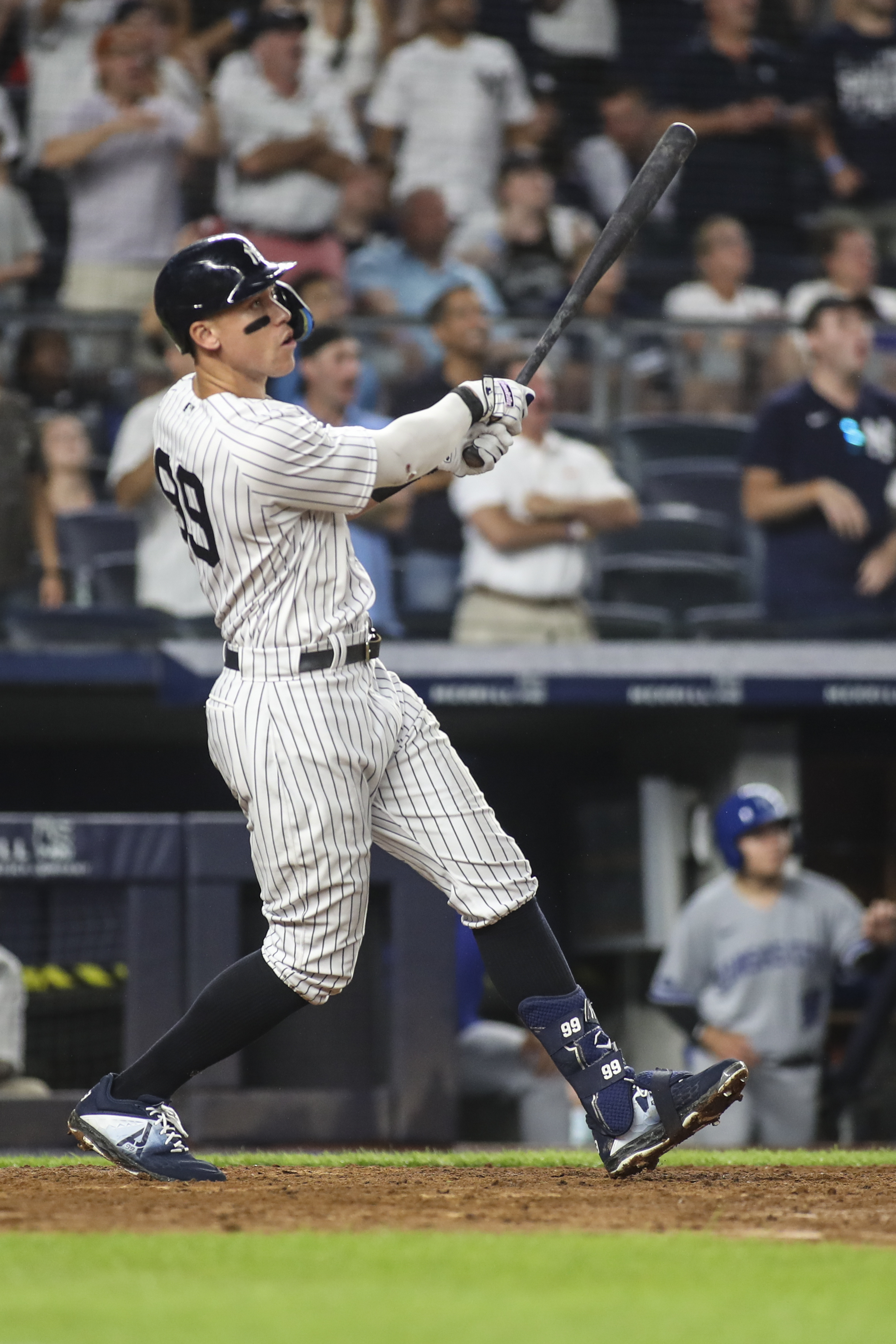
Judge has been the best hitter on the planet since Opening Day, and as things currently stand, the only person who could conceivably stand in his way of winning his first AL MVP trophy would be Angels sensation Shohei Ohtani. However, great as Ohtani has been again in 2022, his offense isn’t quite what it was last year (and isn’t anywhere close to Judge’s league-leading dominance). From a pure WAR perspective, Judge has been so good this year that his value with the bat has eclipsed Ohtani’s combined value at the plate and on the mound.
Regardless, Judge is now poised to reach free agency on the heels of the finest season of his already brilliant big league career. He’ll play the 2023 season at age 31, which is about the only strike against him in free agency. Judge will receive and reject a qualifying offer from the Yankees, and even though he’d be 38 by the end of an eight-year deal, that seems plenty plausible. He could very well command the largest annual salary any position player has ever received, too, and a $300MM overall contract doesn’t seem out of the question. This is what it looks like to bet on yourself and win — in resounding, overwhelming fashion, no less.
2. Trea Turner, SS, Dodgers (LR: 3): There’s not much on the baseball field that Turner doesn’t do well. The 29-year-old is the sport’s fastest player, by measure of Statcast’s Average Sprint Speed, and he’s hitting .305/.345/.499 as of this writing. The 28 home runs he popped in 2021 might very well go down as a career-high, but Turner should finish this year around 25 dingers and has twice in the past hit 19 long balls (including in a 2019 season where he played in just 122 games).
That injury shortened ’19 campaign was the only one in the past half decade in which Turner spent significant time on the shelf. Over the past five years, he’s a .303/.358/.493 hitter who’s made a pair of All-Star teams, won a batting title and taken home a World Series ring.
By the end of a long-term deal, Turner will probably move off shortstop, but he’s a solid option there for now who’d be plenty capable of sliding over to second base at some point. Over the past three seasons, he’s been 43% better than league-average with the bat, by measure of wRC+, and this will be his fourth season of at least four wins above replacement in the past five years — with the 60-game 2020 season, when he boasted 2.8 fWAR and bWAR alike, being the lone exception.
If Turner had been born a day later, next year would technically be considered his age-29 season, but he’ll be 30 on June 30, and the July 1 cutoff is (for whatever reason) generally seen as the arbitrary turning point for a player’s age in a given year. A seven-year deal for Turner would run through age-37, and an eight-year deal through age-38. He’ll have to contend with a qualifying offer and another deep class of shortstops, but Turner is one of baseball’s most well-rounded players and figures to be compensated in line with the game’s 10 to 20 best position players.
3. Nolan Arenado, 3B, Cardinals (LR: 6): It’s difficult to directly compare Arenado’s 2022 season and the 2019 season that propelled Anthony Rendon to a seven-year, $245MM contract, given that Rendon’s Herculean ’19 effort came during the juiced-ball season. Offense is down league-wide now, yet Arenado stacks up favorably in terms of batting average, on-base percentage and slugging percentage. Metrics like wRC+ and OPS+, which weight for both home park and league environment, feel that Arenado’s 2022 production at the plate has actually been slightly better.
Defensively, Arenado is nearly peerless at his position. Since making his MLB debut in 2013, Arenado ranks second among all players, regardless of position, with 151 Defensive Runs Saved, trailing only Andrelton Simmons. He’s third to Francisco Lindor and Nick Ahmed in Statcast’s Outs Above Average, which tracks defensive data dating back to 2016. Arenado’s numbers aren’t inflated by early-career marks, either. He remains elite this season, ranking third in all of MLB in DRS and second in OAA. Defensive metrics and the eye test agree, as Arenado has been a human highlight reel at the hot corner for his decade-long career.
The age gap between 2022 Arenado (31) and 2019 Rendon (29) can’t be ignored. However, that should be more reflected in the length of a theoretical Arenado contract than in the annual value. It’s also, of course, worth noting that Arenado is technically under contract through 2027. He’s guaranteed $144MM in that time but has the right to opt out of the contract after the current season. Arenado forwent an opt-out clause after the 2021 season, but his 2022 campaign is the best of his career.
Even if he’s capped at a five-year deal in free agency, he should be able to trounce the current $28.8MM annual value remaining on his deal by as much as $5-7MM — and a six-year deal doesn’t seem impossible to imagine coming off such a brilliant effort. (Freddie Freeman scored a six-year deal beginning with his age-32 season, so there’s recent precedent.) Perhaps Arenado and the Cardinals will work out a compromise, and it’s always possible he decides he’s happy in St. Louis and just passes on the opt-out entirely. If he does want to test the market again, however, there could be another $20-60MM in earning power for him on top of his current deal.
4. Carlos Correa, SS, Twins (LR: 2): The 2022 season might not have gone quite as well as either Correa or the Twins hoped, but he’s still enjoying a sound all-around year, hitting .265/.343/.433 (22% better than league average, by measure of wRC+). He got out to a slow start in April and has slumped following the All-Star break, but for a three-month stretch from late April to late July, Correa hit .308/.375/.509. Provided the current slump doesn’t last too long, Correa stands a decent chance to be around 30% better than average at the plate for the second straight season and third time in four years.
Last year’s all-world defensive ratings have taken a dip thus far in 2022 — surprising for a player who has generally been a consistent source of elite glovework. He’s made five throwing errors this season, tied for his most since 2016, but Correa has been plenty sure-handed, booting just two balls hit to him. He’s spent the year throwing to Miguel Sano and a pair of makeshift first baseman who’ve converted from other positions (Luis Arraez, Jose Miranda), so perhaps some of the throwing miscues can be forgiven by a team with a better defensive outlook at first base.
If those first couple paragraphs feel like they’re filled with caveats — well, they are. The simple fact is that Correa hasn’t had as strong a season as he did in 2021 and probably shouldn’t be expected to command the type of contract many (MLBTR included) thought to be possible last offseason. That said, Correa still hasn’t even turned 28 — the age at which he’ll play nearly all of the 2023 season. His youth alone gives him the chance to command the longest contract of any free agent this winter; even a 10-year deal would run through age-37.
That type of contract may not be on the table without a huge finish, but Correa is still a plus defender and well above-average hitter with age on his side. It’s perhaps narrowly more plausible that he could opt into a second year with the Twins, take another $35.1MM salary and hope to hit free agency on the heels of a stronger platform in 2023, but his current earning power is still among the best in this year’s free-agent class.
5. Xander Bogaerts, SS, Red Sox (LR: 4): When the last version of our list was published, Bogaerts had homered just four times in 174 plate appearances while posting a below-average .135 ISO (slugging minus batting average). It was easy enough to overlook as little more than small-sample noise at the time, but Bogaerts has hit just five home runs in 267 plate appearances since that time and now has nine long balls and a tepid .141 ISO in 441 trips to the plate. That’s the worst power output we’ve seen from Bogaerts since 2017 by an overwhelming margin. From 2018-21, he belted 90 homers in 2106 plate appearances while turning in a stout .224 ISO.
Bogaerts is still hitting .311/.383/.452 on the season, but he’s also sporting a career-high .382 average on balls in play that he’s not going to sustain — particularly not when his average exit velocity, barrel rate and hard-hit rate are at their lowest or near-lowest levels since 2017.
There’s still no doubt that Bogaerts will opt out of the remaining three years and $60MM on his contract, but he’d be higher on this list if not for his power stroke going MIA. Couple that with ongoing questions about his defense — some teams are surely going to see Bogaerts as a player who needs to move off shortstop, perhaps as soon as 2023 — and the current free-agent outlook is a bit murkier than expected.
Nevertheless, Bogaerts has a long track record of excellent offense and well above-average power output. With a strong finish to the season, particularly in the power department, he should have no problem commanding a notable nine-figure deal — and something in excess of $200MM can’t be ruled out.
6. Jacob deGrom, RHP, Mets (LR: 7): The No. 6 ranking here for deGrom factors in something of a best-case scenario, but this list is based on earning power, after all. If deGrom gets hurt again or struggles down the stretch, it’s possible he’ll drop off the list entirely. The latter of those two scenarios seems unlikely, though, as deGrom hasn’t “struggled” since 2017. He’s been dominant through his first two starts of the 2022 season, averaging 99.2 mph with his fastball and holding opponents to three runs on four hits and a walk with 18 punchouts through 10 2/3 innings.
Dating back to 2018, deGrom has a comical 1.95 ERA in 591 2/3 innings with a 34.9% strikeout rate against a 5.3% walk rate. When healthy, deGrom is simply unmatched in terms of starting pitching dominance over that period. He ranks second among all Major League pitchers with 24 wins above replacement dating back to 2018, per FanGraphs, despite the fact that he’s made only 93 starts in that time. Max Scherzer tops the list but has started 24 more games and logged 143 2/3 more innings — about an extra 75% of a season’s worth of work.
If deGrom finishes the season with no red flags, the bidding should be furious. He’ll turn 35 next June, making him nearly three full years younger than Scherzer was when he secured his record-setting three-year, $130MM deal from the Mets. DeGrom could justifiably look to top that AAV on a multi-year deal, and he’s too good for the bidding to stop at two years. The biggest question surrounding deGrom is just how many years someone will be willing to guarantee. A three-year pact in excess of Scherzer’s seems doable, and a fourth year ought to be on the table as well.
7. Dansby Swanson, SS, Braves (LR: Not Ranked): Long a plus defender at shortstop, Swanson is having another strong year with the glove and a career year with the bat. He’s followed up a career-high 27 home runs in 2021 with a .292/.348/.461 showing through 463 trips to the plate. He’s been the beneficiary of a .375 average on balls in play that he surely won’t sustain over a larger sample, but Swanson is also making hard contact at a career-best 44.7% clip and elevating the ball more than he has in years past.
A greater walk rate than his current 7.3% clip or lower strikeout rate than his 26.3% mark would raise Swanson’s floor, but his glove alone will make him an above-average regular and he’s well on his way to his second straight 25-homer season. Add in that Swanson will play all of next season at 29 years old, and a nine-figure deal seems likely. Both Trevor Story and Javier Baez landed six-year, $140MM pacts last winter at the same age. Swanson will have to contend with a qualifying offer and with some more decorated shortstop options ahead of him on the market, but he’ll be in high demand all the same.
8. Carlos Rodon, LHP, Giants (LR: 8): Rodon was the best pitcher in baseball through late July in 2021, but he was capped to five innings per appearance (at most) down the stretch as he battled shoulder fatigue and diminished velocity. For a pitcher with Rodon’s injury history, that limited interest in him to the point that he took a two-year, $44MM deal with a chance to opt out following the 2022 season — provided he reached 110 frames.
Rodon has not only reached 110 innings — he’s shot past it with career-best velocity (95.8 mph average fastball) and another sub-3.00 ERA (2.95 through 128 1/3 frames thus far). Rodon is averaging just shy of six innings per outing and boasts a 31.2% strikeout rate against a 7.6% walk rate. He’s reached double-digit strikeouts in six of his 22 starts and held opponents to three or fewer runs in 18 of 22 tries.
Rodon’s fastball in his past eight starts is down about one mile per hour over his average from his first 14 starts, but it’s still been a healthy 95.1 mph in that stretch. That said, he threw a complete game on July 9, worked seven shutout innings on July 31, and averaged a resurgent 96 mph with his heater in his most recent outing. At least so far, Rodon doesn’t appear to be fading at all. If he can avoid the type of late swoon he experienced in 2021, he ought to find four- and five-year offers at superior annual values to this contract’s $22MM AAV. He’ll receive a qualifying offer and surely reject it, which isn’t ideal, but he has the best combination of age (30 all of next season) and 2022 performance of any starter on this year’s market.
9. Justin Verlander, RHP, Astros (LR: Not Ranked): Simply returning to make a full season’s worth of starts would’ve been a feat for a 39-year-old who had pitched just six innings since the end of the 2019 season due to Tommy John surgery. Verlander, of course, is no ordinary 39-year-old, and he’s not only returned but positioned himself as a front-runner for the AL Cy Young Award.
It’s a jaw-dropping feat, even for one of this generation’s best. Verlander has a 1.73 ERA with a 25.5% strikeout rate against a minuscule 4.6% walk rate. He’s averaging nearly 6 2/3 innings per start, sitting 95.1 mph with his heater — his second-best mark since way back in 2011 — and has thrown a quality start in 16 of his 20 appearances this year. Verlander hasn’t yielded more than one earned run in a start since June 18 and has held opponents to one or zero earned runs in a stunning 15 of 20 starts.
He’ll turn 40 in February, but Verlander has a legitimate case to break Max Scherzer’s $43.33MM AAV, particularly if he’s looking at a two-year deal. He’s said he wants to pitch into his mid-40s and looks as good as ever, though, so we shouldn’t discount the possibility that a team shrugs and goes to three guaranteed years for this generation’s most prolific workhorse. Verlander unlocked a $25MM player option when he reached 130 innings pitched, but he should be able to crush that in free agency even if he prefers to work out an extension with Houston.
10. Edwin Diaz, RHP, Mets (LR: Not Ranked): It’s been six years since Mark Melancon (four years, $62MM), Kenley Jansen (five years, $80MM) and Aroldis Chapman (five years, $85MM) each set new records for relief contracts in the same offseason. Diaz, the most dominant reliever in baseball this season, will have a chance to topple that Chapman record when he heads into free agency in advance of his age-29 season.
After a nightmarish first season in Queens, Diaz has righted the ship and become a spectacle in the best kind of way. He’s averaging 99.1 mph on his heater this season, has punched out 52.9% of his opponents and has an entrance more befitting of a professional wrestler than a Major League closer.
Diaz’s Baseball Savant profile looks like a video game cheat code. He’s leading the Majors in expected ERA, expected wOBA, expected batting average, expected slugging percentage, strikeout rate, whiff rate and ranks in the 99th percentile in average exit velocity, opponents’ chase rate, opponents’ barrel rate and fastball velocity. Diaz last allowed an earned run on June 18, and in 18 innings since that time he’s posted a 38-to-1 K/BB ratio while yielding just seven hits.
The 2022 version of Edwin Diaz might be the best reliever we’ve seen since Mariano Rivera. He’ll be hit with a qualifying offer, but it’s doubtful the teams pursuing him are going to even care about that. It’d be a surprise if Diaz doesn’t set a new contract record for relief pitchers this winter, and he could be baseball’s first nine-figure reliever.
Honorable Mentions: Brandon Nimmo, Willson Contreras, Jose Abreu, Josh Bell, Chris Bassitt, Nathan Eovaldi, Andrew Benintendi
Injury Notes: Hendricks, Borucki, Jung
Cubs righty Kyle Hendricks underwent an MRI yesterday that will determine whether the veteran starter will be able to return this season, president of baseball operations Jed Hoyer announced to reporters (Twitter link via Mark Gonzales of the Chicago Tribune). It’s been more than a month since a shoulder strain sent Hendricks to the injured list, and the last update from the team (prior to this MRI revelation) came back on July 13, when Hendricks was shut down from throwing for three weeks. Presumably, the Cubs will get multiple opinions on the MRI results before making a determination and ultimately making an announcement regarding the 32-year-old righty.
Hendricks, a former MLB leader in ERA and third-place finisher in Cy Young voting (both in 2016), is in the third guaranteed season of a four-year, $55.5MM contract that also contains a club option for the 2024 campaign. He’s made 16 starts for the Cubs this season and logged a 4.80 ERA — a near-mirror image of last year’s 4.77 mark across 32 outings. The Cubs owe him $14MM in 2023, and there’s a $1.5MM buyout on a $16MM team option for the 2024 season.
Some more injury scenarios that merit attention…
- Left-hander Ryan Borucki, the lone southpaw in the Mariners‘ bullpen, will undergo an MRI after exiting last night’s game with a forearm strain, tweets Ryan Divish of the Seattle Times. Divish notes that Mariners skipper Scott Servais “would prefer to have a lefty out of the bullpen if possible.” The only other lefty option on the 40-man roster is rookie Brennan Bernardino, who has all of 2 1/3 Major League innings under his belt. The M’s do have Roenis Elias, Fernando Abad and Nick Ramirez as non-40-man options in Triple-A Tacoma, and each has posted anywhere from passable to strong numbers with the Rainiers thus far. Borucki, 28, has pitched 19 1/3 innings of 4.26 ERA ball for Seattle since being acquired from the Jays back in June.
- Rangers top prospect Josh Jung will come off the minor league injured list and make his season debut with Triple-A Round Rock tonight, tweets Kennedi Landry of MLB.com. The 24-year-old Jung, whom Texas tabbed with the No. 8 overall pick back in 2019, entered the season as one of the sport’s top overall prospects but required surgery to repair a torn labrum in his left shoulder in late February. At the time, it was believed that Jung would need about six months to be ready just to serve as a designated hitter in a game setting, but he’s beaten that timeline considerably, as Landry notes that he’s slated to play third base tonight and has already played in eight rehab games with the organization’s Rookie-level affiliate in the Arizona Complex League. Jung hit .326/.398/.592 in 342 plate appearances between Double-A and Triple-A last season and, prior to the injury, was seen as a candidate to make his big league debut this year. Now that he’s back in action at Triple-A with two months of season left, it’s again feasible he could reach the Majors in 2022.