
Phillies Notes: Schwarber, Knebel, Bullpen
The Phillies, like most teams around the league, have plenty of work to do once the lockout is resolved and a new collective bargaining agreement is in place. With that in mind, it’s worth noting that NBC Sports Philadelphia’s Corey Seidman writes the Phils “pursued [Kyle] Schwarber hard” prior to the lockout but weren’t able to finalize an agreement.
The 28-year-old Schwarber (29 in March) shook off a slow couple months to begin the 2021 season, ripping through MLB pitching at a Herculean clip throughout the summer and into the postseason. The longtime Cubs slugger inked a one-year deal with the Nats last winter, found himself traded to the Red Sox despite being on the injured list due to a hamstring injury, and finished the regular season with a combined .266/.374/.554 batting line and 32 home runs in just 471 plate appearances. Schwarber added three more homers in the playoffs, though he closed out October with an 0-for-15 skid following an epic grand slam in Game 3 of the ALCS.
When finished, the new collective bargaining agreement is expected to include a universal designated hitter, which would make it easier for the Phillies (or another team) to slide the defensively challenged Schwarber into the lineup. He could still see some reps in left field or even at first base, of course, but Schwarber would be viewed largely as a much-needed bat to pair with reigning MVP Bryce Harper in Philadelphia.
Schwarber ought to have plenty of other suitors, as he’s been linked to the Red Sox, Nationals, Marlins and others since the offseason began. Barry Jackson of the Miami Herald reported not long ago that Schwarber is seeking a deal of at least three years and $20MM annually, though with enough competition the asking price could obviously further increase.
While supplementing the lineup with some help for Harper is a major goal, it wasn’t the top priority for Philadelphia this winter. President of baseball operations Dave Dombrowski made clear that solidifying the ninth inning was one of his top needs this winter, and the Phils look to have checked that box already.
Corey Knebel and the Phillies got their one-year, $10MM contract in just hours before the expiration of the 2016-21 CBA, and he’s expected to serve as the team’s closer in 2022, writes Matt Gelb of The Athletic. Dombrowski noted that he did not promise that role to Knebel (link viaNBC Philly’s Jim Salisbury), but he strongly suggested as much, telling reporters that Knebel opted for a one-year deal in order “to show people that he’s a dominant closer again” now that he’s healthier.
Knebel, who had Tommy John surgery in 2019, saw his fastball velocity jump two miles per hour from the 94.6 mph he averaged in his abbreviated return to the mound in 2020. While his 29.7% strikeout rate didn’t match the ridiculous 40.2% mark he posted in Milwaukee from 2017-18, it was nevertheless a strong mark and a reminder that Knebel can be as dominant as any reliever in the game when at his best.
Gelb suggests that a subsequent acquisition of Craig Kimbrel is unlikely to be in the cards, as the Phils aren’t likely to want to commit $26.5MM to a pair of relievers. Still, Knebel certainly won’t be the only addition to the ‘pen. Said Dombrowski: “We’ve got a guy that we think will close games for us, and that’s a big start. Then we can kind of build the rest of the bullpen.”
The addition of Knebel and the Phillies’ one-year, $1.4MM deal with utilityman Johan Camargo pushed the team’s payroll to a bit more than $181MM — with a near-identical tally in terms of luxury obligations, per Roster Resource’s Jason Martinez. That’s well shy of last year’s $197MM end-of-season payroll and the even-larger $206.5MM in luxury obligations the team carried. Assuming the $210MM luxury-tax threshold is ultimately increased in a new CBA, the Phils could have quite a bit more luxury breathing room than the $29MM they already possess at the moment.
Tigers Sign Javier Baez
The Tigers have landed their new franchise shortstop. Detroit announced on Wednesday they’ve signed Javier Baez to a six-year contract. According to reports, it’s a $140MM guarantee for the Wasserman client, who also lands some other perks in the deal. Baez can opt out after the 2023 campaign and has limited no-trade protection that allows him to block a move to 10 teams each year.
Baez’s salaries break down as follows: $20MM in 2022, $22MM in 2023, $25MM each in 2024-25 and $24MM each in 2026-27. He also receives assorted incentives based upon finishes in MVP and other awards’ voting. Baez is guaranteed $42MM over the first two seasons of the slightly backloaded deal. That means he’ll have four years and $98MM in remaining guarantees after the 2023 campaign, when he’ll need to decide on his opt-out possibility.
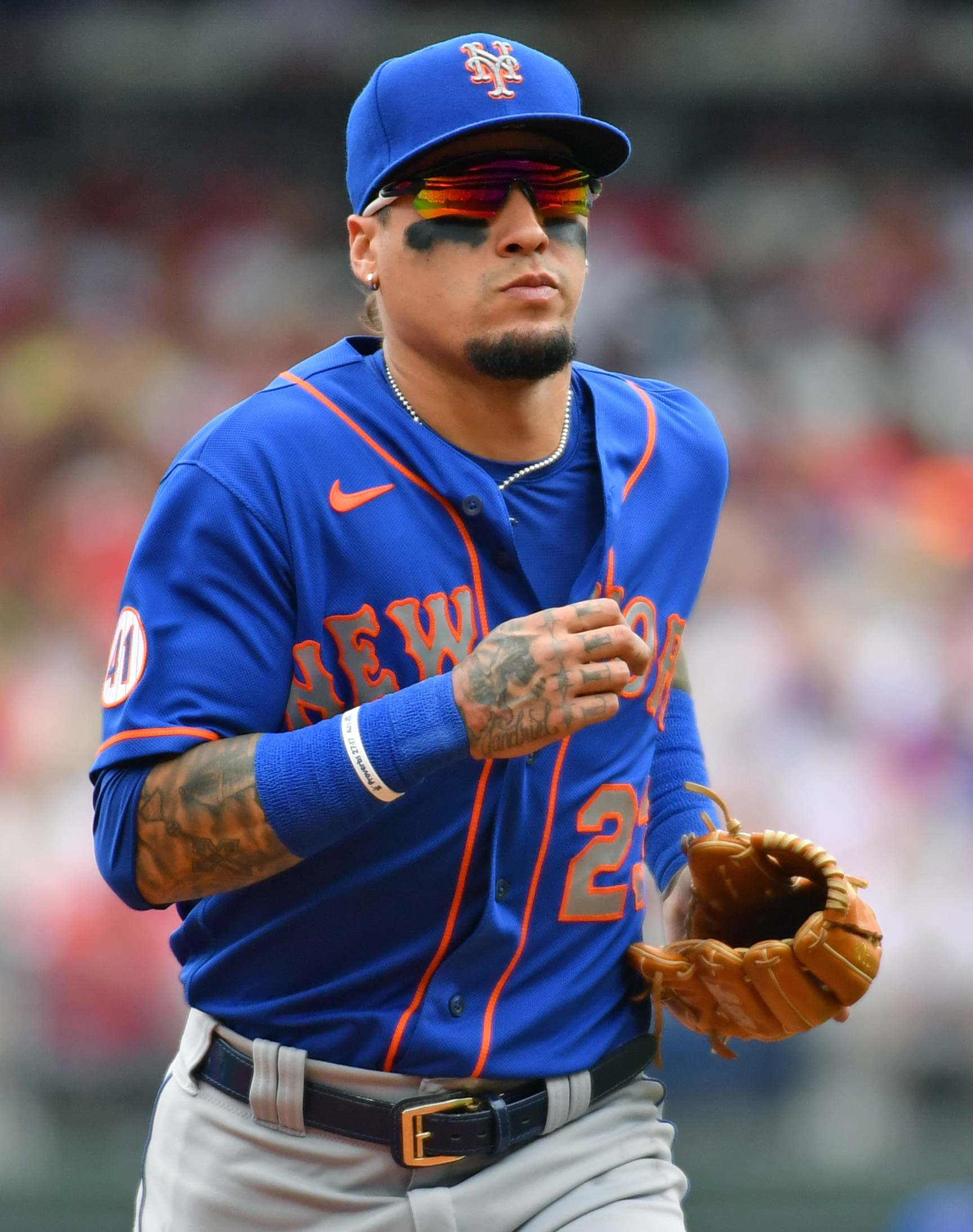
Shortstop has been a glaring need for the Tigers since the onset of free agency, with general manager Al Avila plainly stating his intentions to improve at the position not long after the season’s conclusion. While many speculated that Carlos Correa, who knows Detroit skipper AJ Hinch quite well from the pair’s time in Houston, would be the likeliest candidate to step into that role, Avila & Co. have preached a more measured approach since the offseason commenced. The Tigers already inked lefty Eduardo Rodriguez to a five-year, $77MM contract early in free agency, and adding Baez to the fold would effectively satisfy multiple needs at what figures to be a fair bit less than the cost of Correa on his own.
Detroit shortstops were quite nearly the worst in Major League Baseball from an offensive standpoint in 2021, hitting a combined .201/.275/.321. The resulting 62 wRC+ (i.e. 38 percent worse than league-average production) was the second-lowest mark in the sport, leading only a tanking Pirates club in overall offensive output at the position.
The Tigers have already moved on from their leader in shortstop innings over the past few seasons, bidding adieu to Niko Goodrum after passing him through waivers unclaimed and watching him elect free agency. Baez would represent an across-the-board improvement over Goodrum, providing lights-out, frequently highlight-reel defense in addition to considerable power and baserunning skills for his position.
The 2020 campaign was a season to forget for Baez, but the end result of a roller-coaster 2021 season was a .265/.319/.494 batting line with 31 homers and 18 steals (in 23 tries) for the two-time All-Star and 2018 NL MVP runner-up. Generally speaking, Baez (who’ll turn 29 tomorrow) is a power-hitting but free-swinging shortstop whose penchant for putting the ball over the fence is at least somewhat mitigated by an anemic walk rate that typically lands him near the bottom of the league in on-base percentage. This year’s .319 OBP was actually the second-highest single-season career mark for Baez, who has drawn a free pass in just 4.8% of his 3255 MLB plate appearances.
That said, it’s worth pointing out that there were some positive strides shown by Baez following a trade from the Cubs to the Mets at the July 30 deadline. After whiffing in a whopping 36.3% of his plate appearances in Chicago, Baez cut that figure to a more tolerable (albeit still too lofty) 28.5% in Queens. He also walked at a 7% clip with the Mets — a mark that’s a good bit shy of the 8.8% league average but also well north of 4.7% mark he carried throughout his years with the Cubs. After a rocky run with the Cubs in 2021, Baez finished the season on a heater and posted a composite .299/.371/.515 batting line as a Met.
Inconsistent as Baez may be at the plate, it’s hard to argue with the bottom-line results at the end of the day. Even including 2020’s woeful season, Baez is a .270/.311/.508 hitter (113 wRC+) with 102 home runs over his past 1988 plate appearances, dating back to 2018. He’s one of baseball’s premier defenders — regardless of position.
Since Opening Day 2018, Baez ranks third among all Major League players with 52 Outs Above Average, per Statcast, and his 44 Defensive Runs Saved place him ninth among 4053 defenders who’ve taken the field. While the now-former incumbent Goodrum was a solid defender in hiss own right, Baez is a game-changer with the glove who’ll serve as a pronounced improvement to the Detroit defense.
The Mets were reportedly interested in retaining Baez, who is close friends with New York shortstop Francisco Lindor, but it now seems he’ll instead head to the Motor City and serve as one of the faces of a team looking to emerge from a rebuilding cocoon and announce its return to contention in the American League Central.
Detroit has spent most of the past five years in a prolonged rebuilding effort but has managed to stockpile an enviable farm system that now leaves the team on the precipice of turning the corner. Young starters Casey Mize, Tarik Skubal and Matt Manning will be expected to team with Rodriguez in leading the starting staff, while 2020 No. 1 overall pick Spencer Torkelson and 2019 No. 5 overall pick Riley Greene are both viewed as top-10 leaguewide prospects and potential lineup anchors.
That blossoming young core makes it easy for Detroit, a team that has previously trotted out Opening Day payrolls north of $200MM, to spend heavily in free agency this winter. Miguel Cabrera is signed through the 2023 season, but the only player on the books beyond that point is the aforementioned Rodriguez. Roster Resource’s Jason Martinez projects a $104MM payroll without Baez next season, and that’s before the likely non-tender of Matthew Boyd and his $7.3MM projected salary (courtesy of MLBTR contributor Matt Swartz).
With that in mind, even if this is the last marquee move of the offseason for the Tigers — and, to be clear, there’s no indication that’s the case — the additions of Baez and Rodriguez clearly set the stage for a return to aggressive adding in Detroit. The Tigers will have one more high-end draft pick in 2022, but the goal for the team is clearly to shift into win-now mode, and the additions of both Baez and Rodriguez are notable steps in that direction. Baez has averaged a hefty 4.6 wins above replacement (per Baseball-Reference) per season over the past four years, even including that ugly 2020 campaign, and the Tigers will count on him for more of the same as a linchpin both in the lineup and on defense as they turn the page from a rebuild the fans are all too ready to leave in the rear-view mirror.
Jon Morosi of MLB.com first reported the Tigers and Baez were nearing agreement on a six-year contract. Mark Feinsand of MLB.com first reported the $140MM guarantee. Evan Petzold of the Detroit Free-Press reported the two sides had reached an agreement and that Baez’s deal included an opt-out provision. Ken Rosenthal of the Athletic first reported the opt-out was after 2023 and was first with the limited no-trade protection. Jon Heyman of the MLB Network reported the specific salary breakdown.
Photo courtesy of Imagn/USA Today Sports.
White Sox Re-Sign Leury Garcia
11:05AM: The White Sox have officially announced both the signing and Garcia’s $16.5MM salary, with the additional detail that Garcia will receive $5.5MM in each season of the deal.
TODAY, 12:57AM: Garcia receives a $16.5MM guarantee, Heyman reports.
NOVEMBER 30: The White Sox have agreed to re-sign infielder/outfielder Leury Garcia, reports MLB Network’s Jon Heyman (Twitter link). It’ll be a surprising three-year commitment for MDR Sports Management client.
Garcia, 30, tallied 474 plate appearances with the South Siders in 2021 — the second-highest total of his career — and posted a .267/.335/.376 batting line with five homers, 22 doubles, four triples and six stolen bases (in eight attempts). Dating back to 2017, when Garcia established himself as a fixture on the White Sox’ roster, he’s batted .273/.317/.388 while seeing time at second base, shortstop, third base and all three outfield spots.
Despite a need for an everyday second baseman in Chicago, it seems Garcia’s role won’t change much on his new contract. The Athletic’s James Fegan tweets that Garcia will continue as an oft-used backup around the diamond and, when injury necessitates, a temporary everyday option.
The ChiSox already have Yoan Moncada installed at third base, Tim Anderson at shortstop, Eloy Jimenez in left field and Luis Robert in center. Andrew Vaughn and Gavin Sheets saw some time in the outfield this year but are better suited at first base — where Jose Abreu is locked in — and/or designated hitter. Garcia is a competent backup just about anywhere, with 200-plus innings at every position other than first base, catcher and (of course) pitcher. It still seems likely that Chicago will make an addition at second base, and an upgrade in the outfield is also quite possible.
It’s uncommon, albeit not unprecedented, to see a free-agent bench player of this nature receive a deal of three or more years in length. Ben Zobrist landed four years as a free agent with the Cubs, and the general expectation is that reigning super-utility star du jour Chris Taylor will eclipse Zobrist’s $56MM guarantee. Both Zobrist and Taylor, however, hit the market as above-average hitters with everyday upside; that hasn’t been true of Garcia. The deal is in some ways reminiscent of the Padres’ three-year contract with Jurickson Profar, though Chicago will hope for better results than that deal provided for San Diego in year one.
Mariners Sign Robbie Ray
The Mariners announced their agreement with reigning American League Cy Young winner Robbie Ray, as first reported by Michael Mayer of MetsMerized (Twitter link). It’s a five-year deal worth $115MM and an opt-out after the third season, reports ESPN’s Jeff Passan (via Twitter). Joel Sherman of the New York Post adds that the contract includes a full no-trade clause in the first two seasons and a trade assignment bonus if he’s moved thereafter. Ray is represented by VC Sports Group.
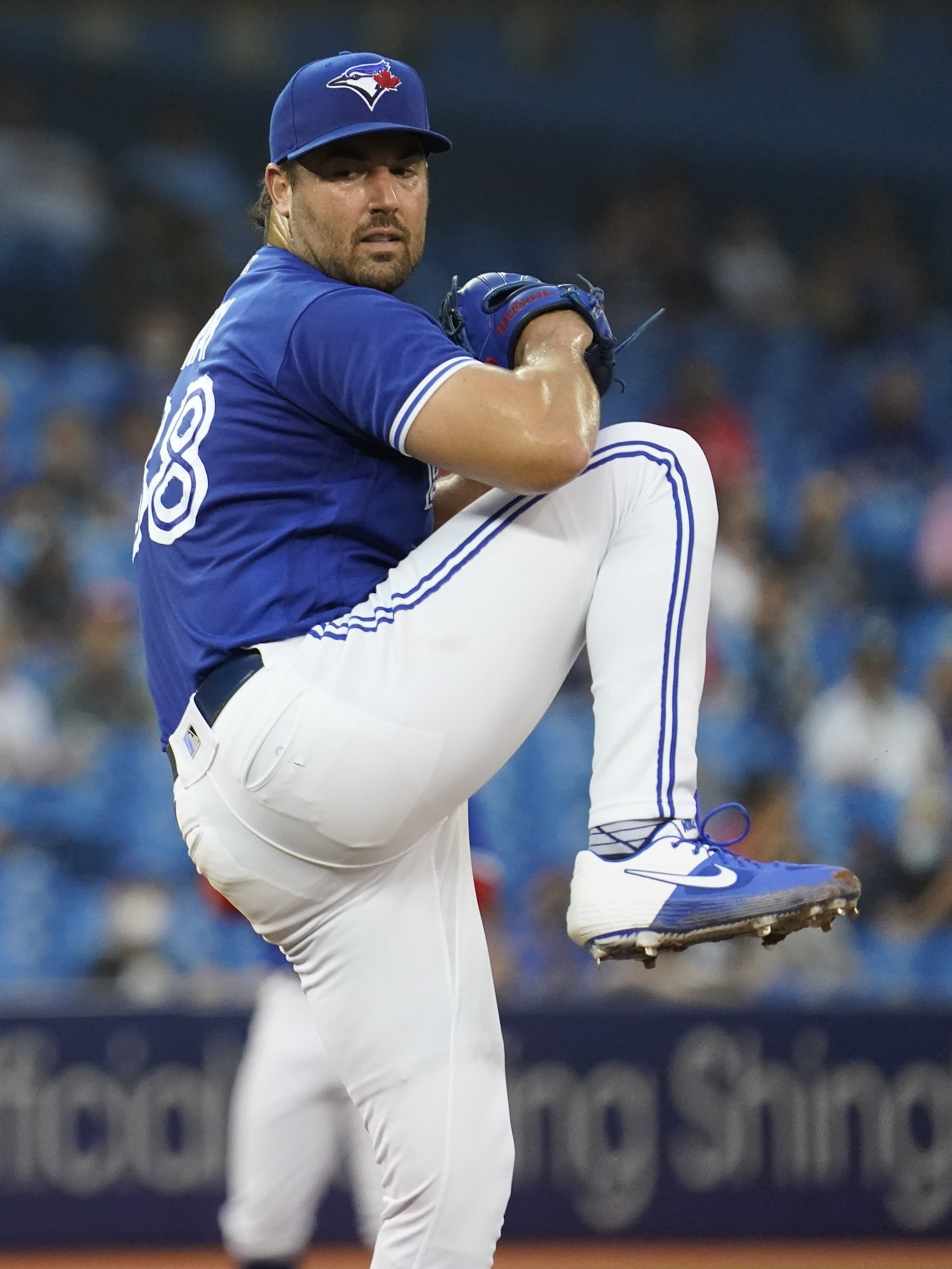
Ray, 30, has long been a premier strikeout arm with command issues, which culminated in a 2020 season that saw him traded from Arizona to Toronto in what amounted to a salary dump. While the lefty didn’t immediately turn things around, the Jays jumped to re-sign him for a year and $8MM right out of the gate in the 2020-21 offseason, clearly believing they could help the lefty find another gear.
Even the Toronto front office’s best-case scenario might not have mirrored the 2021 breakout enjoyed by Ray, who was near-unanimously named AL Cy Young (29 of 30 first-place votes). Ray not only restored his command to prior levels but took it to new heights, walking a career-low 6.7% of his opponents. Ray ramped up the usage of his four-seamer at the expensive of his curveball, largely favoring a two-pitch mix that leaned heavily on his plus slider’s ability to perplex opponents.
The results were obviously outstanding, as Ray compiled an AL-best 2.84 ERA and also paced the American League in innings pitched (193 1/3), total strikeouts (248) and ERA+ (154). Among pitchers with at least 100 innings, Ray’s overall 32.1% strikeout rate trailed only Corbin Burnes, Carlos Rodon, Max Scherzer, Freddy Peralta and Gerrit Cole. His 15.5% swinging-strike rate ranked third among the 129 hurlers who tossed 100-plus frames.
Ray was still prone to the long ball, evidenced by an unsightly 1.54 HR/9 mark, but his ability to keep runners off the basepaths led to nearly 70 percent of those long balls coming with the bases empty. It’s fair to wonder how much concern over that penchant might have impacted his market and kept him from reaching a sixth guaranteed year, but one would also imagine that a move to Seattle and a move out of the generally hitter-friendly AL East will only help to lower that mark.
With Ray departing the Blue Jays, it’s hard to ignore the striking similarity between his contract and the $110MM guaranteed by his former team to another free-agent starter: righty Kevin Gausman. Perhaps the Jays weren’t keen on including an opt-out in the deal, or perhaps they just generally prefer Gausman to Ray when all is said and done. Toronto did pursue Gausman both in the 2019-20 and 2020-21 offseasons, so he’s clearly been of interest to GM Ross Atkins & Co. for quite some time.
In signing Ray, who rejected a qualifying offer in Toronto, the Mariners will surrender their third-highest selection in the 2022 draft. Toronto, meanwhile, will pick up a compensatory pick at the end of the first round by virtue of the fact that Ray signed for more than $50MM in guaranteed money.
With the Mariners, Ray will head up a rotation that also includes lefty Marco Gonzales, righty Chris Flexen and righty Logan Gilbert. Gonzales has long been a steady and durable source of above-average innings, while Flexen proved to be a savvy KBO reclamation project for president of baseball ops Jerry Dipoto and his staff this past offseason. Gilbert, meanwhile, is a former first-round pick and top-end pitching prospect who struggled in the middle of the 2021 season but bookended those struggles with a strong start and strong finish to the season.
Other options in the Seattle rotation currently include Justus Sheffield and Justin Dunn, though the Mariners are deep in tantalizing pitching prospects after a protracted rebuilding effort. Top prospects George Kirby, Matt Brash and Emerson Hancock are all progressing through the system, with Brash and Kirby in particular not far from big league readiness. Lefty Brandon Williamson, too, could emerge as an option before long.
Of course, it’s fair to wonder with all that pitching depth and with a good bit of outfield depth, if the Mariners might not choose to trade for another established rotation piece. Ray figures to be the big-ticket free agent addition on the pitching side — not that they couldn’t simply sign another notable arm — but there’s a bevy of quality arms rumored to be available in trade. Sean Manaea, Chris Bassitt, Frankie Montas, Sonny Gray, Tyler Mahle and Luis Castillo have all had their names kicked about the rumor circuit already, and the Marlins are reportedly open to dealing from their pitching depth as well. Whether it’s a trade or a free agent, another addition to the starting staff to complement the Mariners’ new ace seems likely at some point.
For the time being, it’s possible Seattle will pivot to acquire the bat Dipoto has already suggested he hopes to sign. Dipoto name-checked both Marcus Semien (now with the Rangers) and Javier Baez earlier this winter in voicing a desire to add some “adaptable” free agents, and the Mariners have also been tied to Kris Bryant and Chris Taylor, among others.
From a payroll vantage point, there’s no reason the Mariners shouldn’t be able to add a high-end bat and another rotation addition piece. Even after adding Ray, the Mariners are still projected by Roster Resource’s Jason Martinez to field a payroll of about $88MM (assuming an even distribution of his $23MM annual value). For a Mariners club that has taken payroll north of $150MM in the past, there’s plenty of space to add to pile. Ray currently stands as the largest free-agent addition the Mariners have made under Dipoto, but if he wants to spend more aggressively, the means to do should be present.
After all, the Mariners are staring down a two-decade playoff drought, and now more than ever might be the time for Seattle to push toward ending that dry spell. The Mariners were surprisingly in contention for a Wild Card berth right up until the final weekend of the offseason, and they’ll have even more products of their ballyhooed farm system graduating to the Majors in 2022 — headlined by outfielder Julio Rodriguez. Beyond that, the A’s are on the verge of a tear-down that will see them trade several key players, while the Astros could lose Carlos Correa in free agency. The Rangers are spending aggressively to help put a contender back on the field in the second season of their newly constructed stadium but may be a year or two from truly competing.
In many ways, the time for the Mariners to throttle ahead is now, and the signing of Ray serves as a firm indicator that the front office feels similarly. Armed with an elite farm system and tens of millions of dollars in payroll space, Seattle appears poised for an aggressive winter where Ray is just one of several high-end additions.
Photo courtesy of Imagn/USA Today Sports.
Tender Deadline Signings: 11/30/21
With the deadline to tender contracts to arbitration-eligible players looming tonight at 8pm ET — the MLBPA and MLB jointly agreed to move the deadline up a couple days due to the looming expiration of the collective bargaining agreement — we’ll likely see a slew of arbitration-eligible players signing one-year deals.
It’s commonplace for a large batch of players to sign deals in the hours leading up to the tender deadline. “Pre-tender” deals of this nature often fall shy of projections due to the fact that teams use the looming threat of a non-tender to enhance their leverage. Arbitration contracts at this juncture are often take-it-or-leave-it propositions, with the “leave it” end of that arrangement resulting in the player being cut loose. Given the widely expected lockout, there could be more incentive than usual for borderline non-tender candidates to take those offers rather than being cast out into free agency just hours before a transaction freeze is implemented.
As a reminder, arbitration contracts are not fully guaranteed. In a typical year, a team can cut a player on an arb contract at any point before the halfway point in Spring Training and only be responsible for 30 days’ termination pay (about one-sixth of the contract). Releasing a player in the second half of Spring Training bumps the termination pay to 45 days of his prorated salary.
MLBTR contributor Matt Swartz projected salaries for each team’s arbitration-eligible players last month, although for many of the players listed below, this isn’t so much avoiding arbitration as it is avoiding a non-tender. Here’s a look at today’s agreements…
- The Yankees have agreed to deals with infielder Gio Urshela and right-hander Domingo German, reports Mark Feinsand of MLB.com (Twitter links). Urshela will make $6.55MM, while German has agreed to a $1.75MM deal. Urshela has two seasons of control remaining; German is controllable for three years. Urshela is coming off a .267/.301/.419 showing while playing third base and shortstop. German tossed 98 1/3 innings of 4.58 ERA ball.
- The Twins have signed three arbitration-eligible pitchers, per reports from Feinsand and Darren Wolfson of SKOR North (on Twitter). Right-hander Jharel Cotton signed for $700K, reliever Caleb Thielbar lands $1.3MM and reliever Tyler Duffey signs for $3.8MM. Thielbar and Duffey were both productive members of the Minnesota relief corps in 2021. Cotton was recently claimed off waivers from the Rangers.
- The Giants have agreed to terms with outfielder Austin Slater on a $1.85MM deal, reports Ken Rosenthal of the Athletic (Twitter link). The 28-year-old (29 next month) appeared at all three spots on the grass while hitting .241/.320/.423 over 306 plate appearances in 2021.
- Reliever Emilio Pagan and the Padres have agreed on a $2.3MM deal, reports Rosenthal (on Twitter). The 30-year-old worked 63 1/3 innings of 4.83 ERA/3.93 SIERA ball this past season.
- The Diamondbacks agreed to a $2MM deal with left-hander Caleb Smith, reports Zach Buchanan of the Athletic (via Twitter). The 30-year-old posted a 4.83 ERA/4.68 SIERA across 113 2/3 innings in a swing capacity in 2021.
American League Non-Tenders: 11/30/21
The deadline to tender contracts to arbitration-eligible players has come and gone. The Tigers’ decision to non-tender Matthew Boyd — more on that here — represents the most prominent name cast into free agency tonight, but here’s a quick rundown of the rest of the non-tenders in the American League.
Note that MLBTR’s Anthony Franco also has a rundown of this year’s National League non-tenders, and MLBTR contributor Matt Swartz published his annual projected arbitration salaries earlier this offseason.
Onto the transactions…
- Outfielder Tim Locastro was non-tendered by the Red Sox, the team announced. The speedy HBP-magnet was claimed off waivers from the Yankees earlier this month after an injury-marred season. He is likely to be an in-demand depth option for teams if his ACL tear recovery goes well.
- The Rangers announced that outfielder Billy McKinney and catchers David Garcia and Yohel Pozo were non-tendered. Texas also assigned outfielder DJ Peters outright to Triple-A Salt Lake after he went unclaimed on waivers.
- The Royals non-tendered lefty Richard Lovelady, per a club announcement. Lovelady underwent Tommy John surgery late in the 2021 season and is expected to be sidelined for the entirety of the 2022 season.
- The Twins non-tendered right-hander Juan Minaya, left-hander Danny Coulombe and right-hander Trevor Megill, per a team announcement. Megill’s non-tender is particularly curious, as he was only just claimed off waivers a few hours ago and was not arbitration-eligible. Presumably, the team will try to quickly re-sign him to a minor league pact and bring him to Spring Training as a depth piece.
- Infielder Phil Gosselin has been non-tendered by the Angels, per an announcement from the team. The journeyman saw a career-high 373 plate appearances in 2021, but is unlikely to challenge that number next year owing to below average offensive and defensive metrics.
Tigers Non-Tender Matthew Boyd
The Tigers announced Tuesday that they will not tender a contract to left-hander Matthew Boyd, immediately making him a free agent. Boyd, 30, pitched just eight innings after June 14 this season due to a pair of forearm injuries, ultimately leading to flexor tendon surgery in late September. He’d been projected by MLBTR contributor Matt Swartz to earn $7.3MM in what would have been his final season of arbitration eligibility.
A specific timeline for Boyd’s return to the mound was never provided, with the team stating only it was “hopeful” he’d be able to pitch at some point in the 2022 season. Tigers GM Al Avila briefly discussed Boyd in his end-of-year press conference and acknowledged that a non-tender was a possibility. At the very least, it’s reasonable to expect Boyd to miss a notable portion of the 2022 campaign; were the Tigers expecting him to be ready early in the season, they’d surely have tendered him a contract, given his track record and lengthy tenure with the club.
The 2020 season was brutal for Boyd, who was knocked around for a 6.71 ERA, but he’s otherwise been a solid starter in Detroit — at times looking like an intriguing mid-rotation option. Boyd has shown the ability to miss bats in droves in the past, though he traded some punchouts for efficiency in 2021 when he attacked the strike zone at a career-best rate and accordingly dropped his walk rate to 6.8% — the second best mark of his career.
Even with that woeful 2020 showing, Boyd carries a 4.66 ERA, a 24.9% strikeout rate and a 6.9% walk rate over his past 494 2/3 innings at the MLB level. He’s often been homer-prone in the past, but Boyd has also gone through stretches where he looks on the cusp of taking his game to a new level. He pitched to a 3.44 ERA and 3.75 FIP through 13 starts this past season before landing on the injured list, for instance, and Boyd looked dominant for a good chunk of the 2019 season as well before a dismal second-half swoon. Whenever he’s healthy, Boyd will surely be viewed by teams around the league as an upside play who, with a few tweaks, could potentially sustain some of those flashes of success he’s shown in the past.
For the time being, with the looming lockout and uncertainty surrounding Boyd’s arm, it’s likely he’ll remain a free agent until the expiration of the collective bargaining agreement and instead field offers from other clubs once the forthcoming transaction freeze is lifted.
Yankees Tender Contract To Gary Sanchez
The Yankees announced Tuesday that they will tender a contract to all of their arbitration-eligible players, including catcher Gary Sanchez. Sanchez has come up as a possible non-tender candidate in each of the past two offseasons but he’ll be offered a contract and remain with the club for the time being. He’s projected by MLBTR contributor Matt Swartz to earn $7.9MM in 2022 — his final season of arbitration eligibility.
Sanchez, 29 this week, has become a polarizing player among Yankee fans given his near-unparalleled power at the catcher position but also his low batting averages, high strikeout rates and shaky defensive skills. The former top prospect looked like a star in the making from 2016-17 but has since ridden a roller coaster of productivity to a composite .201/.299/.444 slash with a 28.1% strikeout rate.
Poor batting average notwithstanding, Sanchez’s ability to draw a walk and immense power clearly are valued by the Yankees (and likely would be by other clubs as well). Metrics like wRC+ and OPS+ (both at 99 from 2018-21) suggest that the walks and power are enough to bring Sanchez right up to the cusp of league-average production, though the path he takes to get there is a rather unpopular one among fans. Still, when Sanchez is on a hot streak, his bat can carry a team. Those frequent but brief flashes of potential serve as a reminder of the overall upside and the reason that the Yankees have stuck with him despite the ups and downs.
That said, it’s not as though New York chose not to explore the market for alternatives. MLB Network’s Jon Heyman tweets that the Yankees explored the free-agent and trade markets for catching help in recent days before opting to simply stick with Sanchez. It’s a thin free-agent market for catching options, however, with Yan Gomes standing out as the lone starting-caliber option behind the dish. The trade market, meanwhile had a few potential options, but GM Brian Cashman was ostensibly either nonplused with the available names themselves or the asking prices attached. New York was at least speculatively linked to 2021 Gold Glove winner Jacob Stallings, but he was traded from Pittsburgh to Miami yesterday in exchange for a three-player package.
All that said, while Sanchez is at least in line to serve as the team’s primary backstop in 2022, it’s more written in pencil than etched in stone. Arbitration contracts are only partially guaranteed, as teams can cut a player on an arb contract and owe them only 30 days’ termination pay (i.e. prorated salary) so long as the move is made prior to the halfway point in Spring Training. Cutting a player in the second half of camp boosts that number to 45 days’ prorated salary, and the contract becomes fully guaranteed on Opening Day.
It seems unlikely that New York would simply release Sanchez, of course, but the Yanks could conceivably reinvestigate the catching market to see if there are new trade possibilities — both in terms of players to acquire and teams with interest in Sanchez — in the days following the likely lockout. The smart money is on Sanchez reprising his role as the Yankees’ primary catcher next season, of course, but it remains possible that an unexpected opportunity will prompt the Yanks to pivot.
Backing up Sanchez will quite likely be Kyle Higashioka, who bore some similarities to Sanchez in 2021 — at least offensively. While Higashioka is a better defender, his .181/.246/.389 slash struck a familiar chord: plenty of pop and a respectable number of walks but low average/on-base marks fueled by a lofty strikeout rate. Higashioka is out of minor league options, so if the Yankees wanted to find a different skill set to back up Sanchez, they’d likely need to expose the 31-year-old Higashioka to waivers, as it’s unlikely they’d carry three catchers on the roster.
Jack Curry of the YES Network first reported that Sanchez would be tendered a contract.
Marlins Designate Lewis Brinson For Assignment
The Marlins have designated outfielder Lewis Brinson for assignment, per a team announcement. His spot on the 40-man roster will go to infielder Joey Wendle, whose previously reported acquisition from the Rays has now been formally announced.
Brinson, 27, was the centerpiece of Miami’s return in the blockbuster trade that sent Christian Yelich to the Brewers. Brinson joined the Marlins organization alongside, infielder Isan Diaz, outfielder Monte Harrison and right-hander Jordan Yamamoto. At the time, it was a strong-looking return given that both Brinson and Diaz were regarded as high-end prospects, with Brinson in particular being vaunted as one of the game’s most promising all-around farmhands. As most fans are well aware, however, the deal didn’t pan out for the Fish.
There was always some risk to Brinson, a toolsy first-round pick of the Rangers back in 2012 who found his way to Milwaukee by way of another prominent trade (Jonathan Lucroy). Brinson made a brief MLB debut with the Brewers in 2017, tallying 55 plate appearances and struggling quite a bit as a 23-year-old getting his feet wet in the big leagues. That rough debut didn’t dim his prospect status much at all, but he never really made many strides in parts of four seasons with the Brewers.
From 2018-21, Brinson logged 1056 plate appearances in the big leagues but mustered only a .203/.248/.376 batting line with a 28% strikeout rate against just a 4.6% walk rate. He continues to rate as one of the fastest players in MLB, per Statcast’s average sprint speed, but Brinson doesn’t rate as a premium defender in the outfield by most publicly available metrics. He’s also seen his exit velocity and hard-hit rates drop since 2017-18, and this year’s penchant for popping the ball in the air was particularly concerning; 13 of Brinson’s 75 fly-balls were pop-ups.
Brinson is out of minor league options, so any team that acquires him will have to carry him on the MLB roster next season or else attempt to pass him through waivers before sending him to Triple-A.
Rays Trade Joey Wendle To Marlins
A busy offseason for the Marlins continued Tuesday, as Miami has announced the acquisition of infielder Joey Wendle from the Rays in exchange for outfield prospect Kameron Misner.
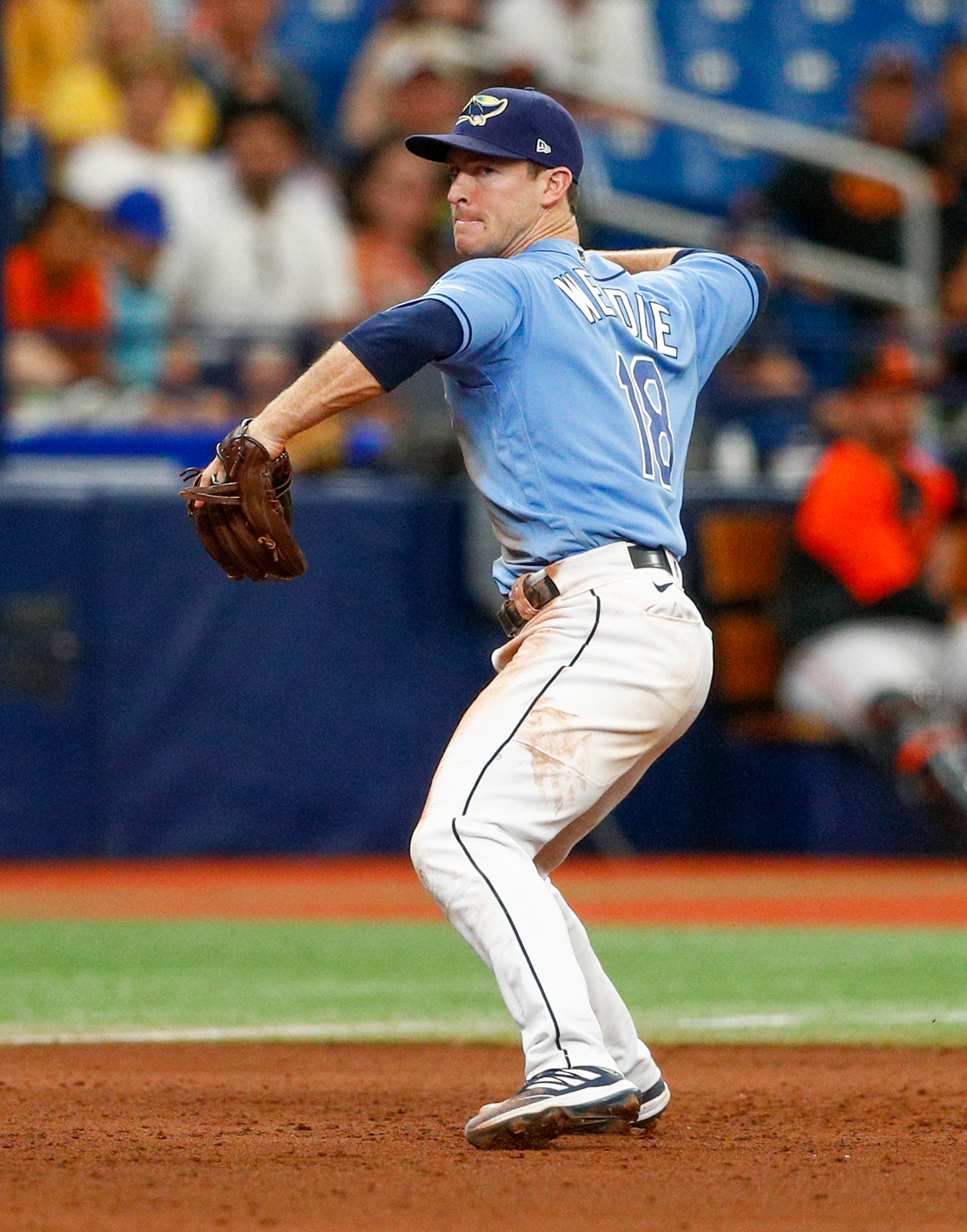
Wendle, 31, gives the Marlins an option at any of second base, shortstop or third base both in 2022 and in 2023, as he’s controlled another two seasons via arbitration. The lefty-swinging Wendle provides quality defense at all three of those positions and will bring a largely contact-driven offensive approach to the plate for Miami. He’s spent the past four seasons with the Rays, hitting at a combined .274/.330/.414 clip — six percent better than the league average, by measure of wRC+ — with 25 home runs, 86 doubles, 14 triples and 40 stolen bases (in 55 tries) through just shy of 1500 plate appearances.
The Marlins, according to SportsGrid’s Craig Mish (Twitter link), plan to utilize Wendle as a super-utility player who’ll bounce between second, short, third and perhaps the outfield or first base. Jazz Chisholm and Miguel Rojas have second base and shortstop largely locked down (respectively), while Brian Anderson has been the team’s primary third baseman in recent years. Anderson, however, has been beset by shoulder troubles and spent considerable time on the injured list. He’s also capable of playing in the outfield corners, so it’s at least feasible he could move to the grass in order to accommodate Wendle at the hot corner at times. The advent of a designated hitter in the National League could also lead to some reps for Anderson (or Wendle) there.
The good news for Miami is that they don’t have to set anything in stone just yet. Adding Wendle unquestionably improves the roster but does so while creating enough agility for general manager Kim Ng and her staff to cast a wide net in their further offseason pursuits. The Marlins are still seeking a center field option but could also pivot to add a corner bat if there’s a chance for an opportunistic strike in left field or at third base.
Wendle’s addition is the latest in an increasingly active offseason for the Marlins, who in the past week have signed Avisail Garcia to a four-year contract, acquired catcher Jacob Stallings from the Pirates, and signed rotation leader Sandy Alcantara to a five-year contract extension with a team option for a sixth season.
On the other side of the deal, Tampa Bay has reportedly been exploring the trade market for Wendle in advance of tonight’s deadline to tender contracts to arbitration-eligible players. Wendle is projected by MLBTR contributor Matt Swartz to earn $4MM in 2022, and the Rays needed to open a spot on the roster to accommodate their recent one-year, $8MM agreement with veteran right-hander Corey Kluber. The Rays are also deep in terms of infield options; Brandon Lowe, Wander Franco, Yandy Diaz and prospects Taylor Walls and Vidal Brujan give them ample cover at second, third and short.
The addition of Misner, who’ll turn 24 in January, is nothing to scoff at from the Rays’ vantage point, either. The No. 35 overall draft pick back in 2019, Misner split the 2021 campaign betweenthe Class-A Advanced and Double-A levels, hitting a combined .253/.355/.433 with a dozen homers, 29 doubles, three triples and 26 steals (in 30 tries).
Scouting reports on Misner tout the lefty hitter’s plus raw power, plus speed and solid defensive tools — which make for a tantalizing package were it not for a substandard hit tool. Misner fanned at a 29.4% clip in 462 of his minor league plate appearances this season, and while he offsets those punchouts (to an extent) with a stout 12.3% walk rate, more advanced pitchers will carry greater potential to expose holes in his swing.
The blend of power, speed and defense makes Misner a relatively high-upside name to add to an already deep stockpile of prospects. Misner ranked 10th among Marlins farmhands at FanGraphs, 15th on Baseball America’s midseason list and 21st on MLB.com’s midseason rankings. The fact that Misner briefly reached Double-A this past season at least opens the door for a potential MLB debut at some point in 2022, though it seems likelier that he’d make an impact in 2023 — assuming he continues to produce in the upper minors.
Craig Mish of SportsGrid and the Miami Herald first reported (via Twitter) that Wendle was headed to Miami. Marc Topkin of the Tampa Bay Times reported that Misner was going back to Tampa Bay in return.
Photo courtesy of Imagn/USA Today Sports.