
Brewers To Promote Cooper Pratt
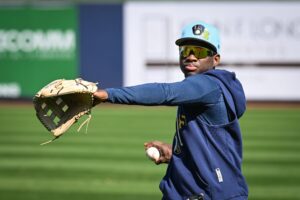
The Brewers are calling shortstop prospect Cooper Pratt up to the major leagues, as confirmed by MLB.com’s Adam McCalvy. There was plenty of “hug watch” social media buzz about Pratt’s possible promotion during Triple-A Nashville’s game today, as teammates were seen congratulating Pratt in the dugout during the sixth inning.
Pratt will be making his Major League debut whenever he appears in a game, which will surely come on Tuesday when the Brewers host the Guardians. Pratt was already added to the 40-man roster when he finalized his eight-year, $50.75MM extension with the Brewers in early April, so only a 26-man roster move will need to made as the corresponding transaction on Tuesday.
The $50.75MM marked the third-largest extension ever guaranteed to a player without any Major League experience, and it came just a few days into Pratt’s first season of Triple-A ball. The Brewers wanted to give Pratt some more minor league seasoning before giving him a look in the majors, and the infielder has delivered an okay but unspectacular slash line of .244/.353/.392 over 258 PA with Nashville.
While the Brewers certainly aren’t going to rush Pratt before they think he’s ready for the Show, the total lack of offense being provided by starting shortstop Joey Ortiz is surely a factor in Milwaukee’s decision. Ortiz is still providing quality defense at short but is hitting only .207/.299/.262 over 170 plate appearances. Regular third baseman Luis Rengifo is posting similar numbers, so the entire left side of the infield has been a glaring weakness for the NL Central leaders.
David Hamilton has been getting an increasing share of the playing time at both third base and shortstop, so the Brewers’ plan could be to have Hamilton, Rengifo, and Ortiz in a timeshare at third base and in a bench role, while giving Pratt an everyday assignment in his first taste of the big leagues. The right-handed hitting Pratt has been a lot more productive against lefties than against righties at Triple-A, so the Brew Crew could also spell Pratt against some tougher right-handed pitching.
The pricey extension put a big spotlight on a player who was viewed as a solid but not necessarily blue-chip prospect heading into 2026. The preseason prospect rankings saw Pratt land 50th on Baseball America’s list, while MLB Pipeline (62nd), ESPN (70th), and The Athletic’s Keith Law (99th) were less bullish on the 21-year-old’s future potential.
Defensively, Pratt is considered to have a good enough glove to stick as a big league shortstop. He has also swiped 79 bags in 88 attempts over his minor league career, so Pratt should fit right into a speedy Brewers team. The question with Pratt is now well his bat can translate against MLB pitching, and his so-so results at Nashville haven’t done much to quiet the doubters.
Milwaukee obviously felt strongly enough about Pratt’s potential to lock him into such a big commitment, even if evaluators felt Pratt was maybe the fourth-best infielder in the Brewers’ farm system. Jesus Made is arguably the top prospect in all of baseball and Luis Pena and Jett Williams are also highly-touted top-100 types, though Pratt is viewed as the most polished defensive shortstop of the group.
Though naturally much can change over the long time, the Brewers might view their infield of the future as Pratt at shortstop, Made and Pena at second or third base in some combination, and Williams in the outfield. This scenario also assumes that Brice Turang will be (like so many established Brewers veterans) traded before he reaches free agency, but that day is a while away since Turang is arbitration-controlled through 2029.
There’s no such thing as having “too many” promising young infielders, of course, and the Brewers’ player development system continues to be the envy of most franchises. Milwaukee has been aggressive in locking up its top prospect to pre-career extensions, between Pratt, Jackson Chourio, and (just a few days ago) outfield prospect Luis Lara.
Brewers Place Coleman Crow On 15-Day IL Due To Flexor Strain
The Brewers placed right-hander Coleman Crow on the 15-day injured list on Friday (retroactive to June 10) due to right forearm flexor strain. Right-hander Craig Yoho was called up from Triple-A Nashville in the corresponding move.
The severity of the strain isn’t yet known, and the lighter variety of such flexor injuries would see Crow return to action in under a month. Beyond that best-case scenario, it isn’t out of the question that Crow’s 2026 season could be in jeopardy, especially given his past history of arm troubles. A Tommy John surgery cost Crow almost all of the 2023-24 seasons, and he was limited to 50 minor league innings in 2025 due to hip problems and another flexor strain.
It seemed like Crow had put his injury woes behind him when the righty made his MLB debut earlier this season. Crow has been called up to the majors three times in his rookie year — twice to make spot starts, and his last three appearances have consisted of two starts and a two-inning relief outing. This appearance out of the pen last Tuesday marked Crow’s last game before his flexor strain surfaced.
Crow has a 5.30 ERA and a tiny 11.8% strikeout rate to show for his 18 2/3 innings in the big leagues. On the plus side, his walk rate is a solid 7.1%, and his ERA was somewhat inflated by a particularly rough outing (six ER over 2 1/3 innings) against the Giants on June 4. While Crow’s time in the majors is a small sample size, the lack of punchouts is unusual considering the righty’s much more respectable 25.39K% over 299 1/3 career minor league frames in the Angels and Brewers farm systems.
Milwaukee has soared to a 42-25 record despite a number of pitching injuries, and Crow’s absence removes another rotation candidate from the mix. Brandon Woodruff (shoulder inflammation) has started a minor league rehab assignment and is expected to be back sometime in June, while Logan Henderson (back strain) is still a few weeks away. Quinn Priester‘s status remains up in the air, as the right-hander again had his rehab assignment put on hold as Priester continues to struggle in his recover from thoracic outlet syndrome.
Jacob Misiorowski‘s brilliance has helped carry the shorthanded Brewers rotation, and Kyle Harrison has also looked great in his first season in Milwaukee. Brandon Sproat has at least contributed 60 innings but with a 5.70 ERA, and Robert Gasser has a 6.38 ERA over 18 1/3 frames as a starter this season. Shane Drohan is slated to make his fourth start of the season today, and the rookie southpaw has looked pretty good in delivering a 3.11 ERA, 24% strikeout rate, and 7.1% walk rate in his first 37 2/3 innings in the big leagues (with 10 bullpen appearances along with his three starts).
The situation should improve itself once Woodruff and Henderson are back, and it could be that Crow’s flexor strain isn’t too serious. The Brewers have a knack for finding and developing rotation help from within, but if depth is still an issue in a month’s time, Milwaukee could consider adding a veteran innings-eater at the trade deadline.
Brewers Pause Quinn Priester’s Rehab Assignment
The Brewers are once again pausing the rehab assignment of Quinn Priester, reports Todd Rosiak of the Milwaukee Journal Sentinel. Priester struggled on Monday in a start in the Arizona Complex League, walking five hitters in 2 2/3 innings while surrendering three earned runs. He also uncorked three wild pitches. Rosiak clarifies that Priester was “without physical complaint,” so the pause isn’t the result of a new injury.
It’s nonetheless another unfortunate note in Priester’s season, which he’s spent on the injured list for neurogenic thoracic outlet syndrome. Priester struggled when he first attempted to rehab at Triple-A and was pulled from that assignment early last month. He resumed pitching on May 16th, but control continues to be an issue. Priester has walked 16 batters in 11 innings across his last five appearances. The last two of those were in the Complex League, where Priester was re-assigned on May 30th.
Brewers manager Pat Murphy reflected on Priester’s rehab after the Monday outing. “It doesn’t bode well to be ready to pitch in the major leagues,” said Murphy. “I think he’s still a ways away, but I think it’s trending in the right direction in that he felt really good, didn’t feel any pain at all.” Murphy added that the team hasn’t considered surgery for Priester and will instead give him more time to recover the feeling in his fingers.
At this point, the timeline for Priester’s return to the Majors is unclear. The Brewers will understandably proceed with caution given the stops and starts in Priester’s rehab. He still needs to get the walks under control, not to mention build up to a full starter’s workload. Per Rosiak, Priester was set to throw five innings and 70-75 pitches in his next appearance after Monday. He maxed out at 3 1/3 innings on June 2nd and is yet to go twice through the batting order in his rehab appearances. At this rate, Priester likely won’t be back until the second half of the season.
Milwaukee’s rotation has fared well overall despite Priester’s absence. The group’s 3.50 ERA is fifth-best in the Majors, and their 27.2% strikeout rate is tops among all clubs (Phillies starters are second at 24.3%). Much of the credit, especially for the strikeouts, goes to Jacob Misiorowski and Kyle Harrison atop the rotation. The back half of the rotation hasn’t fared as well. Brandon Sproat has a 5.70 ERA in 13 appearances (11 starts), while Robert Gasser made one strong start on June 3rd and three mixed to bad ones otherwise. Shane Drohan has allowed five earned runs in 10 1/3 innings across two starts since converting from the bullpen.
Brandon Woodruff and Logan Henderson were both solid before going on the injured list earlier in the season. Woodruff is expected back this month and Henderson in early July, per the team’s injury report at MLB.com. Priester had a 3.32 ERA in 157 1/3 innings last year and can lengthen the rotation once he’s fully healthy. The Brewers have ridden their strong top of the rotation and above-average offense to a 41-25 record thus far, four games ahead of the Cardinals in the NL Central.
Photo courtesy of Benny Sieu, Imagn Images
Brewers Sign Lyon Richardson To Minor League Deal
The Brewers have signed right-hander Lyon Richardson to a minor league deal, according to his transactions tracker at MLB.com. He has been assigned to Triple-A Nashville. He elected free agency last week after being outrighted by the Reds.
Richardson, 26, was a second-round pick of the Reds back in 2018. Cincinnati initially developed him as a starter. He missed the entire 2022 season recovering from Tommy John surgery but the club still valued him highly enough to put him on the 40-man roster in November of that year to keep him out of the Rule 5 draft. He struggled with command in 2023 and 2024, so the Reds moved him to a primary relief role over time.
That hasn’t translated into any major league success yet. Richardson has thrown 56 2/3 innings in the big leagues, allowing 6.67 earned runs per nine. He has shown a bit more potential in the minors. Over 2025 and 2026, he has thrown 62 1/3 Triple-A innings with a 4.48 ERA. His 10.1% walk rate is higher than average but just barely. His 24.7% strikeout rate is a couple of ticks better than par. He has induced grounders on almost half the balls in play he has allowed.
The Reds shuttled Richardson up and down through the 2023 through 2025 seasons, exhausting his three option years. They passed him through waivers unclaimed in the most recent offseason. He was added back to the roster in May of this year as the club was dealing with a number of injuries. He was outrighted again shortly thereafter. Since that was his second outright, he had the right to elect free agency, which led to this deal with the Milwaukee.
For the Brewers, there’s no real risk on a minor league deal. Richardson has an intriguing arsenal. His four-seamer and sinker both average around 96 miles per hour. He complements those two with a slider, curveball and changeup. As a former second-round pick, there’s some pedigree there and the Brewers have a good reputation for helping pitchers become their best selves.
If he eventually gets back to the big leagues, he is out of options but has less than a year of service time, so he could be cheaply controlled for years to come. That will be a secondary concern, as he will first need to earn his way back to the show.
Photo courtesy of Katie Stratman, Imagn Images
Tigers Acquire Jacob Waguespack
The Tigers have acquired right-hander Jacob Waguespack from the Brewers for a player to be named later or cash considerations. Evan Woodbery of MLive Media Group was among those to pass along the news. The righty was just signed to a minor league deal last month and won’t immediately need a roster spot with the Tigers, unless his deal had some sort of opt-out or upward mobility clause.
Waguespack, 32, began the season with the Brewers on a minor league deal. Milwaukee granted him his release in early May. After exploring his opportunities for a little over a week, they re-signed him to a new minor league deal.
He has been having a good year on the whole, though with some important notes. He has tossed 21 2/3 innings over 16 Triple-A appearances, allowing 1.66 earned runs per nine. He has received some help from a .238 batting average on balls in play and 73.2% strand rate. His 16.5% walk rate is very high but he has also punched out 36.3% of batters faced. He has 105 2/3 innings of big league experience with the Blue Jays and Rays, posting a 5.11 ERA in that time. He struck out 18.9% of batters faced and gave out walks at a 10.1% clip.
The Tigers have been working through a huge number of pitching injuries this year, with nine arms currently on the big league injured list. Tarik Skubal, Justin Verlander, Casey Mize and Kenley Jansen are all expected back soon, which could lead to some roster shuffling.
As they sort things out in the coming days and weeks, Waguespack can give them some extra depth without taking up a roster spot, unless his minor league deal had some sort of contract provision that will lead to the Tigers adding him to their 40-man. If that is the case, Waguespack is out of options and will need to be added to the active roster.
Photo courtesy of Mark J. Rebilas, Imagn Images
Brewers Sign Luis Lara To Extension
The Brewers have signed yet another extension with one of their prospects. Milwaukee announced the signing of Triple-A outfielder Luis Lara to a seven-year deal with club options covering the 2033-35 seasons. It’s reportedly a $31MM guarantee that could climb as high as $79MM depending on the option specifics and bonuses. Lara is represented by Octagon.
Lara will remain in Triple-A on optional assignment. The Brewers needed to add him to the 40-man roster to finalize the Major League contract. Left-hander Brian Fitzpatrick has been moved from the 15-day to the 60-day injured list in a corresponding move. The rookie reliever suffered a partial UCL sprain and is going for a second opinion, relays Todd Rosiak of The Milwaukee Journal-Sentinel.
It has become more common in recent years for clubs to commit to their young players before the make it to the majors, or perhaps after just a handful of games in the big leagues. As shown in MLBTR’s Contract Tracker, from 2006 to 2016, there were six extensions signed by players with less than a year of service time. From 2017 to the present, that number is 25, with 15 of them being inked in the past four years.
Milwaukee has played a notable role in that data set, particularly in signing pre-debut deals. In 2023, they gave Jackson Chourio an eight-year, $82MM pact when he was considered one of the top two prospects in the league. That was the record deal for a pre-debut player at the time, though Colt Emerson later broke that record when he signed a $95MM deal with the Mariners. Earlier this year, the Brewers signed another pre-debut deal, though on a lesser scale. They and Cooper Pratt agreed to an eight-year deal worth $50.75MM back in April, though Pratt has remained in the minors on optional assignment since signing that deal.
This deal with Lara comes in at an even lower level. The guarantee is barely a third of what Chourio received and just a bit more than half of Pratt’s deal. Coming in well shy of Chourio is no real surprise. As mentioned, Chourio was one of the top prospects in the league at that time. Lara is a solid prospect but is perhaps more of a borderline top 100 guy right now. Pratt and Lara have some similar prospect rankings but the Pratt deal was seen by some as a bit of an overpay.
Lara, now 21, was an international signee of the Brewers back in 2022. Milwaukee gave him a $1.1MM signing bonus at that time. Lara’s size is notable, as he is listed at 5’7″ or 5’8″, depending on the source. As you would expect for such a player, there’s not a ton of power, but he does have speed. He has 447 minor league games under his belt to this point with just 17 home runs but 144 stolen bases. On account of that speed, his defense also receives high praise, with some evaluators considering him a future Gold Glover.
The offense is more of a question. As mentioned, the power is light, though perhaps Lara is building strength as he ages. He never hit more than four homers in any previous season but is already up to seven in 2026, in just 247 Triple-A plate appearances. The plate discipline appears to be strong, however, as he has often posted strong walk and strikeout rates. This year, his first at the top level of the minors, he has a 15.8% walk rate and 13% strikeout rate. Those are both excellent figures.
Baseball America currently lists Lara as the #5 prospect in the system, a couple of spots behind Pratt. That outlet has Pratt #44 on their Top 100, with Lara in the #50 spot. FanGraphs had Lara #11 in the system back in the winter, before he started putting up good numbers at Triple-A here in 2026. ESPN bumped Lara up to #5 in the system in a recent system update. MLB Pipeline has Lara listed #91 overall and the #5 Brewer.
The Brewers presumably feel good about Lara coming up and being a major league contributor. It seems that Lara’s speed and defense would give him a solid floor even if he doesn’t hit much. If he can maintain his strong approach at the plate and add a bit of power as he gets deeper into his 20s, then that just makes the deal all the more attractive for them.
From Lara’s perspective, he is cutting off the most extreme edges of his earning abilities, as is the case for any prospect signing an early extension. If he hadn’t been able to hit in the majors, he could have ended up in the role of a speedy fourth outfielder, which likely wouldn’t have paid him much. Accepting this deal allows him to bank more money than he would have in that scenario. But if he turns into an All-Star caliber regular, he won’t have as much ability to cash in on that. This deal will lock in his age-21 through age-27 seasons, with the three club options taking him through age-30. He could still theoretically get a nice deal at that point, going into his age-31 season, but could have had more earning power if he managed to hit the open market in his late 20s.
As mentioned, Lara is going to stay in the minors for now. At the major league level, Milwaukee has an outfield group consisting of Chourio, Garrett Mitchell and Sal Frelick, with Christian Yelich, Jake Bauers and Blake Perkins chipping in on occasion. They also have Brandon Lockridge on the injured list, Tyler Black and Akil Baddoo on optional assignment, and Jett Williams in Triple-A in a non-roster capacity.
In the long run, it’s fair to wonder if the Brewers will trade from that group in order to open up playing time. Bauers is an impending free agent but everyone else is under club control for a while. Yelich’s deal is guaranteed through 2028. Chourio is signed through 2031 with two club options. Mitchell can be retained via arbitration through 2028, Frelick and Perkins through 2029.
For now, the Brewers have enviable outfield depth on a club that has few obvious holes. They have a 41-23 record which is second-best in the National League, behind only Atlanta. Though they will undoubtedly be looking to add to the roster ahead of the trade deadline, perhaps they could do so while flipping out an outfielder from their big league roster as they look for more pitching or help on the left side of the infield.
Spencer Michaelis of the Brewers Fanatic Podcast first reported that the sides had agreed to a deal of roughly $30MM over eight years with two club options. Jon Heyman of The New York Post clarified that it’s actually a seven-year deal worth $31MM. Jeff Passan of ESPN confirmed the 7/$31MM framework and noted there are three club options, with a $79MM max. Passan also added that Lara will be staying in the minors for now. Photos courtesy of Dave Kallmann, Imagn Images.
Brewers Re-Sign Jake Woodford To Minor League Deal
The Brewers are re-signing righty Jake Woodford on a minor league contract, reports MLBTR’s Steve Adams. He’ll head to Triple-A Nashville after going unclaimed on waivers and electing free agency yesterday. Woodford, an Excel Sports Management client, can opt out and retest free agency on July 1 or August 4 if the Brewers don’t add him back to the big league roster.
The 29-year-old had previously spent the season in Pat Murphy’s relief group. Woodford is a low-leverage arm who logged 23 1/3 innings across 16 appearances. He allowed just under seven earned runs per nine innings with a bel0w-average 17.9% strikeout rate. Woodford has never missed bats but is willing to attack the strike zone and can cover multiple innings.
It’s the seventh straight season in which Woodford has picked up a decent amount of big league work. His rate metrics have been well below-average for the past few seasons, but he’s been a durable depth arm. Woodford has a 5.25 earned run average in a little under 300 big league innings. He owns a 4.07 mark across parts of seven Triple-A campaigns. Woodford has been a starter for most of his minor league career and could work from the rotation in Nashville.
Jake Woodford Elects Free Agency
The Brewers designated Jake Woodford for assignment on Friday. As of today, he has cleared waivers and rejected an outright assignment in favor of free agency (per Adam McCalvy of MLB.com).
Woodford, 29, signed a minor league contract with the Rays this offseason. The deal included an upward mobility clause, which he triggered before Opening Day, prompting a trade to the Brewers. They added him to their active roster, and he pitched in 16 games for the club, tossing 23 1/3 innings with a 6.94 ERA. Woodford has never been a strikeout arm, which means he needs to generate groundballs and limit hard contact to succeed. He wasn’t doing that for Milwaukee. Indeed, it’s now been several years since the right-hander was a solid swingman for the Cardinals from 2021-22. Over the last four seasons, he’s 3-13 with a 6.83 ERA in 142 1/3 innings pitched.
Despite that, Woodford shouldn’t have much trouble finding another minor league contract. He has seven years of MLB experience with the Cardinals, White Sox, Pirates, Diamondbacks, and Brewers, and he’ll still be under 30 for the rest of the season. His arsenal is deep and diverse, highlighted by a sweeper with good movement and a sinker he consistently throws for strikes. Perhaps there’s another team that wants to tinker with his pitch mix, and even if there isn’t, there’s always someone looking for inexpensive bullpen depth.
Brewers Acquire Joel Kuhnel From Athletics
Today: The Brewers have added Kuhnel to their active roster ahead of tonight’s game against his former team. In a corresponding move, right-hander Craig Yoho was optioned to Triple-A.
June 6: Right-hander Joel Kuhnel is heading to the Brewers for cash considerations. The A’s designated him for assignment on Friday. Both teams have announced the deal. Milwaukee moved Quinn Priester to the 60-day IL to clear a 40-man roster spot for Kuhnel.
The 31-year-old Kuhnel was one of manager Mark Kotsay‘s top options in the ninth inning early in the season. He picked up four saves in his first seven appearances. Kuhnel remained in the high-leverage mix through May, but struggled to close the month, permitting three earned runs over his final two outings.
The final blow came on Thursday against the Cubs. Kuhnel was called upon to preserve a three-run lead in the ninth inning. He gave up four earned runs on five hits while recording just two outs. Righty Luis Medina was unable to put out Kuhnel’s fire, allowing a pair of hits, including a walk-off single to Pete Crow-Armstrong. The disastrous outing raised Kuhnel’s ERA from 2.88 to 4.21.
Kuhnel has pitched for four teams across parts of six big-league seasons. He spent all of 2025 at Triple-A in the Yankees’ and Phillies’ systems. The veteran righty came to the A’s on a minor league deal in December. He didn’t break camp with the team, but reached the majors after just two minor league outings.
Milwaukee is missing several key pieces in the bullpen. Offseason trade acquisition Angel Zerpa was lost to Tommy John surgery. Lefty DL Hall just went down with a pectoral injury. Veterans Jared Koenig and Rob Zastryzny have missed the majority of the season. Kuhnel, being a righty, wouldn’t necessarily alleviate those absences, but he could provide value in a lower-leverage role.
Priester is dealing with symptoms related to thoracic outlet syndrome. He has avoided surgery up to this point. The righty recently had his rehab assignment bumped to Rookie ball after a stretch of poor performances. Priester has 19 walks in 13 1/3 innings across seven minor league outings. Manager Pat Murphy recently said Priester could need another month of rehab.
Photo courtesy of Matt Marton, Imagn Images
Brewers Select Drew Rom
The Brewers selected left-hander Drew Rom ahead of Saturday’s matchup against the Rockies. Fellow lefty Brian Fitzpatrick was placed on the 15-day IL with an elbow injury. Milwaukee had an opening on the 40-man roster, so no corresponding move was needed.
Rom last pitched in the big leagues with the Cardinals in 2023. He struggled to an 8.02 ERA over eight starts. The 26-year-old lefty didn’t pitch in 2024 due to a biceps injury. Additional health issues limited him to seven minor league appearances last season. Rom latched on with the Brewers as a minor league free agent in December.
The results in the minors for Rom have typically been unremarkable, outside of a few solid strikeout seasons. He transitioned to a full-time relief role this year, with excellent returns. Rom has pitched to a 3.04 ERA across 22 appearances with Triple-A Nashville. He has a career-high 33.9% strikeout rate.
Rom’s four-seamer barely cracked 90 mph during his MLB stint with St. Louis. He’s added a couple of ticks with the Sounds, averaging 92.5 mph on the heater. The lefty is also throwing a much harder sweeper. The pitch averaged 79.4 mph in 2023, but it’s been up at 83.1 mph at Triple-A this year.
Fitzpatrick has pitched well in his first taste of the majors. He’s allowed just one earned run across 6 2/3 innings out of Milwaukee’s bullpen. The lefty was optioned in mid-May and had only recently rejoined the big-league squad. Fitzpatrick tossed a perfect inning on Friday against Colorado before going down with the elbow injury.
Photo courtesy of Jayne Kamin-Oncea, Imagn Images