
Rays To Sign Wilson Betemit
The Rays have agreed to sign third baseman Wilson Betemit to a minor league deal, reports Jon Heyman of CBSSports.com (via Twitter). The 32-year-old Dominican missed most of last season with a knee injury.
In his last full MLB campaign, 2012, Betemit posted a .261/.322/.422 triple-slash in 376 plate appearances for the Orioles. The switch-hitter has done most of his damage from the left side of the plate, where he has a career .819 OPS that dwarfs his .636 mark when swinging right-handed. That split was even more pronounced in 2012 (.850 OPS as a lefty and .405 as a righty). Betemit's best season came in 2010 with the Royals, when he slashed .297/.378/.511 in 315 plate appearances for the Royals.
As has been the case for most of his career, Betemit saw most of his action at the hot corner. He has also seen time at first, DH, and even the outfield in recent seasons. Defensive metrics have not looked kindly upon Betemit's glovework in the infield.
Rockies To Re-Sign Manny Corpas
The Rockies have agreed to terms on a minor league deal with right-hander Manny Corpas, tweets Thomas Harding of MLB.com. The 31-year-old reliever gets a Spring Training invite and can opt out of the contract if he is not on the club's Opening Day roster.
Corpas threw 41 2/3 innings last year in his return to Colorado, allowing 4.54 earned runs per nine innings while posting 6.5 K/9 against 3.5 BB/9. He would have been eligible for arbitration, but was removed from the roster at the end of the year. In his first stint with the Rockies, over 2006-10, Corpas was a mainstay in the pen and at times served in a ninth-inning capacity.
Options In MLB Contracts: Primary Option Types
Having already recently examined overall trends in the inclusion of options in contracts, we’ll now take a look at the different types of options. The four most common types of options are: (a) club options, (b) vesting/club options, (c) mutual options, and (d) player options or opt-outs. There are many variations of these approaches that crop up in individual contracts, including player options or voiding rights that vest upon conditions (including trades) as well as variable guarantees.
For looking at aggregated numbers, it makes sense to focus on those contract terms most commonly utilized. (All data refers to the six signing seasons between 2007-08 and 2012-13.) Player options and opt-outs are fairly scarce, highly individualized, and often intermingled with other complicated contract provisions. Accordingly, we’ll leave those for another day. (In the meantime, see here for some recent examples of opt-out clauses.)
Club Options
By far the most common brand of option is the simple club option. The proposition is straightforward: after the last guaranteed year of a contract, the club can elect to keep control over the player for one (or more) seasons. If not, usually the team must pay a lesser buyout sum if it declines the option.
Risks And Benefits
There are several salient features of club options that make them highly beneficial to teams. First, they allow the team to defer the buyout portion of the guaranteed total salary to a later season. Second, they afford the team one or more seasons of control without guaranteeing the player’s salary. And third, unlike retaining rights to tender a contract through arbitration, club option years come with a specified price tag.
On the other side of the ledger, club options can benefit players somewhat, particularly if the buyout makes up a sizeable portion of option price. After all, the effective decision for a team with a club option is whether or not to pay the difference between the option price and the guaranteed buyout. (For example, an $11MM option with a $4MM buyout becomes a $7MM decision for the club.) Hence, if a player’s value falls somewhere between the full value of the option and the value of the option less the buyout, the team may ultimately overpay (on an annual basis, at least) to retain the player.
Likewise, the fact that the team will — at the point an option comes due for decision — have the chance to retain the player on a one-year commitment (or, in the case of multi-year options, retain rights over future seasons) can create incentives in favor of overpaying for a single season. On the other hand, of course, those factors also tend to prevent the player from achieving a new, multi-year deal on the open market.
Recent Usage
We already know from the first part of this series that extensions are more likely to contain option clauses than are free agent deals. It is further apparent, moreover, that the club options obtained through extension tend to come at more favorable prices. Among club options that have matured (i.e., have come up for a yay or nay), and were not otherwise disposed of (such as through a voiding clause or retirement), it appears that free agent club options were significantly less likely to be favorably acted upon than extension club options:


In the case of extensions, a second extension served in several cases to act, in effect, as a favorable exercise of what originated as an option year. (In some cases, the option is formally exercised in the course of reaching an extension; though it can be unclear, I have attempted to categorize such situations as an affirmative exercise rather than putting them in the “extended” category.) Adding those situations to those where the option was exercised outright, we see that it is about 50% more likely (~48% vs. ~30%) that a club option will be exercised if it comes from an extension rather than a contract signed with an open-market player.
This phenomenon is likely a reflection both of the differences in bargaining power and the fact that extended players are often (but certainly not always) at a younger point on the aging curve. Combined, it seems apparent that the option years of extended players are more likely to be good values at the time they come due for decision.
In turn, these observations inform how we assess the value of club options for new contracts. Club options are exercised somewhat less than one third of the time in the case of a free agent. And they are roughly 50-50 propositions when agreed upon via extension.
Click below to read about vesting/club options and mutual options.




Free Agent Contract Trends: 2007-08 To Present
Earlier in the offseason, I broke down the current free agent market spending trends and put them in context with spending over the last several years. As I noted then, the market seemed all but certain to take a huge leap forward in terms of overall spending levels.
Indeed, it has done just that. According to MLBTR's Free Agent Tracker (after removing non-guaranteed deals and the few exercised options or extensions that are reflected), $1.88B has been committed through this year's market. With more spending still to come, the total free agent pot has already expanded by nearly 30 percent over last year.
That is both shocking and unsurprising, given the oft-noted TV money that has flowed into the game. But just how dramatic, really, are the increases? Utilizing ESPN.com's free agent tracker, Dave Cameron of Fangraphs wrote yesterday that free agent deals had jumped from an average annual value of $4.87MM in 2009-10 to a $9.65MM rate in the present signing season. He observed also that multi-year deals were sharply on the rise, with ESPN's figures reflecting that closer to half of free agents were getting more than one year in the last two seasons while that figure had hovered in the 30% range for the previous three years. Ultimately, Cameron wrote, the increase in AAV and years combined to raise the average total commitment in a free agent contract from $7MM in 2009-10 up to $20MM in 2013-14.
With all respect to Cameron, and the useful ESPN data, the information relied upon in that post is incomplete, and the resulting conclusions — while directionally accurate — are somewhat misleading in some respects. MLBTR owner Tim Dierkes asked me last year to compile historical data on free agent signings in support of an effort at developing a projection system, I started from the MLBTR transaction and extension trackers and built it out by mining Cot's on Contracts, Cot's data on non-active players from Baseball Prospectus player cards, and ESPN.com's free agency tracker. I then supplemented those results with internet searches, including undertaking the difficult task of attempting to determine service time at the time that extensions were signed. While there may be some missing pieces, and best estimates were necessary for certain service time markers, I feel fairly confident that this data set provides a sound basis for analysis.
Here are the results of that research, along with the spending tab to date on the present year. It should be noted, of course, that while an unusual number of prominent free agents remain unsigned at present, the total figures will likely drop by the time this offseason is concluded.
First, let's look at the overall figures for all guaranteed, MLB contracts handed out through free agency. (All dollar amounts in this table, and throughout the post, in millions.)
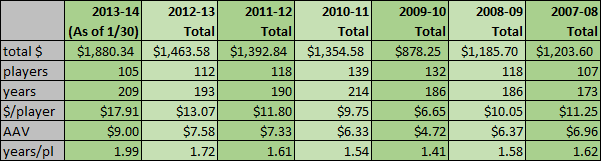
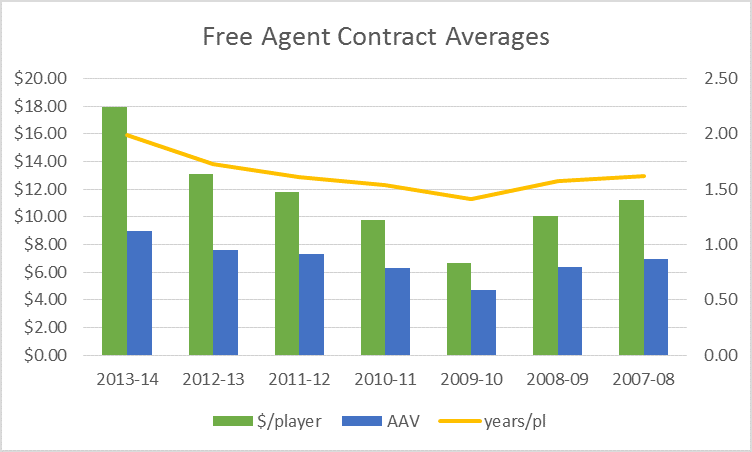
Clearly, though the trend that Cameron notes is still present, it is somewhat less dramatic than it first appeared. As it turns out, the ESPN tracker is missing a good number of deals, most of which are of smaller magnitude.
And, as we can see, the 2009-10 baseline is somewhat misleading. That year was, I believe, largely an outlier in terms of charting market development. There were internal factors at play: the market was headlined by Matt Holliday, John Lackey, Jason Bay, and Chone Figgins. Only Holliday landed a nine-figure deal, and only Lackey and Bay joined him with at least a $50MM guarantee. More importantly, though, the signing period took place in the midst of a massive, global economic downturn. That probably helped flood the player market with supply (notice the high number of players reached the market rather than being tendered arbitration or extended) and created obvious risk for teams in guaranteeing long-term money.
The curve is much less pronounced when using one of the prior years as a starting point. Comparing 2007-08 to 2012-13, we see that the average commitment per free agent contract has gone from $11.25MM to $13.07MM. That figure stands at $17.91MM for the ongoing 2013-14 period, though it will fall somewhat as the rest of a delayed market settles into place.
Moreover, while new local and national TV money is unquestionably having a dramatic impact, the hard-to-capture role of happenstance should not be ignored, either, in assessing the numbers. If, say, Robinson Cano had signed an extension with the Yankees and Masahiro Tanaka not been posted — both of which were certainly possible at various points — all of the roughly $400MM committed to those players would not have stayed on the market. Things might look much different had those two premium players not been available, or if the Yankees had chosen to stay under the luxury tax line.
Also critical to bear in mind is the fact that, as Cameron mentiones in the comments to his piece, many TV deals have only just been negotiated and will not reset again for decades. Those deals have raised the revenue streams of many teams and the league at large, but obviously none will increase annually at anything approaching the 30% free agent spending jump we've seen this year. (The Phillies' new deal, which I took a look at recently, is said to escalate at between 3-4% per year.)
Now, let's isolate things to multi-year deals only. Over the last seven signing seasons, here are how things look for free agent deals that guaranteed more than one year:
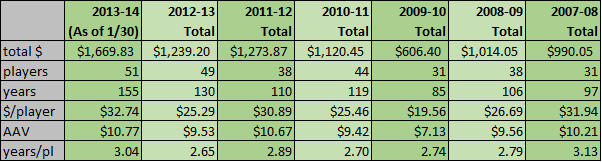
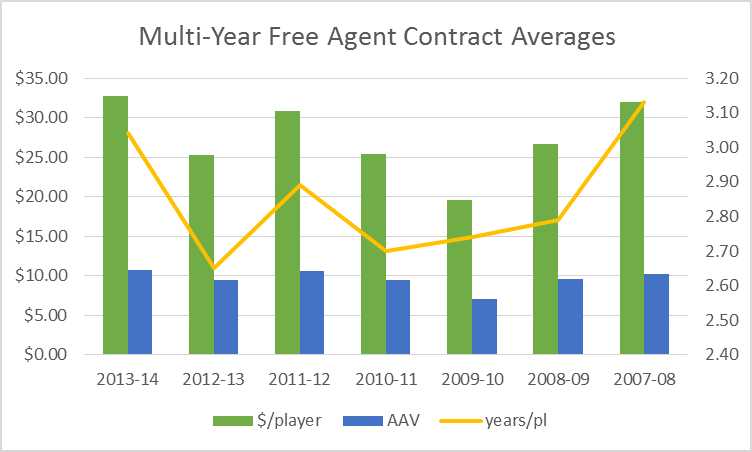
The 2009-10 blip is quite apparent. Again, look at the 2007-08 numbers and compare them across to the present year. The total commitment per player contract, AAV, and average number of years look about equal. When the current signing season ends, I suspect, its multi-year segment will fall below 2007-08 by those metrics.
Of course, that is somewhat misleading in and of itself. After all, with more money being given out than ever before, it must be going somewhere. In fact, as Cameron identifies, the key is in the number of multi-year deals that the market is awarding. Without question, the absolute number of multi-year deals has been sharply on the rise:

While we will have to wait and see where the numbers end up on the present year, it does look like a jump from ~30% to ~50% overstates things somewhat. Between last year and this, my guess is the number will settle in below 45%. Of course, that still represents quite a dramatic increase in the slice of the free agent market that is commanding multiple years.
So, what kinds of deals are the ones driving the growth? I charted out the contract lengths in my dataset to see:
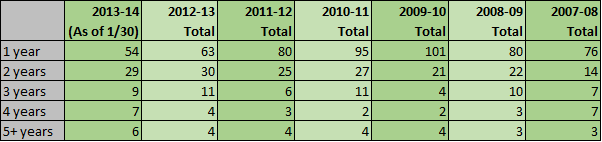
As those numbers suggest, there has been an apparent increase in two particular areas: two-year deals and contracts of four or more years. By percent of all free agent contracts:
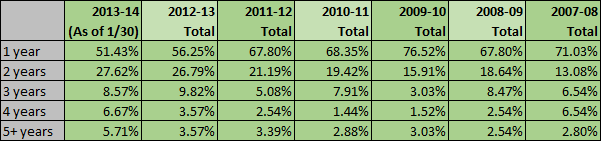
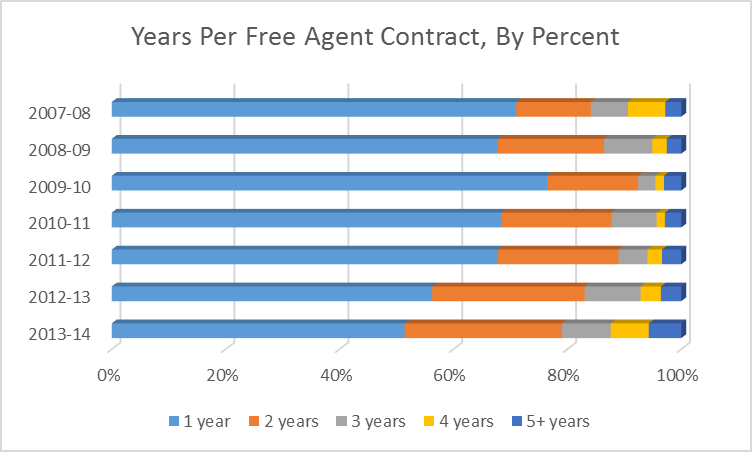
With no additional roster spots, there has been a corresponding drop in the number of one-year pacts. Most likely, strong competition for the best players, combined with increasing financial flexibility, has led to additional years being given all along the spectrum of the market. Interestingly, this shows that financial benefits have trickled down to non-star players, although MLB veterans capable of earning guaranteed money hardly represent the bottom of the baseball world.
The increasing number of two-year deals has held down the average length figures cited earlier. Unmistakably, however, the length of free agent guarantees have risen quite substantially in recent seasons.
Quick Hits: Santana, Jimenez, Dodgers, White Sox
Jim Bowden of ESPN and MLB Network Radio said on MLBN's Inside Pitch show today that the Blue Jays expect to land one of Ervin Santana or Ubaldo Jimenez (Twitter link from MLB Network Radio). While Toronto has yet to make a formal offer to either right-hander, the team has had discussions with each former AL Central hurler's camp. More from around the league…
- Mark Saxon of ESPNLosAngeles.com writes that the Dodgers' lack of infield depth could be troubling when the season gets underway. Of particular concern is Cuban signee Alexander Guerrero, who could struggle with the transition from shortstop to second base. The Dodgers have little in the way of alternatives, with Chone Figgins, Dee Gordon and light-hitting Miguel Rojas as the primary in-house candidates. Saxon also wonders how many games Hanley Ramirez can stay healthy for, and asks if the Dodgers are relying too heavily on Juan Uribe.
- JJ Stankevitz of CSN Chicago looks at the savvy scouting of Joe Siers and Daraka Shaheed of the White Sox — the two scouts who pushed the team to pluck lefty Jose Quintana off the scrap heap following his release from the Yankees organization. General manager Rick Hahn wasn't shy about his praise for Quintana, who he feels has exceeded expectations and become a strong No. 2 starter behind Chris Sale. "He doesn't have to improve in my book," Hahn said. "If he does, fantastic. He certainly has the aptitude and athleticism and now the knowledge of the league that it's not unrealistic to expect the improvement. …if he's this guy for the next several years we'll be very happy."
- The Blue Jays will move waiver claim Brent Morel from third base to second base, Morel told Bruce Levine of 670thescore.com (Twitter link). Toronto claimed the former White Sox top prospect off waivers earlier this year. The move isn't all that surprising given Toronto's lack of depth at the keystone.
- Bowden writes (Insider subscription required) that Athletics GM Billy Beane and Rays GM Andrew Friedman are the GM stars of the offseason. While Yankees GM Brian Cashman spent the most money, and Rangers GM Jon Daniels made the second-most noise with acquisitions of Prince Fielder and Shin-Soo Choo, Bowden feels that the two small-market GMs shined above all others. In particular, he praises Beane's stockpiling of elite bullpen arms and Friedman's decision to resist the pressure to deal David Price.
Mets Owners Refinancing $250MM Loan
Mets owners Fred Wilpon and Saul Katz are close to refinancing the team's $250MM loan, according to Josh Kosman of the New York Post. Kosman writes that Wilpon and Katz were facing a "perhaps insurmountable" spring principal payment on the loan, but the refinancing of the deal could provide the Mets with significant breathing room to help the team increase payroll in future seasons. There will be no payroll limitations written into the reworked loan, as there were in the previous agreement, Kosman reports.
Wilpon and Katz will not be asked for any cash paydown on the seven-year refinancing, and interest payments are said by Kosman's sources to be staying roughly the same. Mets sources told Kosman that the team's payroll will increase slowly in the coming years, but a return to the peak levels of $140MM isn't likely. The refinancing is likely to close in February or March.
As Kosman writes, this is perhaps the best possible outcome for current ownership but is likely not the news that Mets fans hoping for new ownership (and a subsequent payroll increase) have been waiting to hear.
Despite the previous spending limitations resulting from the old loan, GM Sandy Alderson was able to be fairly aggressive on the open market this season, signing Curtis Granderson ($60MM), Bartolo Colon ($20MM) and Chris Young ($7.25MM) as free agents. Alderson could have increased financial freedom next offseason, but it's also worth noting that the club already has $54MM committed to Granderson, Colon, David Wright and Jonathon Niese in 2015. The Mets will also potentially face arbitration raises for Daniel Murphy, Ike Davis, Lucas Duda, Bobby Parnell, Dillon Gee, Eric Young, Ruben Tejada and Scott Rice. Of course, some of those players could be traded or non-tendered between now and next offseason.
Relief Notes: Perez, Sipp, Mets, Tigers
In the midst of a lack of rumors surrounding lefty Oliver Perez, Fangraphs' Mike Petriello outlines the 32-year-old as a potential bargain. While Perez's career once looked to be over, he's reinvented himself as a bullpen arm. Petriello points out that Perez's contact rate over the last two seasons is within one percent of Max Scherzer and Glen Perkins. Perez's swinging-strike rate is better than that of Clayton Kershaw or Michael Wacha and on par with Joe Nathan, and he pounds the strike zone at nearly the same rate as Hisashi Iwakuma. Petriello is quick to point out that these positive indicators don't guarantee success from Perez, but with Boone Logan and J.P. Howell signing lucrative multiyear deals, Perez could be a value add late in the offseason. Other relief market notes…
- Chris Cotillo of MLB Daily Dish reports (via Twitter) that left-hander Tony Sipp is moving closer to a deal with an unidentified team. The 30-year-old Sipp posted a 4.78 ERA with 10.0 K/9 and 5.3 BB/9 in 37 2/3 innings for the Diamondbacks in 2013 but elected free agency after Arizona designated him for assignment earlier in the offseason.
- The Mets are still looking to add a reliever, tweets Adam Rubin of ESPNNewYork.com. New York is likely looking at someone on a low-base salary deal, but with multiple irons still in the fire, nothing is expected in the next couple of days.
- George Sipple of the Detroit Free Press writes that if former top prospect Casey Crosby again makes it to the Majors with the Tigers, it will most likely be as a reliever and not a starter. "I think he’ll adapt to pitching out of the bullpen," Pithching coach Jeff Jones told Sipple. "I think he’ll do fine with that. A lot of times, you take guys who started all their lives and you put them in the bullpen and they just flourish."
Latest On Nelson Cruz
Just yesterday, the reports indicated that the Mariners were "back in business" in their pursuits of Nelson Cruz and Fernando Rodney, and their pursuit of Cruz appears to be picking up. MLB Network Radio's Jim Bowden said on the air today that the Mariners could make an offer to Cruz as early as today (Twitter link from MLBN Radio).
Bowden also tweeted earlier today (prior to the above report) that the market for Cruz currently consists of the Mariners, Orioles and Rangers, with Texas only serving as a fallback option for Cruz should his market completely crash. Seattle is "clearly the best fit" for Cruz in Bowden's mind, he added.
Reports on the Mariners' ability to spend (or lack thereof) have gone back and forth since the team's blockbuster signing of Robinson Cano earlier this offseason. GM Jack Zduriencik quickly followed that mega-deal up by signing Corey Hart and swinging a trade for Logan Morrison, but since that time all has been quiet for the Mariners in terms of significant additions. Cruz is the most powerful bat left on the market, which would make him a welcome addition to a Mariners lineup that is in need of some thump even after the Cano deal.
Cruz would add another corner/DH bat to a mix that already includes Hart, Morrison and Justin Smoak, and his questionable defensive reputation would be magnified by the fact that other corner outfield options (such as Hart and Morrison) aren't considered strong defenders either. Mariners right fielders combined to bat just .239/.290/.400 in 2013, however, so Cruz's bat would be a clear upgrade.
As for the Orioles, they lack an obvious answer in left field and could also upgrade at designated hitter, though they recently signed Delmon Young to a minor league deal and could be looking at him as a potential platoon partner for David Lough in left field. From an offensive standpoint, however, Cruz would likely be an upgrade over that platoon or Baltimore's in-house candidates at designated hitter.
Rangers Nearing Deal With Daniel Bard
The Rangers are closing in on a minor league deal with right-hander Daniel Bard, reports Jeff Wilson of the Fort Worth Star-Telegram (via Twitter).
The 28-year-old Bard was once a dominant setup man for the Red Sox, but following an outstanding run from 2009-11, Boston tried to move him back to the rotation, which triggered a series of problems for Bard. For one, he seemingly lost all semblance of control, as he's walked 45 batters over his past 60 1/3 Major League innings. He hasn't fared any better in the minors, as he's issued 56 walks in his past 47 1/3 minor league frames.
Bard has also been troubled by injuries. He underwent thoracic outlet syndrome surgery earlier this month, according to Wilson. He also missed time at Triple-A with a strained abdomen last season.
This post was originally published on Jan. 31.
Michael Young To Retire
Seven-time All-Star Michael Young will retire rather than sign with a new team this offseason, reports Ken Rosenthal of FOX Sports (on Twitter). The 37-year-old Young had three "good offers," according to Rosenthal, including one from the Dodgers — the last team he played for in his Major League career. Ultimately, Young chose to spend time with his family rather than pursue a 15th Major League season.
Young split the 2013 season between the Phillies and Dodgers after being sent to Philadelphia by the Rangers in an offseason trade last year. That marked the only season of his illustrious career in which he did not don a Texas Rangers uniform. Though his production waned in his final two big league seasons, Young still posted a .249/.335/.395 batting line in 2013, which was slightly above average, as evidenced by his 102 OPS+ and 102 wRC+.
Young will retire with a career batting average of exactly .300 to go along with a .346 on-base percentage and .441 slugging percentage. He mashed 185 homers in his career, scored 1137 runs, drove in 1030 runs and swiped 90 bags in 120 tries. He has more than 3800 career innings at shortstop, second base and third base and also added 884 innings at first base as well. In addition to his versatility, Young brought nearly unparalleled durability to the table. From 2002-13, Young averaged 155 games per season, and though he missed nearly 30 games in 2009, he never landed on the disabled list.
The Rangers got their hands on Young in one of the more lopsided trades of the past 15 years, as they sent Esteban Loaiza to the Blue Jays to land him in a three-player deal. Loaiza went on to post a 4.96 ERA for Toronto over the next two-and-a-half seasons, while Young became a fixture in the Rangers lineup for more than a decade.
In addition to his seven All-Star selections, Young garnered American League MVP votes in five seasons, finishing as high as eighth on two different occasions. Young earned just under $91MM over the course of his career, according to Baseball-Reference. MLBTR wishes him the best of luck and happiness in his post-baseball life.