
Nationals Sign Shinnosuke Ogasawara
The Nationals announced the signing of left-hander Shinnosuke Ogasawara to a two-year deal on Friday. The WME Baseball client is reportedly guaranteed $3.5MM. He’ll make $1.5MM this year and $2MM in 2026. The Nationals will pay a $700K posting fee to his former team, the Chunichi Dragons of Japan’s Nippon Professional Baseball. It’s a $4.2MM investment altogether. Fellow lefty Joe La Sorsa was designated for assignment in a corresponding move.
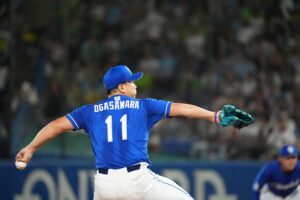 Ogasawara, 27, pitched in part of nine seasons for Dragons. He threw 951 1/3 innings, allowing 3.62 earned runs per nine. He struck out 18.9% of batters faced while giving out walks at a 7.7% clip.
Despite fairly decent run prevention, there are also some concerning elements in Ogasawara’s profile. His strikeout rate in Japan is a bit below what is expected of hurlers in North America these days, as the league average has been in the 22-23% range in recent seasons. He’s also a bit undersized, listed at 5’11” and 183 pounds. That size isn’t necessarily a disqualification, as it actually makes him larger than Shota Imanaga, who is 5’10” and 175. Imanaga proved himself capable of handling MLB hitters in 2024 but he also had a 25% strikeout rate in his NPB career before crossing, notably higher than Ogasawara.
It’s also a metric that has wavered for Ogasawara. He got his rate of punchouts as high as 24% in 2022, but then it dropped to 20.1% the year after and then fell way down to 13.6% in the most recent season. That big drop in strikeouts did coincide with a tiny walk rate of 3.7% and he still managed to post a 3.12 ERA, but it does lead to questions as to how his stuff will play in his new environment. He throws a fastball in the 91-93 mile-per-hour range, as well as featuring a curveball and a changeup.
Despite the question marks, it’s a sensible gamble for the Nats to take. The club has been rebuilding for a while, having recently wrapped up their fifth straight losing season. There was some speculation that they might come into this offseason looking to take a step forward, perhaps making a bold strike or two, but that hasn’t really come to pass.
They did make some moves, but mostly avoided committing themselves to anything beyond 2026. They signed Josh Bell, Michael Soroka, Amed Rosario and Jorge López to one-year deals. They brought back Trevor Williams on a two-year pact. Nathaniel Lowe, who has two seasons of club control remaining, was acquired from the Rangers.
Bringing in Ogasawara on a two-year pact aligns with those other moves. The club has seemingly taken the path of making some decent additions while also waiting to see how young players like Dylan Crews, James Wood and Brady House develop. Once they get more clarity on those players and others, they can decide about more assertive moves in the future.
The same is largely true of their rotation. Young and controllable pitchers like MacKenzie Gore, Jake Irvin, Mitchell Parker, DJ Herz and Cade Cavalli have shown some progress to varying degrees but there are still some question marks there. Irvin and Parker have posted decent run prevention numbers but with subpar strikeout rates. Herz had a nice MLB debut in 2024 but had massive walk problems in the minors. Cavalli missed the past two seasons due to Tommy John surgery.
The Nats would probably like a bit more time to continue evaluating those guys to see who among them can emerge as real rotation building blocks. They could have rolled into the season with a rotation of Gore, Irvin, Parker, Herz and Cavalli but clearly wanted to add some more options and improve the overall depth. As mentioned, they signed Soroka and Williams, with Ogasawara now added into the mix as well.
Those three and Gore should have four rotation spots accounted for, at least to start the season. Both Soroka and Williams have some relief experience and could get pushed to the bullpen if they struggle or one of the younger guys pushes them out. Each of Irvin, Parker, Herz and Cavalli have options and could get pushed to Triple-A. The Nats could perhaps consider a six-man rotation, though doing so would limit them to a seven-man bullpen. Josiah Gray could get back in the mix late in 2025 but is currently rehabbing from a Tommy John and internal brace surgery which was performed in July.
Perhaps the bolstered roster will push the Nats into a greater chance of contention, but they are also looking up at three really strong teams in the division. Atlanta and Philadelphia have been powerhouses for years while the Mets just made the playoffs and have been very aggressive, including adding Juan Soto. If the Nats find themselves outside the playoff mix come July, any of the players they’ve added could become trade candidates, on account of their short windows of club control.
The Dragons posted Ogasawara on December 10, which led to a 45-day posting window that ended today. If he had not signed, he would have returned to the Dragons but he’ll be coming to Washington instead. Unlike Roki Sasaki, Ogasawara is not subject to the international bonus pool system. That’s because he is over 25 years old and has at least six professional seasons on his track record. MLBTR predicted him for a two-year, $12MM deal at the start of the offseason.
The Nats owe the Dragons a posting fee, with the size of that fee dependent on the size of the contract. That fee will be equal to 20% of the contract’s first $25MM, 17.5% of the next $25MM and 15% of any dollars thereafter. Since Ogasawara signed for less than $25MM, it’s simply 20% of the guarantee.
La Sorsa, 27 in April, has been a fringe member of the Washington roster for a while. He was claimed off waivers from the Rays in June of 2023 but was outrighted off the roster in December of that year. He got his roster spot back in August of 2024 but has now been bumped off again.
Between the Rays and the Nats, he has 50 1/3 innings in the big leagues with a 4.47 ERA, 19.2% strikeout rate and 6.4% walk rate. He had a strong showing in the minors in 2022, throwing 73 1/3 innings with a 2.33 ERA, 31.4% strikeout rate and 3.6% walk rate. However, he’s been a bit less impressive over the past two seasons, having thrown 92 2/3 innings with a 2.82 ERA, 18% strikeout rate and 6.2% walk rate. A .268 batting average on balls in play and 82.3% strand rate helped him out in that time, which is why his 4.62 FIP was almost two runs higher than his ERA.
He’ll now head to DFA limbo for a week at most. The Nats could explore trades for the next five days but would have to put him on waivers after that, since the waiver process takes 48 hours. If he were to pass through unclaimed, he would have the right to elect free agency on account of his previous outright.
The Associated Press reported the terms of Ogasawara’s deal.
White Sox Trade Ron Marinaccio To Padres
The Padres have acquired right-handed reliever Ron Marinaccio from the White Sox in exchange for cash, per announcements from both clubs. Chicago designated Marinaccio for assignment earlier in the week. San Diego’s 40-man roster is now up to 35 players.
Marinaccio, 29, has appeared in each of the past three big league seasons, with all his MLB time coming as a member of the Yankees. He’s posted a sub-4.00 ERA in all three of those individual seasons, working to a composite 3.22 mark with a strong 28.2% strikeout rate but an ugly 12.6% walk rate. Marinaccio averaged 93.6 mph on his heater this past season and paired that offering with a changeup and slider, both of which reside in the low 80s.
The ChiSox claimed Marinaccio off waivers from the Yankees on Sept. 23. He didn’t make it into a game for the South Siders, but given the general state of disarray within their roster, he seemed like he’d have a chance to factor into the 2025 bullpen mix. General manager Chris Getz ultimately felt differently, as Marinaccio was bumped from the 40-man roster this week to open space for veteran innings eater Martin Perez.
Marinaccio’s track record in Triple-A is generally supportive of his output in the big leagues, making it something of a surprise that the White Sox moved on for next to no return. He’s pitched in parts of four seasons there and logged a 3.35 ERA in 91 1/3 innings, fanning 29.9% of his opponents against an 11.3% walk rate along the way. Marinaccio still has one minor league option year remaining, and he’s controllable through the 2028 season as things currently stand (though future optional assignments could change that calculus). He won’t be eligible for arbitration until next offseason at the earliest.
Red Sox, Mark Kolozsvary Agree To Minor League Deal
The Red Sox and catcher Mark Kolozsvary have agreed to a minor league contract with an invitation to major league spring training, reports Kiley McDaniel of ESPN. It’ll be his second straight season with the Red Sox organization, as he was with the club’s Triple-A affiliate in Worcester in 2024.
Kolozsvary, 29, has technically appeared in two big league seasons, though he played in only one game for the 2023 Orioles and didn’t log a plate appearance. He tallied 10 games with the 2022 Reds and came to the plate 21 times, going 4-for-20 with a homer and two doubles (.200/.238/.450).
In parts of four Triple-A seasons, Kolozsvary owns just a .176/.297/.312 batting line. He’s yet to provide much in the way of offense in his big league career, but Kolozsvary is regarded as a strong defender with quality minor league marks for framing, blocking balls in the dirt and controlling the running game. He’s thrown out 29% of runners who’ve attempted to steal against him in his minor league career.
Kolozsvary is the latest depth addition for a Red Sox club that doesn’t have much certainty behind starting catcher Connor Wong. Trade acquisitions Carlos Narvaez and Blake Sabol are both on the 40-man roster, but neither has established himself in the majors yet. Narvaez has just six big league games to his credit. Sabol is a .243/.313/.392 hitter (95 wRC+) in 382 MLB plate appearances with the Giants but has fanned in one-third of his trips to the plate and struggled defensively at catcher. Boston also brought in veteran Seby Zavala as a non-roster invitee, giving them another strong defender with a shaky track record at the plate.
Dodgers Sign Tanner Scott
Jan. 24: Scott’s deal also contains a conditional club option for the 2029 season, Fabian Ardaya of The Athletic reports. That option, valued at $5MM plus incentives, would only be available if Scott suffers a “qualifying injury” and is not traded throughout the four-year term of his contract.
In essence, it’s likely a safety net for the Dodgers (and only the Dodgers) in the event of a major injury. Specifics regarding this option aren’t yet clear, though prior instances of conditional options such as this one typically revolve around UCL injuries. Scott does not have a no-trade clause, but he’d receive a $3MM assignment bonus if traded to another team, Ardaya adds.
Jan. 23: The Dodgers’ spending blitz formally continued Thursday, as they announced the signing of left-hander Tanner Scott to a four-year, $72MM deal. Scott, a client of the MVP Sports Group, reportedly receives a $20MM signing bonus on the contract, which contains $21MM of deferred money.
Scott was ranked as the #14 free agent in this winter’s class in MLBTR’s annual Top 50 MLB Free Agents list, where we predicted that the lefty would land a four-year, $56MM deal. His deal with L.A. comes in well above that mark, but that’s not necessarily surprising given reports earlier this month that indicated Scott could land a deal with an average annual value in the $20MM range. Ultimately, this deal doesn’t go quite that far, though his $18MM AAV is still quite the premium for his position. According to MLBTR’s Contract Tracker, Scott is tied for the third-highest AAV for a reliever in free agent history alongside Liam Hendriks‘s deal with the White Sox with the pair trailing only Edwin Diaz and Josh Hader. Meanwhile, it’s the fifth-highest total guarantee a reliever has ever landed in free agency behind only Diaz, Hader, Aroldis Chapman, and Kenley Jansen.
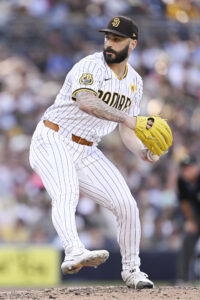 The $21MM in deferred money in the deal could lower the contract’s net present value below this tier of elite closer, but it’s hard to deny that Scott belongs in that elite company based on his incredible numbers the past two seasons. He was among the very best relievers in the sport last year with a 1.75 ERA, 2.92 FIP, and a 28.6% strikeout rate. His peripheral numbers were even stronger in 2023, as he struck out an eye-popping 33.9% of opponents and posted a 2.31 ERA with a 2.17 FIP. Among qualified relievers over the past two seasons, Scott ranks fourth in ERA and fifth in FIP. Only Félix Bautista of the Orioles and Cade Smith of the Guardians rank above Scott in both categories, and neither pitched in both the 2023 and ’24 seasons at the big league level.
Of course, that doesn’t mean Scott is necessarily completely infallible. The southpaw struggled badly with his command earlier in his career, and those issues were a key factor in the lefty surrendering a pedestrian 4.61 ERA and 3.91 FIP over his first six seasons in the majors. That’s left Scott without the lengthy track record of many of his peers in late-inning relief, and even this past season saw Scott walk 12.2% of his opponents. Scott managed to stay elite despite that hefty number of free passes by keeping the ball in the park the past two seasons, and the changes he’s made to improve his batted ball outcomes appear to be sustainable. Opponents barreled up 5.4% of their batted balls off Scott prior to the 2023 season, but the past two campaigns have seen that number drop to just 4.0%. Likewise, Scott’s Hard-Hit rate dropped from 36.2% in his career prior to 2023 down to just 26.7% over the past two seasons.
The Dodgers are clearly betting on his performance to remain as elite as it has been the past two seasons. L.A. got an up-close look at Scott’s dominance during last season’s NLDS, when he pitched three scoreless innings against the club for the Padres and garnered five strikeouts- four of which were against Shohei Ohtani. Looking ahead to the 2025 season, they’ll add Scott’s high-octane arm to an already strong bullpen that also features Michael Kopech, Evan Phillips, Blake Treinen, and Alex Vesia in the late innings. With Scott presumably taking over as the club’s closer, the Dodgers will now have the flexibility to use those leverage arms earlier in the game. That’s particularly useful in the case of Vesia, as he was the Dodgers’ only late-inning relief option from the left side last season.
Per RosterResource, the signing of Scott has pushed the Dodgers’ payroll for 2025 up to just under $369MM, with a nearly matching luxury tax payroll of just under $371MM. Those figures don’t factor in the deferred money in Scott’s contract, but that still puts the Dodgers’ payroll for 2025 more than $40MM higher than 2024, which was already a franchise record. They’re the only team spending even $300MM in payroll this year, and one of just three teams (alongside the Phillies and Yankees) with a luxury tax payroll above that marker. The upper limit on the club’s payroll capacity is unknown, but signing Scott (and Roki Sasaki last week) appear to have checked the final boxes the Dodgers were known to be pursuing upgrades for this winter. While further upgrades to the roster certainly can’t be ruled out, the club’s roster has very little uncertainty and it would hardly be a surprise if the Dodgers mostly stood pat over the final weeks before Spring Training beyond perhaps a long-anticipated deal to bring franchise stalwart Clayton Kershaw back into the fold.
With Scott off the market, right-handers Carlos Estévez and Kirby Yates are perhaps the two best options still available in free agency for clubs on the hunt for bullpen help. Jansen, David Robertson, Kyle Finnegan, and Tommy Kahnle are among the other late-inning relief arms available. The Red Sox, Braves, and Cubs were among the other teams that have been connected to Scott throughout the winter, while the Rangers and Diamondbacks are among other clubs known to be in the market for late-inning relief help at this point in the offseason.
Mark Feinsand of MLB.com first reported the agreement and the terms. Fabian Ardaya of The Athletic and Robert Murray of FanSided added details about the signing bonus and deferrals.
Photo courtesy of USA Today Sports Images
Angels, J.D. Davis Agree To Minor League Deal
The Angels and infielder J.D. Davis are in agreement on a minor league contract, reports Robert Murray of FanSided. The ALIGND Sports client will be in big league camp with the Halos as a non-roster invitee this spring.
Davis, 32 in April, scuffled through his worst season since establishing himself as a big leaguer in 2024. In 46 games and 157 plate appearances between the A’s and Yankees, he hit just .218/.293/.338 — a notable drop-off for a player who from 2019-23 slashed .268/.352/.443 between the Mets and Giants. Davis actually cut his strikeout rate to 24.8% — three points lower than in 2023 and nearly nine percentage points shy of his 2022 mark — but his walk rate fell below average and his batted-ball profile eroded. From ’19-’23, Davis averaged 91.2 mph off the bat and hit 47.1% of his batted balls at least 95 mph; in 2024, he averaged 89.1 mph off the bat and had a 43.7% hard-hit rate.
Davis has played both infield corners and left field in his career, though the majority of his time has come at the hot corner. He hasn’t graded well there or in left field but has more passable defensive marks in 465 innings at first base. With the Angels, he’ll compete for a bench job and provide some depth behind oft-injured third baseman Anthony Rendon and young first baseman Nolan Schanuel.
The Halos’ bench is mostly full right now, with backup catcher Travis d’Arnaud, utilityman Kevin Newman and fourth outfielder Mickey Moniak all seemingly locked into spots. Infielder/outfielder Scott Kingery and non-roster invitee Tim Anderson could vie for that final spot alongside Davis and others. Kingery is on the 40-man roster but has minor league options remaining. None of d’Arnaud, Newman or Moniak can be optioned.
An exact timeline on shortstop Zach Neto, who underwent shoulder surgery following the season, isn’t yet known. However, there’s a chance he could start the season on the injured list. That’d give Davis and other non-roster players in camp a better chance at winning a spot. If Neto indeed opens the year on the injured list, one of Newman or Anderson would presumably get the nod at shortstop to begin the season.
Braves Sign Jurickson Profar
The Braves announced that they have signed free agent outfielder Jurickson Profar to a three-year, $42MM deal. The MVP Sports Group client will make $12MM this year and then $15MM in each of the next two seasons. Atlanta designated right-hander Connor Gillispie in a corresponding move.
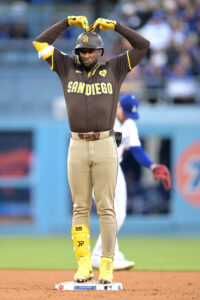
Profar, 32, has been wildly inconsistent in his career but is coming off his best season. Once a top prospect with the Rangers, he made it to the majors as a 19-year-old but struggled in his first few seasons. He eventually showed some promise but frustratingly alternated between good and bad seasons.
He had one of those down seasons in 2023, which is why the Padres were able to sign him last offseason for just $1MM, barely above the league minimum. The Padres probably couldn’t have dreamed about the return on investment they would eventually get from that.
Profar got into 158 games and stepped to the plate 668 times. His 15.1% strikeout rate and 11.4% walk rate were both strong numbers but fairly normal for him. He managed to do more damage when he connected, without sacrificing any of his trademark plate discipline. His 24 home runs were a career high. The three numbers in his .280/.380/.459 slash line were all personal bests as well, apart from a .471 slugging percentage in his nine-game debut back in 2012. His 139 wRC+ easily eclipsed his previous personal high of 113 and was also put him in the top 15 among qualified hitters last year. The switch-hitter did that damage from both sides of the plate, with a 137 wRC+ as a lefty and 147 as a righty.
Given his capricious production over the years, it would be fair to be a bit skeptical that he could keep that kind of performance going. However, there are some encouraging numbers under the hood. Profar’s 44.8% hard hit hate rate, 91.1 mile-per-hour average exit velocity and 7.2% barrel rate were all significantly better than anything he had done before. His .302 batting average on balls in play was a career high but just a bit above the .291 league average.
Though Profar has played all over the diamond in his career, he’s mostly a left fielder now. He’s barely played the other outfield slots in his career. He hasn’t really been an infield regular since 2019. He logged just 18 innings at first base last year, the only place he played apart from left field during the campaign.
Profar’s work in left hasn’t been especially well regarded. Last year, he was given a grade of -8 from Defensive Runs Saved and -6 from Outs Above Average. Despite that, thanks to his huge offense and ten stolen bases, FanGraphs considered him to be worth 4.3 wins above replacement on the season.
That production was huge for the Padres, given that they had notable financial restraints, which is why they took that $1MM flier on Profar. They surely would have welcomed him back, given the longstanding ties between Profar and president of baseball operations A.J. Preller. However, their financial situation is perhaps even more grim now than it was a year ago. They reportedly need to make significant cuts to the budget while also looking for solutions on the roster. In addition to Profar’s absence in left, they have question marks behind the plate, in the rotation and at shortstop.
Profar has also expressed a fondness for San Diego and probably wanted to go back, but he also probably recognized that this is probably his best chance at a free agent payday. He had previously signed a three-year, $21MM deal with the Padres going into 2021 but opted out of that pact after two years. He settled for modest one-year deals in the past two offseasons but has now secured himself a strong three-year deal. MLBTR predicted a three-year, $45MM deal for him at the start of the offseason.
For Atlanta, outfield has stood out as a clear area for improvement this winter. Ronald Acuña Jr. suffered a torn ACL in his left knee last year and missed the second half of the season. He’ll be back in right field at some point in 2025 but probably not on Opening Day. Players like Ramón Laureano and Jorge Soler were used to cover for Acuña’s absence but jettisoned after the season. Soler was flipped to the Angels while Laureano was non-tendered. The club’s acquisition of Jarred Kelenic last offseason also didn’t go especially well. He struck out 29.6% of the time and hit .231/.286/.393 for a wRC+ of 86.
Time will tell how the club plans to play it once everyone is healthy. Michael Harris II will be in center but Atlanta has its designated hitter spot committed to Marcell Ozuna. Profar and Kelenic can flank Harris for now but Acuña will eventually be back. The lefty-swinging Kelenic has better numbers against righties but the club presumably isn’t giving the Profar $42MM to be a short-side platoon guy.
Perhaps Kelenic will eventually get pushed into a fourth outfielder role once Acuña is back, though he may have a bit of time to prove himself worthy of more. Ozuna is an impending free agent, so perhaps the foursome of Harris, Acuña, Profar and Kelenic can better co-exist in 2026 and beyond. Kelenic does have an option remaining, so some time in the minors is possible as well.
With Profar now in the fold, RosterResource calculates Atlanta’s payroll at $212MM and their competitive balance tax number at $230MM. The latter is $11MM shy of this year’s base threshold. They opened last year at $223MM, per Cot’s Baseball Contracts.
President of baseball operations Alex Anthopoulos has previously said that he expects payroll to rise and that the club is willing to pay the tax again this year. However, most of his moves have been focused on adding financial breathing room. As mentioned, Soler was flipped in a salary dump and Laureano was cut. Travis d’Arnaud had his club option turned down. The club restructured the contracts of Aaron Bummer and Reynaldo López to kick some money down the road.
If there is still some powder dry, then perhaps Atlanta will pivot to adding some pitching in the coming weeks. They were connected to Nathan Eovaldi earlier in the winter and reportedly had an agreement in place with Jeff Hoffman, with Hoffman to be stretched out as a starter, before they grew concerned by something they saw in his shoulder during his physical. They were also connected to reliever Tanner Scott earlier in the winter. All those guys have signed elsewhere but the interest indicates Atlanta is looking to add to the staff.
For clubs still looking for outfield help, the market is essentially out of everyday players now. Juan Soto, Teoscar Hernández, Anthony Santander, Tyler O’Neill and Profar are now all off the board. The best remaining outfielders are role players like Harrison Bader, Randal Grichuk and Alex Verdugo. Clubs like the Royals, Astros and Blue Jays have been connected to Profar this winter, though the Jays signed Santander earlier this week.
Gillispie, 27, just signed a non-guaranteed contract with Atlanta in November. He made his major league debut with Cleveland last year but only logged eight innings and was non-tendered at season’s end. In his minor league career, he has thrown 426 1/3 innings with a 4.01 earned run average, 24.3% strikeout rate and 9.4% walk rate. Atlanta will have one week of DFA limbo to figure out what’s next for him. Since the waiver process takes 48 hours, any potential trade talks would have to come together in the next five days.
Robert Murray of FanSided was first with the agreement between Atlanta and Profar.
Diamondbacks Sign Josh Winder To Minor League Contract
The D-Backs signed righty Josh Winder to a minor league deal with an invitation to MLB Spring Training. The deal was announced by the team’s Triple-A affiliate in Reno.
Winder moves to the second organization of his career. He was a seventh-round pick by the Twins back in 2018. The 6’5″ hurler pitched very well up through Double-A. He was selected to the Futures Game in 2021 and ranked as the #6 prospect in a solid Minnesota farm system on Baseball America’s organizational report the following winter. At the time, some prospect evaluators felt he had a mid-rotation ceiling.
That hasn’t materialized at the major league level. Winder started 11 of 15 games as a rookie in 2022. He posted a 4.70 ERA across 67 innings. Minnesota moved him to the bullpen the next year. Winder tossed 34 2/3 MLB innings across 19 relief appearances. He pitched 18 times in Triple-A. Winder struggled at both stops and fell further down the depth chart going into 2024. He only made four MLB appearances last season, allowing four runs (three earned) over nine innings. He surrendered a 6.15 earned run average across 41 Triple-A frames.
Winder has battled shoulder issues dating back to the second half of the 2021 campaign. He spent time on the minor league injured list with shoulder injuries every year between 2021-23. A stress fracture in his shoulder blade cost him the first two months of last season. That has perhaps contributed to Winder’s underwhelming 5.49 ERA through parts of four Triple-A seasos. He owns a 4.39 mark across 110 2/3 major league innings, though his 18% strikeout rate is well below average.
Arizona could keep the 28-year-old in relief or give him another rotation opportunity if they feel his shoulder will hold up. Winder has shown strong command and mixes five pitches. His four-seam fastball sat around 94 MPH during his rotation work a few seasons back. It ticked up to 95 MPH on average in his limited big league action last season.
JB Bukauskas Accepts Outright Assignment With Brewers
The Brewers have passed right-hander JB Bukauskas through waivers and outrighted him to Triple-A, per Curt Hogg of the Milwaukee Journal Sentinel. The righty was designated for assignment last week. He had the right to elect free agency but has decided to accept, per Hogg, and will be in camp with the Brewers as a non-roster invitee.
Bukauskas, 28, has been with the Brewers for almost two years now. He was claimed off waivers from the Mariners in April of 2023. Despite that fairly lengthy span of time on the roster, he hasn’t pitched much for the big league team, spending much of it on optional assignment or on the injured list.
Lack of health was the story last year, as a right lat strain kept him on the IL for most of 2024. He was only able to toss six innings in the majors and another six in the minors. When combined with his previous seasons, including time with the Diamondbacks and Mariners, his big league track record is still small. He has 30 1/3 innings in total, having allowed 5.04 earned runs per nine.
Despite that limited résumé, Bukauskas is appealing in other ways. He’s a former first-round pick and was once a top 100 prospect. He’s also shown flashes of his potential in the minors. In his 83 2/3 innings on the farm over the past four years, he has a 3.23 ERA, 26.1% strikeout rate and 6% walk rate. He still has one more option year remaining.
But that’s apparently not enough to get him a roster spot at the moment, on the heels of his injury-marred season. That suggests he would likely be limited to minor league deals if he were to head out to the open market. He had the right to do so because he was previously outrighted in his career, but decided to stay with the Brewers and accept an invite to camp. He should be looking to show his health and effectiveness in camp as he tries to push for an opportunity to prove himself in 2025.
Mets Sign A.J. Minter
The Mets announced that they have signed free agent reliever A.J. Minter. It’s reportedly a two-year, $22MM contract. The Bledsoe Agency client can opt out after the first season. The Mets had an opening on the 40-man roster.
Minter, 31, has been a strong performer in recent years. However, there is at least some uncertainty due to his health. He went on the injured list twice in 2024 due to left hip inflammation and eventually underwent surgery in August.
It’s unclear exactly when Minter will be fully healthy again but the surgery doesn’t seem to have hurt his market. He’s been connected to the Blue Jays, Cubs, Rangers and Red Sox over the past couple of months and now has a strong pact with the Mets. Perhaps that indicates clubs aren’t too worried about his recovery from the hip procedure impacting him in 2025.

Just looking at Minter’s results, the robust interest makes plenty of sense. From 2020 to 2024, the lefty made 267 relief appearances, allowing 2.85 earned runs per nine innings. He struck out 30.1% of batters faced while limiting walks to a 7.8% clip. He was a key relief arm for Atlanta, who let him earn 16 saves and 92 holds in that time. Even while pitching through the hip problems in 2024, he managed to throw 34 1/3 innings with a 2.62 ERA, 26.1% strikeout rate and 8.2% walk rate.
Despite the hip surgery, it was fair to expect Minter to be one of the most popular relief arms in this winter’s market. MLBTR predicted him for a two-year, $16MM pact but almost all pitchers have been outearning their projections this winter, with Minter no exception. He gets a $22MM guarantee and also an opt-out, meaning he will have the ability to become a free agent again next winter if he demonstrates his health and has a strong season.
The Mets are a sensible landing spot for Minter, as their bullpen is in a state of flux. At the end of the 2024 season, they saw Brooks Raley, Adam Ottavino, Ryne Stanek, Drew Smith and Phil Maton become free agents.
The club also came into the winter particularly shorthanded in terms of left-handed relief. Raley was one such member on the 2024 club, though he underwent Tommy John surgery at the end of May, well before he became a free agent. Jake Diekman was released during the season. Josh Walker was traded around the same time. Alex Young was non-tendered at the end of the year.
All of that left the Mets with Danny Young as their only southpaw reliever on the roster, so an addition made plenty of sense. They signed Génesis Cabrera to a minor league deal and have been connected to free agents like Tanner Scott and Tim Hill. Signing either Scott or Hill could still be an option but the lefty contingent of the Mets bullpen now looks much stronger with Minter in it. Per Mike Puma of The New York Post, the Mets are unlikely to continue pursuing Scott with Minter now on board.
For the Mets, perhaps this is yet another move away from their relationship with Pete Alonso. As recently as yesterday morning, it seemed possible that the Mets and Alonso would work something out. But reporting from yesterday afternoon indicated that the Mets didn’t want to have a prolonged staredown with Alonso. Since they had other players on their radar, they planned instead to move on and spread money around to various different players. In the past 24 hours, they have agreed to new deals with Jesse Winker and now Minter.
The deal with Minter pushed the club’s payroll and competitive balance tax number up to $297MM and $293MM respectively, in the eyes of RosterResource. Last year, those numbers were $336MM and $346MM. If they are willing to get to similar levels in 2025, they still have lots of space to work with. That could be enough room to bring back Alonso but the Mets might also look to make further bullpen upgrades.
They are already between the third and four tiers of the CBT, which are $281MM and $301MM this year. As a third-time payor, they will be facing a tax of 95% for any more money they add up to the fourth line and a 110% rate for spending beyond it. Since Steve Cohen became owner of the team, the tax has never really seemed to be any kind of obstacle for the Mets.
Andy Martino of SNY first reported that the Mets had an agreement with Minter. Joel Sherman of The New York Post reported the two-year, $22MM guarantee. Ken Rosenthal of The Athletic was first on the opt-out provision.
Yankees Claim Roansy Contreras
The Yankees announced Thursday that they’ve claimed right-hander Roansy Contreras off waivers from the Orioles. Baltimore designated Contreras for assignment last week. He’ll now return to his original organization. The Yanks signed Contreras as a 16-year-old out of the Dominican Republic back in 2016. He spent nearly five years in their organization and emerged as one of their better pitching prospects before being included in the trade netting righty Jameson Taillon from the Pirates in Jan. 2021. Coincidentally, today’s claim comes on the eve of that trade’s four-year anniversary.
At the time of the trade, Contreras was quite well regarded. His first season in the Pirates organization did nothing to dull that reputation. In 13 starts between Double-A and Triple-A, he logged a 2.64 ERA with plus strikeout and walk rates. The Bucs game him his MLB debut late in the season, and he fired three scoreless relief innings that December. In 2022, Contreras looked like he’d grabbed hold of a long-term rotation spot in the Steel City. He appeared in 21 games, 18 of them starts, and notched a 3.79 ERA with a 21.1% strikeout rate and 9.6% walk rate. Both of those rates were a bit worse than average, but for a 22-year-old in his first big league season, it was hard not to be impressed.
The following season, however, Contreras lost more than a mile per hour off his fastball and saw opponents ambush him for a 6.59 earned run average across 68 1/3 MLB frames. He was hit hard in Triple-A, too, barely keeping his ERA under 5.00 in eight trips to the hill.
Out of minor league options and losing his grip on a roster spot, Contreras was designated for assignment by the Pirates back in May. The Angels picked him up in a cash swap and leaned on him for 52 innings of low-leverage relief. Contreras held his own with a 4.33 ERA and more questionable rate stats (17.9 K%, 10.6 BB%).
Since the end of the season, Contreras has bounced from the Angels to the Rangers to the Reds to the Orioles and now to the Yankees — all by way of waivers. On the one hand, the constant DFAs are surely a point of frustration. On the other, the fact that he’s yet to make it through waivers and has been with one-sixth of the league since the end of the season alone illustrates that clubs still believe there’s at least a competent MLB reliever to be unlocked.
If he lasts on the 40-man roster, Contreras will compete for a bullpen spot this spring. He’s out of minor league options, so he’d have to make the Opening Day roster or else be yet again jettisoned from a 40-man roster by way of DFA/waiver placement or perhaps a small trade.