
Pirates Sign Vince Velasquez
Dec. 13: The Pirates have formally announced a one-year deal with Velasquez. Their 40-man roster is now full. Pittsburgh has yet to formally announce the signing of lefty Jarlin Garcia, who agreed to a deal on the same day as Velasquez. They’ll need to make a corresponding 40-man move for Garcia once his physical is complete and that deal is official.
Dec. 6: The Pirates and righty Vince Velasquez are in agreement on a one-year deal, reports Kiley McDaniel of ESPN.com. Velasquez will make $3.15MM, according to Robert Murray of FanSided. Velasquez is represented by CAA Sports.
Velasquez, 31 in June, has pitched in each of the past eight MLB seasons, mostly with the Phillies but also with the Astros, Padres and White Sox. He has occasionally tantalized with some high strikeout numbers but has rarely been able to be consistently effective for extended stretches. His lowest ERA in a single season is 4.12, which came back in 2016, though he’s also been above 5.00 in three separate seasons, including one above 6.00. His career high in terms of strikeout rate is 29.9%, in the shortened 2020 campaign, but it’s also been as low as 21.6%. His walk rate has been as low as 7.8% but also as high as 11.8%.
All told, Velasquez has 726 1/3 innings in his career with a 4.93 ERA, 25.1% strikeout rate and 9.4% walk rate. Those numbers vaguely resemble an effective back-end starter, which Velasquez has occasionally been, just not reliably. Last year, he signed a $3MM deal with the White Sox and began the year in the rotation but was hit hard and bumped to the bullpen before the end of May, only making two starts for the rest of the year.
It’s unclear if the Pirates plan to use him as a starter or a reliever, but he fits the mold of the low-cost rotation addition they have done in recent years. They signed Tyler Anderson to a $2.5MM deal in 2021 and traded him to the Mariners at the deadline for prospects Carter Bins and Joaquin Tejada. Going into 2022, they inked Jose Quintana to a $2MM deal and later flipped him to the Cardinals, alongside Chris Stratton, for Johan Oviedo and Malcom Nunez. It’s possible that they have similar designs on Velasquez this year, with the veteran ideally holding down a rotation spot and pitching well enough to become a midseason target of other clubs.
The Pirates have been aggressively rebuilding in recent years, finishing last in the National League Central in each of the past four seasons, tying with the Reds in 2022. It’s unlikely they will suddenly jump into contention in 2023, but they have been looking to bolster their young roster with some veteran additions on short-term deals. They acquired Ji-Man Choi from the Rays and signed free agent Carlos Santana for their first base/designated hitter mix, then signed Jarlín García for some left-handed relief. It was reported earlier this morning that starting pitching was on the list with the club looking to potentially add a couple of arms into the rotation. If Velasquez is indeed one of them, he will join Mitch Keller and Roansy Contreras, with JT Brubaker likely taking up a spot as well. There are some in-house options who could be in the mix as well, including Oviedo, Luis Ortiz, Bryse Wilson and Zach Thompson, with health and performance likely determining who gets the nod most frequently. If they find enough success in that group to bump Velasquez to the bullpen, he posted a 4.25 ERA as a reliever in 2022 compared to a 5.26 as a starter.
Braves Acquire Sean Murphy, Brewers Acquire William Contreras In Three-Team Trade
The Braves, Brewers and A’s have agreed to a three-team blockbuster that will see each team get a new catcher with nine players involved in total. The full trade is as follows:
Braves get catcher Sean Murphy, giving up Kyle Muller, Royber Salinas, Justin Yeager, Freddy Tarnok, Manny Piña and William Contreras.
Brewers get William Contreras, Joel Payamps, Justin Yeager, giving up Esteury Ruiz.
A’s get Kyle Muller, Esteury Ruiz, Freddy Tarnok, Royber Salinas and Manny Piña, giving up Sean Murphy and Joel Payamps.
The deal is official, with the clubs all making announcements.
This move finally brings an end to a trade saga that has been going on for about a year now. After the 2021 season, the A’s leaned hard into a rebuild that saw them trade away Matt Olson, Matt Chapman, Sean Manaea and Chris Bassitt before Opening Day, with Frankie Montas getting flipped at the 2022 deadline.
Murphy was widely seen as the next to go for a number of reasons. Firstly, he just crossed three years of MLB service time in 2022 and will now be making higher salaries via arbitration. MLBTR contributor Matt Swartz projected that Murphy will jump to $3.5MM in 2023 with two further bumps before reaching free agency after 2025. Secondly, the A’s received a highly-touted catching prospect from Atlanta in the Olson deal in Shea Langeliers. He had an excellent season in Triple-A and carried himself well in a 40-game debut in the majors. Given all those factors, it seemed more and more likely that the A’s would hand the job over to Langeliers and trade Murphy for improvements elsewhere on the roster.

By taking this path, the A’s are parting with one of the best catchers in the game. The 28-year-old Murphy has 330 games in the big leagues under his belt thus far and has performed well in just about every facet of the game. He’s hit 46 home runs and has a combined batting line of .236/.326/.429. That production leads to a wRC+ of 116, indicating he’s been 16% above the league average hitter and even further ahead of the average catcher, since they generally come in a bit lower than others. He also took a step forward at the plate in 2022, striking out in just 20.3% of his plate appearances after being above 25% in his career prior to that.
Defensively, Murphy gets rave reviews as well. Since the start of 2020, he’s posted 13 Defensive Runs Saved behind the plate, a number that places him in the top 10 in the league. FanGraphs’ framing metric gives him a 19.5 in that timeframe, the third-highest such tally. Those all-around contributions have allowed him to produce 10 wins above replacement in those three seasons, according to FanGraphs, second among all MLB catchers with only J.T. Realmuto ahead of him.
Taking all that into consideration, it’s hardly surprising that Murphy garnered plenty of interest around the league. The Diamondbacks, Astros, Cubs, Guardians, Twins, White Sox, Red Sox, Rays, and Cardinals were some of the teams connected to him at various points in recent months. It was reported about a week ago that the Braves were getting close to acquiring him but president of baseball operations Alex Anthopoulos shot down those reports, saying that he didn’t anticipate a trade. That was either a bluff or something drastically changed in the past week since Atlanta have now indeed closed the deal. This is now the third huge deal Anthopoulos has negotiated with the A’s, though David Forst has since taken over baseball operations from Billy Beane. He acquired Josh Donaldson when he was working for the Blue Jays and has now nabbed Olson and Murphy for the Braves.
Atlanta always seemed a curious fit for Murphy given that they already had three viable catchers on the roster in Contreras, Piña and Travis d’Arnaud. They have cleared out that logjam and acquired Murphy in one fell swoop by including two of those catchers in the deal. On the surface, it seems that the club was keen to swap out Contreras for Murphy as a way of improving behind the plate. However, since the A’s seem set to give Langeliers a shot, it’s possible they were less interested in Contreras, which necessitated Milwaukee’s involvement.
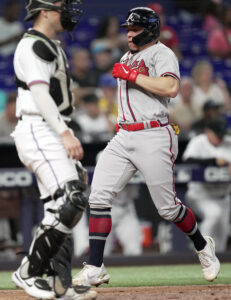
That’s not to say that Contreras isn’t an exciting young catcher in his own right. It’s just that, as mentioned, Murphy is one of the best in the game. Contreras will now join his older brother Willson Contreras, who recently signed with the Cardinals, in the NL Central. The younger Contreras has gotten into 153 games in his career so far, hitting 28 home runs and producing an overall batting line of .260/.338/.471 for a wRC+ of 121. His defensive work isn’t as highly rated as his bat, but he’s still quite young, turning 25 later this month. Even with subpar defense, he’s produced 2.5 fWAR in his brief career thus far, meaning any developments in that department would make him tremendously valuable. It had been recently reported that the Brewers were interested in catching upgrades, but since the club has been paring back a tight payroll, they never seemed like candidates for a big free agent splash. Instead, they’ve acquired a young backstop who has yet to reach arbitration eligibility and has five years of club control remaining. The club has also added a couple of depth arms in Payamps and Yeager.
For the A’s, it’s been reported that they have been prioritizing MLB-ready talent in their trade talks and they have achieved that here. Muller, 25, has appeared in each of the past two major league seasons, logging 49 innings so far. He has an unimpressive 5.14 ERA in that time, but he’s fared much better in the minors. He’s made 40 Triple-A starts in the past two years and has a 3.40 ERA, 28.4% strikeout rate and 9.2% walk rate. Baseball America recently ranked him the top prospect in Atlanta’s system.
Ruiz has spent most of his career in the Padres’ system but he went to the Brewers in the Josh Hader trade last year. He has some MLB experience, having played in 17 games this year between the two clubs. In 114 minor league games, he hit .332/.447/.526 while stealing 85 bases in 114 games. BA has not yet published their list of top Milwaukee prospects for this offseason, but Ben Badler of BA tweets that Ruiz was going to be in the #8 slot.
Tarnok also has very limited MLB experience, with 2/3 of an inning on the books so far. He threw 106 2/3 innings in the minors this year with a 4.05 ERA, 27.2% strikeout rate and 9.6% walk rate. He ranked #9 on the BA list of top Atlanta prospects. Piña is a 35-year-old veteran who is likely to serve as insurance in case Langeliers struggles or needs some veteran guidance. He signed a two-year, $8MM deal with Atlanta but required season-ending wrist surgery in May. He’ll earn $4.5MM in 2023 with a $4MM club option for 2024 with no buyout.
The one prospect who isn’t likely to help the big league club immediately is Salinas. He turns 22 in April and split the most recent season between Single-A and High-A. He posted a 3.55 ERA over 25 starts with a huge 37.6% strikeout rate but a 13.5% walk rate. Baseball America recently placed him #7 on their list of Atlanta prospects.
The Braves were facing a challenge in the NL East despite having won the division in five straight seasons. The Mets and Phillies have been been spending wildly to upgrade for the coming season. The Mets have added Justin Verlander, Kodai Senga, José Quintana and David Robertson, in addition to re-signing Brandon Nimmo and Edwin Díaz. The Phillies have signed Trea Turner, Taijuan Walker and Matt Strahm. The Braves were going to face a challenge in keeping up with that pace since they were nearing the luxury tax. As is his wont, Anthopoulos has turned to the trade market to make his upgrades. The club still has a question mark at shortstop, with Dansby Swanson having departed for free agency. They could always bring him back though they reportedly haven’t been talking much this offseason. After this trade, the club’s CBT figure is at $229MM, per Roster Resource, just shy of the $233MM luxury tax threshold for next year.
For the Brewers, they’ve parted with an outfield prospect they just acquired but have added an exciting young catcher, something they would be challenged to do in free agency with their payroll constraints. For the A’s, they have parted with yet another established major leaguer, adding to the list of quality players they’ve sent out the door. In exchange, they’ve brought in one veteran backstop and four young players that they hope can be a part of forming the next competitive core in Oakland.
Talkin’ Jake of Jomboy Media first reported that the Braves, Brewers and A’s were lining up on a deal, as well as the involvement of Contreras (Twitter links). Jeff Passan of ESPN first reported Murphy going to the Braves, as well as the involvement of Piña and the eventual final deal. Robert Murray of FanSided first mentioned Ruiz and Tarnok (Twitter links). Joel Sherman first mentioned Payamps and Yeager on Twitter. Kiley McDaniel first had Muller’s name on Twitter.
Images courtesy of USA Today Sports.
Padres, Anderson Espinoza Agree To Minor League Deal
The Padres are in agreement with right-hander Anderson Espinoza on a minor league contract, reports Jeff Sanders of the San Diego Union-Tribune. The Friars have also agreed to non-roster pacts with outfielder Preston Tucker and reliever Drew Carlton, Sanders reports (Twitter link).
Espinoza returns to an organization where he spent a half-decade. Acquired from the Red Sox in the 2016 deadline deal that sent Drew Pomeranz to Boston, Espionza was regarded as a possible top-of-the-rotation starter at the time. Baseball America named him the #1 prospect in the San Diego system the following winter. Unfortunately, a series of injuries prevented the 6’0″ hurler from getting a chance to make good on that immense promise. Espinoza felt some elbow soreness at the start of the 2017 season, and he underwent Tommy John surgery. After two years of rehab, he suffered another elbow injury that required a second TJ procedure.
The successive surgeries cost him a staggering four years of game action, as he didn’t throw a single professional pitch from 2017-20. Midway through the ’21 campaign, San Diego dealt him to the Cubs for Jake Marisnick. Espinoza closed out the 2021 season in Double-A, but he briefly got to the majors for the first time this year.
Through seven relief appearances, he worked his first 18 1/3 MLB innings. He allowed 11 runs on 14 hits and a staggering 16 walks, and his work in the minors wasn’t much better. Between Chicago’s top two affiliates, Espinoza pitched to a 7.55 ERA in 70 1/3 frames. He fanned a decent 24.6% of opponents but walked a massive 13.9% of minor league batters faced. At year’s end, the Cubs placed him on waivers. He went unclaimed and qualified for minor league free agency.
Espinoza is certainly no longer regarded as an elite young talent, but there’s no harm for the Padres in rolling the dice to see if he can better hone his strike-throwing as he moves another year removed from the devastating series of injuries. He’s yet to turn 25 despite having been a well-known prospect for nearly a decade. The Venezuela native averaged just under 94 MPH on his fastball during his MLB work with the Cubs, relying on a low-80s breaking ball as his top secondary pitch.
Tucker, the older brother of Astros star Kyle Tucker, is a former Astros outfielder himself. He hit .222/.281/.403 in 221 MLB games with Houston, Atlanta and Cincinnati from 2015-18. After three seasons in South Korea, Tucker returned to the U.S. on a minor league deal with the Braves in May. The 32-year-old had a decent showing with their top affiliate in Gwinnett, hitting .267/.347/.426 in 75 games.
Carlton, 27, has made nine relief appearances with the Tigers over the past two seasons. The right-hander has allowed six runs in 12 1/3 career innings, striking out eight with four walks. The Florida State product doesn’t throw especially hard, sitting in the low 90s with his fastball. He’s shown excellent control throughout his minor league tenure, though, and he punched out an above-average 27.3% of opponents through 58 1/3 innings with Detroit’s top affiliate in Toledo this year. Owner of a 3.90 ERA in 110 2/3 innings at the top minor league level, he’ll presumably battle for a bullpen spot in Spring Training.
Pirates, Tyler Heineman Agree To Minor League Deal
The Pirates are re-signing catcher Tyler Heineman to a minor league contract, reports Jason Mackey of the Pittsburgh Post-Gazette (Twitter link). He’ll receive an invite to big league camp.
Heineman will look to crack the Pittsburgh roster for a second straight season. The Bucs nabbed him off waivers from the Blue Jays last May, and he spent the remainder of the 2022 season in Pittsburgh. Heineman set career marks in both MLB games (62) and plate appearances (174) in 2022, with the bulk of that work coming in the Steel City. He and Jason Delay mostly split catching duties for the second half.
The 31-year-old hit .211/.277/.254 through 158 trips to the plate as a Pirate. He now owns a .214/.279/.276 line with one home run in 236 career big league plate appearances. The UCLA product has a far more impressive .283/.350/.413 mark in parts of seven seasons at Triple-A. Heineman has only gone down on strikes in 14.1% of his career trips to the dish at the top minor league level, and he’s carried those excellent bat-to-ball skills over against big league arms. He has just an 11.4% strikeout rate in the majors, but a complete lack of power has resulted in his overall lackluster offensive production.
At the end of the season, the Pirates designated Heineman for assignment. He was not tendered a contract while in DFA limbo, sending him directly to free agency. A month later, he’ll return to the organization and try to play his back onto the MLB roster. A 10-year minor league veteran, he’ll bring a fair bit of familiarity with the pitching staff in Spring Training.
The Pirates are sure to make more impactful moves behind the plate this winter. The Bucs only have one catcher, prospect Endy Rodriguez, on the 40-man roster at the moment. The switch-hitter is sure to open the season in the minors, so GM Ben Cherington and his staff will have to bring in a starting backstop from outside the organization. They could add multiple big league pieces. At the very least, they figure to bring in a new starter and another player or two on non-roster invitations to compete with Heineman and Delay for a backup job next spring.
Twins, Christian Vazquez Agree To Three-Year Deal
The Twins have jumped into a fast-moving catching market, reportedly agreeing to terms with Christian Vázquez on a three-year contract. The deal, which is pending a physical, will guarantee him $30MM. Vázquez is represented by MDR Sports Management.
A longtime member of the Red Sox, Vázquez now changes uniforms for the second time in five months. Boston dealt him to the Astros at this past summer’s trade deadline, bringing back prospects Wilyer Abreu and Enmanuel Valdez for the final half-season before he hit free agency. That left Vázquez in an unfamiliar role splitting time with Martín Maldonado, but it positioned him to secure his second World Series title.
Vázquez, 32, is one of the better all-around catchers in the game. A light-hitting defensive specialist for his first few seasons, the Puerto Rico native has taken a step forward with the bat over the past four years. He hit .276/.320/.477 in 521 plate appearances in 2019, popping a career-best 23 home runs. Vázquez hasn’t replicated that kind of power outside a season with perhaps the liveliest ball the league has ever used, never reaching double digit longballs in another season. Still, he’s been an adequate hitter in two of the past three years. Vázquez stumbled to a .258/.308/.352 mark in 2021, but he was an above-average hitter during the abbreviated 2020 campaign and roughly league average this past season.
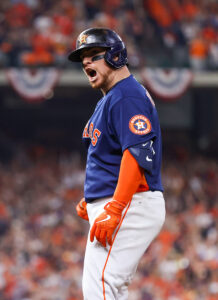
Going back to the start of 2019, he owns a .271/.318/.416 line in slightly more than 1600 plate appearances. That’s five percentage points below league average overall, by measure of wRC+, but it’s above par for a catcher. Backstops have a cumulative .232/.304/.390 mark over that stretch. Vázquez doesn’t draw many walks and, 2019 aside, rarely hits for power. His high-contact approach differentiates him from most of his positional peers, as he owns the fifth-lowest strikeout percentage among catchers (minimum 750 plate appearances) since the start of 2019.
The 2022 season was generally par for the course. Among 29 catchers with 300+ trips to the dish, he had the fourth-lowest strikeout rate (16.2%) and fourth-best rate of contact per swing (85.1%). Overall, Vázquez posted a .274/.315/.399 line in 119 games. He carried an impressive .282/.327/.432 mark with the Red Sox before the trade but stumbled to a .250/.278/.308 showing in 35 regular season games as an Astro. Vázquez also did very little offensively in his six-game playoff showing.
The Twins clearly aren’t deterred by that slow finish to the year. That came in an unfamiliar role dividing his reps with Maldonado, and Minnesota presumably anticipates he’ll more closely approximate his production from his time in Boston moving forward. Offense is only part of the story and Vázquez has an excellent reputation with the glove.
For his career, Vázquez has nabbed just under 34% of attempted basestealers. He had a more modest 27.1% mark this year, but that’s still narrowly above the roughly 25% league average. Statcast also credits him with a better than average arm, placing him 20th among 73 catchers with 10+ throws in pop time (average time to throw to second base). Vázquez consistently draws strong grades from public pitch framing metrics. Pair strong receiving with his ability to control the running game, he’s been rated as an above-average catcher by measure of Defensive Runs Saved in all but one season of his career. DRS pegged him 11 runs above par in 2022 and has rated him as 51 runs above average over his eight years in the majors.
That wealth of experience calling games certainly added to Vázquez’s appeal to the Minnesota front office. The Twins have young backstop Ryan Jeffers on hand already. The 25-year-old will continue to see a fair amount of run at Target Field, but president of baseball operations Derek Falvey and GM Thad Levine have each spoken of a desire to add another starting-caliber catcher to pair with Jeffers. They’ve done just that, leaving manager Rocco Baldelli to decide how to divvy up playing time.
Jeffers, a right-handed hitter, has been far better against lefty pitching (.263/.344/.450) than same-handed opponents (.185/.256/.361) through his first couple MLB campaigns. Vázquez also hits right-handed and is better against southpaws, but his career splits aren’t so drastic. He has a .257/.309/.422 line against lefty arms and a .263/.310/.372 mark against right-handers. Falvey has already suggested the Twins don’t plan to relegate Jeffers solely to the small side of a platoon, but the presence of a more balanced hitter in Vázquez gives Baldelli some more flexibility in matching up against opposing pitchers.
It’s the first meaningful dip into free agency for Minnesota this offseason. Vázquez’s contract lands right in line with MLBTR’s prediction of $27MM over three years. The specific financial breakdown hasn’t yet been reported, but an even distribution of $10MM annually would bring Minnesota’s 2023 payroll around $107MM, in the estimation of Roster Resource. There’s a fair amount of room before getting to this past season’s approximate $134MM mark, and the Twins surely aren’t finished. Addressing shortstop — where the organization awaits Carlos Correa’s decision — is the big question, but the Twins also could stand to upgrade both areas of the pitching staff (especially the bullpen) and potentially shake up their outfield.
Vázquez’s signing follows last week’s five-year agreement between the Cardinals and Willson Contreras and this afternoon’s blockbuster that sent Sean Murphy to Atlanta. As a result, the catching market is drying up quickly. The Blue Jays can still dangle one of their three backstops, with Danny Jansen seemingly the most likely to move. Free agency is without many obvious solutions at this point, with glove-first players like Austin Hedges, Tucker Barnhart, Roberto Pérez and Mike Zunino (the latter two of whom saw their 2022 seasons cut short by surgery) among the options.
Chris Cotillo of MassLive reported Vázquez was making progress on a deal with an unknown team. Jon Heyman of the New York Post first reported the backstop was in agreement with the Twins. Pete Abraham of the Boston Globe reported it was a three-year contract, while Ted Schwerzler of Twins Daily was first to report the $30MM guarantee.
Image courtesy of USA Today Sports.
A’s Designate Vimael Machín For Assignment
The A’s have designated infielder Vimael Machín for assignment, reports Martín Gallegos of MLB.com. Machín is a casualty of today’s blockbuster deal that sent Sean Murphy to Atlanta with five players going to Oakland.
Machín, 29, came over to the A’s by way of the Rule 5 draft, being plucked from the Cubs in 2019. Since then, he has played in 112 big league games with the A’s over the past three seasons. He hasn’t hit much in that time, as his career batting line currently sits at .208/.290/.261 for a wRC+ of 66. He’s fared much better in the minors though, having hit .307/.394/.470 over the past two seasons. The Las Vegas Aviators play in the hitter-friendly Pacific Coast League, but that production was still 18% above league average, as evidenced by his 118 wRC+.
Defensively, Machín brings a lot of versatility to the table, having played all four infield positions in the majors, though most of that has been at third base. In the minors, he’s also had some brief time in the outfield and even in both ends of the battery.
The A’s will now have one week to work out a trade or else put Machín on waivers. He was outrighted in April but selected back onto the club’s roster in June. By virtue of that previous outright, he would have the right to elect free agency if he were to clear waivers. However, given his versatility and strong offensive work in the minors, it’s possible another team could put in a claim. He still has two option years remaining and could thus be kept in the minors as depth once the season begins.
Guardians Sign Josh Bell
December 12: The Guardians have made it official, announcing that they have signed Bell to a two-year deal.
December 6: The Guardians have agreed to a two-year, $33MM contract with free-agent first baseman Josh Bell, reports Jon Heyman of the New York Post. Bell, a client of the Boras Corporation, will be able to opt out of the contract after the first season of the deal.

It’s a short-term but lucrative annual deal for the 30-year-old Bell, who looked poised for a long-term commitment in free agency before a sluggish finish to the season following a trade to the Padres. The veteran switch-hitter opened the season on a tear with the Nationals and maintained that production into late July, but after slashing .301/.384/.493 with the Nats (143 wRC+), Bell hit just .192/.316/.271 in San Diego.
Ups and downs are nothing new for Bell, who at multiple points in his career has appeared on the cusp of solidifying himself as a star-caliber slugger, only to fall into a prolonged slump. Back in the first half of the 2019 season, for instance, the former No. 61 overall draft pick erupted with a .302/.376/.648 batting line and 27 home runs. That netted him what remains the only All-Star nomination of his career, but following the Midsummer Classic, Bell backtracked with a solid but unspectacular .233/.351/.429 slash.
His offensive doldrums spiraled out of control in 2020, when he turned in a career-worst .226/.305/.364 slash in the shortened 2020 season. Following that disappointing campaign, the Pirates sold low on the former top prospect by flipping his final two years of club control to the Nationals in exchange for righty Wil Crowe and minor leaguer Eddy Yean.
A month into Bell’s Nationals tenure, it looked to be more of the same, but he righted the ship in May. From May 1, 2021 through this year’s trade deadline, Bell came to the plate 945 times and recorded a stout .289/.373/.489 slash with 39 big flies, 46 doubles, an 11.5% walk rate and a 15.3% strikeout rate that’s far lower than many would expect from a 6’4″, 255-pound first baseman with 30-homer power.
In spite of that sizable frame and the clear raw power Bell possesses, however, he’s never really been a consistent power threat — at least not to the extent one would expect. The juiced-ball season in 2019 was his lone 30-homer campaign (37, to be exact), and his season-to-season home run totals have otherwise ranged between 12 (2018) and 27 (2021).
It’s hard not to wonder what might happen were Bell to commit to elevating the ball more, but that’s easier said than done for any hitter. Bell’s enormous 49.9% ground-ball rate is far higher than one would expect for a slugger of his stature, and he’s taken that mark north of 50% in each of the past three seasons, topping out with a mammoth 55.7% grounder rate in 2022. Since 2020, only five hitters in baseball have put the ball on the ground more frequently than Bell — a confounding trait for a switch-hitter with plus raw power. Three different teams have been unable to coax consistent power production from Bell, but the Guardians will give their best effort to unlock his maximum potential.
To be clear, Bell remains a well above-average hitter in the aggregate, even with the glut of grounders and a career punctuated thus far by peaks and valleys. Dating back to 2019, he’s been 20% better than the average hitter by measure of wRC+, and his career mark in that regard sits at 116 (16% better than average). Bell is a lifetime .262/.351/.459 hitter whose only below-average season at the plate came in the shortened 2020 season.
Also appealing to the Guardians was surely the fact that Bell, like so much of their team, is exceedingly difficult to strike out. No team in baseball fanned at a lower clip than the Guardians’ 18.2% last year — nor was anyone particularly close. Bell, who struck out at just a 15.8% rate in 2022, should fit right in. He’s kept his strikeout rate at 19% or lower each season other than that grisly 2020 campaign, and he’s also drawn walks in an excellent 11.8% of his 3406 career plate appearances.
All of that aligns well with Cleveland’s general offensive philosophy, and while it seems that Jose Abreu was the Guards’ first choice — Cleveland reportedly made him a three-year offer before he signed in Houston — Bell still adds some needed thump who can join Josh Naylor in splitting time at designated hitter and first base. Bell isn’t an all-world defender at first, but he’s improved his defensive ratings from sub-par to slightly above average in recent seasons, and the Guardians surely feel confident that he’s a reliable source of at least 15 to 20 homers with a robust on-base percentage. He’ll join Jose Ramirez as a switch-hitting, middle-of-the-order threat, continuing to give the Cleveland lineup plenty of balance.
If things go according to plan and Bell can ward off another prolonged slump to close out the season, he’ll be a strong candidate to exercise that opt-out provision and return to the open market a year from now. As previously laid out, the overall offensive track record for Bell is quite strong; had he not fallen into that San Diego swoon, he and Boras might have had a case for a contract upwards of five years in length. Depending on the extent of Bell’s success, the Guardians could even issue him a qualifying offer upon opting out.
We predicted that Bell would still be able to command a four-year deal around this AAV on our Top 50 free agent rankings, but the two-year term and opt-out provides some of the best of both worlds. If Bell performs well, he can collect a hearty salary in 2022 and try again for a lengthier deal a year from now. If not, he’ll at least have a second season around the going rate for a bat-first slugger of this nature. And, even if he forgoes the opt-out next offseason, a strong 2024 showing could position him for a multi-year deal.
From a payroll vantage point, Cleveland had ample room to plug him into the mix — history of low payrolls notwithstanding. Bell, assuming an even distribution of his $33MM guarantee, pushes the Guardians to just $35.3MM in guaranteed salary next season. Add in another $35.7MM in projected salaries for arbitration-eligible players (tip of the cap to MLBTR contributor Matt Swartz) and a slate of pre-arbitration players to round out the roster, and the Guardians will sit around the $87MM mark next season — at least as things currently stand.
The Guardians opened the 2021 season with just a $49.6MM payroll and were at $68.2MM to begin the 2022 campaign, but they won the AL Central in ’22 and are only five years removed from trotting out an Opening Day payroll of nearly $135MM. At least on paper, there should be room to make further additions, though that’ll depend on ownership’s willingness to further ramp up payroll as they look to repeat in a weak division.
KBO’s Kiwoom Heroes Sign Addison Russell, Eric Jokisch
The Kiwoom Heroes of the KBO League have signed shortstop Addison Russell and re-signed left-hander Eric Jokisch to contracts for the 2023 season, according to reports out of South Korea. (Hat tip to Dan Kurtz of MyKBO.net). Jokisch will receive $1.5MM, while Russell receives $700K.
This is Russell’s second KBO stint, after previously playing 65 games with the Heroes during the 2020 season. Russell hit .254/.317/.336 over 271 plate appearances that year, and the Heroes didn’t renew Russell’s contract after the season was up. Russell has spent the last two seasons posting big numbers with Acereros de Monclova of the Mexican League.
Once one of baseball’s top prospects, Russell spent five seasons with the Cubs (2015-19) and was an important part of the team’s 2016 World Series championship club. However, in 2018, Russell was issued a 40-game suspension under the MLB-MLBPA Join Domestic Violence Policy, in the wake of the league’s investigation into accusations made by Russell’s ex-wife of physical and verbal abuse during their marriage. The Cubs chose to tender Russell a contract following the 2018 season, but non-tendered the shortstop following the 2019 campaign.
Jokisch’s Major League resume consists of four games and 14 1/3 innings with the Cubs back in 2014, and he also pitched in the minors with the Marlins, Rangers, Diamondbacks, and Athletics over the course of his nine seasons in affiliated baseball. The southpaw then signed with the Heroes prior to the 2019 season, and has become a staple for the Seoul-based club, posting a 2.72 ERA over 701 2/3 innings and 117 starts for the Heroes over the last four seasons.
Jokisch turns 34 in July, and with such a comfortable niche carved out for himself in the KBO League, it remains to be seen if he’ll ever explore a return to North American baseball. There was some indication that MLB teams were interested in the lefty during the 2020-21 offseason, but he ended up returning to the Heroes.
KBO’s LG Twins Walk Away From Deal With Abraham Almonte
TODAY: According to reports out of South Korea, the LG Twins have pulled out of the contract, due to an issue following Almonte’s physical.
DECEMBER 5: The LG Twins of the Korea Baseball Organization have announced a one-year contract with outfielder Abraham Almonte. (Hat tip to reporter Sung Min Kim.) Almonte will receive $400K in salary, a $100K signing bonus, and up to $300K in incentive bonuses.
The 33-year-old Almonte is a veteran of the last 10 Major League seasons, suiting up with seven different teams at the MLB level and also spending some time in the minors with the Brewers’ and Yankees’ farm systems. Of Almonte’s 455 career games in the Show, 187 were played with Cleveland from 2015-17, and his next highest total was 70 games with the Padres over parts of three seasons.
Almonte consistently found work as a backup or part-time outfielder during his journeyman career, due more to his ability to play all three outfield positions than his bat. While the switch-hitter has a few flashes at the plate, Almonte hit a modest .235/.302/.374 over 1363 Major League plate appearances. He entered the 2022 season on a minor league deal with the Brewers, but didn’t reach the majors until after he was dealt to the Red Sox in July.
Heading overseas for the first time in his pro career, Almonte now joins the Twins. Each KBO League team has up to three roster spots dedicated to non-Korean players, and international players can only sign for a $1MM maximum. An international player’s first KBO contract can also be only one year in length.
Frank Schwindel Signs With NPB’s Orix Buffaloes
Former Cub Frank Schwindel has reportedly signed a deal with the Orix Buffaloes of Japan’s NPB. Schwindel had been playing for the Águilas Cibaeñas in the Dominican Winter League. Sung Min Kim had previously tweeted that the two parties were discussing a deal, and Cibaeñas general manager Ángel Ovalles recently told reporters that the 30-year-old had signed with the Buffaloes and was leaving the team.
Designated for assignment in July 2021 by Oakland, Schwindel was picked up by Chicago and immediately sent to Triple-A Iowa. However, after Anthony Rizzo was traded to the Yankees, Schwindel received a call-up and never looked back. During the second half of the 2021 season, he slashed a robust .342/.389/.613, with a strong 15% strikeout rate, 6.7% walk rate, and 13 homers in 239 plate appearances. This tremendous output, albeit in a limited sample size, earned him minor consideration in the 2021 NL Rookie of the Year voting.
Schwindel opened the 2022 season with the Cubs but struggled and was shuffled between Iowa and Chicago. He also missed time with lower back strains in May and June. His poor performance led to the Cubs designating him for assignment in mid-September, and he was granted his unconditional release. Schwindel finished the 2022 season hitting .229/.277/.358 with eight homers in 292 plate appearances. Notably, his strikeout rate increased to 19.9%.
With a poor 2022, Schwindel might have been hard-pressed to find anything beyond a minor league deal with an MLB team this winter. Instead, the right-handed hitter will head to Japan in search of the magic he captured during the 2021 season. With the Buffaloes, he will likely earn more guaranteed money and ample opportunity to rediscover his swing, perhaps eventually exploring a return to North American baseball.