
Ryan Hanigan Requires Surgery On Broken Finger
Red Sox catcher Ryan Hanigan has suffered a displaced fracture to his finger and is destined for surgery, Peter Abraham of the Boston Globe reports on Twitter. He is expected to miss a significant period of time after taking a deflected ball to his hand in tonight’s game.
That’s highly unwelcome news for a Boston team that is already without the other half of its expected backstop tandem in Christian Vazquez for the rest of the season. Sandy Leon was added to the mix just before the start of the season, and the team does have both top prospect Blake Swihart and veteran Humberto Quintero available at Triple-A.
But none of those options are really ideal, for various reasons. Leon has never been viewed with much promise offensively, while Quintero is a 35-year-old career backup. Swihart is, of course, the game’s best-regarded catching prospect. But he is still completing his development and would line up as a Super Two if promoted now.
Speculation will immediately turn to the possibility of an acquisition, and indeed there seems to be good reason to think that could occur. No player is more available than former Boston backstop Jarrod Saltalamacchia, who remains in DFA limbo with a Marlins club that is highly motivated to save some money on his contract. Players like Dioner Navarro of the Blue Jays and Welington Castillo of the Cubs also remain under-utilized with their current clubs.
Carlos Quentin To Retire
Mariners outfielder Carlos Quentin confirms that he will retire from the game, as Ken Rosenthal of FOX Sports reports in a series of tweets. Quentin had been playing with Seattle’s top affiliate since inking a minor league deal, but left Tacoma last night.
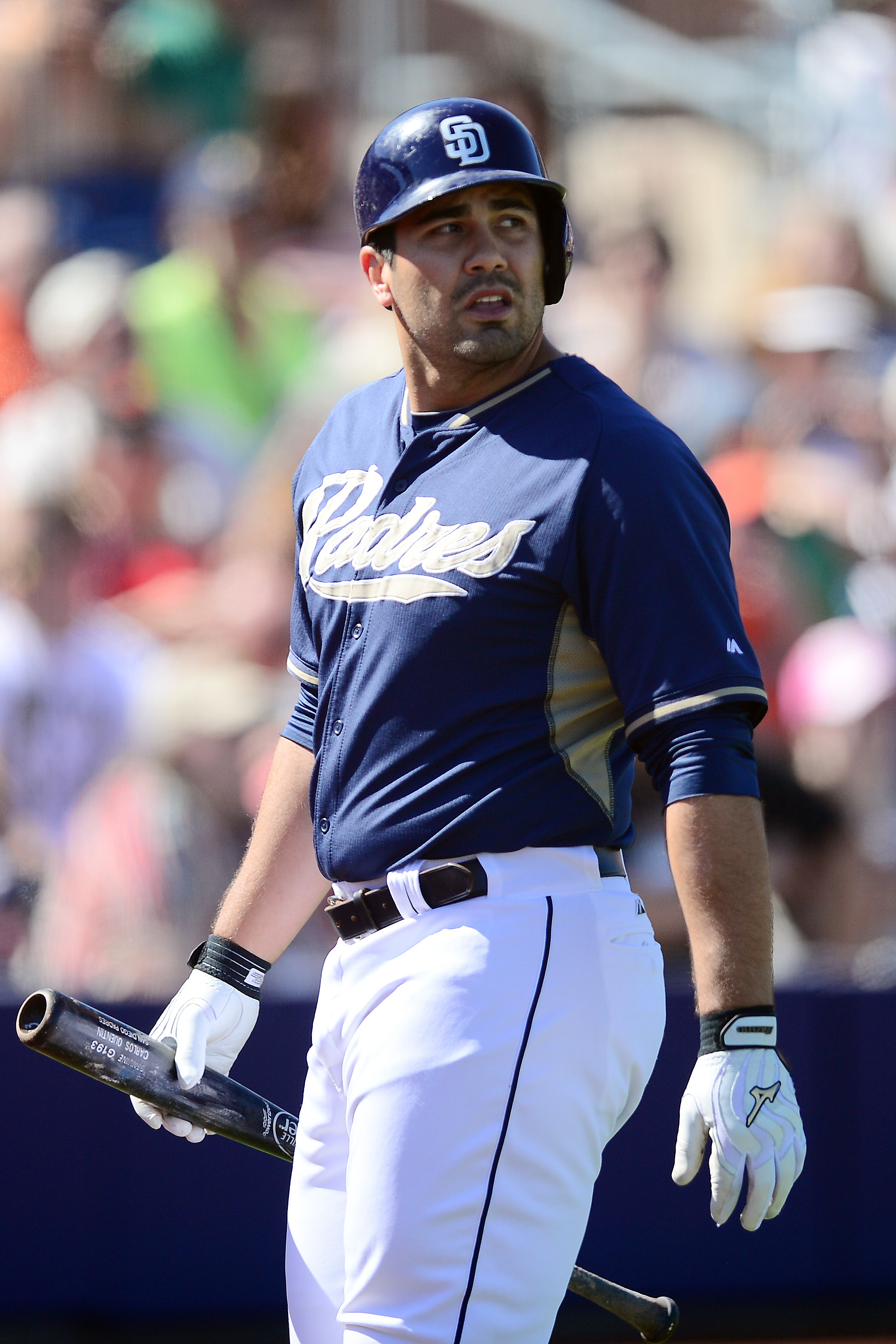
Quentin, 32, has $8MM left on the deal that he originally signed with the Padres. San Diego shipped him to the Braves just before the start of the season, of course, as part of the salary swaps included in the Craig Kimbrel deal. Atlanta cut him loose in short order, eating the remainder of that contract.
The route being pursued currently would see Quentin retain his rights to that guaranteed money. Atlanta would have been able to earn some relief had Quentin continued playing, though that amount would not have exceeded the pro-rated portion of the Major League minimum salary.
The Mariners will technically grant Quentin his release, reports Jon Heyman of CBS Sports (via Twitter), but that’s little more than semantics. Heyman notes that Quentin’s injuries will no longer allow him to play, which is the reason for his departure from Tacoma and his decision to retire.
The Mariners had hoped that Quentin would re-establish himself as a viable part-time bat, though obviously the team was not relying on that outcome and essentially took on no financial risk in signing him. Between 2008 and 2013, Quentin slashed a robust .260/.356/.503 with 136 long balls. But he has been slowed by injuries in recent seasons, making only 815 total plate appearances in that stretch.
Quentin confirmed in the press release that physical issues drove the decision to retire. “Over the past several days, it became clear to me that my injuries have taken too great of a physical toll for me to be able to perform at the level I expect from myself,” he explained. “As a result, I believe it is the right time for me to walk away and to refocus my energy on the next chapter of my life with my family.”
Photo courtesy of USA Today Sports Images.
Early Returns On The Winter’s Minor League Signings
With the month of April in the rearview mirror, we’ve had the chance to see some early results from minor league free agents. Though signed without any financial commitments, many such players have an impact. To take an extreme example, J.D. Martinez signed with the Tigers just before the start of the 2014 season — here’s the story the deal warranted — and has been worth better than four wins above replacement since.
It’s too early to know where it’ll all end up, but let’s have a glance at some of the most impressive performances to date from players who couldn’t find guaranteed money over the winter.
Immediate Impact
These players have put up quality results out of the gates:
John Axford, Rockies – Though he has tossed just five innings after missing time to deal with a frightening episode with his young son, Axford has impressed when available. He’s yet to allow a run while striking out six batters, and still brings mid-90s heat.
Rafael Betancourt, Rockies – The 40-year-old has been nothing short of dominant in his return from Tommy John surgery. Through 9 2/3 innings, he has permitted just two earned runs and five hits while striking out 11 and walking only one batter.
Kelly Johnson, Braves – For a team that needed help at second and third as well as in the run production department, Johnson has brought much-needed pop. He owns a .250/.308/.479 slash and has smacked three long balls in 52 turns at bat.
Ryan Madson, Royals – Madson has fit right in with a dominant Royals pen, striking out better than 10 batters per nine while walking just 2.5 and yielding a 50% ground ball rate. A classic low BABIP/high LOB% combo indicate that some regression is coming, but advanced metrics value his work at a sub-3.00 level.
Justin Maxwell, Giants – Through 57 plate appearances, Maxwell owns a stellar (and non-BABIP-fueled) .255/.333/.510 slash with three home runs. Throw in highly-rated defense from the corner field, and the Hunter Pence fill-in has already racked up nearly a full win above replacement.
Filling A Need
Others have been plenty useful to their clubs and/or look like they could be moving forward:
Anthony Bass, Rangers – For a pitching-needy club, 18 1/3 innings of long relief with a 3.44 ERA is most welcome. That’s just what Bass has delivered, and advanced metrics say that he has if anything been (very slightly) unlucky.
Blaine Boyer, Twins – Boyer has filled up 12 1/3 innings for an underwhelming Minnesota pen. While his 3.65 ERA and slightly lagging peripherals are nothing to get excited about, he’s been a useful piece for Minnesota.
Roberto Hernandez, Astros – When you go hunting on the MiLB free agent market for a fifth starter, you’re hoping for what Hernandez has delivered in Houston: 3.80 earned over 23 2/3 innings in four starts.
Jason Marquis, Reds – The bottom-line results haven’t been there (5.48 ERA), but Marquis has shown surprising promise at age 36. Though he doesn’t even reach 88 mph with his average fastball, Marquis has retired 24 batters by way of strikeout in 23 frames while walking only seven hitters.
Anthony Swarzak, Indians – Though the 4.09 ERA is less than impressive, Swarzak has shown well and carries sub-3.50 metrics. Victimized by a .429 BABIP, Swarzak has K’ed 9.0 while walking just 2.45 per nine innings.
Joe Thatcher, Astros – The 33-year-old was added on a no-risk deal, but has produced quality results at times in the past. He’s been useful as a LOOGY thus far, allowing two earned to cross the plate but striking out five and walking only one over 4 1/3 innings in eight appearances.
Carlos Villanueva, Cardinals – St. Louis reportedly targeted the swingman early and has received a nice return to date, as Villanueva has allowed just one earned run in 9 1/3 innings, striking out seven and walking three. Of course, advanced metrics are far less impressed, as they can see that the righty has benefited from a .048 BABIP and 100% strand rate.
Worth Watching
Some potentially important pieces have yet to see enough MLB time to make much of an assessment. Here are some names to keep an eye on the rest of the way:
Scott Baker, Dodgers – He’s only seen one start, but gave the rotation-needy Dodgers seven innings while allowing just three earned and striking out six. It’s been a while since he was healthy and effective, but Baker has a fairly long history as a solid rotation piece and could help hold down the fort in LA.
Slade Heathcott, Yankees – A former top-100 prospect who had fallen off the radar, the 24-year-old was non-tendered and re-signed by New York. He’s done nothing but impress since, following up on a hot spring in big league camp with a .329/.386/.443 slash in 89 Triple-A plate appearances.
James Russell, Cubs – A sturdy reliever for Chicago for several years, Russell showed well with the Braves last year but was released after a tough spring — due in part to avoid a big piece of his $2.4MM arbitration salary. Since heading to Iowa, Russell has struck out 11 batters in just 7 2/3 frames and has yet to allow a run or walk.
Ryan Webb, Indians – Cleveland added Webb after he was caught up in an early-season salary dumping move by the Orioles and found himself immediately released by the Dodgers. He’s always been a sturdy reliever, and has shown well in limited action thus far.
Joe Saunders Opts Out Of Mariners Deal
Lefty Joe Saunders has opted out of his minor league deal with the Mariners, Triple-A Tacoma announcer Mike Curto reports on Twitter. The 33-year-old will head onto the open market in search of a more favorable situation.
Saunders, a starter for virtually all of his career, had been throwing from the pen for the Rainiers. He allowed seven earned runs in 11 frames, but did strike out a healthy number of batters (12) while issuing just four walks.
Over a decade in the bigs, Saunders has racked up over a thousand frames of 4.37 ERA ball. But he has struggled in his last two seasons, including a 32-start run in Seattle in 2013 when he managed only a 5.26 earned run average. The 42 innings that Saunders threw last year for the Rangers and Orioles were even less successful.
Rays Re-Sign Grant Balfour To Minors Deal
5:47pm: Balfour confirms that he has indeed inked a new deal with the Rays, Topkin tweets.
5:41pm: The Rays may be in the process of re-signing struggling righty Grant Balfour to a minor league deal, Marc Topkin of the Tampa Bay Times reports on Twitter. Tampa Bay released Balfour on Tuesday and remains on the hook for his $7MM salary this year.
Balfour, 37, inked a two-year, $12MM deal to join the Rays before the 2014 season, and to say he has been a disappointment would be an understatement. Over 66 2/3 total innings in his second stint with the club, he has posted a 5.00 ERA with 7.7 K/9 against a troubling 6.1 BB/9.
Things got even worse this year, as Balfour failed to notch a strikeout while permitting four free passes in his first 4 1/3 innings of the season. His fastball was down about two full ticks as against last year, and he had already lost velocity from his prior years’ work.
Over a dozen years in the league, Balfour has worked to a 3.49 ERA while averaging 9.5 K/9 and 4.2 BB/9. Tampa’s plan to bring him back to (or, at least, near) that level of productivity would be to send him to Triple-A for a few weeks, says Topkin, in an effort to get him back on track.
Homer Bailey To Undergo Tommy John Surgery
Reds starter Homer Bailey will undergo Tommy John surgery, the club announced. Cincinnati expects him to return during the 2016 season, per the announcement.
Bailey had missed the tail end of last year after needing surgery to repair a torn flexor mass tendon in his right arm. The 2014 campaign was something of a disappointment even before that point. While Bailey was effective enough, he failed to build off of a strong 2013 and seemed to be settling in more as a sturdy option than a top-of-the-rotation arm.
Now, Bailey’s arm troubles have clouded even that downgraded status. He was able to make it back early this season, but was throwing his average fastball at about 3 mph less than he had been over the last two seasons. With only three strikeouts in 11 1/3 frames, things were already not looking up when Bailey hit the DL.
While Tommy John surgery is obviously far from a death knell to a player’s career, neither is it a minor event. In Bailey’s case, it is particularly concerning given that he already underwent one surgery and has already shown a velocity decline. Then there’s the fact that he will not be back until next summer at the earliest, meaning that Cincinnati will not see any on-field production for its investment during that time.
The real issue for the Reds, of course, relates to Bailey’s contract. While the deal’s first year basically ratified an already-inevitable arbitration salary, the rest represented new money that kept the righty from testing free agency. Cincinnati still owes Bailey $86MM over 2016 through 2019, which includes the buyout of a mutual option for 2020, and it is increasingly unclear whether the club will get anything close to the expected value for that sum.
Tim Hudson “Definitely Leaning” Toward Retiring After Season
Giants starter Tim Hudson tells Ken Rosenthal of FOX Sports that he is “definitely leaning” towards retiring at the end of the season. The 39-year-old righty is playing out the second half of the two-year, $23MM deal he signed with San Francisco before the 2014 campaign.
Though family considerations appear to be drawing him toward hanging up his spikes, Hudson indicated that he is not quite ready to decide at this point. “I feel pretty good,” said Hudson. “I feel as good as most 40-year-olds can feel trying to play a young man’s game.”
Hudson threw 189 1/3 innings of 3.57 ERA ball for the Giants last year, making his fourth All-Star team and eventually winning the World Series for the first time in his career. In the sixteen big league seasons already under his belt, Hudson has a sub-3.50 ERA and has only finished two years having permitted more than four earned per nine.
The bottom line, then, is that Hudson sure looks like he would be able to continue being productive on the mound for some time after the year. But, as the piece explores, it’s never that simple. The piece includes interesting quotes from Hudson’s wife, Kim, about the process of contemplating retirement.
Injury Notes: Medlen, Mesoraco, Bailey, Fernandez, Rendon, Janssen, Verlander, Nathan
Injuries remain perhaps the largest driver of needs in the early part of the season — a topic that MLBTR’s Tim Dierkes and I explored in today’s podcast with respect to starting pitching. Let’s have a look at some key injury situations around the game:
- Rehabbing Royals starter Kris Medlen is headed to extended Spring Training to begin throwing against live batters, MLB.com’s Jeffrey Flanagan reports. That leaves him on track for a rehab assignment in May. Kansas City has $8.5MM riding on the righty’s ability to return to form after his second Tommy John surgery.
- The Reds are missing two key cogs in backstop Devin Mesoraco and righty Homer Bailey. As Michael Hunt reports for MLB.com, manager Bryan Price says that Mesoraco — still not on the DL despite a 17-game absence from his usual catching duties — is still not ready “to try it out just yet,” adding that Mesoraco is “coming along slowly.” There are longer-term concerns with regard to Bailey, of course, and surgery is said to be on the table. “We’re probably going to know in the next one-to-two days what our plans are with Homer,” Price said. “You spend a lot of time when you make a diagnosis, fact-finding and making sure everything you see is as it appears. That’s been the time consumer, making sure it is what we think it is and finding the best way to treat it.”
- Marlins starter Jose Fernandez is working his way back from Tommy John surgery, of course, and recently faced hitters in a live BP session for the first time. You can check out the video of his outing, courtesy of FOX Sports Florida.
- After a pause in his rehab, Nationals infielder Anthony Rendon is preparing for another Double-A appearance in the coming days, MLB.com’s Bill Ladson reports. The issue has not been with his knee, which caused him to hit the DL to start the year, but with tightness in his side. That’s good news for the club, obviously, as is the fact that reliever Casey Janssen appeared in an extended spring game. He is set to begin his own run up through the minors in short order, per Ladson.
- Injured Tigers starter Justin Verlander is set for a third MRI on his right triceps area early next week, Anthony Fenech of the Detroit Free Press reports (Twitter links). Meanwhile, reliever Joe Nathan underwent his Tommy John procedure yesterday, Fenech tweets, with Nathan saying that it went well. It figures to be a long road back for the 40-year-old, but indications are that he’ll try to return to the big leagues.
Chris Johnson Has Fractured Hand; Braves Call Up Foltynewicz
Braves third baseman Chris Johnson will go on the disabled list with a fractured left hand, MLB.com’s Mark Bowman reports on Twitter. Top prospect Michael Foltynewicz will take his roster spot to make his first big league start after picking up 16 relief appearances last year.
Johnson, 30, has not been forced to the DL since a short stint back in 2010. And he continues to produce an excellent batting average, hitting right in the range of his career mark this season.
Of course, the issue with Johnson has never been his ability to generate hits; it has been his inability to consistently hit for power or reach base by other methods, combined with substandard defense. His career slash stands at .283/.319/.418, right at the league average. But by measure of wins above replacement, he has produced less than a full total win in over 2,500 turns at bat. This year, likewise, Johnson currently owns a sub-replacement level mark (by measure of Baseball-Reference) in spite of a sturdy-enough .286/.340/.381 line.
His best season, of course, came in 2013, when he turned from a bit piece in the Justin Upton trade to a highly productive regular. Somewhat unfortunately for Atlanta, that coincided with the team’s aggressive push to lock up multiple players to extensions. Of the deals signed, only Johnson’s really looked bad from the early going. The three-year, $23.5MM pact kicked in this year, leaving Atlanta on the hook for $17.5MM (including a 2018 option buyout) in 2016-17.
Johnson has worked in a timeshare this season, as Alberto Callaspo, Kelly Johnson, and Phil Gosselin have all seen time at the hot corner. While that means that the Braves have plenty of options to fill in for Johnson, the club surely hopes that he will be as productive and healthy as possible given his contract. Even if the team can’t stay in the race this year, it would surely like to find a taker for some of Johnson’s contract.
As for Foltynewicz, a 23-year-old righty, Atlanta will get a chance to see one of the key pieces it acquired in the winter’s Evan Gattis trade. He is off to a strong start at Triple-A, allowing just five earned in 21 2/3 frames while posting 12.5 K/9 against 4.2 BB/9. The Braves will surely give him every chance to succeed as a starter, though some believe his future will be in the late innings as a reliever. Foltynewicz was a consensus top-100 prospect last year, though his stock slid somewhat after an unproductive 2014. MLB.com does still list him as the game’s 78th overall prospect.
DFAs By The Numbers
“Designated for assignment”: three words that strike fear in the hearts of players and their agents. The function of the DFA, after all, is to remove a player from the 40-man roster. Often, that means that a big league stint is over, and that another may not be forthcoming for some time. For players currently in the minors on optional assignment, the loss of a 40-man spot adds barriers to a call-up.
Of course, not all DFAs end up badly for the player involved. Upon designating a player, a team has ten days to trade, release, or outright him. In the case of an outright, another club can claim the player on waivers; that scenario, along with a trade, results in another 40-man spot on a new team. Sometimes, that means a better opportunity (though it can also mean a lot of logistical headaches). Unless a trade or claim takes place, however, it’s the minors (sans 40-man spot) or free agency.
MLBTR introduced its DFA Tracker back in August of 2013, and has endeavored to keep tabs on every single DFA since. In addition to tracking whether a trade, release, or outright is pursued, the tracker further reflects the fact that an outrighted player can be claimed, can be assigned to the minors with their original team, or (if they have sufficient service time or have been outrighted before) can elect free agency. (It also covers the rare scenarios of the return of a Rule 5 player and when a player is designated off the 25-man roster and then optioned; we’ll leave those to the side during this exercise.) The primary purpose, of course, is to make it easier to keep an eye on the timing once a DFA hits. But it also serves as a historical record.
With that in mind, let’s take a look at the numbers. All said, there have been 558 instances of a player being designated since the tracker went live. But so far as the use of the DFA goes, the Rangers have been the kings, with a whopping 38 40-man removals. At the other end of the spectrum, the Cardinals, Mets, Nationals, and Twins only used the DFA six times.
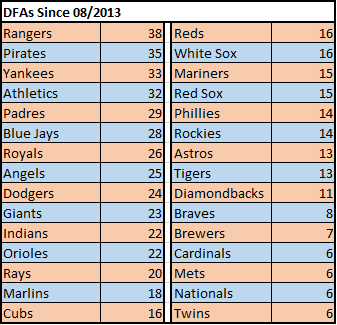
None of that really tells us much, of course. The start and end point are essentially random. And teams can dispose of players through other mechanisms, such as simply going right to an outright or release. But it is at least one indicator of roster management style (as well as recent team needs).
Let’s turn, then, to the results of the DFAs. Tallying things up results in the following distribution:
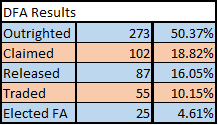
This, again, is not terribly surprising. Most players who have lost their 40-man roster spots are not appealing enough to be claimed, and so make it through waivers and receive outright assignments in their original organizations. The numbers do show that a significant number of players are able to find new 40-man homes — at least temporarily.
At risk of too much excitement in one post, let’s take one more angle for the time being. MLBTR has just one full year — with all the different months covered — in its still-new database. So, here’s a chart of the number of players designated in every month, along with the number of those players who were ultimately successfully outrighted. The first figure gives an idea of when the mechanism is most heavily used, while the latter gives at least some indication of when a club is more likely to be able to hold onto a player that it tries to pass through waivers.
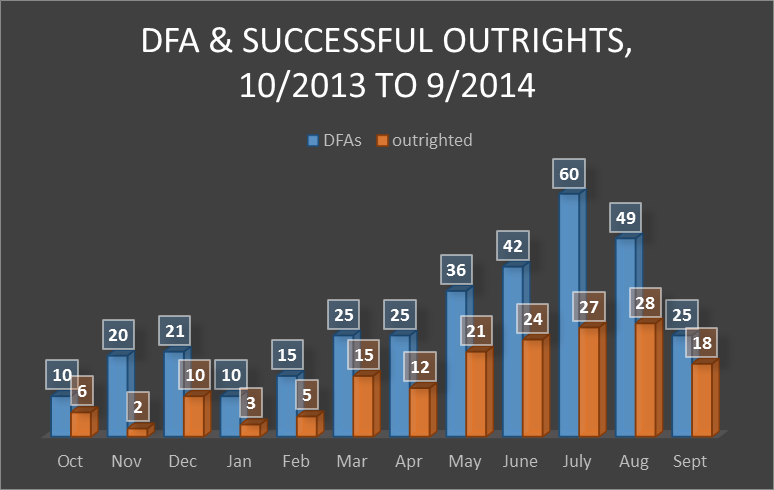
In the end, there is only so much inferring we can do from a dataset limited both by time and the nature of the thing it measures. Perhaps as the DFA Tracker grows, more will be possible. For now, I’ll end with this factoid: in the period of time immediately following the end of the 2013 regular season and running through the end of the 2014 regular season, fully 338 players — that’s more than 11 per team — lost their roster spots by way of the DFA.