
Angels, Giants Among Teams Pursuing Blake Snell
The Angels have lost Shohei Ohtani to the Dodgers and never appeared to be a finalist for NPB star Yoshinobu Yamamoto, but they’re pursuing the biggest fish remaining on the free agent market, per Susan Slusser of the San Francisco Chronicle, who reports that the Halos have made reigning NL Cy Young winner Blake Snell “their priority” now that Ohtani has officially departed. The Giants, too, are interested in Snell, per Slusser.
Signing Snell would be a departure from the norm for either club. The Angels’ three-year commitment to Tyler Anderson last offseason was the organization’s first multi-year deal for a free agent starting pitcher since signing Joe Blanton to a two-year contract a decade prior. Owner Arte Moreno has been comfortable with long-term deals for position players — oftentimes mega-deals that haven’t worked out favorably (Albert Pujols, Anthony Rendon, Josh Hamilton) — but has generally been wary of similar commitments to pitchers. The Angels did pursue Gerrit Cole when he was a free agent, but they of course lost out to the Yankees’ then-record bid of $324MM. (Yamamoto topped that mark by $1MM when he agreed to terms with the Dodgers.)
Similarly, the Giants have eschewed long-term deals for starting pitchers in five years under president of baseball operations Farhan Zaidi. San Francisco hasn’t gone beyond three years on any starting pitcher under the current regime — arguably a shrewd philosophy but also the reason that Kevin Gausman is starring for the Blue Jays on what now looks to be a wildly affordable five-year, $110MM contract. Zaidi’s club has gone to three years to sign Anthony DeSclafani and issued two-year deals for veterans Alex Wood, Alex Cobb, Sean Manaea and Ross Stripling, but longer-term pacts haven’t been in this front office group’s playbook.
Then again, the Giants also haven’t been consistently successful under this front office regime. Their 107-win season in 2021 stands as a clear highlight, but the Giants have fallen well shy of the lofty expectations set by that outlier season. Andrew Baggarly of The Athletic suggested earlier this week in his latest Giants mailbag that ownership could be providing “a little more direction from above” than in prior offseasons — particularly when it comes to this sort of long-term pursuit (one that, as Baggarly rightly notes, is largely possible by virtue of the front office’s prior aversion to taking on this sort of long-term risk). To be clear, Baggarly wasn’t addressing Snell in particular but rather the general philosophical shift associated with pursuing larger-scale additions from the free-agent market.
From a payroll vantage point, both the Halos and Giants can handle a weighty commitment to Snell, who’s reportedly been seeking a commitment of $200MM or more. San Francisco currently projects for a $158MM payroll, per Roster Resource, to say nothing of the fact that the Giants are about $45MM shy of the $237MM luxury-tax threshold. (Luxury tax is calculated by the sum of the average annual value on the payroll and can thus differ from the bottom-line dollars paid out in a given year; contracts are often backloaded or frontloaded for varying purposes.) The only two players signed beyond the 2025 season are ace Logan Webb (five years, $90MM from 2024-28) and newly signed center fielder Jung Hoo Lee, who inked a six-year, $113MM pact.
As for the Angels, they’re stuck paying the aforementioned Rendon $38MM for each of the next three seasons on his backloaded deal. There’s little no hope of trading that cumbersome contract away, so the team can only hope for a return to his Nationals form — unlikely as it may be as he enters his age-34 season. Anderson is signed through 2025 at $13MM per season, and the Angels still owe former MVP Mike Trout $34.45MM annually through the 2030 season.
Even with the huge commitments to Trout and Rendon, the Angels project for a $152MM payroll in 2024 and sit at just $167MM in terms of luxury-tax obligations. That leaves ample room to sign Snell, even if doing so would require shattering the franchise-record for a starting pitcher contract (Jered Weaver‘s five-year, $85MM deal).
It stands to reason that with both Ohtani and Yamamoto now off the board, the market for Snell will continue to crystalize in the coming weeks. Several runners-up for Yamamoto, in particular, could pivot to consider Snell — although various reports out of New York have indicated that the Mets aren’t expected to be among them. Will Sammon of The Athletic wrote last weekend that the Mets weren’t planning to pursue other top-tier free agents if they fell short in their bid for Yamamoto, whom they considered to be uniquely aligned with their long-term plan given his youth. MLB.com’s Anthony DiComo echoed that sentiment today, reporting that the Mets shouldn’t be expected to pursue Snell or fellow free agent Jordan Montgomery.
Tigers Designate Donny Sands For Assignment
The Tigers announced Friday that catcher Donny Sands has been designated for assignment. His spot on the 40-man roster goes to right-hander Shelby Miller, whose previously reported one-year contract has now been formally announced by the club.
Sands, 27, came to the Tigers from the Phillies alongside Matt Vierling and Nick Maton in the trade sending left-hander Gregory Soto and utilityman Kody Clemens to the Phillies. The Tigers viewed him as some valuable, optionable depth behind the plate, but the performance of Jake Rogers in the Majors and some struggles from Sands in Triple-A combined to keep Sands in the upper minors all season.
In 371 trips to the plate with Triple-A Toledo, Sands hit .225/.318/.353. Even when backup catcher Eric Haase struggled in the majors and was designated for assignment, the Tigers went outside the organization to bring Carson Kelly aboard on a one-year deal with a 2024 club option. The Tigers exercised that option earlier this winter, and Kelly is now in line to serve as Rogers’ backup.
Sands still has one more minor league option year remaining, and he’s posted roughly average framing grades in the upper minors. This past season, he logged a 24% caught-stealing rate. And, despite his scuffles in Toledo, Sands still carries a career .261/.352/.403 batting line parts of three Triple-A campaigns. Another club with some needs behind the dish could well hold interest in Sands, be it in a small trade or via a waiver claim. Detroit will have a week to find a trade partner or attempt to pass Sands through outright waivers.
Tigers Sign Shelby Miller
1:48pm: The Tigers have announced the signing. It’s a one-year contract worth a guaranteed $3MM, the team announced. They also hold a club option worth $4.25MM and a $250K buyout.
The Tigers, who have recently begun announcing the full terms of their contracts, added that Miller can earn an extra $1.175MM per season via incentives. He’ll receive $100K bonuses for reaching each of 50, 55 and 60 games pitched, plus another $125K for reaching 65 and 70 appearances. If he winds up serving as the closer, there’s even more money to be unlocked. The contract calls for $150K bonuses for 40, 45, 50 and 55 games finished.
The value of the club option can also be boosted by $1.4MM. Those escalators are tied to appearances ($100K for 50, 55 and 60 games pitched; $150K for 65 and 70 games pitched) and games finished ($200K for finishing 40, 45, 50 and 55 games).
8:39am: It’s a one-year contract with a 2025 option, reports Evan Petzold of the Detroit Free Press. Miller is in Detroit for his physical today, Petzold adds, so the contract should become official soon.
8:26am: The Tigers have agreed to a deal with free agent right-hander Shelby Miller, reports Kiley McDaniel of ESPN. The contract is still pending a physical. Detroit’s 40-man roster is full, so they’ll need to make a corresponding move to accommodate this latest addition. Miller is represented by Excel Sports Management.

Miller, 33, enjoyed a resurgent season with the 2023 Dodgers, pitching to a brilliant 1.71 earned run average in 42 innings over 36 appearances (35 relief outings, one start). He fanned a strong 25.8% of his opponents against a bloated 11.7% walk rate and kept the ball on the ground at a 37.4% clip — a few percentage points below the league average. Miller’s fastball is down about a mile per hour from its peak levels, sitting at a league-average 93.6 mph, but he also brandished a newly implemented splitter in 2023, which flummoxed his opponents.
Prior to the 2023 season, Miller had thrown exactly one splitter in his career — way back in 2014. He threw the pitch 26.2% of the time this past season, however, and batters were largely helpless against it. Miller threw 174 splitters in 2023 and finished off 47 plate appearances with the pitch; opponents posted an awful .136/.191/.250 against the pitch in that sample. Statcast credited the pitch with a .170 “expected” opponents’ batting average and a .274 expected slugging percentage.
That marked Miller’s first successful season since back in 2015. While he’d shown flashes of promise in the interim seven years, injuries and poor performances were far more common for the former top prospect and once-promising young starter. The 19th overall pick by the Cardinals back in 2009, Miller debuted in St. Louis as a 21-year-old, pitched to an outstanding 3.22 ERA over his first 575 1/3 big league frames and was twice traded in blockbuster deals — first going from St. Louis to Atlanta in exchange for Jason Heyward and a year later going to Arizona in the trade that brought Dansby Swanson and Ender Inciarte to the Braves.
Miller struggled immediately with the D-backs and never found his footing before undergoing Tommy John surgery in 2017. At various points, his career looked to be on the brink, but he persevered through considerable struggles and now, in his mid-30s, looks to have found new life as a quality bullpen arm.
The Dodgers didn’t use him in high-leverage spots often last year, but Miller could have a clearer path to setup work in Detroit. Right-handers Alex Lange and Jason Foley are the primary ninth- and eighth-inning options, respectively, and Detroit brought lefty Andrew Chafin back on a one-year deal as a left-handed setup option as well. But Miller has a good bit more experience than the bulk of the Tigers’ relievers and could find himself in more tight, late-inning spots this season.
Miller becomes the latest addition in what’s been a nice offseason of veteran pickups for the Tigers. Detroit has added righty Kenta Maeda (two years, $24MM) to help stabilize a young pitching staff and also bought low on former Cardinals ace Jack Flaherty (one year, $14MM), who’ll look to return to his prior heights in a new setting. The Tigers kicked off the winter by acquiring Mark Canha from the Brewers and picking up his 2024 option; he’ll join the team’s outfield and DH mix this coming season. Chafin, as previously noted, is returning to Comerica Park, where he excelled in 2022 before struggling with Arizona and Milwaukee in 2023. He and Miller have the potential to meaningfully fortify the Detroit relief corps.
There’s still room for some further additions, be they in the bullpen, on the bench or perhaps around the infield, where Detroit still lacks some certainty at multiple positions. Some of those could come from the trade market rather than free agency, although president of baseball operations Scott Harris indicated this week that he doesn’t envision trading from his newly deepened rotation mix. Wherever further reinforcements come from, the Tigers’ 2024 outlook is already brighter than the 2023 group. It’s a deepened roster that, with some continued development from young players like Spencer Torkelson, Riley Greene, Kerry Carpenter and prospects like Colt Keith and Justyn-Henry Malloy, could emerge as a viable contender in a weak American League Central division.
Padres Claim Luis Patiño
The Padres announced Friday that they’ve claimed right-hander Luis Patiño off waivers from the White Sox, who’d designated him for assignment earlier in the week. It’s a homecoming for Patiño, a former top prospect who was originally signed and developed by the Padres. Their 40-man roster is now up to 33 players.
Now 24 years old, Patiño was traded from San Diego to Tampa Bay alongside catcher Francisco Mejia, minor league catcher Blake Hunt and minor league righty Cole Wilcox in the 2020 trade that brought eventual two-time Cy Young winner Blake Snell to the Padres. At the time of the swap, Patiño was regarded as one of the sport’s very best pitching prospects; he’d scuffled through 17 1/3 innings in his initial call to the Majors the prior season (5.19 ERA, 21-to-14 K/BB ratio), but that debut came at just 20 years of age. Entering the 2020 campaign, each of Baseball America, MLB.com, Baseball Prospectus, FanGraphs, ESPN and The Athletic had ranked among the top 30 prospects in all of MLB.
As is made clear by the manner in which he’s returning to the Friars, things haven’t panned out for Patiño. The right-hander posted strong numbers in 29 1/3 Triple-A frames in 2021 and also spent the majority of that season on the big league roster in Tampa Bay. It wasn’t a great season by any means, but Patiño did post a 4.31 ERA with a 22.2% strikeout rate and 8.7% walk rate while averaging 96 mph on his heater. For a 21-year-old in his first full MLB campaign — and one who’d barely pitched above A-ball thanks to the canceled 2020 minor league season — it was a reasonably encouraging first foot forward.
From there, however, things went downhill quickly. Patiño suffered a severe oblique strain early in the 2022 campaign, prompting a 60-day IL placement and an absence of more than three months. Upon returning, he showed diminished velocity and far shakier results. Patiño walked more batters than he struck out in 20 MLB frames that year and was limited to 34 Triple-A innings, where he struggled with home runs and was tagged for a 4.50 earned run average.
In 2023, Patiño developed alarming command troubles, walking more nearly 18% of the opponents he faced in Triple-A between the Rays and the White Sox, who acquired him for cash considerations on the day of the trade deadline. In 21 1/3 innings at the MLB level, Patiño posted a 4.57 ERA with an 18.2% strikeout rate and 14.1% walk rate.
He’ll now head back to a Padres club that’s in need of pitching depth after seeing starters Snell, Seth Lugo, Michael Wacha and Rich Hill reach free agency in addition to relievers Josh Hader, Luis Garcia and Drew Pomeranz. Clearly, Patiño can’t be counted on like the Padres might have expected in 2021, had he not been traded, but he gives them a still-young arm to plug into the rotation mix or bullpen this spring. Patiño is out of minor league options, it should be noted, meaning he’ll have to either make the Opening Day roster or else be traded or placed on waivers once again.
Angels Claim Alfonso Rivas
The Angels have claimed first baseman Alfonso Rivas off waivers from the Guardians, per announcements from both teams. Cleveland designated Rivas for assignment last week. The Angels’ 40-man roster is now full.
Rivas, 27, lost his roster spot when the Guardians made their one-year contract with backup catcher Austin Hedges official. He’d only been in the organization for about a month, having come over in an early November waiver claim.
Rivas has seen MLB time in each of the past three seasons, splitting those years between the Cubs, Padres and Pirates. He hit well in a tiny sample of 49 plate appearances during his 2021 MLB debut with the Cubs but carries a more tepid .233/.316/.342 slash in 410 trips to the plate over the two previous seasons.
That said, Rivas has a minor league option remaining and an excellent track record at the game’s top minor league level. He’s a career .313/.424/.492 hitter in parts of four Triple-A seasons and has drawn a walk in a massive 15.1% of his plate appearances there. He’s more of a gap hitter than true power bat, evidenced by his 40 doubles and 15 long balls in 637 career plate appearances in Triple-A.
In some respects, Rivas has a skill set similar to that of expected Angels first baseman Nolan Schanuel, who raced to the Majors and debuted not even two months after being selected in the first round of the 2023 draft. Both are lefty-swinging first basemen with excellent plate discipline and more of a gap approach than a prototypical slugging first base profile. Schanuel, however, has a better hit tool, evidenced by his tiny 14.4% strikeout rate in a 132 plate appearance MLB debut (again, just months after playing NCAA ball).
Because Rivas has a minor league option remaining, he’s a sensible fallback option if the Angels both miss out on a larger upgrade at first base/designated hitter and see Schanuel struggle (be it in spring training or in the Majors early in the year). He could also serve as a lefty bat off the bench, if the Halos forgo further bench additions and prefer Rivas to 26-year-old first baseman/outfielder Trey Cabbage.
KBO’s Samsung Lions Sign Connor Seabold
The Samsung Lions of the Korea Baseball Organization announced Friday that they’ve signed former Red Sox and Rockies right-hander Connor Seabold. The Beverly Hills Sports Council client will be guaranteed $900K with another $100K available to him via incentives, per Jee-ho Yoo of South Korea’s Yonhap News Agency.
Seabold, 27, was a third-round pick of the Phillies back in 2017 and has twice been traded — first to the Red Sox as part of the deal bringing Brandon Workman and Heath Hembree to Philadelphia, and second to the Rockies last winter in exchange for cash. Colorado released Seabold on the day of the Rule 5 draft, opening a spot to make a selection in the process.
Earlier in his professional tenure, Seabold ranked among the top pitching prospects in both the Phillies and Red Sox systems, but elbow and forearm injuries shortened his 2021 and 2022 seasons. Seabold came to the Rockies with a solid track record in the upper minors, but his lone season with the Rox proved nightmarish both in Colorado and with their Triple-A affiliate in Albuquerque.
Seabold started 13 games and made another 14 relief appearances with Colorado this past season but was tagged for a gruesome 7.52 ERA in the process. He posted a sharp 6.9% walk rate but struggled with a well below-average 16.4% strikeout rate and a sky-high 1.96 HR/9. Seabold’s status as a pronounced fly-ball pitcher did him no favors at Coors Field, and he allowed hard contact a fair bit more often than the average big league pitcher (40.5%). Things didn’t go any better in Triple-A, where Seabold posted a 7.47 ERA in 31 2/3 frames.
As recently as 2022, Seabold tossed 86 2/3 innings of 3.32 ERA ball with Triple-A Worcester in the Sox’ system, striking out 24.7% of his opponents against an excellent 5.3% walk rate. The Lions will be hoping for something closer to that form, and if he’s able to replicate that performance, Seabold would likely position himself to be re-signed on a potential seven-figure guarantee. Given that he’s only heading into his age-28 season, Seabold is certainly young enough that an eventual return to MLB could be in the cards.
Oftentimes that requires multiple strong seasons in the KBO or NPB, although right-hander Erick Fedde, who’s three years older than Seabold, just parlayed one dominant KBO season (wherein he was named league MVP and won the KBO’s Cy Young equivalent) into a two-year, $15MM deal with the White Sox. That’s an ideal scenario for any player headed to Japan or Korea, and Seabold has enough prospect pedigree that if he can reinvent himself (perhaps with the help of a new pitch, as Fedde did), a similar path feels plausible.
Diamondbacks Designate Diego Castillo For Assignment
The Diamondbacks announced Friday that they’ve designated infielder Diego Castillo for assignment. His spot on the 40-man roster will go to outfielder Lourdes Gurriel Jr., whose previously reported three-year deal has now been formally announced by the club.
Castillo, 26, was traded from the Pirates to the D-backs 364 days ago, with Arizona sending minor league righty Scott Randall the other way in the deal. He appeared in just one game with the Snakes this season and went hitless in his lone plate appearance. He tallied 283 plate appearances in Pittsburgh a year prior but struggled to a .206/.251/.382 batting line in that MLB debut.
The bulk of Castillo’s 2023 season came in Triple-A Reno, where he played second base, shortstop, third base and left field over the course of 124 games. In 556 plate appearances, Castillo turned in an excellent .313/.431/.410 slash while walking more often than he struck out (17.4% versus 14.2%). In 177 career games at the Triple-A level, Castillo is a .296/.410/.407 hitter with nearly as many walks (124) as strikeouts (125).
Given his versatility, keen eye at the plate and excellent bat-to-ball skills, there’s a good chance that Castillo will draw interest from another club — if not in a trade (which seems quite plausible) then at least via waiver claim. He was never an elite prospect, but reports on the Venezuelan-born infielder have long touted his plus hit tool, even if that’s generally seen as his only above-average tool. Castillo has never swiped more than 13 bases and only has two seasons where he’s reached double-digit home runs; he hit just three long balls in 2023 despite spending the year in an immensely hitter-friendly setting.
Even if he’s “only” a contact-oriented utilityman, there’s still value to be had with Castillo. The fact that he’s being designated for assignment to make way for Gurriel’s return speaks to the manner in which the Arizona roster has deepened in a short time. The 2021 D-backs lost 110 games, but in just two years they’ve climbed to the World Series runners-up and are jettisoning a player who’d have been a veritable lock for playing time there just a couple seasons ago.
The Diamondbacks will have a week to trade Castillo or attempt to pass him through outright waivers.
Twins, Niko Goodrum Agree To Minor League Deal
The Twins have agreed to a minor league deal with veteran utilityman Niko Goodrum, per the team’s transaction log at MLB.com. It’s a homecoming for the Roc Nation client, who was originally selected by Minnesota in the second round (71st overall) of the 2010 draft. Presumably, the switch-hitter will be in big league camp with the Twins this spring and compete for a bench role.
Now 31 years old (32 in February), Goodrum made his big league debut as a Twin back in 2017, but he appeared in only 11 games late in the season, going 1-for-17 in that brief MLB audition. Minnesota removed him from the 40-man roster that winter, and he quickly signed a minor league deal with the division-rival Tigers. It proved to be a shrewd move for Detroit, as Goodrum spent the next four seasons there and enjoyed two particularly productive years as a highly versatile utilityman.
In four seasons as a Tiger, Goodrum hit .232/.306/.401 in 1468 plate appearances. It was below-average production (10% worse than average, by measure of wRC+), though that’s weighed down by shaky performances in his final two seasons there. From 2018-19, Goodrum turned in a roughly average .247/.318/.427 slash with 28 homers and 24 steals in 968 plate appearances. He moved all over the diamond during his time with the Tigers, logging action at every position other than catcher and pitcher. During that two-year stretch in ’18-’19, however, Goodrum’s glovework graded out especially well. Statcast credited him with a whopping 10 Outs Above Average at shortstop in just 326 innings during the 2019 campaign.
Since that four-year stint with the Tigers, Goodrum has been with the Astros (for whom he made a brief MLB appearance in ’22), Red Sox and the KBO’s Lotte Giants. He concluded the 2023 season with that KBO run, posting a nice .295/.373/.387 slash (114 wRC+). Goodrum didn’t homer during his KBO time — a surprise considering he’s typically shown double-digit home run pop in North American ball — but walked at a hefty 11.4% clip.
The Twins’ bench currently projects to include catcher Christian Vazquez, infielder Kyle Farmer and utilitymen Willi Castro and Nick Gordon. Vazquez and particularly Farmer are trade candidates this winter, however, as Minnesota looks to scale back payroll amid uncertainty regarding their television rights situation. Gordon, meanwhile, struggled immensely in 93 plate appearances last year before fouling a ball into his leg and suffering a broken tibia that ended his season. He’s out of minor league options, so he’ll need a nice spring showing to solidify his place on the club. Depending on how things play out with Farmer’s trade candidacy and Gordon’s spring performance, it’s possible Goodrum could force his way into the mix. If not, he’ll likely head to Triple-A St. Paul and give Minnesota a veteran depth option who could provide insurance at the majority of spots on the diamond.
Yankees, Nick Burdi Agree To Minor League Deal
The Yankees have agreed to a minor league pact with hard-throwing right-hander Nick Burdi, reports Jack Curry of the YES Network. The Apex Baseball client will be in big league camp this spring.
Selected 46th overall out of Louisville by the Twins back in 2014, Burdi joined the professional ranks as a power-armed closer who could potentially have a fast track to the big leagues. He’d obliterated the opposition in college, posting a 1.79 ERA while fanning a comical 47% of his opponents during his NCAA career. He looked the part of a big league reliever following the draft, too, climbing to Double-A less than a year after being drafted and posting gaudy strikeout totals along the way.
As is the case with so many flamethrowing young arms, however, injuries intervened. A bone bruise in his upper arm wiped out most of Burdi’s 2016 season, and his 2017 campaign was cut short by Tommy John surgery. The Twins lost Burdi in the 2017 Rule 5 Draft — the Phillies selected him and immediately traded him to the Pirates — and he made his MLB debut with Pittsburgh late in the 2018 season.
Because he spent the bulk of the year on the injured list, Burdi’s Rule 5 designation carried over from the 2018 season into the 2019 season. He pitched just 8 2/3 innings before undergoing thoracic outlet surgery and missing the rest of the year. Burdi returned in 2020 but pitched just 2 1/3 MLB frames before hitting the injured list with an elbow issue that eventually resulted in his second career Tommy John surgery. Burdi finally returned to the mound with the Cubs organization in 2023, but as if the slate of arm injuries hadn’t been difficult enough, he also missed a substantial portion of the ’23 campaign after requiring an emergency appendectomy in late May.
Although we’re coming up on nearly a decade since Burdi was drafted, he’s pitched just 15 1/3 innings in the Majors due to that stunning slate of injuries. The results haven’t been good, as he’s allowed 16 runs in that time. Burdi, however, has a 3.51 ERA in parts of six minor league seasons and has whiffed just shy of 33% of opponents in his professional career (big leagues and minors combined). His durability is an enormous question, of course, but his arm strength is not; in the tiny sample of three MLB innings with Chicago last year, Burdi averaged 98 mph on his heater and reached triple digits at times.
If he can remain healthy enough to emerge as an option for the Yankees, he still has all three minor league option years remaining, which would give New York plenty of flexibility in the ‘pen. He has to be viewed as a long shot to remain healthy, given his track record of injuries, but Burdi still looks to have plenty of fire in his right arm and deserves credit for grinding through a grueling slate of injuries that would surely have been enough for many pitchers to call it quits.
MLB Announces Modifications To Pitch Clock, Other Rule Changes
1:27pm: In a statement, Major League Baseball Players Association executive director Tony Clark announced that the players on the Competition Committee voted against today’s slate of changes.
“This afternoon, Player Representatives voted against the 2024 rule changes proposed by the Commissioner’s Office,” the statement reads. “As they made clear in the Competition Committee, Players strongly feel that, following last season’s profound changes to the fundamental rules of the game, immediate additional changes are unnecessary and offer no meaningful benefits to fans, Players, or the competition on the field. This season should be used to gather additional data and fully examine the health, safety and injury impacts of reduced recovery time; that is where our focus will be.”
1:15pm: Major League Baseball announced a slate of modifications to the game’s official rules, which have been approved by the MLB Competition Committee (comprised of six owners, four players and one umpire). Per the league’s press release, the changes are as follows:
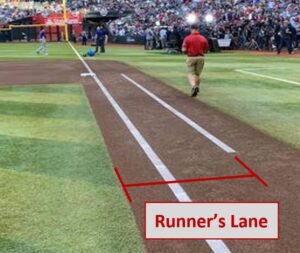
- Runner’s Lane: The Runner’s Lane will be widened to include the dirt area between the foul line and the infield grass. Widening the lane allows batters to take a more direct path to first base while retaining protection from interference. The distance between the foul line and the infield grass will be between 18 and 24 inches in all parks, with some limited grace periods granted by MLB due to difficulty in modifying the field (e.g., synthetic turf field).
- Pace of Game: MLB proposed minor changes to the Pace of Game Regulations to address an increase in game time as the season progressed – the average nine-inning game time increased seven minutes from April to September (five minutes after controlling for the number pitches, breaks, and runs scored).
- Timing Between Pitches: Reduce time from 20 seconds to 18 seconds with runners on base. Pitchers began their deliveries with an average of 7.3 seconds remaining on the 20-second timer in 2023. Pitchers retain the ability to step off and re-set the Clock up to two times without penalty. Violations with runners on base were the least frequent (14% of all violations vs 32% of all pitches) in 2023. A universal 17-second Clock used for the final month of the Triple-A season did not increase violations with runners on base.
- Batter Timeouts: Based on player feedback, MLB withdrew a proposal that would have required the home plate umpire to immediately reset the Pitch Clock after a batter called timeout.
- Pitching Changes: If a new pitcher steps onto the warning track with less than 2:00 remaining on the inning break Clock, the Clock will reset to 2:00 rather than 2:15 as was the case in 2023. Inning breaks that contained a pitching change averaged 2 minutes and 35 seconds in 2023 (broadcasters are only guaranteed two minutes of commercial time).
- Mound Visits: Mound visits will be reduced from five per game to four, and an extra mound visit will still be awarded for the ninth inning if the defensive team has zero remaining at the end of the eighth inning. Mound visits rank among fans’ least favorite events in baseball. Clubs averaged only 2.3 mound visits per game in 2023. Last season, 98% of games would not have exceeded a limit of four mound visits. Umpires will also permit defensive players to signal for a mound visit without actually visiting the mound to further help improve pace of game.
- Circumvention: The FTC (field timing coordinator) will now restart the timer after a dead ball (e.g., foul ball) when the pitcher has the ball and play is ready to resume. There will no longer be a requirement for the pitcher to be on the mound, removing the pitcher’s ability to delay the start of the timer by walking around the edge of the mound.
- Pitcher Who Warms Up Must Face At Least One Hitter: A pitcher who is sent out to warm up for an inning must face at least one batter (in addition to any requirements under the Three-Batter Minimum rule). There were 24 instances this season where the pitcher that warmed up between innings was replaced before throwing a pitch (adding approximately three minutes of dead time per event). There were two such instances during the 2023 World Series.
Runner’s lane photo courtesy of Major League Baseball communications department.