
Hitting Coach Tim Hyers Leaving Red Sox
Hitting coach Tim Hyers has declined the Red Sox’ offer to return in 2022 and will not return to the staff, reports Alex Speier of the Boston Globe. He’s instead exploring opportunities with other clubs. In his place, the Red Sox are set to promote assistant hitting coach Peter Fatse to the lead hitting coach role, per Steve Hewitt of the Boston Herald.
The 50-year-old Hyers has spent the past four seasons as hitting coach in Boston and spent the two prior seasons as the Dodgers’ assistant hitting coach. The Sox have been one of the game’s best offensive clubs during that time, and Speier notes that Hyers worked with both Mookie Betts and Xander Bogaerts to overhaul their approaches at the plate prior to the 2018 campaign. Hyers is the second coach to depart the Red Sox organization this offseason, as chief baseball officer Chaim Bloom already announced during his end-of-season press conference that first base coach Tom Goodwin wouldn’t return to the organization.
Fatse, 34, was a 2009 draft pick of the Brewers (24th round) after playing his college ball at the University of Connecticut. He spent two years in the Brewers’ system and another two years playing on the independent circuit before retiring as a player. He previously served as the Twins’ minor league hitting coordinator before being tabbed as the assistant hitting coach to Hyers heading into the 2020 season.
The Sox still need to replace Goodwin on the staff, and while they’ll handle the departure of Hyers with an internal promotion, they’ll still need to fill the assistant hitting coach role as well. There’s no indication yet as to how they’ll proceed. The team has not formally announced the shakeup to the hitting coach mix but figures to do so before long.
Rangers To Name Donnie Ecker Bench Coach
The Rangers are hiring Donnie Ecker away from the Giants to serve as the new bench coach and offensive coordinator in Texas, reports ESPN’s Jeff Passan (via Twitter). Ecker has spent the past two seasons as the hitting coach in San Francisco.
Ecker, 35, was a 22nd-round draft pick by the Rangers back in 2007 and spent a couple seasons as a second baseman in their system before moving onto a two-year stint on the independent circuit. Since calling it quits as a player, he’s coached in the college ranks, worked on the Cardinals’ player development staff and spent a couple of seasons in the Reds organization. With Cincinnati, Ecker was an assistant hitting coach on the Major League staff and the organization’s overall director of hitting.
As bench coach, Ecker will be stepping in to replace the recently dismissed Don Wakamatsu, who’d spent the past four seasons as bench coach in Texas. The Rangers also parted with hitting coach Luis Ortiz at the that same time, and while Ecker won’t be the team’s new hitting coach, his previous work in that role and the newly created title of offensive coordinator indicate that he’ll play a vital role in developing offensive philosophies and methodologies throughout the organization.
The Rangers still have not named a new hitting coach to replace Ortiz, but to this point it seems that both assistant hitting coach Callix Crabbe and minor league hitting coordinator Cody Atkinson are remaining in the organization. The addition of Ecker is one of multiple organizational changes the Rangers are set to make this winter. They’re also reportedly hiring Josh Bonifay away from the Phillies to serve as their new farm director.
Option Notes: Perez, Vazquez, Chafin
Catcher Roberto Perez‘s $7MM option for the 2022 season isn’t likely to be exercised by the Guardians, Paul Hoynes of the Cleveland Plain Dealer writes in his latest mailbag column. Set to turn 33 in December, Perez has long rated as one of the game’s premium defenders behind the dish and looked to have turned a corner at the plate in 2019, when he hit .239/.321/.452 with a career-high 24 home runs. However, he’s limped to a .155/.253/.277 slash with eight homers in 276 trips to the plate since. Perez has missed significant time over the past two seasons due to a pair of shoulder injuries and, earlier this year, a fractured ring finger. It’s certainly plausible that the shoulder and hand injuries contributed to his decline at the plate, but a budget-conscious Cleveland club doesn’t seem likely to bet $7MM on a rebound — particularly when the buyout is a relatively light $450K. Cleveland has a more affordable, similarly defensive-minded backstop already on the roster in arbitration-eligible Austin Hedges. He’s projected by MLBTR contributor Matt Swartz to earn a $3.8MM salary next season.
Some more notes on various contract options around the league…
- The Red Sox hold a $7MM club option on catcher Christian Vazquez, but the price to retain their backstop was nearly a bit steeper. MassLive.com’s Chris Cotillo points out that Vazquez’s contract called for that option to rise to $8MM upon reaching 502 plate appearances, but he fell just four trips to the plate shy of that mark. Chief baseball officer Chaim Bloom spoke highly of Vazquez in his end-of-season press conference, telling reporters: “It’s a hard position to check all the boxes and you don’t take for granted when you have someone who has shown that he can do it.” The 31-year-old Vazquez hit .258/.308/.352 with plus defense behind the dish this season, and based on Bloom’s comments imply there’s a good chance he’ll be back in the fold next season as well.
- Andrew Chafin‘s one-year, $2.75MM deal with the Cubs was structured to include a $2.25MM salary plus a $500K buyout on a $5.25MM mutual option. The contract, however, also allowed Chafin to pick up a $125K bonus for reaching 50, 55, 60 and 65 games in 2021. Chafin was heavily used both by the Cubs and then by the Athletics following a trade, and he ultimately reached all four of those milestones while wearing an A’s jersey. As such, he’s now sitting on a $5.75MM option for next season. Chafin will have first say of whether to exercise his half of the option and could very well decline in search of a multi-year deal, which would render it a moot point. (He’d get the $500K buyout even if he declines.) If not, the fact that the option is now $500K more expensive makes it even tougher for the cost-conscious A’s pick up their end in what could be an offseason filled with tough financial decisions. Oakland also holds a $4MM club option on fellow southpaw Jake Diekman, which is effectively a net $3.25MM decision for the A’s, given its $750K buyout.
Dodgers Plan To Decline Option On Joe Kelly
The Dodgers hold a $12MM club option with a $4MM buyout on right-hander Joe Kelly, but Jorge Castillo of the L.A. Times reports that the team is planning to pay him the buyout rather than pick up the net $8MM option. Part of the reasoning, according to Castillo, is that the biceps strain which caused Kelly to be removed from the NLCS roster is significant enough that he won’t be ready for the start of the 2022 season.
If that indeed proves to be the case, it’ll be an obvious detriment to Kelly’s free-agent stock this offseason. The 33-year-old could’ve been in position to command another multi-year deal were he at full strength, and the Dodgers would have had to give some consideration to a net $8MM decision for next year. Kelly’s first season in L.A. (2019) didn’t go as smoothly as he or the team hoped, but he’s pitched to a 2.67 ERA with a 26.3% strikeout rate and a 9.8% walk rate over the past two seasons. He averaged 98.1 mph on his heater this year — his best mark since 2018 — and also notched a career-best 11.6% swinging-strike rate.
The possible departure of Kelly is just one layer of what looks like a large amount of turnover among the Los Angeles relief corps. The Dodgers also have each of Kenley Jansen, Corey Knebel and Jimmy Nelson up for free agency this winter, and it’s unlikely that they’ll retain all of those pending free agents.
Depending on how strong an effort the Dodgers make to retain that group, the late-inning picture will look quite different for Dave Roberts & Co. Blake Treinen could step into the closer’s role for the first time since departing Oakland a few years back, while flamethrowing Brusdar Graterol would likely be in line for a higher-leverage role. The Dodgers will also hope to have former Yankees setup man Tommy Kahnle play a prominent role in 2022. He inked a two-year pact with Los Angeles last offseason, and the Dodgers knew at the time that he’d miss the 2021 season while rehabbing from Tommy John surgery.
Turning back to Kelly, it remains to be seen just when he’ll be ready to go next season. If his outlook ultimately is strong enough that he can make it back to the mound relatively early in the season, he should still generate strong interest in free agency. Beyond the fact that he’s one of the hardest throwers on the free-agent market, Kelly has a lengthy track record of missing bats at a strong clip and limiting home runs at a far better level than the average reliever. Kelly has allowed just 0.63 HR/9 over the past five seasons; the league-average relief pitcher has yielded 1.20 HR/9 in that time.
Offseason Outlook: Kansas City Royals
Even after the Royals’ work to put together a contending club in 2021 didn’t pan out, expect newly promoted president of baseball operations Dayton Moore and general manager J.J. Picollo to take another shot at adding some win-now pieces to complement a promising young core.
Guaranteed Contracts
- Salvador Perez, C: $82MM through 2025 (includes $2MM buyout of $13.5MM club option for 2026)
- Hunter Dozier, 1B/3B/OF: $21.75MM through 2024 (includes $1MM buyout of $10MM club option for 2025)
- Mike Minor, LHP: $11MM through 2022 (includes $1MM buyout of $13MM club option for 2023)
- Carlos Santana, 1B/DH: $10.5MM through 2022
- Michael A. Taylor, OF: $9MM through 2023
- Whit Merrifield, 2B/OF: $4MM through 2022 (includes $750K buyout of $6.5MM club option for 2023*)
- Total 2022 commitments: $50.5MM
- Total of all long-term commitments: $138.25MM
*The value of Merrifield’s 2023 option will increase to $10.5MM if he spends fewer than 109 days on the IL from 2019-22. He has not been on the injured list in that time (or at all in his MLB career).
Projected Salaries for Arbitration-Eligible Players (projections via MLBTR contributor Matt Swartz)
- Andrew Benintendi – $9.3MM
- Adalberto Mondesi – $3.2MM
- Jakob Junis – $1.8MM
- Brad Keller – $5.2MM
- Cam Gallagher – $900K
- Scott Barlow – $2.4MM
- Ryan O’Hearn – $1.4MM
- Nicky Lopez – $2.0MM
- Non-tender candidates: Junis, Gallagher, O’Hearn
Free Agents
- Greg Holland, Hanser Alberto, Wade Davis, Ervin Santana, Jesse Hahn, Scott Blewett
The Royals got a head-start on some offseason business in September. General manager Dayton Moore was promoted to president of baseball operations, while longtime assistant GM J.J. Piccolo was elevated to the title of general manager. The pair of title bumps helped the Royals to ensure that both well-regarded execs will remain with the club and avoid being considered for lateral moves (that would previously have represented promotions) with other organizations. Meanwhile, the team kept center fielder Michael A. Taylor from reaching the free-agent market by hammering out a two-year, $9MM extension.
Taylor, 31 in March, turned in a dismal .244/.297/.356 batting line (77 wRC+) but played center field at such a ridiculously high level that it really didn’t matter. The Royals loved the glove enough to give Taylor 528 plate appearances, and he rewarded them with 19 Defensive Runs Saved, a 13.3 Ultimate Zone Rating and 15 Outs Above Average — a mark that trailed only Tampa Bay’s Manuel Margot among all MLB outfielders.
The extension for Taylor preemptively answered the Royals’ center field question, and he’ll now return alongside left fielder Andrew Benintendi, who’s due one final arbitration raise. Benintendi no longer looks like the budding star we saw with the 2018 Red Sox, but he’s settled in as a slightly above-average bat and will give Kansas City a solid option for at least the 2022 season (if the team doesn’t look to further extend him this spring). Taylor and Benintendi can hold down two of three outfield spots, but the third is where the path moving forward becomes murkier.
Whit Merrifield and Hunter Dozier are both under contract for multiple seasons — Merrifield through at least 2022 with a 2023 club option, and Dozier through at least 2024 with a 2025 option. The former has been one of the game’s great bargains and a perennially unheralded star (at least relative to the acclaim he receives). The latter scuffled through a dismal 2021 showing that has made last March’s $25MM contract extension look regrettable.
Twenty-four-year-old Kyle Isbel also forced his way into the outfield conversation this year with a solid Triple-A showing (.269/.357/.444, 116 wRC+) and a torrid hot streak following a mid-September call to the Majors. In 47 plate appearances down the stretch, Isbel hit .286/.362/.524.
Isbel is purely an outfielder, but both Merrifield and Dozier can and have played in the outfield and infield extensively. Looking around the infield dirt, however, the picture is quite crowded. Top prospect Bobby Witt Jr. should seize the shortstop position before too long, and the Royals have already moved Adalberto Mondesi to third base in part to prepare for a potential position change. Nicky Lopez was a Gold Glove candidate at shortstop this year (another reason Mondesi moved to the hot corner) and has likely cemented his spot in next year’s infield mix — even if it means a move to second base.
Kansas City could split first base and designated hitter duties between Dozier and veteran Carlos Santana, with Merrifield taking the bulk of his reps in right field and Isbel getting more work in Triple-A. That might be a palatable option were it not for the looming arrival of another top prospect: first baseman Nick Pratto. The former first-round pick went from potential afterthought to potential building block with a ludicrous minor league season that saw him post a .265/.385/.602 batting line with 36 long balls between Double-A and Triple-A. He’s all but ready for an MLB look himself, and that’s where things get tougher.
First and foremost: Moore has made clear in the past that he has little interest in trading Merrifield. Although Merrifield has long been a player for whom rival fans (and surely rival clubs) have pined in trade scenarios, Kansas City extended him mid-rebuild and has never shown an inclination to move him. Now that Moore & Co. have shifted to a win-now mindset, Merrifield isn’t likely to suddenly be available — even with his club control dwindling.
That said, neither Dozier nor Santana is teeming with trade value. Dozier hit just .216/.285/.394 in 2021 and posted poor defensive marks at multiple positions. Santana was terrific through the season’s first two months before flopping with a .198/.287/.296 slash from June 1 through season’s end. The Royals could explore swapping out either for another sub-optimal contract, but it’s also possible that Dozier simply moves to a bench role and Kansas City hopes for a rebound from one or both. Dozier, after all, has played all four corner spots and finished the season on a big high note, hitting .272/.346/.576 from Sept. 1 onward.
The only other spot on the diamond yet to be addressed in this writing barely even needs mention. Salvador Perez’s 2021 campaign was one of the best by any catcher in Major League history, and he’ll return as the team’s linchpin behind the plate. Perhaps the Royals will explore the market for a veteran backup, as neither Cam Gallagher nor Sebastian Rivero inspires much confidence in the event of an untimely injury to Perez. Then again, both are passable backups — especially considering Perez’s ironman workload — and the Royals likely have a superior safety net waiting in the wings, should Perez require a prolonged stay on the injured list.
For all the attention (rightfully) placed on huge seasons for Witt and Pratto in Double-A and Triple-A, the Royals had a third overwhelming performance from a minor league hitter. Catching prospect MJ Melendez was not only in the Double-A and Triple-A lineups with Witt and Pratto the whole way — he actually outproduced both at the plate. In 531 plate appearances between those two levels, Melendez mashed at a combined .288/.386/.625 pace with 41 home runs. Selected just 38 picks after Pratto in 2017, Melendez joined in his draft-mate in flipping the narrative on that ’17 draft class in convincing fashion.
Unlike Pratto and Witt, however, Melendez doesn’t have a clear path to everyday at-bats moving forward. He could certainly operate as a designated hitter and part-time catcher, gradually increasing his workload behind the dish as Perez’s own workload decreases with age. That opportunity might not present itself until 2023, barring a deal to unload Santana, but it’s certainly one to which the Royals have to be open.
Alternatively, it’s inevitable that catching-needy clubs around the game will see a blocked catching prospect who just put the finishing touches on a mammoth minor league season and try to pry him loose. The Marlins, Astros, Rangers and perhaps the Yankees are all teams in need of long-term solutions behind the dish. This isn’t a situation where the Royals would use Melendez in order to shed a contract such as Santana, to be clear, but Kansas City will field plenty of interest in Melendez this winter. Miami, in particular, is teeming with young pitching it could offer the Royals.
Of course, the Royals have their own collection of impressive young arms on which they’ll rely moving forward. The 2021 Royals were the first team in Major League history to have five pitchers from the same draft class start a game for the team that drafted them (via Royals director of communications Nick Kappel, on Twitter). Brady Singer, Jackson Kowar, Daniel Lynch and Kris Bubic were Kansas City’s top four picks in 2018, and 18th-rounder Jon Heasley made his own MLB debut late in the season. Add breakout righty Carlos Hernandez, veteran Mike Minor, stalwart Brad Keller and righty Jakob Junis to the mix, and the Royals have some obvious depth before even making any additions.
That depth is nice, but it didn’t yield results for the Royals in 2021. Kansas City starters ranked 24th in the Majors with a 4.97 ERA. As was the case with Santana, Minor’s two-year deal failed to pay dividends. He soaked up a team-high 158 2/3 innings but did so with a 5.05 ERA. Fielding-independent metrics were more forgiving, but one has to imagine that the Royals would be open to finding a way to move Minor and the $11MM he’s still guaranteed ($10MM salary in 2022; $1MM buyout of a $13MM club option for 2023).
Looking to the homegrown arms, all four of Singer, Lynch, Kowar and Bubic previously ranked among the game’s top 100 prospects. Singer showed promise during his 2020 debut but took a step back in 2021 (128 1/3 innings, 4.91 ERA). Each of Bubic, Lynch and Kowar walked 10% or more of the hitters they faced and did so with below-average strikeout rates. Not every top-ranked pitching prospect dominates from day one — the vast majority do not, in fact — but it’s fair to say the Royals were probably hoping for better results from at least some of this group through this stage in their young careers.
Be that as it may, the Royals can still count themselves eight deep (if not more) in viable rotation options. They’ll be looking for some to take a step forward, but the fate of next year’s staff is largely dependent on the continued development of the young pitchers. There’s certainly room to add a veteran on a low-cost deal, but the hope will be that some combination of Singer, Bubic, Lynch, Kowar and Hernandez seizes at least a couple of long-term spots.
To recap: the Royals have three near-MLB top-100 prospects, with only one (Melendez) truly being blocked by a veteran. They have more infielders than infield spots available (in part due to underperformers Dozier and Santana), and they have more outfielders than outfield spots available. They’re also teeming with young starters who carry plenty of potential but have yet to piece things together.
It’s not hard to see why the front office is so bullish on the long-term outlook. However, the Royals need a lot of positive strides, from a development standpoint, for this group to be deemed a contender. They could opt for a quiet winter with regard to the lineup and the rotation, relying solely on internal development — or they could do what they did nearly a decade ago and condense some of this talent into more proven stars. It’s been almost nine years since the Royals acquired James Shields and Wade Davis in a trade that sent then-top prospects Wil Myers and Jake Odorizzi to Tampa Bay, but the current Kansas City roster is in a somewhat comparable spot.
There’s virtually no scenario in which the Royals move Witt, and Pratto seems quite unlikely to be dealt himself. But with Melendez being blocked, a smorgasbord of young rotation hopefuls and perhaps players like Isbel or Mondesi lacking straightforward paths to playing time, there are multiple avenues for Moore, Picollo and the rest of the front office to explore.
In surprisingly candid fashion this summer, Moore indicated that the team simply can’t count on the wildly talented but oft-injured Mondesi as an everyday player, though he also emphasized the organization had no plans to give up on him. Still, with several other infield options and Mondesi now just two years from free agency, it stands to reason that other clubs will look into acquiring him. Suffice it to say, while the Royals may not be the most active team in the free-agent market, they’ll likely still be active in talks with other clubs around the league.
The one area of the club that this outlook has yet to address, of course, is the bullpen. Dominant relief pitching was a hallmark of the Royals’ 2014-15 World Series clubs, and the foundation for a similarly strong bullpen could be in place. Controllable, power-armed righties Scott Barlow and Josh Staumont had breakout years and positioned themselves as a formidable one-two punch in 2022 and beyond. Rookie southpaw Jake Brentz had a strong debut of his own and averaged 97 mph on his heater, but he’ll need to curb his 13.3% walk rate. Domingo Tapia and Dylan Coleman showed varying levels of promise.
That said, the bullpen is the most obvious area that the Royals could look to spend in free agency. Kansas City is projected for just shy of $87MM in payroll next season (using Swartz’s arbitration projections), and that number could fall with some non-tenders looking quite likely. The Royals have just $33MM on the books in 2023. It’d still be a shock to see them play at the very top of the relief market (i.e. Raisel Iglesias), but any of the second-tier options thereafter (Kendall Graveman, Corey Knebel, etc.) could easily fit into the Royals’ payroll. Putting together a deep bullpen will only take pressure off the young arms in the rotation.
The 2021 season didn’t go as Moore and his staff hoped when dipping back into the free-agent market last winter, but it’s still hard to look at all of the talent on the horizon in Kansas City and not believe better days are ahead. The Royals can afford to make a splash or two in the bullpen. Their growing crop of young talent and considerable payroll space gives them ample leverage to take a bigger swing on the trade market if the opportunity presents itself.
Thyago Vieira Drawing Interest From MLB Clubs
Yomiuri Giants right-hander Thyago Vieira is drawing interest from Major League clubs as the offseason approaches, MLB.com’s Mark Feinsand tweets. The flamethrowing righty appeared in parts of three big league seasons with the Mariners and White Sox, from 2017-19, before signing overseas in Japan.
Things have gone well for Vieira, 28, in Nippon Professional Baseball. He’s totaled 80 innings out of the Giants’ bullpen over the past two seasons, logging a combined 3.04 ERA with a 26.9% strikeout rate and a 12.4% walk rate.
Vieira averaged 97 mph on his heater during his brief big league run and has the ability to reach triple digits with that fastball — a pitch that drew 80 grades on the 20-80 scouting scale in reports at FanGraphs and MLB.com back in his prospect days. He doesn’t appear to have lost any life on the pitch, as Vieira hit 166 kilometers/103 miles per hour with that pitch earlier this year (YouTube link). Vieira has also drawn praise in the past for an above-average breaking ball, but command (or lack thereof) has generally been problematic. He walked 11.2% of his MLB opponents and 11% of the batters he faced in Triple-A.
Based on his work in NPB to date, those same command problems still exist, but the appeal of that huge fastball and some quality run-prevention numbers in Japan still seem to have drummed up some interest. Feinsand suggests as many as five MLB teams have interest, although the extent of that interest surely varies.
The looming offseason features a relatively thin market for right-handed relievers. Raisel Iglesias is the clear top name available, with pitchers like Kendall Graveman, Corey Knebel, Ryan Tepera and Mark Melancon making up the second tier. Vieira would have the top fastball of any reliever on the market, but it remains to be seen if interest will be substantial enough for him to come back from Japan. Given his success in NPB, he’d surely have some guaranteed offers to remain overseas, so a big league club would presumably need to make a decent offer on a Major League contract.
Front Office Notes: Mets, Angels, Rangers
The Mets’ front office search has become a rather prominent storyline in baseball at the moment, as several notable executives have either removed their names from consideration or been denied permission by their current clubs to interview. Despite those struggles in pursuing rival GMs and presidents, SNY’s Andy Martino reports that the Mets are not considering some of the rumored former baseball ops leaders who are no longer running a department. Former Giants president Brian Sabean, former Marlins president Michael Hill and former Astros president Jeff Luhnow are not currently being considered, per Martino. Rather, current Mets president Sandy Alderson is still actively seeking permission to interview the No. 2 and No. 3 executives with various clubs as the Mets seek a new baseball ops leader.
Some more front office notes from around the game…
- The Angels have hired Tim McIlvaine away from the Brewers to fill as their new scouting director, Kiley McDaniel and Alden Gonzalez of ESPN report (Twitter thread). McIlvaine, who was previously the Brewers’ assistant director of scouting, worked extensively with current Angels vice president of amateur scouting Ray Montgomery when both were in Milwaukee. Montgomery was one of the first hires by under new Angels GM Perry Minasian last offseason. The Angels removed former scouting director Matt Swanson from his post last week but offered him a position elsewhere in the organization. Swanson was hired by former general manager Billy Eppler and has overseen the Halos’ past five drafts.
- Josh Bonifay is returning to the Rangers organization as their new farm director, Evan Grant of the Dallas Morning News reports. Bonifay had been the Phillies’ farm director for the past three seasons but was removed from that role and offered a spot on the team’s pro scouting staff for next season back in August. The son of former Pirates general manager Cam Bonifay, Josh has spent more than a decade in baseball operations, mostly in the Astros organization, but was also the Rangers’ field coordinator and a member of the Major League coaching staff with then-manager Jeff Banister in 2017. Bonifay has also spent time as a minor league coach and manager, a minor league field coordinator and was the Astros’ hitting coordinator in 2018 before being hired by Philadelphia.
Pirates Have “Had Dialogue” With Yoshi Tsutsugo
The Pirates have interest in re-signing first baseman/outfielder Yoshi Tsutsugo and have already “had dialogue” with his camp, general manager Ben Cherington told reporters yesterday (Twitter link via Jason Mackey of the Pittsburgh Post-Gazette).
Pittsburgh was Tsutsugo’s third organization in two MLB seasons. Originally signed by the Rays to a two-year, $12MM contract, the former Yokohama DeNA BayStars slugger was unable to find his footing in St. Petersburg or in Los Angeles, after being picked up by the Dodgers. The Pirates signed him midway through August and enjoyed a productive six-week stretch from Tsutsugo to close out the season.
[Related: Yoshi Tsutsugo Is Finding His Stride In Pittsburgh]
It was only a sample of 144 plate appearances, but Tsutsugo swatted eight home runs as a Pirate — matching his 2020 season output — and notched an impressive .268/.347/.535 batting line down the stretch (134 wRC+, 136 OPS+). After punching out in nearly a third of his plate appearances between the Dodgers and Rays, Tsutsugo curbed that to a much more reasonable 22.9 percent. Statcast credited Tsutsugo with 10 barreled balls in Pittsburgh — just one fewer than he’d turned in through 303 plate appearances between Tampa and L.A. in 2020-21.
It’s not clear just what role Tsutsugo would hold if he did return to the Bucs, though given their rebuilding state, it wouldn’t be hard to slot him into the lineup. Colin Moran is currently slated to play first base in 2022, although with a projected $4MM salary and an injury-marred 2021 showing, he may not be a lock to return. Bryan Reynolds is obviously a lock in center field, but the corners are a bit more open for now. Ben Gamel may have played his way into a 2022 role, but there’s a fair bit of uncertainty. It’s also quite possible the National League will have a designated hitter in 2022, which would make it easier for the Bucs to get Tsutsugo in the lineup.
From a payroll vantage point, there’s obvious space for a handful of offseason additions. The Pirates, somewhat remarkably, don’t have a single guaranteed contract on the books in 2022. They have 11 players up for arbitration this winter, headlined by Reynolds, but those 11 names come with a combined projected salary of just $27.9MM — and some will surely be non-tendered.
Marlins Extend Miguel Rojas Through 2023
TODAY: The Marlins officially announced Rojas’ extension.
OCTOBER 27: The Marlins are keeping their shortstop around for an extra season, agreeing to an extension with Miguel Rojas that’ll keep him under contract through 2023. Rojas, who had already locked in a $5.5MM salary for the 2022 season when he triggered a vesting option in September, is reportedly signing a two-year, $10MM deal.
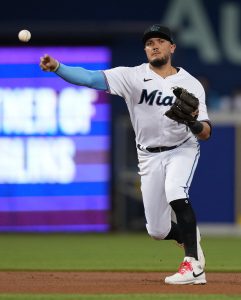
It effectively amounts to the Marlins tacking on an additional year and $4.5MM for what will be Rojas’ age-34 season. The deal does not contain any option years. Rojas, who is represented by the Beverly Hills Sports Council, recently indicated in an appearance on Chris Rose’s podcast that an extension was in the works. He has previously voiced a desire to spend his entire career with the Marlins, and the front office has similarly expressed interest in keeping the clubhouse leader in Miami.
The 32-year-old Rojas saw his bat come back down closer to his career levels after a monster showing at the dish during the 2020 season. Typically a bit below-average with the bat but exceptional with the glove, Rojas erupted with a .304/.392/.496 showing last summer — albeit in a sample of just 143 plate appearances. That said, this year’s .265/.322/.392 showing in 539 trips to the plate was still a solid mark (97 wRC+), and if you take the last three seasons in the aggregate, Rojas has effectively been a league-average hitter.
League-average offense for a player of Rojas’ defensive aptitude is hardly anything to scoff at. Defensive Runs Saved pegged Rojas at plus-4 for the 2021 season and as a plus-20 defender in 4445 career innings at the position, while Rojas notched a 4.8 Ultimate Zone Rating in 2021 and carries a lifetime 28.5 mark in that regard. Statcast’s Outs Above Average is less bullish on his glovework but pegs him as at least an average defender over the past several seasons. Rojas also has ample experience at second base and third base in his career, so he could eventually slide into a utility role — although all current indications are that he’ll reprise his role as starting shortstop in 2022.
A Rojas extension gets some offseason business out of the way early for the Marlins and locks in a bargain source of cost certainty for the 2023 campaign. That’s likely quite notable for the Fish, who are angling to spend some money in free agency this winter but will surely be operating with some degree of financial constraints. CEO Derek Jeter has voiced an expectation that the Marlins will be “pretty active” for the first time under this ownership group.
Time will tell how that vague description from Jeter is defined relative to other “active” teams in free agency. The Marlins are expected to seek long-term options at catcher and in center field, and they could certainly be in the mix for a corner outfielder to pair with promising young Jesus Sanchez. At the moment, Rojas and right-hander Anthony Bass ($3MM) are the only players on guaranteed contracts in 2022. MLBTR contributor Matt Swartz projects an arbitration class in the vicinity of $34.5MM, and Miami will still owe $3MM to the Yankees under the terms of the Giancarlo Stanton trade.
With a projected payroll in the $55-56MM range, there does appear to be room to add — the question is just how high the Jeter/Bruce Sherman ownership group is willing to push payroll. Presumably, they’ll look for a gradual year-over-year increase rather than soaring to their max budget right out of the gates. However they proceed, they can now do so with the certainty that their ostensible team captain is under control for an extra season.
Craig Mish of SportsGrid and the Miami Herald first reported the Marlins and Rojas were in agreement on an extension. Jon Heyman of the MLB Network reported it was a two-year, $10MM deal. Joel Sherman of the New York Post added that the contract did not contain any options.
Image courtesy of USA Today Sports.
Mariners Outright Jake Bauers
The Mariners announced Wednesday that first baseman/outfielder Jake Bauers has cleared waivers and been assigned outright to Triple-A Tacoma. He’ll be able to become a minor league free agent following the completion of the postseason, though Ryan Divish of the Seattle Times reports that the Mariners hope to re-sign him to a minor league contract (Twitter link).
Bauers, 26, is a former seventh-round pick of the Padres who eventually hit his way into top-100 prospect territory in 2017-18. San Diego flipped him to the Rays as one of several players in the three-team Trea Turner blockbuster that sent Turner to D.C. back in 2014.’
After a half season of games in Tampa Bay, Bauers went to Cleveland in another three-team deal — this time the one that sent Yandy Diaz to Tampa Bay, Carlos Santana to Cleveland and Edwin Encarnacion to Seattle. Bauers appeared in parts of two seasons with Cleveland across three calendar years before being traded to the Mariners exchange for a player to be named later (righty Damon Casetta-Stubbs) earlier this season.
The Mariners were the fourth organization of Bauers’ career and the third for which he’s played at the MLB level. He posted just a .220/.297/.275 slash with Seattle, however, continuing the struggles he’s displayed throughout his big league tenure. Through 1126 plate appearances spread across three Major League seasons, Bauers is a .213/.307/.348 hitter with 27 home runs and an impressive 11.5 percent walk rate — but also a sub-part 26.4 percent strikeout rate. He’s posted better numbers in the minors, with similar slash lines at virtually every stop and a career .275/.361/.414 output in parts of seven seasons.