
Blue Jays Set Opening Day Roster
The Blue Jays announced their Opening Day, 30-man roster this morning. Left-hander Brian Moran and right-hander A.J. Cole were both selected to the 40-man roster and will make the club. Toronto also placed righty Chase Anderson on the 10-day IL (retroactive to July 20) with an oblique strain and opted to carry infielder Santiago Espinal, lefty Anthony Kay and right-handers Thomas Hatch and Jacob Waguespack.
Notably absent is right-hander Nate Pearson, one of the game’s elite pitching prospects. He’s on the team’s three-man taxi squad (along with southpaw Ryan Borucki and catcher Caleb Joseph) but won’t accrue service time in that role. He’ll reportedly be called up next week, when the Jays will be able to promote him while extending their club control of him for an additional season (as has long been expected).
Moran, 31, is the older brother of Pirates third baseman Colin Moran. He made his big league debut at 30 years of age with the Marlins last season, pitching 6 1/3 innings while yielding three runs with a 10-to-2 K/BB ratio. A seventh-round pick in 2009, Moran has had quite the odyssey to the Majors, twice taking to the independent circuit as a showcase to get back into affiliated ball. But he carries a career 3.67 ERA with 11.5 K/9 against 3.2 BB/9 in 176 1/3 Triple-A frames and will now get his second opportunity in the Majors.
Cole, 28, is a former top prospect who’s yet to find his footing despite multiple MLB chances. He’s seen action with three teams in parts of five seasons but posted a pedestrian 4.86 ERA and 5.03 FIP in 174 innings. Cole had some success both with the Nats in 2017 and the Indians last year, logging identical 3.81 ERAs in both years. He’s averaged better than a strikeout per frame in the big leagues but has also surrendered an average of 1.8 homers per nine innings pitched.
The Jays don’t need to make any corresponding transactions to add Moran and Cole to the 40-man. The team recently placed Breyvic Valera on the restricted list after he was unable to leave his native Venezuela and report to Jays Summer Camp in Toronto. The club also has Brandon Drury, Jonathan Davis, Wilmer Font and Elvis Luciano on the Covid-19 IL, and none of the four will count against the team’s 40-man roster while on that list.
Tigers Select Dario Agrazal, Jordy Mercer
The Tigers have announced that righty Dario Agrazal and infielder Jordy Mercer have made the Opening Day roster. Their contracts were selected to the 40-man roster. Former top picks Kyle Funkhouser and Beau Burrows both made the roster as well.
Agrazal, 25, was acquired from the Pirates back in November and later outrighted off the 40-man roster. The righty pitched 73 1/3 innings with the Pirates in 2019 but struggled to a 4.91 ERA with 5.0 K/9, 2.2 BB/9, 1.84 HR/9 and a 39.9 percent grounder rate. Agrazal doesn’t miss many bats, even in the minors, but he’s averaged well under two walks per nine innings pitched in parts of seven minors league seasons and typically registers a ground-ball rate north of 50 percent. He’s only totaled 64 innings in Triple-A, but he owns a career 3.62 ERA with 5.8 K/9 against 1.3 BB/9 in 608 2/3 total minor league frames.
The veteran Mercer, meanwhile, will return for a second season in Detroit. He spent the ’19 season with the Tigers after signing a one-year deal but was plagued by quadriceps injuries for much of the season, spending multiple stints on the injured list. The signing looked regrettable at the season’s halfway point, but Mercer returned in early July and closed out the year with a sharp .292/.323/.479 slash line to salvage what was looking to be a lost year. The 33-year-old — 34 next month — is a career .257/.316/.388 hitter in parts of eight MLB seasons.
Both Funkhouser and Burrows were at one point first-round picks. Detroit selected Burrows with the No. 22 selection back in 2015, and Funkhouser was a supplemental first-round pick by the Dodgers just 13 spots later in that same draft. Funkhouser, however, didn’t sign and slid to the Tigers in the fourth round a year later. Both showed promise in 2017-18 before ugly 2019 seasons dropped their stock, but they’ll both get their first look in the big leagues to begin the 2020 campaign.
Alex Vesia, Sterling Sharp Make Marlins’ Roster
Left-handed reliever Alex Vesia and righty Sterling Sharp have made the Marlins’ Opening Day roster, per reports from Jordan McPherson of the Miami Herald and Jon Heyman of MLB Network (Twitter links). Vesia is not on the team’s 40-man roster, so his contract will be selected before the season kicks off. The Marlins’ 40-man roster is technically full, but they have a few players who appear to be on the Covid-19 injured list, and those players won’t count against the 40-man until they’re activated. A corresponding move or moves from the club may yet come, depending on other additions Miami wishes to make.
It seems safe to say that the 24-year-old Vesia has exceeded expectations set for him when he was a 17th-round pick just two summers ago. A product of Division-II Cal State East Bay, Vesia skyrocketed across three levels last year, pitching to a combined 1.76 ERA with a ridiculous 100-to-19 K/BB ratio in 66 2/3 innings of relief. He’s a pure bullpen prospect, but Vesia has a career 1.62 ERA since being drafted.
He ranks 21st among Miami prospects, per FanGraphs’ Eric Longenhagen, and checks in 27th at MLB.com. Vesia’s innings in 2020 will obviously be limited, given expanded rosters and the shortened season, but he’ll get his first look at MLB opponents in the near future and could potentially be a piece of the Miami bullpen for years to come.
Sharp spent the first few years of his professional career with the division-rival Nationals, who used a 22nd-round pick on him in 2016. The Marlins plucked Sharp from the Nats with the No. 3 overall selection in last December’s Rule 5 Draft after he turned in a productive season among the rookie, Low-A and Double-A levels in 2019. Sharp totaled 58 2/3 frames of 3.53 ERA pitching and 8.0 K/9 against 2.3 BB/9. FanGraphs (No. 30) and MLB.com (28th) regard the 25-year-old Sharp as a prospect of note in the Marlins’ system, with Longenhagen writing he could turn into a back-end starter in MLB.
Rockies To Select Elias Diaz, Drew Butera
10:34pm: The Rockies will also select Butera, Patrick Saunders of the Denver Post tweets.
7:55pm: The Rockies are planning to select the contract of catcher Elias Diaz and carry him on their Opening Day roster, MLB Network’s Jon Heyman reports (Twitter link). Manager Bud Black has since confirmed as much, MLB.com’s Thomas Harding tweets. It’s possible still that the Rox will select Drew Butera as well and carry three backstops to begin the season, though it sounds like no final decision has been made on that front just yet.
Diaz, 29, was a rather well-regarded catching prospect when rising through the Pirates’ system and has had some success in Pittsburgh, most notably in 2018 when he appeared to break out with a .286/.339/.452 slash and 10 homers in 277 plate appearances. That set the stage for a more prominent role in 2019, but Diaz was unable to capitalize on his increased playing time. In 332 plate appearances, he mustered only a .241/.296/.307 line.
Problems at the plate weren’t the only issue for Diaz, however, as he also struggled defensively. While his career 28 percent caught-stealing rate is solid, Diaz ranked as baseball’s second-worst pitch framer last year, per Statcast. FanGraphs agreed with those framing woes, and in all he checked in at a staggering -21 Defensive Runs Saved in just 706 innings.
Diaz had never struggled to such extremes on either side of the ball and actually graded out only slightly below average with the glove in that strong 2018 showing. It’s worth noting that he missed all of Spring Training and the first month of last year’s regular season due to a bacterial infection in his stomach, which surely didn’t do him any favors when he returned in late April.
Whether Diaz was actually ready to return when he did, the results spoke for themselves, however. They also convinced the Bucs to non-tender him rather than pay a projected $1.4MM salary in arbitration (via MLBTR contributor Matt Swartz). He’ll now have a chance to prove that last year’s showing was an aberration and that he’s far better than was on display in his illness-shortened 2019 campaign. He’ll likely begin as a backup to Wolters, but given Wolters’ dismal offensive track record, it’s possible that Diaz could play his way into a bigger role.
Dodgers Extend Mookie Betts
7:24pm: Betts’ contract includes a massive $65MM signing bonus, Joel Sherman of the New York Post reports (via Twitter). The Athletic’s Ken Rosenthal adds that the contract contains $115MM in deferrals, and the salaries are backloaded such that Betts will be paid $17.5MM in 2021 and 2022. There are no opt-outs in the deal, which does not come with a no-trade clause, per Rosenthal.
4:01pm: Mookie Betts is a Dodger for the long haul. The team announced this afternoon that Betts has signed a 12-year extension through the 2032 season. It’ll reportedly guarantee him a whopping $365MM in new money on top of this year’s $27MM salary (which has been prorated to $10MM due to the shortened 2020 season). Betts is represented by the VC Sports Group.
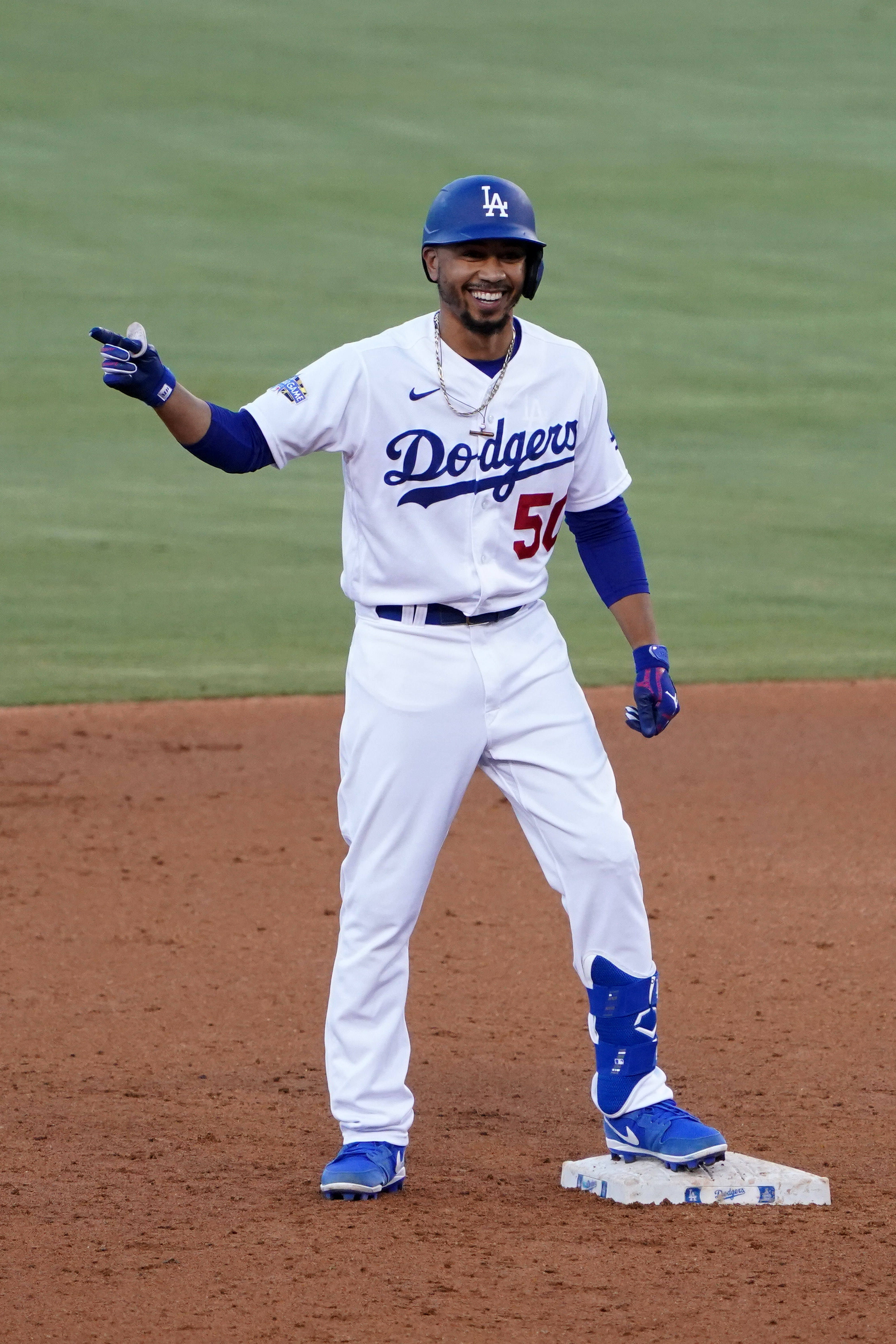
The contract represents the largest amount of new money ever promised to a Major League player on an extension or free-agent signing, topping Mike Trout‘s previous highwater mark of $360MM (over a shorter 10-year term). Trout was already signed at two years and $66.5MM, so his total of 12 years and $426.5MM tops Betts’ 13-year, $392MM figure, but the $365MM new-money benchmark is a notable record nevertheless.
The Betts extension, somewhat remarkably, marks the first time that the Dodgers have guaranteed in excess of $100MM to a player under president of baseball operations Andrew Friedman. Though the team is known for its enormous — at times seemingly limitless — spending capacity, the Friedman regime has worked diligently to shed some prior undesirable commitments and creatively limbo underneath the luxury-tax bar. Doing so paved the way for the Dodgers to issue a historic contract to a premium talent.
After missing out on a free-agent pursuit of Gerrit Cole this winter, the team shifted its focus to acquiring Betts, who came to L.A. alongside David Price in a blockbuster trade that sent Alex Verdugo, Jeter Downs and Connor Wong to Boston. There was plenty of talk about the team’s hope for extending Betts, but he’d been outspoken about his desire to test the open market. Paired with the economic uncertainty stemming from this year’s unprecedented revenue losses, there was real reason to wonder whether a deal would get done.
Perhaps that economic turmoil made Betts more amenable to taking a deal now rather than testing the market, or perhaps he was simply willing all along to sign if a team exceeded Trout’s new-money guarantee. His exact thinking likely won’t ever be fully known, but the end result is that Betts now appears poised to spend the remainder of an already excellent career in Dodger blue.
Still just 27 years of age, Betts has produced at star-caliber levels since a 52-game MLB debut back in 2014. A career .301/.379/.519 hitter, Betts is already a four-time All-Star, a three-time Silver Slugger winner, a former American League MVP and batting champion, and a four-time Gold Glove winner. He’s clubbed 139 home runs and swiped 126 bases in 794 Major League games, showing off an impressive blend of power and speed, and his 13.5 percent walk rate over the past two seasons is nearly the same as his paltry 14.5 percent strikeout rate. Add in that Betts is regarded as an otherworldly defender — he’s third among all players in Defensive Runs Saved since 2015, regardless of position — and it’s easy to see why Betts is regarded among the game’s elite players.
The Dodgers already boasted at least one of those elite talents: reigning NL MVP Cody Bellinger. Betts and Bellinger will pair to form what could be baseball’s best one-two punch for at least the next four seasons, as Bellinger is controlled through at least the 2023 season. Out-of-nowhere slugger Max Muncy is also inked through the ’23 campaign on a highly reasonable three-year, $26MM pact, so that trio should continue thriving in the heart of the order for the foreseeable future. The hope is that rising young talents like infielder Gavin Lux and catcher Will Smith will add to that long-term core. Looking shorter-term, the Dodgers are stacked with above-average contributors, including Corey Seager (controlled through 2021), Justin Turner (through 2020), Chris Taylor (through 2021) and Enrique Hernandez (through 2020).
From a payroll and luxury-tax standpoint, the Dodgers can afford to both sign Betts and still pursue a megadeal with Bellinger, should they see fit. Betts’ contract comes with a $30.4MM annual luxury hit (or $30.1MM, if they roll it into the current deal), which is sizable but still only represents about a seventh of next year’s $210MM luxury cap. (That number could well rise in 2021 CBA negotiations, too.) Los Angeles already has more than $152MM in luxury commitments on the 2021 books, including this new deal for Betts, but that number plummets to $73MM in 2022. Betts is the only Dodger on a guaranteed deal for the 2023 season (although Bellinger, Walker Buehler and Julio Urias will all be arbitration-eligible).
With today’s agreement, Betts, Bellinger and Buehler look like the long-term faces of the Dodgers franchise, though the club has boundless young talent, a knack for high-profile trades and as previously noted, plenty of money to spend even with Betts pulling in more than $30MM on an annual basis. The Dodgers have won seven straight NL West titles, and the Betts deal is a strong step toward continuing that trend. That, of course, won’t be enough to satisfy Betts, though. As the star put it during today’s introductory press conference: “I’m here to win some rings.”
WEEI’s Lou Merloni reported earlier today that Betts was closing in on an extension worth more than $300MM. ESPN’s Jeff Passan reported the agreement and the terms just prior to the team’s announcement (Twitter thread).
Dominic Leone, Mike Freeman, Cam Hill Make Indians’ Opening Day Roster
The Indians have informed several players, including three who aren’t currently on the 40-man roster, that they’ve made the Opening Day club, Ryan Lewis of the Akron Beacon-Journal tweets. Right-handers Dominic Leone, Cam Hill, James Karinchak and Phil Maton; infielders Mike Freeman, Yu Chang and Christian Arroyo; and outfielders Greg Allen and Bradley Zimmer have all made the roster to begin the year. Leone, Hill and Freeman will each need to be added to the 40-man roster.
The team has also informed a quartet of players that they won’t open the year on the 30-man roster. That includes first baseman/outfielder Jake Bauers and righties Jefry Rodriguez, James Hoyt and Hunter Wood. That Wood won’t be on the Opening Day roster is of particular note, as he is out of minor league options and thus cannot be sent down to alternate camp without first being run through outright waivers.
It seems likely, then, that some form of 40-man move involving Wood will help to pave the way for the three non-roster players who’ve made the squad. Cleveland currently has 39 players on the 40-man roster, and Delino DeShields isn’t counting against the group either while on the Covid-19 injured list.
The 28-year-old Leone has the most big league experience of the bunch, having logged 243 1/3 innings of relief dating back to his MLB debut with the Mariners in 2014. Leone’s past two seasons with the Cardinals went poorly, as he worked to a combined 5.15 ERA and 4.77 FIP in 64 2/3 frames, but the righty was excellent for the Jays as recently as 2017, when he pitched 70 2/3 innings with a 2.56 ERA and better than 10 punchouts per nine frames. In all, Leone joins the Indians’ bullpen with a career 3.92 ERA, 9.4 K/9, 3.7 BB/9, 1.15 HR/9 and a 43.6 percent grounder rate.
Freeman, who’ll turn 33 early next month, should be a familiar face for Cleveland fans after suiting up for 75 games there in 2019. Last year with the Indians, Freeman played second base, shortstop, third base, left field and even pitched two innings. Along the way, Freeman hit .272/.362/.390 with four homers and eight doubles — good for a 97 OPS+. That’s a solid showing from a part-time player, and although he had to work his way back on another minor league deal, Freeman clearly impressed the club enough to stick around as a depth piece.
Hill, meanwhile, has never pitched in the Majors, so this’ll mark the 26-year-old’s debut season. A 17th-round pick by the Indians back in 2014, Hill has just a 4.81 ERA in 43 2/3 innings at the Triple-A level but impressed the club with a strong effort this spring (five innings, one run) and summer. He ranked near the back of the organization’s top prospect list at FanGraphs this year, where Eric Longenhagen wrote that Hill has “nasty” stuff but sub-par control that causes some concern.
Wood, 26, has plenty of success with the Rays in his first season-plus at the MLB level before being traded to Cleveland alongside Arroyo last summer. He posted decent numbers with the Indians following the trade and carries a career 3.32 ERA and 4.04 FIP in 86 2/3 MLB frames, so it’s a bit of a surprise to see him on the outside looking in. It’s quite possible that another club with more questionable bullpen depth would have interest in swinging a deal for Wood, who has high-end spin and above-average velocity on his four-seamer. Barring that, he could generate interest on the waiver wire.
Marcus Stroman “Week To Week” With Calf Injury
The Mets announced that they’ve placed right-handers Marcus Stroman and Robert Gsellman on the injured list. Stroman, who was said to be experiencing tightness in his calf earlier today, has been now diagnosed with a tear of some extent in that ailing calf muscles. Gsellman is experiencing some discomfort in his right triceps.
The IL placement for Stroman and the announced muscle tear are more ominous than this afternoon’s report of mere tightness in his calf. It should be noted that even a Grade 1 strain indicates some stretching or minor tearing, so it’s still possible that his absence won’t be substantial. Manager Luis Rojas tells reporters that Stroman will not require surgery (Twitter link via Anthony DiComo of MLB.com), but the skipper also referred to Stroman’s injury as a “week to week” situation, which isn’t a great outlook in a season that’ll barely span nine weeks from start to finish.
The loss of Stroman is a brutal hit for the Mets, who were already without right-hander Noah Syndergaard for the entire season due to Tommy John surgery. Two-time Cy Young winner Jacob deGrom will still head up the team’s rotation, but he’ll now be followed by Steven Matz, Rick Porcello, Michael Wacha and a to-be-determined fifth starter. Non-roster veteran Erasmo Ramirez could be one option, and 2017 first-round pick David Peterson is also in the Mets’ player pool. Right-hander Walker Lockett was placed on the IL this week with a back injury.
On a personal level for Stroman, the injury is about as poorly timed as possible. Already facing a shortened platform season prior to his first foray into free agency this winter, missing multiple weeks could give Stroman fewer than 10 starts to demonstrate his health and effectiveness for interested clubs. Given the potential for teams to be stingier than usual on mid-range free agents following this year’s revenue losses, the calf issue could prove particularly costly for Stroman, who posted a 3.22 ERA with better than a strikeout per inning in 184 1/3 frames last year.
As for Gsellman, it seems there’s lesser concern. DiComo tweets that his IL stint is expected to be back-dated the maximum three days, and a return to the bullpen in early August doesn’t appear to be out of the question. In two years since converting to full-time relief role, the now-27-year-old Gsellman has a 4.45 ERA with 8.1 K/9 against 3.2 BB/9 in 143 2/3 innings.
MLB, MLBPA In Last-Minute Negotiations On Expanded 2020 Playoffs
Major League Baseball and the MLB Players Association are in the midst of some eleventh-hour negotiations about expanding the playoffs for the 2020 season, MLB Network’s Jon Heyman tweets. An agreement would need to be in place before the first pitch of tomorrow’s Nationals/Yankees season opener. It’s not clear exactly when the two sides resumed their talks on an expanded postseason, which was a focal point of their failed negotiations in May and June, but Heyman suggests that there is “optimism” on both sides that an agreement will be reached.
During this summer’s return-to-play negotiations, which did not result in a deal (leading commissioner Rob Manfred to implement a 60-game season under their March arrangement), the league sought to expand the postseason format from 10 to 16 teams. The initial hope was for the change to take effect for both 2020 and 2021, but doing so would’ve required an agreement to be bargained with the players’ union. When that didn’t happen, the postseason status quo of 10 teams remained in place.
Since the 60-game season was implemented, MLBPA executive director Tony Clark has expressed a willingness to resume talks with Manfred’s office should the league push for renewed talks. Exactly what concessions the league is willing to make for the players remains unclear in this newly rebooted set of talks. But given the potential for upwards of $300MM in additional television revenue under an expanded postseason format, it’s hardly a surprise that MLB is seeking one last go at hammering out an agreement.
Pennsylvania Department Of Health Will Not Approve Blue Jays’ Use Of PNC Park
2:10pm: The Pennsylvania Department of Health has formally vetoed the Blue Jays’ Pittsburgh plan, per Will Graves of the Associated Press (Twitter thread). In a statement issued to the AP, Dr. Rachel Levine said the following: “To add travelers to this region for any reason, including for professional sports events, risks residents, visitors and members of both teams.”
2:00pm: With the Blue Jays unable to play their home games at Toronto’s Rogers Centre in 2020, the club thought it had worked out an arrangement to use Pittsburgh’s PNC Park as an alternate site. That deal, however, appears to be in jeopardy. ESPN’s Buster Olney tweets that neither the Jays nor MLB have received the go-ahead from the Pennsylvania government yet, adding that the team is again exploring alternate sites. The Athletic’s Ken Rosenthal tweets that the deal with Pittsburgh is “falling apart.”
Exactly what this means for the Jays remains unclear. They’ve previously explored playing home games at their spring facility in Dunedin, Fla., but Florida’s rapid rise in Covid-19 cases has complicated that idea. The Jays have been working to upgrade their Triple-A facilities in Buffalo in order to bring the lighting and clubhouses up to MLB code, although the organization’s preference has been to be able to play its “home” games in an MLB park, general manager Ross Atkins stated this week. Oriole Park at Camden Yards has also been suggested as an alternative, and the fact that the Pittsburgh plan appears in danger of being scrapped entirely could push the Jays to look more closely into that possibility.
One more extreme possibility, per Olney, would be for the Jays to travel to the home city of every team they’re scheduled to play in 2020, but function as the “home” team on days where they’d been scheduled to host an opponent. With fans unlikely to attend games for much or all of the 2020 season, that may not be quite as detrimental as it would be playing in front of each opponent’s fans, although the aggressive travel and constant changes in scenery would likely make that an unpalatable last resort.
The Jays don’t have a “home” game scheduled until July 29 when they’d host the Nationals, which provides at least a bit of cushion as the team scrambles to find a suitable venue. The clock is ticking, though, and Pennsylvania’s rejection casts some doubt on whether other U.S. cities — particularly those already home to one franchise — will be more amenable to welcoming the Jays for the length of the season.
Cardinals Release Brett Cecil
The Cardinals announced Wednesday that they’ve released left-hander Brett Cecil. The veteran reliever was entering the final season of a four-year, $30.5MM deal that proved to be a substantial misstep. The Cardinals also placed infielder/outfielder Brad Miller on the 10-day IL due to bursitis in his right ankle.
From 2013-15, Cecil was quietly one of baseball’s best lefty relievers, pitching to a 2.67 ERA and an even better 2.54 FIP while averaging 11.5 strikeouts, 3.4 walks and 0.53 HR/9 with a 52.2 percent ground-ball rate in 168 1/3 innings. A triceps injury shortened his 2016 season, but Cecil still posted generally solid results in 36 2/3 frames — parlaying that excellent four-year run into the aforementioned Cardinals deal. The size of the contract was viewed as a surprise at the time, but most pundits had agreed that Cecil had a legitimate case at a lucrative three-year deal, and the four-year term was reflective of wide interest in his services in free agency.
Unfortunately for both the Cardinals and Cecil, things went south in a hurry. Cecil lost a mile off his fastball in his first season with the Cards — a year in which he pitched 67 2/3 frames with a respectable 3.88 ERA but diminished strikeout numbers. A shoulder strain and a foot injury limited Cecil to just 32 2/3 innings of 6.89 ERA ball in 2018. Few would’ve thought that with two years to go on the contract, Cecil had thrown his last pitch as a Cardinal, but he missed all of 2019 after undergoing surgery to relieve carpal tunnel syndrome and now won’t get the opportunity to bounce back in 2020 — at least not with the Cardinals.
Cecil had been throwing during Summer Camp with the Cardinals and was even trying out a new sidearm delivery that he hoped would help him to regain his effectiveness. Cecil turned 34 earlier this month, so it’s not as though he’s too old for a bounceback effort to be plausible. That said, it’s been a half decade since he was last an elite reliever and more than two full seasons have passed since he was last serviceable. The hope is obviously that he can bounce back, but it seems unlikely that another club will sign him and immediately test him out in the high-leverage situations in which he once excelled.
The Cardinals had been set to pay Cecil a $7MM salary in the final season of that four-year pact. Prorated, that came out to just shy of $2.6MM — a sum they’ll still owe to the lefty even after cutting him loose. Any club can sign Cecil at this point, and he’d only be owed the prorated league minimum for any time spent on another club’s Major League roster. That sum would be subtracted from what the Cardinals owe Cecil, but regardless of how the year plays out, they’re on the hook for the vast majority of what he’s owed.
As for Miller, he inked a one-year, $2MM deal with the Cards late in the offseason and was expected to fill an infield/outfield utility role — perhaps also seeing some time at designated hitter against right-handed opponents. There’s no timetable for his recovery just yet.