
AL Central Trade Deadline Recap
With the deadline in the rearview mirror, we’ll look back at each AL Central team’s trade activity over the past month.
Chicago White Sox
- Acquired cash considerations from Giants for OF Luis Basabe
- Acquired OF Jarrod Dyson from Pirates for international bonus pool space
Cleveland Indians
- Acquired cash considerations from Marlins for RHP James Hoyt
- Acquired OF Josh Naylor, RHP Cal Quantrill, C Austin Hedges, INF Gabriel Arias, LHP Joey Cantillo, and INF Owen Miller from Padres for RHP Mike Clevinger and OF Greg Allen
Detroit Tigers
- Acquired INF Zack Short from Cubs for OF Cameron Maybin
Kansas City Royals
- Acquired INF Lucius Fox from Rays for OF Brett Phillips
- Acquired OF Edward Olivares and a player to be named later from Padres for RHP Trevor Rosenthal
Minnesota Twins
- Acquired INF Ildemaro Vargas from Diamondbacks for cash considerations
Cubs Acquire Cameron Maybin
The Cubs have acquired outfielder Cameron Maybin from the Tigers, tweets ESPN’s Jeff Passan. The Cubs will send infielder Zack Short to the Tigers in return, according to Chris McCosky of The Detroit News.
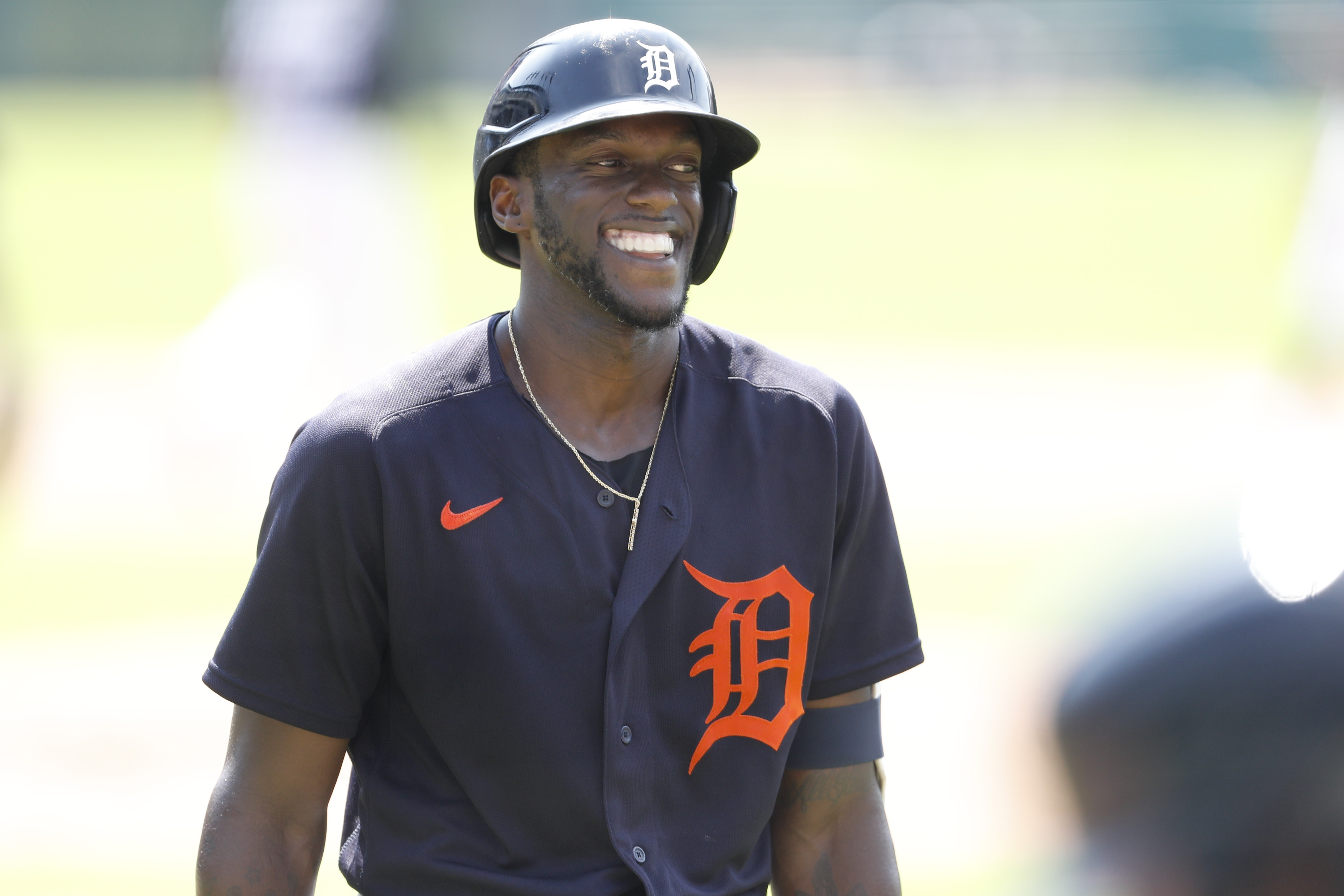
Maybin, 33, has been about league average in his brief 45 plate appearances for the Tigers this year after signing as a free agent in February. He missed time early in the month with a quad strain. The Tigers’ 10th overall pick way back in 2005, Maybin has created value in a utility role in recent years. He posted a 127 wRC+ for the Yankees in 2019, and is able to handle all three outfield positions. A 14-year veteran, Maybin is owed about $225K on the season.
Maybin is the Cubs’ second bench bat addition in two days, as they picked up Jose Martinez from the Rays yesterday. The Cubs’ depth was a bit compromised with Steven Souza Jr. on the IL for a hamstring strain and Kris Bryant out with a sprained finger and sore wrist. The first-place Cubs have been otherwise focused on the bullpen today, adding lefties Andrew Chafin and Josh Osich in trades.
Short, 25, reached Triple-A in 2019 as a middle infielder. Prior to the season, Baseball America ranked Short 28th among Cubs prospects, citing “a consistent blend of strong defensive skills and sneaky impact at the plate.”
Photo courtesy of USA Today Sports Images.
Tigers Claim Dereck Rodriguez
The Tigers announced Monday that they’ve claimed righty Dereck Rodriguez from the Giants, who’d designated him for assignment over the weekend. He’s been optioned to the team’s alternate training site.
Rodriguez, the son of Hall of Famer Ivan Rodriguez, will get a new opportunity with an organization for which his father starred from 2004-08. The right-hander went from minor league signee to breakout rotation member with San Francisco in 2018 when he turned in 118 1/3 frames of 2.81 ERA ball, but he’s gone considerably backwards since that excellent rookie effort. Dating back to the 2019 season, Rodriguez has pitched to an ugly 5.94 ERA with 23 home runs and 39 walks in 103 innings pitched.
Central News & Rumors: Hader, Burnes, Twins, Norris, Romine, Tigers, Chatwood, Gio
The Brewers are receiving a lot of interest on Josh Hader and Corbin Burnes, MLB Network’s Jon Heyman reports (all links to Twitter), though there isn’t any sign that Milwaukee would consider moving either reliever for anything less than a major offer, particularly for Hader. Brett Anderson or David Phelps are perhaps more realistic options to be dealt if the Brewers opt to move an arm. The Yankees and Twins are two of the clubs who have been in touch with the Brew Crew about Hader, but there hasn’t been much indication that talks led anywhere.
Let’s dive into some news and trade buzz from around both the NL and AL Central divisions…
- The Tigers are drawing interest in catcher Austin Romine and left-hander Daniel Norris, The Athletic’s Ken Rosenthal reports in both a tweet and a longer notes column. The Rays are one team linked to Norris, who has impressed by posting a 2.40 ERA, 7.2 K/9, and 4.00 K/BB rate over 15 innings. The former second-round draft pick has been plagued by injuries throughout his career and missed part of Summer Camp recovering from a positive COVID-19 test, though he has performed well as a multi-inning reliever for the Tigers this year. Romine has also enjoyed a strong season with a .291/.309/.418 slash line over 81 PA, though his trade chip status could have a late wrinkle — the Tigers scratched him from today’s lineup due to right knee soreness.
- Tyler Chatwood left today’s outing due to right elbow discomfort, according to the Cubs. The righty bounced a pitch to the plate in the third inning, with manager David Ross telling ESPN.com’s Jesse Rogers and other reporters that Chatwood initially felt a problem while throwing a breaking ball on the previous pitch. Chatwood was making his second start back from the injured list after missing much of August with a back strain. Elbow problems aren’t good news for any pitcher, though it is particularly concerning in Chatwood’s case since he already has a Tommy John surgery on his record.
- The injury bug also struck on the south side of Chicago, as the White Sox placed left-hander Gio Gonzalez on the 10-day injured list (retroactive to August 27) with a right groin strain. Gonzalez’s first year with the Sox hasn’t been a smooth one, as he has a 5.11 ERA over 24 2/3 innings and a 1.5 HR/9 that is almost twice his 0.8 career average. His most recent outing was, intriguingly, 3 2/3 inning of shutout relief against the Cubs, which could hint at Gonzalez’s role for the White Sox when he returns from the IL.
Cubs Asked Tigers About Cameron Maybin
Cameron Maybin‘s name has emerged as part of trade discussions between the Tigers and Cubs, the Athletic’s Eno Sarris and Brittany Ghiroli report (subscription required). Maybin would be a pure rental piece, as the outfielder is only signed through the 2020 season and is owed roughly $280K for the remaining month of action.
Now a veteran of 14 MLB seasons with eight different teams, Maybin signed a one-year, $1.5MM deal with the Tigers last winter in the wake of one of his most productive years at the plate. Maybin his .285/.364/.494 with a career-best 11 home runs over 269 plate appearances with the Yankees in 2019, becoming one of several unheralded bench players to step up big for the injury-riddled Bronx Bombers roster.
Thus far in 2020, Maybin has hit .256/.310/.436 over just 42 PA, as he missed two weeks of action due to a quad injury. Albeit in a very small sample size, Statcast metrics such as hard-hit percentage and barrels indicate that Maybin is continuing the improved solid contract he played last year in New York. Detroit has used Maybin only as a right fielder this season, and while he can still play center in a pinch, the 33-year-old is probably best suited for corner outfield duty at this point in his career.
This might be all the Cubs would be looking for in a depth piece, as Chicago’s outfield corps has been thinned by injuries to Steven Souza Jr. and part-time outfielder Kris Bryant. In theory, Maybin’s right-handed bat would provide cover against left-handed pitching (particularly since the left-handed hitting Jason Heyward and Kyle Schwarber have both struggled against southpaws), but Maybin has been something of a reverse-splits hitter for much of his career.
Tigers Shut Down Matt Manning, Alex Faedo
The Tigers have shut down pitching prospects Matt Manning and Alex Faedo for the remainder of the season, GM Al Avila announced to reporters (including Chris McCosky of the Detroit News). Both right-handers have been diagnosed with right forearm strains, though Avila emphasized that four different specialists examined the pair to ensure that there was not a more severe injury at play.
“We wanted to be super cautious,” Avila said. “We just wanted to be sure we were right in our assessment, that it was not going to be a big deal and we were prescribing the right course of rehab.”
With Casey Mize and Tarik Skubal already making their MLB debuts this season, bringing Manning and Faedo up to the active roster would have given Detroit fans an early preview of what the Tigers hope will be their rotation core for the next decade. Even before the forearm problems, however, Faedo missed the Tigers’ summer camp due to COVID-19, and McCosky notes that Manning was dealing with mechanical issues both in summer camp and dating all the way back to Spring Training.
In terms of who could replace Manning and Faedo in the 60-man player pool, Avila said the club is “looking at adding prospects from within the organization,” though “we do have a list of players outside the organization who, if we needed to in an emergency go out and sign.” Avila didn’t mention the possibility of a trade, though since the 13-16 Tigers are only two games out of a wild card berth, it isn’t out of the question that the club could make an addition before the trade deadline.
Pirates Claim Carson Fulmer, Designate Guillermo Heredia
The Pirates announced Monday that they’ve claimed right-hander Carson Fulmer off waivers from the Tigers and designated outfielder Guillermo Heredia for assignment in order to open a spot on the roster.
Pittsburgh will be the third team in 2020 to try its hand in helping Fulmer to right the ship. The 26-year-old was selected by the White Sox with the No. 8 overall pick back in 2015. At the time, the Vanderbilt star was viewed as a potential high-end starter or at the very least a high-probability late-inning reliever. But he’s struggled virtually every step of the way since Triple-A, pitching to an ugly 5.39 ERA in parts of four seasons there and a less-palatable 6.57 mark in 101 1/3 MLB frames. The Tigers claimed him last month after the White Sox designated him for assignment.
Fulmer’s average fastball in 2020 sat at 92.3 mph — a far cry from the righty’s college days, when scouting reports pegged him as touching 97 mph with regularity. He boasted elite spin rates on his four-seamer and curveball as recently as last season, though, and Fulmer did manage a career-best 12.8 percent swinging-strike rate in this year’s tiny sample of 6 2/3 innings with the Tigers. That’s about all that went right for Fulmer, but the pitching-hungry Pirates were quick to snap him up on waivers in hopes that their staff can coax something more out of him. Fulmer is out of minor league options, so he’ll need to stick on the Bucs’ big league roster or else be designated for assignment a third time.
As for Heredia, he signed a one-year, $1MM contract with the Pirates over the winter but hasn’t delivered for the club. The 29-year-old appeared in just eight games and tallied a mere 18 plate appearances earlier this year before being optioned to the club’s alternate training site. Clearly the team wasn’t happy with what it saw there.
Heredia has appeared in 390 Major League games, mostly with the Mariners, and posted a combined .239/.317/.339 batting line. As a solid outfield defender with a bit of speed and a career .275/.338/.400 batting line against lefties, he can be a useful bench piece when he’s at his best, but he won’t get that opportunity with the Pirates, it seems. Pittsburgh will have a week to trade Heredia, release him or attempt to run him through outright waivers. He’d have enough service time to reject the outright assignment, but doing so would mean forfeiting the remainder of his guaranteed salary.
Minor MLB Transactions: 8/22/20
The latest minor moves from around the baseball world…
- The Tigers outrighted infielder Dawel Lugo to their alternate training site, the team announced. Lugo cleared waivers after being designated for assignment earlier this week. Lugo saw semi-regular action for Detroit in 2019 but hasn’t hit much over 400 total Major League plate appearances, batting .236/.270/.358 and seven home runs. Acquired from the Diamondbacks as part of the J.D. Martinez trade in 2017, Lugo has a .280/.310/.399 slash line over 3340 career PA in the minors, though he did post an .859 OPS over 303 Triple-A plate appearances in 2019.
Tigers Designate Carson Fulmer For Assignment
The Tigers announced this morning that right-hander Carson Fulmer has been designated for assignment in order to open a spot on the roster for fellow righty Buck Farmer, who has been formally reinstated from the injured list.
Detroit claimed the out-of-options Fulmer earlier this year after the White Sox cut bait on the former No. 8 overall draft pick. The Tigers had hoped a change of scenery might help Fulmer turn things around after a dismal tenure in Chicago — 6.56 ERA, 83-to-64 K/BB ratio in 94 2/3 innings — but the former Vanderbilt star’s struggles continued. Fulmer tossed 6 2/3 frames with the Tigers and yielded five runs on eight hits, three walks and a hit batter with seven punchouts.
With the much more established Farmer returning from the injured list, the Tigers needed to either option out a different player or designate Fulmer for assignment, as his lack of options prevents him from being sent down without first clearing waivers. The Tigers will have a week to trade Fulmer, release him or try to pass the once-vaunted righty through waivers themselves. If he does clear, they’d be able to keep him in the organization’s 60-man player pool without dedicating a 40-man roster spot to him. At that point, Fulmer could head to the Tigers’ alternate training site in hopes of earning another look in the big leagues before season’s end.
Tigers Select Casey Mize, Jorge Bonifacio
The Tigers announced a series of roster moves Wednesday, formally selecting the contract of right-hander Casey Mize (as had been previously announced) and also selecting the contract of outfielder Jorge Bonifacio. They’ll both join the big league roster. Righty Dario Agrazal and first baseman C.J. Cron have also been transferred from the 10-day injured list to the 45-day injured list to open space on the 40-man roster. Meanwhile, utilityman Harold Castro is headed to the 10-day injured list due to a strained left hamstring.
Mize, the 2018 No. 1 overall draft pick, will make his MLB debut against another debuting first-rounder: White Sox righty Dane Dunning. Mize is regarded as one of the game’s premier pitching prospects and a potential foundational piece of a rebuilding Tigers squad — one whom the club hopes can pitch atop its rotation through the 2026 season at least. He dominated opponents at Class-A Advanced and Double-A in 2019, working to a combined 2.55 ERA with a terrific 106-to-23 K/BB ratio in 109 1/3 frames.
Bonifacio is no stranger to the AL Central, having spent several years with the Royals as a right fielder and designated hitter. He’s a career .247/.319/.408 hitter in 713 Major League plate appearances and is looking for a rebound opportunity after a PED suspension more or less ended his tenure in Kansas City. Bonifacio did tally 21 plate appearances after being reinstated from that suspension, but he’d since been surpassed on the depth chart and was ultimately cut loose last November.
The injury to the 26-year-old Castro deprives the Tigers of some versatility off the bench. He’d appeared at shortstop, second base, third base and all three outfield positions in 2020 already — all while posting a respectable .276/.364/.379 slash through 33 plate appearances.