
Dave McCarty Passes Away
Former major league first baseman/outfielder Dave McCarty has passed away after a cardiac event, the Red Sox announced. He was 54.
A Stanford product, McCarty was the third overall pick in the 1991 draft by the Twins. Baseball America ranked the 6’5″ right-handed hitter as a top 25 prospect in the sport over the next two seasons. McCarty reached the majors in May ’93. He played parts of three seasons in Minnesota, hitting .226/.275/.310 before being traded to the Reds. Cincinnati flipped McCarty to the Giants around six weeks later. He played parts of two seasons with San Francisco before again finding himself on the move, this time to Seattle.
McCarty had his most productive year in 2000 with the Royals. He appeared in a career-high 103 games and turned in a .278/.329/.478 batting line with 12 homers. He bounced to the Devil Rays and A’s before landing with the Red Sox on a waiver claim in 2003. McCarty played in 89 games as a role player for the World Series winning team the following season. He hit four homers, including a walk-off shot to center field against the Mariners in May. He finished his playing career after the ’05 season and worked as an analyst on NESN for the next few years.
Over parts of 11 years in the majors, McCarty played in 630 games. He hit .242/.305/.371 with 36 home runs, 68 doubles and 175 RBI. He suited up for seven teams, saw some action in the postseason in 2003, and collected a World Series ring the following year. MLBTR joins others around the game in sending our condolences to the McCarty family, his friends and former teammates.
Odell Jones Passes Away
Former big league right-hander Odell Jones has passed away, per John Perrotto of Pittsburgh Baseball Now. No cause of death was given for Jones, who was 71.
Born in California in 1953, Jones was signed by the Pirates as an undrafted free agent in 1971. He made his debut with that club in 1975 but tossed just three innings. He got a more proper run of play in the show in 1977, tossing 108 innings for the Bucs in a swing role. He posted an earned run average of 5.08 over 15 starts and 19 relief appearances.
Jones would go on to bounce around the league, serving in various roles. He was traded to the Mariners in 1978 and then back to the Pirates in 1980. He went to the Rangers in the 1982 Rule 5 draft and recorded 10 saves for them in 1983. He later signed with the Orioles and Blue Jays, though he didn’t make it to the majors with the latter club.
For many baseball fans, Jones is best known for one magical night where almost everything lined up for him. He was with the Brewers in 1988 as a 35-year-old journeyman. Teddy Higuera was supposed to start against Cleveland on May 28 but was dealing with some back spasms, per JD Radcliffe of the Milwaukee Journal Sentinel, which led to Jones taking the ball instead.
Though he wasn’t even the scheduled starter, Jones had the best performance of his life that night. He was perfect through seven, until he issued a one-out walk to Mel Hall. He kept his no-hitter going into the ninth, until it was broken up by a one-out single off the bat of Ron Washington, now the manager of the Angels. Dan Plesac came into to get the final two outs as the Brewers beat Cleveland 2-0 (boxscore here at Baseball Reference).
That was the final big league season for Jones, who finished his career with a 4.42 ERA in 549 1/3 innings over nine different major league seasons. MLBTR joins the baseball world in sending our condolences to the Jones family as well as his fans and friends throughout the game.
Whitey Herzog Passes Away
Hall of Fame manager Whitey Herzog has passed away at 92. The Cardinals announced the news on Tuesday morning. Herzog’s family provided a brief statement, as relayed by USA Today’s Bob Nightengale (on X): “Whitey spent his last few days surrounded by his family. We have so appreciated all of the prayers and support from friends who knew he was very ill. Although it is hard for us to say goodbye, his peaceful passing was a blessing for him.”
MLB commissioner Rob Manfred released the following statement:
“Whitey Herzog was one of the most accomplished managers of his generation and a consistent winner with both ‘I-70’ franchises. He made a significant impact on the St. Louis Cardinals as both a manager and a general manager, with the Kansas City Royals as a manager, and with the New York Mets in player development. Whitey’s Cardinals’ teams reached the World Series three times in the 1980s, winning the Championship in 1982, by leaning on an identity of speed and defense that resonated with baseball fans across the world.
On behalf of Major League Baseball, I extend my deepest condolences to Whitey’s family, his friends across the game, and the fans of the Cardinals and the Royals.”
Herzog is best known for his legendary managerial run, but his time in professional baseball started as a player. He signed with the Yankees out of high school and spent a few seasons in the New York farm system. The Yankees traded him to the Washington Senators on the eve of the 1956 campaign. Herzog made his MLB debut in Washington, appearing in more than 100 games as a regular outfielder and hitting .245/.302/.337 as a rookie.
After Herzog made brief appearances with the Senators in each of the next two campaigns, Washington sold his contractual rights to the then-Kansas City A’s. He spent parts of three seasons with the A’s, hitting at a slightly above-average clip (.268/.383/.384) in 209 games. Herzog continued to produce solid results as a part-time player for two years after being traded to the Orioles before finishing his playing days with a brief stint in Detroit. Over parts of eight seasons, he hit .257/.354/.365 with 25 home runs and 172 runs batted in.
While that would’ve been a solid enough career in its own right, Herzog’s status as one of the sport’s all-time figures developed in his post-playing days. After a brief stint as an A’s scout, he moved into coaching and player development with the Mets. After the 1972 campaign, he landed his first managerial gig with the Rangers. That didn’t go well, as Texas stumbled to a 47-91 record and Herzog was fired before the end of the season when the Rangers seized the opportunity to hire Billy Martin.
Herzog spent the next year on the Angels’ coaching staff, a stint that included a four-game run as interim manager. It wasn’t until 1975 when he got his first extended managerial opportunity. The Royals tabbed Herzog that July to take over from Jack McKeon. He led the team to a 41-25 record down the stretch, although that wasn’t enough to overcome a middling 50-46 start to snag a playoff berth.
While the ’75 team fell a few games shy of the postseason, the Royals found plenty of success over the next few years. Herzog guided the team to three straight AL West titles from 1976-78, the first playoff trips in franchise history. While they were knocked off by the Yankees in the ALCS in all three seasons, that stretch of excellent regular season showings was a prelude to October success the following decade.
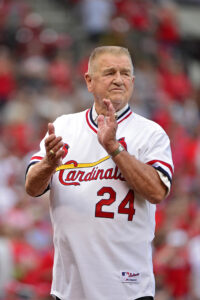
Unfortunately for Royals fans, that came with their in-state rivals. After the Royals missed the playoffs in ’79, Herzog was hired by the Cardinals as both manager and GM. He set about rebuilding the team around speed, defense and contact hitting at the expense of power. While the so-called “Whiteyball” was initially met with some derision, Herzog guided the Cardinals back to the top of the sport.
St. Louis missed the postseason during his first two seasons at the helm before a 92-win showing to snag the NL East title in 1982. After sweeping the Braves in the NLCS, they took on the Brewers in the Fall Classic. The Cards came back from a 3-2 series deficit, erasing a 3-1 lead in Game 7. St. Louis missed the postseason over the next two years but rattled off 101 wins to secure another NL East title in 1985.
Herzog was named the Senior Circuit’s Manager of the Year. A six-game triumph over the Dodgers in the NLCS set the stage for a matchup with his old team. The Cards dropped a classic seven-game set to the upstart Royals, the first title in franchise history. There was no shortage of controversy. With the Cardinals up 3-2 in the series and taking a 1-0 lead into the bottom of the ninth in Game 6, a missed call at first base by Don Denkinger spurred a rally in which Kansas City came back for a 2-1 win. The Royals won the seventh game convincingly.
St. Louis made it back to the World Series once more during Herzog’s tenure. They knocked off the Giants in the 1987 NLCS to set up a showdown with the Twins. That also went seven games, with Minnesota coming back from a 3-2 series deficit to win it. Herzog managed the Cards for another three seasons but didn’t make it back to October. His managerial days ended midway through the 1990 campaign, although he later had a brief stint leading baseball operations for the Angels.
Including his interim work with the Halos, Herzog managed parts of 18 seasons in the majors. He won nearly 1300 regular season games, three pennants and one World Series. The veterans committee inducted him into the Hall of Fame in 2009. He was enshrined in St. Louis’ organizational Hall of Fame a few years later. MLBTR joins countless others around the game in sending condolences to Herzog’s family, friends, loved ones and the many players whose careers he impacted over the decades.
Image courtesy of USA Today Sports.
Carl Erskine Passes Away
Former big league right-hander Carl Erskine passed away today after a brief illness, per multiple sources, including Dana Hunsinger Benbow of The Indianapolis Star. He was 97 years old.
Erskine was born in Anderson, Indiana in 1926. As a boy, he was friends with Johnny Wilson (Wikipedia link), who was black and would go on to play baseball in the Negro leagues as well basketball for the Harlem Globetrotters. Erskine would later mention his friendship with Wilson when the issue of race came up as he shared a locker room with Jackie Robinson.
The young Erskine was signed by the Brooklyn Dodgers and would go on to spend his entire baseball career with that organization, though he played for them in both Brooklyn and Los Angeles. The righty made his debut in 1948, the year after Robinson broke the color barrier. Erskine told Benbow that Robinson once approached him and asked “Hey Erskine, how come you don’t have a problem with this black and white thing?” It was then that Erskine mentioned his friendship with Wilson, telling Robinson: “I didn’t know he was black. He was my buddy. And so I don’t have a problem.”
For his initial season in 1948, Erskine worked a swing role, starting nine of his 17 appearances and tossing 64 innings with a 3.23 earned run average. He would gradually increase his workload in the seasons to come, getting to 79 2/3 in 1949 and then 103 the season after that before getting into the 185-265 range for each season from 1951 to 1956.
It was in that latter stretch that Erskine racked up his most notable career highlights. He made the All-Star team in 1954, a year in which he tossed 260 1/3 innings with a 4.15 ERA. He tossed two no-hitters, one against the Cubs in 1952 and another against the Giants in 1956.
In 1955, Erskine tossed 194 2/3 innings in the regular season with a 3.79 ERA. The Dodgers had made it to the World Series seven times at that point in history but lost each time, including the ’52 and ’53 teams that Erskine was a part of. Erskine’s best World Series performance was in the ’53 series when he struck out 14 batters in Game 3, though the Dodgers eventually lost the series to the Yankees. The Dodgers faced the Yankees again in ’55 and Erskine only tossed three innings in the series but the Dodgers finally emerged victorious to capture the first title in franchise history.
When the Dodgers moved from Brooklyn to Los Angeles for the ’58 season, Erskine went with them, though his career was tailing off by then. He tossed 98 1/3 innings that first year in L.A. with a 5.13 ERA, then had a 7.71 ERA in 23 1/3 frames the next year, which was his final major league action. He finished his playing career with an even ERA of 4.00 in 1,718 2/3 innings.
He returned to Indiana after his playing days and worked various jobs. A profile last year from Tyler Kepler of The New York Times says Erskine “sold insurance, worked as a bank president and coached baseball at Anderson College.” Though perhaps the most notable of his post-playing endeavors was his work with people with developmental disabilities.
Erskine’s son Jimmy was born with Down syndrome, with Carl and his wife Betty deciding to raise him at home, an unusual path in a time when most such cases saw the child sent to an institution of some kind. The couple would later form the Carl and Betty Erskine Society to raise money for the Special Olympics. That charity work led to Carl being given the Buck O’Neil Lifetime Achievement Award from the National Baseball Hall of Fame and Museum last year.
By all accounts, Erskine was beloved by everyone in the Dodgers’ organization, baseball in general and his community in Indiana. MLBTR joins all of them in sending condolences to the Erskine family and everyone else mourning him today.
Ken Holtzman Passes Away
The Cubs announced that former big league left-hander Ken Holtzman passed away recently. Per an obituary from Benjamin Hochman of the St. Louis Post-Dispatch, Holtzman had been hospitalized for the past three weeks due to heart problems. He was 78 years old.
Holtzman was born in St. Louis in 1945. He attended the University of Illinois and was selected from there by the Cubs in the 1965 draft. It didn’t take him long to get to the big leagues, with the Cubs calling him up later that same year.
He only made three appearances in 1965 but got a more proper debut in 1966. He made 34 appearances for the Cubs, 33 starts, and tossed 220 2/3 innings with a 3.79 earned run average. In 1967, he was serving in the National Guard and only able to pitch on weekends, but he made the most of his time in that limited role. He made 12 starts and went 9-0 that year, posting a 2.53 ERA in 92 2/3 innings.
With his military obligations completed, he was able to return to a full-time role. 1968 was the first of nine straight seasons in which he made at least 30 appearances and tossed at least 195 innings. Those Cubs teams of the late ’60s and early ’70s were pretty decent, finishing above .500 each year from ’67 to ’72, but not making the playoffs in any of them. Holtzman was a key component of those clubs, taking the ball and posting generally solid results. That included a no-hitter that he tossed against the Braves in 1969 and another against the Reds in 1971.
Prior to the 1972 season, Holtzman was traded to the Athletics for fellow southpaw Rick Monday. The move to Oakland seemed to suit Holtzman. From 1972 to 1975, he tossed at least 255 1/3 innings in each season with his ERA never finishing higher than 3.14. He was selected to the All-Star team in ’72 and ’73 and the A’s won the World Series in three straight years from ’72 to ’74, with Holtzman playing a big part in those titles. Over those three years and in 1975, he pitched in 13 postseason games with a 2.30 ERA in 70 1/3 innings. He even hit a home run in the ’74 series, with the DH not being implemented in the World Series until 1976.
Holtzman was traded to the Orioles prior to the 1976 season and then to the Yankees in the middle of that campaign. He stayed with the Yanks for a while as his playing time faded, getting traded back to the Cubs midway through the ’78 campaign. He made 23 appearances in 1979 with a 4.59 ERA in what eventually proved to be his last season.
His entire big league career resulted in 451 appearances with a 174-150 record and a 3.49 ERA. He pitched two no-hitters, made a couple of All-Star teams and won three rings. Per Hochman, Holtzman has the most wins for a Jewish pitcher in MLB history, with his 174 just ahead of the 165 wins of Sandy Koufax.
MLBTR joins the rest of the baseball community in sending our condolences to the Holtzman family, as well as his many friends and fans around the game.
Fritz Peterson Passes Away
Former All-Star pitcher Fritz Peterson has passed away at age 82. The Yankees announced the news this evening and offered their condolences to Peterson’s family.
“The Yankees are deeply saddened to learn of the passing of Fritz Peterson, who was a formidable pitcher and affable presence throughout his nine years in pinstripes,” the team said in a statement. “Along with longtime teammate Mel Stottlemyre, Peterson was part of a devastating one-two combination at the top of the Yankees’ rotation.
A known prankster and well-liked among his teammates and coaches, Peterson had an outgoing personality and inquisitive nature that brought lightheartedness to the clubhouse on a regular basis and belied his prowess on the mound — most notably his impeccable control, which was among the best in the Majors. Peterson will be greatly missed by the Yankees, and we offer our heartfelt condolences to his wife, Susanne, and the entire Peterson family.”
A Chicago native, Peterson attended Northern Illinois before signing with the Yankees. He began his career in 1963 and reached the major leagues three years later. The southpaw stepped into the New York rotation as a rookie and spent nearly a decade in the Bronx. Even by the standards of an era of baseball defined by low scoring, Peterson was an excellent pitcher. He turned in a sub-3.00 ERA in three straight seasons from 1968-70. The left-hander’s 2.70 mark over that stretch ranked 12th among 122 qualified hurlers.
Peterson earned an All-Star nod in 1970, a season in which he worked 260 1/3 frames of 2.90 ERA ball. A stellar control artist, he led the American League in WHIP in both 1969 and ’70 and had the Junior Circuit’s lowest BB/9 rate in five straight seasons from 1968-72. He led qualified AL pitchers in strikeout-to-walk ratio in consecutive seasons from 1969-70.
While that late-60s run was Peterson’s peak, he remained a reliable part of the New York rotation through the ’73 season. New York traded him to the Indians early in 1974 as part of a package for future ALCS hero Chris Chambliss. Peterson pitched parts of three years in Cleveland, working to a 4.34 ERA in 346 innings. He had a brief stint with the Rangers before retiring after undergoing shoulder surgery in 1977.
In addition to his on-field accomplishments, Peterson was known for his 1973 “wife swap” with teammate Mike Kekich. Peterson, Kekich and their respective wives, Marilyn and Susanne, decided to reshuffle their relationships after falling for one another. “All of us felt the same way. We went on from there and eventually he fell in love with my wife and I fell in love with his. … Actually, it was a husband trade — Mike for me or me for Mike. It’s a love story. It wasn’t anything dirty,” Peterson would later say (link via Michael Blinn of the New York Post). While Kekich and Marilyn had a brief relationship, Fritz and Susanne Peterson remained together for a half-century until his passing.
Peterson finished his career with a 3.30 ERA in more than 2200 innings. He recorded more than 1000 strikeouts, won 133 games and threw 20 shutouts. MLBTR joins those around the game offering condolences to his family, friends, former teammates and loved ones.
Jerry Grote Passes Away
Longtime Mets catcher Jerry Grote passed away today at age 81. The Mets announced the news via a press release containing tributes from several former teammates who praised Grote as a teammate and as a defensive wizard behind the plate. In the words of former Mets southpaw Jon Matlack, “he was the best catcher I ever threw to. I don’t think I ever shook him off once. I had the pleasure of being his roommate on the road for a few years. It’s a sad day.”
Grote played in parts of 16 Major League seasons from 1963-1981, including a 12-year run with the Mets from 1966-77. He broke into the bigs with the Houston Colt. 45s (now the Astros) in the second and third years of the franchise’s existence, but a bit of a logjam on Houston’s depth chart saw Grote spend all of 1965 in the minors before he was dealt to the Mets.
The deal kicked off Grote’s long run in Queens, and his excellent defense helped him retain either the starting job or at least a timeshare of catching duties for almost the entirety of his Mets stint. Grote hit .252/.316/.326 over his 4844 career plate appearances, with a couple of solidly above-average offensive performances. His 112 wRC+ in 1968 was his personal best, and coincided with the first of Grote’s two All-Star selections (he was also named to the NL squad in 1974).
In 1969, Grote and his teammates become New York icons when the “Miracle Mets” won the World Series. After posting losing records in each of their first seven seasons in existence, the Mets suddenly broke out to win 100 games in 1969, then defeated the Braves in the first-ever edition of the NLCS before upsetting the powerhouse Orioles in the Fall Classic. Grote hit .311/.371/.406 over his final 119 plate appearances of the regular season to help New York surge its way into the playoffs, and his defense and management of the young Mets pitching staff was credited as a key factor in the triumph.
“[Grote] was the reason for my success,” said Jerry Koosman. “I have the photo in my home of me jumping into his arms after we won in 1969. I am heartbroken. No one was better behind the plate. He really controlled the game.”
The Mets dealt Grote to the Dodgers in 1977, and he returned to the postseason as the backup catcher on Los Angeles’ pennant-winning teams in both 1977 and 1978. Grote retired following the 1978 campaign before making a brief comeback in 1981 to play in 24 games (22 with the Royals and two with the Dodgers). His post-career endeavors included stints as a minor league manager and as a radio broadcaster.
We at MLB Trade Rumors send our condolences to Grote’s family, friends, and many fans.
Pat Zachry Passes Away
Ten-year Major League veteran and NL co-Rookie of the Year Pat Zachry passed away on Thursday at age 71, as reported by multiple outlets. Such former teammates as Johnny Bench and Doug Flynn were among the many to pay tribute to the right-hander, with Bench describing Zachry as “one of the great characters and an unbelievable teammate,” while Flynn said “you couldn’t find a better teammate than Zach. We will all miss him dearly.”
A native of Richmond, Texas, Zachry was a 19th-round pick for the Reds in the 1970 draft. He debuted in the majors six years later, and immediately became part of one of baseball’s great teams — the “Big Red Machine” followed up their World Series title in 1975 with another championship in 1976, and Zachry played an important role. The righty posted a 2.74 ERA over 204 innings in his rookie season, and then a 3.09 ERA over two postseason starts (both wins) as Cincinnati swept its way through the playoffs. Zachry and the Padres’ Butch Metzger finished in a tie vote for NL Rookie of the Year honors, which is still the only time the NL ROY has ever been split between multiple players.
Injuries slowed Zachry’s start to the 1977 season, and he found himself leaving the Reds altogether in June of that year when Cincinnati dealt Zachry, infielder Flynn, and outfielders Steve Henderson and Dan Norman to the Mets in exchange for the legendary Tom Seaver. Needless to say, the trade didn’t go over well in New York, and the Mets’ twin deals of Seaver and Dave Kingman on the same day became known as the “Midnight Massacre” for the struggling team. The trade had the side effect of bonding the four ex-Reds — as Flynn put it, “we just stuck together” in the aftermath of the deal, since “none of us knew we could ever replace Tom.”
Zachry ended up pitching with the Mets through to the end of the 1983 season, posting a 3.63 ERA over his 135 appearances (113 of them starts) and 741 2/3 innings for the team. His tenure was highlighted by an All-Star selection in 1978, though that season was cut short for Zachry when he broke his foot while accidentally kicking at his helmet in frustration in the dugout, and instead hitting the dugout steps.
Zachry posted a 3.52 ERA over 1177 1/3 career innings with the Reds, Mets, Dodgers, and Phillies. Turning to relief pitching at the back end of his career, he had an impressive 2.49 ERA over 61 1/3 innings for Los Angeles in 1983, coming out of the pen for 39 of his 40 games that season.
We at MLB Trade Rumors extend our condolences to Zachry’s family, friends, and teammates.
Orioles Owner Peter Angelos Passes Away
Peter Angelos passed away today at age 94, as per an official statement from the Orioles and the Angelos family. Angelos had been battling illness for the last few years and had left the public eye, and his son John took over as the Orioles’ chairman and control person in regards to official league business in 2020.
A Baltimore native, Angelos built his fortune through a renowned legal career, most notably a landmark consolidated action case in 1992 representing thousands of workers in various fields who had been exposed to asbestos over the course of their jobs. Angelos led a group of investors that purchased the Orioles in 1993 for $173MM, and quickly established himself as something of a maverick within baseball’s ownership circles during the 1994-95 players’ strike. Though the strike was settled before replacement players took the field for the 1995 season, Angelos’ refusal to use such players (who he viewed as scabs) drew some animosity from his fellow owners and respect from the MLBPA.
On the field, the Orioles went through plenty of ups and downs during Angelos’ tenure as owner. There was little doubt about Angelos’ desire to win, as he immediately increased the team’s payroll and brought several big-name free agents into the fold, helping Baltimore reach the ALCS in both 1996 and 1997. After that last ALCS appearance, however, the Orioles didn’t have another winning season until 2012, as Angelos was often accused of taking a heavy hand in baseball operations. This manifested itself in a revolving door of managers and general managers, until things began to stabilize under Buck Showalter and executive VP of baseball operations Dan Duquette. The Orioles had five seasons of .500 or better ball from 2012-16, including three postseason appearances and another trip to the ALCS in 2014.
The Orioles’ payrolls tended to fluctuate based on the team’s competitive level, and Baltimore ranked within the top ten of league spending as recently as the 2017 season. Angelos had particular concerns about certain types of baseball-related investments, perhaps most notably a wariness about any kind of long-term guarantee to pitchers (especially pitchers with any sort of injury history). Angelos was also famously critical of baseball’s international signing system, which resulted in the Orioles essentially sitting out for the international amateur market for several years.
John Angelos’ stewardship of the team brought about some changes to the Orioles’ business, as GM Mike Elias was given broad leeway to modernize and revamp the baseball operations department as part of a near-total rebuild. The O’s posted losing records from 2017-21 (the latter three under Elias) before winning 83 games in 2022, and then bursting out to win 101 games and the AL East crown last season. With an incredible core of young talent in place, the Orioles now look like World Series contenders both this season and perhaps for many years to come.
This new era of Orioles baseball will take place somewhat outside of the Angelos family, as it was announced in February that the team had been sold for $1.725 billion to a new ownership group led by David Rubenstein. (John Angelos is still an investor in the Orioles.). The news of the sale followed years of speculation and drama about the future of the franchise, as legal and personal issues within the Angelos family and the Orioles’ expiring lease at Camden Yards in 2023 led to some concerns that the O’s could be sold or moved to another city. As it turned out, the Orioles arranged a new lease to remain at Camden Yards for at least the next 15 years, and Rubenstein’s full purchase of the organization is expected to be approved by the league within a few weeks’ time. Rubenstein was initially slated to take over 40 percent of the team, but now will take full ownership of the club as a result of the elder Angelos’ passing.
We at MLB Trade Rumors send our condolences to Angelos’ family, friends, and loved ones.
Jim McAndrew Passes Away
Jim McAndrew, a former major league pitcher for the Mets and Padres, has passed away, according to Jay Horwitz, vice president of media relations for the Mets. McAndrew was 80 years old.
While McAndrew may have been overshadowed by Hall of Fame teammates Tom Seaver and Nolan Ryan, he was a dependable back-end starting pitcher, and occasional reliever, throughout his time in Queens. Across 146 games with the Mets (105 starts), the Iowa native went 36-49 but pitched to an estimable 3.54 ERA. He was a member of the 1969 World Series champion team, and although he did not pitch in the postseason, he helped the Mets win the NL East that year, tossing 135 innings with a 3.47 ERA.
The following year, McAndrew pitched what was arguably the best season of his big league tenure. He made a career-high 27 starts, crossing the 100-strikeout threshold for the first and only time. Even more impressive, he maintained the lowest walk rate of his career. The 6-foot-2 right-hander threw nine complete games, three shutouts, and to top it all off, he earned two saves in five relief appearances. McAndrew had a difficult season in 1971 but bounced back in ’72, finishing 11th among qualified NL starters with a 2.80 ERA. He went 11-8 that year, adding another four complete games to his career tally. Unfortunately, the righty struggled again the next season, and as was the case in 1969, he did not pitch in the playoffs for the 1973 NL pennant-winning club.
After nine years in the Mets organization, six spent with the big league team, McAndrew played his final season for the Padres. He retired in 1974. Although his last MLB season was marred by injury, he still managed to throw one more complete game, bringing his career total up to an even 20.
McAndrew’s son Jamie, one of four children he shared with his wife Lyn, played two years in Major League Baseball. A right-handed pitcher like his father, the younger McAndrew pitched for the Brewers in 1995 and ’97. We at MLB Trade Rumors send our sympathies and condolences to McAndrew’s family and loved ones.