
Bob Skinner Passes Away
Bob Skinner, an All-Star left fielder and two-time World Series champion as a player, passed away on Monday at age 94. The Pirates announced the news this afternoon.
“As a member of the 1960 World Series championship team, Bob was an important part of one of the most beloved teams in our storied history and helped deliver a moment that will forever be woven into the fabric of our city,” Pirates owner Bob Nutting said in a press release. “Bob was a talented player, a proud Pirate and a respected member of the baseball community. On behalf of the entire Pirates organization, we extend our deepest condolences to Bob’s family, friends and all those who knew and loved him.”
Skinner played parts of 12 seasons in the big leagues, the majority of which came in Pittsburgh. A native of La Jolla, California, Skinner played a season at nearby San Diego Junior College. The Pirates had scouted him since high school and added him on a minor league deal in 1951. Skinner played one season in the minors before being drafted into the Marines during the Korean War. He was stationed in San Diego and played for his base team but was out of the professional ranks for two seasons.
After the conclusion of his service, Skinner returned to the Pirates for the 1954 season. He made his MLB debut that year but struggled as a rookie, leading the Bucs to send him back to the minors in ’55. Skinner made it back to the Majors one year later and finally settled in during his third MLB season, breaking out by hitting .305 in 1957.
Skinner took another step forward during the ’58 campaign. He hit .321/.387/.491 and drove in 70 runs to earn his first All-Star selection and some down ballot MVP support. That’d be his best statistical season, but the left-handed hitter returned to the All-Star Game in 1960. More importantly, the Pirates would go on to defeat the Yankees in a classic seven-game World Series for the franchise’s first championship in 35 years.
After a middling 1961 season, Skinner set a career high with 20 homers while batting .302 in 1962. The Pirates would trade him to the Reds a year later. Cincinnati dealt Skinner to the Cardinals midway through the ’64 campaign, a move that paid off handsomely for him personally. Although he was a role player by that point, he won his second career World Series when the Cards defeated the Yankees in another seven-game Fall Classic. Skinner went 3-4 as a pinch-hitter in that series (though all of his hits came in the St. Louis losses).
Skinner’s playing career ended after the 1966 season. That wasn’t close to the conclusion of his time in baseball, however. He jumped right into minor league managing and would up as an MLB skipper by 1968. The Phillies hired him to replace Gene Mauch midway through that season. Skinner himself was fired less than a year later as Philadelphia got out to a rough start to the ’69 campaign.
He had a brief stint as an interim manager with the Padres in 1977 but spent most of the decade as a hitting coach. That included a return to Pittsburgh in 1979, when the Bucs won another World Series. Skinner worked on the Braves’ coaching staff and as a minor league manager and scout with the Astros after that, remaining in baseball until 2009.
Skinner finished his playing career as a .277/.351/.421 hitter. He topped 100 home runs and tallied nearly 1200 hits while recording 531 runs batted in. MLB Trade Rumors sends our condolences to Skinner’s family — including his son Joel, a former MLB catcher and manager — loved ones, friends, and the countless people whose lives he impacted over his lengthy run in baseball.
Ellie Rodríguez Passes Away
Ellie Rodríguez, a two-time All-Star catcher who played throughout the 1970s, passed away this week. The news was reported by multiple outlets, including ESPN Deportes. He was 79.
Rodríguez was born in Puerto Rico but moved to the Bronx as a child. He began his playing career on a minor league contract with the then-Kansas City Athletics out of high school. His hometown Yankees plucked him away after the 1964 season. Rodríguez spent a few seasons in the Yanks’ system and made a nine-game debut during the ’68 campaign.
Then 23, Rodríguez would change organizations again over the 1968-69 offseason. He’d return to a K.C. club but not the one for which he’d played a few seasons earlier. The new Royals franchise selected Rodríguez in the expansion draft. He was behind the plate on Opening Day as the first starting catcher in team history.
A defensive catcher, he did an excellent job controlling the running game. He threw out 45% of basestealers as a rookie and was selected to the All-Star Game. Rodríguez spent one more season with Kansas City before being traded to the Brewers.
The righty-hitting backstop had his best seasons in Milwaukee. He played three years and 325 games in a Brewers uniform, working as their primary catcher between 1971-73. Rodríguez was selected to his second All-Star Game in ’72 amidst a career-best .285/.382/.352 showing.
Milwaukee traded Rodríguez to the Angels over the 1973-74 offseason. He played two seasons in Anaheim, hitting a career-high seven homers in the first of those years. He was also behind the plate for the fourth no-hitter of Nolan Ryan’s career during the 1975 campaign. Rodríguez closed his MLB career with a 30-game stint for the Dodgers in ’76. He’d play in the Mexican League into the 1980s and coached youth baseball in Puerto Rico as recently as 2018.
Rodríguez finished his MLB career with a .245/.356/.308 slash line over 775 games. He only hit 16 home runs but tallied 533 hits and walked more often than he struck out. He caught nearly 6000 innings and twice led the American League in throwing out baserunners. Rodríguez cut down an MLB-high 56 stolen base attempts (a 48% clip) with the Halos in 1974. MLBTR sends our condolences to his family, loved ones, friends and former teammates.
Garret Anderson Passes Away
The Angels announced Friday that three-time All-Star and 2002 World Series champion Garret Anderson has passed away at just 53 years of age. Anderson passed from acute necrotizing pancreatitis, according to a report from Edward Lewis of The California Post. The organization issued the following statement on the heartbreaking loss of a franchise great:
“We are deeply saddened to announce the passing of Angels Hall of Famer Garret Anderson. Garret will forever hold a special place in the hearts of Angels fans for his professionalism, class, and loyalty throughout his career and beyond. We extend our heartfelt condolences to the entire Anderson family.”
Angels owner Arte Moreno has also issued a personal statement:
“The Angels Organization is mourning the loss of one of our franchise’s most beloved icons, Garret Anderson. Garret was a cornerstone of our organization throughout his 15 seasons and his stoic presence in the outfield and our clubhouse elevated the Angels into an era of continued success, highlighted by the 2002 World Series Championship.
Garret will forever hold a special place in the hearts of Angels fans for his professionalism, class, and loyalty throughout his career and beyond. His admiration and respect for the game was immeasurable.
We extend our deepest condolences to Garret’s wife Teresa, daughters Brianna and Bailey, son Garret ‘Trey’ Anderson III, and his entire family.”
Originally selected by the Angels out of John F. Kennedy High School in Granada Hills, Calif. in the fourth round of the 1990 draft, Anderson shattered any reasonable expectations with that relatively humble draft status. He made his major league debut in July 1994 at just 22 years of age. It was a fleeting five-game cup of coffee due to the 1994 strike, but Anderson’s 5-for-13 (.385) showing served as a portent for what was to come.
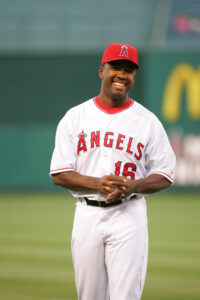
In 1995, Anderson immediately broke out as one of the game’s brightest young players. He torched American League pitching with a .321/.352/.505 batting line, 16 home runs, 19 doubles, a triple and six stolen bases. Anderson narrowly finished second to Minnesota’s Marty Cordova in ’95 Rookie of the Year voting, with both players pulling in 13 of 28 first-place votes. The two were extremely close in terms of on-base percentage and slugging percentage, with Anderson having a big lead in batting average but Cordova having a major edge in games played (137 to 106) and plate appearances (579 to 400).
Anderson followed that Rookie of the Year runner-up showing with several years of roughly average offense and plus right field defense. In 2000, he broke out with a 35-homer campaign and followed it with a 28-homer efforts in 2001. Anderson’s 2002 season produced his first All-Star bid. He paced the majors with 56 doubles, ripped 29 home runs and hit .306/.332/.539 as the Angels’ roster at large gelled together to create an unstoppable force.
Anderson joined homegrown stars like Troy Glaus, Darin Erstad, Tim Salmon, Jarrod Washburn, John Lackey and Francisco Rodriguez on an Angels club that won 99 games to secure a postseason berth. The ’02 Angels toppled a 103-win Yankees club in the American League Division Series before taking down a 94-win Twins club in the American League Championship Series. Their World Series aspirations were hanging on by a thread in Game 6 against the Giants, with the Halos trailing by five runs heading into the bottom of the seventh. Anderson collected a hit as part of the team’s late six-run rally, and in Game 7, he cleared the bases with a third-inning double down the line off San Francisco’s Livan Hernandez, giving the Angels a 4-1 lead they would never relinquish.
That standout 2002 season not only earned Anderson his first All-Star nod, it also secured him a fourth-place finish in AL MVP voting and the first of two Silver Slugger Awards in his terrific career. He finished 14th in MVP voting, won another Silver Slugger Award, and not only made another All-Star team in 2003 but won that season’s annual Home Run Derby. Anderson starred for the Angels all the way through 2008 before closing out his career with a pair of one-year stops in Atlanta and back in Los Angeles — this time in Dodger Blue.
All told, Anderson’s career drew to a close with some rare numbers. He retired with a .293/.324/.461 batting line. On a rate basis, that was roughly league-average offense in that supercharged era of run production, but few players could match Anderson’s consistency, durability and longevity. He slugged 287 home runs (186th all-time) and still ranks in the all-time top-100 doubles (522, 50th) runs batted in (1365, 87th) and hits (2529, 96th). To this day, Anderson is the Angels’ franchise leader in games played, hits, runs scored, RBIs and total bases.
Anderson’s consistent production, smooth swing and stoic personality helped endear him not only to the Angels faithful but to baseball fans from all walks of life. His name is synonymous with the most prosperous era of Angels history, and his indelible legacy will live on in franchise lore. We at MLB Trade Rumors offer our heartfelt condolences to Anderson’s family, the Angels organizations, and the countless fans who hold cherished memories of one of his generation’s most consistent hitters.
Phil Garner Passes Away
Former three-time All-Star and longtime manager Phil Garner passed away on Saturday at age 76. A statement released by Garner’s family praised the medical care given to Garner during his fight with pancreatic cancer, and said that “Phil never lost his signature spark of life he was so well known for or his love for baseball which was with him until the end.”
Debuting with the Athletics in 1973, Garner hit .260/.323/.389 over 6136 plate appearances and 1860 games with the A’s, Pirates, Astros, Dodgers, and Giants during his 16-year career as a big league player. He became Oakland’s everyday second baseman in 1975 and received his first All-Star nod in 1976, but he was dealt after that season as part of a nine-player trade with the Pirates.
Garner played both second and third base (with some appearances at shortstop) during his four-plus years in Pittsburgh. His best season in terms of both personal and team accomplishments came in 1979, when Garner had a career-best 3.9 fWAR while hitting .293/.359/.441 with 11 homers and 17 steals for the Pirates’ World Series-winning team, which remains the last Buccos club to win a championship. Garner was a huge part of that title run, delivering a phenomenal .472/.537/.722 slash line over 41 PA during the postseason.
The Pirates traded Garner to the Astros partway through the 1981 campaign, and he went on to have several more successful years in a Houston uniform before his production declined in 1987. The Dodgers acquired Garner in a trade partway through the 1987 campaign but the change of scenery didn’t spark his bat, and Garner then played 15 games with the Giants over his final year as a player.
Garner’s gritty and grinding playing style made him a fan favorite, and perhaps all you need to know about Garner is that he was known as “Scrap Iron,” a nickname coined by former Pirates announcer Milo Hamilton. The blunt and tough-but-fair approach stuck with Garner in his post-playing days, as he went onto a successful second career as a manager over 15 seasons with the Brewers, Tigers, and back in Houston with the Astros.
As a skipper, Garner posted a 985-1054 career record, beginning with a 92-win season as Milwaukee’s manager in 1992. This was the only winning record Garner would post in eight seasons with the Brewers and three seasons in Detroit (from 2000-02), but he broke through in 2004 after being hired to take over an Astros team that had a 44-44 record.
Houston went 48-26 the rest of the way under Garner, and fell just short of a World Series appearance after losing the NLCS to the Cardinals in a memorable seven-game battle. The Astros beat St. Louis in a rematch the next season for the first pennant in Houston franchise history, though the Astros were swept by the White Sox in the World Series.
We at MLB Trade Rumors extend our condolences to Garner’s family, friends, and many fans.
Davey Lopes Passes Away
The Dodgers announced today that Davey Lopes passed away today at the age of 80. Lopes made his debut as a player in the early 1970s and went on to have a career as a coach and manager, making him a staple of the game for the bulk of five decades.
Lopes was a late bloomer. He didn’t make it to the majors until 1972, which was his age-27 season. Even then, he only got into 11 games for the Dodgers. The following year, his age-28 campaign, he finally established himself as a big league regular. He became the club’s second baseman and showed off the speed that would become his standout trait. He swiped 36 bags that year, his first of what would eventually be a 14-year streak of stealing at least 15 bases.
He stayed on the Dodger roster through the 1981 season, mostly covering the keystone but also with occasional action at shortstop, third base and in the outfield. The Dodgers had a very consistent infield during that stretch, with Steve Garvey the mainstay at first, Lopes at second, Bill Russell at short and Ron Cey at third.
Lopes played in 1,207 games for the Dodgers from his 1972 debut until the end of that 1981 campaign. He hit .262 in that time and launched 99 home runs but the eye-popping stat was his 418 stolen bases. He led the league in steals in both 1975 and 1976, with 77 in the former and 63 in the latter. The second instance was particularly impressive as injuries limited him to only 117 games. In 1978, he won a Gold Glove and also made the All-Star team, the first of four straight All-Star selections.
The Dodgers were quite good in that time but couldn’t quit win a title for most of it. They lost the World Series to the Athletics in 1974, then to the Yankees in both 1977 and 1978. In 1981, they were able to get the job done, topping the Yankees 4-2. Lopes stole ten bases in in 16 postseason games that year.
Prior to the 1982 season, he was traded to the A’s, kicking off the journeyman phase of his career. He would also bounce to the Cubs and Astros, playing past his 42nd birthday. He finished his career with 7,340 plate appearances over 1,812 games. He racked up 1,671 hits, including 155 home runs. He scored 1,023 runs and drove in 614. His 557 steals put him 26th on the all-time list.
He quickly pivoted to his post-playing career by becoming a bench coach with the Rangers. That was followed by stints as a first base coach with the Orioles and Padres. He was hired to manage the Brewers for the 2000 season. The club did not fare well and he was fired early in 2002. He never got another managerial gig and had a 144-195 record in that job. He then went back to being a first base coach, starting with a return to the Padres, followed by stints with the Nationals, Phillies, Dodgers and back to the Nationals. He retired from coaching after the 2017 season.
We at MLB Trade Rumors join the rest of the baseball world in sending condolences to the Lopes family as well as everyone else mourning him today.
Photo courtesy of Jayne Kamin-Oncea, Imagn Images
Wayne Granger Passes Away
Former MLB reliever Wayne Granger passed away on Wednesday at 81. The National Baseball Hall of Fame announced the news this evening.
Granger, a 6’4″ right-handed pitcher, was a native of Springfield, Massachusetts. He signed with the Cardinals as an amateur free agent and debuted with St. Louis during the 1968 season. Granger tossed 44 innings of 2.25 ERA ball as a rookie. He made one mop-up appearance in that year’s World Series, getting through two scoreless innings in a blowout loss in Game 6 against the Tigers. Detroit would win the decider the next night, coming back from a 3-1 series deficit.
That wound up being Granger’s final appearance of his first stint in a St. Louis uniform. The Cardinals traded him to Cincinnati alongside 23-year-old outfielder Bobby Tolan for Vada Pinson, a star center fielder who was by that point in the decline phase of his career.
It turned out to be a win for the Reds. Pinson played one season with the Cardinals, hitting .255 with 10 homers, and was traded to Cleveland a year later. Tolan had a brief peak but had three excellent seasons as a table-setter in front of the bigger bats as the Big Red Machine dynasty developed.
Granger was a bullpen workhorse over his three seasons in Cincinnati. He led the majors in appearances (90) and games finished (55) during his first year with the Reds. Granger threw 144 2/3 innings — a huge amount out of the bullpen even at a time when most relievers went multiple innings — and worked to a 2.80 ERA. The ’69 season was the first in which MLB officially recognized the save statistic. Granger picked up 27, tying him for third-most in the majors.
He had a similar showing the following year. Granger again posted a sub-3.00 ERA while logging 84 2/3 innings during the regular season. He led the majors with a career-high 35 saves, which was at the time the most in a season in MLB history (including retroactive tallies from before it was officially recognized as a stat).
That was mostly a reflection of the changing way in which teams used their relievers. It certainly didn’t hurt that a 102-win Cincinnati team gave Granger plenty of opportunities to shut the door. He pitched quite well in his own right, however, although that unfortunately didn’t extend to the postseason. Granger gave up five runs in two innings over a pair of appearances in the 1970 World Series. The Reds dropped a five-game set to the Orioles.
Granger played one more season in Cincinnati, again leading the National League in appearances in 1971. The Reds traded him to the Twins after that season. Granger pitched one year in Minnesota before kicking around to a handful of clubs (Yankees, a second stint in St. Louis, White Sox, Astros and Expos).
He retired after the 1976 season and was inducted into the Reds’ team Hall of Fame six years later. Granger finished his career with a 3.14 ERA across 638 2/3 innings. He recorded 108 saves and struck out 303 opponents. MLBTR sends condolences to his family, friends, former teammates and loved ones.
Bill Mazeroski Passes Away
The Pirates announced this morning that Hall of Famer Bill Mazeroski passed away yesterday at age 89. The team’s statement included a tribute from chairman Bob Nutting, who described Mazeroski as “one of a kind — a true Pirates legend, a National Baseball Hall of Famer and one of the finest defensive second basemen the game has ever seen.”
“His name will always be tied to the biggest home run in baseball history and the 1960 World Series championship, but I will remember him most for the person he was: humble, gracious and proud to be a Pirate.”
A career Pirate who played 17 seasons in the big leagues from 1956-72, Mazeroski is best-known for his legendary walk-off home run in Game 7 of the 1960 World Series. The Pirates had won their first National League pennant since 1927 on the strength of eight All-Star players, including Mazeroski. Still, they faced a challenge in overcoming a powerful Yankees roster featuring Mickey Mantle, Roger Maris, Whitey Ford, and others.
With the Series tied at three games apiece, it was Mazeroski who delivered the winning blow in the bottom of the 9th of a wild Game 7. On a 1-0 count against Yankees pitcher Ralph Terry, Mazeroski drilled a high fastball over the left-center field wall to clinch the Pirates’ 10-9 victory and the championship. It was their first World Series title since 1925 and the first time a World Series ended on a walk-off home run. To this day, Mazeroski’s blast stands as one of the most iconic home runs in the history of the sport.
Mazeroski joined the Pirates organization out of high school in 1954, and made his MLB debut in July 1956 at the age of 19. He played his first full season in 1957 and established himself as a contact-oriented second baseman, batting .283 with 149 hits and 59 runs scored. His 1958 season was arguably his best, as Maz batted .275/.308/.439 in 607 plate appearances with 156 hits and 19 home runs, the latter being a career high. He was an All-Star for the first time and also earned his first Gold Glove while finishing eighth in NL MVP voting.
In addition to being a contact hitter, Mazeroski’s career came to be defined by his defense. He won a total of eight Gold Gloves, including five straight from 1963-67. His defense alone was valued at 24.0 bWAR, which ties him for 23rd all-time. Mazeroski holds the record for most double plays turned (1709) as a second baseman, and his 6685 assists from the keystone ranks fifth all-time. No discussion of the game’s best defensive players is complete without mention of Mazeroski’s accomplishments.
In an 11-year stretch from 1958-68, Mazeroski tallied 1,608 of his 2,016 career hits while batting .263/.300/.374 and accumulating 32.1 bWAR. He was remarkably durable, playing at least 130 games with 527 PA or more every year from 1957-68. He earned a total of seven All-Star nods, the last of those coming in 1967 when he led the NL in games played and tallied a career-high 167 hits. He became more of a part-time player at the end of his career and won a second World Series in 1971 against the Orioles. He retired in 1972 at the age of 35.
Overall, Mazeroski batted .260/.299/.367 with 2,016 hits, 138 home runs, and 853 runs batted in. He became eligible for Hall of Fame admission in 1978 but did not meet the required threshold before falling off the ballot in 1992. Most pointed to his lower-than-usual offensive output as a reason for exclusion, but the Veterans Committee disagreed in 2001, admitting Mazeroski to the Hall in recognition of his defensive excellence.
We at MLBTR extend our condolences to Mazeroski’s family, friends, loved ones, former teammates, and baseball fans around the world.
Elroy Face Passes Away
The Pirates announced this evening that former All-Star reliever Elroy Face has passed away at 97. He pitched parts of 16 seasons in the big leagues, all but the final of which came in Pittsburgh.
“It is with heavy hearts and deep sadness that we mourn the passing of Pirates Hall of Famer Elroy Face, a beloved member of the Pirates family,” chairman Bob Nutting said in a statement. “I was fortunate to get to know Elroy personally, and I will always be proud that we had the chance to honor him with his induction into the Pirates Hall of Fame. Elroy was a pioneer of the modern relief pitcher — the ‘Baron of the Bullpen’ — and he played a critical role in our 1960 World Series championship, leading the league in appearances and recording three saves against the Yankees. Our thoughts are with his three children — Michelle, Valerie and Elroy Jr. — and his sister Jacqueline.”
An upstate New York native, Face began his career in the Phillies organization in 1949. The 5’8″ righty, a sidearmer whose specialty was the forkball, emerged as a favorite of Hall of Fame executive Branch Rickey, who acquired him when he was Dodgers’ GM over the 1950-51 offseason. Rickey took the same position with the Pirates the following year and added Face during the 1952-53 winter, at which point the pitcher was in Double-A.
Face pitched poorly as a rookie and was sent back to Double-A for the ’54 season. He returned to the majors the following year, working in a swing role before making a full-time bullpen conversion by 1956. Face would lead the majors with 68 appearances that season, tossing 135 1/3 innings of 3.52 ERA ball. The Pirates used him mostly at the back of games at a time when many teams didn’t have set closers. Face led the National League in games finished in four of five seasons between 1958-62.
The save statistic didn’t come into use until 1969. Face was retroactively credited as the NL saves leader in three of those seasons, including MLB high marks in 1958 (20) and ’62 (28). He posted a sub-3.00 earned run average in four of those years, including a career-low 1.88 mark over 91 innings during the ’62 campaign.
Even if saves weren’t around at the time, Face’s accomplishments were appreciated during his career. He appeared on MVP ballots each season between 1958-60. He was an All-Star every year between 1959-61 and technically was selected to six All-Star Games, as MLB had both a midseason and postseason All-Star Game for a brief stretch during Face’s peak.
The 1960 season is etched into baseball history. Face tossed 114 2/3 innings of 2.90 ERA ball with 61 games finished for a 95-59-1 team that won the pennant. The respective best regular season teams in each league went to the World Series in those days. Pittsburgh went up against a Yankees club that had Mickey Mantle, Roger Maris and Whitey Ford in their primes.
The Pirates would go on to win one of the most iconic series in league history. Face got the save in each of their first three victories: Games 1, 4, and 5. He pitched the sixth through eighth innings of Game 7. That wasn’t his sharpest outing, as he gave up a go-ahead home run to Yogi Berra, but Pittsburgh would come back to take the lead in the bottom of the eighth. After the Yankees tied it in the top of the ninth, Bill Mazeroski connected on what remains the only Game 7 walk-off home run in history.
That World Series was the only time that Face would pitch in the postseason, but he remained in Pittsburgh for most of the 60s. He added four sub-3.00 ERA seasons well into his 30s and had brief stops in Detroit and with the Expos to finish his career.
The Pirates have been around for more than 140 seasons. Face remains the franchise’s all-time leader in pitching appearances (802), games finished (547) and saves (186). He pitched nearly 1400 innings with a 3.48 ERA and recorded 877 strikeouts. Face topped 100 wins — including an astounding 18-1 record out of the bullpen in 1959 — and came up just shy of 200 saves overall, as he added five more during his final season in Montreal. Face was inducted into the Pirates Hall of Fame three years ago. MLBTR sends condolences to his family, friends and loved ones.
Jason Mackey of The Pittsburgh Post-Gazette first reported the news.
Terrance Gore Passes Away
Longtime Royals outfielder and pinch-running specialist Terrance Gore passed away yesterday at age 34. According to a social media post from Gore’s wife Britney, Gore unexpectedly passed following what was supposed to be a routine surgical procedure.
A veteran of eight Major League seasons, Gore had one of the more unique careers of any player in baseball history. Gore played in 112 big league games, but made only 14 starts and 85 trips to the plate, as Gore was almost exclusively utilized as a pinch-running specialist. Gore didn’t hit much in the majors (.216/.310/.270 over his 85 PA) or even in the minor leagues, yet he carved out a niche for himself due to his glovework and blazing speed.
On the basepaths, Gore stole 43 bases out of 52 attempts, and scored 33 career runs. As a defender, Gore posted +2 Defensive Runs Saved and +6 Outs Above Average over 188 1/3 regular-season career innings in the outfield, seeing time at all three positions.
Kansas City selected Gore in the 20th round of the 2011 draft, and he spent five of his eight seasons in a Royals uniform. The majority of Gore’s big league time at the plate came during his 2019 season with the Royals, and he delivered a .275/.362/.353 slash line across 58 PA. Gore was a member of the Royals’ pennant-winning teams in 2014 and 2015, stealing four bases in five attempts over eight postseason games in those two iconic seasons in K.C. baseball history.
The Royals’ 2015 championship marked the first of three times Gore played for a World Series-winning team, as he also earned rings with the 2020 Dodgers and 2021 Braves. The back half of Gore’s big league career saw him bounce around to several postseason contenders (the Cubs, Yankees, Dodgers, Braves, and Mets) looking to bolster their baserunning situation heading into the playoffs. Gore played in two regular-season games with the 2020 Dodgers but didn’t see any playoff action, and he then spent the entire 2021 regular season in the Braves’ minor league system before being included on Atlanta’s NLDS roster.
We at MLB Trade Rumors send our condolences to Gore’s family, friends, and loved ones.
Mickey Lolich Passes Away
The Tigers announced Wednesday that three-time American League All-Star and 1968 World Series MVP Mickey Lolich passed away this morning. He was 85 years old.
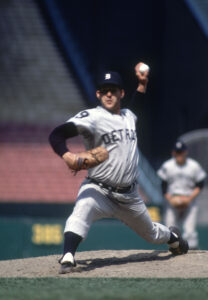
Debuting as a 22-year-old during the 1963 season, Lolich quickly seized a spot in Detroit’s rotation. He became a mainstay on the Tigers’ staff for the next decade-plus, calling greats like Hall of Famer Jim Bunning and two-time Cy Young winner Denny McLain teammates along the way.
After several years as a steady contributor, Lolich carved out a lasting legacy with a historic performance in the 1968 World Series. The left-hander started Game 2, Game 5 and the pivotal Game 7 against the Cardinals, not only securing three victories but going the distance in each of those wins. In one of the greatest individual World Series performances ever seen, Lolich hurled three complete games, held St. Louis to just five runs on 20 hits and six walks (1.67 ERA) and punched out 21 opponents. His final start during that year’s Fall Classic came on just two days’ rest, but he nonetheless held Lou Brock & Co. to one run on five hits and three walks in a 4-1 victory.
That performance alone would’ve cemented Lolich’s place in Tigers lore, but it’s just one of many highlights over his stellar career. The Portland native made the first of three All-Star appearances the following season in 1969 and, in 1971-72, enjoyed a pair of top-three finishes in American League Cy Young voting, losing out to legends Vida Blue and Gaylord Perry, respectively.
Lolich finished top-10 in American League MVP voting in both of those Cy Young runner-up seasons and, in ’71, paced the American League with 45 games started and 376 innings pitched. He completed 29 games that year and did so while maintaining an ERA just shy of 3.00 (2.92). Both those 45 games started and 376 innings are the second-highest single-season marks for any pitcher in the past century; Lolich trails only Wilbur Wood in each category (376 2/3 innings, 49 games started).
Lolich spent the first 13 seasons of his career with the Tigers before being traded to the Mets in a Dec. 1975 swap that sent six-time All-Star Rusty Staub back to Detroit. He briefly retired following his lone year as a Met before returning as a reliever with the Padres in 1978-79 and again calling it quits — this time for good.
All told, Lolich pitched in 16 major league seasons and compiled a 217-191 record with a 3.44 ERA over the life of 3638 1/3 innings. His 2832 career strikeouts rank 23rd all-time, just 33 behind his rookie teammate, the aforementioned Bunning. Lolich is one of just 122 pitchers to ever record 200 wins in his career and is tied with Freddie Fitzsimmons for 87th all-time. His 47.9 wins above replacement (per Baseball-Reference) tie him with another standout lefty, Ron Guidry, for 116th on the all-time list. We at MLBTR offer our condolences to Lolich’s family, friends and countless fans on the loss of one of his generation’s great talents.