
The Reds announced on Friday morning that they’ve signed catcher Tucker Barnhart to a four-year contract extension that will keep him around through at least the 2021 season. Barnhart’s new contract also contains a club option for the 2022 season.
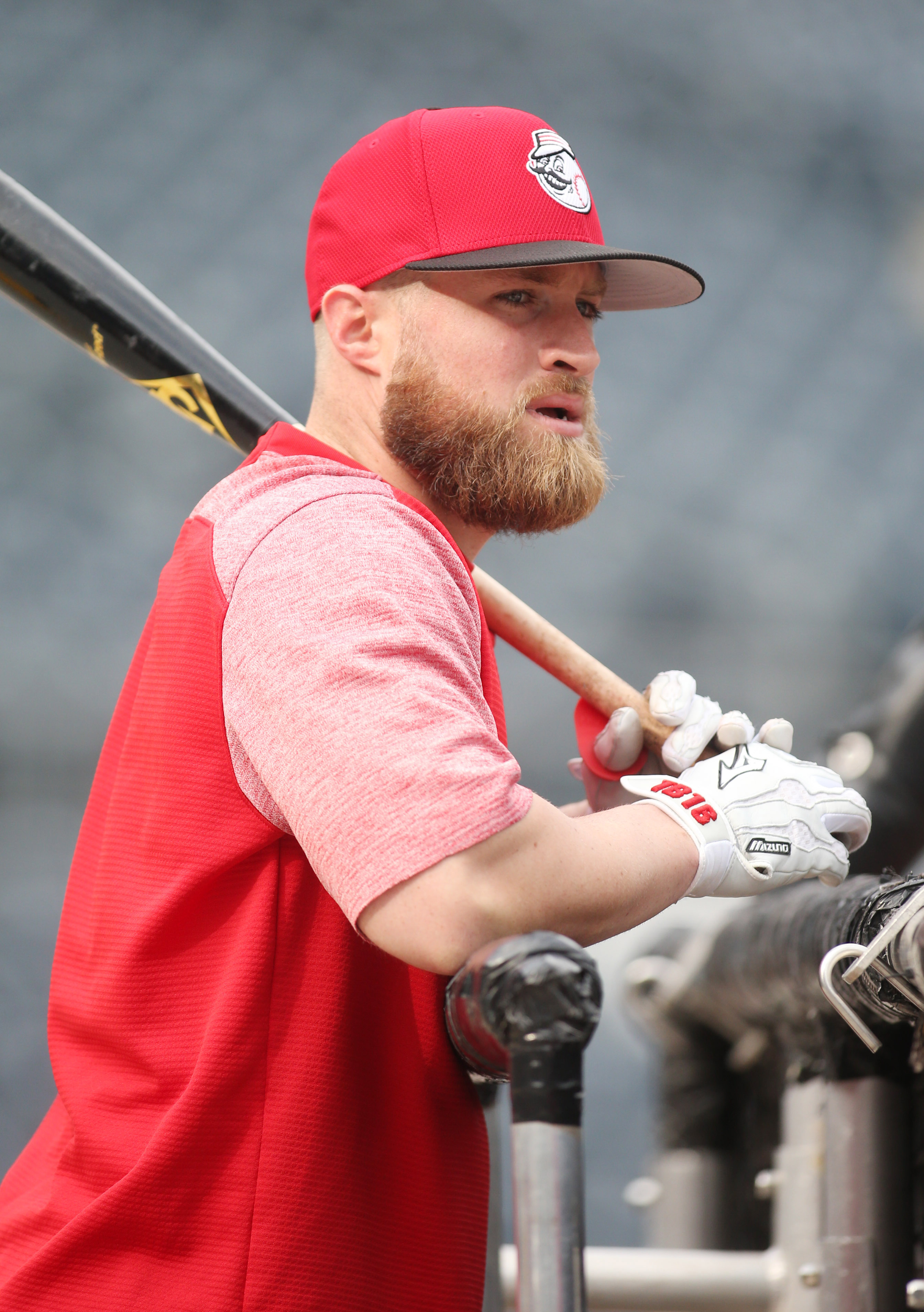 Zach Buchanan of the Cincinnati Enquirer reports that Barnhart will be guaranteed $16MM (Twitter link). That sum will paid out in the form of a $1.75MM signing bonus and annual salaries of $4MM (2018), $2.5MM (2019), $3.5MM (2020) and $3.75MM (2021). The 2022 option is valued at $7.5MM and comes with a $500K buyout, per Buchanan.
If the option is exercised, Barnhart would reach the open market in advance of his age-32 season having earned at least $23MM over the life of his new contract. Escalators could push the maximum value of the deal to as much as $24.5MM over five seasons.
“Tucker has made us proud on the field with his play and off the field with his community involvement,” said Reds president of baseball operations Dick Williams in a statement announcing the contract. “He worked his way up through our system, improving every step of the way, and has established himself as an elite defensive catcher and a productive offensive player. Switch-hitting catchers who can impact the game defensively are tough to find.”
Barnhart, a client of the Ballengee Group, was slated to reach free agency upon completion of the 2020 campaign, so this deal will lock in one of his free-agent seasons and give the Reds control over a second would-be free-agent year. He’d have been eligible for arbitration for the first time this winter, so Barnhart’s contract will also allow him to ever avoid needing to deal with said process.
While Barnhart is far from a household name, he’s quietly produced a quality 2017 season after emerging as the Reds’ primary catcher in 2016 due to Devin Mesoraco‘s persistent injury issues. Barnhart batted a respectable .257/.323/.379 for the Reds in a career-high 115 games/420 plate appearances last season, and he’s elevated his offensive profile in 2017 with a .272/.349/.399 slash. While some of his OBP is undoubtedly a product of batting eighth in a National League lineup, Barnhart typically demonstrated keen plate discipline throughout his minor league career (10.7 percent minor league walk rate) and has struck out in just 16.4 percent of his plate appearances this season.
Looking at the defensive side of his game, Barnhart has been nothing short of sensational when it comes to controlling the running game. He caught a well-above-average 33 percent of potential base thieves in the 2016 campaign and currently leads the National League with a gaudy 44 percent caught-stealing rate in 2017. Baseball Prospectus feels that he’s been the most valuable catcher in terms of throwing arm and one of the three best in terms of blocking pitches in the dirt this season. However, both B-Pro and Statcorner.com peg Barnhart’s pitch framing as well below the league average.
The Barnhart extension gives the Reds four players under contract through at least the 2019 season, although Raisel Iglesias figures to opt into arbitration this winter and, in doing so, forgo his guaranteed salaries for more sizable year-to-year paydays. Cincinnati also has Joey Votto and Homer Bailey earning a combined $48MM in 2019, and Barnhart will now join Votto as the only Reds player signed to a guaranteed deal in 2020 and in 2021.
While there’s very limited financial risk for the team in the first place, the front-loaded nature of the contract further reduces some of that risk. Barnhart seems likely to handle the bulk of catching duties next year, given the uncertainty surrounding Mesoraco’s health, or at the very least split the load in a fairly even timeshare. But, he’ll earn closer to backup catcher salaries as the contract wears on, should the Reds look to augment their catching situation with a more formidable offensive backstop.
As for Barnhart himself, he’ll lock in the first significant payday of his professional career. The former 10th-round pick signed a $250K bonus out of the draft and has earned at scarcely more than a pro-rated league-minimum rate to this point in the Majors. That his value comes more from controlling the running game and getting on base than accruing counting stats (homers, RBIs, etc.) would also likely have suppressed his earning potential in arbitration, giving Barnhart extra incentive to lock in his first fortune as a big leaguer.
Photo courtesy of USA Today Sports Images.
Yesss another rare September extension
Excellent move!
Probably would’ve made more through arbitration so good move by the Reds
Possibly but the Reds signed Devin Mesoraco to a similar deal a few years ago. He got injured and there’s no way he would’ve made the money he did in arbitration with so little playing time. He probably would’ve been non-tendered rather than go to arbitration.
The Reds take the risk that they could spend all that and get nothing, as they did with Mesoraco. Barnhart takes the risk that he could earn more. The upside is a few million more. The downside is that he could earn next to nothing if he flops.
I never understood how the Reds treated Mesoraco. It seems that when he was injured, they’d say “He’s okay”, and have him play through it. They never seemed to monitor his rehabs so he’d actually heal and play again ; thus he never would heal.
On top of that, they never got a decent backup despite his injury pattern.
Love the move
Great move by the Reds. The best defensive catcher in the league, and a surprisingly serviceable bat with a .748 OPS. Leads the league in assists and caught stealing and yet only has one error all year. That’s absurd.
How is his framing?
Below average…but then again you have to have pitchers throw the ball close enough to be strikes to be able to frame anything…and the Reds pitchers have walked more batters than anyone. It’ll improve as the Reds pitchers improve.
Maybe part of the reason they’ve walked so many is that they’re throwing to a below average framer, and they’ll improve with a better receiver behind the plate.
That’s absurd. I’d expect that type of conclusion from a dotard. Have you seen how incapable the Reds pitchers are? You cannot frame a pitch that missed the plate by 18 inches.
That’s enough. He’s a top 5 defensive Catcher in the league. I’ll take him any day. Works amazing with every pitcher, especially the young guys
One would assume that any framing stat worth anything would not penalize him for not getting strike calls that are far off the plate.
Reds pitchers could not hit the ocean from a boat.
This is a nice move here. All Barnhart has to do to give Cincy Market Value is post around 0.5 WAR/yr as 1 WAR=$8m
Using the term “market value” in that sense is comparing Barnhart’s arbitration years to free-agent years, and you can’t really do that when evaluating the deal. The very nature of arbitration is that players only earn a fraction of their market value before reaching free agency.
I’m not disagreeing with the fact that it’s a seemingly solid move on Cincinnati’s part, but comparing arbitration salaries to full market value is going to make every pre-arb extension look like an absolute steal when many don’t pan out that way.
Yep, this is a great point that many fans don’t understand. Since Barnhart wasn’t going to be a free agent until after 2020, this deal pays him for just 1 free agent year, plus that team option. Nevertheless, it seems like a good deal for the Reds. I feel that Barnhart’s salary in 2018, 2019, and 2020 are around what he might make in the arb process. The 2021 salary could be good or bad, depending on if he’s still a good player by then. But seems like a good gamble to take for the Reds.
Kudos to Reds for moving on from Mesoraco. He set the world on fire in 2014, but it’s been an ever-ending series of injuries since that have limited him to 85 games in 3 years. Mesoraco is still owed $13M for 2018, so it should be interesting to see what the Reds plan to do about that.
“Neverending”?
The Reds haven’t moved on from Mesoraco, if he’s healthy on opening day he’s their #1 starter behind the plate.
Excellent move on the Reds part
One of the best move the reds have made in the last decade, right up there with the Alfredo Simon -Suarez trade
*moves
Smart move to front load the contract by a rebuilding team. Pay more now when they have less payroll and gives them less on the books later on when they hope to be back in contention and needing the payroll space to add players
Well done. This gives us a quality catcher. if he plays every day it will even increase the value of the contract for the reds. He also was smart to take the money and run. It secures his family’s future. if we were to have to go get a catch you like this in free agency it would cost us a lot more for 4 years well done
the best part of this contract was front loading it. if more teams did this it will give them certainty and not put them in bad situations.
Johnny Bench look out!!!!!
Smart move
Got to start locking down the future now