
10:04pm: The Associated Press reports that the Rays will pay $14.5MM to the Giants and are responsible to the $13MM that is yet owed to Span. Specifically, the Rays will pay $2MM to the Giants by the end of 2017 to cover Longoria’s $2MM trade bonus, and they’ll also pay another $3MM by Oct. 31, 2022. The remaining $9.5MM, per the AP report, will be deferred in payments from 2025-29.
In essence, then, the Giants are adding $60.5MM to their long-term ledger in order to acquire the final five years of Longoria’s contract. Moreover, it doesn’t appear that San Francisco will take much of a hit at all in terms of the luxury tax. So, when paired with the shedding of Matt Moore’s contract, the move should afford the team ample opportunity to add at least one outfielder on a multi-year deal while remaining comfortably south of the $197MM luxury tax threshold.
7:30pm: Marc Topkin of the Tampa Bay Times reports (via Twitter) that the Rays will send between $10MM and $15MM to the Giants to cover a portion of Longoria’s remaining $86MM as well as a $2MM trade bonus.
11:51am: The Rays and Giants have agreed to a deal that will send Evan Longoria to San Francisco. Young infielder Christian Arroyo headlines the return, with veteran outfielder Denard Span going along with him to offset some of Longoria’s salary. Young pitchers Stephen Woods and Matt Krook are also bound for the Tampa Bay organization.
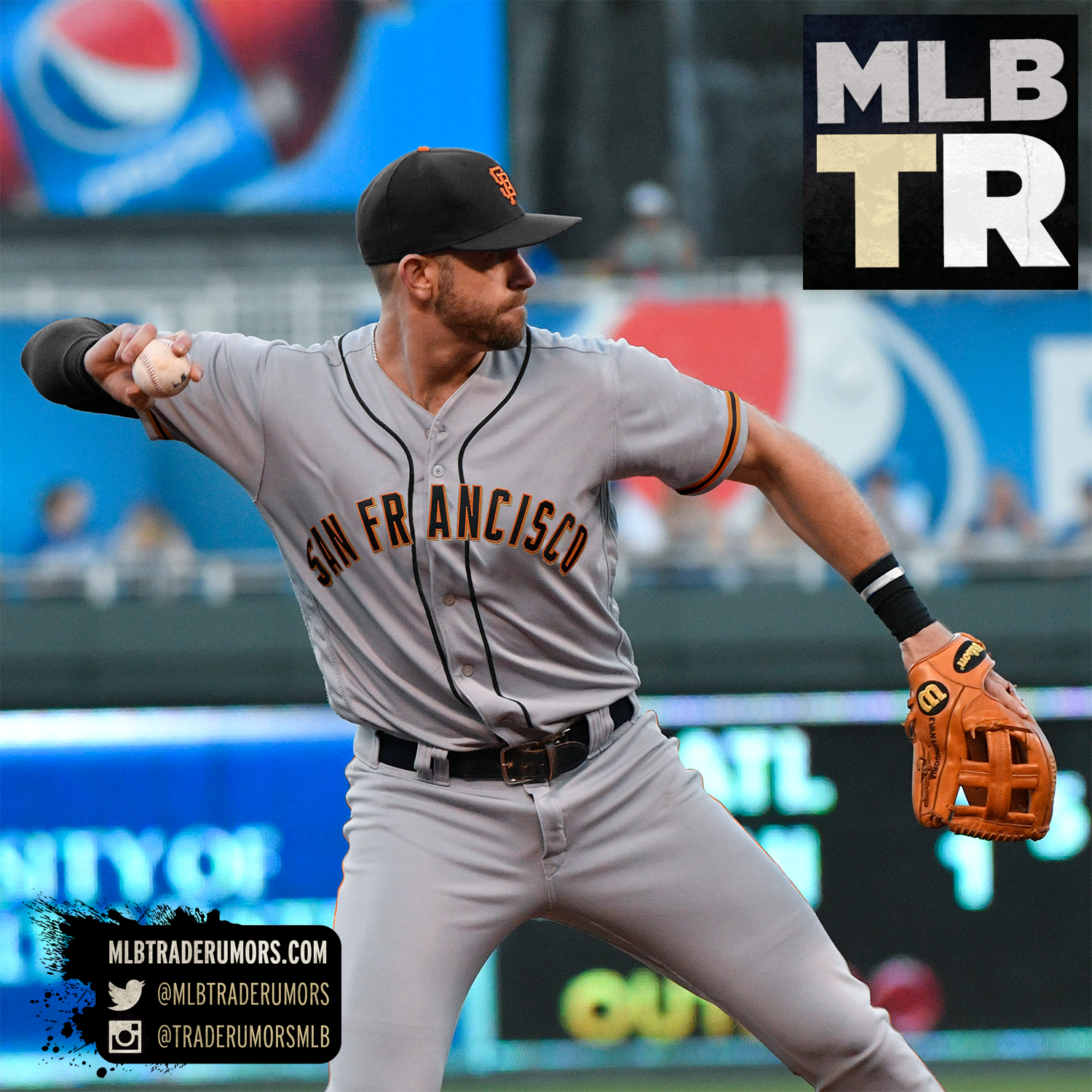
In addition to taking on Span’s contract, Tampa Bay will ship an as-yet-unknown amount of money to the Giants. The 32-year-old Longoria is owed another $86MM between now and 2022, including a $5MM buyout on a $13MM option for the 2023 campaign. He will also receive a $2MM assignment bonus.
Just how much of that will end up on the Giants’ books remains to be learned. The precise cash exchange has yet to be reported. Plus, there’s a bit of uncertainty surrounding Span’s future obligations. He is owed $9MM for 2018, along with a $4MM buyout of a $12MM mutual option for the ensuing season. Those obligations seem destined for San Francisco, but it’s not yet clear what’ll happen with the remaining $3MM signing bonus payment owed to Span in one month.
For both organizations, there’s quite a bit of risk in a transaction involving Longoria. The Giants are taking on a high-priced player who struggled to a career-low .261/.313/.424 batting line in 2017 — adding to a collection of costly, aging veterans. But the Rays are parting with the long-time face of the franchise.
If Longo can bounce back, the rewards could be significant. His days of top-level offensive production are likely in the past, but Longoria was a .273/.318/.521 hitter as recently as 2016, when he also swatted 36 home runs. Of course, that followed two less-than-excellent campaigns, so the overall trajectory of late has framed Longoria more as a solidly above-average hitter than an excellent one.
That said, it’s important to bear in mind that Longoria has also long delivered value with his glove. Though Defensive Runs Saved had observed a downturn of late, it credited him with a substantial bounceback (+11 runs) in 2017. Despite the tepid offensive output, then, Longoria contributed 3.6 rWAR and 2.5 fWAR in 2017.
In return for Longoria, the Rays will get not only salary relief but also some young talent. Arroyo is the chief piece here. He had a messy MLB debut and missed time due to injury in 2017, but is only 22 years of age and destroyed Triple-A pitching in a limited sample in the just-completed campaign. In the best-case scenario for the Rays, Arroyo may be able to compete for a job out of camp.
Span’s inclusion is mostly about cost. Still, he remains a useful player even as he closes in on his 34th birthday. In 2017, Span slashed .272/.329/.427 with a dozen home runs over 542 plate appearances. Though he’s no longer really capable of regular time in center and has battled through core and hip injuries in recent years, Span ought to be capable of at least average work in a corner spot and has long been a productive baserunner.
Padding the return here for the Rays are a pair of interesting young arms. As Eric Longenhagen of Fangraphs tweets, both have quality stuff that still remains to be harnessed. The 22-year-old Woods just threw 110 innings of 2.95 ERA ball at the Class A level, with 9.2 K/9 against 5.2 BB/9. The righty is considered a relief prospect, as is the left-handed Krook, who will play the coming season at 23 years of age. Krook was unsigned as a first-round pick in 2013 and landed with the Giants as a fourth-rounder in 2016. Over his 91 1/3 frames at High-A in the just-competed season, Krook worked to a 5.12 ERA with 10.3 K/9 and 6.5 BB/9.
For the Rays, this move may be a precursor to further action. The club has been in talks on closer Alex Colome all winter. Many anticipate the team will trade a starter, with star Chris Archer representing the most intriguing possibility. Replacing Longoria with Arroyo means there’s arguably still some excess infield depth to work from. And Span could either be used as a part-time player or sent elsewhere to realize further cost savings.
The Giants, meanwhile, still have needs and will be looking to fill them without going over the luxury tax line. It seems this swap won’t impact their spending capacity too significantly, since the average annual values of the two contracts involved aren’t too far apart. But the move takes one outfielder out of the equation while filling the gap at third, possibly leaving the Giants still searching for both a center and corner piece.
Marc Topkin of the Tampa Bay Times first reported Longoria was going via trade (via Twitter). Jeff Passan of Yahoo Sports (links to Twitter) and Robert Murray of Fan Rag (via Twitter) reported the other pieces involved. Murray was first to note on Twitter that the sides had struck a deal, with Jon Morosi of MLB Network (Twitter link) and Ken Rosenthal of The Athletic (Twitter link) mentioning the key names involved.
Photo courtesy of USA Today Sports Images.
yay no more raking against the yanks
A huge boost to pretty much the entire AL East.
Longoria leaving the al east is a “huge boost” to the al east?
Dude, Im a rays fan, he wasnt even an elite player, he is a very good player that can play defense exceptionally but hes not a major game changer.
Yeah this division is going to feel a LOT like the early-mid 2000s with the Red Sox chasing the Yankees, the Blue Jays toiling around .500, and the Orioles and Rays in rough shape.
bang on
Which is exactly why the Jays and Os need to move Donaldson and Machado.
And also should have moved Britton. Looking like the Reds of the AL East waiting too long to make a deal.
That is an almost perfect comparison. They may be even worse than the Reds since they have been doing it for three decades.
Really? Is anyone worse than the Reds
Yah there’s a few. Atleast the reds don’t sign like 4-5 big time free agents then sell them off for peanuts in 2 seasons. Then do it again. Looking at u marlins. Or make huge trades and then toil around 500 and refuse to part with them for returns, looking at u Blue Jays. The reds r what they r a 1 star team with low payroll. Is it better to have 1 Votto and some useful pieces. Or b like the marlins and sell when the payroll raises come due
Doubt Britton will be moved anytime soon due to the Achilles tendon injury.
Ya r name describes what u n is about baseball, ur dust.
Totally agree with your assessment of the AL East teams.
Is it just me, or has this offseason had a higher number of trades centered of salary concerns than previous years?
Seems that way to me, too. Could it be an early indicator that clubs want to be in position for a feeding frenzy next offseason?
Also the new 95% on cap
The 95% is only on payroll over 237M, currently no team is anywhere near that number.
Going to be so nice to see the Yanks chasing the Red Sox in 2018.
You gotta root for somebody with the Orioles in last to second-to-last place.
I should have said it’s going to be so nice to see the Yanks chasing the Red Sox AGAIN in 2018.
It will be nice to see Judge and Stanton hit 11 home runs each against the Orioles
Alcs > Alds
itll be nice for sure but even nicer seeing the red sox go 1 and done in the playoffs
its still 28-7 in championships right?
According to Pythagorean standings the Yankees should’ve won the division in 2017.
27-8******** but in the 21st century it’s 3-2 Boston! I’m not worried about the two one and dones, they lost to two VERY good teams, and were out-managed in each. Should be great to actually have the rivalry back in full force this year.
This was inevitable. Yanks and sox will always have money to spend. The other teams in the league have to operate with limited timing… all the pieces need to line up and the window can only stay open so long.
Wow
:O
End of an Era
Was about to replay the same thing. Makes me sad.
era was already ending… once maddon and friedman left, they should of started rebuilding right then and there.
That dude was right…
I told you bro. My inside with the rays connection cannot mention any names though.
Giants are gonna be the 2012 Phillies in like 2 years
They already are the 2012 Phil’s
“They already are the 2012 Phil’s”
Nope.
The Giants are the 2014 Phillies, but they made a strong 2012 Phillies offseason move. The Phillies grabbed Ben Revere and Delmon Young as “replacements” for Shane Victorino and Hunter Pence.
The Phillies were a .500 team in 2012 while the Giants were a .300 team last year.
The Giants are setting themselves up to spend a decade or more out of the playoffs.
see that thing over your head? Thats the joke buddy. The Giants should be a lot better than last year, but they still arent that good
Nope, if anything the Giants are just the NL version of the Angels. Tons of stars and elite talent, no farm or depth. They will both not be relevant for this sole reason.
Nah 2012 Phillies was like last year,
Right now they are the equivalent of the 2013 and 2014 Phillies where they are still acting like a contender off the field, but playing like a non-contender on the field. At this rate, we aren’t going to see another GIants world series for a long time
Lol
As stupid as the Phillies were during 2013 and 2014 they didn’t trade any of their top 30 prospects for 30-something vets. They either signed those as free agents or gave up a lower level prospects for Michael Young. The one deal they did give up prospects in was for Ben Revere. He had 5 years of club control.
If the Giants give up players like they did today for players like Longoria they’ll hinder their recovery.
The Phillies rebuild began in October of 2011. They just lied and lied until 2014 to try to suck every last dollar out of the fan base.
The Giants dealt talent for talent to try to keep their seats full. So no, the Giants rebuild has not yet begun.
Always love to read the keyboard general managers and have a good laugh. Thank you.
They just won’t be good. They’ll be hoping for comebacks from too many players. And they have a lot of bad contracts
Just looking at the terms of Span’s contract is enough to make you sick. What was Evans thinking when he agreed to that? It isn’t like it happened 5 years ago – Span was signed only 2 winters ago. Nats had already moved on from him because they saw decline coming a mile away.
how is that? in 2 years if they are sucking they will have like 2 or 3 contracts on the books – posey, possibly longoria and crawford – belt if they don’t trade him but I would be surprised if he either doesn’t break out or get traded. All of these guys won’t be relatively old so it isn’t like you are hanging on to guys for a lot of money that are over the mid 30 mark.
After the next 2 seasons are complete (2020) the Giants will still have $130 million on the books not including arbitration eligible players and other additions (Posey, Cueto, Melancon, Samardzija, Crawford, Belt, Bumgarner, Longoria). They will all be closing in on their mid-30s. The Giants appear to be content competing for 4th place as their payroll to balloon out of control.
130 on payroll with no changes isn’t great but it doesn’t handcuff them, as long as they stay out of the tax and don’t give up any picks they can restock without too much issue – I don’t expect all the guys you see here to stick around – if they can’t compete and melancon is healthy, regardless of the contract he is a deadline trade chip, so can belt be – bumgarner is actually only signed through next year, shark is (I am pretty sure) signed through 2020- so it is far different than the phils.
Correct on Bumgarner, but that only makes it worse. He’ll be getting a minimum $30 million, which brings salary commitments up to $160 in 2020! Sure there’s a possibility Cueto opts out and somebody else gets moved, but still not a pretty picture all things considered.
You need to look more closely at the Phillies. Like the Giants they did have salaries coming off the books. Also like the Giants they had a poorly ranked minor league system. They had an expensive bad team and no reinforcements to make them good again.
You seem to be proposing that the answer for the Giants is to keep spending up to the luxury tax threshold. The Phillies did that but still ended up with bad teams. Eventually they decided to stop doing that and traded off their old veterans, only a few of which got them anything valuable in return.
I suppose they could’ve acquired new aging expensive veterans that they knew wouldn’t be enough to help them make the playoffs. Instead the Phillies decided to play the kids they got and ones they finally started developing. I doubt the Giants can return to contention without trading vets away to replenish the farm. Throwing money at it isn’t enough.
Spot on. The reason why the Yankees (and trust me, I do NOT like the Yankees) was because they finally understood that if you develop your own talent, build a top-tier MiLB program and hold onto your top 3 prospects you can use Free Agency to top off your roster as well as flipping other well-regarded MiLB talent.
The Giants still haven’t figured this out. As someone who lives in the Bay Area, I’m amazed at how many Giant fans think that their team is just a player or two from being a WS contender.
Cueto isnt opting out of his contract. Lots of what if’s here. And for a team that’s pushing to be under luxury tax in 2018, I dont think their payroll is necessarily ballooning out of control?
You’re absolutely right. It seems like SF (and the fans) are constantly looking at only the starting players. They don’t seem to have great bench players let alone a decent farm. It’s all well and good to have players like Posey, Crawford, Panik etc in the starting lineup but when one or two of those players go down, SF are screwed because they don’t have anyone in the farm or bench that can come in and step up.
Cueto apts out? When? He already said no
We get it. You’re an A’s fan. Worry about them.
He has another opt-out in two years. It’s pretty unlikely that, heading into 2020, he’ll still be the same pitcher as 2016. He’d be a fool to not take the money through 2021.
I thought Cueto already said he’s not opting out?
In 2021 they will have payroll of $100 million on 6 players. In 202 they will have $126 million in 7 players. Belt will not get traded unless he has a monster year and then the Giants would probably keep him. Don’t try to sugar coat it the Giants tied up future payroll to win now.
Having over 100 million committed in years down the road is awful. You will 100 percent have to rebuild at some point and thats if they dont plan on re signing Bum
They will be hurting
Hey, that’s an even year
Yep, bad trade in two years, but will need to live with it for 3 more years.
Whoa
Thank god the Yankees don’t have to face this man anymore
Wow
I wonder if Span will be heading to Tampa to help balance the salary.
You trying to seem cool by pretending u didn’t read the article?
Definitely posted that comment when the news just broke, and all it stated was “Giants to Acquire Evan Longoria” with no other details to the trade… so nope.
Called this Trade was already done hours before the news broke public. Posted it on the Zach Britton page. MLB Trade Rumors Should give me mention for breaking the news first lol.
Would that make your life better and fill the void caused by the lack of recognition?
Can you not sense sarcasm? Your life is already filled with being the biggest D on this message board anyway. Pretty sure not many people can stand you on here. You’re nothing but a miserable, arrogant, keyboard warrior buddy.
Haha I actually saw that and took it completely seriously. When the news popped on here I was like “yawn, old news” Nice work buddy!
Btw ignore trolly mctrollerson… so many people have a stick up their ass on this site
Thanks man appreciate it. I literally can’t stand that guy all he does is shoot crap out of his mouth.
My guess is yes. They’ll likely include Arroyo as the center piece and perhaps a couple of pitchers along with Span. We’ll see though…
That was really good insight. Pretty spot on!
My guess is that the two pitchers will be Stephen Woods and Matt Krook, but we’ll see.
Front office positions for all of you.
Inside information tells me that Giancarlo might get trade to the Yankees for Starlin Castro
beat me to it lmao
Wow, nice move.. Can’t way to see the trade details.
it’s arroyo
Nice move for the Giants. Awful move for the Rays…but average under this awful FO.
Unless the Giants are receiving a huge chunk of change then it’s a bad deal for them. This has Matt Kemp type risk all over it. Sure they didn’t give up much, but you really want to pay $17mil for 35/36 year old Longoria after he put up numbers like that at 32?
Matt Kemp is no way comparable to Longoria. Besides playing different positions, one that Kemp was not good at, and the other where Longoria was, Kemp’s contract was much bigger. Plus there is no indication that Longoria has any kind of chronic physical limitations like Kemp’s arthritis.
Panda will somehow still get a starting job somehow.
1st base…. Belt’s gone.
jeez
I would have preferred to see him on the Rays for his entire career
Same, I’m not even a Rays fan
Wish Longo nothing but the best with San Fran. I’ve spent years watching him torture the Yankees, thanks for all the AL East battles
kind of a blow to tampa, losing the face of the team… but i get it from a baseball stand point.
While he’s been a big part or Ray’s history, I don’t think he’s been the face the past couple of years. Archer has had a lot more prominence especially while Longo was hurt
I have to disagree. Just because Longoria has taken a step back with his production doesn’t mean he wasn’t the steady face of the franchise. Did Jeter cease to be the face of the Yankees when he declined? Longoria was (and will continue to be, I’m sure) Mr. Ray.
I agree that he’s been the steady face but it’s seemed like the popularity of Archer passed Longo recently
Archer!?! How is Chris Archer more of face than Longoria. Look at the years Longoria had and production as well. Longoria was the older player there. Plus Archers pitching number are not as impressive as Longo’s batting stats.
Plus, that homer.
Nope. It makes no sense. A bunch of half prospects for your team leader? In no world does this make sense from the Rays point of view. Just a terrible FO that has dismantled what was a solid franchise.
$$
They’ll be relocating in the next decade anyway; it’s just a matter of where (Montreal, Las Vegas, Mexico City, etc).
They will not be relocating. Once their TV deal ends in a couple of years they will go from getting 20M per year to over 100M per year in TV revenue. No way they could match that in those other markets.
Good for the Giants. I am surprised to see this trade.
Looks like the Rays are finally rebuilding
So true! But why would they take Span in this trade? Offset money I guess? Looks like the Giants will still be signing or trading for some OF help too!
It’s a salary dump, he is in a contract year so it isn’t like they are taking on a long term guy
Yes! CC won’t have to face him anymore. Wish Longoria the best in SF!
For what though?
arroyo
As a Giants fan, im scared.
Giants are still a disaster!
He’s gonna be 32.5 come opening day, and has 85M guaranteed on his contract. I can’t see how this works out for the Giants, but hey, it is an even year after all
Ha yep, so was 2016.
When they were one series win away from the world
Series?
You mean the NLCS?
Dream big!
They’ll try to flip him in July when they are out of the race .
Did you just say he’s 32 and a half?
Kinda odd right?
Adults still celebrate half birthdays, right?
Longo had an off year. 32 isn’t necessarily a drop off the earth year. Longo might benefit from a change of scenery will help. Maybe the Giants will even be competitive next year. Let’s see…..
yeah, let´s see. According to BR, his greatest comps thru age 31 were Ryan Zimmerman, Aramis Ramirez, and Scott Rolen, and all those 3 had something left in the tank afterwards (SSS warning on Zimmerman), so there´s an upside. Plus of course the change of scenery.
Arroyo to the Giants
I mean Rays, whoops. My bad.
And how I am suppose to focus on homework :). I guess the Rays might not be done, they are building an impressive farm system.
arroyo, span, and who else?
So who is the face of the franchise now?
Archer (for now).
It has and always will be Vinny Castilla
The same Vinny Castilla that played for the Braves, Rockies, Astros, Nationals and Cardinals? The Rays DFA’d him!
No a different one. He works at the concession stand and he is very cordial
Nice
I told him my nachos were a little soggy..and he gave me the finger.
Joey Wendle
Without knowing what the Giants gave up, this is a bit scary because Longoria hasn’t been the same dominant player he was before he hit age 30. BUT, the contract is pretty team friendly if he continues to put forth 3plus WAR seasons for 4 years or more.
5yr/80M left is hardly team friendly. Especially considering his power is going to take a hit in SF and is 32
uhhhh, 16mil a year is very team friendly, this isn’t Milwaukee.
Dang. Was hoping to get him in a deal for Avi.
Avi Garcia? Why do people think his value is so high?
He’s young, cheap, and coming off a 4+ WAR season.
And I’m not quite sure how wanting Arroyo for him makes it seem like I think his value is “so high”… Just because he was the best prospect in an awful farm system doesn’t make him some sort mega-prospect.
If the Rays were able to get Arroyo AND have SF eat that contract that’s a steal.
Arroyo is in deal along with Denard Span and 2 other minor guys.
Span and Arroyo back to Tampa?
wow love this for the rays from a baseball perspective they free up tons of money and get a good 3b prospect. sad to see him go tho
This is the worst thing ever they just blatantly took advantage of the rays because they’re trying to be in with the cool guys no they just sold off they’re most prized pig for a Busch league amateur. The dude can’t hit for crap.
Well that was interesting.
Budweiser has a league? Nice. I posted a 3.6 beer WAR last year- do I qualify?
LOL
Those are rookie numbers. Ya gotta pump those numbers up!
The whole AL East, up to and including Zach Britton’s Achilles just gave up. Maybe not the Red Sox
Red Sox give up, trade Mookie Betts for Pablo Sandoval.
It’s just The Yankees and The Red Sox.
wow, I saw him as a lifer. I wonder what the full details are.
Sabean has a fetish for players in their 30s on their decline with huge contracts. Confirmed.
He’s trying to obtain his Ph.D. from the Ruben Amaro School of Asset Management.
You, sir, win all the internets for the day.
His protege Colletti seemed to do this too. Friedman hire was a complete and welcome change in that department.
1988
Get used to living in the past, cutie. Pretty sure SF’s future is in the toilet.
1988.
You probably like the smell of your own farts. I don’t care about anything you have to say.
Yet your WS choking a$$ team in the one sitting in Chavez Latrine. Ironic isn’t it?
2017
98 losses
Farm is non existent
Next year you guys could aim big and go for 100 losses instead of 98. NL West looks great with the Giants in last place. No irony here, pumpkin.
wow
OMG THE YANKEE KILLER IS GONE !!!!
Lol as a Sox fan I have the same reaction. Getting Longo out of the East is a small victory. Guy always smoked us too
I haven’t been this happy at a player leaving a team since Ortiz retired LOL !!!! Praise the baseball gods !
you mean last year?…
So basically you’re looking at $88M/5 (Longoria get’s a $5M buyout for ’23 and supposedly gets a $2M bonus if traded) for a 32-year-old 3B coming off a down year (in which he was still quite valuable, FWIW).
Will need to see what players and what money is involved before jumping to conclusions. That said, I don’t see myself loving this from the Giants’ perspective.
Contract info.: fangraphs.com/statss.aspx?playerid=9368&posit…
There goes the Giants ONLY stop 100 prospect. Their farm is trash.
At least they got older.
Heliot will be up there in no time.
Too bad to see a franchise cornerstone leave in basically a salary dump deal…
So are the Rays going to rebuild now? Looks like a sign they may.
Nice. Shame it’s sf but it’ll be cool to see him play 19 times a year
Does longeria have a no trade. I’d refuse this trade a million times over.
He would have next year (10 and 5 rights).
I hope for his sake it falls through. Giants arent going anywhere anytime soon. They could use 2 starters as well. Bum can’t pitch every day.
Neither can Kershaw
Nope on the NTC, although he does have a $2M trade kicker according to Fangraphs.
fangraphs.com/statss.aspx?playerid=9368&posit…
Cc must be the happiest guy in the ALE right now
The Giants future looks bad with their -0 valued farm system. They must flip mad bum to replenish it
Well I guess since the Giants are acquiring longo, I’ll go burn my jersey in front of Tropicana field and this may be a sign they’re going to trade archer so I’ll have burn his shirt to.
Seems constructive.
Do it. Film it.
You should burn Tropicana Field instead.
And force the Rays out of St. Pete? Seconded.
Welp, denial isn’t just a river in Africa,
I genuinely have no idea how ANYONE in the Giants organization thought that this deal would be a good idea. They are giving up very highly ranked organizational prospects, both at least top 10, maybe top 5, as well as a throw in prospect for an aging third baseman with a huge contract.
It’s not as bad as the Shelby Miller trade, but I still see no benefit in this for the Giants. At least this accelerated the Rays rebuild a little. I always like seeing when the Rays are good.
Giants must think they still have a little space before that window completely shuts and they’re going to go for it for a year or two, try to win another title, and then enter the basement for a while during the rebuild.
I’m sure they are dancing in Dodger town! Just makes it easier
Not sure how Longo’s contract can be deemed huge, comparatively speaking. Also, I’m not as fond of egg nog as I was many years ago.
Oh brother, this is nothing like the Shelby Miller trade.
Look at the entire trade, not just the age of Longoria. Giants got rid of Span’s contract, filled a huge 3rd base need (offensively and defensively), and didn’t lose draft picks signing a mediocre free agent. Arroyo might turn out okay, but he didn’t impress last year. I’m always trying to be optimistic, and with two ace pitchers that were hurt last year, a return to form from Melancon and Smith… the Giants have to see what happens. Worst that can happen is they flip some of these guys at the deadline. At least they aren’t gutting their draft picks and didn’t get rid of Ramos.
They weren’t top 5 prospects, those are Ramos, beede, duggar, Shaw, etc. Arroyo didn’t perform well at the major league level and the 2 pitchers aren’t close. Not saying I think they should have taken on another aging vet but you are overvaluing the send- they all need work.
Mediocre on-base guy.
So the Rays make a trade and somehow find a way to make the Yankees and Red Sox better.
If I was the red sox I’d rather have a younger better hosmer over 35.something mitch moreland. Dumb sign imo. They probably won’t get JDM either.
more overpriced older players going to the Giants and they give up arguably their top prospect in return.
Arroyo is not their best. He had a shot, and struggled. He’s unproven and far from MLB ready. Heliot Ramos, Steven Duggar, Tyler Beede – all much better prospects, and still in the system.
Arroyo is still pretty young and got injured last year, but does anyone see him developing enough pop to be an impact bat in the majors? I’m not so sure.
That he is the only Giants prospect ranked in the Top 100, indicates that the people with some knowledge of the situation would disagree.
That top 100 isn’t even updated. And Arroyo is behind like 4 others now since he just got injured. Everyone is so off about the Giants system it’s funny.
AND we got rid of Span? Love it. Finally some action this offseason. Let’s go!
Here’s a fun little factoid:
Span in 2017: .272/.329/.427 102 wRC+
Longoria in 2017: .261/.313/.424 96 wRC+
nice that you purposely left out their defensive values, how convenient…
lies, damn lies, and statistics…this is the problem with the new baseball people: you focus on these supposedly ironclad stats. Is there anyone in baseball who would rather have Denard Span than Evan Longoria? Not talking this little stat or that, but as a complete player? via the eye test? Exactly.
Nice move for the Giants, but that terrible offense still needs some work. Still a nice first step
Rays fans are feeling what I felt when nomar was traded. There are so few players that spend their careers with one team. Not like the old days. We are just rooting for the laundry
Tampa throwing in the towel wonder if it will be a full rebuild if so the Braves need to jump on Archer.
Great move by Tampa. Time to rebuild and look to contend in a couple of years when the new TV contract comes up. They just have to draft and develop the future core players.
Only part of the deal I️ don’t like is Arroyo. Hopefully Longo can turn it on at the plate this year
The only part of the deal you don’t like is half of it?
Well sure, it would’ve been a good trade for SF if they didn’t have to give up anything of value.
I think longo will put up better numbers with the giants. As long as if he’s batting in front if posey, he’s never really had a great hitter behind him in Tampa. He’ll see more fastballs and be able to do more with those. I think it’s a pretty decent deal.
This is an interesting perspective, one I hadn’t thought of. Longo WAS the Rays offense for too many of his years there; should be very interesting to see if he still has some hooey left if he sees a few more decent pitches.
The Sandoval Experiment is OVER!!!
It better be.
I like Longoria, but seems like the Giants are getting a very expensive guy who is a shell of his former self. Should of just signed Adrian González on the cheap and got similar production
Gonzalez could be a +5 run defender at third base? I think not
wow, not sure how to reply or if it even pays…….Gonzalez?
STOP POSTING
Not sure this was the smartest thing for the Giants. Giving up your top prospect? I guess anything is better than Pablo..
Top prospect but most in the industry aren’t overly high on Arroyo and the giants because of their poor farm have to try and compete the next 2-4 years cause the future is bleak.
Great pick up for the Hated Ones.
And the other half of what was the anti CC doomsday machine (Sean Rodriguez was the other) has finally left Tampa. CC’s 2018 winning percentage went up due to this trade alone
I feel kinda bad for him, and TB fans. He seemed like one player who was going to play with one team for his entire career.
I feel like Evan Longoria welcomed that possibility & has taken less than he almost assuredly would’ve received on the open market to stay as well. I’m surprised it wasn’t a heavier package coming back, but he has been in decline too so it isn’t THAT light. That said, SF has improved with this move (just have to wait to see how much). .
Thank God this Red Sox killer is gone. Stupid numbers at Fenway.
Our respective fan bases can hold hands and sing Kumbaya together
This front office is in over its head. Maybe they can get a giftcard in a deal for Archer? You trade face of your franchise for this? What a joke. Peobably counting on matt duffy who I predict will never play an inning for the Rays. Almost like they are giving up.
Don’t stop now, Giants. You know you want to overpay for another former superstar…
Cutch will name his next kid, Silicon.
My bet its Adrian Gonzalez. ha ha They will have the senior league wrapped up.
Or Kemp lol
Was secretly hoping he would be traded to the angels and return home, but when the signed cozart that went out the door. Goodnight sweet prince.
Giants gonna regret this deal
I think San Francisco overpayed for Longoria. However, I think he’ll perform better than he did last year. 2016 was not a bad year for Longoria. I think 1 less person on the trade would be ideal. I am Yankee’s fan and Longoria might improve his line drive here. Less home runs more singles and doubles I predict. But then again I’m not an expert
Longo put up a 4.5 WAR in 2016. That is All Star level of play.
Sure, if the all star game decided to include 10 third basemen…
You guys should probably wait and see how much money the Giants are getting back before saying the trade is good or bad.
If Tampa Bay wats half the salary, then it would be a great deal for SF.
If SF takes on most of the $86M, then that would suck for SF in the long run.
Seems like a bad trade for Tampa. Sending money AND getting Span? And then only really getting Arroyo back for value… I think a better trade could have been made.
Up above, a guy has a post showing Span was a better offensive player than Longoria in 2017. If he can maintain his slightly above league average production he’s a fine pickup to take for a top 100 prospect.
Doesn’t seem like a good trade
Interesting trade… love getting longoria but hate giving up arroyo would’ve rather seen belt honestly. Open a hole for a posey/ Shaw first base and saves money. Arroyo could’ve been our super utility but aww well. Opens the door for a spot or two in the outfield as well…
The article makes out like this is a huge risk for both teams. Looks like a huge risk for the giants. They are getting a player who has been fading and getting rid of 3 of their top 30 prospects, including their “best” prospect for it. If anything, the risk is hardly any for the rays. Just sucks not having that kind of vet on ur team
The giants have a bad farm system so “best” prospect is still pretty bad. And Arroyo has fallen from grace some with an underwhelming career at the MLB level.
LMFAO. Top 30 prospects. Neither of those guys would be top 100 prospects in a good system. The only reason Krook and Woods are top 30 for the Giants is because the cabinet is bare.
Span is done. Getting rid of him makes the Giants better even if he is replaced by Parker or Bernard.
Longo has put up 4.1 WAR, 4.5 WAR and 2.5 WAR over the past 3 season. Not much of a decline.
Giants suck
Do you ever hang out with Kyle Schwarber’s mom?
I went to look up his splits to see how his batting game might translate to SF, but in his career, it looks like he’s had only 25 PA (22 AB) against the Giants, and according to what I saw, all of them were in Tampa Bay. That tells me absolutely nothing!
The Giants will probably face different pitchers than the ones in the AL east too.
It is official: the Giants have lost the off season
Maybe SF will flip Longoria back to NY for Part of Ellsbury $$ and Frazier.
Fraizer is staying as we will need a outfielder when Gardy leaves after this upcoming season
Whoever said this deal is bad for Tampa is wrong imo. They got the Giants best prospect and free themselves of a contract of a declining third baseman. Franchise player he was but since they don’t spend too much on payroll they were smart to let him go
really it is more even – the prospects even the money out and arroyo is one of the internally more appreciated prospects – the one that everyone has been trying to pry from the giants is ramos.
Not a fan of this deal. Much rather Giants sign Frazier or Cosart. Slater should be able to replace Spans offensive production. Now go get an excellent defensive Centerfielder.
Cozart’s gone.
I guess with longoria, this 98 losing team will be an 87 losing team.
now Tampa needs to trade Adeiny Hechavarria as he took James loney’s Place as tampas designated scruby Yankee killer
When everything under the sun screams rebuild – the Giants deplete their already barren farm system and push for .500
Interesting contradictions in the comments. First lots of people saying Longoria is washed up, yet all the AL East fans are delighted he’s out of there division. Second is everyone trashing the Giants prospects saying that they gave up too much. Arroyo is basically Panik light, a good player but fairly replaceable. Span is washed up. The two young pitchers prospects are the 12th and 16th best pitching prospects in their system. As to the money . In my view this is neither a great trade or an awful one, but a good start with more moves needed. At least I won’t have to watch Sandoval and Span take the field opening day.
My take is a bit different from yours. The belief from many is that Longoria still holds value, but his best years are probably behind him. Not “washed up” but you wont expect a 33 yr old Longoria to perform at as high a level as his younger self.
Re what the Giants gave up… We’ll see if Arroyo is “Panik-lite.” He’s yet to produce as a MLBer but he tore up AAA. While the Rays probably won’t be in the playoff hunt, they continue to have a lot of solid young pieces and I don’t think they will significantly regress in ’18 as far as wins and losses are concerned.
Not to mention he could be in a slump but still kill our team
When I say Panik-lite I mean a similar hitting profile with less defense. As to AAA everyone tears up the PCL. I’m not saying he won’t be a good player, maybe even an all star, but he doesn’t have enough power to stick at third and his range won’t play at short. He’s a good player but the Giants are set at second for a while.
As to the money I meant to say that while it seems like a lot it isn’t for a large market team and deducting Span’s salary means he is playing for $6mil this year and Pence is coming off the books next year.
Span was a negative 1.1 WAR player last season and is projected to do the same in 2018. Putting anyone else out there is an improvement. Addition by subtraction. If it’s Cain it’s a 4-5 win improvement. Jarrod Dyson is a 3 win improvement
Longoria put up a 2.5 WAR in a down season and is projected to produce a 3.1 WAR in 2018. That is a 3 win improvement over the Giants 3B last season.
Even if you assume that Arroyo, a SS by trade, was going to be the 3B all season, that is still a 2 win improvement.
This is a great trade for the Giants.
So, about a 10 win improvement? That means they finish only 30 games back of LA this year instead of 40?
You really think the Dodgers will win 100+ again? The Giants don’t need to be better than the Dodgers to make the playoffs in any case. How many rings do they have from years they were the WC?
Extremely disappointed to see Longo traded. But at least the Rays got a great return for him.
As far as Longo goes, he’s going back home. He’s from California and played college ball at Long Beach State.
About time. Longo deserves better.
Giants aren’t done. Belt will be traded for a CF or Cain/Jarrod Dyson will be signed to play CF.
This is not a team hurting for money and they were struck by a record level of injuries last year. I have already laid it out in detail, so not going to do it here. Do not be surprised to see the Giants in the WC hunt in September.
The Giants weren’t affected by injuries much more than anyone else – the team had 23 DL stints last year, which was quite literally middle of the pack (15th out of 30 teams). No Team was exempt from losing quality players through injuries – except for the Padres, but that’s because they lack quality players to lose in the first place.
The Giants lost four players to the DL for more than 100 days each – Jarrett Parker, Conor Gillaspie, Will Smith and Michael Morse. Not exactly crippling talent to lose. By comparison, the Dodgers lost 7 players for more than 100 days each.
The Giants real issue is a simple one – lack of talent. Both at the MLB level and in the farm – which is now further depleted.
They’ll need a lot of breaks to go their way, just to even sniff the second wild card spot.
Not all DL stints are equal so you can’t compare general numbers like that. The Giants lost their ace, for a significant amount of time. They also lost their #2 SP in Cueto, who not only spent time on the DL, but tried to battle through a blisters issue, which accounted for his sub-par year. They also lost their closer to time on the DL. And if you don’t think the loss of Will Smith wasn’t a significant loss, then you just don’t know the Giants that well.
You’re absolutely right – not all DL stints are created equal, so there is more to the story than the numbers.
I think the Giants can be summed up by simply saying, the depth to absorb inevitable loss of talent, just isn’t there. The majority of Teams lose key players for a length of time during the season – it’s almost a death and taxes scenario. The Giants just didn’t have the horses to absorb those losses without sinking. And to respond to the OP here, who says they could very well be in the WC hunt later on – there’s a good argument to say that no, they probably won’t. But it’s the off-season, and it’s okay to be optimistic.
They’ll need everything to break their way, just to even have a sniff. Assuming the WC2 spot is around the same win total as it was for 2017, they Giants will have to turn around another 23 wins to be there. Good luck doing that with a few shiny pieces and zero impact from the farm.
It wasn’t just the pitching. Every opening day starter spent time on the dl. And then their replacements got hurt.. In 60 years I have never seen a season like this one. And as far as reaching the playoffs this is essentially the same core that went to the NLCS the year before last. And it’s not an old team. Excluding Pence, Longoria is the old man of the crew. Granted the outfield is a mess right now, but Longoria gives them five recent all-stars on the infield, as well as arguably the best defensive infield in baseball. They still need a couple major pieces, but I feel better about the season than I did yesterday..
I disagree. You’re still making generalizations. I don’t believe that a majority of teams suffer a lot of injuries to key personnel. And when teams do most teams that have non-contending seasons.
Even the Dodgers with their huge payroll that gave them depth, would have not had the season the did, had they lost Kershaw for an additional 10 starts, Kenley Jansen had missed 33 games, had whomever is their #2 SP struggle with blisters, and then go on the DL for another 10 games, lost Justin Turner for 25-30 games, and lost their main left-handed set-up man for the entire season. All those things are comparable to what happened to the Giants in 2017.
The Dodgers spent 80M more on payroll (counting the luxury tax). That builds a significant amount of depth that other teams without the payroll flexibility can’t overcome. A young team at the beginning of their win window can compete because of cheap young talent (Astros). But established teams at the end of their window struggle with depth because of paying the stars who got them the rings. Not a complaint its just the nature of the beast.
Number of stints on the DL means nothing. With the new 10 day DL many teams had record numbers of stints on the DL. What matters is how many days those players spent on the DL. The Giants had the 2nd highest number of player days on the DL. It was a franchise record.
Bumgarner, Cueto, Shark, Posey, Crawford, Longoria, Belt, Panik, Pence, Melancon, Smith, Dyson, Gearrin, Strickland. That is a very talented team.
The Giants were projected to win 81 games before they acquired Longoria and dumped Span. That alone is a 5 win swing. Add Bruce and it’s another 2-3 wins. Now they are knocking on 90 wins.
You are letting being a hater get in the way of seeing what is right in front of you.
Unless the Giants are trying to mislead, they are not trading Belt, nor signing Cain. They have said they are sticking with their pitching and defense philosophy. Belt is one of the best defensive first basemen in MLB. He’s a lefty, which is preferred for defense at 1B. Being a lefty hurts his hitting at AT&T but the Giants aren’t going to give up that better lefty defense for better RH hitting.
Replacing his hitting alone would be difficult. He has a career 126 OPS+. He’s about the 10th best at 1B in MLB. If it were that easy to find a better hitter 20 other teams would have done so.
And the Giants have also said they aren’t signing anyone who turned down a QO like Cain did.
Jay Bruce will be the LF.
The deal will look okay for SF in the first 1-2 years, then Longo declines further and they are screwed for the last three years.
Getting Longo is good enough, but shipping Span’s deal out too? Great deal for the Giants.
This strikes me as a panic move by the Giants, because they haven’t been able to trade for anyone they had been linked to in reports (e.g. Hamilton, all the Marlins OFs, Cutch, etc.). Taking on a player in his age 32 season with 5 years and tons of money left on his contract for a top 100 prospect? Yikes. Arroyo is just 22 and has already dominated Triple A. That’s real promise not many players achieve at that age. He has years to grow and learn at the highest level. Giants are going to regret this one.
Getting Span out and installing Longoria at 3B helps the Giants in the short term. The pattern of their acquisitions illustrates why SF is in their current predicament. Most of the players they’ve either signed or traded for in recent years peaked prior to their arrival in SF: Cueto, Span, Melancon, Samarzdija (though it’s tough to really determine his peak), Moore, and now Longoria. Pence arguably peaked in SF, but his years of decline have significantly obscured that. Trades like this one with TB work in the moment, but it only makes it much more difficult for the Giants to change course in the future.
Everyone raving about how Arroyo dominated AAA needs to take a breath. Everyone dominates the PCL. His AA stats are a more accurate gauge of his hitting profile.
Nobody is mentioning the fact that this trade drops moostakas market even more. Can be had for below market rate ? Can a team like the Yankees snag him for one year while staying below the luxury tax threshold ? If they did I would love to trade him at the deadline for more prospects to keep the farm full. Doubt getting him while staying under the 197 is possible though
Why not just give Andujar a shot? They should have more than enough offense to make up for him if he gets off to a poor start. And if that does happen, they should be able to find a cheap, replacement level 3B pretty easily around the deadline. I wouldn’t be too concerned.
I want andujar to start (I LOVE his bat and his defense can improve). Just throwing ideas out there. We could flip moose and start andujar for example
Royals may end up keeping 2 of their big 3 free agents after all – maybe all 3. The markets for these guys are drying up with every passing day. I think Moustakas’ best hope is that BAL trades Machado or TOR trades Donaldson, and then one of those teams turns around and signs him. Otherwise the 3B and 1B markets are turning to dust, and the teams in need of a CF don’t want to pay premium prices in $$$ and years to Cain who will begin declining within 2 years or so.
Guy finally gets out of Tampa, only to get sent to get another LOSER. This trade makes no sense, he is not a difference maker at this point in his career, and the Giants overpaid massively for a guy that is on the down swing of his career. I love Longoria, but he’s a shell of his former self, and this move to SF is a complete waste for a guy that truly could and should be given the opportunity to compete for a contender.
That’s a better deal than I would have thought Tampa could get. Will be interesting to see what they get for Archer.
Interesting that all of the Giants fans are praising this deal getting Longoria and getting rid of Span’s contract. You do realize that Span was the better hitter last year, right?
All it did was fill need at 3rd but left whole in Center, there infield Defense will be really good now, but there outfield is bad now Giants Need to Sign CF
There was already a hole in CF, as Span cannot play that position anymore.
That would be a valid point if you just ignore half of the game; defense.
No reason for anybody to watch baseball in the state of Florida for a long while.
Love Longo. He hasn’t been as productive as most people would have hoped, but he is still a solid player and especially so defensively. I feel bad for the Rays, I loved them when Maddon was there but after he left everyone else has pretty much left too. I sort of wish he would have been dealt to a team with a likelier chance of getting to and winning a world series. Nothing against the Giants, and obviously they’ve had recent success of winning the World Series, but I just don’t see it happening next year.
If Giants get Cain maybe they can contend but that’s big if
I’m a baseball fan.. I’ll continue to watch and follow the rays. Sucks to see Longo be traded, and I think that the Giants made a good deal. Longo has been productive, maybe not to other people’s expectations, but he has been consistent. The Rays are sending money back (unknown amount) and have take on spans contract. The three prospects that the Rays received are just that, prospects. No telling how those prospects turn out. We’ve traded many players for prospects and those prospects have not been a factor, Duffy being an example. I wish Longo and his family good luck in SF.
This TB front office is hilarious.
So…you trade away the face of your franchise in a cost-cutting move…and you throw in money to help cover the salary? How do these guys even have a job? Used to be a great franchise, but over the last few years these guys have run it into the ground. Congrats.
Yes, after Friedman left, the dominos fell and the org is a shell. Hickey was a huge loss. Personally, I think they are finally selling or moving. MLB probably has some shady thing lined up to get them out of their lease.
Am I the only one that thinks this is a bad deal for both sides?
I’m with you. At least the Tampa Bay area has nostalgia to ease them through his bad years, SF fans don’t have any attachment to him.
Unfortunately, this move is just a continuation of the bumbling, “throw a veteran band-aid” on the roster to try to stay in contention for yet another year attitude of Sabean and Evans. The only reason they are in their current roster dilemma is because of past moves, past failures and an unwillingness to embrace their own young guard. Instead the brain trust consistently trades them away in favor of veterans.
They needed Span because Gary Brown flopped and Pagan became old and injury prone.
They needed Pence ( and Beltran) because they never developed their own RF after BB..
They needed to extend Crawford because they traded away Matt Duffy.for pitching they failed to develop internally.
They traded Duffy because they had to trade for a starter because they failed to develop one from their own system.after the decline of Lincecum and Cain.
They had to trade for Smith because they couldn’t develop their own successor for Affeldt.
They had to sign Melancon because they were content to slide by with Romo & Castilla and failed to develop, trade for or sign a top Closer.
They needed to trade for Nunez and now Longoria because their successor to Sandoval was traded away for a 4th starter. (Moore).
After just 2 years and a 12-20 record, Moore was “dumped” to Texas to reduce roster salary costs.,
Arroyo was tradeable because of the extension given to Crawford, to play SS, Arroyo’s most logical position and because of the earlier trade of Duffy.
Ironically, Tampa wil now have a SF Giant left side of their infield: #B = Duffy, SS= Arroyo.
To dispose of the final year of Span & fill the 3B hole while effectively staying in contention to take advantage of MadBum’s final 2 years as a Giant, they took on Longoria.
While burning through band aid solutions in LF, such as: Pill, Belt, Morse, Pagan and waiting for Parker or Williamson to TAKE the position, the next hopeful is Slater.
Current Concerns now are financial commitments to: Cueto, Sarmardzija, Belt Crawford, Longoria, Posey.
In 2-3 years = who can we dump the remaining years of Longoria on??
Duffy played only a handful of games for the Rays. You missed him sitting on the DL for 2 seasons. He’s been worthless.
Matt Moore had a 5.12 ERA and cost the Giants $10 million in his 1.5 years there before they basically gave him away this offseason, while the Rays still have Duffy for 3 more seasons and a 50 FV SS prospect in Fox. I can’t possibly see any way this trade wasn’t a huge win for the Rays. Even if Duffy never plays another game and Fox never gets above AA, it was a win for the Rays not having Moore in their rotation.
This is total, critique in a vacuum, one-sided, BS. All teams make trades. All teams make bad ones as well as good ones. All teams draft stinkers as well as find the occasional diamond in the rough. The Giant’s farm is weak, at least partially, because of their success, having to draft low in the order. How do you think the Astros and Indians accumulated so much talent? The Giants, along with the Cards have the most home grown players on their rosters. Their success at developing players is extremely good. Because resources are finite, they prioritize pitching, then the IF, in drafting and development, because the OF is the easiest area to supplement externally. Just as is the case with Barry Bonds, whom they did not develop BTW.
Yes they made all those trades, but they also won three World Series by mostly developing their own homegrown talent and supplementing through trades such as these.
Posey, Crawford, Panik, Belt, Pablo, Romo, Lincecum, Cain, Bumgarner all came up through a “weak” farm system and then were added to in what became a dynasty of the 2010s. Can they do it again? Who knows really, but I wouldn’t count them out.
So they traded an aging outfielders and their best prospect for an aging third baseman.
Longo has been a 3-4 WAR player every single the year since 2014, if he just keeps that up, he’s more than worth his contract.. Giants gave up about market value. No real “winner” or “loser” in this trade, both sides got what they needed. Really wonder if Kiermaier and Archer are next, or if the Rays just wanted to get out from that Longo money.
Giants should just go off all the way and roll up on 2018 with this lineup:
1B B Belt
2B J Panik
SS B Crawford
3B E Longoria
C B Posey
LF H Pence
CF L Cain
RF JD Martinez
Wow,some infield defense of the Giants.
As a Dodgers fan of course I hate to see the Giants get better but I have to admit this is. Good pick up for him. I know he had a bad year compared to what we are use to seeing from him but I don’t think that will be the case this year, I think he still has plenty left, even if he doesn’t hit 30 + home runs he will be an upgrade for the Giants at 3rd and adds a solid bat in their lineup. I hear this talk of Jay Bruce as well and if they add Bruce along with this addition of Longoria that a huge boost for the Giants I think but even with just this trade they’ve gotten better. I highly doubt Cueto will have a year like he last year that was pretty bad considering what we are use to seeing from that guy and one would think Mad Bum will be the Mad Bum we are use to seeing even if he does a small step back like all pitchers tend to do over time so I think it would be crazy to think they’d be as bad as they were last year. I think the Giants really need to add someone like Bruce and hope for the best out of Pence but they do need to address their bullpen as well. To be honest as much as us Dodgers fans hate the Giants I personally want to see them be better this year because it’s not the same without that rivalry coming down to the final week or two of the season like we are so use to lol of course I don’t like when it comes to the final series, that’s a little too close for me but I do like when these teams have to battle eachother for the division, makes it a lot more interesting. Not even sure if the Giants will be in the mix this season but this trade does help for sure.
Thank you to the one person who isn’t a fan that saw what actually happened to the Giants last year. I don’t think they’re a 98-loss team again if just a few guys bounce back. Their infield defense might be the best in the NL, and the pitching when healthy isn’t bad. If you add a hitter like Bruce and a defender like Dyson and someone in the pen (plus the addition of Smith returning), they could be in the WC hunt, and then at that point watch out. They won the 2014 WS from the WC spot and could’ve taken the Cubs to game 5 from the WC spot with any bullpen help at all.
This nice thing with them is, they have proven all you have to do is get in and they can win it.
Sign Jay Bruce, might as well, didnt realize he’s only 30.
Sad part is by the end of the year, he’ll be the 2nd best 3rd baseman in the bay.
Who will be the first best?
My guess is he means Matt Chapman. Unless he’s talking about some dude that we haven’t heard of at Bishop O’Dowd High School.
Chapman. But I don’t see him getting there just yet, and this is coming from an avid supporter of him. I think he will easily surpass Longo by 2020 though, if he stays healthy of course.
Giants should have a contest over the next few weeks, and one lucky fan will get to do the honors of designating Sandoval for assignment.
What a moronic comment. Sandoval is a fan favorite, even after he left. Here is San Francisco we have a saying. GIANT FOR LIFE. I rocked my panda pat at a game last season and was stoked to see the panda play. You dont understand the giants or their fans, so don’t assume you do. We are irrational, flamboyant, and on average way smarter than you, the giants prime fan base isn’t San Francisco, it’s the silicon valley. So please, respond.
Remind me to destroy this auto correcting crapware running my cell phone.
Giants fan here. I would love to DFA Sandoval!
^^^Same here
There isn’t much of a point to dfaing Pablo, he is a super cheap bench solution when trying to keep under the tax
right on
He isn’t a solution to anything though other than selling stupid hats. He has been a bad baseball player going on 4 years now. Nostalgia and hope won’t change that fact.
With the money coming with Longoria he ends up getting 12 million a year. Add the fact that you got Span off the books and this trade is looking a lot better when I first heard about it this morning and thought it was Longoria for Arroyo straight up.
Giants need to rebuild or at least retool….this only sets them back further
Yes much better with Longoria instead of Span (garbage)….but it delays the inevitable
This deal is the sort that gets gm’s fires. If Longo gives them 2 good years I would mildly surprised, but 5? Seems unlikely. Not in love with giving up Arroyo but was probably necessary to get them to take Span. As long as they sign a free agent outfielder then it’s a good short run move. As for the long range thats a serious gamble. Highly doubtful This doesn’t end up like Rowand at the end
ok
i always worry about that…
I’m sorry but as a fan some people just need to stay on a certain team and longo is one of them. It’s gonna be weird not having him on the rays after what he’s done
as a neutral observer, the look of the trade changes when you see the money involved.
it really comes down to how good Arroyo is, or will be. A decent hit tool but minimal power and speed, who doesnt walk much.
id he just turns out to be a run of the mill player, the Rays gave up the face of the franchise to save some of a contract and get a guy who isnt a solid piece of a rebuild, while the Giants don’t give up much and dont constrain themselves financially too badly to add a major contributor as they try to regain/maintain relevance instead of going into a rebuild, which they apparently dont want to do in the market they are in.
Here’s a fun little exercise. Both players below are third basemen entering their age 32 season and their stats over the past 3 seasons.
Player A: .320/.461/.781, 113 OPS+, 109 wRC+, 1 DRS, 10.8 UZR, 10.9 WAR
Player B: .317/.466/.783, 110 OPS+, 110 wRC+, 14 DRS, 10.0 UZR, 10.4 WAR
One of these players is a free agent without any draft pick compensation and projected for a 3 year, $35-$40 million contract. The other one is already under contract for 5 more years and $86 million.
Somehow Rays fans are upset that they were able to get a 55 FV, MLB ready left side IF and 2 live armed A ball pitchers in return for player A. Personally, I’m happy with this trade, but I root for the Tampa Bay Rays, not the Tampa Bay Longorias.
Here’s a fun little exercise. Both players below are third basemen entering their age 32 season and their stats over the past 3 seasons.
Player A: .320/.461/.781, 113 OPS+, 109 wRC+, 1 DRS, 10.8 UZR, 10.9 WAR
Player B: .317/.466/.783, 110 OPS+, 110 wRC+, 14 DRS, 10.0 UZR, 10.4 WAR
One of these players is a free agent without any draft pick compensation and projected for a 3 year, $35-$40 million contract. The other one is already under contract for 5 more years and $86 million.
Somehow Rays fans are upset that they were able to get a 55 FV, MLB ready left side IF and 2 live armed A ball pitchers in return for player A. Personally, I’m happy with this trade, but I root for the Tampa Bay Rays, not the Tampa Bay Longorias.
Thanks Rays ! You sent away a yankee killer. We are happy !
I wanted rhe Giants to sign Cozart for 3B, but maybe he didn’t want to play for SF.
The luxury tax total came out yesterday. Giant paid 4.5m. So they went over by 10 million. Should have did the salary dump last year to resent the tax.
Well at least the rays have Matt Duffy to save the day. The best lineup in baseball arroyo,span,kiermaier, Duffy, some prospect, and heccevieria or however its spelled. World championship type material here!