
The Angels announced Friday that three-time All-Star and 2002 World Series champion Garret Anderson has passed away at just 53 years of age. Anderson passed from acute necrotizing pancreatitis, according to a report from Edward Lewis of The California Post. The organization issued the following statement on the heartbreaking loss of a franchise great:
“We are deeply saddened to announce the passing of Angels Hall of Famer Garret Anderson. Garret will forever hold a special place in the hearts of Angels fans for his professionalism, class, and loyalty throughout his career and beyond. We extend our heartfelt condolences to the entire Anderson family.”
Angels owner Arte Moreno has also issued a personal statement:
“The Angels Organization is mourning the loss of one of our franchise’s most beloved icons, Garret Anderson. Garret was a cornerstone of our organization throughout his 15 seasons and his stoic presence in the outfield and our clubhouse elevated the Angels into an era of continued success, highlighted by the 2002 World Series Championship.
Garret will forever hold a special place in the hearts of Angels fans for his professionalism, class, and loyalty throughout his career and beyond. His admiration and respect for the game was immeasurable.
We extend our deepest condolences to Garret’s wife Teresa, daughters Brianna and Bailey, son Garret ‘Trey’ Anderson III, and his entire family.”
Originally selected by the Angels out of John F. Kennedy High School in Granada Hills, Calif. in the fourth round of the 1990 draft, Anderson shattered any reasonable expectations with that relatively humble draft status. He made his major league debut in July 1994 at just 22 years of age. It was a fleeting five-game cup of coffee due to the 1994 strike, but Anderson’s 5-for-13 (.385) showing served as a portent for what was to come.
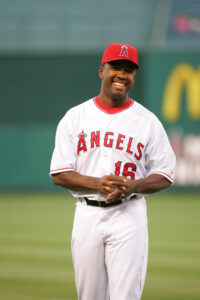
In 1995, Anderson immediately broke out as one of the game’s brightest young players. He torched American League pitching with a .321/.352/.505 batting line, 16 home runs, 19 doubles, a triple and six stolen bases. Anderson narrowly finished second to Minnesota’s Marty Cordova in ’95 Rookie of the Year voting, with both players pulling in 13 of 28 first-place votes. The two were extremely close in terms of on-base percentage and slugging percentage, with Anderson having a big lead in batting average but Cordova having a major edge in games played (137 to 106) and plate appearances (579 to 400).
Anderson followed that Rookie of the Year runner-up showing with several years of roughly average offense and plus right field defense. In 2000, he broke out with a 35-homer campaign and followed it with a 28-homer efforts in 2001. Anderson’s 2002 season produced his first All-Star bid. He paced the majors with 56 doubles, ripped 29 home runs and hit .306/.332/.539 as the Angels’ roster at large gelled together to create an unstoppable force.
Anderson joined homegrown stars like Troy Glaus, Darin Erstad, Tim Salmon, Jarrod Washburn, John Lackey and Francisco Rodriguez on an Angels club that won 99 games to secure a postseason berth. The ’02 Angels toppled a 103-win Yankees club in the American League Division Series before taking down a 94-win Twins club in the American League Championship Series. Their World Series aspirations were hanging on by a thread in Game 6 against the Giants, with the Halos trailing by five runs heading into the bottom of the seventh. Anderson collected a hit as part of the team’s late six-run rally, and in Game 7, he cleared the bases with a third-inning double down the line off San Francisco’s Livan Hernandez, giving the Angels a 4-1 lead they would never relinquish.
That standout 2002 season not only earned Anderson his first All-Star nod, it also secured him a fourth-place finish in AL MVP voting and the first of two Silver Slugger Awards in his terrific career. He finished 14th in MVP voting, won another Silver Slugger Award, and not only made another All-Star team in 2003 but won that season’s annual Home Run Derby. Anderson starred for the Angels all the way through 2008 before closing out his career with a pair of one-year stops in Atlanta and back in Los Angeles — this time in Dodger Blue.
All told, Anderson’s career drew to a close with some rare numbers. He retired with a .293/.324/.461 batting line. On a rate basis, that was roughly league-average offense in that supercharged era of run production, but few players could match Anderson’s consistency, durability and longevity. He slugged 287 home runs (186th all-time) and still ranks in the all-time top-100 doubles (522, 50th) runs batted in (1365, 87th) and hits (2529, 96th). To this day, Anderson is the Angels’ franchise leader in games played, hits, runs scored, RBIs and total bases.
Anderson’s consistent production, smooth swing and stoic personality helped endear him not only to the Angels faithful but to baseball fans from all walks of life. His name is synonymous with the most prosperous era of Angels history, and his indelible legacy will live on in franchise lore. We at MLB Trade Rumors offer our heartfelt condolences to Anderson’s family, the Angels organizations, and the countless fans who hold cherished memories of one of his generation’s most consistent hitters.
What??? RIP
horace – My reaction as well. Especially weird, I was just watching and writing about the anniversary yesterday of the Flying Pizza and how professional Garret handled it.
Rest in peace Mr. Anderson, thoughts and prayers to your loved ones.
Fever, I’m visioning Angel fans in shock and mourning like us Sox fans were and still are with Wake. Condolences to the family and those fortunate to have known him.
dewey – I love Wake, but this is worse IMO because fatal heart attacks come with no warning before death, unlike cancer.
Garrett was a professional hitter EVERY year of his career. I wish there were more players like this today and Garrett left way too young. Condolences to his family.
RIP. That is entirely too young to go.
Noooooooo. This one hits me hard, what a professional. RIP
I agree. It hit our family hard. RIP GA.
Franchise leader in hits, arguably the greatest player on that 2002 team, over 2000 games played for the team. His number should have been retired by the angels long, long ago. May he rest in peace.
As a lifelong fan of a division rival, I am baffled that his number isn’t retired.
Did you forget he was inducted into the Angels HOF in 2016?
Each team has specific rules. Boston for example only retires Cooperstown HOFers. As the club made an exception for Papi whose number was retired before he was in shrine in Cooperstown, I’ve been asking that they also retire at Dwight Evans and Luis Tiant’s numbers
dewey – Not true on the Sox retired numbers, as Pesky’s number was retired long ago. They really should retire Roger’s, they don’t issue it to anyone else so what are they waiting for?
Good to see you posting again my friend, I hope you are doing better. Not sure if you saw my last reply directed to you.
The Mariners rule for the entirety of the teams history was that only hall of fame players who played their whole careers here would get the honor. Then they made an exception for Junior (rightfully so). Then they made an exception for Ichiro (rightfully so). Now Randy is getting the treatment this year and I couldn’t be more thrilled. A lot of these rules are interesting and for a team like Boston with more history you’d assume they are less likely to be broken. Then again, Yankees have beards now
One of Arte’s most underrated offenses is that he hasn’t retired any numbers from the 2002 team. I feel a bit of disappointment every time I see 14, 15, 16, and 17 in use.
Couldn’t have been too disappointed with the guy wearing #17 between ‘18-‘23
The player was great, but I’m disappointed they issued #17 to him, same as I was disappointed they issued #27 to Trout.
dudes stats are criminally underrated!
A few weeks back I looked at who’s number the An
“Angels” retired. 3, Ryan, Fregosi and Carew. Anderson definitely deserved that a long time ago
Damn, underrated player and universally loved Angel. We’ll miss you GA.
VERY underrated player—he and Bobby Abreu were the two most underrated and underappreciated players during this time.
Some nearly identical numbers:
Abreu: 2,470 hits, .288 HR, .291 avg, 1363 RBI
Anderson: 2,529 hits, 287 HR, .293 avg, 1365 RBI
Amazing that they are separated by such a gap in WAR (Abreu 60.2/Anderson 25.7)….that was the difference playing in AL/NL back then…Anderson got quite a bit of DH time.
Two of my favorite players. But I think the difference can be largely attributed to two things: plate discipline and baserunning. Here are their respective walk and stolen base numbers:
GA: 429 / 80
Bobby: 1476 / 400
DH time is not the difference. Abreu spent 161 games as DH, Anderson only had 73 more.
Uh…they were only similar in that they were both good defensive RFs and contemporaries. They may have hit for similar average with similar power numbers but Abreu was a *massively* better hitter:
Abreu: 291/395/475
Anderson: 293/324/461
The 71 point OBP advantage for Abreu is the reason why Abreu has more than twice the WAR that Anderson has. It has nothing to do with the fact that one was in the NL and the other in the AL
Anderson was a very underrated LF, which he played 10 as many games as RF.
I’ve seen very few left handed left fielders get to the line, spin, and throw darts to second base better than Anderson.
@halo11fan not trying to be disrespectful to GA, but he was a lazy outfielder. He was definitely called out for it.
It’s funny how long it’s taken Jo Adell to finally master the subtleties of playing the corner outfield at Angel stadium and throughout his entire career I don’t recall him misplaying a ball driven into the corner and he saved homers. It’s fitting that your Rex Hudler. Stay off the pot and you blew the play off game against the Ms . Langston stared you down then and now
No he wasn’t. He was so smooth he looked lazy. I get it though.
@butter. Are we talking about Anderson or adell. You might need to take some Adderall because you can’t stay on topic.
@bkbk True. Garret was a soft spoken and underrated player. Definitely was a big part of our only champion and brought us Angel fans lots of memories during fonder time. Most notably the 10 RBI game vs the Yankees.
RIP Garrett, a true Angel in the Outfield.
Oh no😢one of my favorite Angels🥹so sad 🙏🙏🙏R.I.P🙏🙏🙏
GA my all time favorite Angels player. RIP
RIP this is so damn tragic. One of the most underrated players in the early 2000’s.
Loved his smooth swing too.
Absolutely gut punch to all baseball fans.
RIP Garret…..
Did he ever get HOF votes?
2500+hits
287 hr 1365 rbi
500+ doubles
.293 avg
Hall of Very Good.
Only received one vote.
And one vote is a really big deal. Only a very small percentage of players ever get there. One of my favorites. RIP
He didn’t get on base. He wasn’t great on starting a rally, but when you were looking for someone to get that big hit, there was no one on the Angels more likely to deliver.
There is no 2002 Angels without him.
I am actually crying.
Damn, and just days after Here Comes The Pizza day, too. He will forever be immortalized in that. Rip
The very definition of professional hitter. RIP.
I remember watching him as a kid… gosh makes me sad.
So sad, so young, and an all time great Angel on the field, in the club house, and in the community!!!
Was playing as recently as 2010. Barely got to enjoy his retirement
A lot of people don’t even get to see retirement, especially at his age. Either way, he was way too young to go. RIP
16 years of retirement??
Angels legend. 53 is way too young. Rest in peace sir.
No way. 😭. How . rip
Even though he did not win the award, he was the best rookie in baseball 1995.
He was a huge part of the best run in Angel history. Sad day for his family, Angel fans and Baseball fans.
He died far too young.
Unbelievable, already at 53…
Wow, I remember him playing. Usually when you see these announcements it’s about someone who was before your time.
RIP and may his family find peace.
Wow. Hell of a ballplayer, gone far too soon.
Was he on the Angels’ telecasts earlier this season? I don’t remember seeing him.
So sad. Too early. RIP GA. One of my faves.
Athletic is reporting it was a heart attack.
RIP Garret. Always liked him as a player!!! A class act
Aww man. No.
This hits hard. I had a poster of him in my room growing up and I still have his jersey hanging in my closet.
I was just thinking about him yesterday. How he had an amazing 10 months in 02-03. He won the World Series in 02 and had the decisive bases clearing hit in game 7. Then in 03 he won the Home Run Derby and was the All Star Game MVP.
I am praying for comfort and strength for his family.
… Holy sht.
Dude wow, he was a great player to watch, he had a really nice swing. That’s way too young, may he go the Field of Dreams and play with other greats.
Very sad news today shocking and reminding me of the Adenhart tragedy 17 years ago. I was fortunate to watch them both. Enjoyed GA’s professionalism with the 2002 WS Champs and always vs. the Yankees. Great memories to a classy great ballplayer. Loved watching him setup the pitchers to throw the pitch that he wanted and taking it deep which I knew he was doing. He was really good at that.
youtube.com/watch?v=J5SoeTnAB2Y
I’m still not over Adenhart, only a year older than what he would have been if that _____ never drove drunk. I didn’t even know or met him but that rocked me to the core.
Angels have the worst luck when it comes to untimely deaths, starting with Lyman Bostock and now GA.
*Sigh*
Goodness gracious. Seems like he just played yesterday. Entirely too daggone young.
RIP. Condolences to his family and friends.
What the hell? I don’t know how do react to this. Truly I don’t. Now my memory might be skewed a little bit.
Game 7
Games loaded
4th inning
3 run double down the right field line
Anaheim Angels win the 2002 World Series.
World Series MVP Garret Anderson
Joe Buck had the audacity to ask TimMcCarver, Do you think there’s a chance that Barry Bonds wins the WS MVP? I don’t remember his response
Rest in Paradise Garrett Anderson 🌹🌹🌹😢😢
WOW out of LF no pun intended 😥 My team the OAKLAND A’s were battling the Angels for a few years and Garrett seemed to kill us acouple times
Wow. This is shocking for sure! RIP
Terrible news. Garrett Anderson was nothing if not consistent every season.
R.I.P. GA
Wow. This one hits close to home. This is not some guy that was playing when I was 7. Or an old timer that had already retired by the time I was born. This is a man that is just four years older than me and in much better shape I would imagine. Anderson was a very underrated player and I don’t care what WAR says, the man had over 2500 career hits and nearly 300 homers. He deserves HOF consideration. Maybe, maybe not, but he at least has the numbers to be considered by the veteran’s committee.
Geez man what a loss RIP
I really liked him. Great bat on ball skills and a player that scared you with runners on. Very clutch in the ’02 postseason. Remarkably consistant. RIP
Absolutely speechless and on the verge of tears. One of my heroes and favorite players of all time. An Angel on the field and now in heaven. Rest in peace GA. Love and prayers to his family, he will be missed by all. 😢
Devastated. All time great Angel and just as great of a person. Incredibly nice guy.
A true part of the Angels family.
This sucks.
To die so young, that in itself is a tragedy
Certainly HOF type career
RIP, my condolences to his family and friends
I watched Garrett Anderson for his entire career, right from the beginning, you could tell immediately the Angels had something special. From day one he was spraying line drives all over the field, and as the years went on he grew into the complete hitter average, doubles, quiet power, and those steady 100‑RBI seasons
People forget how much he meant to this franchise. Without Garrett Anderson, the Angels probably don’t win the World Series. He was the heartbeat of that lineup, the guy who always came through when the moment was big. He took the home run contest and the 2003 All‑Star Game MVP because that’s who he was a star who never needed to shout about it.
He carried himself with humility, professionalism, and a quiet leadership that teammates respected. He just showed up, did the work, and let the results speak for him.
Our prayers to his wife and his three children. This is a sad day in Angels history. We lost not just a great player, but a cornerstone of the franchise and a huge part of our memories.
Rest in peace, GA. You’ll always be an Angel.
RIP GA, deeply saddened today by the news of his passing.
He was one of my favorite players on a team other than my hometown team. Hate to see these headlines.
RIP, to one of the Greatest Angels now in Halo Heaven!
Condolences to all of Garrett’s family & friends. We have lost three long time veterans in Garner, Lopes & Anderson in these last two weeks.
He, Erstad, and Salmon made up one of the great outfields ever in my opinion. As an M’s fan I saw him a lot. Nationally, I don’t think he got the respect he deserved but it may have been his quiet nature that contributed to that. So sad to go at 53. He should have many years left. Rest in peace Garret.
Damn. One of the best pure hitters I ever saw. Hope his family will be ok.
My condolences to Angel fans. What a major part of the organization and a lot of peoples personal history. We think we’ll be seeing these guys pop in every once in awhile for decades to come – and then someone is gone. RIP
Quality guy. Quality hitter. It’s sad to lose sweet people like Garrett. Thank you for a good career in baseball, Garrett. You could really hit. I can feel the sadness today for his passing. Garrett had plenty of wonderful fans.
So sad. This guy was younger than me. Appreciate your time. Excellent player.
RIP Dodger legend
Anderson was so chill broadcasters and reporters would say he needed to give more effort in the outfield and base paths. He was a stud. Real Angel fans knew it. Thanks for that 2002 season. I remember the feeling of those wins more than the Dodgers amazing WS just last year.
I mostly remember the ‘fans’ attacking him for his lack of hustle in the outfield and on the base paths. But I also saw the ‘fans’ rip apart Salmon towards the end of his career.
@orange2001. His lack of hustle stopped after 2000, but he was durable and dependable wasn’t a bad player by any means. Erstad just ripped salmon about his defense. I guess we had a Good outfield so it was something to complain about.
Devastated. Garrett was one of a kind and a true gentleman and class act. RIP, GA…
One of my favorites, RIP.
Wow, this is just awful. As a kid I always thought his 1997 stat line was so cool, reaching those RBI totals with single-digit HRs. Huge part of the 2002 Angels and that iconic World Series too. RIP Mr. Anderson.
The smoothest swing, I’ve seen live.
(I never got to see Griffey play in person.)
You will be missed GA! RIP.
Gone way too soon.
It definitely was picturesque
Woah… RIP, Garrett.
Great baseball player. Used to regularly be my sleeper fantasy pick.
Angel fan here, same age as Garret, watched his entire career. Absolutely loved him as a player, so smooth, such a cornerstone guy in franchise history. I love this site…but you refer to him as a Right Fielder? An easy search shows he played almost 1400 games in left field and only 162 in right. I expect better.
No words. Too many memories of him as a rookie/prospect to helping the Halos win the World Series to his post-career on TV as an Angels analyst. He’ll be sorely missed in the Angels baseball community. RIP #16.
And I always felt that he was robbed of the ’95 ROY award.
Shocking.
Only 53 My heart breaks for his wife and three children
One of the most underrated players of his generation and something many of today’s players could learn from. A contact hitter and doubles machine. Sacrificing power to put the ball in play. Plus had one of the biggest hits in Angels history. Shocking for him. A three run Double that cleared the bases and put the angels ahead for good in game 7 of the 2002 World Series. Should have been the series MVP
A true Halo for life. Rest in peace and god speed. Spare a thought for his family tonight and hug yours a little tighter
RIP Mr. Anderson, you’ll always be remembered as one of the greatest to evwr wear a Halos uni!
RIP
There’s just no way…
RIP
So sad. Love GA. Hope it wasn’t the clot-shot.
You should be ashamed of yourself.
So sad. Was always an absolute Mariners killer. RIP
RIP Garret, you will be missed. You were such an underrated player in your day.
Terribly sad news. Always enjoyed watching him play. Solid, solid palyer.
53 is way too young, but RIP #16. We travel to Morro Bay from Colorado every year and try to catch a game at Angels Stadium. Last saw Anderson play June 18th ’06 in an inter-league game against the Pads. Followed all him the time as a baseball fan and he was very good with his skills to say the least. Always seemed to have a smile on his face.
He was a big guy. I’ll always remember his patented kickslide into the catchers shin guard at home plate taking him out and scoring the run!
Sad. Rest in Peace.
Great career. Definitely deserves to have his number retired, statue, etc. Hall of the really really good players, especially with 2,500+ hits.
Anderson was the type of player every championship team needs. A guy where no individual aspect of his game jumps off the charts but every single aspect of the game he did very, very well and you could rely on him to play 150 games a year. The late 90’s Angels outfield of Anderson, Tim Salmon and Jim Edmonds is among the best complimentary skillsets I’ve seen any team have playing the outfield.
Garret Anderson died just after Jackie Robinson day, and lived less than a month longer.
Just before Jackie died, I remember seeing him making an appearance at the 72 World Series. Then he died and I thought he was pretty old.
Today, Garret was way too young. Amazing how perspectives change.
They both died at 53.
RIP- a great teammate abd player
No!!! RIP to a great player and an incredible person. Prayers to his family and to the Angels organization
So young.
That’s sad and 53 years young doesn’t make it better.