
There was a time not too long ago where Dillon Dingler seemed to be on track to be a backup catcher. That’d have been a perfectly fine career, but it now seems he is so much more than that, which is great for him and the Tigers.
Dingler was a second-round pick of the Tigers in 2020. For most of his time in the minors, the book on him was that he had a great defensive skill set but his ceiling would be capped by a propensity for swinging and missing.
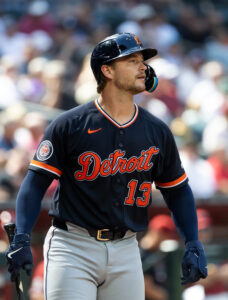
In 2022, Dingler spent the entire year at Double-A. He hit 14 home runs in 448 plate appearances and drew walks at a solid 10% clip, but his 31.9% strikeout rate was far too high high. For reference, the MLB average was 22.2% last year. The highest qualified hitter was Ryan McMahon at 32.3%. Players generally strike out more as they climb the minor league ladder and face tougher competition. With Dingler already whiffing at a high rate in Double-A, it would be natural to expect his rates to increase as he got to Triple-A and then the majors.
That season dimmed his stock a bit. Baseball America had him as the No. 4 prospect in the Tigers’ system going into 2022 but bumped him to No. 7 ahead of the 2023 season. Going into 2022, FanGraphs had Dingler at No. 4 in the system and even slotted him in as the game’s No. 108 prospect. Tthe following year, Dingler was off the Top 100, dropped to No. 7 in the system, and given a 45 FV (future value) on the 20-80 scale. The May 2024 scouting report from FanGraphs’ Eric Longenhagen provides a good snapshot of how Dingler was viewed at that time:
“The athleticism and receiving to be a do-it-all defender behind the dish is here, and much of Dingler’s prospect variance is tied to whether his hit tool and medium-sized frame will enable him to be a primary catcher or just a luxury backup. He swings through a ton of in-zone fastballs and really struggles to get on top of anything in the upper third of the zone. There aren’t many catchers capable of punishing mistakes with power the way Dingler does, but his bat-to-ball ability is also comfortably worse than the typical hitter at that position. He shares quite a few similarities with Jake Rogers and should end up playing a lot, producing about 1.5 annual WAR in a low-end primary catching role.”
The 2023 season didn’t improve the way he was viewed. Injuries limited him to 89 games, including 26 at the Triple-A level. He punched out in 31.2% of his plate appearances and put up an ugly .202/.266/.384 line. Going into 2024, the Tigers gave him a 40-man spot to keep him out of the Rule 5 draft, but BA knocked him down to No. 9 in the Detroit system. FanGraphs bumped him down to No. 10 and dropped his FV to 40+ (again, on the 20-80 scale).
Dingler’s 2024 was something of a mixed bag. His results at the Triple-A level were very encouraging. He took 301 trips to the plate and trimmed his strikeout rate to 20.3% — a massive improvement. His 10% walk rate was still good, and he hit 17 home runs. His .308/.379/.559 line translated to a 145 wRC+. That got some help from a .337 batting average on balls in play, but there were a lot of good signs regardless.
However, Dingler also got his first taste of the majors and delivered more worrisome results. It was a small sample size of 87 plate appearances, but his 34.5% strikeout rate was the exact kind of thing that prospect evaluators were concerned about in previous seasons. His .167/.195/.310 line was obviously unpleasant.
Last year was a breakout. An early injury to Rogers opened up some playing time, and Dingler ran with it. By the end of the year, he had appeared in 126 games. His defense received strong grades, as expected for a guy who was considered a glove-first prospect. He was credited with six Defensive Runs Saved, putting him among the top 15 catchers for that stat. FanGraphs had him as one of the game’s 10 best pitch framers. Statcast had him in the top ten in terms of framing, throwing and blocking. He won the American League Gold Glove for the catcher position.
The offense was arguably more notable, given his past reputation. Dingler’s 23.5% strikeout rate was a bit higher than average but very tolerable and certainly better than his minor league work. His 4.9% walk rate was subpar, but he hit 14 home runs and slashed .278/.327/.425 for a 109 wRC+. That was juiced by a .345 BABIP but was encouraging nonetheless.
So far in 2026, he’s been even better. It’s a tiny sample of 83 plate appearances but his walk rate has moved up a bit to 6%, still well below average but an uptick nonetheless. His strikeout rate is all the way down to 16.9%. He has a .264/.346/.528 line and 145 wRC+, despite a subpar BABIP of .264. Statcast puts his average exit velocity in the 84th percentile of qualified hitters. His hard-hit rate is 96th and barrel rate 95th.
As mentioned, that is a small sample and maybe he can’t maintain it. But at this point, Dingler has 639 career plate appearances. Even with his nightmare start in 2024, he has a combined .261/.311/.421 line, 104 wRC+, 4.9% walk rate and 24.1% strikeout rate. That walk rate may even increase, since he usually walked about twice as much in the minors.
Maybe the strikeouts will creep back up, but there are some encouraging indicators under the hood. Dingler had a decent eye, hence the walks in the minors, but he would miss when he did decide to swing. As mentioned in the pull quote above, a big problem was him missing balls in the strike zone, not so much a problem with chasing.
His contact rate in Double-A in 2022 was 67.8%. For context, the major league average last year was 76.4%. In 2023, when he was still striking out a lot in the minors, his contact rate was 70.6%. But in 2024, he got that up above 76%, both in the majors and in the minors. He was at 77% last year and is at 78.5% so far in 2026.
It’s possible that pitchers adjust how they attack Dingler. Perhaps due to his reputation, 53.8% of the pitches he saw last year were in the strike zone. That was well above the league average of 41.9%. In the early going here in 2026, only 47.8% of pitches he has seen have been in the zone. That’s still above par but a big drop from the year before. If pitchers continue to throw him fewer strikes, he may have to adjust his approach, but he’s not a free swinger right now. His 48.5% swing rate last year was above average but barely, as the league-wide mean was 47.4%. Since he was getting attacked more, it makes sense that he would swing more. He is up to 49.5% this year, despite seeing fewer pitches in the zone, though he is still getting balls over the plate a lot.
The overall package has been valuable so far. Dingler has appeared in 174 big league games. Thanks so his contributions on both sides of the ball, FanGraphs has credited him with 5.0 wins above replacement. Dating back to the start of last year, Cal Raleigh and Shea Langeliers are the only backstops with more fWAR. Baseball Reference is a bit more bearish, giving him 3.9 WAR so far. Time will tell if Dingler can hold his gains on the strikeout side of things, but the defense gives him a strong floor and he can clearly put a charge in the ball when he does connect.
Dingler’s breakout is a great development for the Tigers. They are about to lose Rogers to free agency in a few months. If Dingler were a strikeout-prone backup, as expected, Detroit would have been looking for a new catcher in the coming offseason. Instead, they should be able to just roll with Dingler.
They may have to replace Rogers, but that could also be done in house. Eduardo Valencia is already on the 40-man roster and has some helium thanks to a .319/.405/.622 showing in Triple-A last year. His numbers aren’t as strong so far in 2026, currently sporting a .182/.308/.299 line, but with an unfortunate .222 BABIP. There are questions about whether he can stick behind the plate, but the Tigers are still trying. He’s been in the catcher position for 101 innings this year, compared to 53 1/3 at first base. FanGraphs currently considers him the No. 8 prospect in the system.
Dingler is controlled through 2030, so there are also long-term questions to be answered. A couple of Detroit’s top prospects are catchers. Thayron Liranzo and Josue Briceño are consensus top five guys in the system. Briceño is generally considered a top-100 prospect. Liranzo is already on the 40-man roster but hasn’t yet reached the Triple-A level. He spent most of 2025 at Double-A and struck out at a 31.7% rate. He was slowed by an oblique strain this spring and is only now getting ramped up. Briceño also reached Double-A last year and hit better but has more questions about his ability to stick at catcher. He recently underwent wrist surgery and is likely to miss a few months of this year. Neither of these two are knocking on the door yet but could be at some point.
Even if Briceño is ultimately pushed to first base and designated hitter, the Tigers have Spencer Torkelson and Kerry Carpenter under club control through 2028. It’s possible the Tigers will get to a point where they feel someone from that group can be traded.
Even if they don’t build up enough of a surplus to trade someone, Dingler’s development is great for the long-term spine nonetheless. Kevin McGonigle is now signed through 2034 and could be the everyday shortstop for much of that span. Max Clark is one of the top prospects in all of baseball and is currently playing in Triple-A. He should be up at some point this season and could be the center fielder in Detroit through 2032.
Along with that long-term core, the Tigers have financial flexibility. Thanks to an aversion to long-term free agent contracts in recent years, their books are fairly clean. The Javier Báez deal is done after 2027. Framber Valdez is signed through 2028 but can opt out of the final year. All their other players making eight-figure salaries are slated for free agency after the current season. Pretty soon, the McGonigle and Colt Keith extensions will be the only guaranteed deals on the books, and those aren’t especially onerous.
The Tigers will probably need more pitching. Valdez can opt out after 2027. Tarik Skubal, Jack Flaherty, Justin Verlander and Casey Mize are free agents after the current season. That clean payroll outlook will give the front office space to sign guys, and as mentioned, they could also find themselves with a position player logjam that leads to a trade.
Detroit could also explore a Dingler extension if they were so inclined. He would probably be amenable to one. Catchers don’t age especially well due to the rigors of the position, which means they rarely receive big free agent deals — at least relative to other position players. J.T. Realmuto got to $115.5MM back in 2021, and he’s still the only free agent backstop to crack nine figures. That’s a big number, but dozens of infielders and outfielders have beaten that handily.
Dingler was a bit of a late bloomer, as he didn’t reach the majors until his age-25 season and didn’t break out until he was 26. His window of club control already goes through his age-31 season, meaning he would hit the open market ahead of his age-32 campaign. If the Tigers wanted to lock him up and add another year or two, it seems fair to assume he would be interested.
Extensions for catchers this early in their careers are rare. Most of the notable recent deals for catchers came when they pushed into their arbitration years. Will Smith signed his $131.5MM deal with the Dodgers when he had over four years of service time. Alejandro Kirk was also in that bucket when the Blue Jays gave him $58MM. Raleigh and Sean Murphy had between three and four years of service when they got $99.4MM and $73MM, respectively.
The one recent deal that aligns with Dingler’s current status is the eight-year $50MM deal signed by the Nationals and Keibert Ruiz. Apart from the fact that both catchers have between one and two years of service, it’s not a great comp. Ruiz hadn’t had as much success then as Dingler has now. The deal was mostly a bet on Ruiz’s prospect pedigree, which has not panned out so far. Ruiz has mostly struggled and the deal looks like an albatross. It’s safe to presume he’d top that deal by a comfortable margin.
Contract talk aside, Dingler is making the Tigers stronger now and can continue to do so for years to come. Detroit will face some challenges with none of their starters signed long-term, but the Tigers have a strong foundation on the position player side to utilize, with Dingler rapidly emerging as a key piece of that core.
Photo courtesy of Rick Osentoski, Imagn Images
He has been the best player on the team beyond Skubal. There’s really no need to sign him to an extension now that would start at his age 32 season. I think the only obvious extension candidate in the franchise is Clark.
The best layer on the team has been McGonigle and it isn’t close. He has been the most valuable player in the AL. Skubal has several loses and should have had another one today. You could say mize has been better that Skubal.
Skubal has two losses this year, not several. He also has a 1.99 FIP, even if his ERA is somewhat higher. But yes, McGonigle has been the best player on the Tigers so far this season.
Lot of words dedicated to a journeyman off to a good start. Written by Dillon’s manservant or aunt?
Do you know what the term “journeyman” means in sports terms? Dingler is a Tigers draft pick who worked his way through the system at a normal pace and is now one of their better players. If you just don’t like the guy then say that instead of trying to be clever with words you don’t understand.
He is just a third year player, who is an elite defender whose expected batting stats (.458 xwOBA) so far are third in the majors behind only Alvarez and Trout. Will he keep up this pace all year? Almost certainly not. But I think this is more than a “journeyman off to a good start.”
About what can be expected from a dumpster.
Exactly my thoughts. A lot or writing about someone who is marginal
Tonight…. on Biography
Dirk’s younger brother??
Dang, ya gotta dig Dillon Dingler, what a name, what a guy. 🤣
“Catch Rockwell”
Most know it all fans would have dumped him after the 2024 season
Modern-day Bill Freehan for Detroit fans, with similarities including time in the Big Ten and perhaps destined for the Hall of the Very Good.
Massive ks, very low walks, low average. Maybe he has improved a bit, but i still think he needs work in AAA.
This has to be a joke
“Dingler has been the primary source of power for the 2026 Tigers, leading the team in both homers (5) and RBI. Most of his production has come in high-leverage situations, with 16 of his 18 RBIs coming in Tigers wins.” – mlb.com
So the best catcher in the Tigers organization should be sent down to AAA? Ohhh kaaay
Ain’t no way my mans name is Dillon Dingler
Then what is your man’s name?
Any relation to Dirk Diggler?
When you see the best catchers getting paid around the 15 million mark, you see a group of overlooked players. I think his value to Detroit will be like Sal Perez has been to K.C. in the future. Dillon looks real time scary when he comes to the plate, he’s in full command of his self. Add what he does behind the plate, and its safe to say he’s the best catcher Detroit has had since the two greats Parrish and Freehan. GO TIGERS !
Agree. He’s the real deal. A bonus is his athleticism, which was responsible for a Tigers run today when he turned a DP into a FC by hustling down the line.
I worked for the Whitecaps the year him and Tork were drafted. There was a reason he was called up to double A after around a month. There is a reason he’s blown through the minors. He’s built like a tank, is fearless, and is insanely focused. Take away from all the other offensive/defensive variables, Dingler was going to be at minium a good everyday catcher just out of his work ethic alone.
I was happy we got Briceño and Liranzo, but both times we traded for them, I kept asking why? We already have Dingler.
Did the Tigers actually trade for Briceño? I thought he was their own IFA signing.
It’s difficult to determine whether Liranzo is the best prospect they could have acquired for Flaherty or not, but I find the concerns about him overblown. Last year he improved his catching and hit at an averagish clip at AA in his 21 year-old season. Unfortunately, Rodgers’ offense is far from elite, so the Tigers won’t need a phenomenal backup catcher to replace him. Liranzo might need an additional year with Toledo, but he is still a viable prospect and has a decent chance of becoming the #2C in 2028.
Gruß,
BSHH
Briceño was signed by the Tigers.
He’s been better than anyone had predicted. I’ll put him on the “ keep him “ list.
Go Tigers !
He’s no Drake Baldwin but he’s certainly up near the top of the next wave of perennial all star Catchers.
Both are great players. Baldwin is a better hitter, Dingler is a better defender. Baldwin is 2 yrs younger though so that makes a difference too.
At what point do we start worrying about Will Vest?
Perhaps when the article has anything to do with him.
Thanks so much.