
Dillon Dingler Keeps Getting Better
There was a time not too long ago where Dillon Dingler seemed to be on track to be a backup catcher. That’d have been a perfectly fine career, but it now seems he is so much more than that, which is great for him and the Tigers.
Dingler was a second-round pick of the Tigers in 2020. For most of his time in the minors, the book on him was that he had a great defensive skill set but his ceiling would be capped by a propensity for swinging and missing.
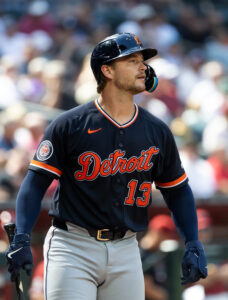
In 2022, Dingler spent the entire year at Double-A. He hit 14 home runs in 448 plate appearances and drew walks at a solid 10% clip, but his 31.9% strikeout rate was far too high high. For reference, the MLB average was 22.2% last year. The highest qualified hitter was Ryan McMahon at 32.3%. Players generally strike out more as they climb the minor league ladder and face tougher competition. With Dingler already whiffing at a high rate in Double-A, it would be natural to expect his rates to increase as he got to Triple-A and then the majors.
That season dimmed his stock a bit. Baseball America had him as the No. 4 prospect in the Tigers’ system going into 2022 but bumped him to No. 7 ahead of the 2023 season. Going into 2022, FanGraphs had Dingler at No. 4 in the system and even slotted him in as the game’s No. 108 prospect. Tthe following year, Dingler was off the Top 100, dropped to No. 7 in the system, and given a 45 FV (future value) on the 20-80 scale. The May 2024 scouting report from FanGraphs’ Eric Longenhagen provides a good snapshot of how Dingler was viewed at that time:
“The athleticism and receiving to be a do-it-all defender behind the dish is here, and much of Dingler’s prospect variance is tied to whether his hit tool and medium-sized frame will enable him to be a primary catcher or just a luxury backup. He swings through a ton of in-zone fastballs and really struggles to get on top of anything in the upper third of the zone. There aren’t many catchers capable of punishing mistakes with power the way Dingler does, but his bat-to-ball ability is also comfortably worse than the typical hitter at that position. He shares quite a few similarities with Jake Rogers and should end up playing a lot, producing about 1.5 annual WAR in a low-end primary catching role.”
The 2023 season didn’t improve the way he was viewed. Injuries limited him to 89 games, including 26 at the Triple-A level. He punched out in 31.2% of his plate appearances and put up an ugly .202/.266/.384 line. Going into 2024, the Tigers gave him a 40-man spot to keep him out of the Rule 5 draft, but BA knocked him down to No. 9 in the Detroit system. FanGraphs bumped him down to No. 10 and dropped his FV to 40+ (again, on the 20-80 scale).
Dingler’s 2024 was something of a mixed bag. His results at the Triple-A level were very encouraging. He took 301 trips to the plate and trimmed his strikeout rate to 20.3% — a massive improvement. His 10% walk rate was still good, and he hit 17 home runs. His .308/.379/.559 line translated to a 145 wRC+. That got some help from a .337 batting average on balls in play, but there were a lot of good signs regardless.
However, Dingler also got his first taste of the majors and delivered more worrisome results. It was a small sample size of 87 plate appearances, but his 34.5% strikeout rate was the exact kind of thing that prospect evaluators were concerned about in previous seasons. His .167/.195/.310 line was obviously unpleasant.
Last year was a breakout. An early injury to Rogers opened up some playing time, and Dingler ran with it. By the end of the year, he had appeared in 126 games. His defense received strong grades, as expected for a guy who was considered a glove-first prospect. He was credited with six Defensive Runs Saved, putting him among the top 15 catchers for that stat. FanGraphs had him as one of the game’s 10 best pitch framers. Statcast had him in the top ten in terms of framing, throwing and blocking. He won the American League Gold Glove for the catcher position.
The offense was arguably more notable, given his past reputation. Dingler’s 23.5% strikeout rate was a bit higher than average but very tolerable and certainly better than his minor league work. His 4.9% walk rate was subpar, but he hit 14 home runs and slashed .278/.327/.425 for a 109 wRC+. That was juiced by a .345 BABIP but was encouraging nonetheless.
So far in 2026, he’s been even better. It’s a tiny sample of 83 plate appearances but his walk rate has moved up a bit to 6%, still well below average but an uptick nonetheless. His strikeout rate is all the way down to 16.9%. He has a .264/.346/.528 line and 145 wRC+, despite a subpar BABIP of .264. Statcast puts his average exit velocity in the 84th percentile of qualified hitters. His hard-hit rate is 96th and barrel rate 95th.
As mentioned, that is a small sample and maybe he can’t maintain it. But at this point, Dingler has 639 career plate appearances. Even with his nightmare start in 2024, he has a combined .261/.311/.421 line, 104 wRC+, 4.9% walk rate and 24.1% strikeout rate. That walk rate may even increase, since he usually walked about twice as much in the minors.
Maybe the strikeouts will creep back up, but there are some encouraging indicators under the hood. Dingler had a decent eye, hence the walks in the minors, but he would miss when he did decide to swing. As mentioned in the pull quote above, a big problem was him missing balls in the strike zone, not so much a problem with chasing.
His contact rate in Double-A in 2022 was 67.8%. For context, the major league average last year was 76.4%. In 2023, when he was still striking out a lot in the minors, his contact rate was 70.6%. But in 2024, he got that up above 76%, both in the majors and in the minors. He was at 77% last year and is at 78.5% so far in 2026.
It’s possible that pitchers adjust how they attack Dingler. Perhaps due to his reputation, 53.8% of the pitches he saw last year were in the strike zone. That was well above the league average of 41.9%. In the early going here in 2026, only 47.8% of pitches he has seen have been in the zone. That’s still above par but a big drop from the year before. If pitchers continue to throw him fewer strikes, he may have to adjust his approach, but he’s not a free swinger right now. His 48.5% swing rate last year was above average but barely, as the league-wide mean was 47.4%. Since he was getting attacked more, it makes sense that he would swing more. He is up to 49.5% this year, despite seeing fewer pitches in the zone, though he is still getting balls over the plate a lot.
The overall package has been valuable so far. Dingler has appeared in 174 big league games. Thanks so his contributions on both sides of the ball, FanGraphs has credited him with 5.0 wins above replacement. Dating back to the start of last year, Cal Raleigh and Shea Langeliers are the only backstops with more fWAR. Baseball Reference is a bit more bearish, giving him 3.9 WAR so far. Time will tell if Dingler can hold his gains on the strikeout side of things, but the defense gives him a strong floor and he can clearly put a charge in the ball when he does connect.
Dingler’s breakout is a great development for the Tigers. They are about to lose Rogers to free agency in a few months. If Dingler were a strikeout-prone backup, as expected, Detroit would have been looking for a new catcher in the coming offseason. Instead, they should be able to just roll with Dingler.
They may have to replace Rogers, but that could also be done in house. Eduardo Valencia is already on the 40-man roster and has some helium thanks to a .319/.405/.622 showing in Triple-A last year. His numbers aren’t as strong so far in 2026, currently sporting a .182/.308/.299 line, but with an unfortunate .222 BABIP. There are questions about whether he can stick behind the plate, but the Tigers are still trying. He’s been in the catcher position for 101 innings this year, compared to 53 1/3 at first base. FanGraphs currently considers him the No. 8 prospect in the system.
Dingler is controlled through 2030, so there are also long-term questions to be answered. A couple of Detroit’s top prospects are catchers. Thayron Liranzo and Josue Briceño are consensus top five guys in the system. Briceño is generally considered a top-100 prospect. Liranzo is already on the 40-man roster but hasn’t yet reached the Triple-A level. He spent most of 2025 at Double-A and struck out at a 31.7% rate. He was slowed by an oblique strain this spring and is only now getting ramped up. Briceño also reached Double-A last year and hit better but has more questions about his ability to stick at catcher. He recently underwent wrist surgery and is likely to miss a few months of this year. Neither of these two are knocking on the door yet but could be at some point.
Even if Briceño is ultimately pushed to first base and designated hitter, the Tigers have Spencer Torkelson and Kerry Carpenter under club control through 2028. It’s possible the Tigers will get to a point where they feel someone from that group can be traded.
Even if they don’t build up enough of a surplus to trade someone, Dingler’s development is great for the long-term spine nonetheless. Kevin McGonigle is now signed through 2034 and could be the everyday shortstop for much of that span. Max Clark is one of the top prospects in all of baseball and is currently playing in Triple-A. He should be up at some point this season and could be the center fielder in Detroit through 2032.
Along with that long-term core, the Tigers have financial flexibility. Thanks to an aversion to long-term free agent contracts in recent years, their books are fairly clean. The Javier Báez deal is done after 2027. Framber Valdez is signed through 2028 but can opt out of the final year. All their other players making eight-figure salaries are slated for free agency after the current season. Pretty soon, the McGonigle and Colt Keith extensions will be the only guaranteed deals on the books, and those aren’t especially onerous.
The Tigers will probably need more pitching. Valdez can opt out after 2027. Tarik Skubal, Jack Flaherty, Justin Verlander and Casey Mize are free agents after the current season. That clean payroll outlook will give the front office space to sign guys, and as mentioned, they could also find themselves with a position player logjam that leads to a trade.
Detroit could also explore a Dingler extension if they were so inclined. He would probably be amenable to one. Catchers don’t age especially well due to the rigors of the position, which means they rarely receive big free agent deals — at least relative to other position players. J.T. Realmuto got to $115.5MM back in 2021, and he’s still the only free agent backstop to crack nine figures. That’s a big number, but dozens of infielders and outfielders have beaten that handily.
Dingler was a bit of a late bloomer, as he didn’t reach the majors until his age-25 season and didn’t break out until he was 26. His window of club control already goes through his age-31 season, meaning he would hit the open market ahead of his age-32 campaign. If the Tigers wanted to lock him up and add another year or two, it seems fair to assume he would be interested.
Extensions for catchers this early in their careers are rare. Most of the notable recent deals for catchers came when they pushed into their arbitration years. Will Smith signed his $131.5MM deal with the Dodgers when he had over four years of service time. Alejandro Kirk was also in that bucket when the Blue Jays gave him $58MM. Raleigh and Sean Murphy had between three and four years of service when they got $99.4MM and $73MM, respectively.
The one recent deal that aligns with Dingler’s current status is the eight-year $50MM deal signed by the Nationals and Keibert Ruiz. Apart from the fact that both catchers have between one and two years of service, it’s not a great comp. Ruiz hadn’t had as much success then as Dingler has now. The deal was mostly a bet on Ruiz’s prospect pedigree, which has not panned out so far. Ruiz has mostly struggled and the deal looks like an albatross. It’s safe to presume he’d top that deal by a comfortable margin.
Contract talk aside, Dingler is making the Tigers stronger now and can continue to do so for years to come. Detroit will face some challenges with none of their starters signed long-term, but the Tigers have a strong foundation on the position player side to utilize, with Dingler rapidly emerging as a key piece of that core.
Photo courtesy of Rick Osentoski, Imagn Images
Players Avoiding Arbitration: 11/21/25
The deadline for teams to tender contracts to arbitration-eligible players is this afternoon at 4pm CT. Throughout the day, we’ll surely see a handful of arb-eligible players agree to terms with their clubs to avoid a hearing.
These so-called “pre-tender deals” usually, although not always, involve players who were borderline non-tender candidates. Rather than run the risk of being cut loose, they can look to sign in the lead-up to the deadline. Those salaries often come in a little below projections, since these players tend to have less leverage because of the uncertainty about whether they’ll be offered a contract at all.
Under the 2022-26 collective bargaining agreement, players who sign to avoid an arbitration hearing are guaranteed full termination pay. That’s a change from prior CBAs, when teams could release an arb-eligible player before the season began and would only owe a prorated portion of the contract. This was done to incentivize teams and players to get deals done without going to a hearing.
All salary projections in this post come via MLBTR contributor Matt Swartz. This post will be updated throughout the day as deals are announced and/or reported. Salary figures are from The Associated Press unless otherwise noted.
- The Astros signed right-hander Enyel De Los Santos to a one-year deal and outfielder Taylor Trammell to a split deal, per Brian McTaggart of MLB.com. Per Chandler Rome of The Athletic, De Los Santos gets $1.6MM, plus a $100K bonus if he appears in 60 games, while Trammell $900K if in the majors and $500K in the minors. They were projected for $2.1MM and $900K respectively.
- The Athletics announced that they have signed right-hander Luis Medina and left-hander Ken Waldichuk to one-year deals. Medina gets $835K, while Waldichuk comes in at $825K.
- The Braves announced that they have signed infielder Vidal Bruján, infielder Mauricio Dubón, outfielder Eli White and left-handers Joey Wentz and José Suarez for the 2026 season. Bruján’s deal was announced as a split contract; he’ll make $850K in MLB and $500K in the minors. Dubon will make $6.1MM, per Jon Heyman of The New York Post, right around his $5.8MM projection. Suarez gets $900K, per Ari Alexander of 7 News, below his $1.5MM projection. White and Wentz also get $900K salaries.
- The Brewers announced that they have signed first baseman Jake Bauers for 2026. He’ll make $2.7MM, per Jon Heyman of The New York Post. He was projected for $2MM.
- The Giants have agreed to a one-year deal with right-hander JT Brubaker, per Justice selos Santos of Mercury News. He commands a $1.82MM salary.
- The Guardians have agreed to one-year deals with outfielder Nolan Jones, catcher/designated hitter David Fry and right-hander Matt Festa, per Zack Meisel of The Athletic. In a follow-up, Meisel also provides the salary figures. Jones will make $2MM, Fry $1.375MM and Festa $1MM. They were projected for $2MM, $1.2MM and $1MM respectively.
- The Mets and outfielder Tyrone Taylor have agreed at $3.8MM, per Mark Feinsand of MLB.com, right around his $3.6MM projection.
- The Nationals announced they have signed catcher Riley Adams to a one-year deal. It’s a split deal that pays $1MM in the big leagues and $500K in the minors.
- The Orioles and right-hander Félix Bautista have agreed to a $2.25MM contract, reports Mark Feinsand of MLB.com. He was projected for $2.1MM.
- The Padres announced they signed catcher Luis Campusano to a one-year deal. He’ll make $900K next year, per Dennis Lin of The Athletic. He was projected for $1MM.
- The Phillies have agreed to a split deal with catcher Garrett Stubbs, reports Matt Gelb of The Athletic. Stubbs will make $925K in the majors and $575K in the minors. The major league salary is an exact match for his projection. The Phils announced that they also signed catcher Rafael Marchán. He’ll make $860K, per Todd Zolecki of MLB.com. He was projected for $1MM.
- The Rangers announced they signed outfielder Sam Haggerty to a one-year deal. It’s a $1.25MM contract.
- The Rays and right-hander Cole Sulser have settled at $1.05MM, per Marc Topkin of The Tampa Bay Times. Sulser was projected for $1.2MM. According to the AP, it’s a split deal that pays at a $600K rate in the minors.
- The Reds and left-hander Sam Moll have agreed at $875K, per Jon Heyman of The New York Post. He was projected for $1.2MM. His 2026 deal also has $150K in potential incentives — $50K each for 45, 55 and 65 appearances.
- The Royals and infielder Jonathan India agreed to an $8MM deal. You can read more about that in this post.
- The Tigers and infielder/outfielder Matt Vierling agreed at $3.225MM, per Jon Heyman of The New York Post. He was projected for $3.1MM. Detroit signed right-hander Beau Brieske at $1.1575MM, per Heyman, right around his $1.3MM projection. The Tigers signed catcher Jake Rogers at $3.05MM, per Evan Petzold of the Detroit Free Press, right around his $2.9MM projection.
- The Twins signed right-hander Justin Topa to a one-year, $1.225MM deal. MLBTR covered that earlier in this post. The Twins turned down a $2MM club option for Topa, giving him a $225K buyout instead, but he remained under club control via arb. Between the buyout and next year’s salary, he’ll collect $1.45MM. Darren Wolfson of KSTP reported Topa’s 2026 salary. Aaron Gleeman of The Athletic adds that the guarantee is broken down into a $1MM salary in 2026 followed by a $225K buyout on a $5MM mutual option. The buyout can rise to $300K via unspecified incentives.
- The White Sox announced that they have agreed to terms on a $900K deal with outfielder Derek Hill. He was projected for $1MM.
- The Yankees and infielder Oswaldo Cabrera have agreed to a $1.2MM contract, per Jack Curry of Yes Network, an exact match for his projection. The Yanks have also signed right-hander Clarke Schmidt to a $4.5MM deal, per Robert Murray of FanSided, right around his $4.9MM projection.
Photo courtesy of William Liang, Imagn Images
Tigers Designate Tomas Nido For Assignment
The Tigers announced Tuesday that catcher Tomas Nido has been designated for assignment. His spot on the roster will go to fellow catcher Jake Rogers, who is being reinstated from the injured list after missing about six weeks with an oblique strain.
Nido’s DFA shouldn’t come as a huge surprise. Though he’s hitting .343 with Detroit, that’s a 12-for-37 sample that’s consisted entirely of singles and has come without a walk. Nido’s offense has been buoyed by a .480 average on balls in play. He’s fanned 10 times in 37 plate appearances (27%) and chased pitches off the plate at a grim 41% clip. He’s a well-regarded defender, but Nido entered the season as a career .210/.245/.309 hitter in 945 major league plate appearances. He was hitting .160/.222/.320 in 28 Triple-A plate appearances at the time he was originally summoned to the majors in place of the injured Rogers.
Detroit will happily take the month-plus of solid backup work for Nido and would surely love to pass him through waivers in order to retain him as a depth option in Triple-A Toledo. It’s hardly out of the question that he gets claimed, but there’s a good chance he’ll pass through waivers unclaimed as he did in June 2023 after the Mets had designated him for assignment. If Nido does clear waivers, he’d have the right to reject a minor league assignment (by virtue of both service time and that 2023 outright) in lieu of electing free agency.
Tigers To Activate Jake Rogers
The Tigers will reinstate catcher Jake Rogers from the injured list today, manager A.J. Hinch announced to the team’s beat (link via Evan Woodbery of MLive.com). The likely corresponding move will be to move on from veteran Tomas Nido, who has hit well in a small sample of 37 plate appearances but can’t be optioned to the minors without first clearing waivers.
Rogers, 30, went 5-for-15 with three doubles during a brief Triple-A rehab assignment. He landed on the injured list about a week into the season thanks to an oblique strain that wound up sidelining him nearly six weeks. He was 4-for-18 with a double and three walks in 22 plate appearances when healthy and carries a .198/.262/.351 batting line dating back to last season.
Though he’s coming off a down season with the bat, Rogers is a premium defensive catcher who popped 21 home runs as recently as 2023. From 2022-23, Rogers slashed .225/.291/.457 (103 wRC+) with 27 big flies in only 492 plate appearances. The Tigers will certainly hope that he can return to that form at the plate, but Rogers’ glovework is strong enough that he’ll hold down a key role on the team even if his bat doesn’t return to form.
In Rogers’ absence, former second-round pick Dillon Dingler has seen the lion’s share of playing time and made a case for a larger role than that of the standard backup. He’s hitting .292/.319/.462 with four homers, eight doubles and a triple in 135 turns at the plate. Dingler’s 27.4% strikeout rate is a few ticks too high — though lower than Rogers’ typical levels — and he’s not going to sustain a .382 average on balls in play, but he increasingly looks like a competent offensive player whose glovework is similarly well-regarded to that of Rogers. Time will tell how the Tigers will divide up the reps behind the dish, but it’s possible that Dingler has played himself into more of an even timeshare already.
As for the 31-year-old Nido, he’s appeared in 10 games since Rogers’ injury and gone 12-for-37. He’s hitting .343, but all of his hits have been singles and he’s sitting on a .480 average on balls in play he can’t possibly sustain over a larger sample. Nido, like his two fellow Detroit backstops, is a plus defender but entered the season with a career .210/.245/.309 batting line. He’s out of minor league options and has more than five years of service anyhow (meaning even if he did have minor league option remaining, he’d have to consent to being sent down).
If the Tigers end up designating Nido for assignment, they’ll have five days to try to trade him before he’d have to be placed on outright waivers (which is a 48-hour process). The Tigers would presumably prefer to keep Nido in the organization as depth in Triple-A Toledo, but even if Nido were to go unclaimed on waivers, he could reject an outright assignment to Triple-A in favor of free agency.
Jake Rogers Diagnosed With Oblique Strain, Could Miss More Than One Month
April 9: Manager A.J. Hinch said this morning that Rogers was diagnosed with a strained oblique and noted that it’ll be more than a minimal IL stint, adding that strains of this nature often take a month or more to heal (via Chris McCosky of the Detroit News).
April 8: The Tigers announced Tuesday that they’ve selected the contract of veteran catcher Tomas Nido from Triple-A Toledo and placed fellow catcher Jake Rogers on the 10-day IL with tightness in his left oblique. Infielder/outfielder Wenceel Perez has been transferred from the 10-day IL to the 60-day IL to open a 40-man roster spot. Perez’s 60-day stint includes the time he’s already missed; he’ll be eligible to return in late May.
Rogers, 30 next week, was scratched from the lineup less than an hour ago. He felt the discomfort in his oblique area while taking swings in the batting cage prior to today’s game, per Cody Stavenhagen of The Athletic. The Tigers — whether influenced by the frigid temperatures at today’s home opener or not — will take the cautious route. They have not yet provided a timetable for his return or specified whether Rogers will head for an MRI. At this point, they’re using the term “tightness” and not “strain,” which suggests Rogers could escape with a relatively minimal IL stay.
Rogers has appeared in six games thus far and is out to a .222/.364/.333 start. He’s seeking a rebound from a down year in 2024, hopeful of returning to the 2023 form that saw him belt a career-best 21 homers while providing his typical brand of plus-plus defense behind the dish. Evan Woodbery of MLive.com pointed out earlier thiat his IL placement will snap a stretch of 37 straight Tarik Skubal starts caught by Rogers.
Nido doesn’t have the same power upside as Rogers, but he’s a plus defender with plenty of big league experience under his belt — most of it coming with the Mets. The 30-year-old veteran (31 this weekend) is a .210/.245/.309 hitter in 945 big league plate appearances accrued over parts of eight MLB seasons. Nido is just over seven weeks shy of six years of big league service time, and this new stint with Detroit will help him inch closer to the six-year mark. He appeared in 49 games between the Mets and Cubs last year, slashing a combined .192/.219/.315 with four homers.
Though Nido has never hit much outside a tiny seven-game sample in the shortened 2020 season, he’s consistently drawn above-average marks for his framing, his ability to block balls in the dirt and his prowess in controlling the running game. His throwing numbers did dip a bit below-average in 2022-23, but he bounced back with a 22.7% caught-stealing rate in 2024 — a couple ticks higher than the league-average 20.4% mark.
Tigers Notes: Margot, Vierling, Rogers
The Tigers placed outfielder Manuel Margot on the 10-day injured list due to left knee inflammation and recalled fellow outfielder Brewer Hicklen from Triple-A, per a club announcement.
Margot has gone 6-for-19 (all singles) to begin his Tigers tenure. He joins Parker Meadows, Matt Vierling and Wenceel Perez on the injured list for a Detroit club that has seen too many injuries in its outfield corps. The team didn’t provide an immediate timetable for Margot’s return. Notably, the left knee is not the same knee that Margot injured back in 2022, when he missed about half the year with a strained patellar tendon in his right knee.
The 29-year-old Hicklen was acquired from the Brewers on March 28 in exchange for cash. He’s hitless in a tiny sample of nine big league plate appearances but has appeared in parts of four Triple-A seasons, slashing .244/.352/.476 in 1366 plate appearances at the top minor league level. Hicklen will join Riley Greene, Kerry Carpenter and utilitymen Zach McKinstry, Ryan Kreidler and Andy Ibanez as outfield options for skipper A.J. Hinch.
The Tigers added in a separate announcement this morning that Vierling, who’s been out all season with a strained rotator cuff, is beginning a throwing program today. There’s still no firm timeline for his return, though Hinch noted to reporters that a motivated Vierling was out on the field playing begin throwing in 30-degree weather this morning — both a testament to his eagerness to return and the improved state of his shoulder (link via The Athletic’s Cody Stavenhagen).
In other Tigers injury news, the team scratched catcher Jake Rogers today due to tightness in his left oblique. As MLive’s Evan Woodbery points out, this means that reigning Cy Young winner Tarik Skubal will be caught by a different catcher for the first time since 2023. Backup Dillon Dingler is getting the start today, snapping a streak of 37 consecutive Skubal starts caught by Rogers.
There’s no indication from the Tigers whether Rogers will require an MRI or a trip to the injured list. Veteran Tomas Nido is on hand in Triple-A Toledo as an experienced option to pair with the 26-year-old Dingler if Rogers is forced to miss any time.
Rogers, 30 next week, is out to a .222/.364/.333 start in his first six games of the season. He’s a premium defender behind the dish and has been looking to rebound from a down year at the plate in 2024, when he batted just .197/.255/.352. As recently as 2023, Rogers popped 21 homers in a season while batting .221/.286/.444.
The Tigers Are Reaping The Benefits From A Quiet August Pickup
Over the next two weeks, the Tigers are widely expected to become deadline sellers. That’s perhaps not as set in stone as it once looked — not with an 8-2 showing in their past 10 games and nine games against the Twins and Guardians remaining between now and the deadline. In many ways, they’ll control their own fate. At 47-50, they’re a dozen games back of Cleveland for the division lead and seven games out of the American League Wild Card chase. An impressive run, particularly against those division foes, could change the complexion of the AL Central.
Given their standing in the division for the majority of the season, there’s been been plenty of chatter about the top names Detroit could peddle on the summer trade market. A trade of ace and AL Cy Young favorite Tarik Skubal — who’s controlled through 2026 — seems immensely unlikely, though given the sheer volume of interest and possibility of a team making a stratospheric offer, we still tucked him into the No. 50 spot last week when listing our top 50 trade candidates for this year’s deadline.
Three other Tigers made that list, including top name Jack Flaherty as well as reliever Andrew Chafin and utilityman Gio Urshela. There’s at least one other Tiger that had a clear case to be on the list, but ultimately, we chose an arbitrary 50 candidates to highlight, and not every plausible name made the cut. That, however, doesn’t mean that catcher Carson Kelly isn’t an intriguing trade candidate himself.
At the time the Tigers signed Kelly last August, the transaction drew little fanfare. While he was a former top prospect with the Cardinals and one of the headline pieces in the trade that sent Paul Goldschmidt from St. Louis to Arizona, Kelly had struggled for much of the 2022-23 seasons after originally turning in a pair of nice seasons with the Snakes in 2019 and 2021. At the time of his DFA and subsequent D-backs release, he was hitting .226/.283/.298 in 92 trips to the plate. He’d batted .211/.282/.334 in 354 plate appearances a year prior. It was an inauspicious conclusion to a nearly five-year run in Arizona.

Kelly didn’t do much to change any narratives surrounding him down the stretch in Detroit. He hit just .173/.271/.269 in 59 plate appearances. He continued to play standout defense, as has been the case throughout his big league career, but he looked the part of a punchless, glove-first backup. Despite that, the Tigers clearly saw something they liked and picked up the $3.5MM club option they’d negotiated into Kelly’s contract — a lesser price than he’d have commanded had the Tigers simply kept him and gone through the arbitration process.
It’s proven to be a savvy move. After a disastrous stretch at the plate in 2022-23, Kelly has rebounded back to the 2019 and 2021 form that made him into a quality all-around catcher. He’s hitting .247/.326/.410 with seven home runs on the year. He’s been even better since a slow start; in 120 plate appearances dating back to mid-May, Kelly is hitting .290/.358/.505.
That production doesn’t appear to be overly fluky in nature. Kelly’s .276 average on balls in play is higher than his career .257 mark, but not by much, and it’s still south of the 2024 league average (.289). Kelly’s 19.9% strikeout rate is the lowest full-season mark of his career (albeit only by a narrow margin), and he’s drawing walks at a solid 8.6% clip. Statcast shows that Kelly is making hard contact at far and away the highest rate of his career (45.4%) and also averaging a career-best 89.7 mph off the bat. (From 2022-23, those numbers sat at 35.4% and 87.4 mph, respectively.) By measure of wRC+, Kelly’s bat has been 10% better than average.
The increased production at the plate is particularly encouraging because Kelly’s glove remains a premium asset. He’s thwarted a whopping one-third of stolen base attempts against him (18-for-54). The league average this season is 23%. Kelly has also drawn plus marks for his blocking and at least average marks for his framing. In 437 innings behind the dish, Statcast credits him as four runs above average. Defensive Runs Saved pegs him at a strong +3 in that same time.
Kelly’s production has been sufficient enough that he’s overtaken Jake Rogers by a slight margin in terms of playing time. Though he was signed to be Rogers’ backup, Kelly’s 437 innings behind the plate top his teammate’s 422 frames there.
Given Rogers’ struggles this season — he’s hitting .203/.251/.346 — it’s possible that Kelly has played his way into the Tigers’ long-term plans. However, he’s slated to become a free agent at season’s end. Rogers, who’s a plus defender himself, is controlled through the 2026 season. He’s drawn trade interest in the past and could potentially do so again over the next couple weeks, though this year’s downturn at the plate obviously has an adverse impact on the level of interest Rogers would realistically command.
It’s rare for a team to go acquire a new starting catcher at the deadline, as learning a new pitching staff on the fly midseason is a tall order. There are a few teams on the lookout for catching help, however — the Cubs seemingly chief among them. Other postseason hopefuls that have received minimal production from their backstops in 2024 include the Guardians and the Rays, and the majority of contending clubs would consider the 2024 version of Kelly an upgrade over their current backup catcher.
In retrospect, I’d probably go back and find a way to get Kelly onto last week’s top 50 list, perhaps pushing off one of the many middle relievers who populated the middle tiers. But catching help is rarely as in demand as bullpen help on the summer trade market, and we went with more relievers as a result.
Regardless, Kelly stands as a clear trade candidate, barring a surge against the division-rival Guardians and Twins in the next two weeks. That fact alone is deserving of praise for multiple parties. Tigers scouts and evaluators deserve credit for looking at Kelly and determining that even after a dismal two years, he still had a potential rebound in the tank. The front office deserves credit for not only signing Kelly last year but including a low-cost club option that’s made him into an even more appealing bargain option.
And, of course, Kelly himself deserves praise for the manner in which he’s put that forgettable two-year stretch behind him and revitalized his career. This is his best stretch since early 2021, and having just turned 30 on Sunday, he still has plenty of years ahead if he can sustain anything close to this pace. The big question, for the moment, is whether that continues in a Tigers uniform or whether he changes hands in the next 14 days. He and his teammates will have plenty of say in which route their front office ultimately chooses.
AL Central Notes: Counsell, Twins, Rogers
The Guardians have secured permission to interview Brewers manager Craig Counsell, per Paul Hoynes of Cleveland.com. Cleveland had previously been reported as requesting permission from Milwaukee to interview Counsell earlier this week. While it was unclear if the Brewers would grant that permission, it’s hardly a surprise that they did so after recently offering the Mets the same courtesy. Counsell, 53, is among the most well-respected managers in the game after piloting the Brewers to a 707-625 record during his nine-year tenure that’s included five postseason appearances in the past six seasons.
Just as Counsell has other suitors beyond Cleveland in Milwaukee and Queens, the Guardians also have options outside of Counsell as they look to replace Terry Francona in the dugout. Cubs bench coach Andy Green recently interviewed for the position, and Dodgers first base coach Clayton McCullough, Yankees bench coach Carlos Mendoza, and Giants bullpen/catching coach Craig Albernaz have all also met with the Guardians regarding their managerial vacancy. Of that group, only Green has past experience as a big league manager aside from Counsell. While Counsell reportedly enters free agency hoping to move the ball forward for future managers around the game in terms of salary, that seems unlikely to preclude the Guardians from making a run at Counsell’s services, given Francona was the highest paid manager in the game this season, with Jon Heyman of the New York Post reporting that Francona made $4.5MM in 2023.
More from around the AL Central…
- Despite not being part of the club’s starting lineup during their postseason run, veteran catcher Christian Vazquez figures to remain a significant part of the Twins in 2024, per Bobby Nightengale of the Star Tribune. Per Nightengale, the team plans to offer roughly equal playing time to Vazquez and fellow catcher Ryan Jeffers behind the plate next year. Vazquez just wrapped up the first season of his three-year, $30MM deal with the club and suffered the worst offensive season of his career with a .223/.280/.318 slash line across 355 plate appearances. By contrast, Jeffers had a breakout season, slashing .276/.369/.490 in 335 trips to the plate. While Jeffers is clearly the stronger offensive option, Vazquez is regarded as an elite defensive catcher and Jeffers could feasibly see additional playing time at DH next year as a way to keep his bat in the lineup on days Vazquez is behind the plate.
- The Tigers had another difficult season in 2023, posting a 78-84 record and finishing 9 games out of a postseason spot. That being said, one significant bright spot for the club this year was catcher Jake Rogers, who Evan Petzold of the Detroit Free Press indicates has already secured his role as the club’s top option behind the plate for 2024. Rogers improved on defense in 2023 to post framing numbers in line with other quality regulars at the position like Adley Rutschman and Alejandro Kirk while also slashing a respectable .221/.286/.444 with 21 home runs in just 365 trips to the plate. Among catchers with at least 300 plate appearances in the majors this year, Rogers’s 97 wRC+ ties him with Mets rookie Francisco Alvarez for the 14th-best figure in the majors.
The Tigers’ Last Chance To Get Something From The Justin Verlander Trade
There once was a time when Justin Verlander had only played for the Tigers. He was drafted by them with the second overall pick in 2004 and then cemented himself as one of the best pitchers in baseball in the years that followed. He twice signed contracts that extended the club’s control over his services, once in 2010 and another in 2013. That latter contract ran through his age-36 season and was signed while the club was one of the best in the league. They were fresh off a World Series appearance in 2012 and would eventually get to a four-year streak of winning the AL Central in 2014. It wouldn’t have been outlandish to expect him to be a Tiger for life.
However, the fortunes of the franchise changed in the years after that, as they slipped into the basement of the division in 2015. They bounced back with an 86-win showing in 2016 but still missed the playoffs, then were not doing so great again in 2017. It was decided that it was time to turn things over, with the Tigers making two huge deals at the waiver deadline that year. They first traded Justin Upton to the Angels and then Verlander to the Astros. The latter deal was Verlander, a player to be named later and cash for prospects Franklin Pérez, Daz Cameron and Jake Rogers. The PTBNL was later reported as outfielder Juan Ramirez.
It’s now been over five years since that franchise-altering pivot. The Astros went on to win their first World Series a few months after acquiring Verlander, though that title is now forever asterisked in the minds of many baseball fans due to the trashcan-banging scandal. But subsequent contracts kept Verlander in Houston through 2022 as the club continued to be among the best in the league. They made the ALCS in each of those seasons, making it to the World Series again in 2019 and 2021 before winning their second title last year.
As for the Tigers, they have been on the opposite end of the spectrum, continually rebuilding during that entire stretch. That 86-win showing in 2016 is still their last winning season. They’ve also reaped little from those future-focused moves back in 2017. Right-hander Grayson Long, who came over in the Upton deal, topped out at Double-A and retired in 2019. The PTBNL in the deal was later reported as Elvin Rodríguez, who made seven appearances with the Tigers last year but was outrighted at season’s end and is now with the Rays on a minor league deal.
As for the Verlander deal, Pérez was generally considered the headliner at the time as he was a highly-touted prospect then. Baseball America had him in the #54 slot of their top 100 at the start of 2017 and bumped him to #35 going into 2018. Unfortunately, the injury bug bit him badly, mostly in the shoulder. He was only able to throw 19 1/3 innings in the minors in 2018 and 7 2/3 in 2019. The minor leagues were canceled by the pandemic in 2020 and then shoulder surgery wiped out 2021 for Pérez. He was released by the Tigers and re-signed, eventually tossing 25 1/3 innings in the Complex League last year but with a 9.59 ERA. He appears to still be in the organization but it’s hard to count on him for anything now after so much missed development time. He’s 25 years old and has yet to crack Double-A, outside of a brief stint at that level prior to the trade.
Cameron was also a highly-touted young outfielder, having cracked BA’s top 100 list in 2016. Though he had slipped off by the time of the trade, he was still an exciting young player. He made his way to the big leagues but couldn’t do much with the opportunity. He got into 73 major league games over the past three years but hit just .201/.266/.330 and struck out in 31.6% of his plate appearances. He was put on waivers in November, getting claimed by the Orioles and subsequently outrighted.
That leaves Rogers as the last hope for the Tigers to salvage the deal in some way. Arguably seen as the least significant piece of the deal at the time, Rogers was Houston’s #20 prospect at Baseball America coming into 2017. The catcher hasn’t been able to provide much value to the Tigers so far, but that’s not really his fault. He required Tommy John surgery in September of 2021, which wiped out his entire 2022 season. Prior to that, he was showing some positive signs in a small sample. He got into 38 games in 2021 and hit six home runs. Despite striking out in 36.2% of his plate appearances, his .239/.306/.496 was above average, resulting in a 116 wRC+.
He’s now back from that long layoff and showing encouraging signs in a small sample again. His 28.3% strikeout rate this year is still high but it’s an improvement from his previous work. He’s also nearly doubled his walked rate from 8.7% in 2021 to 15.2% this year. His .237/.370/.447 batting line on the season amounts to a 135 wRC+.
This is a tiny sample of 46 plate appearances in 15 games and will surely change. However, Rogers doesn’t need to hit like a superstar to be valuable since he’s considered a strong defensive backstop. In his limited time in the big leagues, he has four Defensive Runs Saved. Both FanGraphs and Baseball Prospectus gave him negative grades for his framing prior to the Tommy John but he’s in the positive range so far this year. He’s thrown out 16 of 39 attempted base stealers in his career, a 41% rate that’s well above average, though he’s nabbed just one of six this year.
Rogers’ career thus far is so limited that it’s hard to draw any meaningful conclusions. Thanks to the lost season, he has just 88 major league games under his belt despite now being 28 years old. But given his reputation as a strong defensive catcher, even something near league average offense would make him a useful contributor. He’s shown the potential to be more than that, hitting 12 home runs already in barely half a season of cumulative work. He’s yet to reach arbitration but is slated to get there this winter and is on pace to reach free agency after 2026.
It’s highly likely that the Verlander trade will eventually be seen as a big miss for the Tigers overall. Fans had to watch an iconic player win two rings elsewhere while the highly-touted young players they got in return couldn’t meet expectations and the team posted miserable results overall. But if Rogers can keep serving as a solid defender behind the plate who launches a ball over the wall every once in a while, he can keep it from going down as an utter disaster.
Tigers Notes: Lorenzen, Wentz, Vest, Haase, Rogers
Tigers right-hander Michael Lorenzen is going to start the season on the 15-day injured list, manager A.J. Hinch indicated this afternoon (relayed by Chris McCosky of the Detroit News). The offseason signee is dealing with a left groin strain. Hinch indicated it’s not expected to be a serious issue but will require Lorenzen to miss a couple turns through the rotation.
Detroit brought the veteran in on a one-year, $8.5MM guarantee over the winter. He and fellow free agent pickup Matthew Boyd were added to take the final couple rotation spots beyond Eduardo Rodriguez, Spencer Turnbull and Matt Manning.
While that’s on hold, Detroit is likely to turn to Joey Wentz as a starter, McCosky adds. The 6’5″ southpaw was first called up last May. He got into seven games during his debut campaign, working to a 3.03 ERA with a slightly below-average 20% strikeout rate. Wentz had a solid 3.17 mark across 48 1/3 frames with Triple-A Toledo. He’s gotten hit hard this spring, allowing 13 runs in 14 2/3 innings in spite of a respectable 19:6 strikeout-to-walk ratio.
No pitcher had a tougher go in Detroit camp than reliever Will Vest, however. The righty managed four innings over five appearances, giving up a staggering 13 runs on as many hits with only three strikeouts. That knocked him out of consideration for a season-opening bullpen job, as Detroit optioned him to Toledo this afternoon.
Vest looked to have a bullpen spot more or less sewn up entering camp. The 27-year-old worked 63 innings over 59 outings last season. He allowed exactly four earned runs per nine but posted average or better strikeout (23.2%), walk (8.1%) and ground-ball (49.7%) marks. Vest could certainly factor into the bullpen as the season goes along but will first have to earn his way back up.
Alongside Vest, Detroit optioned catcher Donny Sands this afternoon. Hinch told reporters that non-roster backstops Andrew Knapp and Michael Papierski were being reassigned to minor league camp (link via Evan Petzold of the Detroit Free-Press). That leaves Eric Haase and Jake Rogers as the season-opening catching duo. Haase always looked assured of a roster spot. He was one of Detroit’s most productive hitters last season and is out of options. Rogers earns the backup job as a defensive specialist, setting him up for his first MLB action since undergoing Tommy John surgery in September 2021.