
John Buck To Retire
Catcher John Buck is retiring in order to spend more time with his family, the Braves announced. The veteran backstop had been in camp with Atlanta but did not figure to make the Opening Day roster.
Buck, 34, has played in eleven big league campaigns, amassing over 4,000 plate appearances and 1,000 games behind the plate. His .234/.301/.398 batting line and 134 career home runs are solid numbers for a catcher. A sturdy defender, Buck was a stabilizing force who saw the majority of the catching reps for his team in eight separate seasons.
After coming up with the Royals, Buck had his biggest season in a one-year stint with the Blue Jays in 2010. That year, Buck slashed .281/.314/.489 and swatted a career-high twenty long balls — excellent production while catching 118 games.
Buck landed a three-year, $18MM pact with the Marlins before the 2011 campaign, but never quite got back to his All-Star form. In addition to the teams already named, Buck ultimately spent time with the Mets, Mariners, Pirates, and Angels
Indians Notes: Kluber, Chen, Marcum, Downs, Sands
Let’s have a look at some notes out of Indians camp:
- While extension negotiations between the Indians and Corey Kluber have been friendly, Joel Sherman of the New York Post writes that it is a high-risk situation for both sides. For the team, the appeal of cost certainty (and, potentially, extended team control) is obvious, but guaranteeing money for the soon-to-be 29-year-old does have downside. And for Kluber, as agent B.B. Abbott notes, there is a balance to be struck between achieving fair value and locking up some security as an older pre-arb player. “If he considers this, he is doing it with his eyes wide open,” said Abbott. “He knows this will be the only time to sign this kind of multi-year deal.”
- The Indians have informed veteran pitchers Bruce Chen, Shaun Marcum, and Scott Downs that all three will not be on the Opening Day roster out of camp, Paul Hoynes of the Plain Dealer reports. All three are in camp on minor league deals. Of that group, only Downs is an Article XX(B) free agent, meaning that he will need to be offered a $100K retention bonus if the club wishes to retain his rights in the minors. Both Chen and Marcum have out clauses in their deals permitting them to return to the open market rather than going to Triple-A, Hoynes reports.
- Another player still battling for a roster spot, outfielder/first baseman Jerry Sands, helped his cause with a mammoth home run yesterday, as Hoynes reports. While the quality production out of his right-handed bat this spring has increased his appeal to Cleveland, Sands is still not far removed from surgery on his tendon sheath and can be controlled through an assignment in the minors to start the year. “I don’t know if Sands fits yet,” said Indians manager Terry Francona. “But you have to believe that a guy that can do what he does at some point is going to help us. Is it opening day, we don’t know yet. But we’re glad he’s here.”
Offseason In Review: New York Mets
The Mets picked around the edges this winter after entering the offseason committed to fielding a contender built from in-house pieces; indeed, Matt Harvey‘s return is probably better than any free agent addition that might have been had. While optimism reigns in Queens, the club is already dealing with the early losses of Zack Wheeler and Josh Edgin to elbow surgery.
Major League Signings
- OF Michael Cuddyer: two years, $21MM
- OF John Mayberry Jr.: one year, $1.45MM
- Total Spend: $22.45MM
Notable Minor League Signings
- 1B Brandon Allen, RP Duane Below, RP Buddy Carlyle, OF Alex Castellanos, C Johnny Monell, RP Scott Rice
Trades And Claims
- Claimed Sean Gilmartin from Twins in Rule 5 draft
Extensions
- None
Notable Losses
OF Bobby Abreu, 1B/OF Andrew Brown, C Juan Centeno, RP Gonzalez Germen, SP Daisuke Matsuzaka, SP/RP Logan Verrett (Rule 5 selection of Orioles), OF Eric Young Jr.
Needs Addressed
Despite plenty of viable arms in the rotation mix, the Mets nevertheless added one of the best pitchers in the game to their rotation. Of course, Matt Harvey was already under team control, but nursing him back to health and getting him back on the bump does more for New York’s chances than any actual transactions that the club could have made.
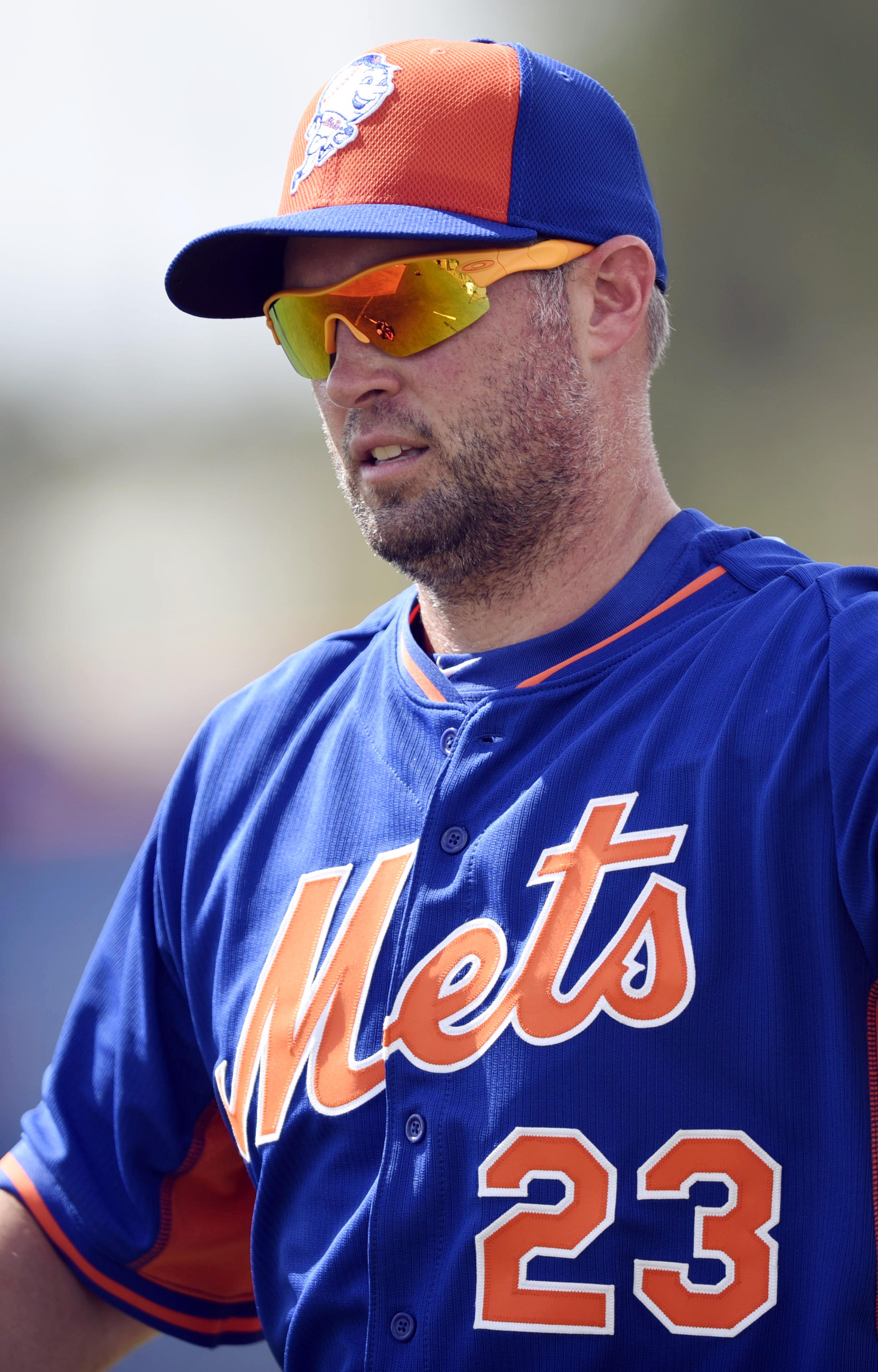 GM Sandy Alderson’s most impactful decision was the signing of Cuddyer. That came as a major surprise, as the veteran outfielder had appeared destined to become the first player ever to accept a qualifying offer. He chose instead to decline that one-year deal and sign with the Mets, inking for a fairly reasonable guarantee but also costing the team a mid-first round pick in this year’s amateur draft. New York had an obvious need in the corner outfield, and chose to bank on Cuddyer’s ability to stay productive despite questions about his health (he had DL stints for shoulder and thigh issues last year) and age (he’ll soon turn 36).
Of course, some might argue that an even more important choice was the team’s lack of action at shortstop. Some reports, and persistent speculation, pegged the Mets as suitors for both Troy Tulowitzki and Ian Desmond, two of the game’s very best overall shortstops. Whether or not either were serious possibilities, the end result is that 23-year-old Wilmer Flores will enter the year as the starter. (More on that below.)
Otherwise, the club largely picked around the edges of the roster. John Mayberry Jr. will serve as a bench bat and could see time in the corner outfield and at first base. But he and Cuddyer represent the entirety of the Mets’ major league commitments.
New York was even fairly quiet in terms of adding veteran minor league free agents, preferring instead to rely primarily on in-house options to round out the bench and staff. Among the players that were signed, only bullpen candidates Buddy Carlyle and Scott Rice appear to have much of a chance of making the roster.
Questions Remaining
Shortstop remains a source of controversy and intrigue for the Mets. Flores had a fairly promising 2014 campaign, slashing .251/.286/.378 and playing surprisingly well-reviewed defense, but he is far from a proven commodity. The same holds all the more true of presumptive backup Ruben Tejada, still just 25, who has failed to lock down the job despite nearly 2,000 MLB plate appearances over the last five seasons. If that combination falters, a mid-season acquisition and/or major free agent pursuit could ensue.
Uncertainty of a different kind looms at second, where Daniel Murphy is entering his final season of team control. There seems to be little chance of an extension, and Murphy could become a trade candidate if the club fails to stay in contention. An extended look for one or more future replacement candidates could come earlier than expected if Murphy’s hamstring pull forces him to miss time. Leading the way as a long-term option is Dilson Herrera, who cracked the bigs at age 20 last year and looks to be a gem mined by Alderson in the 2013 Marlon Byrd trade. But older, lower-upside minor leaguers like Matt Reynolds or Danny Muno appear to be first in line for a short-term run.
Elsewhere in the everyday lineup, it’s all about trusting and hoping for performance. Cuddyer and Curtis Granderson are established big leaguers at the corner outfield positions, but both come with their share of questions. In the infield corners, Lucas Duda will look to build on his strong 2014 while David Wright will aim for a rebound to his top-level form. Up the middle, backstop Travis d’Arnaud and center fielder Juan Lagares will look to cement themselves as fixtures for years to come.
In terms of bench roles, the lack of options will play a significant role. As MLBTR’s Tim Dierkes recently reported, reserve candidates Mayberry, Kirk Nieuwenhuis, and Cesar Puello all lack option years (as do Flores and Tejada). The first two of those names seem destined for bench spots, while the 23-year-old Puello, who has yet to see big league action, could end up looking for a new team.
The rotation is loaded with a variety of candidates, and is the clear strength of this roster. That holds true even with 24-year-old righty Zack Wheeler out for the season after Tommy John surgery, because the team never pulled the trigger on dealing Dillon Gee and has an armada of young arms lining up at Triple-A. All eyes will be on Harvey, of course, especially if there is cause to question the team’s handling of his return from his own TJ procedure. Jacob deGrom will look to prove that his unexpected 2014 was no fluke, while a trio of veterans (Gee, Jon Niese, Bartolo Colon) fill things out. Should the need arise, well-regarded hurlers such as Rafael Montero, Noah Syndergaard, and Steven Matz will be on hand to step in.
The bullpen, too, seemed to be shaping up nicely with its most established piece, Bobby Parnell, set to return early in the season after missing virtually all of 2014. Adding him to a late-inning mix that includes Jenrry Mejia, Jeurys Familia, and Vic Black seemed likely to form the core of a solid unit. There’s probably an argument to be made that another quality, veteran arm could have been added to this group, particularly since Parnell was (and still is) no sure thing.
It remains to be seen whether the club will regret not bolstering its right-handed reserves, but it already seems clear that the failure to add more southpaws will create challenges. Josh Edgin, the team’s lone established lefty, was lost for the year to TJ surgery just days after the last veterans were snapped up off the open market. The club will presumably keep an eye out for players missing out on other rosters later this spring, but otherwise will be forced to lean on the 33-year-old Rice or untested options such as Dario Alvarez and Rule 5 pick Sean Gilmartin.
Deal Of Note
The Cuddyer signing came as a legitimate surprise, in large part because many believed that he would be forced into taking the qualifying offer to avoid too great a dent into his market. But by lining up a deal before his deadline came, his representatives were able to avoid the fate of several draft compensation bound players who came before.
From the perspective of the Mets, the decision to sacrifice a valuable pick to add the aging and injury-prone Cuddyer is at least worth questioning. One charge that has often been leveled at the team of late is that it its ownership group is unwilling (or unable) to maintain a salary befitting the club’s large-market status. Sacrificing a pick rather than paying more for a comparably valuable player fits that narrative to some extent, at least at first glance.
But the reality is that Cuddyer represents a rather particular player that, arguably, makes particular sense for this club. One of the game’s most respected clubhouse members, Cuddyer could play an important role in bringing the team along competitively without requiring a huge commitment. While his numbers in Colorado were obviously aided by playing in Coors Field, and he posted rather wide home/road splits last year, he mashed everywhere during his excellent 2013 campaign.
Cuddyer is a poor defender, in addition to the above-noted risks, but that segment of the market does not contain flawless players. The alternatives in the general price range — players such as Nick Markakis, Colby Rasmus, Michael Morse, and Torii Hunter — all come with their own question marks. And it is not difficult to think of reasons that the Mets preferred Cuddyer among this group. When it turned out that his price tag included the sacrifice of a pick, that was simply one of the factors to be weighed, and there is an argument to be made that the team showed resolve to win by giving up that future value to obtain him.
Of course, as MLBTR’s Tim Dierkes notes, Cuddyer seems to be a great fit as the right-handed-hitting portion of a time share at first. Duda struggles against same-handed pitching while mashing righties, seemingly creating a nice match. While the team has given indication that it intends to allow Duda to try to work out his issues in that regard, potentially limiting Cuddyer’s time at first, he remains a very appealing option in such a role if Duda cannot turn things around.
Overview
Of course, there is a plausible scenario where the Cuddyer deal turns out poorly. But its limited duration cabins the risk. The most stringent questions about this offseason will probably come if Flores and Tejada struggle. While it is easy to defend the decision not to dabble in a free agent market at short that featured names like Jed Lowrie and Asdrubal Cabrera, and it is fairly likely that it would have taken a huge prospect outlay to land Tulowitzki or Desmond, the fact remains that Alderson and co. have much at stake in how those young players (Flores, in particular) come through this year.
The same holds true to a lesser extent in the relief corps, where the team seemingly passed on plenty of opportunities to add veterans. But the end of the spring and the summer trade market should hold plenty of solutions if the need is there and the Mets are in contention.
On the whole, this offseason was less about pushing the organization’s chips onto the table than it was about gathering its young core for a first real effort at winning. There will be plenty of disappointment if that does not occur — and plenty of blame directed at ownership and the front office. From one perspective, at least, the real test of the team’s willingness and ability to spend will probably come next year, with a 2015-16 free agent market that is shaping up to be one of the strongest in years.
Of course, an alternative read of the Mets’ winter is that the club decided not to invest in a winner. The total outlay did not exactly set the pace league-wide, and stands in some contrast within the division to the Nationals’ signing of Max Scherzer, the Marlins’ significant investments (mostly through trades and extensions), and even the Braves’ roster reshaping. All will probably be forgotten if the Mets compete to the wire, but there could be some what-ifs here. New York will field a highly variable team with its share of both upside and downside, and it is eminently arguable that some thoughtful additional moves would have raised the floor and provided some depth for a full year of competition.
Perhaps, then, the true test will come this summer: if New York is in the hunt and has a few areas of need, will it part with prospects and/or commit payroll to bolster its roster down the stretch?
NL East Notes: Wheeler, Howard, Nationals
The Mets have announced that starter Zack Wheeler underwent successful Tommy John surgery today, as Adam Rubin of ESPNNewYork.com tweets. New York will hope that it is all uphill from here for the well-regarded young righty. While the team certainly appears to have ample rotation depth now and in the future, he still figures as a key cog as the organization looks to ramp up into contention.
Here’s the latest from the NL East:
- Ryan Howard‘s previously-reported list of teams to which he cannot block a deal did not seem to provide him with much leverage; rather, as I noted at the time, it seemed to be motivated by other considerations. That is, in fact, the case, as Jon Heyman of CBSSports.com reports: Howard replaced his formerly NL-heavy slate with American League clubs in an effort to help the Phillies find him a new home. Of course, that has yet to occur, though Howard has shown some promise this spring and could be a worthwhile mid-season addition for the right team.
- While much attention has focused on the potential free agent departure of Nationals starters Jordan Zimmermann and Doug Fister (among other players), Chelsea Janes of the Washington Post writes that the club believes it has more than adequate pitching talent percolating through its system. Of course, it also seems worth noting that the Nationals could conceivably use those arms not only to fill in the big league rotation and provide depth, but also to acquire replacement pieces elsewhere via trade. GM Mike Rizzo has done just that in the recent past, dealing young pitching to acquire players like Denard Span, Doug Fister, and Jose Lobaton.
Tigers, David Price Open Exploratory Discussions
The Tigers have opened a line of communication with agent Bo McKinnis, the representative for ace lefty David Price, regarding the possibility of a new contract, Price tells reporters including MLB.com’s Jason Beck (Twitter link).
Price downplayed the significance of the communications to date after meeting with McKinnis last night. Numbers have not yet been discussed, said Price. “I wouldn’t even call it groundwork,” he explained.
Though it appears that only the most preliminary contact has been established, that obviously at least indicates that both sides have at least some interest in exploring an extension. Detroit gave up a substantial package of big leaguers and prospects to acquire Price last summer, of course, and went on to watch Max Scherzer depart via free agency. In that regard, team interest has always made some sense.
The question, as always is one of cost. Scherzer reportedly declined a $144MM offer from the Tigers entering his walk year, only to land $210MM on the open market. MLBTR’s Tim Dierkes has listed Price at third on his free agent power rankings, but that is largely a reflection of the upside of the two position players above him and the reality of pitching risk. As Dierkes has noted, Price has a strong case to join Scherzer in topping $200MM — if he puts up a typical year.
Market Notes: Cuban Players, Ibanez, Mets
Cuban ballplayers coming to the big leagues have never had a higher profile. And with large sums of money being invested in those players, teams have never had more obvious incentives to fully vet them. Nevertheless, tweets ESPN.com’s Buster Olney, different clubs still seem to have widely divergent views about the true talent levels of many players coming over from the neighboring island, creating a true “boom or bust” scenario in some cases.
Here are a few more notes from around the game to start the day:
- One Cuban player who has gone under the radar of late is young second baseman Andy Ibanez. MLB.com’s Jesse Sanchez notes on Twitter that Ibanez remains unsigned and adds that he could still elect to sign in the next July 2 period.
- Mets GM Sandy Alderson says the team “wasn’t complacent” about addressing the club’s shortstop situation over the winter, as Casey Stern of MLB Network Radio tweets. New York “went through seven or eight opportunities,” says Alderson, but of course ultimately decided to go with in-house options Wilmer Flores and Ruben Tejada.
Reactions To Hector Olivera Signing
Earlier today, Cuban free agent infielder Hector Olivera reportedly struck a six-year, $62.5MM agreement with the Dodgers. A late entrant onto the free agent market, Olivera ultimately landed the ninth-largest guarantee of the offseason.
Here are some reactions to the signing:
- The Dodgers’ move for Olivera was set in motion, in part, by other international happenings, says Peter Gammons of GammonsDaily.com (links to Twitter). After losing righty Yoan Lopez to the Diamondbacks, the Dodgers elected not to incur future spending restrictions by going after Yoan Moncada. The club then turned its focus to inking Olivera and Pablo Hernandez, neither of whom was subject to spending caps. But that leaves Los Angeles positioned as the “team to beat” for pitchers Yadier Alvarez and Vladimir Gutierrez in the next signing period, says Gammons.
- Olivera represents a move that prioritizes roster flexibility, writes Jeff Passan of Yahoo Sports, but also demonstrates that the Dodgers will seek to marry advanced analysis with budgetary muscle. It remains to be seen how things will play out, of course, but Passan says that the rest of the league is on notice: the Dodgers are intent upon a long-term strategy as both the smartest and the richest organization in the game.
- Dave Cameron of Fangraphs voices a similar sentiment, positing that Olivera is unlikely to offer much of an upgrade to the club for 2015, if he does at all. Instead, the club was able to plunk down a large amount of cash in order to prepare for 2016 and beyond.
- The club’s long-term plans for Olivera are not dependent upon whether top prospect Corey Seager can stick at the shortstop position in the long run, tweets Bill Shaikin of the Los Angeles Times. Olivera is believed to be capable of playing at second, third, or first, making him a flexible option depending upon where Seager ends up. The club currently employs pending free agents up the middle and at the hot corner, so figures to have plenty of options in charting a course after seeing how things progress in 2015.
- Los Angeles primarily sees Olivera as a third baseman, tweets Joel Sherman of the New York Post. To some extent, the club was buying at that position early given its evaluation of next year’s free agent class at third, says Sherman.
- Of course, it remains to be seen what that means for incumbent Juan Uribe and the rest of the infield mix for the present season. While Uribe could conceivably move to a utility role, such a move would have implications for fellow infielders Justin Turner, Alex Guerrero, and Enrique Hernandez (and, in turn, the team’s already-full slate of outfielders). Needless to say, the Dodgers figure to remain busy over the coming months and beyond.
West Notes: Upton, Cook, Giants, D’Backs, Padres
Padres GM A.J. Preller says that the team does not view outfielder Justin Upton as a mere rental player, as MLB.com’s Barry Bloom reports. “We made a big trade for him, and when you do something like that, you always hope you can work something out long term and do something together,” said Preller of Upton. “… That’s why we acquired him. You always want guys like that on your team.” While Preller has already made quite an impression in his first offseason at the helm in San Diego, an extension or free agent signing of Upton would be grander and more committing than any of his other moves. The 27-year-old sits atop the free agent power rankings of MLBTR’s Tim Dierkes, owing in large part to his youth and power output. For now, Preller says the team is focused on letting Upton get comfortable with the organization in the hopes that he will “see the long-term fit.” Upton, meanwhile, says it is too soon to discuss the possibility of a new deal with the Padres. “”I’ve only been here for a month,” he said. “I don’t even want to talk about that.”
Here’s more out of the western divisions:
- The Athletics have optioned righty Ryan Cook to Triple-A, as MLB.com’s Jane Lee reports. Cook has struggled this spring, but has a well-established track record at the big league level and owns a 2.77 ERA over nearly 200 frames over the last four seasons. It is worth noting that Cook has more at stake than his immediate roster spot: he entered the year with three years and 36 days of service, meaning that a lengthy minor league stint could delay his free agency by a year.
- Giants GM Brian Sabean addressed the team’s outfield situation today, as Henry Schulman of the San Francisco Chronicle reports. Angel Pagan‘s back troubles are not cause for the team to go searching for another outfielder, he said, noting also that Hunter Pence is only out for a small portion of the season.
- The Diamondbacks, in many respects, “appear to see things differently than the rest of the league,” Dave Cameron of Fangraphs writes. That applies to the team’s overall approach to blending statistics and scouting and its assessment of the defensive capabilities of several of its young players, among other things. Cameron cautions not to write off the team’s ultimate ability to compete based on a process that he believes is flawed, citing the Orioles’ somewhat surprising run of success, though he also makes clear that he does not see a promising method being applied in Arizona.
- The first trade of Preller’s stint with the Padres was not nearly as heralded as his later swaps, as MLB.com’s Corey Brock writes. Lefty Kyle Bartsch was, in fact, the first name added to San Diego’s slate of players under the Preller regime, representing the return on outfielder Reymond Fuentes. The 2013 seventh-round pick probably fit expectations for the new San Diego front office better than the later, splashier additions. “With Fuentes, he was someone who was coming off our roster, so you look for smaller deals and value-type pieces and in Kyle we found someone with three pitches, had success [in the pros], had success in college,” Preller said. “He’s a lefty and that’s always a good thing. That’s an area he fit for us.”
AL East Notes: Orioles, Matusz, Red Sox, Karns
The Orioles still have multiple roster competitions ongoing, Eduardo Encina of the Baltimore Sun writes. Out-of-options infielder Jimmy Paredes may be hitting his way onto the roster, while option-less outfielder David Lough faces a logjam. Neither player will be easy to keep, but the organization will be loath to part with the pair. Baltimore also has tough decisions in the rotation, the bullpen, and behind the dish (assuming that Matt Wieters is not ready to open the year on the active roster).
Here’s more from Baltimore and the rest of the AL East:
- One Orioles player who is said to possibly be available is lefty Brian Matusz, with the Mets being a rumored destination. But Mike Puma of the New York Post tweets that the clubs have not talked about the players and money that would be involved in a possible deal. Instead, New York has only proceeded to the “scouting stage” on Matusz.
- The Red Sox‘ glut of outfielders has been a story to follow all spring, and as Nick Cafardo of the Boston Globe writes, the situation remains about as complicated as might have been expected. Optioning Mookie Betts seems not to be a realistic or desirable possibility at this point, and Rusney Castillo is back in action and looking solid, creating problems — good ones, for the time being. As Cafardo explains, the difficulty at present revolves around questions such as whether Allen Craig can be dealt and whether Shane Victorino can or should open the season on the DL.
- Rays righty Nate Karns has been impressive in camp, MLB.com’s Bill Chastain writes. Picked up from the Nationals in last year’s Jose Lobaton deal, Karns is expected to open the year in the rotation, due in part to the team’s rash of injuries. The 27-year-old still has only 24 innings of big league experience to his credit, but has already burned two option years and will look to take full advantage of the opportunity to prove he can stick as a major league starter.
Offseason In Review: Philadelphia Phillies
The Phillies officially embarked on a rebuilding effort, but several key trade chips remain with the organization as the season approaches.
Major League Signings
- SP Aaron Harang: one year, $5MM
- SP Chad Billingsley: one year, $1.5MM
- RP Elvis Araujo: one year, $507,500 (estimated)
- Total Spend: $7.075MM
Notable Minor League Signings
- INF Andres Blanco, OF Brian Bogusevic, INF/OF Russ Canzler, SP Paul Clemens, OF Chase d’Arnaud, RP Jeanmar Gomez, OF Jeff Francoeur, C John Hester, C Koyie Hill, OF Darin Mastroianni, 1B Chris McGuiness, 3B Chris Nelson, SP Sean O’Sullivan, INF/OF Cord Phelps, SP/RP Kevin Slowey
Trades And Claims
- Acquired SP Zach Eflin, SP Tom Windle from Dodgers in exchange for SS Jimmy Rollins and $1MM
- Acquired SP Ben Lively from Reds in exchange for OF Marlon Byrd and $4MM
- Acquired RP Joely Rodriguez from Pirates in exchange for RP Antonio Bastardo
- Claimed OF Jordan Danks from White Sox
- Claimed OF Odubel Herrera from Rangers in Rule 5 draft
- Claimed RP Andy Oliver from Pirates in Rule 5 draft
Extensions
- OF Grady Sizemore: one year, $2MM
- SP/RP Jerome Williams: one year, $2.5MM
Notable Losses
Mike Adams (declined club option), Antonio Bastardo, A.J. Burnett (declined player option), Marlon Byrd, Kyle Kendrick, Wil Nieves, Jimmy Rollins
Needs Addressed
This winter, for Philadelphia, addressing needs meant opening up holes on the big league roster in exchange for salary relief and youth. Simply put, none of the team’s trades made sense from the perspective of competing in 2015. To the contrary, each obviously made the team worse in the near term — but all fit in the bigger picture.
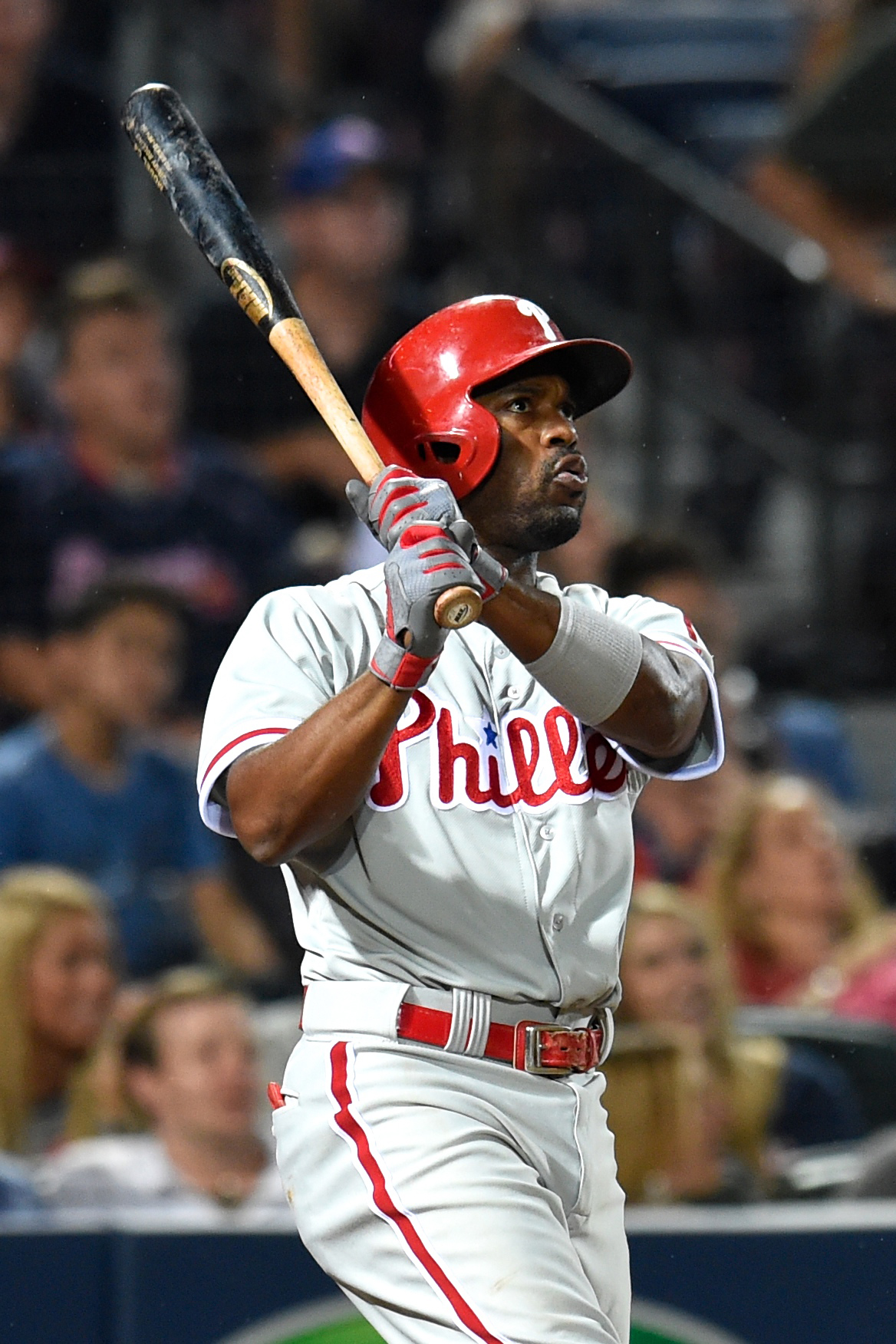 In addition to the public comments of newly-rehired club president Pat Gillick and GM Ruben Amaro Jr., dealing away franchise cornerstone Jimmy Rollins was the surest sign yet that the organization is committed to turning over its roster. Though it had been unclear whether the still-productive veteran would waive his no-trade clause to facilitate a deal, he ultimately chose to accept a move to the powerful Dodgers.
Of course, it was the long-anticipated parting with useful lefty Antonio Bastardo that kicked things off. And by the time he and Rollins were gone, a deal involving the aging Marlon Byrd seemed all but inevitable, and it was not long before he was ticketed for Cincinnati. Of course, that same reasoning seemingly applied to several other key veterans; yet, as discussed further below, that trio is as yet unaccompanied in departing.
Regarding the return on those assets, only time will tell whether Amaro chose wisely. Certainly, none of the players acquired appear to have terribly impactful futures in store. The cumulative haul, however, added a good bit of depth to the organization’s pitching ranks, together constituting the type of move that could pay dividends down the line by enhancing flexibility and limiting the need to pay market rates to fill out the roster.
Rollins, Byrd, and Bastardo were once key components on the active roster, of course, so replacement options had to be found. At short, Freddy Galvis figures to take the majority of the innings, but that just opened a utility role on the bench. The club brought in a variety of infielders on minor league deals to join the mix with the versatile Cesar Hernandez. Another possibility to see time in a utility capacity is Rule 5 pick Obudel Herrera, an infielder in Texas who is learning to apply his speed on the outfield grass.
As for the outfield, Grady Sizemore profiles as a more-or-less direct replacement for many of Byrd’s plate appearances from the corner. Otherwise, the team appears to be staging an open competition among numerous non-roster veterans to take on outfield bench roles. And three of the team’s offseason additions — Joely Rodriguez, Elvis Araujo, and Rule 5 pick-up Andy Oliver — were added to join Mario Hollands in filling the lefthanded relief void in Bastardo’s wake. Rodriguez and Araujo have already been optioned to Triple-A, and Hollands was just shut down with a tendon injury, leaving Oliver looking good to crack the MLB roster as the second lefty.
Likewise, departing starters Kyle Kendrick and A.J. Burnett — the latter of whom declined his $12.75MM club option to sign for nearly $5MM less with the Pirates — left rotation innings to be filled. Philadelphia opted to bring in the durable Aaron Harang and veteran swingman Jerome Williams while rolling the dice on a return to form for the injury-addled Chad Billingsley.
Taken as a whole, it is obviously hard to get excited about the new additions to the Philly roster. It was remarkable that Sizemore was able to return to a big league level of play last year after his long run of injuries, but entering his age-32 season after a more-or-less replacement level 2014, there is little reason to think he can make it all the way back to his former All-Star form. Likewise, Harang seemingly offers good value after a strong effort last year, and could conceivably bring a return at the trade deadline, but he does not offer much in the way of upside.
More might be hoped for from the talented Billingsley, who is still just 30 years old, but he has racked up all of 12 innings since the 2012 season and still needs to answer a lot of questions before he can even get back to the bump in a major league game. It’s a modest risk at $1.5MM, though Billingsley can bump his earnings up an additional $5MM through incentives. Philadelphia would gladly pay that if it can get innings from the veteran righty, who at least offers some possibility of bringing back real value if he can establish himself heading into the summer.
Questions Remaining
Once again, it is worth separating the club’s forward-looking situation from its immediate needs in 2015. With the focus on 2016 — or, perhaps, beyond — we’ll start with the former.
By kicking in a significant amount of cash to accompany Byrd (and, to a lesser extent, Rollins), the large-budget Phils evidenced a willingness to buy down contracts to improve the marketability of their costly veteran player assets. But the divestiture process slowed after early progress, and at present seems all but stalled.
Looking at the books as things stand, a half-dozen players stand out for their experience and cost on an admittedly rebuilding team: Cole Hamels ($96MM over four years + vesting option), Ryan Howard ($60MM over two years + club option), Cliff Lee ($37.5MM over one year + vesting option), Jonathan Papelbon ($13MM over one year + vesting option), Carlos Ruiz ($17.5MM over two years + club option), and Chase Utley ($15MM + three successive vesting options). The star power of that group is undeniable. In both 2008 and 2009, those six players combined to produce better than 25 fWAR (not all with Philadelphia, of course). But those days are long past: in each of the past two seasons, this group has been valued at about 15 fWAR. That’s still plenty useful, of course; then again, Philadelphia owes $105MM to the above-named players for 2015 alone.
Clearly, it was never realistic to expect this organization — fresh off a big new TV deal that should maintain the club’s spending advantages — to part with all of its veterans in one fell swoop. And practicalities such as the size of the deals and a variety of restrictive no-trade clauses also present barriers. Nevertheless, it is fair to question, as many have, whether more could have been accomplished over the offseason. Likewise, one of the two biggest questions currently facing the franchise is whether, when, and how it will cash in those player contracts. (The other? Its ability to acquire and develop a new wave of young talent.)
Hamels, of course, has drawn the most attention; winter rumors involving the Red Sox alone could fill a book. Amaro has repeatedly maintained that he has no intention of simply taking what he can get for the 31-year-old lefty, with reports suggesting that the club is looking for impact prospects and is disinclined to cover much (if any) of the remaining dollars left on the deal.
It is hard to judge this situation without knowing what has been offered, but it seems to me at least that there has been a rush to come down hard on Amaro. Hamels is clearly a valuable asset, in spite of his substantial contract, and the team would be doing little more than bowing to public pressure were it to part with him for young players that it did not believe in. Of course, he is not terribly young, and the risk of injury and/or performance decline cannot be ignored. But Philly can certainly afford Hamels, and it is at least plausible to think that holding him for the trade deadline (or, later this spring) is preferable to taking whatever might currently be on the table.
That has not stopped many from pointing to the recent experience with Lee as a sign that the Phillies are foolish for not auctioning Hamels immediately. The veteran ace seems all but certain to take home his last $37.5MM from the club without bringing any trade value in return — if he comes back to pitch again at all. But every arm is different, and it seems the real lesson from Lee is less about dodging the risk of injury than it is about realizing when the a team’s competition window is closed.
Regardless, losing the possibility of achieving any value from Lee is a big loss for the Phils. Howard and Papelbon could still bring back some cost savings and/or useful pieces. The former could still be a desirable player to roster, especially for an AL team, but is owed so much that the club will need to eat a huge amount of money to deal him even if he does perform. Papelbon, at least, comes with some flexibility at this point, particularly since he has remained quite productive despite a drop-off in his fastball velocity. A big first half could make the 34-year-old an attractive target at the deadline, when relief pitching has by far its greatest value and by which time an acquiring team may be more comfortable with his vesting option. (If he has performed well enough to that point, the idea of a $13MM salary may not be so terrible; if not, the Phillies can drop him from the closer’s role in favor of young fireballer Ken Giles to avoid being on the hook.)
It is at least somewhat interesting that we have heard very little on the possibilities of trades involving the team’s two other highly-paid veterans, Ruiz and Utley. That could be because the front office decided not to trade the pair of holdovers from the organization’s glory days — or, at least, not to market them. On the other hand, both were above-average regulars last year, and could well hold fairly significant appeal to contending clubs this summer.
The relatively younger, relatively less expensive portions of the roster are not without issues, either. Domonic Brown is entering a make-or-break season after following his strong 2013 with a terrible effort last year, though he could start out on the DL with tendinitis in his left Achilles tendon. And fellow outfielder Ben Revere needs to prove that he can hit for a high enough average and play good enough defense to make up for his lackluster on-base and power numbers. Depending upon how things play out, either could conceivably be viewed as a piece of the future, dealt, or non-tendered after the season.
Corner infield also figures to be an area to watch in 2015. Entering his age-25 season, Cody Asche still has a lot to prove at the hot corner but did at least demonstrate that he is not overmatched by MLB pitching. Coming up behind him, of course, is the highly-touted Maikel Franco. Still just 22, Franco seems ticketed for Triple-A to start the year but could push his way onto the roster at some point. He was not dominant in his first run at the highest level of the minors last year, struggled in a brief call-up, and could ultimately be shifted across the diamond to first. Of course, a combination of Howard and Darin Ruf currently occupies that role, so the team’s actions with regard to Howard and the progress of Asche, Ruf, and Franco this year could go a long way toward pointing the future at those positions.
Up the middle, the team is probably in something of a holding pattern. Until we hear otherwise, Utley and Ruiz remained entrenched at second and catcher, respectively. And Galvis will likely keep the seat warm for top prospect J.P. Crawford, who is still just 20 years of age and has not seen action above the High-A level.
On the other side of the equation, the rotation is a huge question mark heading into the season. The focus will remain on Hamels, no doubt, unless and until he is dealt. Behind him, Harang and Williams are at least known quantities, and can be counted on to sop up innings. Billingsley represents a wild card, with Lee a mere lottery ticket at this stage. 25-year-old David Buchanan seems fairly assured of a slot after a sturdy debut campaign last year, though he appears to be a back-of-the-rotation type. The aforementioned Rodriguez, a 23-year-old picked up in exchange for Bastardo, was said to be in the running to take the fifth slot out of camp but was recently sent down. Otherwise, some combination of Kevin Slowey, Miguel Gonzalez, Paul Clemens, and Sean O’Sullivan could be deployed. Top 2014 draft pick Aaron Nola looks like a quick mover, but was not invited to big league camp and probably will not figure into the club’s plans this year unless he advances even faster than expected. All told, there is immense uncertainty in this unit, which has the potential to be downright awful — particularly if Hamels is taken out of the equation.
If there is a clear bright spot at present, it may lie in a bullpen that now features not only the veteran Papelbon, but a rising closer-of-the-future in Ken Giles. It remains to be seen whether the Phils will look to move Giles into the 9th inning this year, but he was rather dominant as a rookie last season and certainly profiles into that role. Jake Diekman, a lefty, also possesses intimidating stuff and could combine with Giles to form a devastating combination for years to come. Justin De Fratus put up impressive numbers last year as well, and will look to establish himself as part of that group. There are several other options, many of them mentioned above, with the two most interesting being Gonzalez and fellow righty Phillippe Aumont. The former has shown little sign of delivering on the three-year, $12MM deal he signed out of Cuba last year, while the latter is the last man standing from the 2009 deal that sent Lee to the Mariners. Now out of options, Aumont will need to produce or will likely end up on the waiver wire.
Deal Of Note
Jimmy Rollins unquestionably belongs on the Phillies’ list of all-time greats after racking up over forty five wins above replacement and an MVP award in 14 seasons with the club. Over his tenure, he compiled a .267/.327/.424 slash with 216 home runs and 453 stolen bases, adding value with his glove all the while.
Indeed, there’s an argument to be made that Rollins will ultimately deserve a place in Cooperstown. He ranks among good company statistically: 20th lifetime in fWAR for a shortstop, nestled amongst several Hall of Famers. A few more quality seasons could put Rollins over the top. Barring a future reunion, however, he’ll make that run wearing another team’s uniform.
Trading a player of that magnitude is never easy, particularly when you have to eat some salary and do not receive a projected impact player in return. While it obviously made sense in theory for the Phillies to cash in a veteran asset, there is some potential for regret here. For one thing, the club still has some ways to go before handing the position over to the heir apparent (Crawford), who must still prove himself in the upper minors and the bigs. For another, any mid-season shortstop needs that arise around the league could look like missed opportunities to have extracted more value.
Ultimately, while Amaro has been panned for his supposed unwillingness to take a fair price for Hamels, his commitment to breaking up the team cannot really be questioned after the Rollins deal.
Overview
The Phillies got started on a future plan this winter, even if it came one year too late. It’s still fairly early in the process, and the near-term looks rather bleak, but it should be recalled that Philadelphia’s rebuilding project will benefit from the team’s substantial spending capacity. That will not only open opportunities to acquire high-level young talent, but should enable the team to ramp up quickly when it sees the light at the end of the tunnel.
Amaro’s decision to exercise patience in moving veteran assets has drawn a good bit of ire, as has become common for most any moves he makes. But the fact is that Philadelphia is not only well-suited to carry large financial obligations while it searches for fair value, but also is likely unwilling to completely gut its big league roster — and risk even greater attendance decline — just to be rid of its most recognizable players. While a spring deal or two remains possible, it could be that the team will wait until the trade deadline, if not beyond, to send out a few more big contracts.
Of course, trades are not the only way to add young talent, and neither is the annual amateur draft. It is at least somewhat notable, then, that the Phillies did not end up landing any of the top international players this offseason, despite the fact that the international market arguably represents the best chance for large-market clubs to gain an edge in the acquisition of young talent. The club was said to be the top pursuer of Yasmany Tomas, but ultimately backed off — perhaps because Gillick was not on board with that signing. Likewise, Philadelphia had at least some interest in Yoan Moncada, but never seemingly entered the bidding picture. Neither was the team one of those that busted its international bonus pool allocations by signing July 2 prospects or other recent Cuban defectors. Amaro has said that he intends to be “very aggressive” in the international arena, and it could still be that the club is set to do just that — while several other big-spending clubs serve out two-year periods of strictly limited international spending.
All in all, it is far too early to judge the organization’s still-fledgling efforts to chart a new course. There is little doubt, particularly in retrospect, that it waited too long to shift its gaze to the horizon — and paid for that by losing the chance of cashing in on Lee. But money talks in baseball, as elsewhere, and Philadelphia still has plenty in its war chest: having opened last year with nearly $180MM in payroll, the club has just $76MM committed for 2016, $34MM on the books for 2017, and only $23.5MM promised beyond that.
Photo courtesy of USA Today Sports Images.