
Pirates, Ben Heller Agree To Minor League Deal
The Pirates have agreed to a deal with free agent reliever Ben Heller, as first reported by Jomboy’s Jack Oliver. Jason Mackey of the Pittsburgh Post-Gazette adds that it’s a minor league deal for the right-hander. Heller is a client of Onyx Sports Management.
Heller, 32, pitched 18 2/3 innings for the Braves in 2023, logging a 3.86 ERA with a 19.5% strikeout rate, 13.1% walk rate and 49.1% ground-ball rate. He also notched a tidy 3.27 ERA with a 28.9% strikeout rate and 7.6% walk rate in 44 2/3 Triple-A frames between the Braves and Rays organizations.
Once a fairly well-regarded bullpen prospect who went from Cleveland to the Bronx (alongside Clint Frazier, Justus Sheffield and J.P. Feyereisen) in the 2016 Andrew Miller trade, Heller has seen his career decimated by injuries. From 2018-22, Heller dealt with bone spurs in his pitching elbow (2018), underwent Tommy John surgery (2019) and was plagued by a nerve injury in his right biceps (2020-21). He was limited to just 35 2/3 innings between the big leagues and minors combined during that brutal stretch of health woes.
When he’s been healthy enough to pitch in the majors, Heller has been quite effective. He touts a career 3.06 ERA in 50 frames, albeit with suboptimal strikeout and walk rates of 20.9% and 11.8%, respectively. While he was working to rehab all those injuries, Heller restored some zip on his fastball; he flashed a 96.2 mph average as a rookie in 2016 before dipping to 94 mph in 2017-20. He was back up to 95.9 mph on his seldom-used four-seamer with Atlanta this past year, however, and averaged 94.9 mph on his newly implemented sinker.
He’ll need to make the big league roster as a non-roster invitee, but if Heller works his way back to the big leagues in Pittsburgh, he can be controlled for at least three more seasons via the arbitration process.
Rockies Focused On Pitching Help, Bench Upgrades
The Rockies’ 59-103 record in 2023 was third-worst in baseball, leaving general manager Bill Schmidt no shortage of paths to explore when searching for upgrades. However, although the Rockies were somewhat surprisingly one of MLB’s lightest-hitting clubs in ’23 — 17th in batting average, 25th in on-base percentage, 20th in slugging percentage and 30th in wRC+ — Schmidt said at this week’s Winter Meetings that pursuing a power bat isn’t high on his list of priorities (via Patrick Saunders of the Denver Post). Upgrading the pitching staff and deepening manager Bud Black’s bench will be the greater focus, per Schmidt. Specifically, he’d like to add a veteran backup catcher behind Elias Diaz (via DNVR’s Patrick Lyons).
Both areas could clearly use augmentation. The pitching staff, in particular, was dreadful — due in no small part to injuries. An already shaky Rockies staff lost both German Marquez and Antonio Senzatela to Tommy John surgery last year. Each of Kyle Freeland, Austin Gomber, Ryan Feltner, Connor Seabold, Chase Anderson, Ty Blach, Peter Lambert and Chris Flexen started at least 10 games for the Rox. None did so with an ERA lower than Freeland’s 5.03. Colorado starters posted an MLB-worst 5.91 ERA, and things weren’t any better in the bullpen, where the Rockies sported an MLB-worst 5.41 ERA and a 29th-ranked 20.4% strikeout rate.
Schmidt has already added one arm to the rotation mix, buying low on Guardians righty Cal Quantrill following a down season. Coors Field isn’t exactly an ideal spot for a pitcher to try to rebuild his value, but Quantrill did post a 3.08 ERA in 368 innings from 2020-22. Shoulder inflammation limited him to 19 starts in 2023 (and perhaps contributed to an ugly 5.24 ERA), but Quantrill took the ball 32 times as recently as 2022. He was a perfectly sensible addition for a Rockies team that’s desperate for arms but lacking in high-end prospects needed to acquire difference-making pitchers. Most available high-end trade targets are controllable for two or even just one year anyhow, and a Rockies team that’s at best an extreme long-shot to contend probably doesn’t want to sacrifice too much long-term value for short-term upgrades.
Because of their long odds at playoff contention, it seems the Rockies are intent on taking a look at a series of young players rather than displacing them with more expensive free agents. Shortstop Ezequiel Tovar will get another opportunity to provide some value with his bat after a brilliant defensive showing in his rookie season but a lackluster offensive performance (.253/.287/.408). The 2024 season will be something of a mulligan for second baseman Brendan Rodgers, who missed much of the 2023 season on the injured list. Nolan Jones will look to build on an impressive rookie showing, likely in right field.
Schmidt indicated that first base will likely belong to Kris Bryant, though occasional right field work is also on the table (link via Lyons). Ryan McMahon, signed through 2027, is locked in at the hot corner. The Rox re-signed veteran Charlie Blackmon to serve as their primary DH before the season even opened, guaranteeing him a surprisingly strong $13MM salary in the process.
Saunders writes that the Rockies also have higher hopes for outfielders Sean Bouchard and Brenton Doyle. The former suffered a ruptured biceps tendon prior to the season and missed most of the year, but he’s produced a massive .304/.429/.563 slash in 140 plate appearances between 2022-23. Doyle was perhaps baseball’s least-productive hitter in 2023, batting .203/.250/.343 with a 35% strikeout rate in 431 plate appearances. He also posted flat-out elite defensive grades, however, drawing enormous positives from Defensive Runs Saved (19), Ultimate Zone Rating (24.5) and Outs Above Average (16) in well south of a full season’s worth of innings. With that type of defensive wizardry, he only needs to clear a low bar at the plate to be a valuable everyday player, but last year’s output wasn’t enough.
Improving the bench shouldn’t be a difficult proposition. Brian Serven is the current favorite for backup catching work but carries just a .195/.248/.314 line in 228 MLB plate appearances. Bouchard and/or 24-year-old Hunter Goodman could get regular work in right field or carve out a bench role, but both have minor league options remaining. Utility infielder Alan Trejo has hit .243/.292/.367 in 402 MLB plate appearances over the past three seasons. He’s versatile but also out of options, and a more productive utility infielder should be available.
The main question for the Rockies’ bench could pertain to former top prospect Elehuris Montero, who’s yet to cement himself at either infield corner. The presence of McMahon, Bryant and Blackmon leaves the 26-year-old Montero, who’s hit just .239/.283/.428 in 492 MLB plate appearances, without a path to regular playing time. But Montero is also out of minor league options, so he’ll have to crack the big league roster or else be either traded or exposed to waivers. Montero was a notable piece of the Rockies’ Nolan Arenado return from the Cardinals, but he’s something of an odd man out with regard to the current allotment of playing time. Then again, Bryant has spent ample time on the injured list in recent seasons, and Montero could be the first man up should he again need time on the shelf.
The Rockies currently project for a payroll of about $142MM, per Roster Resource, which is around $30MM shy of last year’s franchise-record Opening Day payroll (a bit more than $172MM). There’s room for the club to spend, but convincing free agent pitchers to sign on the dotted line and call Coors Field home is no small feat. And the Rockies’ farm system generally isn’t well regarded, which makes adding arms on the trade market difficult, too (hence the buy-low pickup of Quantrill).
Reds, Mark Mathias Agree To Minor League Deal
The Reds have agreed to a minor league deal with infielder/outfielder Mark Mathias, per the team’s transaction log at MLB.com. He’ll presumably head to big league camp this spring. Mathias is repped by Apex Baseball.
The 29-year-old Mathias split the 2023 season between the Mariners, Pirates and Giants organizations, reaching the big leagues with the latter two of that trio. In a small sample of 72 trips to the plate, Mathias batted .226/.333/.258. He’s a career .246/.317/.391 hitter with six home runs and seven stolen bases in a total of 199 big league plate appearances. Mathias has walked at a healthy 9.5% clip in that time against a higher-than-average 26.1% strikeout rate.
Mathias hasn’t had much big league experience, but he’s a lifetime .288/.383/.454 hitter in parts of three Triple-A seasons totaling 919 plate appearances. He’s logged more than 3000 career innings at second base and more than 1000 frames at third base, with additional cameos at shortstop, first base and the outfield corners.
Cincinnati is already loaded with infield options, with Elly De La Cruz, Matt McLain, Noelvi Marte, Jonathan India and Christian Encarnacion-Strand all in the mix. Jack of all trades Spencer Steer can play virtually any infield or corner outfield spot as well, though he may be ticketed for left field to begin the upcoming season. TJ Friedl and Will Benson are slated to handle center field and right field, respectively, and the Reds also have former top prospect Jose Barrero and outfielder/DH Jake Fraley in the mix for playing time.
Mathias doesn’t have a clear path to a prominent role with the team, but he provides some defensive versatility with a decent track record at the plate both in Triple-A and in the big leagues.
Mozeliak: Cardinals Listening To Offers On Tyler O’Neill
3:40pm: In addition to O’Neill, both Carlson and Alec Burleson have drawn trade interest to some extent this offseason, writes Derrick Goold of the St. Louis Post-Dispatch. Both stand as plausible trade candidates themselves, though Mozeliak hasn’t taken the step of publicly declaring that with either player as he did with O’Neill.
In an appearance on MLB Network’s Hot Stove this morning (video link), Mozeliak again touched on his trade talks regarding the outfield, admitting that it would be “a surprise” if some trade involving one of his outfielders doesn’t come together. Specifically, Mozeliak said he hopes to upgrade his bullpen next, whether via the trade of an outfielder or other means.
10:29am: Tyler O’Neill‘s status as a potential trade candidate isn’t exactly a well-kept secret. Heading into the winter, it’s been widely expected that the Cardinals would listen to trade offers on both O’Neill and fellow outfielder Dylan Carlson. Cardinals president of baseball operations John Mozeliak removed any doubt about the likelihood of an O’Neill trade in an appearance on MLB Network Radio on SiriusXM from this week’s Winter Meetings (video link).
“In the outfield, right now, if we were to play tomorrow it’d likely be [Lars Nootbaar], Tommy Edman and [Jordan Walker],” said Mozeliak. “Our fourth outfielder would be Dylan Carlson. … Tyler O’Neill is somebody that we are listening to on trades.”
Mozeliak added that he’s received “a lot of hits” on his outfielders in general, but O’Neill was the only one he specifically highlighted as a potential trade piece. The Cards have been against moving Nootbaar for some time now, and it stands to reason that there’s similar reluctance to consider moving Walker, who entered the 2023 season as one of the game’s top-ranked prospects and posted a .291/.358/.478 slash following the trade deadline.
O’Neill, 28, has ostensibly become an odd man out of the group. While the Cardinals could play Edman in the infield and thus open more playing time for O’Neill, the arrival of prospects like shortstop Masyn Winn, second baseman Nolan Gorman and utilityman Brendan Donovan have crowded the infield outlook as well. Winn, 21, didn’t hit well in last season’s MLB debut (.172/.230/.238), but that came in a sample of just 137 plate appearances — and Mozeliak specifically mentioned him in his MLB Network Radio appearance when describing his infield mix as “pretty solid” with Winn at short, Gorman/Donovan at second base and veterans Paul Goldschmidt and Nolan Arenado at the corners.
All signs seem to point to a potential trade of O’Neill, who as recently as 2021 slashed .286/.352/.560 with 34 homers and Gold Glove defense in left field but has since mustered just a .229/.310/.397 slash in 169 games. Injuries have played a significant factor in those struggles; O’Neill had an IL stint due to a shoulder impingement and a pair of IL stints for hamstring strains during the 2022 season. His 2023 campaign included a trip to the 60-day injured list for a lower back strain and a later return to the IL for a foot sprain.
There’s little doubt that a healthy O’Neill has game-changing power, but O’Neill simply hasn’t been healthy enough in his big league career. He played in 50 games during the shortened 2020 season and 138 games in 2021 but has otherwise rarely been on the field for the majority of a given season. That 2021 campaign is the only time he’s ever reached 100 games played or reached 400 big league plate appearances.
O’Neill is slated to become a free agent at season’s end and is projected by MLBTR contributor Matt Swartz to earn $5.5MM this coming season. The power is clearly legitimate, but he’s been a bit below average at the plate overall throughout these two most recent, injury-riddled seasons. He still grades as a plus defender in left field and is an above-average runner. As far as change-of-scenery candidates go, O’Neill is a fairly appealing one, but the litany of injuries, minimal club control and limited recent track record at the plate will all coalesce to tamp down his value in a trade.
Roberts: Betts Expected To Be Dodgers’ Primary Second Baseman
Mookie Betts‘ unique blend of defensive versatility and elite offensive production led to a runner-up finish in 2023 NL MVP voting, as the six-time Gold Glove-winning right fielder saw considerable time at both second base and shortstop, in addition to his customary right field. Betts might have more of a set position in 2024, but it won’t be right field, according to manager Dave Roberts.
“I think it’s pretty safe to say that No. 50, Mookie Betts, is going to be our everyday second baseman,” Roberts told MLB Network’s Alanna Rizzo in an appearance on High Heat today (video link). “It’s one of those things where he’s a Gold Glover out in right field, but I think when you’re talking about putting together a roster and someone who can be so offensive at second base — you can get more games out of him if he’s playing second base. And obviously with the signing of Jason Heyward, to put him out in right field, to go out there and play versus right-handed pitching and to play a Gold Glove right field, it just makes our club better.”
While Roberts didn’t expressly rule out the possibility of Betts playing any outfield — he notably specified that Heyward would again play primarily against right-handed pitching — it seems the immediate plan is for Betts to line up at second base and form a double play tandem with Gavin Lux (or a potential outside acquisition). Defensive Runs Saved (6) and Ultimate Zone Rating (1) both pegged Betts as an above-average defender at second base, while Statcast’s Outs Above Average put him only slightly below, at -1. Betts played plenty of middle infield during his early minor league tenure in the Red Sox’ system and largely moved to the outfield due to the presence of Dustin Pedroia on the big league roster.
A full-time return to the infield for Betts gives the Dodgers a primary outfield of Chris Taylor, James Outman and Heyward (left to right), with Betts, Jonny Deluca and top prospect Andy Pages all potentially joining the mix. Additional outfield depth could yet be brought in, of course. In the infield, they’ll likely lean on Max Muncy at third base, Lux at short, Betts at second and fellow MVP candidate Freddie Freeman at first base.
Injuries could ultimately push Betts back to the outfield with more regularity, but in a followup appearance on MLB Network Radio on SiriusXM (video link), Roberts spoke about Betts personally being on board with the move to second base, as it’ll allow him to remain in the lineup more as he ages: “I think when he runs out to right field every day, and as he starts to get a little bit older, he’s starting to look and see that we’ve got to play him less when he plays right field. And so when he played second base a lot last year, he was able to be in the lineup [more].”
Roberts added that it’s easier for the team’s front office to “find someone” who can pair with Heyward as a right-handed option in right field than to find a second baseman, making the move better from a roster construction standpoint. Based on the full context of Roberts’ comments, it doesn’t seem as though the move to second base is presently viewed as a one-off for the 2024 season, although Betts’ superb athleticism and subsequent versatility will allow the club to keep a return to right field on the table as a possibility down the road, should it make sense from a roster construction standpoint in future offseasons.
Brewers Re-Sign Wade Miley
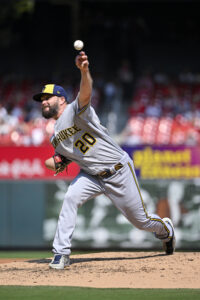
There’s plenty of chatter about the Brewers potentially trading their ace, but Milwaukee is also maintaining some continuity on the starting staff, announcing on Monday that they’ve re-signed veteran southpaw Wade Miley to a one-year deal with a 2025 mutual option. Miley, a client of O’Connell Sports Management, will reportedly be guaranteed $8.5MM in the form of a $7MM salary and a $1.5MM buyout on a $12MM mutual option.
The contract also gives Miley the opportunity to earn another $2.5MM via innings-based incentives. He’d receive $250K bonuses for reaching both 50 and 75 innings, plus another $500K upon reaching 100 innings and $750K for reaching both 125 and 150 innings pitched. Miley also secured a limited no-trade clause and would be paid a $1MM assignment bonus in the event that he’s traded.
Miley, who pitched for Milwaukee in 2018 and again in 2023, will now return for a third stint with the Brew Crew. While he just turned 37 years old a couple weeks ago, the left-hander’s age hasn’t been showing in his recent results. After pitching to a sharp 3.16 ERA in 37 innings during an injury-shortened year with the ’22 Cubs, Miley started 23 games and gave the ’23 Brewers 120 1/3 innings of nearly identical 3.14 ERA ball.
Although Miley’s strikeout rate continues to sit close to the bottom of the league (16.1% in 2023), he’s offset that lack of punchouts with better-than-average command (7.8% walk rate) and a knack for avoiding hard contact. Miley’s 87.3 mph average exit velocity ranked in the 83rd percentile of big league pitchers, and his 31.1% hard-hit rate checked into the 93rd percentile.
Back in 2016-17, Miley’s career had hit something of a crossroads. He’d posted an ERA well north of 5.00 in two consecutive seasons and had to settle for a minor league deal with the Brewers ahead of the 2018 season. He revived his career in Milwaukee, pitching to a 2.57 ERA in 80 1/3 frames, and with the exception of a brief injury-ruined 2020 showing with Cincinnati (5.65 ERA in 14 1/3 innings), the left-hander has been an effective big league starter ever since. Dating back to the 2018 resurgence, Miley sports a 3.43 ERA in 582 2/3 innings.
Miley’s return to the Brewers comes amid ample uncertainty regarding the team’s rotation. The Brewers made the difficult decision to non-tender Brandon Woodruff after it was learned he’d miss the majority of the 2024 season following capsule surgery in his right shoulder. Co-ace Corbin Burnes‘ name has flown about the rumor mill frequently in the first month-plus of the offseason, given his status as a free agent next winter. Burnes is expected to test free agency rather than sign an extension, leaving Brewers GM Matt Arnold with another painful decision: hang onto Burnes and hope for one final playoff push with the former NL Cy Young winner, or trade him now and receive substantially more value than Burnes would fetch upon declining a qualifying offer next winter.
At least for now, Burnes slots into the top of the rotation ahead of right-hander Freddy Peralta. Miley gives the Crew a quality third option behind that pair, and Milwaukee still has righties Adrian Houser and Colin Rea for fourth and fifth options, to say nothing of left-hander Aaron Ashby. Milwaukee also has a reported one-year agreement with former Nationals righty Joe Ross, who hasn’t pitched in the Majors since 2021 due to injuries but has at times looked like a viable mid-rotation arm. Ross had a second career Tommy John surgery in 2022, so given the recent layoff from pitching, it’s possible he’s viewed more as a swingman option anyhow.
With Miley back in the fold, the Brewers’ projected payroll will land somewhere between $106-116MM (depending on how this morning’s extension for top prospect Jackson Chourio breaks down). That’s a bit shy of last year’s $118MM Opening Day mark. Potential trades of Burnes and/or shortstop Willy Adames could dramatically alter that outlook, as could further free agent additions.
In many ways, the 2024 season will be something of a transitional year for the Brewers with or without its longtime ace atop the rotation. The Brewers already lost manager Craig Counsell to the rival Cubs, and they’re likely turning center field over to Chourio, who just made history by signing the largest contract ever inked by a player with no Major League service time. Miley affords some continuity on the pitching staff, but the Brewers’ core is in the process of turning over.
Ken Rosenthal of The Athletic reported yesterday that Miley and the Brewers were expected to finalize a new deal and first broke the news of the agreement on a one-year deal and mutual option. ESPN’s Jesse Rogers first reported the financial terms and incentive package. Jon Heyman of the New York Post reported the no-trade protection. USA Today’s Bob Nightengale added the assignment bonus upon being traded.
Phillies Extend Manager Rob Thomson
The Phillies have extended the contract of manager Rob Thomson through the 2025 season, per a team announcement. He’d previously been signed through the 2024 campaign, so this will tack another year onto his deal and prevent him from entering the coming season with lame-duck status. The Phils also announced the hiring of Dustin Lind and Rafael Pena as assistant hitting coaches. Lind was previously an assistant hitting coach with the Giants. Pena has spent six seasons with the Astros organization and most recently served as their minor league hitting coordinator.
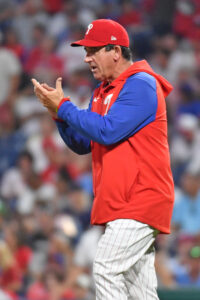
Thomson, who turned 60 in August, spent 15 seasons as a coach between the Yankees and Phillies before finally getting elevated to his first big league managerial gig in 2022, when the Phils dismissed then-skipper Joe Giradi. Thomson, his bench coach, was expected to take over the club for the remainder of the year, but the turnaround enjoyed by the Phillies under his watch has since earned him an increasingly lengthy look as the team’s skipper.
Following Thomson’s appointment as manager in ’22, the Phillies went 65-46 to close out the season, sneaking into a Wild Card berth in the National League playoff scene. They made the most of that longshot playoff bid, toppling the Cardinals in the Wild Card series, the Braves in the NL Division Series and the Padres in the NL Championship Series. The Phils eventually came up short in a 4-2 World Series loss to the Astros, but their ascent to the Fall Classic stands as one of the more remarkable midseason turnarounds in recent memory.
Unsurprisingly, on the heels of that run and with the clubhouse rallying around Thomson as a leader, the Phillies shed the “interim” label last November and inked Thomson a to a two-year contract. The Phils enjoyed further success in 2023, once again earning a Wild Card berth and once again winning multiple postseason series. After an 87-win season in 2022, the Phils won 90 games this past season before besting the Marlins in the Wild Card round and, for a second straight season, overcoming the division-winning Braves in the NLDS. The Phillies fell in the seventh game of the NLCS against the World Series runner-up Diamondbacks.
The 35-year-old Lind, in addition to four years with the Giants organization, spent two seasons with the Mariners as a quality assurance coach and director of hitting development. Pena, 33, has served as a minor league hitting coach with the Astros in addition to coaching stints in the Arizona Fall League and the Dominican Winter League. They’ll both work underneath hitting coach Kevin Long, one of the sport’s most respected voices in that position. Long is returning for his third season as Philadelphia’s hitting coach.
Pirates Showing Interest In Jack Flaherty
The Pirates are among the teams with some interest in free agent righty Jack Flaherty, reports Jeff Jones of the Belleville News-Democrat. The Bucs are interested in a short-term pact with their former division-rival, per Jones.
Interest on a short-term deal, of course, is contingent on how the remainder of the market views Flaherty. At 28 years of age, he’s the youngest starting pitcher with ample big league experience available this winter. However, Flaherty is also coming off a down season that saw him pitch to a 4.99 ERA in 144 1/3 innings between the Cardinals and the Orioles, who acquired him prior to the trade deadline.
Not long ago, Flaherty looked like a burgeoning ace. The former first-round pick and top prospect turned in a 3.34 ERA over 151 innings back in 2018, his first full big league season, and followed it up with even better numbers. At a time when most pitchers in the league were falling victim to what we now know was a juiced ball in 2019, Flaherty was delivering the best season of his still-young career: 196 1/3 innings, 2.75 ERA, 29.9% strikeout rate, 7.1% walk rate. Unfortunately for both him and the Cardinals, injuries (primarily shoulder troubles) limited him to 154 1/3 innings from 2020-22 combined. Last year marked a return to better health but also lesser results.
Flaherty figures to have multiple scenarios he could pursue. A straight one-year deal or perhaps a two- or three-year pact with an opt-out would allow him the opportunity to reenter free agency not far down the road — ideally on the heels of a better platform season. In the past, a straight one-year deal was often the norm for a player in this situation. Increasingly, however, we’ve seen free agents coax two-year deals out of teams, with the second season being a player option.
There’s also the possibility of pursuing a more conventional, longer-term deal that’d still allow Flaherty to return to market at a reasonably young age. In the past, we’ve seen some free agents around the same age (e.g. Phil Hughes, Tyler Chatwood) take three-year deals that provided some financial security while also affording an opportunity to get back to the market in time for another chance at a contract of note. A three-year deal for Flaherty would cover his age-28, age-29 and age-30 seasons. If the market bears it, that arrangement could effectively set Flaherty for life financially and still create the chance to hit the market in search of a more elusive five- or six-year commitment.
As for the specific fit with the Pirates — it’s a strong one, regardless of which type of contractual structure Flaherty prefers. While Pirates ownership might balk at a multi-year commitment of note, Pittsburgh is in dire need of rotation help. Mitch Keller is the only established starter on the roster now that righty Johan Oviedo will miss the 2024 season due to Tommy John surgery. Flaherty would slot comfortably into the starting staff and do so knowing that he’d have a long leash regardless of how he starts the season. Other options on the Pittsburgh staff currently include Bailey Falter, Roansy Contreras, Quinn Priester and Luis Ortiz. This past season’s No. 1 overall pick, right-hander Paul Skenes, will likely debut at some point in 2024 as well.
With regard to the team’s payroll, the Pirates only have three players under contract for the 2024 season (Ke’Bryan Hayes, Bryan Reynolds, Ryan Borucki) and another four arbitration-eligible players (Keller, David Bednar, Connor Joe, JT Brubaker). Roster Resource projects just a $53MM payroll for the upcoming season. Even by the Buccos’ standards, that’s at the bottom of the scale. Pittsburgh opened the 2023 season at $73MM and operated under a franchise-record $100MM back in 2016. There ought to be plenty of room to add multiple starters — even if some money is perhaps earmarked for another reunion with Pirates icon Andrew McCutchen.
Whether Flaherty is a part of the solution or not, the Pirates simply need to bring in multiple arms this winter. Flaherty’s youth and track record (particularly that 2018-19 run) give him more upside than most free agents in the second and third tiers of free agency, but that might also make him a popular target and push the bidding beyond the comfort zone of the perennially low-spending Pirates.
Braves Likely To Trade Marco Gonzales
Last night’s Braves/Mariners trade saw Jarred Kelenic, Marco Gonzales and Evan White go from Seattle to Atlanta, but it seems Gonzales’ stay with the Braves will be brief. Ken Rosenthal of The Athletic reports that the Braves aren’t planning to keep Gonzales and expect to move him in another trade. Ryan Divish of the Seattle Times adds that Gonzales himself expected as much to happen after being informed he’d been traded to Atlanta. It’s not yet clear if there’s an imminent trade involving Gonzales or if he’s being shopped around at present, but it’s a notable revelation with regard to the Braves’ rotation outlook all the same.
Gonzales, 32 in February, is due to earn $12MM this season in the final season of a four-year, $30MM extension he signed back in 2020. The contract also contains a $15MM club option for the 2025 season, which does not come with a buyout.
The soft-tossing Gonzales was a quality member of the Seattle rotation from 2018-22, pitching 765 2/3 innings of 3.94 ERA ball along the way. He became quite homer-prone in 2021, however, and saw an already below-average strikeout rate dip to concerning levels in 2022. Gonzales still posted a solid earned run average over those two seasons, but the home run and strikeout trends were noted red flags.
While the lefty managed to cut back on the homers he allowed in 2023, Gonzales was still tagged for a grim 5.22 ERA in 50 innings. His 15.8% strikeout rate was one of the lowest in the game and the second-worst of his Mariners tenure. His 8.4% walk rate was the worst of his career. Three of his ten starts last year were actually quite serviceable, but Gonzales was clobbered for eight runs on two occasions and also served up four runs through five innings in his first outing of the year. Ultimately, a left forearm strain ended his season in late May.
For the Braves, it’s sensible to see them look to move Gonzales elsewhere. He’d at best have been a fifth starter candidate in a team that boasts Spencer Strider, Max Fried, Charlie Morton and Bryce Elder in the top four spots on the staff. His $12MM salary also pushed the Braves into the second tier of luxury penalization.
The Associated Press reports that Seattle is set to send $4.5MM to Atlanta to cover part of that $12MM sum — $12.25MM, if counting the $250K assignment bonus Gonzales received as part of being traded. As such, the Braves would only owe Gonzales about $7.75MM in actual salary, but he’s still cost them a bit more than $10MM once factoring in the penalties the team would’ve incurred under the competitive balance tax.
That’s probably more than the Braves care to spend on a back-of-the-rotation candidate who’s not clearly a superior option to in-house candidates like AJ Smith-Shawver and Dylan Dodd, and it might even be more than Gonzales could expect to command on the open market after an injury-marred season. Presumably, if and when Gonzales changes hands a second time, those cost-savings will be redirected to his new team.
While Gonzales perhaps isn’t a fit for a win-now Braves club with at least four healthier and better options in the rotation ahead of him, that doesn’t mean he can’t help another club. There are several teams throughout the league — Royals, A’s, Rockies, White Sox, Padres, Nationals to name a few — who are simply looking for innings to round out the starting staff. Gonzales’ 50 frames last year don’t paint the picture of an innings eater, but he’d averaged 30 starts and 174 frames over his past four 162-game seasons prior to 2023 (plus 11 starts and 69 2/3 innings in the pandemic-shortened 2020 campaign). If Gonzales’ medicals show that the forearm strain which ended his season is in the rearview mirror, another club might feel it can comfortably rely on him for 150ish innings this coming season. And if the Mariners are footing roughly a third of the bill regardless of where Gonzales lands, he could be viewed as a relatively affordable source of those innings at a time when veteran free agents in their late 30s (i.e. Lance Lynn and Kyle Gibson) are commanding $12-13MM for similar roles.
Angels, Padres, Marlins, White Sox Have Shown Interest In Martin Maldonado
TODAY: The Angels are also interested in Maldonado, according to USA Today’s Bob Nightengale. The Halos already have Logan O’Hoppe, Max Stassi, and Matt Thaiss lined up behind the plate, though O’Hoppe and missed most of the year due to injury and Stassi didn’t play at all due to a hip strain and time off for a family situation. Conceivably, L.A. could look to trade from this catching surplus if they brought Maldonado into the fold. Maldonado previously played for the Angels in 2017-18, making him a known quantity to the organization.
DECEMBER 1: The Astros have interest in a reunion with catcher Martin Maldonado, but they’re not alone in showing interest. MLB.com’s Mark Feinsand reported last month that four or five clubs had shown interest in the 37-year-old, and Chandler Rome of The Athletic reports today that in addition to the Astros, Maldonado has received some level of interest from the Padres, Marlins and White Sox.
All three clubs are in need of some catching help, to varying extents. The Padres received a breakout performance from former top prospect Luis Campusano in 2023, as the 25-year-old turned in a stout .319/.356/.491 batting line in 174 plate appearances. That showing likely puts him atop the team’s depth chart, particularly following the Friars’ decision to non-tender veteran backstop Austin Nola, who’d been their primary catcher since his acquisition in 2020. Maldonado would represent a backup option — one whose acumen in terms of game-calling and game-planning would be particularly beneficial in a mentorship role for a young catcher like Campusano.
The ChiSox have a young catcher of their own, one who’s quite familiar with Maldonado: former Astros first-round pick Korey Lee. Chicago acquired Lee from Houston in the deadline trade sending Kendall Graveman back to Houston. Lee’s initial stint with the Sox went poorly, as he hit just .077/.143/.138 — albeit in a tiny sample of 70 plate appearances. Lee hit .278/.325/.386 in 82 contests at the Triple-A level last year, and the Sox will hope for something closer to that level of output in the Majors this season.
The Sox are also hoping for continued development from prospect Edgar Quero, acquired from the Angels in the Lucas Giolito/Reynaldo Lopez trade. Quero is just 20 years old and not yet on the 40-man roster, but he hit .255/.380/.351 in 101 games against far older competition at the Double-A level last year. He could be up in the big leagues at some point in 2024 or 2025. And even if his big league debut doesn’t come next season, he’d surely be in spring training with the Sox, where Maldonado could take both Quero and Lee under his wing.
Things are far more open in Miami, where the only catcher on the 40-man roster is defensive standout Nick Fortes. The Marlins non-tendered Jacob Stallings in November, and newly installed president of baseball operations Peter Bendix has already made clear that he could add multiple catchers this offseason. A pairing of Fortes and Maldonado wouldn’t do much for the Marlins offensively; Fortes hit just .204/.263/.299 last year, but he also has minor league options remaining. If the Fish were to add both Maldonado and another more seasoned catcher with superior offensive capabilities, they could option Fortes and relegate him to No. 3 on the organization’s catching depth chart.
Of course, it remains eminently possible — if not likely — that Maldonado stays put in Houston. The Astros organization has routinely extolled the veteran backstop’s intangible value to the team’s pitching staff, even as his framing grades and throwing numbers have deteriorated. The ‘Stros love Maldonado’s work with their pitchers, his ability to help plan for games, and his actual game-calling skills. He still rates as an above-average catcher in terms of blocking pitches in the dirt, as well. Houston has already gone out of its way to anoint young Yainer Diaz as the primary catcher in 2024, but Maldonado could occupy a similar mentor role to the highly touted Diaz that he could offer any of his other suitors and their young catchers.
In parts of six seasons with Houston, Maldonado carries just a .191/.273/.350 batting line. That lack of offensive production makes a backup role seem likely wherever he eventually lands but also speaks to the extent to which the Astros have valued him. He’s received nearly 1600 plate appearances and twice re-signed in Houston despite that dearth of offensive output, which only underscores how much Houston loves his work with their staff.