
Dodgers, Tucker Barnhart Agree To Minor League Deal
The Dodgers have agreed to a minor league contract with free agent catcher Tucker Barnhart, reports Robert Murray of FanSided. The Ballengee Group client was released by the Cubs last week.
Barnhart, 32, signed a two-year, $6.5MM deal with the Cubs over the winter. The second season of that contract is a player option, though that’s a moot point for the Dodgers, who are inking him to a new minor league deal. The Cubs will remain on the hook for the rest of Barnhart’s salary both this year and next — minus the prorated league minimum for any time he spends on a big league roster with the Dodgers or another team.
In 44 games with Chicago, Barnhart tallied 123 plate appearances but mustered only a .202/.285/.257 batting line with a 9.8% walk rate and 32.1% strikeout rate. It was Barnhart’s second straight year with all of his rate stats clocking in below .300, as he batted .221/.287/.267 in 308 trips to the plate with the Tigers last season.
Perhaps the Cubs felt Barnhart had a good chance to rebound to his 2015-21 levels of production (.249/.326/.375), but that clearly didn’t happen during his limited time at Wrigley Field. They were likely drawn to his longstanding status as a highly regarded defender as well, but Barnhart has taken some steps back in that regard this year. While he continues to grade as a quality framer, this season’s 19% caught-stealing rate is a career-low. Statcast also pegged Barnhart as the best in the sport at blocking pitches in the dirt from 2018-22, but he’s graded out below the league average in that capacity in 2023. The Cubs turned to 24-year-old Miguel Amaya to team with Yan Gomes behind the plate, and their longtime catching prospect has delivered a .235/.363/.392 slash in 125 plate appearances since essentially replacing Barnhart.
The Dodgers have one of baseball’s best all-around catchers, Will Smith, and have deployed veteran Austin Barnes in a backup capacity since 2015. Barnes, however, is sitting on a career-worst .165/.235/.209 output at the plate this year. He’s been one of the least-effective hitters in the game over his 154 plate appearances, and opponents have gone 56-for-62 against him in stolen base attempts.
The signing of Barnhart doesn’t necessarily jeopardize Barnes’ spot on the roster, but it does give Los Angeles a veteran option if the team wishes to carry three catchers or eventually make a switch. Barnhart’s numbers this year aren’t much to look at, but they’re a bit better than those of Barnes. And prior to this addition, the Dodgers weren’t exactly deep in seasoned options should an injury occur. Journeymen Patrick Mazeika and David Freitas are both on the roster in Triple-A, but neither has much big league time. Top prospect Diego Cartaya is highly touted, but he’s struggled in his first season at the Double-A level and wasn’t likely to be an option, should a need arise. For now, Barnhart will presumably head to Triple-A Oklahoma City, but it’s possible he’ll surface back in the big leagues at some point next month — particularly with rosters set to expand to 28 players on Friday.
Paul Blackburn, Now Featuring Strikeouts
The majority of the Athletics’ fire sale has been concluded, with trades of everyone from stars like Matt Olson to little-known relievers such as Sam Moll (flipped to the Reds at this year’s deadline). The most interesting player remaining on the roster might’ve already been moved were it not for some health troubles.
Right-hander Paul Blackburn enjoyed something of a breakout with Oakland last year, pitching to a 2.90 ERA and 3.48 FIP through his first 16 starts and 87 innings. It was a largely out-of-the-blue emergence for a pitcher who’d just a year prior been placed on outright waivers and passed over by every team in Major League Baseball. Blackburn’s 18.8% strikeout rate wasn’t going to wow anyone, but he coupled it with strong command (6.2% walk rate) and a heart 48.7% grounder rate.

Clubs might’ve generally looked at him and seen a fourth starter’s ceiling, but Blackburn was earning scarcely more than the league minimum and came with three more years of club control beyond the 2022 season. Given the perennial demand for controllable starting pitching, there’d surely have been interest.
The injury bug had other plans, however. Blackburn was trounced for six runs by the Astros on July 8, and over his next four appearances he served up another 19 runs. The stretch of 24 1/3 innings with 25 runs allowed sent his ERA careening to 4.28, and shortly after the trade deadline, Blackburn was placed on the injured list. It was eventually revealed that he’d been attempting to pitch through a torn tendon in the middle finger of his pitching hand. He didn’t require surgery, but he didn’t make it back to the mound in 2022.
The A’s likely received at least some trade interest in Blackburn over the winter, but any offers for him were surely diluted by the injury-shortened season and uncertainty about the small sample size of his breakout. They opted to hold onto the right-hander heading into the 2023 season, only for further health troubles to arise. Blackburn tore the fingernail on his right middle finger late in spring training and then had multiple setbacks while waiting for that to heal, including blisters on his pitching hand.
Though the injuries were minor in nature, they kept Blackburn from taking the mound for more than a month to begin the season. Upon returning, the results weren’t sharp — 5.48 ERA through his first eight trips to the mound — but there was a noticeable change in his arsenal that led to promise of not just a turnaround but an improvement over his 2022 performance.
After throwing sliders just 4.5% of the time in 2022, Blackburn is now throwing the pitch at about four times that level. He entered the 2023 season with a career 15.5% strikeout rate but has punched out 23.1% of his opponents this season. His career 8% swinging-strike rate has jumped two percentage points, and his 29.3% opponents’ chase rate has spiked to 34.3% as well. Though Blackburn still has below-average life on his heater, this year’s 91.9 mph average is a career-high mark.
While Blackburn’s first eight starts produced that ugly 5.48 ERA, he was also plagued by a sky-high .374 batting average on balls in play and an abnormally low 67.3% strand rate during that time. Things have trended in the other direction recently. Over his past seven starts, Blackburn touts a 2.79 ERA. He’s still been unlucky on balls in play (.345 BABIP), but his strand rate has climbed back upward and now sits right in line with his 2021-22 levels. Overall, Blackburn has a 4.15 ERA but a 3.44 FIP. He’s getting fewer grounders (40.9%) because he’s throwing fewer sinkers, but that rate paired with Blackburn’s 23.1% strikeout rate and 7.8% walk rate have the look of a legitimate mid-rotation starter. His strikeout, walk and ground-ball rates are all roughly in line with names like Jose Berrios, Jordan Montgomery and Tanner Bibee.
As with any Oakland pitcher, it’s perhaps tempting to assume that a spacious home park is a primary factor to Blackburn’s success. He does, after all, have a 3.77 ERA in Oakland this year compared to a 4.54 mark on the road. But that’s largely a function of a .406 BABIP away from his home environs; Blackburn isn’t giving up gobs of home runs once he leaves his cavernous home setting and pitches in more neutral or hitter-friendly stadiums. He’s actually been more homer-prone at home — both this year and especially last year — than on the road.
Blackburn isn’t the same pitcher he was in 2022, but both versions were serviceable. On the whole, he has a 4.22 ERA in his past 196 innings at the big league level, with better fielding-independent marks — particularly in 2023, as he’s adopted a more slider-heavy approach that’s helped him induce more chases, miss more bats and limit hard contact at an elite level. Blackburn’s 86.8 mph average opponents’ exit velocity is in the 88th percentile of MLB pitchers. His paltry 4.7% barrel rate and 31.2% hard-hit rate rank in the 90th and 92nd percentiles, respectively.
Heading into the offseason, the A’s will have two years of control over Blackburn remaining. He’ll be due a raise on his already modest $1.9MM salary, and the injury that sidelined him into May will tamp down his raise a bit and somewhat limit his earning power. He has the look of an affordable third or fourth starter who can be controlled for another couple seasons. A league-average strikeout rate, above-average command, below-average velocity and plenty of weak contact may not be the sexiest of profiles — but it’s undeniably valuable.
The A’s don’t have much left from their big league roster to peddle in the offseason, and it’s unfortunate for them that Blackburn’s peak trade value could coincide with a deep and talented crop of free-agent starting pitchers this winter. But teams that don’t want to meet those exorbitant open-market prices and are eyeing starters who they can control beyond the 2024 campaign will surely ask Oakland GM David Forst about Blackburn’s availability. This year’s gains in strikeouts and continued strong command likely make him a more appealing arm than he has been in the past.
Image courtesy of USA Today Sports.
Yankees Release Spencer Howard
The Yankees announced Wednesday that they’ve released right-hander Spencer Howard. The former top prospect, acquired from the Rangers in exchange for cash prior to the trade deadline, was pitching with the team’s Triple-A affiliate. His release opens a spot on the 40-man roster.
A second-round pick by the Phillies in 2017, Howard ranked among baseball’s top 100 prospects prior to the 2020 and 2021 seasons on the vast majority of publications. He went from the Phils to the Rangers as part of 2021’s Kyle Gibson swap.
Things haven’t panned out for Howard in the Majors. He’s appeared in parts of four seasons but tallied just 115 innings while pitching to a grim 7.20 earned run average. He excelled up through the Double-A level, breezing through the lower levels of the minors with pristine ERAs, strong strikeout rates and mostly sharp walk rates. Injuries have played a significant role in his struggles, as he’s battled shoulder trouble at multiple points and spent the bulk of the current season on the 60-day injured list due to a lat strain.
Howard, 27, struggled to a 5.40 ERA in 18 innings in the Rangers’ system prior to the trade, and his three outings with the Yankees’ top affiliate weren’t any better. He was tagged for five runs on seven hits and a walk with four strikeouts in 2 2/3 innings. He’s sitting on a 6.86 ERA overall between the two teams’ Triple-A clubs in 2023 and now carries a 4.43 mark in parts of three seasons at that level.
With Howard’s release the Yankees’ 40-man roster is now down to 38 players. That likely sets the stage for them to add a pair of players to the 40-man roster when rosters expand from 26 to 28 players on Friday of this week. The Athletic’s Chris Kirschner reported yesterday that top catching prospect Austin Wells — who’s not on the 40-man roster — is among the likeliest candidates to be selected to the roster Friday. His colleague, Brendan Kuty, later added that the Yankees have also given consideration to promoting top outfield prospect Jasson Dominguez. Like Wells, he’s not on the 40-man roster.
There’s no guarantee just yet that it’ll be Wells and/or Dominguez receiving those September call-ups, though that’d certainly align with the Yankees’ recent youth movement. The Yanks released Josh Donaldson yesterday, firmly signaling that they’ll give young Oswald Peraza a legitimate look at third base down the stretch. They also called up outfielder Everson Pereira for his big league debut and have started him every day since.
Wells, 24, is hitting .243/.335/.447 in 424 plate appearances across three minor league levels (including .262/.355/.467 in 32 Triple-A games). Baseball America currently ranks him as the game’s No. 81 prospect. Dominguez has been generating fanfare since signing as a 16-year-old amateur and currently sits 60th on Baseball America’s list. “The Martian” has only played eight Triple-A games after slashing .254/.367/.414 in 507 Double-A plate appearances, but he’s handled himself quite well in Scranton, going 12-for-27 with a pair of doubles, a triple and more walks (five) than strikeouts (two) in 32 plate appearances.
Adam Kolarek Elects Free Agency
Mets left-hander Adam Kolarek rejected an outright assignment to Triple-A Syracuse after clearing waivers and elected free agency, per the transaction log at MiLB.com. Outfielder Abraham Almonte, also designated by the Mets over the weekend, went unclaimed and has been assigned outright to Syracuse as well. Like Kolarek, Almonte has the right to elect free agency, but there’s no indication yet that he’s chosen to do so.
Kolarek, 34, now stands as an interesting, last-minute depth addition for playoff hopefuls seeking to stockpile bullpen arms in advance of Friday’s postseason eligibility deadline. The sidearm southpaw has appeared in parts of seven big league seasons, logging a combined 3.62 ERA with a well below-average 15.9% strikeout rate but strong command (6.8% walk rate) and a mammoth 63.9% ground-ball rate. He’s tossed six shutout innings with a 7-to-1 K/BB ratio between the Dodgers and Mets in 2023, plus another 35 1/3 innings of 2.55 ERA ball in Triple-A (albeit with an uncharacteristic 13.5% walk rate in that time).
Kolarek struggled with the A’s in 2021-22 (5.74 ERA in 26 2/3 innings) but has had success at every other stop in his big league career, including with the Rays, Dodgers (two stints) and Mets. He’s not a hard thrower (as is the case with most sidearmers), but he’s held opponents to an ugly 87.2 mph exit velocity in his career and allowed less than a third of the batted balls against him at 95 mph or more — both strong marks. He’ll presumably draw some interest on a minor league deal from a playoff hopeful, and with rosters set to expand to 28 players on Friday, a return path to the big leagues could be all the more realistic.
As for the 34-year-old Almonte, he went 1-for-15 with eight punchouts in 16 plate appearances with the Mets. The journeyman outfielder has suited up for eight teams in parts of 11 seasons at the MLB level. He’s typically been a reserve outfielder, never topping 258 plate appearances in a season, and is a career .233/.300/.371 batter in 1379 plate appearances. Almonte is a lifetime .287/.388/.493 hitter in parts of nine Triple-A seasons, including a .228/.331/.564 slash in 118 plate appearances with Syracuse this season.
White Sox Reportedly Place Mike Clevinger On Waivers
The White Sox have placed started Mike Clevinger on waivers, reports Ken Rosenthal of The Athletic. This is one of several moves today as players with notable salaries are being placed on waivers by clubs out of contention, trying to dump some salary by having a contending club put in a claim.
Clevinger, 32, is playing the season on a one-year, $12MM contract, though the structure of the deal leaves a decent chunk yet to be paid out. The veteran righty is earning an $8MM salary, with about $1.42MM of that yet to be paid out, but is also owed a $4MM buyout on a $12MM mutual option for the 2024 campaign. As such, there’s about $5.42MM in total guarantees remaining for any club that places a claim.
Steep as that price may be for a month of work (and potentially more during the playoffs), Clevinger would be an upgrade to the pitching staff of most contending clubs. He’s made 18 starts for the White Sox this season, tallying 97 2/3 innings of 3.32 ERA ball along the way. Clevinger’s 20.8% strikeout rate is down nearly seven percentage points from its peak, and he’s walked 9.3% of his opponents this year — right in line with his career mark.
Clevinger missed about six weeks of the summer due to inflammation in his right biceps but has done his best work of the season since being activated. In six post-IL starts, the right-hander has notched a 2.31 earned run average and 3.39 FIP while fanning opponents at a 23.7% clip against an 8.3% walk rate. Clevinger’s most recent outing saw him punch out 10 A’s hitters across seven one-run frames, and he also blanked the Cubs while posting seven strikeouts over seven innings back on Aug. 16.
The White Sox didn’t move Clevinger as part of their deadline sell-off, presumably because he only returned from the injured list just three days before the deadline itself. Given the injury uncertainty, a less-impressive pre-IL performance and the amount of money remaining on his contract, other teams were surely wary of giving up much of anything to acquire him in a trade. Today’s placement on waivers gives the South Siders the opportunity to at least shed some of the money he’s owed.
If Clevinger goes unclaimed, the Sox could still let him go in order to try to latch on with a contender between the expiration of his waiver period and the Aug. 31, 11:59pm ET deadline for postseason eligibility. In that scenario, the new team would only owe him the prorated league minimum, which would be subtracted from the Sox’ obligation to Clevinger.
Clevinger is essentially a rental player — mutual options are almost never exercised by both parties — and he’ll now be made available to all 29 other clubs, in order of reverse standings. Unlike the now-defunct revocable August trade waivers, outright waivers are not league-specific. (MLBTR has confirmed this with league sources on multiple occasions.) Waiver priority on Clevinger and all other veteran players who were waived today will be based on a worst-to-first basis, beginning with the A’s and ending with the Braves.
Josh Bell’s Turnaround Started Before His Trade To Marlins
The deadline swap that saw the Marlins and Guardians exchange Jean Segura and Josh Bell was generally viewed as an exchange of bad contracts. The Marlins were getting the more productive hitter of the two, though that wasn’t saying much. Bell hit .233/.318/.383 as a member of the Guardians after signing a two-year, $33MM deal in the offseason. Segura hit just .219/.277/.279 with Miami after signing his own two-year deal (worth $17MM) and was immediately released by Cleveland. The Guards used the trade to effectively purchase former first-round pick Kahlil Watson from Miami, who sold low on the former top prospect and took on some cash as a means of adding some life to the lineup.
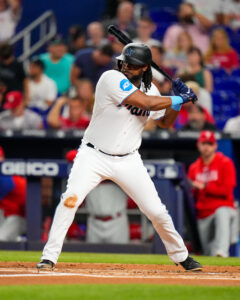
Bell has absolutely exploded in South Florida, however. He turned in below-average offense during his time with Cleveland but has mashed at a .271/.351/.586 pace in a still-small sample of 97 Marlins plate appearances. The eight dingers he’s swatted with the Marlins is already nearly as many as the 11 he totaled in more than quadruple the plate appearances with the Guardians. It’s not as though Bell simply moved to a bandbox either; Miami’s loanDepot Park has been the fourth-worst for home runs over the past three seasons, per Statcast.
The switch-hitting Bell looked wholly unremarkable in more than three months with the Guardians but has not only been one of the National League’s best hitters since the trade — he’s had one of the best months of his entire career. So, what gives? This is perhaps an oversimplification, but the Marlins have succeeded where basically no other club has to date: Bell is finally hitting the ball in the air. A lot. The 45.2% fly-ball rate he’s posted this month is the first month in his entire career that he’s posted a fly-ball rate that high.
The change, however, began well before Bell was traded to Miami. Whether the Marlins keyed in on this or merely jumped at the opportunity to purge Segura’s contract isn’t clear, but the numbers are pretty easy to see. Bell entered the current season with a 50% ground-ball rate in his career and just a 31.9% fly-ball rate — a ridiculous number for a 6’4″, 261-pound first baseman. Bell has never had good speed, and the idea that half of his career batted balls have been beaten into the ground is counterintuitive. He’s far from the only should-be slugger with this type of problem — Eric Hosmer is also a member of this club, for instance — but Bell’s penchant for grounders has regularly undercut his well above-average bat-to-ball skills and what’s clearly above-average or even plus raw power. This is a player who bashed 37 home runs in 2019, after all. Juiced ball or not — that’s a big number.
A look at Bell’s month-to-month splits this year reveals some familiar trends. In April he put a ridiculous 62.3% of his batted balls on the ground, against a 28.6% fly-ball rate. In May, it was 51.6% and 26.6% (with a noted uptick in line drives). If you look in late May, Bell had a stretch of five games where he didn’t hit a single fly-ball. He hit three line drives, and the other 81.8% of his balls in play were grounders. Whether this was a wakeup call or the beginning of Bell trying to make a conscious adjustment, things began to change.
In June, Bell’s fly-ball rate jumped to 37%. In July, it climbed a notch higher, to 38.4%. It’s up to 45.2% in August, and Bell is absolutely mashing. Those might sound like arbitrary numbers, and to some extent they are. However, using that arbitrary 37% cutoff point (his June 2023 fly-ball rate), I scanned back through Bell’s monthly splits for his entire career. He’s only had a monthly fly-ball rate of 37% four times in his career … all coming in 2019, when he hit 37 home runs and posted his career-best .277/.367/.569 batting line.
The results weren’t necessarily there as Bell began elevating the ball more regularly. From May 28 (the first day after that stretch of five games with no fly balls), Bell hit .251/.309/.440. That’s only about seven percent better than league average, by measure of wRC+, but it’s a massive improvement over the .215/.327/.326 slash he produced while pounding an incredible (not in a good way) 59.7% of his batted balls into the ground. At the very least, Bell looked like a hitter on the upswing due to a tangible change in his approach. The Marlins might’ve hoped they were acquiring that somewhat above-average hitter, but Bell has been much, much more than that in Miami. He’s been 50% better than the league-average hitter since being traded.
Of course, it’s an open question whether Bell can sustain this pace. He had four months of fly-ball production in 2019 and then quickly reverted back to the grounder-happy plodder who has often looked on the cusp of stardom but never sustained his pace. It’s encouraging, however, that he’s reeled off three straight months of this fly-ball approach. Even in his career year in 2019, he still posted a 46% grounder rate from July through August. This year, in that same span, he’s at 39.7%. This current stretch is the least grounder-driven span of Bell’s career.
Bell spoke to Craig Mish and Barry Jackson of the Miami Herald about his surge at the plate in Miami, attributing plenty of the success to the manner in which hitting coach Brant Brown preps for games with hitters.
“We watch video together and decide there how the attack plan is going to go and I can work on that in batting practice and it tends to show up in the games,” said Bell, who called Brown’s prep work with Marlins hitters “advanced.” Bell also spoke favorably of loanDepot Park, noting that while the dimensions are pitcher-friendly, the consistency from playing in a stadium with a roof can be advantageous. “With the turf, and with the consistency of the dome, you’ve got the same lighting every inning, every at-bat, and it’s easy to get hits.”
Bell noted to the Herald that his focus has been simply on hitting line drives, but it seems those efforts have translated more into fly balls than the intended liners. His 12.9% line-drive rate with the Fish is actually lower than it was in Cleveland (19%) by a wide margin. Bell is simply elevating the ball at a strong, albeit not elite rate. His 45.2% fly rate since the trade ranks 35th of 173 hitters (80th percentile). But Bell is a big man with plenty of power; when he elevates the ball, good things happen.
Bell’s surge has been a boon for the Marlins and also creates a fascinating scenario to watch down the stretch. If he can continue putting the ball in the air close to this frequently and continue to produce at well above-average levels, the player option he once looked like a lock to exercise could become a borderline call — or, with a strong enough finish, a relatively easy one to decline. The upcoming free agent class is light on hitters, and Bell is flat out raking thanks to a noticeable change in his batted-ball profile. This version of Bell would fetch far more than $16.5MM in free agency, particularly since he can’t be saddled with a qualifying offer and thus won’t be tied to draft pick compensation.
If Bell does decline his player option, it’d wind up looking like a rather deft swap of contracts for the Marlins; at the time of the swap, Miami was effectively surrendering Watson and paying about $9.25MM ($3.25MM in ’23, $6MM in ’24) to upgrade from Segura to Bell. That sum would drop to just $3.25MM in added salary if Bell opts out — all of it coming in 2023 — and a hefty $10.5MM of savings beyond the current season. The Marlins would be off the hook entirely next year, while the Guards would remain on the hook for Segura’s $8.5MM salary and $2MM buyout on a $10MM club option for 2025. It’s doubtful even Marlins GM Kim Ng and her staff expected Bell to perform this well early on, but their ostensible bet on Bell’s change in approach is already a boost to the team’s playoff hopes and now has the possibility to provide substantial payroll benefit in the future.
Reds Designate Tony Santillan For Assignment
The Reds announced Tuesday that right-hander Tony Santillan has been designated for assignment. His spot on the 40-man roster will go to utilityman Alejo Lopez, who has had his contract selected from Triple-A Louisville. Outfielder Michael Siani was optioned to Louisville to clear active roster space.
A second-round pick back in 2015, the now-26-year-old Santillan ranked among the Reds’ top farmhands for several years before making his big league debut in 2021. He looked to be a potential mainstay in the bullpen after pitching 43 1/3 innings of 2.91 ERA ball with a hefty 29.5% strikeout rate. Santillan’s 11.1% walk rate was in clear need of improvement, but it was nonetheless an impressive debut campaign for a prospect whom the Reds viewed as a potentially notable part of their future.
As is so often the case, however, injuries have intervened and radically altered the equation. Ankle surgery, a stress fracture in his back and a knee strain have combined to limit the righty to just 23 big league innings since that debut. He’s posted a 5.09 ERA during that time, fanning just 19.3% of his opponents against an alarming 14.9% walk rate. Santillan has just 3 1/3 MLB frames under his belt this season and has otherwise spent the year in Louisville, where he’s been clobbered for a 9.26 ERA in 23 1/3 frames with nearly as many walks (22) as strikeouts (28).
Santillan still throws hard, averaging 96.1 mph on his heater over the past two seasons. He’s posted a solid 11.6% swinging-strike rate in his MLB career and clearly has had shown promise at times, but he’ll be out of minor league options next season and the Reds likely wouldn’t have gone through the entire offseason dedicating a 40-man spot to him anyhow. They’ll have no choice but to place Santillan on waivers now, and any team that claims him can keep him in the minors for the remainder of the year. He’d have to break camp on that team’s Opening Day roster next year or else again be designated for assignment, however.
As for the 27-year-old Lopez, he’ll join the Reds for a third straight season. He’s hit for a solid but empty .262 average in 179 career plate appearances, getting on base at a below-average .307 clip with just a .321 slugging percentage. He has big league experience at second base, third base and in the outfield corners. He’ll give the Reds a contact-oriented bench bat who’s fanned in just 14.6% of his career plate appearances but also walked at a well below-average 5% clip.
Tigers Place Jose Cisnero On Waivers
The Tigers have placed right-handed reliever José Cisnero on waivers, reports Ken Rosenthal of the Athletic (Twitter link). All 29 other clubs will have 48 hours to claim him and take on his remaining salary. If he goes unclaimed, he can reject an outright assignment to the minors in favor of free agency while retaining the remainder of his $2.3MM salary, as is his right as a player with more than five years of Major League service time. The Tigers, however, don’t have to assign him to a minor league affiliate if he goes unclaimed and can opt to keep him on the Major League roster.
Cisnero, 34, drew at least some level of deadline interest, but no deal was ever reached to send him to another club. He’s slated for free agency at season’s end and is thus a pure rental for any club that places a claim. Like the other slew of veteran players placed on outright waivers today, his waiver window will claim before the Aug. 31, 11:59pm ET deadline for postseason eligibility, making him a potentially “free” (beyond the financial cost) bullpen addition for a postseason contender.
In 48 2/3 innings this season, Cisnero is sitting on an ugly 5.36 ERA, though some of the under-the-hood numbers offer a bit more promise. He’s averaged 96 mph on his heater and fanned a quarter of his opponents against a respectable (albeit higher-than-average) 9% walk rate. Cisnero has been plagued by a lofty .343 average on balls in play despite yielding hard contact at a roughly league-average rate. Most of his struggles have been fairly recent, too. The righty touted a 2.18 ERA through the early portion of July but has been hammered for 21 earned runs in his past 15 1/3 frames.
Miserable as these past six or so weeks have been, Cisnero has a track record that a contending club might feel is worth taking a chance on. From Opening Day 2020 through early July of this year, he racked up 149 1/3 innings of 2.77 ERA ball with a 24.5% strikeout rate and 11.4% walk rate. He totaled 38 holds and five saves along the way, yielding just 0.60 homers per nine frames and keeping the ball on the ground at a 42.5% clip.
Waiver priority for Cisnero (and others on outright waivers) will be determined based on reverse standings. As MLBTR has reported at multiple points in the past, outright waiver priority is not league-specific (as was the case under the now-defunct revocable August trade waivers). If Cisnero is not claimed and ultimately does become a free agent, the Tigers will remain on the hook for the bulk of his salary, though he’d technically have a few hours to latch on with a new team on a free-agent deal between the point at which he clears and the end of the day Thursday. That would allow him to retain postseason eligibility for a new team.
MLBTR Chat Transcript
Click here to read a transcript of Tuesday’s chat with MLBTR’s Steve Adams.
Latest On Edwin Diaz
Injured Mets closer Edwin Diaz has been targeting a late-season return since tearing the patellar tendon in his knee during the World Baseball Classic, and even with the Mets squarely out of postseason contention, he’s still working toward that goal. Diaz told reporters yesterday that he just threw his first bullpen session and is still hoping to pitch before the end of the year (video link via Anthony DiComo of MLB.com). Diaz’s hope is “to finish the year on a positive note,” and he later added that he was hitting 93 to 95 mph in Sunday’s bullpen session.
Onlookers may question the notion of bringing Diaz back at the short end of his recovery window of six to eight months, but both the pitcher and key members of the organization have previously spoken about the importance of Diaz getting back onto the mound to be sure he’s healthy and give him piece of mind through a hopefully normal offseason. Via Jerry Beach of the Associated Press, manager Buck Showalter said just yesterday that Diaz even being considered a possibility to return is a “good thing” and that the righty getting back on the mound would be “really exciting for everybody.” Showalter also emphasized that no decision will be made until Diaz is given medical clearance — which is still a aways off.
Diaz inked a five-year, $102MM contract to return to the Mets before free agency even opened in earnest last offseason — the largest contract ever given to a reliever. The first season of that pact has been wiped out entirely by his WBC knee injury. Given all that’s gone wrong in Queens this season, it’s unlikely that a healthy Diaz would’ve been enough to salvage the 2023 campaign, but losing him for the majority of the year was the first of many contributing factors to the downfall of a club featuring MLB’s largest-ever payroll.
The 29-year-old Diaz’s fastball isn’t back up to full strength, of course, but it’s nonetheless encouraging that he’s throwing 93 to 95 mph in his first ‘pen session. Diaz averaged 98.7 mph on his heater from 2020-22 — including 99.1 mph last year — and pitched to an electric 2.27 ERA with 70 saves during that time. His 2022 campaign was one of the best ever by a relief pitcher, as he worked to a pristine 1.31 ERA with 32 saves, a better-than-average 7.7% walk rate and a historic 50.2% strikeout rate that stands as the second-highest ever for a qualified reliever during a 162-game season (third-highest, if counting Devin Williams‘ 53% mark during the shortened 2020 season).