
Phillies Sign Josh Harrison
The Phillies have signed infielder Josh Harrison to a minor league contract and invited him to Spring Training, per a team announcement. MLB Network’s Jon Heyman had recently reported that the MSM Sports client was weighing minor league interest from as many as five clubs (Twitter link).
A two-time All-Star with the Pirates, Harrison spent the 2019 season with the Tigers after signing a one-year pact to serve as their primary second baseman. However, the deal didn’t pan out, as shoulder and hamstring injuries combined to limit the versatile Harrison to just 36 games, during which time he batted .175/.218/.263.
Last year’s lost season notwithstanding, the 32-year-old Harrison isn’t far removed from a productive four-year run as a key contributor with the Pirates. From 2014-17, he batted a combined .290/.331/.428 with 37 homers, 118 doubles, 17 triples and 59 stolen bases while playing second base, third base, shortstop and the outfield corners.
Matt Duffy Clears Release Waivers
Third baseman Matt Duffy has cleared release waivers after being designated for assignment by the Rays and is now a free agent, Marc Topkin of the Tampa Bay Times reports (via Twitter).
The Tampa Bay organization explored the trade market for Duffy before making the move to designate him and clearly didn’t find much in the way of interest. The 28-year-old (29 in January) was projected by MLBTR contributor Matt Swartz to earn $2.9MM in what would’ve been his final trip through the arbitration process, and after he was limited to just 46 unproductive games in 2019, other clubs apparently didn’t find him to be a particularly palatable option — even in a buy-low capacity.
Injuries have devastated what looked early on to be a promising career for Duffy. The 2012 18th-round pick debuted to minimal fanfare with the Giants in 2014, but his 2015 season earned him a runner-up showing in National League Rookie of the Year voting. Duffy slashed .295/.334/.428 with 12 homers, 28 doubles, six triples and 12 steals (in 12 tries) that year — all while playing brilliantly rated defense at third base. He got off to a slow start in 2016 but was still highly regarded enough that the Rays acquired him as a focal point in the trade that sent lefty Matt Moore to San Francisco.
Duffy was injured at the time of the trade but returned to make his Rays debut in mid August. However, he was only able to suit up for 21 games before that same Achilles injury ended his season and ultimately required surgical repair. While he was recovering from that surgery, Duffy underwent a second procedure to remove loose bodies from his heel. He ultimately missed the entire 2017 season.
Duffy dealt with a hamstring injury in 2018 but was healthy for most of the season and in many ways resembled the player the Rays initially hoped they’d acquired. His already modest power was notably absent, but Duffy hit for average and got on base (.294/.361/.368 in 560 plate appearances) while playing quality defense in the eyes of Ultimate Zone Rating. Hamstring issues once again sidelined Duffy for much of the 2019 season, however, and the Rays turned to other options in his absence — most notably Yandy Diaz and Mike Brosseau.
Now that he’s a free agent, Duffy should find other clubs with interest on minor league pacts or perhaps on incentive-laden deals with a lower base rate than his previously projected level of pay. Although he’s never consistently hit for power in the Majors, Duffy has generally shown the ability to hit for a high average (which helps to mitigate his pedestrian walk rate) and has shown good bat-to-ball skills (16.1 percent career strikeout rate). Paired with a well-regarded glove at third base and the ability to handle shortstop as well, that should pique the interest of a team with some needs on the left side of the infield.
MLB Investigating Sam Dyson Under Domestic Violence Policy
Major League Baseball has launched an investigation into free-agent reliever Sam Dyson after a pair of Instagram posts made by his ex-girlfriend alluded to abuse, Ken Rosenthal and Katie Strang of The Athletic report (subscription required). NBC Sports’ Craig Calcaterra also covered the topic earlier this morning.
Specific incidents aren’t detailed, though the posts do make reference to objects being thrown at the alleged victim. Dyson is not mentioned by name, but Rosenthal and Strang have confirmed that he is indeed the person being referenced within. Additionally, there are broader references to the alleged victim’s physical and emotional well-being.
“I’ve allowed my physical health, my emotional health and my mental health to diminish to nothing. I’ve allowed more things to happen than I want to admit,” one post reads. Another concludes by stating: “No one deserves to be intimidated, scared, worthless and hopeless.”
As with the early stages of nearly all investigations under MLB’s joint domestic violence, sexual assault and child abuse policy, details are rather scarce, and the potential for punitive action against Dyson at this juncture can’t be known. Dyson is currently a free agent, so he needn’t be placed on administrative leave. And given that he underwent season-ending shoulder surgery that is expected to keep him out for most, if not all of the 2020 season, the specifics of how the league would handle a potential suspension are also difficult to forecast. For now, the league has arranged to interview the alleged victim in the “near future,” per The Athletic report.
This wouldn’t be the first instance of social media posts leading to league-issued punishment under the domestic violence policy. Allegations against Addison Russell first surfaced when a friend of his ex-wife spoke out on Instagram, and while that didn’t lead to an immediate ban for the Cubs infielder, Russell’s ex-wife herself came forward a year later and offered more detailed accounts that culminated in a 40-game suspension. Back in 2017, free-agent catcher Derek Norris was suspended for the final month of the season under similar circumstances, when his ex-fiancee alleged both physical and emotional abuse in an Instagram post that also declined to mention him by name.
Major League Baseball is also still in the process of investigating Yankees right-hander Domingo German under the same policy. German was placed on administrative leave late in the season and barred from appearing in the postseason with the Yankees.
Offseason Outlook: Houston Astros
MLBTR is publishing Offseason Outlooks for all 30 teams. Click here to read the other entries in this series.
A month ago, the Astros came within a game of winning their second World Series in three seasons. Now? They’re the subject of an investigation by MLB commissioner Rob Manfred’s office and could lose one of the game’s best pitchers to free agency.
Guaranteed Contracts
- Jose Altuve, 2B: $130MM through 2024
- Alex Bregman, 3B/SS: $100MM through 2024
- Zack Greinke, RHP: $70MM through 2021 ($22MM deferred, D-backs paying $10.33MM annually)
- Justin Verlander, RHP: $66MM through 2021
- Ryan Pressly, RHP: $17.5MM through 2021
- Michael Brantley, OF: $16MM through 2020
- Josh Reddick, OF: $13MM through 2020
- Yuli Gurriel, 1B/3B: $8.3MM through 2020
Arbitration-Eligible Players (contract projections via MLBTR contributor Matt Swartz)
- George Springer – $21.4MM
- Brad Peacock – $4.6MM
- Jake Marisnick – $3.0MM
- Aaron Sanchez – $5.6MM
- Lance McCullers Jr. – $4.1MM
- Carlos Correa – $7.4MM
- Roberto Osuna – $10.2MM
- Chris Devenski – $2.0MM
- Joe Biagini – $1.5MM
- Aledmys Diaz – $2.4MM
- Non-tender candidates: Sanchez, Devenski, Biagini
Free Agents
- Wade Miley, Robinson Chirinos, Martin Maldonado, Hector Rondon, Joe Smith, Will Harris, Collin McHugh
We’ll get this out of the way up front: while the Astros have plenty of roster needs to address this offseason, the primary storyline right now is the league’s investigation into the electronic sign-stealing accusations brought forth against them, which stem back to the 2017 season. There are potentially severe ramifications for the Houston organization if sufficient evidence arises to prove their guilt, but at this point the extent of those still-theoretical sanctions can’t be known. This outlook will focus purely on the team’s roster and payroll outlook, as there’s no means of determining exactly when, how or even if the Astros will be penalized by the commissioner’s office.
With that out of the way, the biggest needs facing the Astros organization come in the rotation and behind the plate. Houston picked up Zack Greinke in a last-minute trade-deadline blockbuster, but Gerrit Cole and Wade Miley both reached free agency at season’s end. Robinson Chirinos and Martin Maldonado are both free agents, too, leaving 26-year-old Garrett Stubbs as the only catcher on Houston’s 40-man roster. Clearly, that leaves president of baseball operations Jeff Luhnow and his staff with some work to do.
To what extent is ownership willing to spend to address those needs, though? Owner Jim Crane said in early October that the Astros “prefer not to” cross the $208MM luxury tax barrier, though he cautioned that the team’s postseason showing could influence that decision. A run to Game 7 of the World Series surely put some extra cash in the pipeline, but the strongest comments Crane has made with regard to spending this winter came earlier this month when discussing Cole’s free agency: “We’re going to take a run at it. We don’t know if we can get to where they want to get. [Agent Scott] Boras is tough to deal with.” A resounding cry of aggression, it was not, but that shouldn’t come as much of a surprise. The likelihood that Cole has become too large a piece to fit into this puzzle has been apparent for some time now.
The biggest obstacle for the Astros is that even assuming a non-tender of July acquisition Aaron Sanchez, whose 2020 status is up in the air after shoulder surgery, Houston’s payroll will top $200MM in 2020. The exact projections will vary, as the specific number is dependent on arbitration-eligible players and on determining exactly what they owe Greinke. The D-backs are paying a reported $10.33MM of the $35MM owed to Greinke in 2020 and 2021 ($32MM base salary plus a $3MM payment of his pro-rated signing bonus), and $11MM of that yearly sum is deferred to 2022-26.
None of those payroll gymnastics matter for luxury-tax purposes, though, as that calculation is more straightforward and based on the average annual value of the team’s contractual obligations. Between guaranteed contracts, arbitration projections, pre-arbitration players and money set aside for player benefits, Jason Martinez of Roster Resource has their current luxury obligations at a whopping $238MM. Non-tendering Sanchez would trim $5.6MM of that, but it’s clear that the team’s offseason level of activity will be heavily dependent on whether Crane and his group can indeed stomach what looks like a potentially notable luxury hit.
Given the team’s cloudy fiscal outlook, it’s perhaps not surprising that Luhnow has already gone on record as stating that right-hander Jose Urquidy will “likely” be in the team’s rotation next year. He’ll be joined by a returning Lance McCullers Jr., and the club has some upper-level depth in Rogelio Armenteros, Cionel Perez, Bryan Abreu and Forrest Whitley. But Whitley’s stock is down after a miserable 2019 season, McCullers is something of a wild card in his first season back from Tommy John surgery, and the team traded righties Corban Martin and J.B. Bukauskas to the D-backs in the Greinke swap. At the very least, one veteran stabilizer or would seem to be a prudent addition — even if it’s a low-cost add in the Brett Anderson or Homer Bailey mold. If the Astros want more of an upside play, they could roll the dice on Josh Lindblom, Kwang-hyun Kim or Shun Yamaguchi as they look to jump from the KBO (Lindblom, Kim) and NPB (Yamaguchi) to the Majors.
Behind the plate, a reunion with any number of old friends would be logical: Chirinos, Maldonado and Jason Castro are all available in free agency. The Mariners are reportedly exploring the market for Omar Narvaez, who’s only projected to receive a modest $2.9MM salary in his first year of arbitration. On the pricier side of things, the Cubs could listen to offers for Willson Contreras. Ultimately, whether it’s via trade or free agency, the Astros have to add a catcher or two; Stubbs hit just .240/.332/.397 (79 wRC+) last year in Triple-A while the rest of the league exploded with historic levels of offensive output.
Around the rest of the roster, things look largely set. Yuli Gurriel, Jose Altuve, Carlos Correa and Alex Bregman will comprise the infield, while the outfield has Michael Brantley, George Springer, Josh Reddick, Jake Marisnick and Kyle Tucker in the mix. Rookie of the Year Yordan Alvarez will return to DH and could see some occasional reps in left or at first base. It’s a stacked lineup.
There’s a scenario where the Astros stick primarily in house for the starting staff, pick up a cheap catcher and hope their core can stay healthy enough to carry them to yet another AL West championship. They could even look to shed some of Reddick’s remaining $13MM and go with the younger, more affordable Tucker in right field. There’s enough talent there, but relying on McCullers and a pair of young arms to round out the starting staff would leave the team with little depth, especially in the event of an injury to Verlander or Greinke.
Frankly, however, it’s hard to see just how this Astros roster could possibly be constructed to drop below the luxury tax without severely compromising its core. Barring a shocking trade — e.g. Springer, Greinke — there just aren’t many natural means to reducing payroll. As such, the best course of action is probably to just bite the bullet and wade deep into luxury-tax waters. After all, the Astros will see Reddick, Brantley, Springer, Gurriel and Peacock all come off the books for the 2021 season. Greinke and Verlander will both be free agents the following winter. That’s not to say Houston’s window is “closing,” but the current roster presents an excellent shot at returning to postseason play (particularly with a few additions). A one-year dalliance into luxury territory isn’t likely to come with especially lengthy or concerning ramifications.
And if Houston is willing to pay the luxury tax, the market offers plenty of intriguing mid-rotation arms that won’t require a $30MM+ annual salary like Cole or Stephen Strasburg ultimately will. A reunion with Dallas Keuchel or a pursuit of a mid-tier option like Rick Porcello, Tanner Roark, Kyle Gibson or Michael Pineda would make plenty of sense. Alternatively, the Astros could look to the trade market to find a less pricey option. Jon Gray or Chris Archer have high-end raw stuff, and Houston has successfully coaxed better performances out of pitchers in similar scenarios. The team had interest in Matthew Boyd at the trade deadline and could look into him again.
The flexibility they have on the position-player side bodes well for creative additions, too. If the Astros have grown weary of Correa’s injury troubles, could they even utilize him to acquire starting pitching help and make a separate run at a high-end trade target? Francisco Lindor and Kris Bryant have already seen their names pop up in rumors, and the free-agent market isn’t short on quality third basemen if the team is comfortable with Bregman playing shortstop on a full-time basis.
At this point, a legitimate run at signing any of Cole, Strasburg or Anthony Rendon seems hard to fathom, as it’d truly put the Astros into unprecedented luxury tax territory. But there’s room for the team to shed some salary (Sanchez, Reddick, Chris Devenski, Jake Marisnick, perhaps Roberto Osuna), still make a few additions and simply be OK with living in the second tier of penalization. (The max penalty any first-time CBT offender would pay for going right up to the cusp of the top penalty tier would be $10.4MM.) It’ll be a fine line to walk, but this Houston front office should be creative enough to successfully thread that needle.
Mariners, Evan White Agree To Long-Term Contract
NOVEMBER 25: The Seattle organization has announced the signing.
NOVEMBER 22: The Mariners and first base prospect Evan White are in agreement on a six-year, $24MM contract that contains three club options, Jim Callis of MLB.com reports (via Twitter). The contract, which can max out at $55.5MM if the options are exercised (via Robert Murray), locks up a key piece of the Mariners’ future before he even sets foot in the Majors. White is represented by True Gravity Baseball.
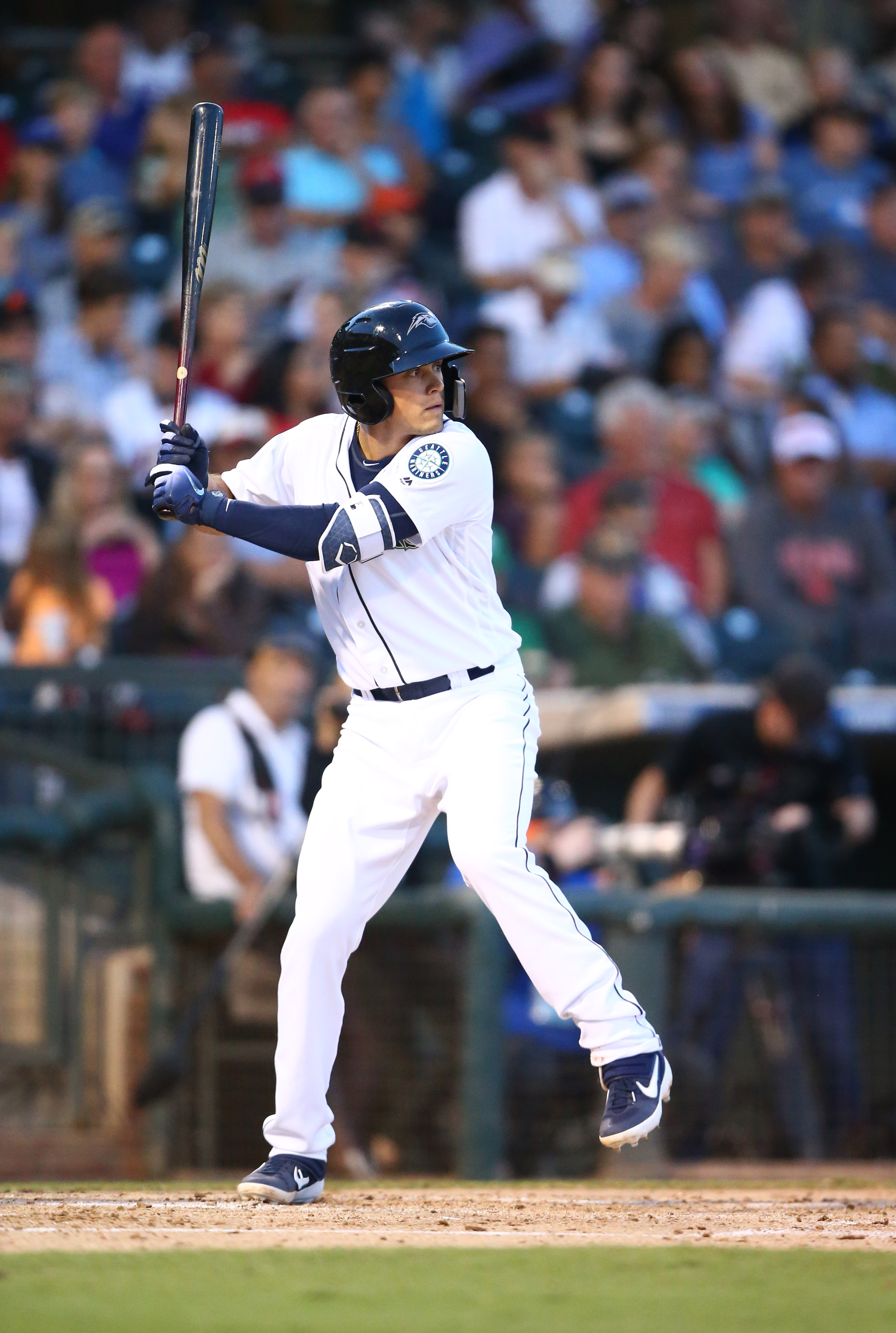
White, the No. 17 overall pick in the 2017 draft, spent the 2019 campaign with the Mariners’ Double-A in Arkansas, where he batted .293/.350/.488 with 18 home runs, 13 doubles, two triples, a 7.3 percent walk rate and a 23 percent strikeout rate in 400 plate appearances. Those numbers were particularly impressive in a pitcher-friendly setting, evidenced by White’s robust 132 wRC+ (indicating that he was 32 percent better at the plate than the average hitter in the Texas League).
From a broader offensive standpoint, the University of Kentucky product has performed well throughout his minor league tenure. He hit .277/.345/.532 in a tiny sample of 14 games of short-season Class-A ball in 2017 after being drafted and followed that up with a .303/.375/.458 slash in a full season at Class-A Advanced in 2018.
White is also regarded as a superlative defensive first baseman, with scouting reports at FanGraphs and MLB.com pegging him as a 70-grade defender. He currently ranks in the game’s top 100 overall prospects at MLB.com (No. 58), Baseball America (No. 73) and FanGraphs (No. 77).
The extension in many ways mirrors the long-term deal signed by Scott Kingery just prior to the 2018 season. As was the case with Kingery at the time, White is a 23-year-old top prospect who is widely expected to be a key contributor for his club in the near future. Both deals guaranteed the player $24MM over six years, though Kingery’s option years are valued at a slightly higher rate, as his contract can max out at $65MM. That’s perhaps reflective of the fact that Kingery, unlike White, had already played in Triple-A and was perhaps on the cusp of making the Opening Day roster out of Spring Training. White, meanwhile, could still be ticketed for some Triple-A time to being the 2020 season, although the long-term deal should increase his chances of breaking camp with the team. There’s no longer any reason to play service-time games and option him to Triple-A if he convinces the team of his MLB readiness with a strong spring effort.
White is suddenly the only player on the Mariners’ roster signed to a guaranteed contract beyond the 2021 season. The 2020 campaign will be a pivotal one for the “reimagining” Mariners, as they’ll get their first glimpse at White and quite possibly (later in the summer) at vaunted outfield prospect Jarred Kelenic (acquired in last winter’s Edwin Diaz/Robinson Cano trade). Lengthy auditions for lefty Justus Sheffield, righty Justin Dunn and outfielders Kyle Lewis and Jake Fraley — each of whom made his MLB debut in 2019 — are likely on the 2020 docket as well.
Athletics, Jaime Schultz Agree To Minor League Deal
The Athletics have agreed to a minor league contract with right-handed reliever Jaime Schultz, per Susan Slusser of the San Francisco Chronicle (Twitter link). He’ll be invited to Major League Spring Training and vie for a bullpen job in camp.
Schultz, 28, has spent the past two seasons in the Rays and Dodgers organizations, where he’s scuffled to a combined 5.86 ERA in 35 1/3 innings at the MLB level. Schultz has averaged 9.7 K/9 during that time but has also surrendered an average of 5.1 walks and 1.8 homers per nine innings of work. That said, Schultz averaged just under 96 mph on his fastball in 2019, has a career 12.5 percent swinging-strike rate in the big leagues and was in the 87th percentile of MLB pitchers in terms of fastball spin rate this past season, perhaps suggesting there’s more in the tank.
Schultz has also appeared in parts of four Triple-A campaigns and notched a 4.42 ERA with 12.1 K/9 against 4.9 BB/9 in 226 innings. He’s been more of a fly-ball pitcher since moving to the bullpen a few years back but did post an above-average 47.2 percent mark in that regard with the Dodgers’ Triple-A affiliate in 2019.
Yankees Trade Nestor Cortes Jr. To Mariners
1:41pm: The two teams have both announced the move.
“Nestor is a versatile lefty who can do a little bit of everything,” Mariners GM Jerry Dipoto said in a statement announcing the swap. “He can start, he can relieve, he can give you those middle innings or even operate as an opener.”
Seattle’s 40-man roster is now at 36 players.
1:30pm: The Yankees have traded left-hander Nestor Cortes Jr. to the Mariners in exchange for international bonus allotments, Buster Olney of ESPN reports (via Twitter). New York designated Cortes for assignment last week when setting the 40-man roster in advance of next month’s Rule 5 Draft.
Cortes, 25 next month, has appeared in 37 big league games over the past two seasons — all but one of which was a relief outing. Though he’s been a longtime Yankees farmhand, the lefty actually made his MLB debut with the Orioles in 2018 after Baltimore selected him in the 2017 Rule 5 Draft. He wasn’t able to hold his roster spot, however, and was returned to the Yankees during the ’18 season.
This past year, Cortes made his Yankees debut but limped to a 5.67 ERA in 66 2/3 innings. He averaged 9.3 strikeouts per nine innings pitched and logged a 10.5 percent swinging-strike rate, but Cortes also averaged 3.8 walks and 2.2 home runs per nine frames in his limited time with the Yanks. He doesn’t generate many grounders (34.2 percent), nor does he throw especially hard (89.6 mph average fastball), but lefties with strong Triple-A track records and minor league options remaining will always have some appeal throughout the league. Cortes has a pair of options left and, in 205 1/3 innings at the Triple-A level, has a 3.11 ERA with 8.7 K/9 against 2.7 BB/9. A move to a more pitcher-friendly setting could certainly help to curb the home-run troubles that plagued him in 2019, and at the very least he’ll give the Mariners some depth both in the rotation and as a long relief option.
The amount of money the Yankees received in return for Cortes isn’t presently known, but international allotments have to be traded in blocks of $250K, so New York picked up at least that much in additional resources to add to its pool.
Blue Jays, A.J. Cole Agree To Minor League Deal
The Blue Jays have agreed to a minor league contract with right-hander A.J. Cole, Shi Davidi of Sportsnet reports (via Twitter).
Cole, 27, spent the 2019 campaign with the Indians, for whom he tallied 26 innings of 3.81 ERA ball with 10.4 K/9, 2.8 BB/9, 1.38 HR/9 and a 30.8 percent ground-ball rate. Once regarded as one of the game’s top pitching prospects, Cole has yet to establish himself as a consistent MLB contributor but has demonstrated some intriguing traits since moving to the bullpen on a full-time basis in 2018.
Over his past 62 innings between the Indians and Yankees, Cole has worked to a 4.21 ERA with 11.3 K/9 and 3.3 BB/9. He’s still been far too homer-prone (1.89 per nine) and may always struggle a bit in that regard thanks to his extreme fly-ball tendencies (32.2 percent grounder rate), but Cole could also stand to benefit a bit if next year’s ball is a bit less charged. The 6’5″, 238-pound righty averaged 94.2 mph on his heater between his time with New York and Cleveland, and both his swinging-strike rate (15.1 percent) and opponents’ chase rate on pitches out of the strike zone (33.2 percent) were sources of intrigue as well. Beyond all that, Cole’s spin rate on his fastball skyrocketed in 2019 and wound up ranking in the 82nd percentile of MLB hitters, per Statcast.
Cole will have to earn a job in big league camp with the Jays next spring, but the thin nature of the Toronto pitching staff should give him a decent chance at doing so if he performs well in camp. He’s out of minor league options, so once the Jays select him to the MLB roster, he won’t be able to be sent back down without first being passed through waivers. Even if he did clear waivers, as a player who’s previously been outrighted (twice, in fact), Cole would be able to turn down the assignment in favor of free agency.
Drew VerHagen To Sign With Japan’s Nippon Ham Fighters
Tigers right-hander Drew VerHagen will sign a one-year deal with the Hokkaido Nippon Ham Fighters, Chris McCosky of the Detroit News reports (Twitter links). Detroit has formally requested release waivers on VerHagen in order to facilitate the move, per a club announcement. The move drops the Tigers’ 40-man roster to a total of 39 players.
“It sounds like they are going to give me a great opportunity to start,” VerHagen tells McCosky (Twitter link). “I just felt like this is something cool and different and it will big financially, as well. I’m excited.”
VerHagen, 29, has spent his entire career in the Tigers’ organization. Originally drafted in the fourth round back in 2012, the 6’6″ righty has made a handful of starts with the Tigers since debuting in 2014 but has worked primarily out of the bullpen. VerHagen’s 5.11 ERA in 199 Major League innings doesn’t exactly stand out, but he’s notched a hearty 53.9 percent ground-ball rate at the game’s top level. Metrics like FIP (4.76), xFIP (4.50) and SIERA (4.29) all feel he’s been a fair sight better than his baseline ERA, which is perhaps unsurprising given that he’s played in front of some lackluster defenses as the Tigers have worked through their current rebuilding phase.
VerHagen’s time at the Triple-A level has gone much better. He’s appeared in parts of six seasons there, compiling a 3.97 earned run average with 7.2 K/9 and 2.9 BB/9 in 321 2/3 innings. He wouldn’t be the first pitcher to reinvent himself in Japan before returning to MLB in his early or mid 30s, so his results in NPB will at least be worth keeping an eye on next season.
Rich Hill Undergoes Surgery, Won’t Be Ready For Opening Day
Free-agent lefty Rich Hill won’t be ready for the start of the 2020 season after undergoing primary revision surgery, reports WEEI’s Rob Bradford. It’s unlikely that the 39-year-old would be ready to return until June, and he could be delayed into July as well.
A source familiar with the procedure tells MLBTR that the operation is similar to the Tommy John alternative that right-hander Seth Maness underwent a few years go. Primary revision (also sometimes referred to as “primary repair”) is a less-intrusive repair of a tear in a player’s ulnar collateral ligament and comes with a shorter rehab period. However, not all UCL tears make for good candidates to undergo the operation. The procedure is dependent on the general health of the tissue as well as the placement and extent of the tear. Hill, who actually pitched through the injury for some of the 2019 season, was deemed a good candidate for the lesser-known procedure.
Although he’ll turn 40 next March, Hill has voiced a desire to continue pitching as long as he can and has been vocal about his desire to return to the Dodgers. He’s also expressed some interest in pitching with the Red Sox again, as a Boston native whose family still resides in the area. Now, rather than opening the season in a rotation, Hill could instead be a midseason reinforcement. Whether he’ll sign a contract this winter and attempt to rehab with his 2020 team or wait until he’s able to demonstrate his health for clubs next summer isn’t known.
Knee issues and a forearm strain wiped out a fair bit of Hill’s 2019 season, limiting him to 58 2/3 innings in what was the final season of a three-year, $48MM contract with the Dodgers. But Hill was excellent when healthy enough to take the ball, pitching to a 2.45 ERA with a 72-to-18 K/BB ratio and a 49.6 percent ground-ball rate in that time. Hill missed time in each of the three seasons of that contract with L.A. but did log a 3.30 earned run average with nearly 11.0 K/9 in a total of 327 regular-season innings (plus another 37 innings of 2.43 ERA ball).
Since resurrecting his career with the Red Sox late in the 2015 season, Hill has pitched 466 1/3 innings with a 2.91 ERA, 10.7 K/9, 2.8 BB/9 and 1.0 HR/9.