
Mets Designate Brad Emaus For Assignment
The Mets designated infielder Brad Emaus for assignment and recalled Justin Turner, tweets David Lennon of Newsday. Emaus, a Rule 5 pick from the Blue Jays, earned the second base job out of Spring Training but only received 42 plate appearances to establish himself. If he's not traded or claimed in the next ten days, the Mets have to offer him back to the Blue Jays (or work out a trade to keep him in the organization). If another team picks up Emaus, they'll still be subject to the Rule 5 restriction of keeping him in the Majors all year.
Emaus, 25, hit .290/.397/.476 in 534 plate appearances for the Blue Jays' Double and Triple-A clubs last year, playing second and third base.
2012 Contract Issues: Chicago Cubs
The Cubs are next in our 2012 Contract Issues series.
Eligible For Free Agency (5)
- Kosuke Fukudome has had a respectable Cubs career, getting on base at a .370 clip and playing solid right field defense. However, he hasn't hit for much power and he has been streaky, mixing great months with terrible ones. He's a useful player, but not a $12MM one, and I think this is his last year with the Cubs.
- Carlos Pena is probably a rental, one that could benefit both sides if he rediscovers his 35 home run pop.
- John Grabow's extension was questionable when it was signed, and he'll probably be allowed to leave.
- Kerry Wood might be retained if he has a solid year, though the Cubs probably won't manage a $1.5MM base salary in that case.
- Reed Johnson is also eligible for free agency after the season.
Contract Options (2)
- Aramis Ramirez: $16MM mutual/vesting option for 2012 with a $2MM buyout. Ramirez has a complicated contract. He can void the 2012 option and forfeit the buyout, which seems possible with a strong year. The option can vest in various situations, the most likely of which is Ramirez being traded unless you are optimistic about the third baseman winning the NL or NLCS MVP award. He can still void the option if it vests, so Ramirez once again controls his fate. The difference this time will be the Cubs' ability to decline their side.
- Ryan Dempster: $14MM player option. The Cubs are also at the mercy of Dempster. If the righty's 2011 is similar to his 2008-10 campaigns, the best business move would be to decline the option and seek a new contract. However, he does have a long relationship with Cubs GM Jim Hendry.
Arbitration Eligible (6)
- First time: Randy Wells, Blake DeWitt
- Second time: Geovany Soto
- Third time: Matt Garza, Jeff Baker, Koyie Hill
Assuming at least Wells, Soto, and Garza are tendered contracts, the Cubs might be looking at $17MM or so in arbitration salaries. They might be able to reduce their 2012 obligation by agreeing to an extension with Soto or Garza.
2012 Payroll Obligation
Not counting Ramirez's buyout or Dempster's salary, the Cubs have a 2012 payroll obligation of $56.6MM, significantly below their typical $135MM range. If Ramirez and Dempster have poor seasons, the Cubs might have to add another $2MM for Ramirez's buyout and $14MM for Dempster's 2012 salary, bringing the obligation to $72.6MM. The team could have needs in the rotation and at both infield corners, plus a lot of money to spend, so it should be an interesting 2011-12 offseason.
Should They Have Been Non-Tendered?
On November 2nd of last year I listed 85 non-tender candidates, most of whom were indeed cut loose. Almost five months have passed since the December non-tender deadline, and I'd like to revisit five of those decisions.
- Kevin Kouzmanoff, tendered a contract by the Athletics. The A's certainly shopped around for third base alternatives after tendering a contract to Kouzmanoff, which ended up being for $4.75MM. So far the third baseman has again been part of the problem, though he's not alone as the team ranks 11th in the AL with 3.63 runs scored per game. There weren't many alternatives for the A's this offseason, but they probably should have saved Kouzmanoff's money for a trade deadline addition. They'll still be able to pursue someone, though.
- James Loney, tendered a contract by the Dodgers. Loney is already on notice with the Dodgers given the arrival of Jerry Sands. Loney settled for a predictable $4.875MM salary for 2011. Sands doesn't actually project to do any better than Loney, but the two are close enough that the Dodgers probably should have traded Loney and used the money elsewhere.
- Russell Martin, non-tendered by the Dodgers. According to Yahoo's Steve Henson, Martin wanted a guaranteed $5.5MM rather than the Dodgers' offer of $4.2MM. GM Ned Colletti made the difficult decision to non-tender Martin, but kept the offer on the table while suggesting a possible super-utility role. Martin ended up taking less guaranteed money to start at catcher for the Yankees, and he's off to a great start. The Dodgers could have forced Martin's hand by tendering a contract and arguing for a pay cut through arbitration. That would have been a risky choice, and Martin's health was a concern at the time, so I can't fault the Dodgers for non-tendering him.
- Bobby Jenks, non-tendered by the White Sox. Non-tendering Jenks was the right move given his $7.5MM salary, and the pitcher understood that decision according to MLB.com's Scott Merkin. However, Jenks and the Sox were not on the same page about the team's desire to retain him and confidence in his abilities, so he signed with Boston. The White Sox lead baseball with six blown saves, but it was still best for them to part ways with Jenks.
- Brandon McCarthy, outrighted by the Rangers in November. If they had retained McCarthy, the Rangers probably would have had to pay him something similar to last year's $1.3MM salary rather than the $1MM he received from the A's. McCarthy has looked good so far, though it's only been three starts. The Rangers are second in the AL in starter ERA without McCarthy. Still, given the strong offseason interest in him I think it would have been best to tender a contract and shop him around.
If The Astros Become Sellers
Today is April 19th and the Astros are four games out in the NL Central. It seems rash to count them out entirely, but Baseball Prospectus' Playoff Odds Report gives the team a 0.0% chance of making the playoffs. Let's see who they could offer in trades a few months from now. The remaining salary figure is calculated as one-third of this year's salary plus any additional salaries and buyouts, so we're assuming players would be dealt around the July 31st trade deadline.
- Carlos Lee, LF/1B: $24.7MM owed through 2012. Since September of 2009, Lee is hitting .248/.290/.415 in 839 plate appearances. He seems more likely to be released than traded. Contenders might view Lee as nothing more than a bench bat, a role with which he could be unhappy.
- Wandy Rodriguez, SP: Up to $38.3MM owed through 2014. Since Wandy is paid only $7MM this year, he'd fit into most contenders' 2011 budgets. His '13 club option becomes a player option with a trade, the salary of which is reflected in the $38.3MM figure. If the 32-year-old is in the midst of a disappointing but not terrible season, the Astros could have a way of getting out of the contract. If he's pitching well, the Astros could get solid players in return.
- Brett Myers, SP: $16.3MM owed through 2012; could become $23.3MM through 2013 if option vests. Like Rodriguez, Myers is earning only $7MM this year. At the least he's an innings eater, and the Astros could extract a decent bounty from a desperate team at the trade deadline. GM Ed Wade holds a couple of excellent trade chips in Rodriguez and Myers, though it remains to be seen if they'll become available.
- Hunter Pence, OF: $2.3MM owed through 2011; arbitration eligible for 2012 and '13. Moving Pence would be unpopular and could decimate an already-questionable offense. Still, after winning his arbitration case in February, Pence is in line for $10MM+ in '12 and even more in '13. If the Astros don't see him as part of their long-term plans, the best time to move him is this summer.
- Brandon Lyon, RP: $7.25MM through 2012. The Astros would have an inexperienced bullpen without Lyon, but Wade has to be willing to make short-term sacrifices. If Lyon is pitching decently in July the Astros have a chance to get out of a contract that makes little sense for them.
- Michael Bourn, CF: $1.5MM through 2011; arbitration eligible for '12. Credible center fielders are hard to come by, and as a Scott Boras client Bourn probably won't be signing an extension with the Astros. The Nationals could be a match.
- Clint Barmes, SS: $1.3MM through 2011. Barmes would like an extension, and considers himself an everyday player. He'd need to play well for a few months to establish trade value.
- Bill Hall, 2B: $1.25MM through 2011. Hall is only through about a tenth of his season, but he'll need to pick it up to prove he should be a regular. An acquiring team might want him back in a super-utility role.
- Jeff Keppinger, IF: $778K through 2011; arbitration eligible for 2012. Keppinger had foot surgery in January and may make his season debut in May. He's probably the Astro most likely to be traded this summer.
2012 Contract Issues: Toronto Blue Jays
The Blue Jays are next in our 2012 Contract Issues series.
Eligible For Free Agency (6)
- The Jays seemingly took Juan Rivera from the Angels as a means of facilitating the Vernon Wells trade. In February they were rumored to be shopping him. If he's still struggling a few months from now a release could be in order.
- Frank Francisco is expected to join the big league club today after dealing with pectoral muscle and shoulder issues. Health is always a concern for Francisco. Though his salary is already at $4MM, I can still see the Jays offering arbitration if a draft pick is involved.
- I'm curious to see whether Shawn Camp has Type A or B status, once Eddie Bajek starts projecting Elias rankings this year.
- Role players John McDonald, Jose Molina, and Corey Patterson are also eligible for free agency.
Contract Options (5)
- Aaron Hill: $8MM club option for 2012, $8MM club option for '13. It's too early to say whether Hill can return to his '09 or '07 form and compel the Jays to pick up one or both of his options.
- Jason Frasor: $3.75MM club option. Blue Jays GM Alex Anthopoulos created flexibility for his 2012 bullpen by getting club options for Frasor, Rauch, and Dotel in the same range. After the season we'll see who's worth keeping around.
- Jon Rauch: $3.75MM club option with a $250K buyout.
- Octavio Dotel: $3.5MM club option with a $750K buyout.
- Edwin Encarnacion: $3.5MM club option with a $500K buyout. If Encarnacion happens to pop 30 home runs for the first time in his career, the Jays can retain him at a bargain price.
Arbitration Eligible (9)
- First time: Jesse Carlson, Jo-Jo Reyes, Jayson Nix
- Second time: Yunel Escobar, Brandon Morrow, Jesse Litsch
- Third time: Carlos Villanueva, Casey Janssen, Dustin McGowan
The first-timers won't necessarily make it to the point of being tendered contracts. Escobar, Morrow, Litsch, Villanueva, and Janssen seem to be the locks here.
2012 Payroll Obligation
The Blue Jays' 2012 payroll obligation excluding buyouts is $29.9MM, according to Cot's. Jose Bautista, Adam Lind, and Ricky Romero account for most of that. The club options are mostly unknowns at this point; the obligation could range from a couple million for buyouts to $22.5MM if everyone stays. I'll use $15MM as a ballpark figure for the key arbitration eligible players, putting the team around $47MM if all options are declined. The Blue Jays have kept payroll over $70MM for quite some time, so there's room to exercise some of the options and join the bidding for a few significant free agents.
Offseason In Review: Boston Red Sox
The Red Sox are next in our Offseason In Review series.
Major League Signings
- Carl Crawford, LF: seven years, $142MM.
- David Ortiz, DH: one year, $12.5MM. Club option exercised.
- Bobby Jenks, RP: two years, $12MM.
- Dan Wheeler, RP: one year, $3MM. Includes $3MM+ vesting/club option for 2012
- Jason Varitek, C: one year, $2MM.
- Hideki Okajima, RP: one year, $1.75MM.
- Matt Albers, RP: one year, $875K. Arbitration eligible after 2011 season.
- Alfredo Aceves, SP: one year, $650K. Arbitration eligible after 2011 season.
- Total spend: $174.775MM.
Notable Minor League Signings
- Andrew Miller, Randy Williams, Dennys Reyes, Brandon Duckworth, Nate Spears, Rich Hill, Tony Pena, Paul Hoover, Matt Fox
Extensions
- Clay Buchholz, SP: four years, $29.945MM. Includes $13MM club option for 2016 with a $245K buyout and $13.5MM club option for 2017 with a $500K buyout.
- Adrian Gonzalez, 1B: seven years, $154MM.
Trades and Claims
- Acquired SS Brent Dlugach from Tigers for RP Pedro Perez
- Acquired P Andrew Miller from Marlins for RP Dustin Richardson. Miller was later non-tendered and re-signed to a minor league deal.
- Acquired 1B Adrian Gonzalez from Padres for SP Casey Kelly, 1B Anthony Rizzo, CF Reymond Fuentes, and OF/2B Eric Patterson
- Acquired 2B Tony Thomas from Cubs for P Robert Coello
- Acquired cash considerations from Indians for OF Bubba Bell
- Acquired C Mike McKenry from Rockies for RP Daniel Turpen
Notable Losses
- Adrian Beltre, Victor Martinez, Bill Hall, Mike Lowell, Pedro Perez, Dustin Richardson, Casey Kelly, Anthony Rizzo, Reymond Fuentes, Eric Patterson, Robert Coello, Bubba Bell, Daniel Turpen
Summary
This offseason the Red Sox lost a couple of key contributors in Beltre and Martinez, compensating by committing to Crawford and Gonzalez through 2017 and '18, respectively. Otherwise, GM Theo Epstein retained Ortiz, tinkered with the bullpen, and locked up Buchholz to a flexible contract.
Beltre and Martinez were huge losses for the Red Sox, who did not seem aggressive about retaining either player. The team was able to maintain great corner infield offense, while improved left field production should make up for a downgrade at catcher. The draft pick results: the Sox lost #24 to sign Crawford, but gained #19, 26, 36, and 40 for Beltre and Martinez. The Red Sox once again demonstrated that it's better to sign someone else's Type A and let yours leave rather than re-sign your own.
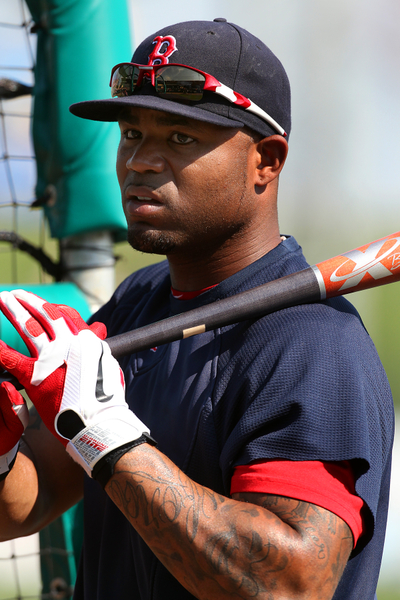
The Red Sox flexed their financial muscle with the Crawford signing, agreeing to a contract in the range of what most people expected for the left fielder. His first 58 plate appearances of 2011 notwithstanding, Crawford adds offensive value with his bat and a little more with his basestealing. Still, Corey Hart and Nick Swisher offer similar offensive production, and they wouldn't have gotten seven-year deals or $20MM salaries as free agents. Instead, the Crawford signing appears to be the biggest investment in defense we've ever seen.
Only a few teams could afford to pay Crawford over $100MM, but the battle to obtain Gonzalez was a level playing field. The superstar first baseman earns just $6.3MM this year, about a quarter of his market value. Acquiring him for the 2011 season meant luxury tax savings and no draft pick cost. Gonzalez instead cost three significant young players. Kelly is a consensus top 50 prospect, and Rizzo fits into the top 75. Fuentes is also highly regarded.
Even dealing with the GM who knows Boston's farm system best, Jed Hoyer, Epstein made a good win-now move in acquiring Gonzalez. A trade like this makes more sense for the Red Sox than waiting for the prospects to develop. Another benefit: Gonzalez was willing to sign a below-market contract and didn't require the 2011 salary to be overwritten.
The Buchholz extension was of a different type; the Red Sox guaranteed him almost $30MM in the name of three free agent years and possible arbitration savings. This has been an effective strategy for Boston, but as it gains in popularity the prices rise and the deals become less team-friendly. Though Buchholz's 2.33 ERA earned him a sixth-place Cy Young finish last year, Baseball Prospectus' SIERA put him at 4.29. The top-notch ERA estimator placed Kevin Slowey and Luke Hochevar in the same ballpark, so Buchholz isn't an ace yet. Like Jon Lester after '08, the Sox need Buchholz to take another step forward to make this contract a big win.
Epstein's bullpen tinkering brought in Jenks, Wheeler, Okajima, Albers, Aceves, plus several lefties on minor league deals. The Red Sox could have purchased a more established southpaw, looking at the free agent market.
I agree with the decision to exercise Ortiz's option, even if $12.5MM seems steep compared to certain DH signings. Victor Martinez and Adam Dunn required at least that much, plus four-year commitments, to essentially serve as DHs. The trio is a cut above players like Vladimir Guerrero, Hideki Matsui, and Jack Cust.
Waiting until the Gonzalez extension became official allows me to talk about Boston's slow start; they're 5-10 at the time of this writing. This is a concern. If you pegged them as a 95 win team back in March and consider the first 15 games a fluke, they're projected now to win 91 games. Unless the team balances their start by reeling off a winning streak, I think they'll be aggressive in seeking trade deadline upgrades.
Photo courtesy of Icon SMI.
2012 Contract Issues: San Diego Padres
The Padres are next in our 2012 Contract Issues series.
Eligible For Free Agency (3)
- Heath Bell may not finish the season with the Padres, though he hopes for a three-year extension. If he reaches the open market he'll be joined by several other solid stoppers.
- The Padres chose to tender a contract to Ryan Ludwick, paying him more than he'd have earned on the open market. So far, he hasn't done anything in his Padres career.
- Jorge Cantu took an 86% pay cut this year as he attempts to re-establish himself.
Contract Options (3)
- Aaron Harang: $5MM mutual option with a $500K buyout. The mutual option is basically a way to transfer some money to the next fiscal year. Rarely do both sides pick one up.
- Brad Hawpe: $6MM mutual option with a $1MM buyout.
- Chad Qualls: $6MM club option with a $1.05MM buyout. Though this is a club option, the goal here again appears to be pushing off some money to next year. Qualls would need a really strong season for the Padres to pick this up.
Arbitration Eligible (14)
- First time: Clayton Richard, Luke Gregerson, Nick Hundley, Will Venable, Joe Thatcher, Rob Johnson, Eric Patterson
- Second time: Chase Headley, Tim Stauffer, Dustin Moseley, Chris Denorfia, Alberto Gonzalez
- Third time: Mike Adams, Pat Neshek
Though not all 14 will get to the point of being tendered a contract, the Padres have many raises due. As a whole, I think the Padres' arbitration eligible players could be paid as much as $25MM in 2012.
2012 Payroll Obligation
The Padres have a 2012 payroll obligation of just $13.55MM, according to Cot's, most of which is for their middle infield. Add in their arbitration eligible players and payroll could approach $40MM before the minimum salary players are accounted for, which is normal for this club since '09.
Athletics Acquire David Purcey
The Athletics acquired lefty David Purcey from the Blue Jays for minor league reliever Danny Farquhar, tweets Ken Rosenthal of FOX Sports. The deal is now official. The A's cleared a space on the 25-man roster by putting Dallas Braden on the DL, and gained a spot on the 40-man by transferring Rich Harden to the 60-day DL, tweets Jon Paul Morosi of FOX Sports.
Purcey, 29 in a few days, was designated for assignment by the Jays last week. He drew "very strong" interest, according to GM Alex Anthopoulos. The former first-rounder is out of options, so the A's must keep him in the Majors or attempt to pass him through waivers. Purcey, who switched to the bullpen to start the 2010 season, has battled control problems for much of his career. He's always posted strong strikeout rates, averaging 92-93 miles per hour on his fastball since converting to the bullpen.
Though they sandwiched an elbow strain, Purcey's '07 and '08 stints in the minors did include good control. Purcey seemed to be on to something in '08, finishing the season in the Majors and tossing a couple of eight-inning gems. MLB.com's Jane Lee has a bit more on Purcey, after talking to A's assistant GM David Forst.
Farquhar, 24, returns to his old organization after a brief stint this year as a Sacramento River Cat. The A's had acquired him in November as part of the Rajai Davis deal with Toronto. He posted a 3.52 ERA, 9.3 K/9, 4.9 BB/9, and 0.8 HR/9 in 76 2/3 Double-A relief innings last year. Baseball America ranked him 22nd among A's prospects, noting that his "defining characteristic is his use of two different arm angles."
Last Players Under Contract
When signing players to long-term deals, teams are forced to look many years into the future. Let's take a look at which player is locked up the longest for each club (guaranteed salaries only).
- Angels: Vernon Wells, paid $21MM in 2014.
- Astros: Wandy Rodriguez, paid $13MM in 2013.
- Athletics: Trevor Cahill, paid $12MM in 2015.
- Blue Jays: Jose Bautista, paid $14MM in 2015. Ricky Romero, paid $7.5MM in 2015.
- Braves: Dan Uggla, paid $13MM in 2015.
- Brewers: Ryan Braun, paid $12MM in 2015.
- Cardinals: Matt Holliday, paid $17MM in 2016.
- Cubs: Alfonso Soriano, paid $18MM in 2014.
- Diamondbacks: Justin Upton, paid $14.5MM in 2015.
- Dodgers: Chad Billingsley, paid $12MM in 2014.
- Giants: Barry Zito, paid $20MM in 2013.
- Indians: Travis Hafner, paid $13MM in 2012.
- Mariners: Felix Hernandez, paid $20MM in 2014.
- Marlins: Hanley Ramirez, paid $16MM in 2014.
- Mets: Johan Santana, paid $25.5MM in 2013. Jason Bay, paid $16MM in 2013.
- Nationals: Jayson Werth, paid $21MM in 2017.
- Orioles: Nick Markakis, paid $15MM in 2014.
- Padres: Jason Bartlett and Orlando Hudson, paid $5.5MM in 2012.
- Phillies: Ryan Howard, paid $25MM in 2016.
- Pirates: Kevin Correia, paid $3MM in 2012. Matt Diaz, paid $2MM in 2012.
- Rangers: Adrian Beltre, paid $18MM in 2015.
- Rays: Wade Davis, paid $4.8MM in 2014.
- Reds: Jay Bruce, paid $12.5MM in 2016.
- Red Sox: Adrian Gonzalez, paid $21.5MM in 2018.
- Rockies: Troy Tulowitzki, paid $14MM in 2020.
- Royals: Billy Butler, paid $8MM in 2014.
- Tigers: Miguel Cabrera, paid $22MM in 2015.
- Twins: Joe Mauer, paid $23MM in 2018.
- White Sox: Alexei Ramirez, paid $10MM in 2015.
- Yankees: Alex Rodriguez, paid $20MM in 2017.
The Rockies have the last player under contract at the moment, with Tulowitzki's deal running through the 2020 season (and there's a club option for 2021). Meanwhile the future is wide open for the Pirates, who are committed to just $5MM in 2012 salaries and nothing beyond next year.
Blue Jays Acquire Yohan Pino
The Blue Jays acquired righty Yohan Pino from the Indians for cash considerations, according to the Tribe's Twitter page.
Pino, 27, posted a 5.75 ERA, 7.0 K/9, 2.9 BB/9, and 1.5 HR/9 in 26 Triple-A starts last year, but was working out of the bullpen in Double-A this year. He'd joined the organization in August of '09 as the player to be named later in the Carl Pavano deal with the Twins. Pino last cracked a Baseball America handbook four years ago, when his command was said to rank among the best in the Twins' organization.