
Twins, Brewers Enter Offseason In Position To Spend
Each year, our top ranking of the top 50 free agents and their projected contracts/destinations prompts many to raise an eyebrow. In the now five years that I’ve spent contributing to that behemoth of a post, though, I’m not sure I can recall a more unpopular pick with readers than the notion that Jake Arrieta could sign with the Brewers for what would be the largest free-agent signing in Milwaukee’s franchise history. The notion that the Brewers would win a bidding war isn’t one to which most are accustomed. Milwaukee signed Matt Garza to a four-year, $50MM contract prior to the 2014 season and has, at times, played in the second tier of free agency. But the Brewers are among baseball’s smallest markets, and placing Arrieta there admittedly felt odd even for us.
The question we kept asking, however, is: Why should it? The Brewers are one of two teams we kept coming back to that are in a position to act in a manner in which we’ve never really seen them act before. The other is just a five-hour drive to the west, in Minneapolis. I’m not suggesting that it’s a slam dunk that we’ll see the Brewers and Twins shatter their longstanding small-market perception; however, there’s an argument to be made for both teams to give serious consideration to spending far more aggressively this winter than they have in years past.
The 2017 season was a similar tale for both the Brewers and the Twins. Each club was largely written off heading into the 2017 season as they sought to continue rebuilding with an eye more toward 2018 and beyond than toward 2017. Last winter, the Twins’ biggest expenditure was a $24.5MM contract for veteran catcher Jason Castro. The Brewers spent $16MM on KBO reclamation project Eric Thames. The moves were not met with excessive fanfare.
But both the Brewers and Twins saw the majority of their young, potential core pieces take a step forward. Travis Shaw and Domingo Santana broke out with three-win seasons in Milwaukee, while Thames made good on his investment. Jimmy Nelson, Chase Anderson and Zach Davies led a surprisingly strong rotation, and Corey Knebel announced his presence as one of the best relievers on the planet.
Over in Minnesota, Byron Buxton rebounded from a terrible start and batted .274/.333/.452 over his final 459 PAs with elite defense. Miguel Sano hit 28 homers in 114 games before a stress reaction from a foul ball to the shin cut his season short. Eddie Rosario belted 26 homers, Jorge Polanco posted a 128 wRC+ in the second half, and Jose Berrios established himself as a useful big league starter. Joe Mauer even quietly rebounding to hit .305/.384/.417 (116 wRC+).
Suddenly, both teams look like potential contenders not just in 2018 but for the foreseeable future. The Twins share a division with the rebuilding White Sox and Tigers. The Royals are set to lose Eric Hosmer, Lorenzo Cain and Mike Moustakas to free agency after already having bid adieu to Wade Davis and Greg Holland in recent years. In 2018, at least, the AL Central outlook is promising for the Twins and the Indians.
Milwaukee will have to deal with the Cubs, Cardinals and Pirates in 2018, but the Bucs had a tough season and will soon have to seriously entertain trade offers for both Andrew McCutchen (a free agent next winter) and Gerrit Cole (a free agent the following offseason). The Cardinals are expected to radically alter their roster after a pair of disappointing seasons. The Cubs have work to do on the pitching front. Any of those teams could contend next year.
One advantage that both the Brewers and Twins have over their division rivals, though, is a largely blank payroll slate moving forward. Even after arbitration projections, the Twins have just $85.5MM on the books for the 2018 season. After the coming year, that commitment drops to $24MM. Minnesota doesn’t have a single dollar committed to the books in 2020.
It’s an even more favorable situation in Milwaukee (at least as far as 2018 is concerned). The Brewers have just $55MM committed payroll (including arbitration projections) and $31.5MM of guaranteed cash on the 2019 books. The recent extension of Chase Anderson gives them club options over the right-hander for the 2019-20 seasons, and Milwaukee also holds a 2020 option on Thames. Ryan Braun is the only guaranteed contract on the 2020 ledger, and his front-loaded deal will call for just a $16MM salary that season. That wide-open payroll was a large reason that the Brewers were connected to Justin Verlander on the summer trade market; the injury to Jimmy Nelson perhaps only adds impetus to the pursuit of a significant hurler.
Further working in the favor of both traditionally low-payroll clubs is the fact that many of the big-market teams that typically dominate free agency are either taking a step back on spending in 2017-18 or figure to focus their spending on areas other than the Twins and Brewers, who both need pitching help. It’s possible to imagine scenarios where the best pitchers don’t generate feverish bidding frenzies — perhaps allowing surprise suitors to participate in the market in a more measured way than the Diamondbacks did with their sudden and massive outlay for Zack Greinke.
The Yankees, for instance, have bluntly stated that they plan to get under the luxury tax barrier in advance of the 2018-19 mega crop of free agents (featuring Bryce Harper, Manny Machado, Josh Donaldson, Charlie Blackmon, Clayton Kershaw, Craig Kimbrel and many others). The Red Sox’ primary focus seems like it’ll be on adding a significant bat to the lineup rather than adding arms. The Giants have often played at the top of the free-agent market, but they’re already on the cusp of the luxury tax threshold before making a single move. The Angels have money to spend but have already committed to Justin Upton and still need to add a pair of infielders. The Tigers won’t spend much this winter as they kick off an aggressive rebuild. The Rangers are attempting to scale back their payroll by $10MM or so. The Nationals surpassed the luxury tax line in 2017 and already have a pair of $25MM+ annual salaries in Max Scherzer and Stephen Strasburg.
There will still be large-market teams looking to spend, of course. The Cubs need to add at least two arms in the rotation and could conceivably target as many as three bullpen additions. The Dodgers have reportedly been aiming to gradually pare back the payroll but of course still figure to spend some money this offseason, even if this current front-office regime hasn’t made a habit of top-level free-agent expenditures. Even the Phillies, once one of the team’s highest-payroll clubs prior to this rebuild, could begin throwing some dollars around this winter now that several of their own young players (e.g. Rhys Hoskins, Aaron Nola, Aaron Altherr, Odubel Herrera, Nick Williams) are showing promise at the big league level with others on the cusp.
That said, the Twins and Brewers nonetheless find themselves in the unique position of having pristine long-term payroll outlooks with a burgeoning young core carving out its foothold in the Majors. With several big-market teams likely to eschew massive contracts, they’ll have the opportunity to perhaps be unusually competitive when it comes to names for whom they’d traditionally be outbid. None of this is to say that Minnesota or Milwaukee should be considered the odds-on favorites to sign a Yu Darvish or Jake Arrieta, but it stands to reason that both could consider those types of moves far more closely than we’re traditionally accustomed to seeing. In fact, as I was finishing writing this piece, FanRag’s Jon Heyman reported that the Twins are indeed expected to consider a run at top-tier names like Darvish, Arrieta, Alex Cobb and Lance Lynn. And Brewers owner Mark Attanasio told Tom Haudricourt of the Milwaukee Journal-Sentinel in late September that the team’s financial flexibility may allow it to “punch a little bit above [its] weight.”
Trades will, as ever, factor into the decision-making process for both clubs this winter. Each still has a number of intriguing prospects despite the significant amount of graduations in recent years, and there’s something to be said for pursuing a controllable arm from the Rays, Pirates or Cardinals — organizations that possess multiple intriguing young pitchers that could conceivably be dangled on the trade market this offseason. However, those markets figure to be ultra-competitive, and part of the way in which the Twins and Brewers got to their current standpoint was by stockpiling young prospects and filling out their roster with that talent. Maintaining a quality pipeline of high-upside talent will remain a priority in both markets.
All of which leads back to the idea that the Twins, who haven’t topped $110MM in payroll since 2011, and Brewers, who have never opened the season with even a $105MM payroll, could be more aggressive than any would expect based on history. Some will roll their eyes at the notion, and it may prove in the end that neither lands a top-ranked free agent, but both Milwaukee and Minnesota are in excellent position to alter their image this offseason if they find an opportunity to their liking.
Brewers Outright Carlos Torres, Quintin Berry
The Brewers have announced the removal of two players from the team’s 40-man roster. Right-hander Carlos Torres and outfielder Quintin Berry have each been outrighted to Triple-A.
With the move, Milwaukee is effectively sending both into free agency. Torres has the right to refuse the assignment by virtue of his MLB service time. Berry does not, but will nevertheless qualify for minor-league free agency.
Torres, who recently turned 35, contributed 72 2/3 innings of 4.21 ERA ball in 2017. Despite the generally decent results, his strikeout and walk rates worsened from a productive 2016, in which Torres had provided Milwaukee with a 2.73 earned run average over 82 1/3 frames.
There’s some reason to believe that Torres can continue to succeed even at his relatively advanced age. Notably, he averaged a career-best 93.4 mph with his two-seamer. But the Brewers obviously did not feel it was worth staking a projected $3.3MM to retain Torres via arbitration, so he’ll seek another opportunity via free agency.
As for Berry, who’ll soon turn 33, he only briefly cracked the majors. Indeed, he has seen scant MLB action since a 94-game run with the Tigers back in 2012. The fleet-footed Berry will likely end up finding a minors deal to serve as Triple-A depth and provide a possible defense and baserunning option down the stretch.
Minor MLB Transactions: 10/31/17
Here are the day’s minor moves:
- Righty Tim Dillard will be back where he belongs in 2018, as he’ll remain in the Brewers organization after agreeing to a minor-league pact. The 34-year-old, who was a contributor to MLBTR during the 2017 campaign, tweets that he has agreed to return for his 16th campaign with the club. Dillard has not pitched at the major league level since 2012, but has carved out a niche at Triple-A. Those unfamiliar with Dillard will want to follow the above links to learn more about one of the game’s most uniquely situated players.
- Veteran middle infielder Ramon Santiago is officially retiring, as Danny Knobler reports. Now 38 years of age, the 13-year MLB veteran last suited up at the game’s highest level back in 2014 and had not played affiliated ball in the last two season. Santiago appeared in 920 total MLB contests — most of them with the Tigers — and posted a cumulative .243/.314/.330 batting line. There’s more information on Santiago’s career available at the above link. He’s presently focused on being with his family, it seems, but also hopes to get back in the game as a coach at some point.
NL Central Notes: Bell, Anderson, Brewers, Ross
The Reds have hired Buddy Bell for a senior advisor position in their front office, MLB.com’s Mark Sheldon reports (Twitter link). The team is expected to officially announce Bell’s hiring tomorrow. Bell, who managed the Tigers, Rockies and Royals from 1996-2007, has been working in the White Sox front office for the last decade, most recently acting as Chicago’s assistant GM. This will be Bell’s second stint in Cincinnati, as he played for the Reds from 1985-88 during his 18-year career in the big leagues. The Bell family has long-standing ties in Cincinnati — Gus Bell (Buddy’s father) spent eight seasons with the Reds and is in the team’s Hall of Fame, while Buddy’s sons Mike and David also spent time with the Reds as a player and minor league manager, respectively.
Here’s more from around the NL Central…
- Chase Anderson discussed his contract extension in a conference call with reporters (including Tom Haudricourt of the Milwaukee Journal Sentinel), noting that he was eager to put pen to paper after solidly establishing himself as a quality starter. “Going into last season, I wasn’t sure I’d be in the rotation. But it showed me what I really could do and opened up different windows for me,” Anderson said. “I always wanted a multi-year contract once I got into this position. When the team offers you an extension and it’s guaranteed money, it’s hard to turn it down.” While he had three arbitration-eligible years remaining as a Super Two player, Anderson also turns 30 in November, so one can’t fault him for wanting to lock in a big payday. The righty will earn at least $11.75MM from the contract’s two guaranteed years, and he could an addditional $29.25MM in 2020-21 should the Brewers exercise their two club options.
- From that same conference call, Brewers GM David Stearns said the team is in discussions with some other players about multi-year contracts. Stearns didn’t cite any names, though arbitration-eligible closer Corey Knebel seems like a logical candidate, as do pre-arb building blocks like Domingo Santana or Travis Shaw.
- Now that Dave Martinez has been hired as the Nationals’ new manager, David Ross seems like a logical candidate to step into Martinez’s old role as the Cubs‘ bench coach. Two sources tell NBCSports.com’s Patrick Mooney, however, that it could be difficult for Ross to commit to the season-long job, given his family commitments and various off-the-field endeavors. Ross is so widely respected around the game that he “can pretty much write his own job description” whenever he wants to dive back into a full-time baseball job. Mooney suggests that Cubs first base coach Brandon Hyde could be an internal candidate for the bench coach position.
Brewers Re-Sign Eric Sogard
The Brewers announced Thursday that they’ve re-signed infielder Eric Sogard to a one-year, Major League contract. Sogard had been set to hit free agency but will instead return to the Brewers rather than test the open market.
[Related: Updated Milwaukee Brewers depth chart]

Sogard will receive a guarantee of $2.4MM plus $650K worth of possible incentives. That includes $150K apiece upon playing in his 30th, 50th, 70th, and 90th games as well as another $50K if he raches 120 games played. Octagon brokered the deal on the player’s side.
Sogard, 31, inked a minor league deal with the Brewers last winter after missing the 2016 season due to knee surgery. The longtime A’s infielder came to Milwaukee with a reputation as a plus defender with a light bat but posted a career-year at the dish in 2017. After having his contract selected in mid-May, Sogard turned in a .273/.393/.378 batting line with three homers, 15 doubles and a triple over the life of 299 plate appearances.
Most of Sogard’s defensive reps came at second base with the Brewers, but he also played shortstop and third base in addition to logging eight innings in left field with Milwaukee. The knee injury that cost him the 2016 season didn’t appear to have any adverse effect on Sogard, as Defensive Runs Saved pegged his work at second base as five runs above average (in just 365 innings) and his glovework at shortstop at two runs above average (160 innings).
“Eric brings to the team a veteran presence who possesses the ability to play multiple positions and reach base at a high rate,” said general manager David Stearns in a press release announcing the move. “We are pleased to welcome Eric and his family back to Milwaukee for the 2018 season.”
SB Nation’s Chris Cotillo (via Twitter) and MLB.com’s Adam McCalvy (Twitter link) reported financial details.
Photo courtesy of USA Today Sports Images.
Brewers Extend Chase Anderson
8:40am: McCalvy provides additional financial details (Twitter link): Anderson will receive a $1MM signing bonus and is guaranteed salaries of $4.25MM in 2018 and $6MM in 2019. The contract also has $400K worth of incentives available each year.
8:34am: The two options are valued at $8.5MM and $9.5MM, MLBTR has learned (Twitter link). Both contain $500K buyouts.
8:26am: Anderson will be guaranteed $11.75MM over the two guaranteed years of the deal, reports FanRag’s Jon Heyman (on Twitter). MLB.com’s Adam McCalvy, meanwhile, tweets that Anderson can earn up to $31.35MM over the four years if both options are exercised and if Anderson meets all of the incentives that are baked into the deal.
8:05am: The Brewers announced this morning that they’ve signed right-hander Chase Anderson to a two-year contract that runs through the 2019 season and contains club options for the 2020 and 2021 seasons. Anderson, a client of Hub Sports Management, was arbitration-eligible for the second time as a Super Two player this winter. The new contract gives Milwaukee cost certainty over his final three arbitration years and as well as control over one would-be free-agent season.
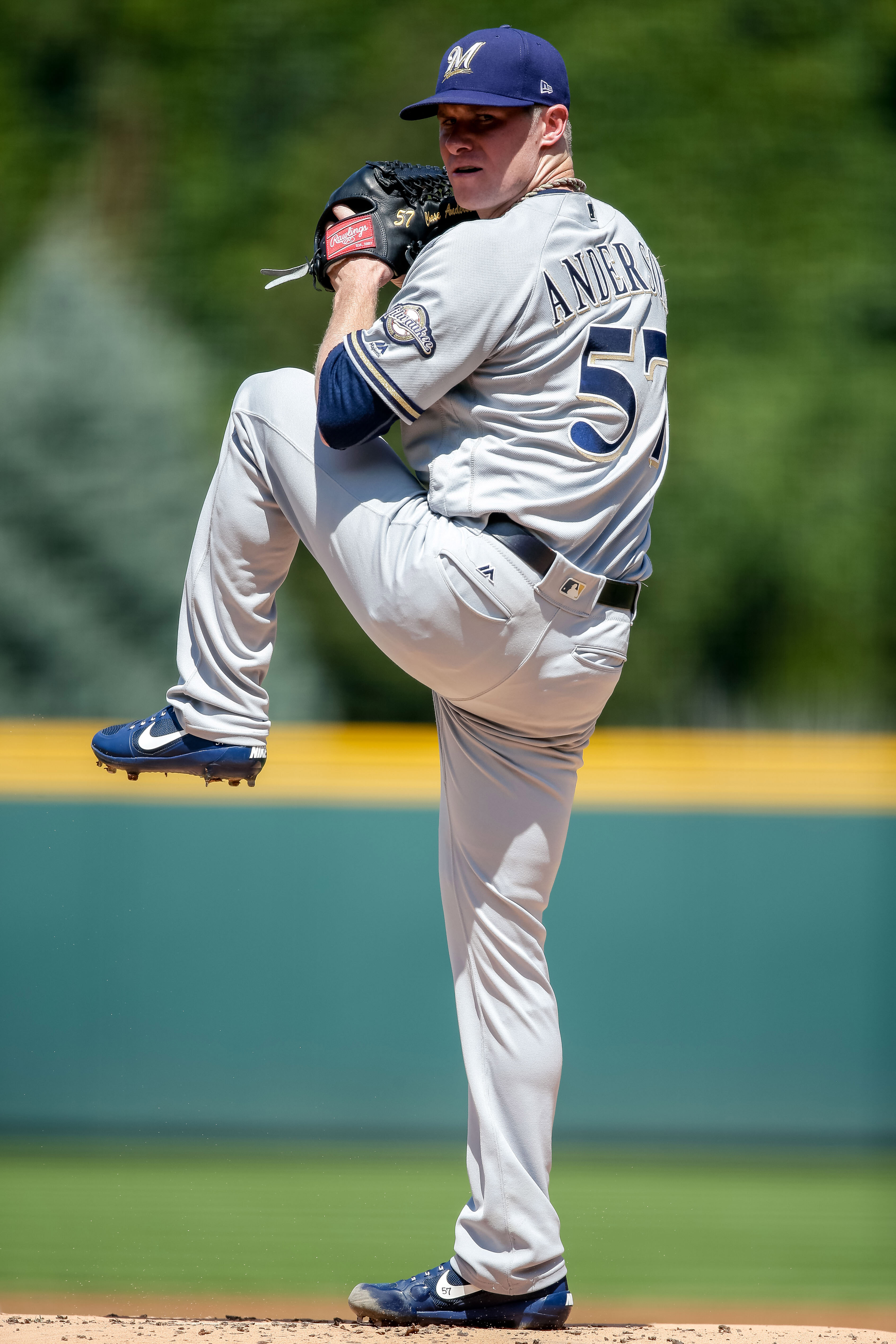
“Signing Chase to a multi-year contract furthers our strategy to acquire, develop and retain talent throughout our organization,” said Brewers GM David Stearns in a press release announcing the new contract. “Chase’s 2017 performance elevated his stature in the game and demonstrated that he has the capability to lead a rotation. Since he arrived in Milwaukee, Chase has been a model contributor to our community both on and off the field. We are happy for him and his family and look forward to Chase’s contributions for years to come.”
Anderson, 30 next month, was originally acquired alongside prospect Isan Diaz in the trade that sent Jean Segura from Milwaukee to Arizona. The righty has been a stable source of useful innings since debuting with the D-backs in 2014 but elevated his game to a new level in his second season with Milwaukee. This past season, Anderson broke out with a 2.74 ERA, 8.5 K/9, 2.6 BB/9 and a 39.2 percent ground-ball rate in 141 1/3 innings.
Anderson’s velocity jumped a bit in 2017, and in addition to his career-high K/9 rate, he also posted career-best marks in swinging-strike rate and opponents’ contact rate. Beyond his velocity increase, Anderson also began throwing more cutters and curveballs at the expense of his changeup and four-seam fastball — and the results were clearly favorable. An oblique injury cost him nearly two months of his season this summer, but outside of a minor triceps issue in 2015, Anderson has never been on the MLB disabled list with an arm injury.
Moving forward, Anderson figures to play an even larger part in the Milwaukee rotation, as the Brewers are not yet certain what to expect out of emergent ace Jimmy Nelson in 2018. Nelson underwent shoulder surgery last month, and it’s known that he’ll miss a notable portion of the upcoming regular season, though the team has yet to put a specific timeline on his recovery or project a return date. Anderson will be joined in the rotation by young righty Zach Davies, though as noted in MLBTR’s Offseason Outlook on the Brewers, the Brewers possess several options but few locks beyond those two spots. In all likelihood, that pair will be joined by at least one starting pitcher that isn’t currently in the organization.
Photo courtesy of USA Today Sports Images.
Offseason Outlook: Milwaukee Brewers
MLBTR is publishing Offseason Outlooks for all 30 teams. Click here for the other entries in this series.
In what most expected to be another transitional season, the Brewers spent much of the year in contention for the NL Central title and finished just shy of an NL Wild Card berth. With an 86-76 record under their belts and a promising core of controllable players, the Brewers will no longer enter the offseason with a “rebuilding” label and will instead likely add pieces with an eye toward winning in 2018 and beyond.
Guaranteed Contracts
- Ryan Braun, OF: $57MM through 2020 (includes buyout of 2021 option)
- Eric Thames, 1B/OF: $12MM through 2019 (includes buyout of 2020 option)
Arbitration-Eligible Players (Service time in parenthesis; projections via MLBTR contributor Matt Swartz)
- Jared Hughes (5.162) – $2.2MM projected salary
- Carlos Torres (5.114) – $3.3MM
- Jeremy Jeffress (4.104) – $2.6MM
- Stephen Vogt (4.084) – $3.9MM
- Chase Anderson (3.146) – $5.4MM
- Jonathan Villar (3.113) – $3.0MM
- Jimmy Nelson (3.107) – $4.7MM
- Hernan Perez (3.079) – $2.2MM
- Corey Knebel (2.151) – $4.1MM
- Non-tender candidates: Torres, Jeffress, Vogt
Free Agents
[Milwaukee Brewers Depth Chart | Milwaukee Brewers Payroll Outlook]
General manager David Stearns and his staff caught some flak from Brewers fans this summer for not acting more aggressively to add pieces to a surprising contender. While flipping prospects Ryan Cordell and Eric Hanhold to add a pair of solid veteran rentals (Swarzak and Walker) definitely strengthened the roster, the division-rival Cubs went for broke and shelled out multiple top prospects for Jose Quintana, Justin Wilson and Alex Avila. It’s possible that had the Brewers splurged in similar fashion, adding Quintana or Sonny Gray, that they could’ve emerged as the NL Central champs, but Stearns & Co. steadfastly refused to part with top-echelon prospects — most notably center field prospect Lewis Brinson. Now, they’ll spend the offseason looking for long-term help while holding onto the luxury of plugging Brinson and other top prospects into the lineup in the near future.
Starting on the position-player side of the equation, the Brewers made several then-unheralded moves in the 2016-17 offseason that now look to have helped form a solid nucleus. Manny Pina enjoyed a breakout behind the plate and should at the very least be in an even timeshare with Stephen Vogt (or another veteran backstop should Vogt be non-tendered). Eric Thames cooled after a Cinderella start to his comeback season in MLB, but his overall numbers were strong. Jesus Aguilar, a waiver claim out of the Indians organization last winter, gives Thames an affordable platoon partner. Travis Shaw, meanwhile, was deemed expendable by the Red Sox with Rafael Devers on the horizon and instead broke out as one of the NL’s best third basemen after the Brewers acquired him in a December trade.
Top prospect Orlando Arcia showed quite well at shortstop as the season wore on, and the Brewers will return Braun and Domingo Santana as corner outfield options with plenty of pop. (Thames, too, can play some corner outfield.) Keon Broxton saw the bulk of the time in center field in 2017 and could be reinstalled there to open the 2018 season if the Brewers want to play some service time games with Brinson. But center field should go to Brinson by midseason, assuming good health, so it’s possible that the Brewers will look to shop Broxton this summer. His 37 percent strikeout clip is an eyesore, but Broxton has plenty of speed and power, and he handles center field well enough. Brett Phillips gives the Brew Crew another option in center, should they ultimately move Broxton, or he could simply spell Braun, Broxton and Santana in a semi-regular role.
The biggest question mark for the Brewers, then, is at second base. Jonathan Villar had a breakout 2016 season, but the Brewers likely feel as though they dodged a bullet when Villar reportedly rejected a contract extension last offseason. The 26-year-old’s strikeout woes returned stronger than ever in 2017, and he hit just .241/.293/.372 in 436 PAs. Veteran Eric Sogard saw plenty of action at second base as Villar lost playing time, and Walker stepped in and hit well there following his acquisition. With both Walker and Sogard set to hit the open market, the Brewers will need to decide whether they can once again trust Villar or if external reinforcements are needed.
Re-signing Sogard to an affordable one-year deal could provide some insurance, but the Brewers must now also think more like a contender. If there’s an obvious hole to fill, they’ll likely covet more certainty. Milwaukee had interest in Ian Kinsler before the non-waiver deadline, and he’s all but certain to be traded by the Tigers this winter. Re-signing Walker would be more expensive than retaining Sogard, though he’d bring more reliable production. Other free-agent options are fairly thin, though Howie Kendrick and Eduardo Nunez could stabilize the spot. The trade front is more interesting, where Philadelphia’s Cesar Hernandez and Miami’s Dee Gordon will both be available. Gordon is owed $38MM over the next three seasons, but the Brewers can afford to take on some significant financial commitments this winter.
It’s also worth mentioning that Braun’s name figures to once again surface in trade rumors at least occasionally this offseason. However, he’s coming off his worst season since 2014 and has full veto power over any trades (to say nothing of the $57MM he’s still owed through 2020). A deal doesn’t seem particularly likely.
On the pitching front, things are far less clear for the Brewers. Emergent ace Jimmy Nelson will miss a yet-unreported amount of time in 2018 following shoulder surgery. That leaves Chase Anderson and Zach Davies as the two locks for rotation spots. Brent Suter performed well in 14 starts, but he’s averaged just 124 1/3 innings across the past three seasons. Relying on him for 170+ frames would be difficult, but he’ll certainly be in next year’s rotation mix. Righty Brandon Woodruff showed flashes of potential but didn’t cement himself, while Junior Guerra posted terrible numbers in his followup to his out-of-the-blue rookie success at age 31. Touted prospect Josh Hader shined in the bullpen, but the lefty will likely get a look as a starter next year.
The Brewers look as though they’ll need to add at least one established starter, and making a second, smaller-scale addition wouldn’t be unwise. One glance at the “guaranteed contracts” section above is evidence that they could afford to spend as aggressively as they wish this offseason, though the team’s lower payroll ceiling creates less margin for error when shelling out cash to a Jake Arrieta or Yu Darvish. Second-tier names like Alex Cobb or Lance Lynn seem much more plausible, though their last foray into that price range (Garza) didn’t pan out.
Alternatively, the Brewers have an exceptionally deep farm — deep enough that they can acquire both one-year rentals and more controllable options. Given the Brewers’ questionable on-paper rotation, relatively blank payroll slate and wealth of prospects, there are literally dozens of scenarios on which to potentially speculate. Suffice it to say — they’ll be connected to a plethora of arms this winter.
The Milwaukee bullpen brings a bit more clarity. Corey Knebel broke out as one of the game’s most dominant relievers, posting baseball’s fourth-highest strikeout percentage and second-highest K/9 rate in 2017. His walk rate is still troublesome, but Knebel functioned as a genuinely elite bullpen weapon in his record-setting 2017 season (most consecutive relief appearances with at least one strikeout). If Hader isn’t in the rotation, he’ll be back in the bullpen, pairing with Knebel to create a formidable duo. Jacob Barnes and Jared Hughes should return as additional right-handed options. Jeffress is a fan favorite in Milwaukee and showed improvement after returning in a July 31 trade, but his overall output makes less certain to be brought back. I’d still expect him to be tendered, though perhaps at a lower rate than the projected $2.6MM sum, as our algorithm doesn’t factor in context such as Jeffress’ off-the-field issues.
Swarzak was terrific after being acquired from the White Sox, so a potential reunion with him is something the Brewers will surely explore. Milwaukee also needs to add at least one left-handed reliever — if not two, depending on what happens with Hader. The Brewers were without a southpaw reliever for much of the year and certainly would prefer to have greater matchup flexibility in 2018 and beyond. Tyler Webb is one intriguing internal option, and the free-agent market bears names such as Jake McGee, Brian Duensing and Tony Watson. As ever, the trade market will be rife with options in this department, though Brad Hand stands out as the likeliest name to be bandied about on the rumor mill this winter.
An oft-overlooked component of the offseason among fans is the possibility of extending core pieces. While many focus on what pieces can be added to a contending core (or shipped off of a rebuilding roster), the Brewers are in a strong position to obtain some cost certainty and perhaps some additional club control over long-term cornerstones. After trying to do with Villar last winter, they’ll likely try once again with other targets as Spring Training nears in 2018. Arcia, Shaw and Davies all make sense as candidates for a long-term pact. Anderson does as well, to a lesser extent. He’s already controlled through his age-32 season, but the club could try to buy out his arbitration years in one fell swoop and possibly tack on a club option over his age-33 season in exchange for the up-front payday. As a late bloomer, he could be more amenable to that type deal than some younger arms would be.
The Brewers enter the 2017-18 offseason with a sizable portion of a contending club already in place, though they’ll still need to make some adjustments — most notably at second base and on the pitching staff. Their unexpected status as contenders in 2017 has undoubtedly accelerated their timeline to contention, though, and their deep stash of prospects and pristine long-term payroll ledger should give Stearns and his charges plenty of opportunities to creatively supplement a roster that roster that looks infinitely better than it did one year ago at this time.
Front Office/Managerial Notes: Marlins, Brewers, Tigers
The latest front office and managerial updates from around the majors:
- Yankees vice president of player development Gary Denbo is leaving the Bombers to become the Marlins’ director of player development and amateur scouting, George A. King III of the New York Post reports (on Twitter). Denbo will work under Michael Hill, who will stay on as the Marlins’ president of baseball operations, Barry Jackson of the Miami Herald tweets. Since a group including former Yankees shortstop Derek Jeter agreed to purchase the Marlins in August, there had been plenty of speculation about Denbo heading to Miami. Denbo served in various capacities during multiple stretches with the Yankees dating back to the 1990s and even managed Jeter in the Gulf Coast League in 1992. The two still have a close relationship, paving the way for Denbo to reunite with Jeter in Miami. The Marlins haven’t requested permission to speak with anyone else from the Yankees’ front office, per Mark Feinsand of MLB.com (Twitter links).
- The Brewers’ David Stearns-led front office has promoted Karl Mueller to vice president of player personnel, Matt Kleine to director of baseball operations and Scott Campbell to special assignment scout, according to a team announcement. Mueller, a 14-year veteran of Milwaukee’s baseball department, spent the past two seasons in Kleine’s new position. Kleine, who’s entering his 12th year with the Brewers, most recently served as their manager of baseball operations. Campbell, yet another longtime member of the organization (he’s entering his 13th year), was the Brewers’ assistant director of video scouting from 2015-17.
- Royals catching instructor Pedro Grifol is an early candidate to become the Tigers’ next manager, Jon Morosi of MLB Network tweets. Grifol has served in that position since 2014. He also has experience as a major league hitting coach (Royals, 2013-14) and a minor league manager (with low-level Mariners affiliates from 2003-05 and in 2012)
Five Brewers Minor Leaguers Select Free Agency
Right-handers Wily Peralta, Rob Scahill, Michael Blazek, David Goforth, and outfielder Kirk Nieuwenhuis have all elected to become free agents, as per the Brewers’ player development Twitter feed (tip of the hat to MLB.com’s Adam McCalvy).
Peralta is the most notable name of the bunch, as it wasn’t long ago that the righty looked like a promising part of Milwaukee’s rotation. After posting solid numbers in 2013-14, however, Peralta’s form dipped the next two seasons and then cratered this year, as he managed only a 7.85 ERA over 57 1/3 IP, with 10 homers and 32 walks in that stretch. Peralta wasn’t helped by a month-long DL stint due to a calf strain, but his performance also fell off at the Triple-A level over the last two seasons.
His struggles got him designated for assignment and then outrighted off Milwaukee’s 40-man roster over the summer, which allowed Peralta to elect free agency even though he still had two remaining years of team control thanks to Super Two status. Peralta and the Brewers avoided arbitration by agreeing to a one-year, $4.275MM deal last winter.
Blazek was twice DFA’ed and then outrighted off Milwaukee’s roster this season, so it perhaps isn’t surprising that he’s looking for a chance of scenery, especially given his displeasure at being demoted to the minors during Spring Training. Blazek only made five appearances (one of them a start) for the Brewers in 2017, posting an 8.31 ERA over 8 2/3 innings of work. The righty posted very effective numbers out of Milwaukee’s bullpen in 2015 but ran into some injury problems and struggled in 2016.
Scahill was also twice designated for assignment this season, plus once more back in February. The 30-year-old tossed 22 1/3 innings for the Brew Crew, posting a 4.43 ERA despite recording the same number of strikeouts (10) as walks, though four of those free passes were intentional. Never one to miss many bats over his six years in the bigs, Scahill nevertheless posted a solid 3.03 ERA over 65 1/3 innings for the Pirates and Brewers in 2015-16.
Nieuwenhuis agreed to a split contract last winter and spent much of the season at Triple-A, only appearing in 16 big league games. Nieuwenhuis received the most playing time of his six-year career in 2016 (125 games and 392 PA) but became an afterthought this year as the Crew had more outfield depth.
Goforth appeared in just one game for the Brewers in 2017, and has 36 1/3 Major League innings to his name after appearing in parts of the last three seasons. The right-hander has a 3.96 ERA over 533 2/3 career frames in the minors (all in the Milwaukee organization), though he has had increasing control issues and a lack of strikeouts over the last couple of years.
Central Notes: Brewers, Tigers, McCutchen, Kluber
Second base is “a position we’re going to have to take a long look at,” Brewers GM David Stearns said during the team’s end-of-season meeting with reporters (including Todd Rosiak of the Milwaukee Journal Sentinel). Jonathan Villar‘s struggles required the Brew Crew to trade for Neil Walker in August, and now with Walker headed for free agency and Eric Sogard (another free agent) perhaps best suited for utility duty, a decision will need to be made about giving Villar another chance or perhaps looking for another addition. Starting pitching is another need given the uncertainty surrounding Jimmy Nelson‘s return from a labrum procedure, though manager Craig Counsell said it was too early to consider whether Josh Hader could be moved into a rotation role.
Here’s more from both the NL and AL Central…
- The Tigers will interview Marlins third base coach Fredi Gonzalez and White Sox bench coach Joe McEwing this week about the managerial vacancy, MLB.com’s Jason Beck reports. Angels bench coach Dino Ebel is also on Detroit’s list of candidates, MLB Network’s Jon Morosi tweets. Several other internal (coaches Lloyd McClendon, Omar Vizquel, Dave Clark) and external (Phil Nevin and Charlie Montoyo) have already been linked to the Tigers’ search, which reportedly began with around 50 names in consideration.
- Andrew McCutchen is the key figure of this Pirates offseason, Bill Brink of the Pittsburgh Post-Gazette writes, as the team faces a big decision about trading the long-time star outfielder. Dealing McCutchen would essentially mark the end of an era for the franchise, though it would free up $14.5MM in payroll for 2018 (Brink rightly figures McCutchen’s club option is sure to be exercised by the Pirates) that could then be used to fill other roster holes. McCutchen turns 31 next week and is coming off a solid 2017 season that revived his value following a very disappointing 2016 campaign.
- Corey Kluber was a promising but unheralded young arm in the Padres farm system when he was acquired by the Indians in July 2010, as Cleveland.com’s Bud Shaw revisits the trade that gave the Tribe its ace. Kluber was acquired as part of a three-team deal that saw the Cardinals send Ryan Ludwick to the Padres, while St. Louis picked up Jake Westbrook from Cleveland and Nick Greenwood from San Diego. Indians president of baseball operations Chris Antonetti, then the team’s GM, said they received good scouting reports and “great analytical information” on Kluber that caught their interest, but “at the same time, no one sat there and said we were trading for a future Cy Young winner. We had no idea.”