
In Favor Of MLB’s Brainstorming
MLB and the players are kicking around all kinds of ways to play a season in 2020. In today’s video, Jeff Todd explains why it’s too early to cancel.
Dusting Off The MLBTR Mailbag
It’s been awhile since we’ve asked readers to submit questions for the MLBTR Mailbag. How long? The last mailbag column we did focused on whether the Mets should tender a contract to Matt Harvey for final arb year. The prior mailbag post fielded questions on Diamondbacks slugger J.D. Martinez‘s earning power in free agency and how the Orioles might be better off trading cornerstones like Zack Britton, Manny Machado and Adam Jones than pursuing free-agent rotation upgrades.
Ok — so maybe it’s been more than “awhile.”
Given the lack of news and current uncertain state of the 2020 season, it seems like a reasonable time to open up the floor to some reader questions. Of course, no one knows when or even whether a season will be played this year, so there’s no way to speak with any certainty about the timeline of a return to the sport’s normalcy. But readers who have been wondering about rosters, future classes of free agents, potential trades (whenever the transaction freeze is lifted), extension candidates, etc. — let us know what’s on your mind! Alternatively, if you have a particular topic/subject you’d like to see explored or a new series you’d like to see unfold here at MLBTR, feel free to make a suggestion.
You can submit your questions via email (mlbtrmailbag@gmail.com), via Twitter or just in the comments of this post.
Which Players Will Reach 10-And-5 Rights This Year?
As players continue to bounce around the league with greater frequency for a variety of reasons — teams leaning increasingly toward shorter-term deals, financial incentive to reach free agency, etc. — the number of players gaining 10-and-5 rights have diminished in recent years. For those unfamiliar or those who need a reminder, 10-and-5 rights are granted to a player who has accrued 10 years of MLB service time, including five consecutive years with his current team. These players are given veto power over any potential trade involving them.
It’s rare that a player invokes his 10-and-5 rights, although we’ve seen them come into play in the past. Adam Jones utilized his 10-and-5 provision to block a deal to the Phillies two summer ago, and Brandon Phillips quashed a pair of trades that would’ve sent him out of Cincinnati before he finally acquiesced on a deal sending him to Atlanta.
In other cases, such as Coco Crisp‘s trade from Oakland back to Cleveland in 2016, players are willing to waive that veto power for the right deal and/or some additional financial incentive. Those rights were a major factor in the Rays’ decision to trade Evan Longoria when they did; had he opened the 2018 season with Tampa Bay, he’d have gained full no-trade power just two days into the year.
As a reminder, players will receive a year of service time even if no games are played in 2020. And if a season is played, the service time will be prorated to match the truncated nature of the season. In other words, current big leaguers are going to get their year of service unless they’re optioned to the minors or released.
With all that said, some 10-and-5 rights looming on the horizon (I’ve omitted players such as Buster Posey, whose contracts already included full no-trade protection)…
- Kenley Jansen: Jansen’s five-year, $80MM contract with the Dodgers didn’t include a no-trade clause, although it does pay him a $1MM assignment bonus in the event of a trade. Jansen has nine years, 73 days (9.073) of MLB service time, so he’ll clear 10 years of service in 2020 with or without a season. As such, he’ll have full no-trade power next winter, when he’d have one year and $20MM remaining on his contract.
- Jason Heyward: Heyward is getting to the elusive 10-and-5 status in a bit of a different manner. He’s already reached 10 years of service, and once this year elapses, he’ll have spent five years in a Cubs uniform. His contract allows him to block deals to a dozen teams of his choosing in 2020, but he’ll gain full no-trade power next winter. His contract would be cumbersome to move in the first place, given the four years and $86MM remaining on his deal at the moment.
- Johnny Cueto: Like Heyward, Cueto already has the requisite decade of MLB service, but he’s only spent four years with his current team. Next offseason, Cueto will have spent five seasons as a Giant, giving him veto power if the club wants to trade the sixth season of that deal and the subsequent club option. He’s owed $21MM in 2021 and a $5MM buyout on his 2022 club option.
- Freddie Freeman: There’s no real reason to think the Braves would be entertaining the notion of trading a player who has long been considered the face of the franchise (even if Ronald Acuna Jr. is now taking over that title), but Freeman’s eight-year, $135MM contract didn’t contain any no-trade protection and he currently has 9.033 years of service. He’s owed $22MM in 2021, the final season of his current contract, but an extension seems likelier than a trade.
The D-backs Replaced Paul Goldschmidt With A Waiver Claim — And It Worked
It’s been three years since Christian Walker rode the waiver carousel. A 2012 fourth-round pick of the Orioles, Walker’s chance of being a regular with the Baltimore organization likely went up in flames the moment owner Peter Angelos green-lighted the seven-year, $161MM deal that brought Chris Davis back to the club after he’d reached free agency. The Orioles still had a designated hitter spot, but a year later in the 2016-17 offseason, the Orioles re-signed Mark Trumbo to a three-year deal that only further cut into Walker’s opportunities. In Spring Training 2017, Walker was cut loose when the O’s acquired Richard Bleier from the Yankees.
From there, it was a whirlwind month for Walker — and likely one with a fair bit of frustration. After being blocked in Baltimore by Davis and Trumbo, Walker was surely hoping for a clearer path to the Majors. Instead, he landed in the National League, with no DH… behind Freddie Freeman. The Braves claimed Walker four days after his DFA in Baltimore but tried to sneak him through waivers themselves not two weeks later. Walker was again left to hope for a path to the Majors. Upon landing in Cincinnati on another claim, he was, of course, looking straight up at an in-his-prime Joey Votto. Three weeks later, Walker hit waivers again when the Reds tried to outright him at the end of camp. This time, he landed directly behind Paul Goldschmidt in Arizona.
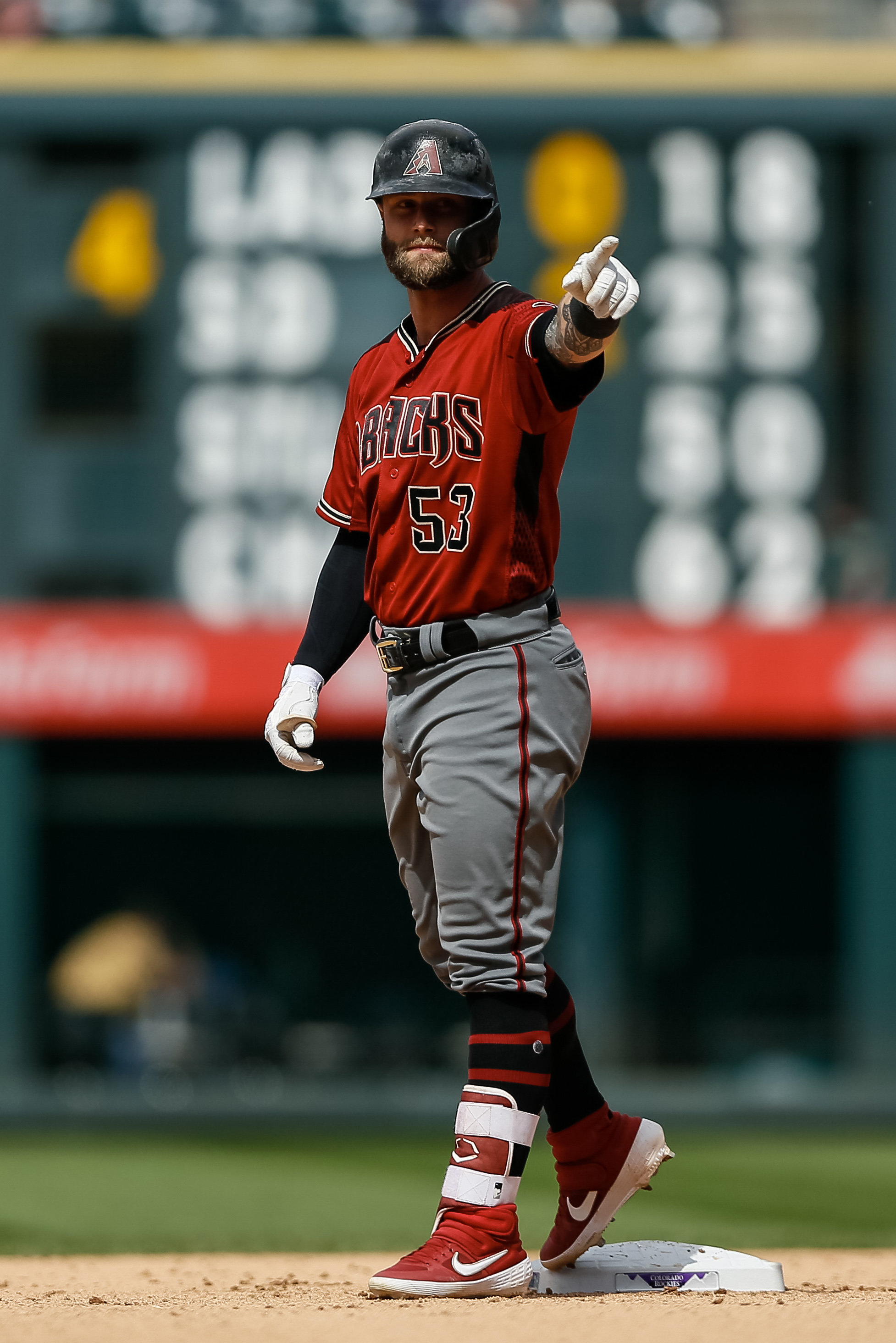
The D-backs finally succeeded in passing him through waivers, though they selected him back to the big leagues later that year. For two seasons, Walker obliterated Triple-A opposition, slashing a combined .305/.372/.586 (142 wRC+) with 50 home runs, 59 doubles and 13 triples. And yet, his Major League counterpart matched him blow for blow in the big leagues; Goldschmidt posted a ridiculous .294/.396/.547 (144 wRC+) with 69 home runs, 69 doubles and eight triples. By the time the 2018 season concluded, Walker was out of minor league options while Goldschmidt entered the final season of his contract.
A trade of Goldschmidt seemed plausible but hardly a sure thing entering the winter of 2018-19. There was little hope of the D-backs re-signing him with Zack Greinke still on the books. Goldschmidt had already signed one team-friendly extension in his career and wasn’t likely to do so a second time. The D-backs explored deals involving both Goldschmidt and Greinke that winter, ultimately lining up with the Cardinals on a return of Luke Weaver, Carson Kelly, Andy Young and a Competitive Balance draft pick (Round B).
Even at that point, though, Walker wasn’t a lock to step into Goldschmidt’s shoes. The D-backs had re-signed Eduardo Escobar to a three-year deal, crowding the third base mix and perhaps pushing Jake Lamb across the diamond to first base. Lamb’s 2018 season was ruined by a shoulder injury, but he hit 59 home runs from 2016-17, batting a combined .248/.345/.498 along the way. A platoon looked to be the likeliest outcome for the right-handed-hitting Walker and the lefty-swinging Lamb, and that’s indeed how the club operated — until Lamb landed on the injured list once again on April 5 with a quadriceps injury that would sideline him into late June.
Prior to the 2019 season, Walker hadn’t started consecutive games in the Majors since Sept. 2014. With Goldschmidt out the door and Lamb on the shelf, however, the everyday opportunity he’d sought in the nearly five years since making his MLB debut was sitting right in front of him, and he seized it. Walker appeared inn 71 games while Lamb was on the IL — starting 66 of them — and hit .258/.333/.461 with 11 homers, 17 doubles, a triple, four steals and elite defense at first base. Even with Lamb back in the fold and playing on a $4.825MM salary, Walker had earned the trust of the organization and earned himself an everyday role.
By season’s end, the then-28-year-old Walker had compiled a .259/.348/.476 slash and 29 home runs. While his hitter-friendly home park and the juiced ball that prompted home run totals throughout the league to explode rendered that production perhaps a bit lighter than some might expect (112 wRC+, 111 OPS+), Walker complemented his output at the plate with quality baserunning and with some of the best glovework of any first baseman in the Majors. Walker’s 11 Defensive Runs Saved and 9 Outs Above Average trailed only Oakland’s Matt Olson for the MLB lead at his position. Walker’s 3.0 bWAR, in fact, topped the 2.4 mark of the franchise icon he’d replaced.
It’ll be important to see how he carries himself at the plate in the event of a course correction with regard to the composition of the baseball, but there’s little reason to doubt his ability. Walker (fittingly) drew a base on balls in 11.1 percent of his plate appearances and was among the game’s very best in terms of hard-hit rate (94th percentile), average exit velocity (85th percentile), xwOBA (81st percentile) and percentage of barreled balls (90th percentile). And even if those numbers take a step back, his superb glovework and excellent baserunning (relative to his positional peers) help to give Walker a relatively high floor.
All of that should be music to the ears of the D-backs, whose patience in hanging onto Walker was rewarded not only with a potential everyday heir to the first base slot — but one that can be controlled all the way through the 2024 campaign. Heading into the 2020 season — assuming there is one — there should be little doubt that Walker has a firm grip on the starting job that’s eluded him for his entire career. As insane as it would have sounded when Walker was acquired in 2017 and as improbable as it might’ve seemed even last spring, the D-backs look like they’ve successfully replaced Goldschmidt with a waiver claim.
Quick Hits: Shapiro, Blue Jays, Ryu, Draft, Payrolls
It was on this day in 1916 that one of the biggest trades in early baseball history was finalized, as the Indians acquired superstar center fielder Tris Speaker from the Red Sox for right-hander “Sad” Sam Jones, minor leaguer Fred Thomas, and $55K in cash considerations. A salary dispute prompted the move, as the Sox wanted Speaker to take a pay cut following something of a down year (.322/.416/411 over 653 PA) by his huge standards in 1915. While the two teams agreed to the swap a few days prior to April 12, it wasn’t officially completed until Speaker received a reported $10K bonus to agree to play for Cleveland, a bonus Speaker demanded be personally paid by Red Sox owner Joseph Lannin.
While the Sox were criticized for the trade, they weren’t exactly hurt in the short term, as Boston went on to win the World Series in both 1916 and 1918 — Jones posting a 2.25 ERA in the latter season to play a big role in the championship run. Speaker, meanwhile, had plenty of great baseball left in him, as he hit .354/.444/.520 over 6634 plate appearances with the Tribe from 1916-26, and also served as Cleveland’s manager for the last eight of those seasons. Speaker’s time with the Indians was highlighted by a World Series victory in 1920, the first title in franchise history.
Some notes from around the modern baseball world…
- Though the Blue Jays loaded up on arms this offseason, team president/CEO Mark Shapiro still feels “pitching, pitching and more pitching” is his club’s biggest need. In a Q&A conversation with The Athletic’s Jim Bowden (subscription required), Shapiro noted that Toronto’s splashy $80MM signing of Hyun-Jin Ryu was partially based on that need, since “we have more position players than pitchers that are major-league ready to impact and we needed more balance.” Another factor, however, was the internal confidence amongst the Jays’ current core roster “that they are closer to winning than people think.” This is one of many topics addressed during the interview, as Shapiro also discussed issues as rule changes, how baseball could adapt to a shortened season, and how he is coping with trying to run an organization with everyone staying at home.
- Also of note was Shapiro’s mention that “more of a traditional center fielder” was the Blue Jays‘ second-biggest need, though “we have lots of outfielders and we would like to give them an opportunity before adding to that mix.” Randal Grichuk is slated for the bulk of center field duty, though Teoscar Hernandez, Derek Fisher, Anthony Alford, and perhaps even Cavan Biggio could all get some time up the middle. While Grichuk is mostly thought of as a right fielder, he has actually amassed almost as many innings in center (1988 1/3) as he has in right (2196 2/3) over his MLB career, though defensive metrics are somewhat split on which is his better position. UZR/150 and Statcast’s Outs Above Average favor Grichuk’s work in right field, while the Defensive Runs Saved metric prefers his glovework in center field.
- With this year’s amateur draft slated for only between 5-10 rounds, many top high school prospects could opt to attend college or junior college, while some college seniors could take their renewed year of NCAA eligibility and instead enter the 2021 draft. Other youngsters, however, will opt to begin their pro careers, which MassLive.com’s Chris Cotillo notes will likely lead to a huge free agent market of available amateur talent. Teams can’t spend more than $20K to sign any undrafted amateur, so a host of other factors could impact whether or not a player chooses one particular team over others offering the same dollar figure, as executives, agents, and players tell Cotillo. These factors range from the relationship between a team’s scout and the player, a player choosing a team close to his hometown and family, or perhaps even a club strategically drafting one prospect in order to draft another. As one scouting director put it, “If we draft a kid in the fourth round, do we have a better shot at signing his buddy?“
- “Team officials and player agents are bracing for what they expect to be a dramatic shift in the financial landscape if the sport is shut down for the season,” ESPN.com’s Buster Olney writes (subscription required), which could mean particular concern for teams with major long-term salary commitments on their books. Clubs like the Angels, Padres, and Rockies are in this camp, while teams with less money committed beyond the next season or two — such as the Giants, Rangers, Mariners, or Dodgers — are in a bit better position. Of course, the coming Collective Bargaining Agreement negotiations are “the industry X factor” in all financial forecasts.
MLBTR Chat Transcript
Click here to read the transcript of tonight’s live baseball chat
Austin Maddox Retires
Red Sox right-hander Austin Maddox announced his retirement during the offseason, as reported by SoxProspects.com (Twitter link) in March. The 28-year-old Maddox is hanging up his glove after 13 Major League appearances (all with the Sox during the 2017 season) and seven total professional seasons.
A University of Florida product, Maddox was a third-round pick for the Red Sox in the 2012 draft and he pitched almost exclusively as a reliever during his time in Boston’s farm system — 136 of his 151 career minor league appearances came out of the bullpen. After some issues with the home run ball early in his career, Maddox began to post better results in 2015, and then made a three-level jump during the 2016 season. Another strong performance at the Double-A and Triple-A levels in 2017 led to his call-up to the Red Sox roster.
Maddox’s brief MLB career will go into the books as an impressive one by the numbers, as he allowed just a single earned run over 17 1/3 regular season innings. Beyond that minuscule 0.52 ERA, Maddox also recorded 14 strikeouts against just two walks. This was enough to earn Maddox a spot on the Red Sox postseason roster, and he allowed a run in two innings pitched during Boston’s ALDS loss to the Astros.
What looked like a promising start ended up as the entirety of Maddox’s big league career. A shoulder strain limited him to only eight total outings in the minors in 2018, and he missed all of 2019 recovering from rotator cuff surgery. The Red Sox re-signed Maddox to a new minor league deal over the offseason, though he didn’t appear in any Spring Training games.
MLBTR wishes Maddox the best in the next step in his post-playing career.
Rebound Candidate: Khris Davis
Since joining the Athletics in 2016, Khris Davis has been a steady offensive force in the Oakland lineup, consistently finding his name near the top of yearly home run leaderboards. He hit more at least 42 homers in every year from 2016-2018 and played in at least 150 games each year. He even garnered MVP votes in 2017 and 2018, finishing eighth in the latter year when he slugged a league-leading 48 round-trippers. In April of last year, his reliability earned him a handsome two-year, $33.5MM extension that will keep him in an A’s uniform through at least 2021.
After that, however, things went south for Davis. All told, 2019 wound up being his worst year as a Major Leaguer, with his OPS dropping to just .679 and his wRC+ (81) dipping below league-average 100 for the first time in his career. And given that he doesn’t offer anything defensively, Davis’s value as a player is more sensitive to the fluctuations of his bat, and any slump becomes more pronounced. His value was always going to be limited to the offensive side—the A’s knew that when they signed him, but they couldn’t have foreseen such a sudden and steep fall from grace. But what was the root of his 2019 shortcomings, and what are the chances that Davis can right the ship in 2020 (whenever baseball does return) and be the slugger we’ve come to expect?
Beneath the surface, the striking difference between the 2019 version of Khris Davis and his previous years is that his exit velocity numbers slipped from elite to merely good. From 2016-2018, Davis’s first three years in Oakland, his average exit velocity ranked in the 94th percentile or better every year; in 2019, his 90.1 mph average placed him in only the top 30% of players. That’s still solid, no doubt, but for a player whose game is predicated almost entirely on power, that decline is considerably more significant. Davis has never been a batting average or OBP guy, so every tick off the exit velocity metric is important.
This worked against Davis in combination with a lessened ability to elevate the ball: along with the exit velocity numbers, Davis’s average launch angle on batted balls lowered from 18.1 to 13.2 degrees. Consequently, Davis saw his fly ball rate drop from 48.8% in 2018 to 37.4% last year, his lowest mark since 2013 when he was a Brewer. And of course, sacrificing fly balls comes with a corresponding jump in line drives and ground balls, which are markedly less valuable to a slugger like Davis—especially when he isn’t hitting the ball with as much authority as in years past.
Even when he did hit the ball in the air, he wasn’t doing as much damage as we’re used to seeing (which is even more unusual in 2019, given the league-wide power surge fueled by a jumpy baseball). And most of the drop-off came in a particular category: fly balls to the opposite field. Davis is a prolific opposite-field hitter, and it’s one of the traits that makes his power stand out; he hit 16 oppo homers in 2018 alone, more than anybody this side of J.D. Martinez. Last year, though, his wOBA on opposite-field fly balls was just .264, down from the astronomical .489 he posted the year prior. In essence, Khrush’s oppo power—a staple of his power game—became a non-factor, and anything in the air needed to be pulled.
As for his approach on a more micro scale, he swung the bat more than ever last year, especially at pitches in the zone: his 82.2% swing rate on pitches in the strike zone was the highest of his career, and his overall swing rate the second-highest. But Davis has lived in that neighborhood for his entire Athletics tenure, and it hasn’t stopped him from hitting in the past. Anyway, attacking hittable pitches is a good thing, and he doesn’t get exploited by going after too many bad pitches; his chase rate is just about league average. Moreover, that change hasn’t had any effect on his ability to make contact, and it hasn’t produced a precipitous change to either his walk or strikeout rate, which both sat right about where they were the year before.
So, what’s to blame for the sharp decline in production? It seems unlikely that a player in his early 30s, who just a year earlier mashed 48 home runs, could be sapped of his strength so suddenly. Career designated hitters like Nelson Cruz and Edwin Encarnación have maintained their pop into their late-30s; why should Davis be any different? It’d be more appropriate to chalk Davis’s struggles up to injuries: he was able to play in just 133 games for the A’s—the fewest in his Oakland tenure—and likely dealt with nagging consequences of oblique and hand injuries, both of which are notoriously troublesome for hitters. And it makes sense that with lingering hand problems, opposite field power would be one of the first things to go.
The oblique injury occurred in early May, while the hand issue dates to a HBP in late June. Sure enough, Davis’s three worst months in terms of OPS were July, August, and September. And trying to play through those injuries probably didn’t help things any. But with a full offseason (and more) to heal up the oblique and hand, the hope is that the Athletics will be able to count on a fully-healthy Davis to anchor the middle of their lineup for another postseason bid. The bet here is that Davis will be able to re-establish the consistent production he maintained for his first three years in Oakland.
The 2019 A’s were still able to succeed without much of the production they relied upon from Davis in 2018, thanks in part to the continued offensive maturation of Matt Chapman, Matt Olson, and Marcus Semien, as well as unexpected contributions from a host of low-profile hitters like Mark Canha. Their stout bullpen and patchwork rotation of misfits managed to prevent runs like the American League powerhouses, and with young guns A.J. Puk and Jesús Luzardo on hand and here to stay, they expect more of the same in 2020. Davis could be the missing ingredient to that equation, and another year of elite power output might make the difference between a third consecutive Wild Card exit and a deeper playoff run.
The Marlins Built An Interesting Rotation Via Trade
The Marlins’ rotation has a collection of young hurlers with plenty to like. It’s not a group chock full of certainty, but the unit performed reasonably last season and comes with varying degrees of future upside. Four of the team’s starters came up in trade rumors over the offseason, but the Fish elected to hold onto all of them.
Taking a look at the options on hand, a common thread emerges. Most of the Marlins’ hurlers were acquired via trade. Of the club’s projected rotation at Roster Resource, only José Ureña was signed as an amateur. To some extent, that’s expected for an organization that has spent a good portion of the past two decades selling off pieces for future assets. For the most part, though, the club’s starters came over as relatively unheralded trade pieces. Whether because of quality scouting, player development or a mere string of good luck, the Fish have turned a few under-the-radar prospects into decent MLB starters.
Staff leader Sandy Alcantara came over from the Cardinals in the Marcell Ozuna trade. He and Magneuris Sierra co-headlined that deal, but Alcantara’s early career results dwarf those of his outfield counterpart. The 24-year-old has a 3.83 ERA in 239.2 innings. His strikeout and walk numbers are unimpressive, but Alcantara has done well at avoiding hard contact. He’s miscast as a staff ace, but he alone would’ve been a solid return for two years of Ozuna (more on that in a bit).
Caleb Smith and Pablo López were further off the radar at the time of their respective acquisitions. Smith, a former fourteenth-round pick who never ranked among the Yankees’ top thirty prospects at Baseball America, was acquired alongside first baseman Garrett Cooper for pitching prospect Mike King and international bonus pool space in 2017. Smith had performed well in the high minors in the New York system, but it’s doubtful anyone would have foreseen him posting a 25.9% strikeout rate and 12.3% swinging strike rate in his first 249.1 MLB innings. Unlike Alcantara, Smith gives up a lot of authoritative contact, but his swing-and-miss stuff is no doubt intriguing.
López, meanwhile, was a low-level flier acquired from Seattle in 2017 as part of a package for David Phelps. Injuries limited Phelps to just ten appearances as a Mariner, while López looks to be a solid long-term rotation piece in Miami. He throws a ton of strikes, induces a fair amount of grounders, and ran a serviceable 20.3% strikeout rate last season.
Jordan Yamamoto was the fourth piece in the four-player package acquired from the Brewers for Christian Yelich. That deal turned sour quickly, but Yamamoto had a decent fifteen start cameo in 2019. His long-term future’s still up in the air, but he’s an interesting arm to have in the mix. Prospects Nick Neidert and Robert Dugger were acquired from the Mariners for Dee Gordon and are near-ready rotation depth pieces.
The best under-the-radar starter the Marlins have acquired in the last few years is the one they’ve since traded away. Zac Gallen was the third piece of the Ozuna package, but his stock has skyrocketed since. After combining for a 2.93 ERA in 245.1 Triple-A innings, Gallen had a strong seven start MLB debut in Miami. The Marlins flipped him to the D-Backs for shortstop prospect Jazz Chisholm, Baseball America’s #88 overall prospect, last July. However one feels about the Gallen-Chisholm swap, it’s clear the right-hander was a fantastic get as the tertiary piece from St. Louis.
It’s been less than smooth sailing for the Marlins in a number of ways in recent years. But the Miami organization has picked up a few notable starting pitchers from elsewhere along the way. Whether some or all of these young arms will form the core of the Marlins’ next contending club or themselves wind up on the move for future assets remains to be seen.
Padres’ Offseason Acquisition Could Be Poised For Breakout
The Padres have been on the hunt for long-term outfield pieces for a while. Over the past five years, the Friars have trotted out ten different Opening Day starters on the grass. Only Manuel Margot (three times), Wil Myers and Matt Kemp (two apiece) had garnered multiple Opening Day opportunities in that time. Evidently, they weren’t sold on their 2019 group, either. Of the four outfielders with the most playing time for the Friars last season, three are gone. Hunter Renfroe and Margot were sent to the Rays in separate deals, while Franmil Reyes was traded to the Indians in last summer’s three-team blockbuster. Only Myers is still around, and that’s seemingly because the club found his contract ($67.5MM remaining over three years) too difficult to move.
Yet the club acted decisively to solidify the outfield this offseason. Tommy Pham came over from Tampa Bay in the Renfroe deal. He’s a known commodity who should shore up left field for the next two years, his final seasons of arbitration control. More interesting from a long-term perspective is Trent Grisham. The 23-year-old was acquired from the Brewers in November in a four-player deal that cost the Pads prized young infielder Luis Urías and starter Eric Lauer.
A first-round pick (15th overall) out of a Texas high school in 2015, Grisham’s pro career got off to a bit of a rocky start. Baseball America’s #49 overall prospect after his draft year, his stock fell in the eyes of evaluators with each passing season. High strikeout rates in the low minors combined with relatively little power production to tamp down his offensive output. He always drew an elite number of walks, but it was fair to question whether that would continue against higher-level pitchers.
In 2017, Grisham seemingly turned a corner. He increased his fly ball rate by ten percentage points from the year prior. Not only did he maintain that ability the following year, he upped it another six points in his first crack at Double-A. Things fully clicked last season, when Grisham maintained his fly ball oriented batted ball profile while cutting his strikeouts four points. All the while, he managed to maintain his elite walk rates. In 283 plate appearances in the pitcher-friendly Southern League, Grisham hit .254/.371/.504 with a career-high 13 home runs. He matched those 13 homers in a month-plus in the PCL before earning an August call to the majors.
With only 183 MLB plate appearances under his belt, Grisham certainly doesn’t have a long track record at the highest level. Early indications, though, are he’ll carry over much of that minor-league approach. He remains exceptionally patient. That willingness to run deep counts will probably always lead to a fair amount of strikeouts, but Grisham made contact at a league average rate in the big leagues when he did swing. He also showed surprising speed, ranking in the 93rd percentile leaguewide, per Statcast.
To some, Grisham’s probably only known for his costly error in right field in last season’s NL Wild Card game. That unfortunately proved to be the final image of his Milwaukee career, but Brewers GM David Stearns shot down any notion (via Adam McCalvy of MLB.com) that one play had anything to do with the trade. No doubt, the left-handed hitter’s performance track record and physical gifts weigh heavier on decision-makers’ minds than a single misplay, no matter how high-profile.
MLB.com’s AJ Cassavell reported last month Grisham had the inside track at the Padres’ center field job. If/when the 2020 season resumes, that presumably would still be the plan. San Diego no doubt hopes his impressive high-minors performance will translate into an MLB-ready, long-term outfield fixture.