
Revisiting The Ozzie Albies Extension
Today marks the one-year anniversary of a deal that looks like it’ll pay dividends for years to come. On April 11, 2019, the Braves and second baseman Ozzie Albies agreed on an extension that could keep the dynamic switch-hitter in Atlanta through 2027.
Albies, who was under team control through 2023 prior to the deal, received a $1MM salary in 2019. He’ll match that this season, take home $3MM in 2021, $5MM in 2022, and $7MM apiece from 2023-25. The Braves hold a pair of $7MM club options (the first with a $4MM buyout) for the 2026 and 2027 seasons. All told, the deal guaranteed Albies just $35MM with a maximum payout of $45MM over nine seasons.
Even at the time, those were shockingly low numbers for a player of Albies’ promise. The former top prospect had compiled a .272/.323/.456 line (107 wRC+) through his first 977 MLB plate appearances. Combined with strong baserunning and keystone defense, Albies had amassed upwards of five wins above replacement before his 22nd birthday.
As MLBTR’s Steve Adams wrote at the time, the deal looked exceptionally lopsided in the club’s favor:
“Frankly, this seems like the type of deal that an agent would strongly advise his client not to take. Perhaps Albies simply wanted to take the largest guarantee the Braves were willing to offer; he received just a $350K signing bonus as a prospect, after all, and his career earnings to date may not even total seven figures. From a purely human standpoint, it’s hard for any 22-year-old player without much in the way of career earnings to rebuff $35MM under the guise that he’ll earn more on a year-to-year basis beginning 24 months down the line. Presumably, all of the points made here were spelled out to Albies before he made what amounts to a life-altering decision.”
While the deal already looked like a coup for the club, Albies took his game to another level in 2019. He played in 160 games and hit .295/.352/.500 (117 wRC+) with an NL-best 189 hits. That was enough to earn him the Silver Slugger among NL second baseman. There could’ve also been an argument for him to win a Gold Glove (although Kolten Wong was no doubt a deserving winner). Albies racked up eleven defensive runs saved in 2019, bringing him to 28 runs above-average for his career by that metric. All told, he was worth about five wins above replacement, per both Fangraphs and Baseball Reference.
That marked a welcome step forward from Albies’ previous level of production at the plate. But it was hardly out-of-the-blue. He’d long shown the talent to be a plus hitter with strong contributions as a baserunner and defender. He faded offensively down the stretch in 2018, but it was reasonable to project further growth with reps against MLB pitching and physical maturation.
For the Braves, the Albies extension (as well as the one signed by Ronald Acuña, Jr.) looks like a slam dunk. It’s hard to give the Alex Anthopoulos-led front office too much credit; every team in baseball presumably would’ve signed up for the same deal if given the opportunity, even after Albies’ late-2018 swoon. This wasn’t a front office taking a gamble on an unknown, unheralded player they loved. The consensus was Albies was a high-level talent. Indeed, as Steve explored at the time, a $50MM guarantee would have been more in line with deals signed by comparable players in the 1+ service class, including Christian Yelich and Andrelton Simmons. Some commentators (including Jon Tayler, then at Sports Illustrated, and Michael Baumann of the Ringer) even questioned the team’s ethics in offering the deal.
Albies, of course, was well within his right to value the upfront multi-million dollar guarantee. He hasn’t expressed any public regret since. Yet the extension arguably looks even more team-friendly now than it did at the time. Not only did Albies post a career year in 2019, last offseason’s free agent market was much stronger than the previous two. Whether the abnormally quiet markets of 2017-18 and 2018-19 impacted Albies’ decision isn’t clear, but they no doubt played a role in the high volume of spring 2019 extensions signed leaguewide. (Admittedly, it’s unclear precisely how future markets will respond to lost revenue related to the coronavirus-forced hiatus).
Albies figures to be penciled into Atlanta’s lineup at minimal rates for the next eight years. It’s plausible to project even more offense as he enters his mid-20’s, particularly if he can rein in his plate discipline a bit. Even if he’s already reached his peak, he’d be among MLB’s biggest bargains. He and Acuña should comprise one of the game’s most formidable one-two punches for a good chunk of the next decade.
Recapping Farhan Zaidi’s Trades As Giants’ President
Farhan Zaidi was hired as the Giants’ president of baseball operations from the archrival Dodgers in November 2018. The club has largely eschewed headline-grabbing moves since, but the front office has been as active as any on the waiver wire. That emphasis on low-cost additions to the margins of the roster has extended to the trade market. It’s still too early to judge Zaidi’s overall body of work, but some of the lesser-heralded names have produced strong early returns.
Equally as noteworthy as the deals Zaidi has made are the ones he hasn’t. The club didn’t move impending free agents Madison Bumgarner or Will Smith at last summer’s deadline. In Zaidi’s defense, the club sat at 55-53 last July 31, just two games back of the second NL Wild Card (and eventual World Series champion) Nationals. They surely also considered the draft compensation they were in line to receive this winter if each signed elsewhere as qualified free agents (as both ultimately did). Yet the Giants never looked especially likely to make a deep playoff run (Fangraphs gave them just a 5.9% shot of reaching the postseason at the time). There was certainly a case to be made they should’ve acted as a decisive seller. Instead, they pursued something of a middle-ground, trading away a few notable relievers while also making further marginal acquisitions.
With that second-guessing out of the way, we’ll turn to the moves Zaidi’s front office has struck since he took charge in SF (excluding the most minor transactions).
2018-19 Offseason
- Acquired RHP Trevor Gott from Nationals for cash considerations
- Acquired INF/OF Connor Joe from Reds for RHP Jordan Johnson and cash considerations
- Acquired OF Mike Yastrzemski from Orioles for RHP Tyler Herb
- Acquired LHP Williams Jerez from Angels for RHP Chris Stratton
2019 Season
- Acquired RHP Jesus Ozoria from Mariners for C Tom Murphy
- Acquired OF Kevin Pillar from Blue Jays for RHP Derek Law, INF/OF Alen Hanson and RHP Juan De Paula
- Acquired 1B/OF Tyler Austin from Twins for OF Malique Ziegler
- Acquired OF Alex Dickerson from Padres for RHP Franklin Van Gurp
- Acquired RHP Prelander Berroa, OF Jaylin Davis and RHP Kai-Wei Teng from Twins for RHP Sam Dyson
- Acquired IF/OF Mauircio Dubon from Brewers for LHP Drew Pomeranz and RHP Ray Black
- Acquired RHP Tristan Beck and RHP Dan Winkler from Braves for RHP Mark Melancon
- Acquired 2B Scooter Gennett from Reds for cash considerations
- Acquired OF Joe McCarthy from Rays for LHP Jacob Lopez
2019-20 Offseason
- Acquired IF Will Wilson and INF Zack Cozart (released thereafter) from Angels for LHP Garrett Williams
How would you grade Zaidi’s first year-plus on the trade market? (Poll link for app users).
Grade Farhan Zaidi's Trades As Giants' President.
-
B 35% (2,220)
-
C 33% (2,139)
-
D 13% (856)
-
A 11% (722)
-
F 7% (460)
Total votes: 6,397
Curious to look back on additional GMs and their trade histories?
We’ve already polled on Diamondbacks GM Mike Hazen, recently fired Astros president Jeff Luhnow, Brewers president of baseball ops David Stearns, Angels GM Billy Eppler, Rockies GM Jeff Bridich, Tigers GM Al Avila, Braves GM Alex Anthopoulos, Blue Jays GM Ross Atkins, Mariners GM Jerry Dipoto, Phillies GM Matt Klentak, Padres GM A.J. Preller, Dodgers president of baseball operations Andrew Friedman, Rays GM Erik Neander, ex-Red Sox front office leader Dave Dombrowski, Mets GM Brodie Van Wagenen, Reds GM Dick Williams, Orioles GM Mike Elias and former Diamondbacks GM Dave Stewart.
What If The Mariners Had Drafted Anthony Rendon?
It could have easily been Anthony Rendon. The media certainly believed the Mariners would draft Rice’s star third baseman with the second overall draft pick in 2011, despite injury concerns. Former Mariners GM Jack Zduriencik recently told Corey Brock of The Athletic, “We liked Rendon…a lot. Going into the draft, he was probably the player a lot of people thought we were going to take…and we did, too.”
Most observers expected the Pirates to use the first overall pick on UCLA righty Gerrit Cole, and indeed they did. That scenario left two strong possibilities for the Mariners: Rendon, and University of Virginia lefty Danny Hultzen. Rendon was considered by some to be the top talent in the 2011 draft even with recent ankle and shoulder injuries. But those injuries loomed large for the Mariners, with Zduriencik telling Brock, “Anthony had some physical issues. He’d been hurt the year before and was limited somewhat. There were a few things that were concerning.”
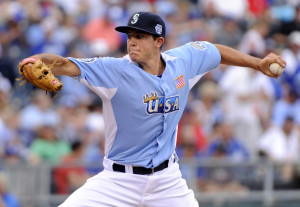
You can debate whether it’s fair to criticize the Mariners’ choice of Hultzen in hindsight. Zduriencik told Brock, “Danny was the guy who everyone loved. It made a lot of sense.” But while Hultzen was by no means a reach or a bad pick at the time, he was considered the “safe” choice. After Day 1 of the draft, Keith Law (then of ESPN) said the Mariners “shock[ed] everyone,” elaborating, “I’m not criticizing Hultzen in the least here, but I think drafting at No. 2 overall is a rare chance to go for ceiling, and the Mariners didn’t do that. They took a very safe, very good college pitcher who will move quickly but doesn’t have No. 1 starter upside.” Unfortunately, even the safest pitchers carry extreme risk, and Hultzen’s career was all but wiped out by shoulder issues.
No one could have foreseen that the draft’s best player would turn out to be Mookie Betts, as the Red Sox landed him 172nd overall. But the draft gurus were correct on Rendon, who ultimately has been the second-most productive member of his draft class by measure of Baseball-Reference WAR. And that was a draft that included Cole, Francisco Lindor (also of interest to the Mariners), George Springer, Trevor Story, Javier Baez, and many other excellent players.
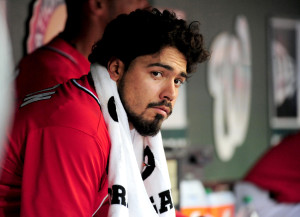
To the surprise of the baseball world, the Pirates, Mariners, Diamondbacks, Orioles, and Royals all decided to pass on Rendon. Maybe it was the ankle and shoulder injuries, maybe it was adviser Scott Boras, but whatever the reason, Nationals GM Mike Rizzo was “pleasantly surprised” when Rendon fell all the way to the sixth spot. The Nationals went with who they considered to be the best player available, even with Ryan Zimmerman entrenched at third base. That choice paid off in a huge way for the Nationals. But with apologies to Mariners fans, let’s consider an alternate universe where Zduriencik called Rendon’s name instead of Hultzen’s on June 6th, 2011.
Rendon reached the Majors in 2013 and had his first highly productive season in 2014. By that point, Kyle Seager was already established as the Mariners’ third baseman. Seager’s 18.4 fWAR run from 2013-16 was actually much better than what Rendon did, albeit with a slightly lower ceiling. As with the Nationals, Rendon would have likely been shifted to second base as a rookie to accommodate the incumbent third baseman.
The Mariners had used the second overall pick in the 2009 draft on Dustin Ackley, whom they decided to shift to second base the following year. Ackley never hit like the Mariners (and everyone else) expected him to, nor did he take to playing second base, so the club gradually shifted him to the outfield starting in 2013. Second base would have been the primary infield opening for a top prospect, since Brad Miller came up around the same time to take over at shortstop. In real life, the Mariners had a quality middle infield prospect coming in Nick Franklin. Franklin was capable of playing shortstop but seen as more of a second baseman. Even with Ackley in the outfield and Miller at shortstop, Seager’s success at the hot corner would likely have left Rendon and Franklin to battle for the Mariners’ second base job as rookies in 2013.
Franklin was a top 50 prospect prior to 2013 and he had an OK showing as a rookie that year, but it wasn’t enough to prevent the Mariners from signing Robinson Cano to a franchise-altering ten-year, $240MM free agent contract that offseason. Rendon’s real-life rookie showing was similarly mediocre, though he was more highly-regarded than Franklin.
Franklin became a popular trade chip once Cano signed in Seattle. The Mariners ultimately parted him at the 2014 trade deadline in the deal that netted them center fielder Austin Jackson and landed David Price in Detroit. With Cano in the fold, would the Mariners have traded Franklin, Rendon, or both? And when? The Mariners may have been more willing to part with at least one of them during the offseason rather than at the trade deadline, and were known to have interest in Price.
Or, would the presence of two promising second basemen have led the Mariners to spend their money elsewhere? Though Cano was the biggest fish that winter, that was also the point where the Yankees signed Masahiro Tanaka and Jacoby Ellsbury and the Rangers signed Shin-Soo Choo. The Mariners never seemed to be in play for Ellsbury despite his Northwest roots, but Tanaka or Choo would have been viable financially if not for the Cano signing. In the end, Cano performed well in his five seasons with the Mariners, and though they had to include Edwin Diaz and a lot of cash, Cano was part of the reason the Mets were willing to part with Jarred Kelenic in December 2018 (more on that here). In a roundabout way, if the Mariners had drafted Rendon, they might not have Kelenic now … though they might have other appealing players instead.
If the Mariners’ hypothetical second base surplus would have prevented them from trying to upgrade the position in the 2013-14 offseason, what would have become of Cano? A return to the Bronx was the prevailing guess in November of 2013, yet the Yankees reportedly topped out at a $175MM offer for Cano despite going on a spending spree on other players. Would Cano have swallowed that alleged lack of respect and remained a Yankee? Or would some other team have stepped up to fill the void?
The Dodgers sat out the Cano bidding that winter. The Mets took a meeting with Cano’s agent Brodie Van Wagenen, their future GM, but the team might have just wanted the chance to meet Jay-Z. Beyond the Yankees and Mariners, there was never another serious suitor for Cano that winter, at least as it was known to the public. If somehow the hypothetical presence of Rendon would have reduced the Mariners’ interest in Cano, the logical conclusion is that he would have returned to the Yankees — at much less than $240MM.
But the Mariners went into that winter intending to make a big splash, and it’s quite possible they would have traded Franklin for pitching, kept Rendon, and signed Cano. In reality the Cano signing mostly tapped out the Mariners’ budget, and they traded for the affordable Logan Morrison to split time at first base with Justin Smoak in 2014. Though it would been a waste of his defensive talents, might the Mariners have found a temporary home for Rendon at first base? The 2014 Mariners fell one win shy of a Wild Card berth, a season in which Rendon was worth 6.4 fWAR while Morrison and Smoak combined for 0.6. It’s not too hard to picture a 2014 Mariners club with Rendon, Cano, and a pitcher acquired for Franklin overtaking the Royals in the Wild Card game and maybe even making a deep playoff run.
Even a 2014 playoff run might not have been enough to save Zduriencik’s job, given all the things that went wrong in 2015. So even in our alternate Mariners universe, Jerry Dipoto still takes over as GM in 2015 and remakes the team in his image. Rendon might have been enough to put the Mariners in the playoffs in 2016 and/or ’18, changing the trajectory of the franchise. In reality, the Mariners continue to suffer through the longest postseason drought in the sport.
The implications of the Mariners choosing Hultzen over Rendon nine years ago can make your head spin, and we didn’t dive into the hypothetical consequences of the Yankees keeping Cano, the Nationals drafting someone else sixth overall, or the Diamondbacks, Orioles, or Royals drafting Hultzen instead of Trevor Bauer, Dylan Bundy, and Bubba Starling. Feel free to do so in the comments or let us know how you think things might have played out had the Mariners drafted Rendon.
Photos courtesy of USA Today Sports Images.
Quick Hits: Braves, Rays, Cubs, White Sox
The Braves have pledged to continue paying their employees—both full-time and part-time—through May 31, according to Kiley McDaniel of ESPN. Several teams extended a stipend to employees through March, but the Braves are the first team that will compensate its staff through the end of this month, let alone the end of May. McDaniel would go on to clarify in a later Tweet that gameday employees, whose pay is normally tied to games, will be paid in accordance with the $1MM fund established last month. However, workers whose earnings aren’t attached to games will be paid as usual. It’s encouraging that teams are willing to offer a helpful hand to their staff, and it’s possible that more teams will follow in the Braves’ footsteps. And while there are plenty of problems that still need solving, this kind of decision can go a long way towards relieving the stress that comes with these circumstances.
- The Rays, meanwhile, have a plan for how they’ll divvy up the $1MM fund established by all 30 MLB teams in March, as explained by Marc Topkin of the Tampa Bay Times. Some 1,200 Rays gameday staffers will receive a one-time payment to help support them during the delayed season: Team employees (ushers, guest services, etc.) will receive $1,000 and concessions workers, security, and others will receive $500.
- Similarly, Chicago’s Cubs and White Sox have offered grants of $500 to their part-time ballpark employees as their means of allocating the aforementioned $1MM fund, writes The Athletic’s Jon Greenberg. Importantly, Cubs VP of Communication tells Greenberg that the Cubs’ fund “will go way beyond a million,” but at the same time is uncertain whether there will be a second round of payouts to employees. It’s notable that the referenced $1MM figure was established merely as a baseline, and it’s possible—perhaps even likely—that many teams will go above and beyond that threshold, especially depending on the length of the season delay, which can have a profound impact on the livelihood of the thousands of employees who make MLB games possible.
Giving The Sixth Man Of The Year Award To Howie Kendrick
For those in the Mid-Atlantic, the Nationals and Astros road warrior World Series is airing on MASN this week. For the rest of us, the 7-game battle has hardly disappeared from memory, as it remains the most recent non-exhibition game played in Major League Baseball. Still, when a player steps up his game on the biggest stage and raises his profile like Howie Kendrick did last fall, it’s hard not to look back early and often to re-live the heroics.
Strictly by definition, Kendrick wasn’t even an “everyday player” for the Nationals last season. Coming off an achilles injury and playing in his age-35 season, manager Dave Martinez was rigid about giving Kendrick enough rest to keep him fresh throughout the season. No matter the volume of clamor from Nationals fans, Martinez refused to deploy Kendrick indiscriminately, starting him in only 70 of the team’s 162 games (with liberal usage off the bench). Kendrick was the designated hitter of choice for Martinez in 7 of 10 interleague road games, and he also called upon Kendrick 41 times as a pinch-hitter.
While Kendrick found himself on the bench more often than not, he still added value as a versatile defender. Of the games he did start, 35 came at first base, 18 at second, and 10 at third. Unlike years past, Kendrick wasn’t utilized in the outfield, but it’s hard to know if that was a strategic decision made to shelter Kendrick. The Nats simply had no need to deploy him in the grass having gotten uncharacteristically stable play from their trio of outfielders. Juan Soto started 147 games in left, Victor Robles made 147 starts between center and right, and even the previously-fragile Adam Eaton made 143 outfield starts in 2019 (his most since 2016).
Whatever the reason, it’s hard to knock the Nationals’ prudent use of Kendrick. Not only did he stay healthy, but he came through time and time again, finishing with an otherworldly slash line of .344/.395/.572 across 370 plate appearances. If baseball had a sixth man award, it would be intended to spotlight a season exactly like Kendrick’s 2019. He was Lou Williams: high-energy, low-maintenance, instant offense off the bench.
And like Williams, Truck could close. Without a true sixth man award, Kendrick took the postseason as his opportunity to shine. It’s hard to imagine a player of Kendrick’s pedigree seizing quite so many opportunities for heroics in a single postseason (I see your hand, David Freese, but I’m not calling on you). As in his career on the whole, Kendrick wasn’t perfect. He made a couple of errors, looked foolish on the bases at times and finished the postseason with a slash line (.286/.328/.444) that one could easily overlook.
But in terms of peak value, Kendrick made his hits count. First, there was the series-winning, 10th-inning grand slam in the winner-take-all game five to vanquish the Dodgers. Considering this was just the Nationals second win in a winner-take-all-game in their history (coming a week after their first), Kendrick’s grand slam was, at the time, no doubt the biggest hit in Nationals’ team history. No longer could the Nats be shrugged aside as a franchise without a postseason series win (Mets fans on Twitter will have to find something new). With a history as long and storied as baseball’s, it’s rare these days to have the opportunity to watch in-real-time as moments exists in a self-actualized vacuum wherein each big hit instantly supplants its prior as the biggest in team history – but that was the case for the Nats this postseason, and Kendrick was the guy who kept outbidding himself with greater and greater moments.
Kendrick didn’t get that scene-stealing moment in the NLCS, but he did capture MVP honors by hitting .333/.412/.600 with four doubles. Kendrick was great against the Cardinals, but let’s be clear, he was not the most valuable piece of the Nats’ NLCS puzzle. That would be the starting pitchers, who didn’t allow an earned run until game four, yielding just 7 hits across those three games while striking out 28. When everyone is an ace, no one is an ace, so Kendrick took home the hardware for continuing to put together quality at-bats and driving home important runs.
But there’s no such thing as a transcendent playoff performance that doesn’t include the World Series. Pitching again took centerstage for the Nats, especially as the bats went ice-cold at home. The Nats scored just one run apiece in each of their home games, taking the L in all three. Kendrick went one-for-eight at home while only starting in games four and five. He had a good game two in Houston, but it was a relatively punchless series for Kendrick by the time he came to the dish in the top of the seventh inning of game 7, his club trailing by one. Kendrick’s biggest moment of the postseason – of his career – gave the Nats their fifth come-from-behind victory of the playoffs – the most ever – and it solidified his place in the baseball canon.
What made Kendrick’s postseason play so impressive, really, was how late it came it a good-but-not-great career. The bulk of Howie’s career took place on good-but-not-great Angels teams that, like Kendrick himself, were often quite good, but failed to make a lasting impact on the baseball landscape.
Kendrick himself went from productive regular to bench contributor for the Dodgers and Phillies before making his way to Washington. Now, you’ll be hard-pressed to find an announcer in the game who hasn’t referred to Kendrick as a “professional hitter.” To their collective credit, they’re not wrong. Kendrick is a career .294 batter who consistently puts the bat on the ball, never striking out in more than 20.4% of his plate appearances. Most seasons his strikeout rate hovers around 16-17%, though in 2019 he was even better, striking out a career-low 13.2% of the time.
Kendrick can hit, but that’s far and away his best skill. His 9.2% walk rate in 2016 with the Dodgers was easily a career-high. His career rate is 5.4%. He runs okay, but not great, notching double-digit stolen bases in 8 different seasons, but never more than 14, a high he reached four times. Generally speaking, he’s about a 14-stolen-bases level defender as well, sure-handed as a second baseman, but never threatening as a top shelf defender. Power-wise, his career .137 ISO leaves a lot to be desired, but he hit for just enough power to leverage the rest of his skillset. He was an All-Star once (2011) when he finished with 4.6 bWAR, and his “best season” earned him an 18-spot in MVP voting. That came in 2014, his last with the Angels, when he put up 6.1 bWAR/4.6 fWAR, which is impressive considering it was one of his worst power outputs, finishing .293/.347/.397 with just 7 home runs.
But in 2019 everything clicked for Kendrick. He managed 17 home runs while easily notching career highs in many rate metrics (ie, .228 ISO, 146 wRC+). Before last season, he’d never been more than 23% better than league average. But achilles surgery clearly agrees with Kendrick, because at age-35, not only was he 46% better than average, but he put a bow on his career year with the final game-winning hit of the season. More than any award, that’s the type of thing baseball remembers.
How Good Was Dante Bichette?
Before he became the third-most-famous dad of a Toronto Blue Jays starting infielder, Dante Bichette held a similar title in a different barbershop quartet: the Blake Street Bombers. In both groups, Bichette fits comfortably in the George Harrison role as the love-able third cog, the character actor capable of carrying a film (say, as the 3-hole hitter), but nonetheless of tertiary relevance after two obviously-more-famous counterparts (Craig Biggio and Vlad Guerrero, Paul and John, Larry Walker and Andres Galarraga). Along with Vinny Castilla (who rightly-or-wrongly has fallen into the Ringo role in the Blake Street Bombers), Bichette helped the Rockies to their first playoff appearance in franchise history (1995) and became an indelible part of Colorado baseball history.
Bichette wasn’t destined for stardom, necessarily. He capitalized with a case of perfect time, perfect place (emphasis on place, as Coors Field in ’95 wasn’t a bad place to take your home hacks). 1995 wasn’t Bichette’s first season as a productive regular, nor was it his best by WAR, but it was his loudest: .340/.364/.620 while leading the league with 40 home runs and 128 RBIs.
It was a feel-good story for both Bichette and the Rockies, the former of whom had found belated stardom at the age of 31, and for the latter, as the organization enjoyed its first taste of success as an MLB franchise. Don Baylor‘s club didn’t set the world aflame, but they did scratch out a 77-67 record, good enough to capture the newly instituted Wild Card slot to make the National League playoffs. The Rockies would fall to the Braves in four games and fail to reach the playoffs for a second time in the era of the Blake Street Bombers, however. They would not return to the playoffs until capturing the Wild Card in 2007, long after Bichette’s departure following the 1999 season.
As for Bichette, 1995 wasn’t all that anomalous. He would make the All-Star team and earn MVP votes in four out of five seasons from 1994 to 1999 (including a second-place finish in ’95). Over that five-year stretch, Bichette had an overall slash line of .320/.352/.542 while slugging 146 of his 274 career home runs. All of the above considering, and Bichette looks like a classic short-peak superstar, maybe even worthy of consideration for the colloquial hall-of-very-good.
But the story changes when you get a look at his Wins Above Replacement totals. For his career, Bichette amassed a surprisingly meager total of just 5.7 bWAR across 14 seasons. There were 18 position players with at least 5.7 bWAR in 2019 alone. By measure of fWAR, Bichette was slightly better, putting up a total 8.9 fWAR. In other words, he wasn’t very good? Frankly, it’s difficult to view Bichette’s WAR totals in context. His era brings no measure of complications, but we’d normally worry about that era from an inflation standpoint. Looking at his fellow Bombers, Castilla managed 19.4 bWAR, which matches more closely to his standing in the baseball zeitgeist. Galarraga’s numbers are lower than what one might expect for the Big Cat (31.7 bWAR), but they still point to a solid career. Larry Walker was the best of the Colorado bunch, putting up a Hall-worthy 72.7 bWAR, for which he was finally inducted into the Hall of Fame this year.
Of course, nobody was looking at Wins Above Replacement when Bichette was a player. Given his offensive output, it’s still not surprising he made four All-Star teams. His career WAR numbers actually undersell his peak abilities as a player, largely because his overall numbers were hampered by three seasons of negative bWAR, including a disastrous -2.3 bWAR/-2.1 fWAR campaign in his final season with the Rockies in 1999. Bichette’s offensive output was down that season, but it still wasn’t bad: .298/.354/.541 with 34 home runs and 133 RBIs. That hardly looks like a -2.3 WAR season – and yet – it was (the MLB average slash line that season was .267/.338/.417).
Needless to say, Bichette was not a standout defender or baserunner. He was clocked for -34 runs from fielding that season along with -5 runs from baserunning per baseball-reference. He somehow made 13 errors as a left fielder that year (while also collecting 17 outfield assists). The last time an outfielder committed double-digit error totals was Ian Desmond in 2016 with the Rangers, his first season in the outfield as a converted shortstop. It’s not so surprising, then, that Bichette’s offensive numbers don’t buoy the other parts of his game to better bloat those WAR totals. Had Bichette played in the American League where he could have been utilized as a designated hitter, perhaps his career numbers would have a slightly different shape than they do now. Of course, the same could be said for if he’s played his peak seasons for a different franchise.
Regardless, Bichette found a time and a place to make an impact on the game. Plus, his contribution continues in the form of his son, Bo Bichette, who put up 2.3 bWAR as a 21-year-old for the Blue Jays last year. Bo looks astoundingly like his father even down to the haircut, but he brings a more well-rounded game to Toronto’s infield. At this rate, Bo will eclipse his dad’s bWAR total before the midpoint of his age-23 season.
How The White Sox Could Benefit From A Shortened Season
The White Sox could be in a unique position to benefit from a shortened 2020 season. MLBTR’s Jeff Todd explores the team’s substantial upside in today’s video.
NL Central Notes: Yelich, Burdi, Moore
Brewers star Christian Yelich is drawing plaudits for his charitable efforts during the coronavirus pause, as Tom Haudricourt of the Milwaukee Journal-Sentinel writes. He’s playing an active role in both Milwaukee and his native California, with the latter effort an extension of prior work in his home state. “We’re in a fortunate position,” Yelich says of he and his partners in the California Strong foundation (including teammate Ryan Braun). “Not everybody has the ability to have the same reach. We understand that. In tough times, people understand if they can help, they should and they will.”
More from the NL Central:
- While he’s a total health wild card at this point, Pirates reliever Nick Burdi had shown some signs of a rebound in camp, as Mike Persak of the Pittsburgh Post-Gazette reports. His eye-popping fastball has returned after his latest rehab effort — occasioned by surgery that followed a hard-to-watch mid-game injury. Burdi may benefit from an extended layoff, though it seems he was largely back to full strength. The Pirates will have plenty of flexibility in utilizing him once the season gets underway. Burdi still has options remaining and it’s likely that we’ll see temporarily expanded rosters regardless, so he can be handled with care. If the season ends up being wiped out, the 27-year-old will get a full season of service and quality for arbitration, though he’d also have limited earning capacity given his thin MLB track record (just ten innings).
- The work stoppage has presented an unusual situation for everyone, but it’s actually a continuation for one pitcher. Andrew Moore had thrown remotely after signing a minors deal with the Reds, as Steve Mims of the Register Guard writes. The plan was for the 25-year-old to show up later in spring before heading to one of the top Cincinnati affiliates. Moore is instead continuing to send in his video and other data to the club. You won’t be surprised to learn that he has prior experience with Reds pitching coordinator Kyle Boddy, who has links with many of the hurlers that the organization has inked this winter. Moore is a former second-round pick of the Mariners. He has thrown 63 2/3 total innings of 5.51 ERA ball in the majors with the Seattle club, but was left searching for a career reset after a brutal 2019 showing in which he bounced between multiple organizations and compiled an 8.02 ERA in 101 upper-minors frames.
Revisiting The Nats’ “Steal” Of A Deal
Back in the 2013-14 offseason, the Tigers were looking to move a veteran starter … but not because they were in a rebuild. The club had taken three consecutive AL Central titles (and would add another in the ensuing campaign).
The issue was quite the opposite: with Justin Verlander, Max Scherzer, Doug Fister, Rick Porcello, Anibal Sanchez, and Drew Smyly all on the staff, the Detroit organization felt it had depth to spare. Looking ahead at the cost to retain the team’s stars — they ultimately failed to reach a deal with Scherzer but inked a monster extension with Miguel Cabrera later that offseason — the decision was made to trim some costs where possible and bring back some long-range talent.
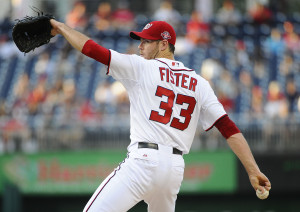
Meanwhile, the Nationals were in search of a quality arm to plug into would land Fister in a swap that sent a largely underwhelming three-player package back to the Tigers. Utilityman Steve Lombardozzi and lefty reliever Ian Krol were each young players with MLB experience but little in the way of apparent ceiling. The Tigers hoped that they’d be affordable contributors, but neither carved out a career in Detroit. The most interesting long-term piece was a notable but not overly heralded lefty pitching prospect by the name of Robbie Ray.
This wasn’t quite how the Tigers wanted talks to play out. The club reportedly wanted a different young hurler to headline the deal: Taylor Jordan, who had emerged out of obscurity in 2013. Jordan utilized his decidedly Fister-esque skillset to compile 51 2/3 innings of 3.66 ERA work in 2013, averaging just 5.1 K/9 but limiting the walks (1.9 BB/9) and homers (0.52 HR/9) while generating lots of groundballs (57.5%). It seemed Jordan might well be a long-term rotation piece, even if it was unlikely he’d ever really dominate.
Ray, a 22-year-old former 12th-round pick, hadn’t yet reached the highest level of the minors, let alone the bigs. But he was perhaps a higher-ceiling young hurler than Jordan. In 2013, Ray worked to a 3.68 cumulative ERA over 142 frames at the High-A and Double-A levels while racking up 10.1 K/9 against 3.9 BB/9.
For good reason, the Nationals were widely lauded for their acquisition. I characterized the deal as a value-laden, well-timed strike. Dave Cameron of Fangraphs said the Nats had paid “a shockingly low price, considering that Fister is one of the game’s most underrated pitchers.” While anything but flashy, the tall right-hander had a nice track record of high-quality rotation work — over 800 frames of 3.53 ERA ball — and came with two seasons of remaining arbitration control. The thievery metaphor was popular, beginning with the title of Cameron’s post. Plenty of people termed the swap a “steal,” especially after Fister turned in an outstanding 2014 campaign.
There’s no discounting Fister’s excellence in his first year in D.C. Though he missed some action, he still managed to spin 164 innings of 2.41 ERA ball. But as it turned out, that would be the last truly productive campaign of his career. Fister struggled with a lat injury at the start of the ensuing campaign and never really got going. He did manage a useful 4.19 ERA in 103 frames in 2015, so it was hardly a minimal contribution, but the peripherals didn’t support the results and the output didn’t account for his final arbitration salary of $11.4MM. Any thoughts of recouping draft compensation by issuing a qualifying offer went right out the window.
On the other side of the swap … well, the Tigers didn’t quite get what they hoped for either, but they only had their own ensuing actions to blame. After watching Ray struggle in a brief 2014 debut, Detroit ended up sending him out in a memorable three-team trade that really didn’t work out for the Motown side. That deal, which also cost the Tigers a decent infield prospect in Domingo Leyba, returned righty Shane Greene. While he had his moments in Detroit, they came after he transitioned to a relief role. Greene was swapped out last summer. The arrangement would have gone better had the Tigers simply taken shortstop Didi Gregorius, who ended up with the Yankees.
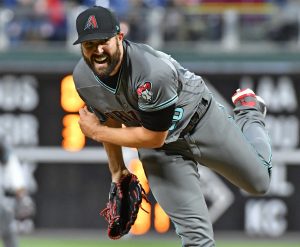
By that point, Ray was ready for a full test at the MLB level. He turned in a very strong debut in 2015. And while the results have taken a bit of a rollercoaster ride since, he has produced huge strikeout numbers and generally fared well in the eyes of advanced metrics. Ray has contributed 762 innings of 3.96 ERA ball in Arizona while racking up 11.3 K/9 against 4.1 BB/9. The long ball has been an issue, but it hasn’t stopped him from compiling 10 rWAR and a dozen fWAR — well over twice what Fister ended up providing to the Nats (4.5 rWAR / 1.7 fWAR) — in advance of his final season of arbitration eligibility.
Photos courtesy of USA Today Sports Images.
Stan Kasten On Potential Paths To 2020 MLB Season
We’ve seen some interesting potential proposals floated for getting the 2020 season underway — including an All-Arizona Plan and a Grapefruit/Cactus League Variation. Those may just be the tip of the iceberg when it comes to the possibilities.
Dodgers president Stan Kasten discussed the matter in an appearance on the Petros & Money Show on AM 570 LA Sports (h/t Bill Plunkett of the Orange County Register, on Twitter). He gave clear indication that Major League Baseball has yet to fix its intention on a particular approach.
Indeed, per Kasten, the expanded Spring Training approaches floated to date are just some of many ideas under consideration. What is known publicly represents “just one percent” of the logistical modifications that have received some degree of consideration, according to the long-time baseball exec.
As for how things will turn out, Kasten wasn’t interested in making predictions as to whether and how a season will be staged. “The truth is,” he said, “we just don’t know.”
The coronavirus shutdown has created a quandary for MLB. Like any business, the league is understandably anxious to get back to action and is rightly planning for different possibilities. But putting on sporting events — even without fans present — is an awfully tricky proposition in the midst of a pandemic, as Stephanie Apstein explored today at SI.com.
Somehow, it still hasn’t quite been a full month since Spring Training was halted. We can only hope we’ll be in a much better place when we look back thirty days from now — perhaps even such that it’s possible to re-engineer the 2020 season.