
Orioles Notes: Arroyo, Burnett, Payroll
Now that Bronson Arroyo has agreed to terms with the Diamondbacks, the Orioles have one fewer option available in their search for a starting pitcher, Eduardo A. Encina of the Baltimore Sun writes. It was reported last night that the Orioles and Diamondbacks were the top contenders for Arroyo. Encina notes that the fact that the Orioles are in the American League (and perhaps, more specifically, the tough AL East) hurt them in their pursuit of Arroyo, and appears to be hurting them in their pursuit of A.J. Burnett as well. If the Orioles can't get Burnett, their next logical choices would be Ubaldo Jimenez or Ervin Santana (although draft-pick forfeiture is an issue in both cases), or perhaps Suk-Min Yoon. Encina also notes that Fernando Rodney's pact with the Mariners makes it increasingly likely that the Orioles will fill their closer position internally. Here's more on the Orioles.
- The Orioles' highest priority remains a top-of-the-rotation starter, writes MASNsports.com's Roch Kubatko. Kubatko suggests that the Orioles should make sure they outbid any of Burnett's NL suitors, then let the press know they did so if Burnett chooses to go to stay in the NL anyway. They should also be willing to give up their draft pick for Jimenez, Santana or Kendrys Morales. Kubatko also suggests that Tim Hudson, who signed early in the offseason, would have been a good addition for the Orioles.
- Many Orioles fans are upset about the team's relatively thrifty offseason thus far, but the correlation between spending and winning isn't that strong, MASNsports' Steve Melewski writes. Only three of the ten highest-payroll teams made the playoffs last year (the Dodgers, Red Sox and Tigers), while three of the bottom five teams did (the Pirates, Athletics and Rays). Spending and trying to win aren't the same thing, Melewski says.
Freddie Freeman And The Changing Extension Market
Freddie Freeman's eight-year, $135MM extension, signed as he entered his first of three years of arbitration eligibility, certainly appears to present a new model for extensions. As I noted yesterday in writing up the signing (along with MLBTR's Steve Adams), the deal wants for ready comparables.
Ryan Braun's five-year, $105MM guarantee with the Brewers came at a similar point in the players' service clocks, but Braun was both a next-level talent and already bound by five more years of an earlier extension. (In that respect, the second Evan Longoria extension is similar.) The cleanest comp — Justin Morneau's January 2008 extension with the Twins (six years, $80MM) — is unquestionably out of date.
One is tempted to look at two similarly-sized deals for an explanation. Buster Posey landed eight years and $159MM from the Giants just before playing out his Super-2 season. But Posey had a Rookie of the Year Award, two World Series titles, and an MVP award under his belt, and is one of the game's premier players at a premium defensive position. Looking at first basemen, Adrian Gonzalez's 2011 deal with the Red Sox (seven years, $154MM) appears to land ahead of Freeman's deal, but Gonzalez was less than a year shy of free agency and had posted five straight years of production that averaged out to Freeman's best single season.
Then, there is last year's $120MM promise made by the Rangers to Elvis Andrus. Particularly when one considers that the Andrus deal — unlike Freeman's — conveyed significant upside to the player via two opt-out provisions, that contract seems a closer mark. Granted, Andrus was a year nearer to free agency than was Freeman and probably carries a higher floor as a top-end, up-the-middle defender. But like Freeman, Andrus was 24 at the time of the deal and was promised big money for future years well before he was ready to enter the open market. Critically, unlike Posey, neither Andrus nor Freeman are fully established, superstar-level players.
Both the Andrus and Freeman contracts raise an important question for market valuation of extensions. Though he rejects the Andrus deal as a comp given the differences in service time, Dave Cameron of Fangraphs argues that Freeman's contract represents a market correction — not an outlier. Utilizing MLBTR's Extension Tracker, Cameron looks at the recent history of four-year or longer extensions inked by players that were still three or more years away from free agency. The results show that such contracts have been startlingly team-friendly, and not just because the arbitration and pre-arbitration years included came at an understandably cheaper rate.
Cameron estimates that roughly 75% of the deals have worked out swimmingly for the team, noting that Andrew McCutchen's deal standing alone probably saved the Pirates more money than was wasted on the few failed extensions. Freeman's new deal could, Cameron suggests, render largely obsolete the recent early-career extension models.
While I would suggest that the Andrus deal represents a similar data point in the correction Cameron proposes, the point stands. Freeman's contract, perhaps, shows that the phenomenon has extended back earlier in the service time spectrum. Put together, the Andrus and Freeman deals show that non-superstar players can command prices more commensurate with their abilities — and, correspondingly, that such players have greater bargaining power than was previously possible at their levels of service.
This development is similar to that observed in this year's free agent market. As I recently wrote, the rise in free agent spending has been driven by a boom in two types of deals: two-year and four-or-more-year contracts. Simply put, with more TV money (national and local) on the market, players have seen an uptick in their ability to pry away money and years. Some of the types of players that used to settle for one year have been able to demand two; some of those that used to get three years have scored four or more.
Likewise, non-superstar, above-average extension candidates appear increasingly to have enhanced bargaining power to demand more (and more expensive) years. Indeed, that seems to be precisely how Braves GM Frank Wren viewed the Freeman extension. As MLB.com's Mark Bowman reports, Wren made some illuminating comments yesterday:
"The deal makes sense because the normal escalation the three arbitration years would have had naturally. Then he gets paid in his free agent years at the current market. What we're I guess gambling is that by the time his free agent years come in three years, that market may have inflated even further and we've got a good deal. We feel it's a solid market deal as [there] is for an above-average player."
Viewing Freeman as a young and very good player, but not necessarily a top-line superstar, the Braves were willing (and, given their new stadium deal, able) to promise him current open-market rates for his future services. As Cameron notes, it was not long ago that McCutchen — coming off of a year that bettered Freeman's platform year, and playing a premium defensive position — sold three free agent years (the last one of which was not even guaranteed) for just $41MM in total. Freeman is promised $106.5MM over five free agent years. Simply put, the Freeman deal is different in concept.
One other salient point to be made, as Cameron also observes, relates to age. Masahiro Tanaka just commanded one of the biggest contract commitments ever made to a player ($175MM with posting fee included) despite having never thrown a pitch in North America. The reason he could command a financial output greater than that made for an established top-of-the-line free agent like Zack Greinke — just one year earlier, on the open market — boils down in large part to the fact that he is just 25 years old.
With an increasing appreciation for the analytical value of aging curves, it makes greater sense to make a long-term commitment at a point at which that commitment covers peak years of a player's career. In this sense, perhaps, the extensions of Freeman and Andrus (both 24 at the time of signing) represents an acknowledgement that earlier commitments deliver both a safer and higher-upside investment. Of course, the corresponding result is that young players could continue to see a substantially enhanced bargaining position even though they remain years away from free agency.
Of course, all of this does not necessarily mean that deals of this ilk will replace completely the old model of the "team-friendly extension" for non-superstars. The lesson, I think, is this: it is now demonstrably plausible for a younger, non-superstar player to make a credible demand for a more sizeable contract, rather than selling their future at a cut rate to avoid risk of injury or decline. At least when that player's team is sufficiently motivated and financially able to meet that price, such contracts are a reasonably achievable outcome.
Put another way: whereas Cameron calls the Freeman deal a market correction, as distinguished from being an outlier, I would suggest that it is representative of a new conceptual model that can still exist alongside others. (A fine distinction, to be sure.) Whether or not this new model comes to dominate the market remains to be seen, but its introduction both reflects a booming market and changes the scope of possibilities moving forward.
Ultimately, any player — particularly one who did not get a big signing bonus and has yet to reach multi-million arbitration paydays — must balance risk against the potential sacrifice of future earnings. As Cory Luebke recently reminded us with his need for a second Tommy John surgery after signing his extension, nothing is guaranteed until pen meets paper. Likewise, teams that lack the will or the capacity to guarantee current market rates for future free agent years, or that have genuine questions about the player's ability to continue or increase performance levels going forward, will remain hesitant to make Freeman or Andrus-sized commitments.
It remains eminently possible, then, that below-market valuations on free-agent years will still remain a reasonable outcome as well. Extensions will continue to occur at the point that player and team incentives overlap. Surely, however, the Freeman and Andrus extensions have shown that the point of overlap may be rising. And they show that players with less service time (and less mileage on their bodies and more peak years yet to come) can drive their demands northward.
The effect may well continue to trickle down. After all, the purpose of extensions is to increase the value of an asset (the team's rights in a player) by taking advantage of exclusive negotiating rights and leverage through team control. Though there are practical limits to the practice — including roster limitations, risk, and the relative availability of commensurate players — it stands to reason that the general theory applies nearly as much to good players as it does to great ones. Just as relatively marginal free agents have been able to increase their long-term security by adding guaranteed years, more marginal extension candidates might increasingly be able to secure multi-year guarantees at reasonably substantial rates from teams looking to invest their money wisely.
Players whose potential extension talks could be impacted include not only superstars like Giancarlo Stanton (3.118 years of service), but above-average players such as Pedro Alvarez (3.085). We knew already that Mike Trout (2.070) would command a massive deal, but will, say, Eric Hosmer (2.146) or Brandon Belt (2.128) command a Freeman-esque deal if they talk extension with their clubs next winter? Or might their clubs take a harder line, forcing the players either to wait for a big-dollar promise or take a smaller deal? Each of these outcomes is possible. Many other 2+ position players could have their extension situations impacted by the Freeman framework, led by names like Kyle Seager, Jason Kipnis, and Desmond Jennings.
Then, of course, there is the pitching market that just paid the youthful (but not MLB-tested) Tanaka like an established MLB frontline starter. Will that logic extend to the extension market? Increased risk has always factored into pitching extensions, but the standard five-year, $30-35MM extension could soon be busted as well. Can, say, Mike Minor (2.138) take down more guaranteed money than did Chris Sale just last year? That depends on the countervailing wills of the player and the club. But after Freeman's deal, Minor (and others like him) certainly can plausibly insist that the prevailing model is not the only way.
Quick Hits: Epstein, Cespedes, Tanaka, Arb Hearings
Current Cubs president of baseball operations and former Red Sox GM Theo Epstein covered a range of subjects in a fascinating interview on WEEI's Hot Stove Show on Thursday (audio link; transcript). In addition to discussing the two clubs he has headed from a baseball ops perspective, Epstein emphasized the impact of changes to the CBA. The new system has both reduced teams' abilities to reap draft picks from outgoing free agents, Epstein said, and made it difficult to pay for hard-to-sign talent in later draft rounds. Here's more from around the league, including other notable talking points from Epstein:
- Discussing his current club's reported pursuit of Masahiro Tanaka, Epstein noted that the pitcher likely cost the Yankees more in real terms than the team's $175MM contract and release fee commitment, once the collective bargaining tax is accounted for. The signing, said Epstein, "reflects the dynamic that there are many, many teams with lots and lots of dollars to spend and very few places to spend them, very few players who represent sound investments for the dollars."
- "There are lots of teams demanding talented, prime-age players, and supply is really a trickle," Epstein continued. "Fewer and fewer players of that ilk are reaching free agency. … You're going to see these prices that cause people to shake heads. … Because of the TV deals, the teams that have them have a lot of money and not a lot of attractive players to spend the money on." Indeed, as I explored earlier tonight, some teams' desires to use free cash to enhance the value of their player assets (i.e., control and contract rights) could result in increasingly robust contracts for some younger players that remain years away from free agency.
- One player that seems suitable for an attractive, long-term investment is Yoenis Cespedes of the Athletics. Fresh on the heels of today's extension of teammate Coco Crisp, Cespedes said that he, too, hopes to ink a new pact, tweets John Shea of the San Francisco Chronicle. The 28-year-old slugger, who still has two years remaining on the deal he signed out of Cuba, said that he hopes to play for the A's for his entire career. Of course, given his relative youth, upside, and high profile, Cespedes figures to command a much higher price than the $22.75MM over two years just given to Crisp. It remains to be seen whether the A's will be willing to dangle a sufficient guarantee to get a deal done.
- Turning back to the aforementioned Tanaka, Yankees GM Brian Cashman told ESPN Radio today (via ESPNNewYork.com's Andrew Marchand) that the club views its new acquisition as "a really solid, consistent number three starter." Cashman noted that, though the club scouted Tanaka extensively, uncertainty remains as to how he will transition to the big leagues. "If we get more than that," Cashman said, "all the better. He's got a great deal of ability."
- Two arbitration hearings took place today, after none occurred last year. Andrew Cashner of the Padres and Vinnie Pestano of the Indians both made their cases to their respective panels. Cashner and the Padres are quite close in filing numbers ($2.4MM against $2.275MM), while Pestano ($1.45MM) and the Indians ($975K) left a larger absolute and relative sum to chance.
- Glancing in at MLBTR's Arbitration Tracker, 16 cases remain unsettled as hearings begin to take place. By my count, just over $23MM remains at stake between the player filings ($79.325MM total) and team counters ($56.15MM). Only the Indians, with Justin Masterson, Michael Brantley, and Josh Tomlin (in addition to Pestano), have more than one outstanding arbitration case.
Minor Moves: Cole Kimball, Omir Santos
We'll round up some minor moves from the day here:
- The Yankees have signed righty Cole Kimball to a minor league deal, reports Matt Eddy of Baseball America. Kimball, 28, had spent his entire career with the Nationals organization, making a brief big league debut in 2011 with a 1.93 ERA in 14 innings (though he both struck out and walked 7.1 batters per nine). Since then, however, Kimball has struggled with shoulder issues. In 2012, he threw just 5 2/3 minor league innings. Last year, splitting time between Rookie ball and Triple-A, Kimball posted a 7.31 ERA in 28 1/3 innings with 8.9 K/9 against 4.8 BB/9.
- Catcher Omir Santos has inked a minor league pact with the Pirates, the club announced today. The 32-year-old got just one plate appearance last year with the Indians, and has only one season of substantial MLB time under his belt. In 2009 with the Mets, Santos hit .260/.296/.391 in 306 plate appearances. In 222 plate appearances at the Triple-A level last year, he slashed .248/.285/.354.
- The MLBTR DFA Tracker features four situations awaiting resolution, led by Emilio Bonifacio of the Royals, who is set to be claimed, traded, released, or outrighted by the end of the weekend. He is joined in DFA limbo by Brett Wallace (Astros), Donovan Hand (Brewers), and Jimmy Paredes (Marlins).
Free Agent Notes: Arroyo, Madson, Santana, Lyon, Ankiel
Here's the latest on free agent situations around the league:
- Bronson Arroyo's decision came down to the Diamondbacks and the Orioles, ESPN.com's Jerry Crasnick tweets, with Arroyo's preference to stay in the National League playing a role in his decision to sign with Arizona. Baltimore's best offer was "competitive" with the two-year, $23.5MM guarantee that Arroyo landed, tweets Eduardo Encina of the Baltimore Sun.
- Reliever Ryan Madson hit 93 mph on the radar gun during an audition today in front of 15 clubs, reports Crasnick (via Twitter). Multiple teams have expressed interest in the one-time relief ace, who is working back after missing each of the last two seasons due to elbow issues. Madson's former club, the Phillies, are one of the teams that planned to watch Madson, Todd Zolecki of MLB.com reported earlier today.
- Another rehabbing pitcher, former ace Johan Santana, tweeted today that he started throwing off of a mound this week. Last we heard, Twins GM Terry Ryan suggested that Santana probably would not be ready to throw competitive pitches until the summer.
- Multiple teams have shown interest in free agent reliever Brandon Lyon, tweets Chris Cotillo of MLBDailyDish.com. The 34-year-old threw 34 1/3 innings of 4.98 ERA ball for the Mets last year, but advanced metrics (3.98 FIP, 4.48 xFIP, 4.38 SIERA) put a somewhat more positive spin on things.
- Free agent outfielder Rick Ankiel told SiriusXM Fantasy Sports Radio (hat tip to Cotillo, on Twitter) that he is still open to playing. But having yet to hear from clubs with interest, Ankiel says he is "in a holding pattern."
Dan Wheeler, Joel Zumaya To Retire
Relievers Dan Wheeler and Joel Zumaya have officially retired from the game, reports Chris Cotillo of MLBDailyDish.com (Twitter links). The pair of 6'3" righties each saw their share of success at the MLB level.
Wheeler, 36, had far the lengthier career of the two. Over 13 big league seasons, Wheeler posted a cumulative 3.98 ERA over 640 2/3 innings, most all of them in relief. He was a sturdy presence in the pen for the Rays and Astros over much of the first decade of the 21st century, and also had stints with the Mets, Red Sox, and Indians. He ended his MLB career with a disappointing run in Cleveland in 2012, and likewise struggled last year with the Royals' Triple-A affiliate.
Zumaya, who just turned 29 in November, showed flashes of excellence in his short career. Over five seasons with the Tigers, the fireballer posted a 3.05 ERA in 209 2/3 innings pitched. (Somewhat oddly, he notched exactly one save in each of those campaigns.) His lifetime rate stats stand at 9.0 K/9 and 4.9 BB/9. Zumaya's best season was his first: in 83 1/3 innings in 2006, he allowed just 1.94 earned runs per nine innings. A series of elbow surgeries led to an untimely end to Zumaya's playing days.
Marlins Designate Jimmy Paredes For Assignment
The Marlins have designated outfielder Jimmy Paredes for assignment to create roster space for Jeff Baker, the club announced. The 25-year-old utilityman had been claimed in November off of waivers from the Astros.
Paredes saw limited action over the last three years in Houston. In 2013, he put up a .192/.231/.248 line in 135 trips to the plate. Seeing most of his time at Triple-A last year, Paredes was good for a .287/.345/.462 line at that level. He does have some speed as evidenced by his 166 stolen bases over seven minor league seasons, though he is just 11-for-20 in the majors. Primarily a second baseman in the minors, Paredes has seen most of his big league time in the outfield and at third.
Alex Rodriguez Voluntarily Dismisses Lawsuit Challenging Suspension
Alex Rodriguez has voluntarily dismissed his lawsuit against MLB, the Commissioner's office, and the MLBPA, tweets Jim Baumbach of Newsday. Though the suit can be refiled, Rodriguez's decision likely indicates that he will no longer contest his suspension for all of next season.
Rodriguez had filed the lawsuit to challenge the arbitrator's decision to uphold most of the term of his suspension for using prohibited performance enhancing drugs. Though the Yankees will be without their everyday third baseman, the club will now definitively be off of the hook for the $25MM they owed him for 2014. The 38-year-old still is owed $61MM over 2015-17, in addition to $6MM bonuses for home run milestones begining with number 660.
Though Rodriguez had vowed to fight to the bitter end, there is no question that his legal case stood little chance of success. (Today was the deadline for his team to respond to the motions to dismiss the action.) If indeed this proves the end of Rodriguez's efforts to overturn his suspension, it could also be the final chapter in the Biogenesis saga.
Diamondbacks, Dodgers, Orioles Finalists For Arroyo
2:55pm: Arroyo may have a clearer picture of where he's going to land by the end of the day today, a baseball source tells ESPN's Jerry Crasnick (Twitter link).
FRIDAY, 12:44pm: Jim Bowden of ESPN and MLB Network Radio tweets that Arroyo will end up signing with either the Dodgers or the Diamondbacks.
THURSDAY: Joel Sherman of the New York Post tweets that Arroyo's camp has lowered the asking price to the two-year, $22MM range, and the Orioles and Diamondbacks are "definitely pushing" for the veteran righty.
WEDNESDAY, 9:32pm: The D'Backs are "very serious" about signing Arroyo and are planning to meet with him, Nick Cafardo of the Boston Globe tweets.
2:11pm: The Diamondbacks, Dodgers, and Orioles are the three finalists to land free agent starter Bronson Arroyo, reports Bob Nightengale of USA Today (via Twitter). Among those clubs, the Diamondbacks are "slight favorites" to lock up the soon-to-be 37-year-old.
We heard recently that Arroyo had yet to receive a firm offer, but reported interest has never waned in the durable righty. Another recent report suggested that Arroyo has continued to ask clubs for a third guaranteed year. Arizona, a newer entrant to the chase for Arroyo, is said to be interested in a two-year pact.
Athletics Extend Coco Crisp
2:45pm: Crisp receives $11MM in 2015 and 2016, and his vesting option is worth $13MM with a $750K buyout, Slusser tweets.
2:38pm: John Hickey of the Bay Area News Group reports that Crisp's extension guarantees him $22.75MM (Twitter link). Susan Slusser of the San Francisco Chronicle reports the option breakdown: Crisp's 2017 option will vest if any of these conditions are met: 550 PAs in 2016; 1100 PAs in 2015-16; 130 games played in 2016; or 260 games played from 2015-16 with at least 110 of those coming in 2016.
1:41pm: The Athletics have announced (via Twitter) a two-year extension for center fielder Coco Crisp that includes a vesting option for the 2017 season. The Steve Comte client had been scheduled to hit free agency following the 2014 campaign but is now controllable by the A's through his age-37 season.
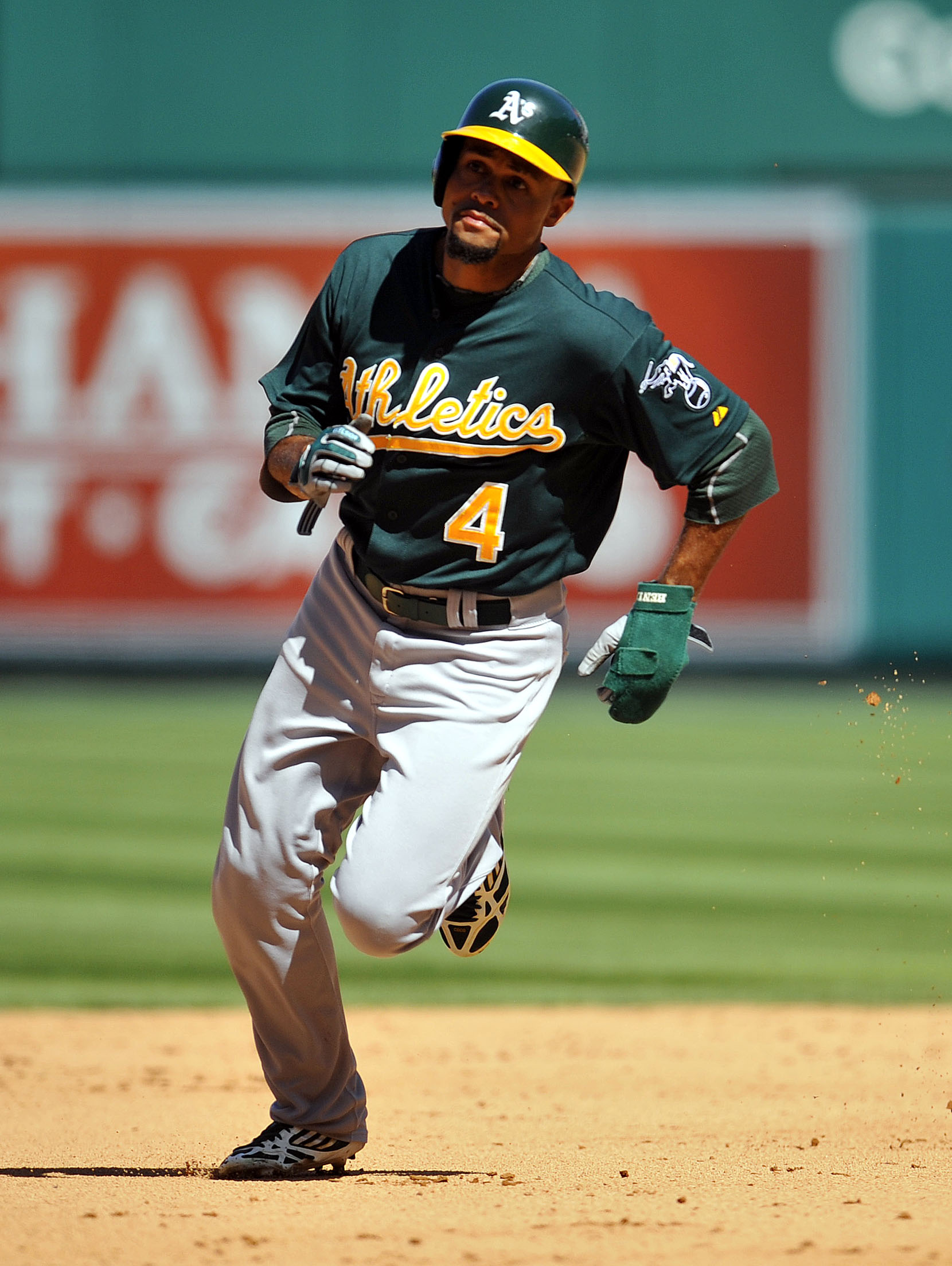
Crisp, who turned 34 in November, slugged a surprising 22 homers in 2013 — a new career-best. Those 22 homers were accompanied by 21 stolen bases (in 26 attempts) and a strong .261/.335/.444 triple-slash line, resulting in career-highs in OPS+ (119) and wRC+ (117). Ultimate Zone Rating pegged Crisp's glove in center field as slightly below average for the the third straight season, but Defensive Runs Saved rated him at +6 runs and feels he's been slightly above average in that same three-year span.
Crisp originally came to the A's on a one-year, $5.25MM deal prior to the 2010 season. Oakland exercised a $5.75MM club option for the 2011 season and then re-upped with Crisp on a two-year, $14MM contract following the completion of that campaign. Earlier this offseason, GM Billy Beane picked up his primary leadoff hitter's $7.5MM option. All told, he's earned $31MM in his Athletics career to this point (including his 2014 salary) and rewarded the team with a .264/.327/.417 batting line, solid defense in center field and elite value on the basepaths. Dating back to 2010, only four players in baseball — Michael Bourn, Elvis Andrus, Drew Stubbs and Rajai Davis — have added more value on the basepaths than Crisp, per Fangraphs.
Crisp should be flanked corner outfielders Yoenis Cespedes and Josh Reddick for at least the next two seasons in Oakland. His extension weakens what already looked to be a thin market for free agent position players next offseason — particularly outfielders. Brett Gardner and Colby Rasmus are among the top names in next year's class, which also includes aging sluggers such as Michael Cuddyer and Josh Willingham. Rebound campaigns from Chris Young, Grady Sizemore, Melky Cabrera and/or Nick Markakis could improve the outlook.
Photo courtesy of USA Today Sports Images.