
Nationals GM Mike Rizzo addressed his club’s acquisition of Adam Eaton from the White Sox, which cost a trio of quality pitching prospects. Eaton, who just turned 28, is controllable for five years at the reasonable rate of $38.4MM (the last two seasons via option). Here are a few highlights from the press conference:
Rizzo emphasized the importance of the flexibility that Eaton brings to the organization. Whether or not it opens the team to spend more money to add in other areas remains to be seen, but that certainly appears to be one possibility. The team’s “decisions aren’t made in a vacuum,” noted Rizzo. Eaton, he said, “gives us flexibility both positionally [and] flexibility payroll-wise,” which “puts us in position to do a lot of things.”
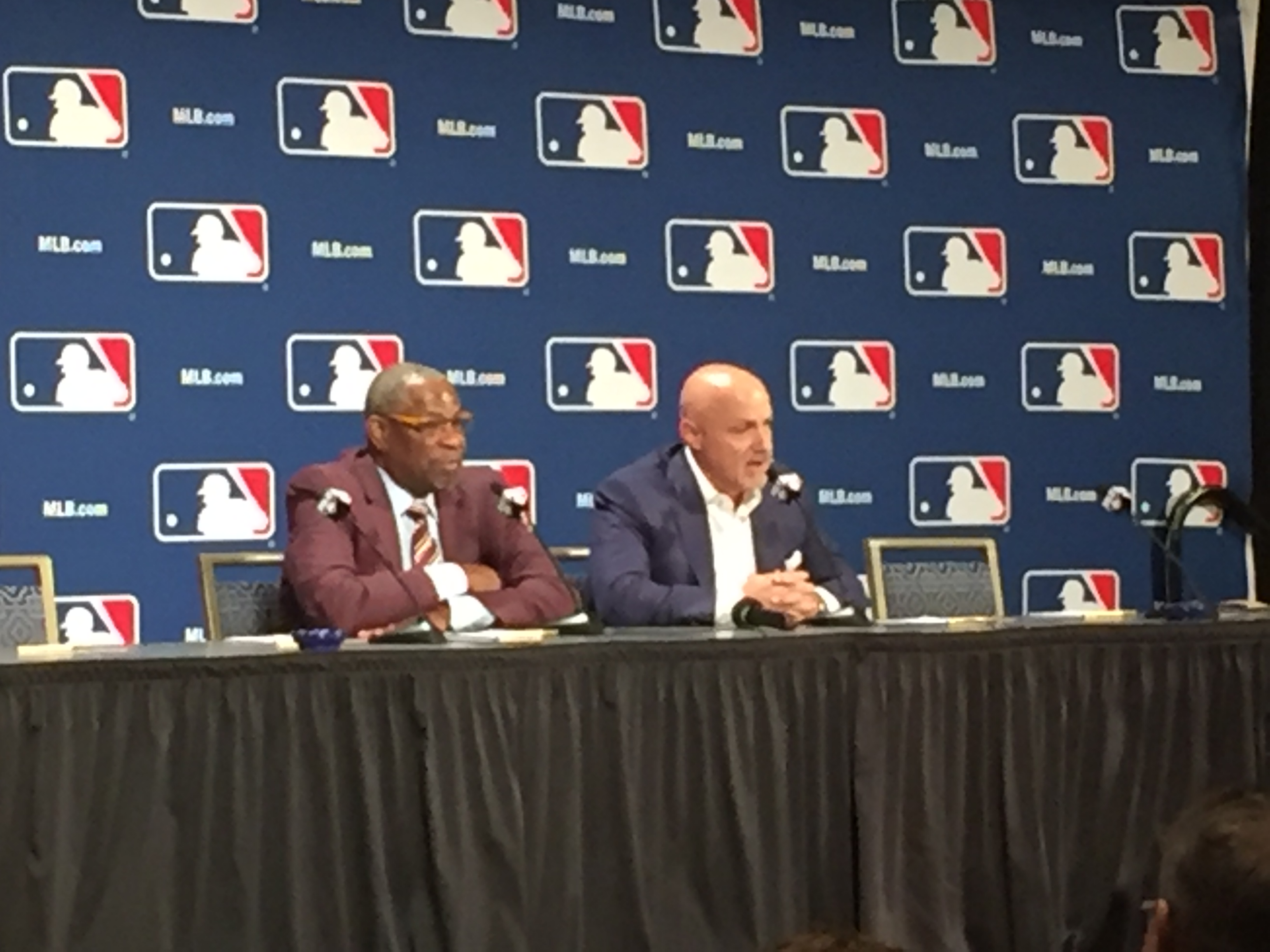
The contract and rate was obviously important, but Rizzo emphasized that Eaton himself was the driving consideration. Rizzo spoke glowingly of Eaton’s all-around game, explaining that he has a grinder’s approach, good contact skills, “sneaky pop,” and situational awareness at the plate. It helps, too, that Eaton is palatable against lefties, as Rizzo noted, though he fares much better in the on-base department (.359 career OBP) than with power (.352 slugging). All told, said Rizzo, “we think the arrow offensively is going up.”
Washington further believes that Eaton “also makes us better in the clubhouse” and “gives us a little edge and excitement at the ballpark,” in Rizzo’s words. And Eaton also rates as a quality defender, in the team’s estimation. “In the short term he’s certainly capable of playing center field very well,” said Rizzo. “And he’s an outstanding corner outfielder.” The strong-armed performer could, at least in theory, end up moving to a corner after the 2017 season, when Jayson Werth will hit the open market.
All told, the decision wasn’t quite as difficult internally as it might have seemed. “It was one of the few times in the draft room, in the war room where the analytical information matched up with the scouting eye, and it was a decision in the room that was very easy for us to make, to determine that this was the player, at this time, with that skillset, with the control, where at that price was the right guy for us to do it,” said Rizzo.
The veteran executive went on to note, interestingly, that Eaton also “gave [the Nationals] the most value for the players we were giving up.” Sacrificing Lucas Giolito, Reynaldo Lopez, and Dane Dunning surely hurt, but that quote seemingly hints that the Nationals had identified certain hurlers as expendable. He emphasized that the team “traded from a position of depth,” using its arms to “fill a hole in our lineup” while still maintaining “the depth that we have in the major league rotation.”
In that regard, said Rizzo, “this deal was built around asset allocation.” Calling it a “win-win” arrangement, he characterized the White Sox’ side of the swap as a package of “good, potential upside players.” In return for parting with that still-to-be-developed talent, the Nats’ GM says they “got ourselves a good, young, skillful player that we control at below-market values for five seasons.”
Though Rizzo was disinclined to say whether the move meant that Trea Turner would take over for Danny Espinosa at short, that seems to be the only logical conclusion at the moment. Barring a surprise move involving Werth, he and Bryce Harper are expected to man the corners, and the remainder of the infield is otherwise spoken for, making for a rather clear, regular alignment in which Eaton plays center and Turner handles short. Of course, that doesn’t necessarily mean that D.C. will deal Espinosa. He’s still a quality defender with a powerful (albeit strikeout-prone) switch-hitting bat, and still seemingly fits on the roster unless there’s a desire to re-allocate his payroll.
Am I the only one that thinks this trade is nuts? It’s the kind of haul I’d expect to get for McCutchen not Adam Eaton. If the A’s who are terrible signed Eaton, I would have Zero excitement. Seems like such a high price.
I don’t even think Cutch trade would’ve gotten that much. Maybe Lopez and 2 other decent guys at best for cutch
It was a nice haul for the White Sox to be sure, but you’re greatly undervaluing Adam Eaton. I’d much rather have him than McCutchen, especially given that contract.
Absolutely!!
I like that you all are defending the trade and then a story posted an hour later saying the Nationals had a similar deal in place to get McCutchen everyone is saying how bad the Eaton trade was…should of posted my comment on that article instead. Sorry
You’re not seeing that Eaton/his contract represent a much more valuable asset than McCutchen/his contract.
Eaton was a 6-win player last year, just turned 28, and is controlled for 5 years at a very cheap price. Cutch struggled badly in 2016, is two years older, and is only controlled for two years at a higher rate.
You are one of those people who thinks Heyward is a good player.
Heyward is a good player with the elite glove if he can get his bat back to his career averages. I think he will bounce back.. He’s moving to AZ this winter and will be working hard on doing just that.
Me and the front offices of the Cubs, Cardinals, Nationals, and every other team that offered him monstrous sums of money. Before his bat fell off the face of the earth last year, yeah, he was.
You are one of those people that is way over his head discussing baseball with people that understand it.
Been hearing the same song since his rookie year with the Braves. In fact, i was harassed for calling Freeman a better hitter after their rookie years. Heyward is not a good hitter, period! But for every year he struggles with the bat, is another year where people still think he will turn it around.
He was about 15% better than league average as a hitter heading into free agency. He has never consistently been more than a solidly above-average hitter. But he was that, and may be again. Why would you deny this?
He is (was?) an above average hitter that is great on the bases and plays great defense. A run saved = a run scored
and if you look at Heyward’s numbers, its not as if his plate discipline totally disappeared and he started striking out a ton and walking a lot less. Those numbers are right in line with what he has done previously. His BABIP was also 60 points lower than usual, which seems to directly coincide with the 60 point drop in his batting average. I dont know what his hard hit ball profile looks like, and am too lazy to look, but I’d expect Heyward to be more like his usual self moving forward
Oh, Jeffery! There’s no arguing with some people…
IMO, He’ll never get his swing back until he goes back to his batting style from his rookie year. He started to try to pull the ball all the time after that.
You’re the best, Miss Schwarbs.
Agreed, I said the same thing about Aaron Roward when the Sox traded him back in ’06 to the Phillies.
Sox likely got the better end of this deal EXCEPT they should have fought for an OF and not another starter. If the Sox have one thing in their org, it is starting pitching.
I called Freeman the better hitter as well. Got a lot of sh-t for it too. When he took Halloday deep for his first homer, I knew he was going to be the face of the Braves. Heyward has always been an average player with elite defense. Im just waiting for Albies now.
Heyward is going to a mistake for everyone that touches him
Hayward just hasn’t been the same at the plate since being hit on the face in NY. His defense still makes him a great player, but he no longer seems like the perennial MVP candidate that people though he would be.
This is what you get when you don’t want to trade Robles.
I completely agree with you. No matter how high anyone praises Eaton, the bottom line is he’s not worth what the Nationals gave up. He’s a good center fielder, but definitely not the caliber player to yield the best pitching prospect in all of baseball along with 2 other top prospects in the nats organization. Not quite sure what Rizzo was thinking
Giolito probably isn’t the best pitching prospect in baseball anymore, at least not in the Nats’ eyes. That’s a pretty important component of this.
considering he explains the thought process in the article you are commenting on, it must be really hard to figure out……..
He states he ads flexibility and he’s controllable and he’ll bring a valued component to the team. That’s all great, but it still doesn’t justify the move. When I say I’m not sure what he was thinking, I’m referring to the fact that this is a very lopsided deal. Way too much talent left the Nationals organization. It just looks like a very poor judgement call on his part.
“Asset allocation” doesn’t mean trade unnecessary talent to fill a void. That’s exactly what Rizzo did
he got a really good player, that has been able to play CF except for 1 down year, on a really cheap deal for 5 years. Its going to take a lot to get that. Still, Giolito and Lopez both have some questions, and Dunning was just drafted and has yet to pitch in A ball.
Giolito has already had TJ surgery, and isnt in the greatest shape, as well as the fact that his stock is down from apparently showing some bad signs during his callup, like diminished velocity and command. Lopez is still raw, despite his obvious talent, and his mechanics arent the greatest, with the effort in his delivery, as well as possible durability concerns in the future based on his size. Dunning being so far down the road that I pretty much disregard him here. Again, it is a lot to give up, but the Nationals still have young arms in the upper minors to supplement their already very good rotation
This might go down as the worst trade of the offseason. Nats are desperately trying to win a World Series before Harper leaves for the Yankees
Could be, but the fact that Fowler just got 80M for the same five years gives more context to why they gave up what they did. To me, the big question of overpay/underpay is whether Giolito is worthy of the hype. His hype is “#1 Starter” potential, and I think he created a lot of questions about that prospect this year.
White Sox did very well in this one.
Well, the Sox have gotten quite a haul over the past 2 days; they now have the #1 prospect in baseball, and #1 pitching prospect in baseball. Hats off to them
He also added, “Dusty Baker hates young guys anyway, if we don’t win a title in two years I’m getting fired and Bryce Harper will be gone soon, nothing for me to lose.”
I think this was an overpay but not as egregious as many are making it seem. Nats didn’t have an obvious spot for Giolito or Lopez for the next year or two. They had the depth in the system and it won’t necessarily gut their system like many are acting like. Eaton gives them a contact bat which they have lacked. FOr 5 years at his price it gives the Nats great flexibility. Again, definite overpay but not as crazy as some are making it out to be
Congrats Chi Sox fans. You are now, along with the Braves are winning the farm system world series ring. Better than winning at a major league level!
You do know this is how the Cubs and astros became competitive right?
Were you saying this to Cubs fans 2 years ago?
as a White Sox fan, I told Cub fans this when they decided to start the rebuild. I laughed at them when they wanted to sign Pujols and other top free agents when they were trying to rebuild. I didn’t know if it would work, but if that’s the way they were going, it was worth doing it right, and that was before they built up the farm.
Anyone seen the guy who wants to offer a contrary opinion no matter what logic is in front of him?
Uhh neither were doing jack at the major league level. Everyone said the same thing about the Royals
Plain and simple the Nats rotation is 5 deep as long as everybody is healthy. They are win now and Giolito and Lopez are both not at the level they project to be so they made a deal that helps their team for the next couple years in more than 1 way. It allows them to move Turner back to SS where his bat plays above average. And Eaton plays CF where his bat plays well.
I also just heard on tv that Lou Whitaker’s career WAR was better than Derek Jeter’s. That fake stat lost any credibility after hearing that.
Also heard that the top 5 WAR OF since 2014 was Trout, Betts, Kiermaier,Eaton & Marte.
Ok I see the 1st 2 but can anybody on here honestly explain to me how anyone could justify any of the other 3 over Cespedas, Braun, Harper or Stanton ???
It’s utter nonsense for U athletic stat geeks who could play the game with the big boys
sure. cespedes is overrated, Braun can’t play d, Harper was not very good last year and Stanton is consistently hurt.
Cespedas is overrated but he carried the Mets over the course of a month to a WS. 4-5 plate appearances out weigh 6-9 chances in the field. Utter nonsense anybody that has played the game on a high level laughs at that stat. Jon Heyman damn near puched Brian Kenny in the face. It is just as irrelevant as win loses for a pitcher.
You mean to tell me Eaton would be more important in a lineup than Cespedas, Braun, Stsnton or Harper ???
And please somebody I am still waiting to hear how Lou Whitaker was better than Derek Jeter ???
Yeah, that mets’ pitching staff had nothing to do with their success….
There is more to being a successful baseball team than just having a good lineup. Trying to play the “i played at a high level” card is just stupid. How many former mlb players (who I’m sure played at a higher lvl than you) have we seen make terrible managers and front office members?
To your jeter question, cuz he was a bad defensive short stop.
Even Jeter’s rather over-exagerrated “bad” defense is a silly reason to justify Whitaker being the better player.
Half the game is played on defence and you can’t see how a back-to-back gold glover is in the top 5 in WAR?
Who are you talking about? Eaton did not win a gold glove in 2015. He actually sucked in centerfield in 2015. That’s why the Sox moved him to right.
Kevin Kiermaier
It’s really not. Among people that actually watch the game, many of them will agree that probably 70-80% of defensive plays throughout the course of the season are just routine plays that even the not so good defenders should typically make.
It’s that high of an empahsis put on defense is what gets many people to not trust stats like WAR and say that they give you skewed results.
So half the game isn’t played in the field? I don’t recall saying the routine outfielder is a top 5 player, but Kiermaier is well above average in terms of fielding. I’m not talking about an okay left fielder, but an elite defending center fielder. WAR may factor defence in too much, but saying a gold glover being in the top 5 couldn’t be justified was ridiculous by that guy.
The problem is your wording of the whole thing is probably more misleading than WAR. But I’ll bite.
Yes, on a technical sense, half the game is played is on the field. But as how many of those plays actually require you to be a great/elite defender, I’d venture to say anything higher than 5-15% throughout the the course of a season is pushing it greatly. And when you factor in how many of them actually turn into runs for the opposition, the number is obviously even lower.
*as far as
I’m not completely sold on WAR either, I’m just against the people who are dead-set against “stat nerds”. Steelerbravenation reminds me of someone who couldn’t hack it and is now looking to bully the people who can explain why with intelligence.
As for defence, one thing I’d like to add to this is what about the “intangibles” that the anti-stat people say are so important….defensive intangibles may be the most evident. The threat of a great arm, holding a runner to a single on a ball in the gap….that’s an inning changer in terms of double play possibility and keeping a runner out of scoring position….it indirectly prevents runs and isn’t quantifiable
rabble rabble rabble get off my lawn! I don’t understand new stats so they are the devil! Rabble rabble rabble.
You do realize there is a reason that every GM/front office member that thought like you no longer has a job, right?
Brian Sabean has a job. John Hart got one JS got one as a matter of fact Theo would be great in any era. Cash man got a job too so what are you talking bout. Defense. Baserunning are not on the same level as offense and intangibles.
Yeah, the cubs team that led baseball in defense and was 5th in base running didn’t care about defense and base running.
There payroll/depth/pitching didn’t play a bigger part than base running and defense ?
Saber metrics back a few years ago said the closer role is overrated yet the number 1 saber metric guy Theo goes and trades for the best closer on the planet. That had nothing to do with it either.
Sabermetricians never said anything about closers being overrated; I often hear a lot of them saying that relief pitchers should be used more often, earlier in the game. You have no idea what you’re talking about.
Well yes, “sabermatricians” have thought “closers” are over rated, because your best relief pitchers should pitch your highest leverage innings.. You will notice that the cubs didn’t strictly use chapman as a closer. You clearly don’t even know what you are arguing against.
The cubs pitching staff out performed their fips by a good margin. Wanna take a guess what a large part of that was? And if payroll was really the defining measure, why weren’t the dodgers the ones playing in the world series?
Tell that to Carter.
I think the main reason that I love this website so much is that the commenters have either converted non believers in sabermetrics to believers or made them look like fools.
Eaton is a really good player, and is on a really cheap contract for 5 years. So the Nationals pretty much just have to add a closer, like Chapman (maybe another reliever), possibly a depth signing for the rotation, and they’re pretty much good to go. They still have Austin Voth, Aj Cole, and Erick Fedde in the upper minors, as well as obviously their rotation of Scherzer, Strasburg, Tanner Roark, Joe Ross, and Gio. They gave up a lot, in Giolito and Lopez primarily, but there is no reason to believe they cant overcome the loss of that depth. They just need to stay healthy for once in 2017
I wouldnt go out on and say heyward and eaton are bad players. Theyre good. But i cant be the only one who thinks eaton just doesnt “look” or “feel” like a 6 win player.
Just “feels” like corner OF defense is overrated by WAR. I know im wrong and dont have a basis in numbers…… but they just “FEEL” overrated. Know what i mean? lol
I guess bat first or bat only type players just “seem” different from a value perspective to all defense guys.
Hope theres enough caveats there lol.
I dont understand why everyone is acting like Eaton was garbage before he moved to the corner OF. He still had a 5 WAR season there a couple of years ago in only 123 games, and in a down defensive year in 2015, still had close to 4 WAR lol….He’ll be fine in CF for a year, and when Werth gets hurt, he’ll probably move over to the corner for one of their young guys for a couple of months anyway
Acting like eaton is garbage =/= just saying that eaton doesn’t seem like a 6 win player even tho i acknowledge he really is that good.
I guess a man cant ever use enough caveats to satisfy the average mlbtr reader xD lmao
Im just saying its harder for me to believe eaton is worth 5-6 wins and equals a miguel cabrera value wise. Perception wise based on star power, not reality wise. Or some other bat only type dude like 2016 david Ortiz worth like 4.something
I personally dont look at 1 stat by itself when I think about a player’s value. WAR isnt the be all end all. That being said, it does a good job of mostly quantifying a player’s overall worth. Yes, defense is a little overly skewed, but those metrics have gotten a lot better in the last 7 years or so, and I predict they’ll be better in the next couple of years, as we start to get more info from stuff like Statcast…Nobody is trying to say Adam Eaton is as good of a hitter as Miguel Cabrera. He can hit at the top of the order, which is hard to find nowadays, and he does a little bit of everything. And he is super cheap in comparison to what players like him are worth on the open market, and the Nationals have control over him at that price for 5 full seasons.
Eaton’s production with his defense combined is above average, but at some point, you have to acknowledge that misleading stats like WAR doesn’t tell the whole story, like a .790 OPS player being that big of a difference maker. When you give up that big of a talent haul, you have to consider things potential. It’s too bad some people can’t see that and would rather blindly follow spreadsheets to justify every move.
It’s usually those people that are mocked for making that one-sided trade or bad contract investment later on and they are left scratching their heads to justify their moves apart from to just say “well his WAR to that point had suggested…”
You can’t tell how the future is going to turn out because you just don’t know what can happen to players. So in that sense it’s premature declare which team WILL come out the winners of this trade. But I can’t believe that there are people seriously denying that the ChiSox clearly got the far better deal in this on paper.
Are you suggesting that people that care about sabermetrics dont care about predicting future value? Thats almost the entire point of sabermetrics
Good trades are trades that help both teams,I think both teams got what they wanted,the Nats want to win now,Easton will help them,the White Sox are building for the Future,they acquired some very nice prospects the last 2 days,now they have to develop them.
Guys. Come on. Realizing that last year, Eaton compiled a great WAR, he’s absolutely NOT a good clubhouse guy and has been rather injury prone.
Beyond that he’s a below average center fielder who for whatever reason takes great routes to balls in right, but is poor in center.
And for that the Sox got 3 blue-chippers.
We (Chicago fans and sports media) are laughing at Rizzo. Sox robbed him and he made Rick Hahn look like Branch Rickey.
The whole thing with LaRoche in the Spring soured me on Eaton, and made me question Sale, especially when such players refer to a 12 yr old as a leader in the clubhouse.
Correct. Always struck me as an odd bird.
The Drake LaRoche was a leader in the clubhouse thing just proved it…
Nats got robbed….2 of their top 5 prospects for Eaton….that’s the package they were expected to give up for Sale….I would rather have Sale….unless Robertson is thrown in from the Sox….I wouldn’t have done this deal
I think u send the same package with Ross to the Rays for Archer….KK and Colome….
You think the Nationals could have got 5 years of Archer on that contract, 4 years of the best defensive CFer in baseball in Kevin Kiermaier, and 4 years of a young arm coming off a really dominant year as a closer for Ross, Giolito, Lopez, and Dunning? Have you not seen the trades that have been made in the last year, or even in the last couple of days? You’re really delusional if you think that
I agree with usafcop
White Sox outfielder finds rare territory with combination of leadoff-man skills and Gold Glove-caliber defense
“He’s brought last year’s combination of pesky on-base skills, threatening on-base speed and surprising pop, and traded iffy center field defense for an ironclad Gold Glove candidacy in right. This kind of player is already immensely valuable. This kind of player received an $184 million contract from the Cubs.” – Jim Margalus SB Nation Sept 14th, 2016
Washington got absolutely taken to the cleaners.. I love listening to you completely uneducated “Baseball” fans.. Rationalize your faces off … You just paid a ridiculous price for a peripheral CF who isn’t a great clubhouse guy. You could of had a former MVP for a slightly cheaper cost and you try to spin the narrative to make yourself feel better about a idiotic move by Mike Rizzo.. McCutchen suffered from the Pirates asking him to play way, way to shallow in CF last season and hurt his defense immensely. This guy can play good if not great defense when you put him where he belongs in the outfield. His batting stats suffered because of a bad right thumb that bothered him all summer. Clint Hurdle has said repeatedly that he doesn’t want Cutch to steal bases as much as before because of injury risk.. he was hurt twice in 3 seasons on slides. His speed is ABSOLUTELY still there. …. You “Baseball” fans just buy into some analyst’s opinion and run with it like it’s gospel. Think for yourselves for once and actually formulate a rational opinion.
Very well, master. May I go to the bathroom now?
I personally believe McCutchen will bounce back, and just had a down year defensively. His thumb injury, as you mentioned, was a factor, and he hit a lot better after the first couple of months. Also, his range factor is still good, which suggests he still has speed. That being said, they would only control him for 2 years, and at a much higher amount than Eaton, making Eaton the more valuable asset. If they want McCutchen, they could just wait to sign him as a free agent. They have Eaton for 5 seasons