
Dec. 23, 10:32am: Jordan Bastian of MLB.com provides some additional details on Alonso’s 2020 option. It’s reportedly a $9MM vesting option that vests following a successful physical after 2019, on the added condition that he makes 550 trips to the plate during the 2019 season, or accumulates 1,100 PA combined across the 2018-2019 campaigns. In line with previous reports, the option becomes a $9MM club option with a $1MM buyout if the vesting criteria aren’t met.
9:32am: The Indians have officially announced the signing.
Dec. 21: MLB.com’s Mark Feinsand tweets that Alonso will earn $7MM in 2018 and $8MM in 2019. The vesting/club option comes with a $1MM buyout.
Dec. 20, 8:55pm: It’s a two-year deal that comes with a $16MM guarantee, according to Ken Rosenthal of The Athletic (Twitter link). There’s also an $8MM vesting option for a third season.
8:38pm: The Indians have agreed to a deal with free-agent first baseman Yonder Alonso, reports Bob Nightengale of USA Today Sports (via Twitter). Alonso is a client of MVP Sports.
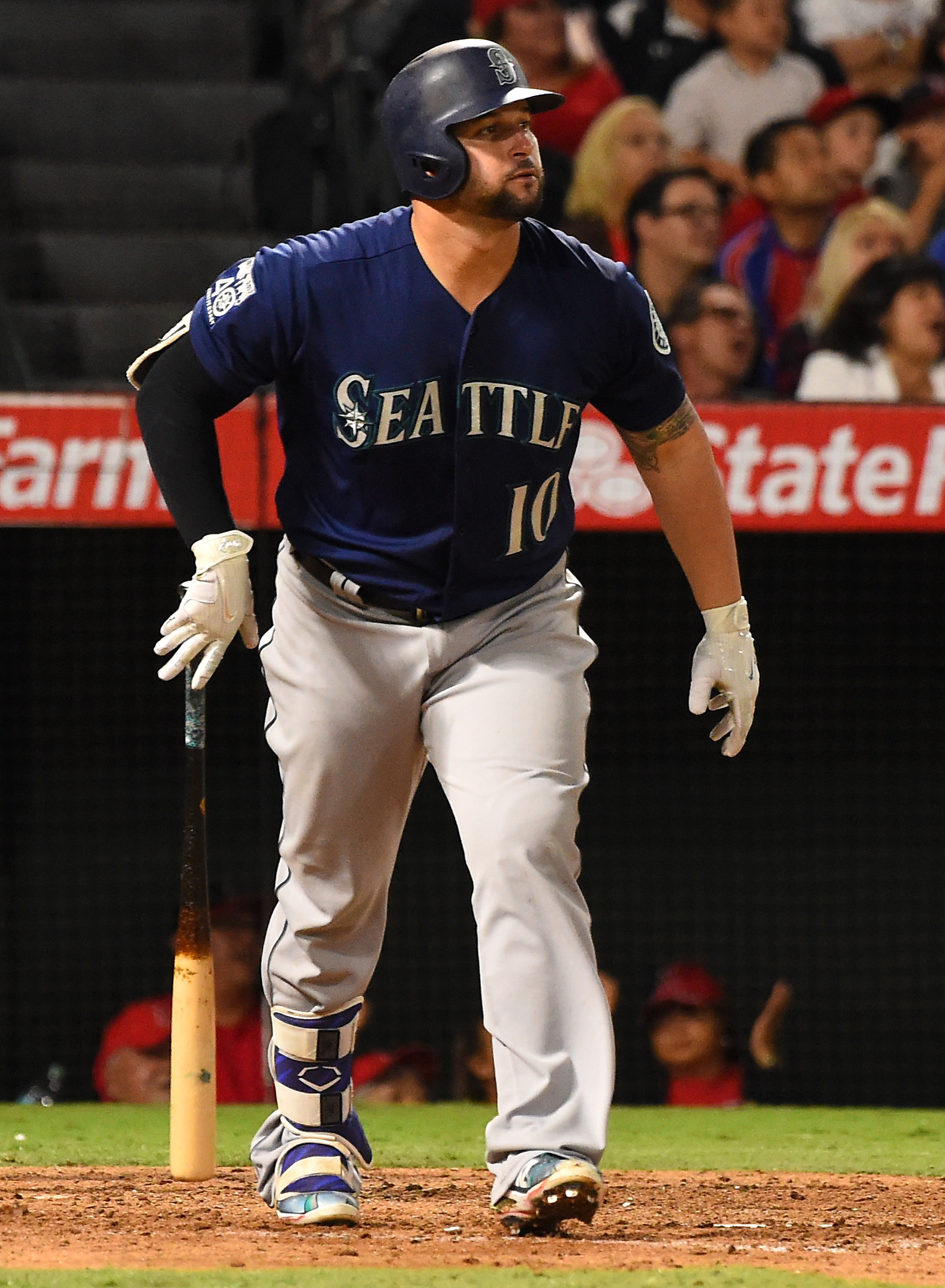
Alonso, 31 in April, will step into the void that was created when longtime Indians first baseman Carlos Santana signed a three-year, $60MM contract with the Phillies. The former first-round pick and top prospect just wrapped up a career year in which he slashed .266/.365/.501 with a personal-best 28 home runs — shattering his previous highwater mark of nine long balls in a season. That quality season landed him 22nd on MLBTR’s list of the top 50 free agents, with a prediction of a two-year, $22MM contract.
Alonso was, for much of the 2017 season, the poster boy for the “fly-ball revolution,” as he made a concerted effort to lift the ball and experienced great success with that newfound approach in the season’s first half. Through 298 plate appearances prior to the All-Star break, Alonso sported a 48.7 percent fly-ball rate and batted a hefty .275/.372/.562 despite playing his home games in Oakland’s cavernous Coliseum. Alonso’s fly-ball rate fell to 36.1 percent in a second half that was far more pedestrian, though his post-break output of .254/.354/.420 was still generally solid.
Overall, Alonso’s average exit velocity (89.2 mph) was comfortably among the top quarter of hitters in the league (min. 100 batted ball events), and his 36 percent hard-contact rate ranked 47th among 144 qualified MLB hitters. That uptick in power for Alonso came at the cost of his previously excellent contact skills, as he whiffed in a career-worst 22.6 percent of his plate appearances this past season (though that mark comes in barely north of the league average 21.2 percent for non-pitchers). Even if there’s some regression in terms of his power, Alonso has long shown a penchant for getting on base, with a career walk rate just under 10 percent — including a strong 13.1 percent walk rate in 2017.
Of course, while Alonso enjoyed a terrific overall year at the plate in ’17, he’s not without his warts. His strong offensive production was in some part due to the fact that both the A’s and Mariners shielded him from facing left-handed pitching; Alonso absolutely clobbered righties (.283/.384/.519) but struggled to hit for average and get on base against fellow lefties, as evidenced by a .181/.263/.417 slash in just 72 plate appearances. In his career as a whole, Alonso has batted just .234/.303/.349 against same-handed opponents.
[Related: Updated Cleveland Indians depth chart]
On the plus side for Cleveland, they have a ready-made platoon partner in the form of Edwin Encarnacion. While Encarnacion will obviously be in the lineup on a regular basis as the team’s DH, he can also shift to first base on days when the Indians face a left-handed starter, should skipper Terry Francona ultimately decide to keep Alonso out of the lineup for those matchups. That’d free the DH slot to keep other regulars fresh, or it could allow the Indians to sign a right-handed-hitting outfielder/first baseman to occupy a reserve role on the bench.
Cleveland currently has righty bats Brandon Guyer, Erik Gonzalez and Giovanny Urshela ticketed for bench spots, though president of baseball operations Chris Antonetti, GM Mike Chernoff and the rest of the staff may yet look to augment the team’s stock of reserve options.
As far as his defense is concerned, Alonso doesn’t stack up to the stellar work that Santana provided in 2017. Alonso rated as an above-average defender at first base per both Defensive Runs Saved and Ultimate Zone Rating each season of his career up until the 2016 campaign. Both metrics pegged him slightly below average in ’16, and while UZR had him only slightly below average again in 2017 (-2.8), DRS graded him out at -9.
Alonso becomes the fourth first baseman to come off the board in the past week — the latest domino in a market for position players that is slowly beginning to pick up after a largely stagnant offseason. Beyond the agreements for Alonso and Santana, the Red Sox announced yesterday that they’ve re-signed Mitch Moreland on a two-year deal, while the Nationals earlier today reportedly agreed to terms on a one-year deal with Matt Adams. With that group now off the board, Eric Hosmer, Logan Morrison and Lucas Duda are the most notable names remaining on the free-agent market for first basemen.
Photo courtesy of USA Today Sports Images.
guy has a career year, as soon as he signs with CLE it’ll be back to below league average player
Thank you, Sunshine.
never hit more than 9 homers or slugged more than .390something in a year before this. just stating facts!!
Same could be said about Logan Morrison, had a career year, yet has not track record
He falls into the same situation as Alonzo
“Back to below league average” is not a fact. It’s an opinion.
And he’s entitled to it….whats your problem?
Isn’t that the same about the Yankees lineup?
The Yankees young players aren’t even in their prime yet and they don’t have a track record of being mediocre (except for hicks)
Wasn’t aware career years were determined by no older than 25 years of age
Just let him be my friend, let him be lol
I think we can say (at least I think) last year was close if not a career year for Judge.
Will he hit 50+ home runs next season ? Probably not (will probably do it again down the line though). But the difference is he is still developing and isn’t in his prime yet. As long as he continues to work hard the sky is the limit or judge. He’s an amazing athlete !
I don’t argue his talent. I just think unless he cuts down on the K’s his average has to come down. The guy had a walk/strikeout in 235 of his plate appearances. That’s not sustainable. Not to mention he hit .220 the second half of the year. Pitchers will start to figure him out as they see him more.
Guys like Mark Reynolds and Chris Davis come to mind. Yes I think Judge has more talent but keep in mind how hyped Davis was for the O’s. If you strikeout 200+ times in a year it’s not realistic to expect higher than a .250 average
I understand completely and he even said himself that he is still a work in progress. He had a horrid august but still lead the team down the stretch in September. This seasons experiences are beyond valuable to him
“Guys like Mark Reynolds and Chris Davis come to mind. Yes I think Judge has more talent but keep in mind how hyped Davis was for the O’s. If you strikeout 200+ times in a year it’s not realistic to expect higher than a .250 average”
Mark Reynolds made history for becoming the first guy to have higher strikeouts than his BA. His .198 batting average established him as the first full-time position player in Major League history to finish the season with a lower batting average (x 1000) than strikeout total.
In 2017, Judge had 208K but he still batted .284 (70+ higher)
Also, Davis/Reynolds never take a walk. Judge has more walks in his rookie season, than Davis or Reynolds ever had in a season so far in their career and each has 9-10 years league experience.
They’re both in their 30’s and who they are as hitters.
Judge is 25.
Davis his age 27 season – .286/53/138 with 199K. Sound familiar to Judge this year?
Davis started under-performing after getting his contract and aging into his 30’s.
Judge isn’t even yet arbitration eligible and 2 years younger than that Davis age-27 season stat-line you cherry-picked.
If you read the above comments we were talking about career years. So I “cherry picked” Davis’s career year. My entire argument is that if you strikeout 200+ times a year a consistent average of .285 is not sustainable. The proof is in his .228 2nd half average. If he doesn’t cut down the K’s this past season will be a career year for him.
My apologies for missing the “career year”. I just have a more positive view of Judge’s career outlook even if he doesn’t cut down K. I believe the best is yet to come.
No I get it dude. I can’t keep up with these threads most days. Especially on my phone lol. There’s no doubt I think Judge will be far more consistent and overall much better than Davis and Reynolds. I just imagine a career for Judge being about what it was last year. But don’t get me wrong the guy has huge talent and will be a force for another 10 years
He struck out 30% of the time and walked 20% with zero lineup protection. Now he’s got Giancarlo Stanton batting behind him, and unlike the second half last year teams will have to pitch to him. The BABIP looks a bit high relative to the rest of his career, but between BABIP regression, gains due to lineup protection, and improvement with age and experience, I’d have to say his offensive output looks pretty sustainable year over year.
Wow…all this coming from what I figure is a Brewers fan….what did you see Judge play all of 5 times on TV?
“you think Judge has more talent than Reynolds and Davis”….that’s a profound statement if I’ve ever read anything on this site.
Reynolds a journeyman first baseman, and Chris Davis who isn’t exactly up for any Gold Gloves from what I’ve read being compared to Judge.
I’ve read over and over again on this site how batting average doesn’t mean a dog gone thing and that strikeouts aren’t considered bad any longer in the “new” baseball set of analytics.
Maybe stick to the Brewers? DUDE!
Zero lineup protection? are you for real? There where like 9 yankees aside from Judge that had a .748 OPS or higher input. Talk about being picky for good protection…
It’s a different game today. A lot of these analytic guys are kinda not freaking out about strikeouts as much. I think their outlook is an out is an out, no matter how you make it!
Trout was like that when he first came up, but he kept making adjustments. Great players make adjustments to keep themselves on top, we will have to wait and see this year.
Aaron judge… the next steve balconied
Balboni *
Ah, so Judge is a player like Trout now? Good to know that Yankees fans have stayed realistic about him…
launch angle launch angle launch angle…one more time….launch angle
How about another strike zone adjustment. Never hear anything about that.
Indians could have landed Ozuna and Bour for prospects. Then the Tribe would be looking great.
For the next couple of years. And then they’d have an old team with no farm
Yonder completely changed his approach to hitting last year and increased his fly ball rate by a large margin. It’s the same exact thing Josh Donaldson did before his MVP season. Josh was a middle of the pack player in Oakland and can be compared to Yonder in that respect. Saying Yonder will go back to his previous numbers is foolish.
That being said don’t expect him to win an MVP anytime soon. If Yonder hits .260 25 80 then $8 mil a year is an absolute steal
Donaldson was a perennial MVP candidate in Oakland in 2013 and 2014. He made the swing adjustment in AAA in 2012
Small monetary commitment and at least there is a story behind his emergence as a power hitter: launch angle. Same as many, including Zimmerman and the beloved Lindor.
Since Yonder can sit against lefties, perhaps it opens up the opportunity to turn the RH hitting Yandy into a spare part that plays 75% of the time between third and first? If not Yandy learning first, they need to sign a RH bat that can spell at first and the corner outfield spots.
If Yonder is a fluke, they Indians will deal with it with only $16M guaranteed.
They got him for a 2 year guaranty with a vesting option at under $10 million per year. Not bad for a guy coming off a nearly .900 OPS regardless.
All the FA out there holding out for 4 and 5 year deals for $20+ million per year take note. Teams would rather take chances on shorter less expensive deals with guys like Alonzo than tie up cash for 5 years.
Huh. I knew they were in on him, but wasn’t expecting a deal to come tonight
Yeah, but for how much?
Good signing. Underrated player.
Proud of Yonder. Saw him every game with that trade to Seattle in August, and he’s a consistent performer. Not a boom or bust first baseman, and out of the options at first base this year for free agency, I felt as if he resembled Carlos Santana the most.
MLBTR Commenters: I like Alonso – hes consistent!
2014: .682 OPS
2015: .742 OPS
2016: .683 OPS
2017: .866 OPS
Also MLBTR Commenters: Hosmer’s terrible – too inconsistent!
2015: .822 OPS
2016: .761 OPS
2017: .882 OPS
Alonso $16 million. Hosmer over $100 million. Both are mediocre.
You’re right, but part of the dislike for Hosmer is the fact that he’s way overrated. He’s more consistent for sure, but he’ll also get paid significantly more for work that was — at least last season — comparable to Alonso.
Funny jaysfan how you omitted hosmers ops in 2014… it was .716. 2013 was .801, 2012 was .663. So let’s not pick and choose stats to fit personal opinions. Anyone who says Hosmer is inconsistent has a valid argument.
I’m not sure I follow your argument here. Yes Jaysfan left those years out, but they did say Hosmer is inconsistent which is what you agree with..
The dominos start to fall, let’s go!
If its like 3 x 10 – 30 mill – fine
if its 3 x 15 – 45 – not good
“It’s a two-year deal that comes with a $16MM guarantee, according to Ken Rosenthal of The Athletic (Twitter link). There’s also an $8MM vesting option for a third season.”
Looks like a 2+1
2 years 16M guaranteed– third year vesting option maxes it at 24M
I was disappointed that Santana wasn’t coming back, but Alonso was my top choice for the Indians to replace him. I don’t expect him to completely replicate last year’s production, but if he can even approach that, then I’m okay with it.
I don’t see why he can’t repeat last year’s performance or do better. He’s going to a more hitter friendly park. He’s going to be surrounded by a better lineup. And he’s going to be facing weaker pitching staffs in the AL Central.
I agree with what you said and I buy the fact that he’s made legitimate changes to his approach; that said, he did fall off slightly in the second half, even if he was still a decent bat then. I’m mostly trying to temper my expectations, but there’s certainly plenty of potential for this to turn into a great value even if he doesn’t quite match last year’s production.
He was 30 years old and will be 31 by the first week of April. His track record shows he won’t do this again unless he is a really late bloomer (which I doubt). His second half stats are more of what you can probably expect
I wouldn’t expect 28 HR again..
Why wouldn’t you expect 28 HRs again? He played in two bad hitting ballparks last year.
Well considering he has 64 total HR’s in his career counting last year..to expect that output again is a little lofty.
Well considering he played the previous four seasons prior to Oakland/Seattle as mostly a part time player in the worst hitting environment in MLB (San Diego), I don’t think you can read that much into past performance.
Maybe not, but I read somewhere that Alonso has worked hard to increase his launch angle.
I thought it would be interesting to see where Alonso and Morrison would fit this offseason. Kind of surprised that Cleveland didn’t wait until Hosmer’s decision came. Maybe they didn’t have enough interest to begin with???
I would’ve preferred Morrison.
Same.
Didn’t Morrison have attitude issues?
yeah ” LoMO” is screwed.
Id say 1 year $8 mil
at that price….White Sox should be all over LoMo for 1B/DH duties to split with Abreu. He could be a nice trade chip in July. I don’t think “blocking” Davidson is something any Sox fan would be upset about.
I don’t think Hosmer will even top a $80 million guarantee at this point.
Hosmer still might get 5yr 90mil.
With Boston, Washington, and Cleveland all signing short-term 1Bs, Hosmer is realistically down to SD or KC at $30M or so less than he was looking for in a long term deal. So now watch Boston sign him at a discount that exceeds what they are paying Moreland. Could happen?
More and more firstbaseman are signing contracts while the number of teams that need an everyday firstbaseman gets smaller and smaller. Will Hosmer get that huge over pay that many expected for him or will he eventually only find one real team bidding against itself?
1B Chris Davis contracts are the new Throwback Thursday. It’s looking like teams are more willing to either pay less for 1st or will convert players to the position.
Hosmer will get a big pay day. But I think that teams are now shying away from players who play 1 position and have 1 or 2 tools
At that price, that’s a great signing. Guy hit 28 HRs in 2 of the most pitcher friendly parks. He’s in his prime. Would definitely rather have him at this price than Santana at what the Phils paid.
I agree with that.
How about it just now says 2yr 16 mil. Happy?
Bad signing imo. He turned back into a pumpkin in the second half and the #’s showed that.
Not sure what you mean. He was still much better in the second half than he’d ever been before that.
Literally, counting his second half would have tired his career high in HR and set a new high in ISO and SLG.
Did he regress? Yes. Turned completely back into what he was? No.
His second half being the best of his career isn’t saying much. He only hit 8 home runs and ops’d under 800
actually his defense is so bad, his 2nd half was replacement level at best…
but if they picked him up to DH, he should be fine.
Bad defense? No he has average defense. He has average range but is good at digging balls out of the dirt on bad throws.
wow thats a good deal
prob – didnt want to be unemployed
its like musical chairs.
he got a chair.
Not a hater – but LoMo – you got no chair.
Morrison is going to be super cheap at this rate
Great signing at that price point.
who else needs a 1b man ?
mets? ( maybe)
KC ( maybe)
SD ( maybe)
COL ( maybe)
Rays ( maybe)
all those teams have an in house option.
Nice sign by CLEVE –
there might be some – guys looking for gigs in March
I would have signed alonzo to a one year deal if anything else. It’s not like teams were banging down his door to sign him this off season
Locking him up for an extra year at the price they got him for is not a bad idea just in case last year was not a fluke. They aren’t breaking the bank to see if this guy really is that good now.
This seems weird but I have a lot of faith in the Indians front office #Blessed
I guess Dudee
sorry duda
is the other guy screwed here
dont mean to hate on LoMO.
If im tampa
maybe call LoMo & say
hey you were at $2.5 last year
how about $6 mil this year
??
Lovely poem.
Hosmer may be headed for the Scott Boras Academy until the June draft.
With the Chris Davis and Max Scherzer contracts Boras deferred money many years(a decade+) into the future. This allowed him to brag to the press about the huge contract but really the current value was much less.
I wonder if he will try the same trick with JD and Hosmer.
Not that bad of a pickup, if they finish up with a monster additional masher. I prefer Donaldson and I would trade Mejia, Salazar and Naquin for him. Tribe, get it done
Wow, I’m sure glad that you’re not the GM.
Why not the 25 man or even the 40 man roster while you are at it too?
Tribe could have done worse than Alonzo, and with first base being a buyer’s market, there’s no reason to come away empty-handed. The best part of this signing is that it all but eliminates the possibility CLE will attempt to convert Kipnis to 1B. Hopefully this is a sign that they’re confident they can move him.
Nice work Tribe… at least SOMEONE wants the AL Central.
KC go get LoMo
Bro I just devoured way too many cheese doodles
I was upset when the Mariners traded for Healy and opted to simply let Alonso walk; particularly in light of so many others screaming how they “needed” one of Santana or Hosmer. All three have their warts, but Alonso was coming at such a low relative price tag, I wouldn’t have been able to resist were I a GM. Even more so if I were a GM for such an empty farm system to trade from and who wants to scratch up every possible net run as possible.
So you wouldn’t have cared (if we had resigned Alonso) that we would have had four years in a row of a first base platoon? Or, you would’ve came up with the 60 million to get Carlos Santana, and done nothing to improve the pitching, at all? Because you couldn’t possibly tell me that you’re not one of the fans that are saying we didn’t/don’t need to improve the pitching.
K.C. will probably sign Morrison next.
So same as Moreland smh this deal makes the Red Sox look like geniuses.
Precursor to Manny? His brother-in-law? Hehe
No
Nice pickup to plug in Clevelands lineup with Encarnacion
I can live with this.
A low-expense signing. I approve pending the rest of the off-season.
The fact that Zimmer (& Naquin) is the only OF under control for 2019 is my biggest concern for the Tribe.
Michael Martinez?
Hehehe…..stop it.
So long as we don’t trade him, Greg Allen will be around.
Alonzo sucks.
What a good upgrade from Santana…
As a Yankees fan, I kind of wish the team had taken a flyer on Alonso at this price. Can’t count on Bird.
Trade for Chris Davis.
I feel this was a tremendous signing. They’re getting a guy who will come close to Santana’s production for 1/4 the financial commitment. His ’20 option will not vest because he will be benched & pinch hit for against lefties. Great job and I’m a white Sox fan too!
Trout was like that when he first came up, but he kept making adjustments. Great players make adjustments to keep themselves on top, we will have to wait and see this year.
Does this signing make Boras worried, because of a decline in the number of homes for Hosmer, or thrilled, because of scarcity?
That’s bargain! Dude is a stud… he definitely left money on the table somewhere.