
Rockies right-hander Chase Dollander fired seven scoreless innings to earn a win against the Mets on Sunday. The outing lowered his April ERA to a pristine 1.29. He’s piled up 34 strikeouts over 28 innings this month. Sunday’s outing was the first traditional start of the season for Dollander. He’d pitched exclusively out of the bullpen to begin the year, typically as a bulk reliever following an opener.
Dollander’s win over the Mets came at Citi Field. It was his fifth appearance on the road this season, compared to just two games at Coors Field. The young righty has been able to tame the hitter-friendly venue so far. Dollander allowed a run over 4 1/3 innings at home against the Phillies in his second outing of the season. He limited the Padres to a run across six innings early last week, piling up nine strikeouts. Colorado scored one run total in Dollander’s two home games, saddling him with the loss both times.
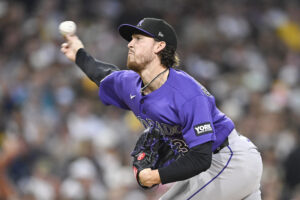
The Rockies took Dollander with the ninth overall pick in the 2023 draft. MLB Pipeline ranked him as the No. 2 prospect in the system in 2024, behind only infielder Adael Amador. Dollander struck out minor leaguers at a healthy 33.9% clip that season. The hard-throwing righty debuted with the Rockies last year. The results were brutal in basically every regard. Dollander struggled to miss bats, failed to find the strike zone consistently, and was frequently barreled. His 6.52 ERA was backed by an xFIP and SIERA near 5.00.
Dollander has taken a step forward in multiple areas in his second attempt as a big leaguer. He’s added a tick to his fastball, which was already extremely hard for a starter. Dollander’s four-seamer is sitting at 99 mph this year, ranking fourth among all pitchers. He’s more than doubled his sinker usage, contributing to a well-above-averge 51.9% groundball rate. Despite the increase in sinkers, Dollander has a strong 13.4% swinging-strike rate.
Keeping the ball on the ground while getting ample whiffs is a great recipe for success. Dollander’s 55.7% hard-hit rate stands out as a red flag, but it’s not turning into damage due to the type of batted balls he’s permitting. Only 8.9% of the contact against Dollander has been pulled in the air. Hard-hit balls on the ground and to the opposite way are generally going to lead to better outcomes for a pitcher than pulled air contact.
Colorado brought in Paul DePodesta to run baseball operations this offseason. He’s tasked with reviving a club that hasn’t won 70 games since 2021. The organization is currently in a seven-year playoff drought. DePodesta’s tenure is off to a solid start. The Rockies are just three games under .500 after sweeping the Mets over the weekend. The acquisitions of TJ Rumfield (trade) and Troy Johnston (waiver claim) have been additive, as has the signing of Tomoyuki Sugano. The Johnston addition came shortly before the DePodesta hire was announced, but it’s still part of what looks to have been a productive winter. DePodesta didn’t draft Dollander, of course, but his regime will be in charge of the righty’s development. The decision to initially use Dollander behind an opener, whether it came from manager Warren Schaeffer or the front office, proved fruitful.
Coors Field remains the most difficult place to pitch in the league. Per Statcast, it has a 112 overall Park Factor over the past three seasons, which ranks first by a significant margin. Chase Field is second on the list at 105. Colorado’s stadium ranks first in park effect for runs, OBP, hits, singles, and doubles, which makes sense given the spacious dimensions. The thin air in Denver also limits the effectiveness of breaking balls, forcing pitchers to reconsider their arsenals.
The Rockies have had the occasional pitcher break through with a productive season, despite the difficult home environment. Kyle Freeland finished eighth in ERA with a 2.85 mark in 2018. Jon Gray had a pair of sub-4.00 ERA seasons in the late 2010s. Jorge De La Rosa and Jhoulys Chacin formed a formidable duo in 2013, each posting sub-3.50 ERAs over 30+ starts. ERA is far from the only relevant pitching stat, but it’s a reliable marker for a successful season in a venue that boosts run production like no other.
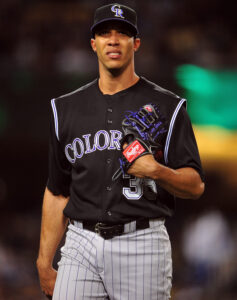
Ubaldo Jimenez stands out as one of the only starters to have extended success in Colorado. He’s the name that gets whispered whenever a Rockies pitcher brushes up against relevance. The righty entered the rotation on a full-time basis in 2008. He racked up 16.8 WAR (per Baseball Reference) over the next three seasons. The walks were a bit high, but Jimenez limited damage with the help of a diverse arsenal. The 2010 campaign was his masterpiece. Jimenez posted 221 2/3 frames of a 2.88 ERA with nearly a strikeout per inning. He earned an All-Star selection and finished third in NL Cy Young voting. Jimenez had better numbers on the road, but not by much. He held opponents to a .661 OPS and a .294 wOBA in 101 2/3 innings at Coors Field.
Jimenez was the rare pitcher to perform worse after leaving Colorado. He had one good year after getting traded to Cleveland, but didn’t find much success beyond his Rockies tenure. Jimenez did provide what would seem to be a viable blueprint for surviving at Coors Field: above-average velocity, a diverse arsenal, and a pitch mix that isn’t overly reliant on breaking balls. Dollander checks those boxes. He uses a changeup instead of a splitter, but the rest of the repertoire lines up with peak Jimenez. It’s around 60% four-seamer/sinker, 12% changeup, and then a smattering of breaking balls (slider/curveball/sweeper). Dollander has also improved his walk rate to 6.9%. Even in Jimenez’s stellar 2010, he issued free passes at a double-digit clip.
Dollander is just 28 appearances into his big-league career. It’s a seven-game sample of positive results. There’s plenty of season left for him to succumb to the Colorado conditions, which aren’t limited to home games. Rockies players also have to adjust to leaving the Denver altitude for road trips. But the formula is there for Dollander to conquer Coors Field.
Photos courtesy of Wendell Cruz, Denis Poroy, Gary A. Vasquez, Imagn Images
Ubaldo Jimenez was a beast the Astros probably would still take him in their rotation right now.
Ubaldo was a solid pitcher when he was going good.
he lost velo as he aged, and could not transition from fireballing thrower to actual pitcher. IT is something every great pitcher needs to figure out between 28-31. Either they figure out how to do it with a little less velo, or they wash out.
My favorite example was match Greg Maddux at the end of his career. By that time he was 20 years into his mlb career- was throwing 88mph with his gas (that was once a well above average fastball), but he was still getting outs and was a #3 or 4 starter. Pedro did much the same in his last come back. Few guys play long enough to lose enough velo that it gets to this point.
Didn’t he have only two or three good years in his entire career? No I haven’t checked, but I remember he was always disappointing everyone everyplace he went.
Don’t you disrespect Ubaldo
Sorry.
He left the rockies, and was bad in Cle and Baltimore. He at least had 1 playable year at both stops- but the fans wanted a fireballing ace, and not a 2 WAR meh guy when he was at his best for the team
James, I’m not talking about anything that the fans might have wanted. I remember this guy pitching and everybody wondering what happened to that guy that had the few good years in Colorado. It wasn’t even that long ago.
Whatever it is that has Dollander rolling, do that with other pitching prospects and replicate the process.
I just wanna know if he still does male modeling on the side and still has that little itty-bitty tiny phone!
In a race or a game of darts, sure.
In a getting hit with a baseball bat over and over again or a how many people can you fit inside you competition, not so much.
It’s all contextual.
Nobody can defeat Coors Field. He can learn to live with it though
The only one Coors truly defeats is the agent because the raw counting stats are all wonky, but ultimately both teams in the park have to deal with the conditions. The real issue is simply that Rockies pitchers, save for a few standouts over the years have just not been very good.
AND they play 81 games in Colorado. Which means the pitcher throws in a lot more games at Coors.
And so does the opposing pitcher. Ultimately the conditions are the same for both sides. Only thing that looks weird are the counting stats
the thing that a lot of people forget is that your spin rates change with the thin air. Basically the ball comes out of your hand slightly differently- in a game where the difference of 1 inch of movement over 60 feet is huge. So the ball plays differently out of your hand.
Now half your starts are in this place where everything is slightly different, now you travel and your stuff plays different in away games. IT is enough of a difference that you will notice, and you will lose or gain some break. Between the other 29 parts (and the vast majority of the minors- generally excluding the international league in AAA) the way the ball behaves will generally be the same.
So that change is what throws guys off when they play for the rockies. There are always guys who are solid at home in coors and trash on the road- or the opposite (good on the road, trash at home) and i feel for those guys since they would be good on most other teams. The rockies also did weird stuff during the past few years- there is a few years they did the 3 and 4 man rotations- where the game starter (3 man rotation) went throught he lineup 1-2 time, the 4 man then came in and went through the lineup 1-2 times, and then normal bullpen (generally you are only going through a lineup 4 full times)- that threw literally everyone off since no one was going deep into games ever by design.
Much like Father Time, Coors Field will remain undefeated.
Although he was a reliever one could say that Steve Reed was the most successful Rockie pitcher to date
There is no defense for altitude. Oh, hundreds have tried to figure out the formula for success but, alas, have failed. Even Albert Einstein would have been perplexed by this thin air poser.
All should stop being obsessed with limiting home runs. The canyon-like outfield dimensions at Coors are absurd. They’d be better off reducing the vast acreage outfielders have to cover and, by extension, shorten their time to retrieve balls hit into the gaps and shorten the distance of their throws back to cutoff men.
But chicks dig the long ball, so I doubt the suits in the suites will pay me heed.
The best solution is to get a home and road rotation with options and guys stick to the one they do well with. Stop using high picks on pitchers, and literally trade for every AAAA you can get, use late picks for guys you can legit use, since you are going to need 10-12 SP that you can option up and down on home/road series.
The idea being that some guys can figure out coors. The issue is that once they figure out coors, they often cannot figure out how to make the adjustment on the road, and then adjust back when they return home. The ballpark just plays different than almost everywhere else. They have a AAA stadium that plays similar enough, and can get a AA that plays closer to other places- and just rotate all of your pitchers when you are at home vs. on the road.
I’ve got a one word solution even Einstein wouldn’t see coming… Stilts. That is, Dakota “Stilts” Albritton of the Savanna Bananas. Just pound the zone with heaters and let the extreme downhill plane and gravity-assisted drop do all the work!
Jorge De La Rosa had long term success in Coors field on many bad teams.
And how much is Hollander’s agent paying MLBTR to make him look good with this puff piece that will be in front of the front office execs who read this site all the time? Is the agent giving them a kickback from his arbitration salary? That conflict of interest is the only reason to put this low-effort slop that isn’t even comprehensive with just a few stats regurgitated from Fangraphs. Analyze transactions and leave other stuff to the pros instead of this amateurish crap. Stop trying to be Fangraphs.