
The 2026 season is underway and last offseason is officially in the books. While free agency hasn’t completely closed — Lucas Giolito continues to wait for an offer he and his camp find acceptable — we’ll take our first look at next winter’s class.
As a reminder, these lists are based on our predictions of a player’s market value. This isn’t strictly looking at the most valuable free agents. Players in their mid-to-late 30s are going to have a difficult time cracking the top 10 because they’re naturally limited to shorter-term deals. Even in what is shaping up as a weak class, everyone in the top five and arguably the top eight have a path to a nine-figure contract.
MLBTR publishes our first free agent power ranking each April. A player’s walk year performance is the biggest factor in what they make, but their play over one week of the ’26 season doesn’t have much of an impact on their initial ranking. At this point, we’re going more off age and career track record — particularly the past couple seasons. There’s a lot of volatility this far out.
That’s especially true for the 2026-27 class. In recent offseasons, it has been fairly easy to identify the top free agent hitter at least a year in advance. Over the past five years, the respective top free agents on our first in-season rankings were Kyle Tucker, Juan Soto, Shohei Ohtani, Aaron Judge, and Corey Seager. Seager signed for $325MM, while the other four all set records for overall guarantee and/or average annual value.
This year also features a clear No. 1 free agent, but it’s a pitcher for the first time in years. Pitchers occupy the top two spots, in fact, and Jesús Luzardo would have made three of the top four if not for his recent extension with Philadelphia. Pitchers are riskier bets than an elite free agent hitter because of the ever-present worry of an injury that could wipe out a season or more.
There simply isn’t an impending free agent position player of Tucker’s or Seager’s caliber, much less an Ohtani or Judge. Nico Hoerner had an argument as the best or second-best free agent position player before signing a six-year extension with the Cubs last week. It’s the weakest hitting class in recent memory.
[Related: Who Will Be The Top Free Agent Hitter?]
The likelihood of a lockout looms over any projection of the 2026-27 offseason. It seems inevitable that MLB and the Players Association will not reach agreement on a new collective bargaining agreement before the expiration of the current CBA on December 1. MLB would immediately implement a lockout, freezing all roster movement and communication between teams and players until a new agreement is reached. The 2021-22 lockout brought the sport to a halt for 99 days.
The anticipated lockout isn’t a factor for this list. It’s too early in the process to predict specific contracts. It also doesn’t seem that last winter’s group of free agents feared the work stoppage. Four players accepted qualifying offers, setting the stage for a return to the open market during the expected lockout offseason. A handful of others took short-term deals at higher annual values with opt-out opportunities this winter. The CBA will be the defining story of next offseason, but it has no bearing on the first ranking of the class.
We’ll refresh these rankings at least twice more during the season as injuries and players’ performances change their market value. There’s frequent turnover in the back half of these lists throughout the season. A lack of top-end talent means that’ll be particularly true this year.
One final note: players whose contracts contain opt-out clauses or mutual options are considered for these rankings. Those whose deals have club options are not. For instance, there’s no scenario in which Ronald Acuña Jr. signs a massive free agent contract next offseason. The Braves are all but certain to exercise their $17MM option for the 2027 season. It’d take some kind of catastrophic injury for Atlanta to buy him out.
Onto the rankings:
1. Tarik Skubal, LHP, Tigers
Skubal enters his walk year on track for the largest pitching contract of all time. He’s probably the best pitcher in the game right now, no lower than second after Paul Skenes. Skubal is the two-time defending Cy Young winner in the American League.
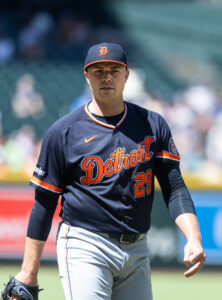
Going back to the start of the 2024 season, he carries a 2.25 earned run average that ranks second among qualified pitchers behind Skenes. He’s third in strikeout rate after Garrett Crochet and Chris Sale, each of whom has thrown fewer innings. Only Logan Webb has logged a heavier workload. Skubal has been even more dominant in October, turning in a 2.04 ERA while striking out 38% of opponents in six career playoff starts.
Skubal has a prototype workhorse build and sits in the 97-98 mph range on his fastball. He dominates hitters from either side of the plate and has no issue working deep into games. The only potential concern is that Skubal has twice undergone elbow surgeries: a 2017 Tommy John procedure while in college and a ’22 flexor repair that cost him a year. Skubal has not missed a start since returning from the latter surgery.
As long as he stays healthy, he should shatter the record for the largest pitching contract ever. Excluding the Ohtani deal, that’s currently held by Yoshinobu Yamamoto, who got to $325MM over 12 years. Skubal turns 30 in November, so he’s not signing for 12 years, but he could land a nine- or 10-year pact that beats the $43.33MM record average annual value for a pitcher. We’re probably looking at the sport’s first $400MM arm and the clear prize of the winter.
Skubal and agent Scott Boras have already broken new contractual ground. They were rewarded for a bold arbitration filing, resulting in a record salary ($32MM) and the largest single-year jump (nearly $22MM) via that process. He’ll be attached to a qualifying offer unless the Tigers unexpectedly face plant and trade him at the deadline (which makes a player ineligible for the QO). That’s irrelevant for players this good. Teams will happily forfeit a couple draft choices and international bonus pool money to install Skubal atop their rotation for the better part of the next decade.
2. Freddy Peralta, RHP, Mets
Peralta has been one of the best and most consistent starting pitchers in the majors for over five years now. From 2021 to 2025, he has thrown 738 1/3 innings, allowing 3.30 earned runs per nine. His 9% walk rate in that time is around league average while his 29.6% strikeout rate is tied for 16th among 208 qualified pitchers. He has a four-pitch mix consisting of a four-seamer, changeup, slider and curveball, getting good results will all four.
For that span, he has been credited with 14.8 wins above replacement from FanGraphs, making him one of the 20 most valuable pitchers in the league. He hasn’t had a major injury in that time. A lat strain limited him to 18 appearances in 2022, but he has made at least 30 starts in each season since.
After the Mets acquired Peralta from the Brewers this offseason, many expected an extension to keep him in Queens. However, it seems there may be a misalignment of priorities. President of baseball operations David Stearns prefers short-term deals, for all players but especially for pitchers. Including his time with the Brewers as well as with the Mets, he has only twice gone beyond three years for a pitcher. In both cases, they were five-year extensions for pitchers early in their careers. One was for Peralta himself, a $15.5MM deal signed before he was established. The other was a $20.5MM deal for Aaron Ashby.
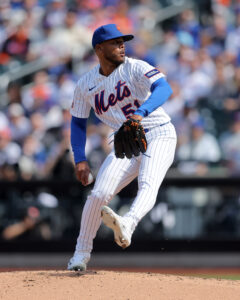
The Mets would presumably offer Peralta a very high average annual value, but it seems he would prefer a more traditional long-term deal. He has publicly said he is hoping to sign a deal of seven or eight years in length. He would have a case for such a pact. His profile lines up fairly nicely with Dylan Cease, who just got a seven-year deal worth $210MM from the Blue Jays, though deferrals knocked the net present value down to the $180-185MM range. Here are the two pitchers from 2023 to 2025:
Peralta: 95 starts, 516 innings, 28.9% strikeout rate, 8.8% walk rate, 38.5% ground ball rate, .265 BABIP, 79.8% strand rate, 13% HR/FB, 3.40 ERA, 3.88 FIP, 3.63 SIERA
Cease: 98 starts, 534 1/3 innings, 28.8% strikeout rate, 9.5% walk rate, 37.5% ground ball rate, .304 BABIP, 69.3% strand rate, 10.3% HR/FB, 4.18 ERA, 3.45 FIP, 3.72 SIERA
The strikeout, walk and ground-ball profiles are extremely close. Peralta had a bit better luck in terms of batted balls and sequencing, giving him an edge in the ERA department, but advanced metrics put them much closer together. Front offices these days tend to overlook ERA, as Cease’s deal shows.
Peralta will be one year older than Cease, in baseball terms. Cease signed his deal with the Jays going into his age-30 season. Peralta turns 30 this June, so 2026 will technically be his age-30 campaign. However, the difference is actually just six months. Cease turned 30 in late December, about three months before his first start with the Jays. Peralta will turn 30 about nine months before the start of the ’27 season. Like Cease, he’ll be attached to a qualifying offer but shouldn’t be impacted by draft forfeiture.
3. Bo Bichette, 3B, Mets
Bichette was just one of the top free agents of the past offseason but has a chance to be in that position again. Though he did receive at least one long-term offer — the Phillies reportedly bid around $200MM — he opted to go for a short-term deal with an extremely high average annual values and opt-outs.
With a healthy season, Bichette could return to the open market with fewer questions. He finished last season injured and with an uncertain defensive future. He was never considered an excellent shortstop and then suffered a sprained PCL in his left knee late in the 2025 season. He finished the campaign on the injured list and missed the first few rounds of the Blue Jays’ playoff run. He was activated for the World Series but was clearly not 100% and was limited to second base and designated hitter duty.
Despite the question marks, Bichette still had a robust market thanks to his bat. He doesn’t walk much but is also tough to strike out. He generally has 20-plus homer power, giving him an intriguing contact/power combo. He has a .292/.335/.466 batting line in his career, resulting in a 121 wRC+, indicating he’s been 21% better than league average overall. Before the knee injury in 2025, he hit 18 home runs and slashed .311/.357/.483 for a 134 wRC+.
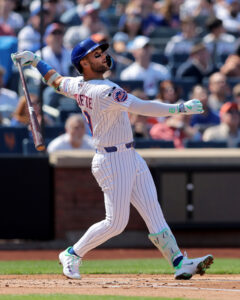
Bichette’s largest total offer this winter came from the Phillies, who put forth a seven-year framework worth around $200MM. Instead, he signed a three-year deal with the Mets. The $126MM guarantee is well shy of the Philly offer but allows Bichette to bank $42MM this year. If he decides to opt-out, he will collect a $5MM buyout on his way out the door. While turning down $200MM isn’t easy, Bichette can return to free agency with about a quarter of that money already under his mattress.
It’s also theoretically possible he could get an even better long-term offer this coming winter. He will be a year older but still relatively young, as he will turn 29 in March of 2027. The Mets are playing him at third base this year. Moving down the defensive spectrum hurts his earning power, but that was already the expectation for him. Having one year of experience should at least give him some proof of concept at a new position. Ideally, he won’t go into the coming offseason with any health issues. He was a $200MM guy a few months ago and should still be that a few months into the future. He’s ineligible for the qualifying offer after receiving one from Toronto last winter.
4. Jazz Chisholm Jr., 2B, Yankees
There’s a clear tier break between the Nos. 3 and 4 players in the class. Chisholm seems to have the highest ceiling of the non-Bichette group of position players. He’s a lefty-hitting middle infielder with plus bat speed and athleticism. Chisholm was one of seven players to go 30-30 last season, setting a career-high with 31 home runs. His matching stolen base total was the second highest of his career.
The hangup is the amount of swing-and-miss in his game. Chisholm has fanned at a higher than average rate in every season of his career. He punched out in 28% of his plate appearances a year ago, batting .242 in the process. A personal-high 10.9% walk rate resulted in a solid .332 on-base percentage, but he has a more pedestrian .315 mark over his career. Chisholm’s career .247/.315/.451 batting line is around eight to nine points better than league average, in the eyes of park-adjusted metrics.
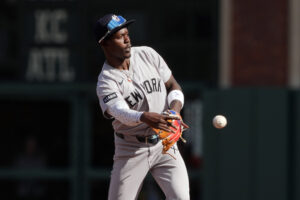
Free agency has generally been unkind to second basemen in recent years. Hoerner’s $141MM extension could be a nice boost for the position, but he may have gotten interest as a shortstop if the Cubs had let him hit free agency. That’s less likely for Chisholm, who is a solid but not elite second baseman and hasn’t played shortstop in five years. He could be an option for teams seeking third base or outfield help, though a downward trend in his sprint speed means he’s probably not returning to the everyday center field work he logged with Miami between 2023-24.
Chisholm will be eligible for qualifying offer. He wouldn’t have much delay in declining it if he repeats last season’s production. He’s one of the younger players in the class, not turning 29 until next February. Matching his 2025 numbers could set him up for a nine-figure contract.
5. Trevor Rogers, LHP, Orioles
The past 12 months have represented a remarkable turnaround for Rogers. Baltimore’s 2024 acquisition of the former All-Star lefty for Kyle Stowers and Connor Norby was heavily scrutinized. He was bombed over his first four starts as an Oriole and optioned to Triple-A to end the ’24 season. He began last season on the injured list and was on optional assignment to Triple-A into the middle of June.
From the time of his final recall through the end of the season, Rogers ripped off 17 starts with a 1.92 ERA. He fanned a slightly above-average 24.4% of opponents against a 7.2% walk rate while holding hitters to a .185/.246/.272 line. Within a half-season, Rogers went from a depth piece to Baltimore’s Opening Day starter. He has opened this season with a pair of quality starts, allowing two runs with an 8-to-5 strikeout-to-walk ratio over his first 13 innings.
Rogers’ dominant run prevention hasn’t come with a huge amount of swing-and-miss. He has good but not elite strikeout and whiff rates. His 93 mph average fastball isn’t overpowering on the surface. He gets a lot of weak fly-balls on the heater while using his changeup and sinker as ground-ball offerings. Rogers picked up a sweeper last year to build out the arsenal.

There are obvious red flags to which Rogers’ detractors could point. He’s not going to match last season’s .226 average on balls in play, even if it’s reasonable to expect him to sustain a lower-than-average BABIP based on hitters’ struggles squaring him up. Durability is the other big concern. Rogers has yet to reach even 140 innings in a big league season. He missed time early in his career due to back, lat and biceps issues. A right knee subluxation cost him the first six weeks of the ’25 campaign.
Rogers is among the highest variance players in the class. He could hit the market as a 29-year-old coming off a season and a half of ace-caliber production. Another injury or a slight drop in velocity or whiffs could quickly drop him back into prove-it territory.
There’s a lot of projection in slotting him this high, but it’s also a reflection of how few pitchers in this class are hitting the market in their primes. There are a handful of pitchers below Rogers on this list who have much longer track records, but they’re mostly into their early-mid 30s. Rogers has a chance at a five-plus year deal that most of the older, more established arms do not. He’ll be eligible for a qualifying offer.
6. Michael King, RHP, Padres
King can return to the market by opting out of the final two seasons of his three-year, $75MM deal. The right-hander had a fairly robust market last winter despite being limited to 15 starts, largely by a nerve issue in his shoulder. However, King was unlikely to command five or six years coming off that platform, so he opted for three years with opt-outs to return to the Padres.
This is almost entirely dependent on health. King performed at a borderline ace level throughout 2024 and the first two months of the ’25 season. He struggled down the stretch after returning from the nerve injury and an August IL stay due to a minor knee issue. After a shaky spring, he worked around four walks across five scoreless frames versus the Tigers in his season debut. His 94 mph average fastball was at typical levels.
King won’t be eligible for another qualifying offer. He turns 31 in May, so a free agent deal would begin with his age-32 season. Five-year deals for starting pitchers at that age aren’t common. A healthy season could get him to four years at a strong enough annual value to reach nine figures. Injuries could take him off the market entirely by leading him to forego the opt-out.
7. Daulton Varsho, CF, Blue Jays
Varsho missed the final month of the 2024 season due to a shoulder injury that required offseason surgery. The rehab from that operation, coupled with a separate hamstring strain, limited him to only 71 games in 2025. Despite that considerable time off, he still ranks fifth among all major leaguers, at any position, in Defensive Runs Saved over the past three-plus seasons at 44. The four players above him have all played at least 1000 more innings. Varsho’s 22 Outs Above Average tie him for 23rd in baseball in that same span. The Ultimate Zone Rating metric isn’t as commonly used as it was 15 years ago, but no player in MLB (min. 1000 innings) has been a better defender than Varsho since 2023 by measure of UZR/150.
A former catcher, Varsho took shockingly well to center field and now stands as one of baseball’s premier defensive players. He’s far from a one-trick pony, however, even if his glove is his best asset. The second-generation big leaguer has been a perennial threat for 20-plus home runs, but his power output exploded in 2025. Varsho belted 20 round-trippers in only 271 turns at the plate. He chipped in three more homers in 81 postseason plate appearances. If he’d maintained that regular season pace over the same 562 plate appearances he averaged in the three preceding seasons, Varsho would’ve topped 40 home runs.
That type of power output was a new development, and whether he can sustain anything close to it will go a long way toward determining the extent of his earning potential this coming winter. If Varsho can somehow maintain anything close to last year’s breakout .310 ISO (slugging minus batting average), he could be in line for a nine-figure contract. If his power comes back down to Earth, things are less certain. Varsho is a good player, but he’s strikeout prone and typically has only an average walk rate. That’s led to a career .295 on-base percentage, which many teams will see as a glaring red flag.
There’s a wide range of outcomes here, but Varsho is going to reach free agency as a 30-year-old. He’ll turn 31 in July of year one on his new contract. A plus-plus center field defender with 20-homer pop should, at the very least, command three to four years in free agency. If he can sustain last year’s power output, Varsho can more credibly look for a contract of five years, which might be enough to push him into nine-figure territory. It’d be a big bet to place on someone with such paltry OBP skills, but 40-homer pop and a poor OBP netted Anthony Santander a $92.5MM deal (albeit with heavy deferrals). Varsho should be more appealing if he can stay healthy and deliver a career-best performance in the power department. He’ll be attached to a qualifying offer.
8. Tatsuya Imai, RHP, Astros
Imai’s market didn’t materialize the way many expected last offseason. Despite several predictions of a nine-figure contract — MLBTR included — the Japanese righty wound up settling for somewhat of a prove-it deal. He signed a three-year, $54MM guarantee with the Astros which included opt-outs after the first two seasons.
The Astros also paid a $9.975MM posting fee to NPB’s Seibu Lions. In a sense, Houston was willing to spend nearly $28MM for one year of Imai’s services. That’s a decent amount, but scouts had enough trepidations about Imai’s command and the quality of his secondary pitches that teams weren’t willing to make a long-term commitment.
That’d probably change if he pitches at a mid-rotation level as a rookie. Imai is the youngest starter of note in this class, as he won’t turn 28 until May. He has a plus fastball that averaged 95.6 mph in his MLB debut. It was a rocky start overall, as he walked four batters and couldn’t escape the third inning, but one poor outing doesn’t say much about the caliber of pitcher he’ll be moving forward. (Yoshinobu Yamamoto gave up five runs and lasted all of one inning in his own MLB debut.)
Imai probably won’t be in this spot on the next iteration of the free agent rankings. If he’s pitching well, he could jump into the top five based on the youth and velocity. If he struggles, he could drop off the list equally quickly. He would be eligible for a qualifying offer if he opts out of his current contract.
9. Randy Arozarena, LF, Mariners
Arozarena is an above-average everyday left fielder. He has been between 14 and 27 percent better than average at the plate in five straight seasons. He hit a career-high 27 homers while stealing 31 bags last year. Arozarena has gone at least 20-20 in each of the last five years and is a lifetime .250/.344/.433 hitter.
That blend of power and speed comes with some swing and miss. Arozarena has struck out a near-26% clip in his career and punched out in 26.9% of his trips last year. Defensive Runs Saved has graded him as a league average left fielder, while he’s generally a little worse than par by measure of Outs Above Average.
Arozarena will hit the market at age 32, likely with a qualifying offer attached. A high-AAV three-year deal seems likelier than four guaranteed seasons. His camp would probably try to beat the $66MM Teoscar Hernández contract if he has his usual year.
10. Seiya Suzuki, RF/DH, Cubs
Much of the Arozarena writeup also applies to Suzuki. The righty-hitting slugger owns a .269/.346/.472 slash over four big league seasons since signing out of NPB. He popped 32 homers with a .245/.326/.478 mark over 651 plate appearances last season.
Suzuki has plus power and takes a lot of walks. It comes with some strikeouts but not enough to prevent him from slotting into the middle of a lineup. Suzuki is probably a slightly better offensive player than Arozarena, but he faces more questions about his position fit and injury history.
The Cubs have used Suzuki frequently as a designated hitter over the past couple seasons. He has the speed and arm strength to play right field, where the public metrics have graded him as a slightly below-average defender. He missed time in 2023 and ’24 with oblique strains and began this year on the shelf with a minor PCL sprain in his right knee suffered during the World Baseball Classic.
Suzuki will be eligible for a qualifying offer. Like Arozarena and teammate Ian Happ, he’ll hit free agency as a 32-year-old corner outfielder. They’re all consistently good but not top-tier hitters, and clubs could reasonably order them in any way. They each have a shot at three years and more than $20MM per season. A fourth year for any of the three isn’t a complete stretch but also shouldn’t be considered likely. As MLBTR’s Contract Tracker shows, the only free agent deals of four or more years for outfielders 32 or older in the past decade have been for Starling Marte (four years, $78MM) and Lorenzo Cain (five years, $80MM) — both of whom played center field in their platform seasons.
Honorable Mentions (listed alphabetically): Bryan Abreu, David Bednar, Shane Bieber, Kris Bubic, Jack Flaherty, Zac Gallen, Kevin Gausman, Trent Grisham, Ian Happ, Shota Imanaga, Brandon Lowe, Casey Mize, Adrian Morejon, Nick Pivetta, Brady Singer, Gleyber Torres, Taylor Ward, Brandon Woodruff
Respective images courtesy of Imagn Images.
I think Bichette would need to have an uber all- star year to walk away from 3/$126 mil.
Who do you root for when the Knicks and Cavs play each other?
The Bulls 🤣
It could be the Virginia Cavaliers.
He wouldn’t be walking away from 3/$126 million. He’d be walking away from 2/$84 million, and getting paid $5 million to do so. It’s definitely possible.
imo, though, he’s going to opt in this coming offseason and opt out after 2027. That way, he can collect $89 million ($84 million in salary and a $5 million opt out) over the first two years of the deal and still hit FA just shy of his 30th birthday.
Not so fast as Bo won’t be collecting a dime once the players are locked out after this season as it’s 100% guaranteed the owners going to force major changes in next labor agreement. I predict at least half a season wiped out maybe entire season! The current structure with all this deferred contracts, no international draft and allowing international free agent players to choose their teams will need to go into draft pool to stop all Japanese players from choosing Dodgers only.
The owners won’t get the favorable changes they want because it takes two to tango during negotiations. It’s such a tired trope with fans definitively predicting an imminent work stoppage and missed games.
Nobody knows until the parties – owners, players, Manfred, fans, MLBTR users, and you – actually sit down at the CBA negotiating tables during the fall/winter lockout.
No George Springer? I know he is getting up in age, but he is still a valuable free agent.
not top 10 valuable. Which FA listed will he beat in total earnings?
Apparently not top 18 valuable since he didn’t get one of the 8 honorable mentions.
Except they list 28. I think he is easily in that group.
They do list all 28. Somehow after counting 18 honorable mentions, I dropped the 1, and was thinking only 8. (Should’ve checked my work.) But Springer is still not among the top 28 listed.
Springer will get a 2-3 year deal max, won’t be too 10 maybe not even top 20
The stuttering cheating boy
Problem with Springer is two things: number one, he’s older than the mud from under my boots which i haven’t cleaned for 40 years, and I’m 85 and weigh over 385 pounds if that helps. Number two, next year, unless I’m mistaken, Springer will be 75 years old, and if my math is correct, that’s 20 years older than me. Which makes him 95.
With Shota and Taillon coming off the books, the Cubs get Skubal. This stuff is easy to figure out
Spoilers below.
Speaking of free agents, CONGRATULATIONS to Gregory L McGarvey (1st) and Samuel Canaday (2nd) for picking 19 correct free agent signings in the 2025-2026 contest. Each had 19 correct for a .388 average, but McGarvey wins the tiebreaker.
I got 13 right.
.265 avg
Rank 377th
Best I have ever done.
Poor group of free agents
Weakest in recent memory
Alec Bohm??
Definitely NOT a Top Free Agent.
Its a year away, but Jazz would look great in a Giants uniform
The Giants have several promising middle-infielder prospects, 4 of the team’s top 5, with 3 in the top 100 overall. I doubt they’d want to commit to the years Chisholm will want. And seems like what it would take in terms of salary would be better used elsewhere.
Josuar is 18, Level is 19. Kilen just turned 22 and has 43 PA in the minors. None of them are likely to contribute before 2028. And they are prospects, they could all bust. Second base has been a weak spot for the Giants for a long time, and Jazz would be a perfect fit.
Anyway, we can continue this conversation in November 🙂
It’s a good point about their ages, but I think any Chisholm deal goes long past 2028. I think he’ll be looking for at least 6 years, and probably more like 7. The Adames deal is a reasonable comp. That would take it through 2032-2033. He got 7 years running through 2031.
You’re right that more prospects fail than succeed, but with 4 guys the odds are better that one will be what we hope for. And it’s entirely possible someone like Josuar makes his debut at age 20-21. He’s so thought highly of that he was ranked 41st overall without having played a single professional game.
Jazz is also not a $30-35 million avv player
So? I never once mentioned salary. The entire point was about number of years.
What teams could even come close to affording what Skubsl will want?
About half if they weren’t all crying poor
Not the Padres, MLBTR AI articles seem to mention it every chance they get.
By MLBTR AI do you mean Nick “get a proofreader” Deeds
Any in the top 10 in revenue.
It’s only Dodgers or Mets.
The Giants and Yankees could hop in this conversation. Giants are too cheap to spend. Great ballpark for a pitcher too.
I think the Mets will make a deep run at Skubal. They need an ace. With the Yankees’ front-end rotation entrenched and aging in Cole, Rondon, and Fried, they do already have a bunch of young arms waiting in the wings. I see them taking a pass on him.
Dodgers, Mets, Yankees, Blue Jays, Red Sox, Cubs, Braves, Giants, Phillies, and Astros. I would not be at all surprised to see the Padres who are now in the top 10 in revenue and the Orioles and Tigers also make competitive bids.
Skubal will need to wait until 2028 since 2027 will be wiped out due to looming strike.
The players aren’t going to strike. The biggest factor is the disagreement among owners. It’s doubtful they’ll kiss billions of dollars goodbye locking out the players for an entire season.
The Players can’t strike unless they start the season with no new CBA. There is less than zero chance of that happening.
CBA will definitely play a role in the 26/27 offseason…. Plus determine whether there will even be a 2027 season. Will be very, very interesting to see how everything plays out but I’m not (unfortunately) hopeful of a quick or easy resolution.
You definitely have a right to your own delusional opinion…however if I were you I wouldn’t be putting any deposit down on a 2027 season ticket package
When the owners can’t agree on what they want, because they’re split into big market/small market factions, it won’t be easy agreeing with the players. I still wouldn’t be surprised if the players went on strike before the playoffs. Playoff earnings mean more to the teams than the players.
There’s definitely disagreement between the big and small market teams. But the big market teams are making so much that they can increase revenue sharing enough to get the small market teams to agree. Neither side is going to be willing to lose all the money both owners and players are making.
For all 30 teams existing season ticket holders have to have their season ticket deposits in while the 2026 season is still going on.
Manfred made this same pronouncement about the owners being ready for a long term work stoppage in 2021 and then they locked the players out. But they didn’t miss a single game. All 162 games were played in 2022. That lockout still cost the owners more than $350 million collectively due to changes in scheduling and TV broadcasting losses according to Manfred.
If the owners lock out the players for the entire 2027 season they lose 100% of their revenue. All of it. All $13.5 billion that Manfred says the sport earned in 2025. After taking those huge losses on the chin, the owners still have to pay stadium leases and maintenance, salaries for all of their other employees, and all their debt service. Forbes estimates the owners will still have to cough up more than $5 billion even if there is no baseball played. Statista estimates the total losses are close to $20 billion. Many of the smaller revenue teams will not not be able to survive a 100% loss of revenue for a full year.
There also won’t be a minor league season as those players are also part of the MLBPA.
The MLBPA can’t go on strike unless they start the season without agreeing to a new CBA. There is less than zero chance of that happening.
Well said, I agree
Am I missing something on the statement regarding there being a big drop off between #3 Bichette to #4 Chisholm?
I’d rather have Jazz over Bichette in a heartbeat.
IF Bichette continues to scrub for hits then he won’t be a FA
What a brainless comment. Dude hes played 7 games this year. Theres 162 of them in case you didnt know.
sports-reference.com/stathead/tiny/fzPxV
Bo has definitely had the better career so far and they are mere weeks apart in age.
I like Jazz and might prefer him for his lefty pop on my team but think he’ll get less money than Bo.
How interesting is to see Brady Singer being considered among the honorable mentions. Reds never considered trading him during the offseason, which is the kind of decisions that differentiate a mediocre organization from a good one like, for example, the Brewers.
Lets just move all the star japanese players to LAD already and pay them enormous sums with deferrals (it wouldn’t be LAD without ’em)
Can we throw a wrench in their player development system while we’re at it?
Funny, I didn’t realize Skubal was Japanese.
None signed with them this last off-season. But maybe math isn’t his thing.
The new Labor agreement will most definitely put an end to this scenario forcing them to enter a draft for all international players and the deferred salary structure will be taxed at full value of contract immediately and at a higher tax rate to prevent these stupid deferred deals.
There were four major Japanese players signed this off-season. None went to the Dodgers. I’m not sure what exactly people are complaining about.
The Dodgers obviously don’t sign every Japanese player. It’s a rather lazy narrative, all things considered.
I didn’t realize the Chicago Cubs were the Dodgers. They deferred money in the Nico Hoerner contract. There are other teams doing this as well.
King will be paid $58 million for 2027-2028. Those will be his age 32 and 33 seasons. While he may get a larger guarantee, he is far from certain to get more AAV. I could see him being extended if a new ownership is in place in San Diego prior to the end of the season rather than opting out.
Shouldn’t this be titled “Future Dodger Power Ranking?” 😀
Weak class when Varsho is in the top 10!
Good pitching class. Very very mediocre everything else. I’m not even a cubs fan but Suzuki should be at #7 and Ian Happ shouldn’t be much lower than 11-15
This is a really bad free agent class
However it seems like the free agent class the royals have been waiting for for years lol
When I saw “April edition” I thought this would be based on early individual results this season but…it was not.
That would be absolutely ridiculous, and no one who really knows baseball would ever think that. Just like people who value spring training stats (if a corresponding swing change or a new pitch, etc. was involved then it might be relevant; otherwise, the numbers themselves are meaningless).
Why does it have to be some Uber important armchair gm metric thats good enough for you? It’s interesting and if you follow it thru the whole year you can follow the guys who hit the peaks and valleys. Geez man buzzkillington
Less free agents probably means more trades. It will all work out. Teams with good farm systems will be fine.
Arozarena would look good in Detroit and tick some boxes…Clark to center and Carp to DH full time. I have a funny feeling Flaherty re-signs there too…if he has a decent season. The big question will be Skubal…in or out, and who do they bring in if he’s out?
Skubal is done in Detroit. They are at record payroll already. The player they seem to dismiss is Casey Mize. He learned to pitch last year. If he repeats his success, he will be top 10.
Guys… PLEASE make these HUGE articles “click to expand” going forward please. Makes scrolling on mobile so annoying, especially when I’m here almost entirely for quick updates, news/transactions.
Jazz that high on the list is very interesting. He’s gone from New York probably should have been traded.
Yanks need to let jazz walk, move volpe to second base and bring up Lombard for shortstop
Why? Do you think Lombard is better defensively than Volpe? Do you think Lombard/Volpe would provide more offense than Jazz/Lombard? Its not like NYY will be cash strapped, and need to cut payroll like San Diego will.
I have said what I have said
I would think it’s pretty premature and foolish to assume even half of these guys make it to free agency
Free agency begins five days after the WS ends. They’re not signing extensions if they haven’t yet already.
You’re right, guys never sign extensions during the season lol
If Jazz Chisholm is the third best free agent this coming off-season, rebuilding teams are in trouble if they’re looking for a quick fix.
Just wondering how many games out of 1st place before the trade deadline that it will take for the Detroit Tigers to flip Skubal to another contending ballclub for a very nice return package of young major league/major league ready talent?!
Same question applies to the San Diego Padres about their team and roster starting with Nick Pivetta, Michael King and others.
In past trade deadlines, some teams that traded away talent on short term deals actually played better after those trades when many thought that they were “throwing in the towel” on their seasons…
Skubal’s $32M salary may be a factor limiting his deadline suitors to big market teams. It would also be an even more unfavorable move to Tiger fans to include a big sum of money to trade him to a surprise small/mid market team. I think he sticks regardless of how the Tigers do and they Q.O. him.
The disappointing way this season has started in SF, the Giants might also be in the sad position of looking to offload some veteran contracts: veteran starter Robbie Ray (and various bullpen arms) on the pitching side. And guys like CF Bader, C Bailey, INF Arraez and even 3B Chapman on the position player side.
The contracts for SS Adames – and especially the deal for OF Lee – look to be underwater already. Major bust. It’s only ten games into the season, but Buster Posey looks to have created an expensive mess. Giants need to do what they should’ve already done back in 2018: start a proper rebuild.