
Poll: How Can The Rockies Best Improve Their Starting Pitching?
The Rockies are coming off a 119-loss season, which stands as one of the worst seasons in modern baseball history. The team’s starting pitching was a key factor in that poor performance. In 2025, Rockies starters had a 6.65 ERA, a league-worst 7.4% K-BB rate, and allowed a league-worst 1.79 HR/9. It is therefore unsurprising that Rockies president of baseball operations Paul DePodesta identified the rotation as “an era of focus” for his newly-hired front office.
“We would like to add some stability to the rotation,” said DePodesta in a phone interview with Patrick Saunders of the Denver Post. “I think that’s obvious … given our current situation.” He went on to say that the team will consider trading from their bullpen and outfield depth to acquire starters, while also counting on improvement from existing starters. Referring to his coaching staff, DePodesta said, “Given the sheer manpower we have allocated to the pitching side, there’s definitely room for improvement with the players we have.”
The comments come across as generic boilerplate. As is well-known, Rockies pitchers have the challenge of playing half the season at high altitude. Dating back to 2021, the club’s starters have posted a league-worst 5.60 ERA and 28.3 fWAR, including a mere 1.5 fWAR in 2025. Its top starters this year by innings pitched were Kyle Freeland, Germán Márquez, and Antonio Senzatela. Freeland was once an above-average starter but logged a 4.98 ERA in 162 2/3 innings this year, including a 5.75 mark at home. Though he remains onboard as the nominal “ace,” he will play 2026 at age 33 and is unlikely to recover his old form.
Márquez had a nightmarish 6.70 ERA in 126 1/3 innings in 2025, with a well-below-average strikeout rate of 14.0%. He is now a free agent and unlikely to be re-signed. Meanwhile, Senzatela’s 11.8% strikeout rate was a career-low. He was demoted to the bullpen for the last month of the year and won’t be guaranteed a rotation spot in 2026. Chase Dollander and Tanner Gordon were the only other Rockies starters to reach 60 innings this year, and they both had ERAs in the mid-6.00s and struggled with the long ball.
Given those struggles, it’s hardly a surprise that DePodesta wants to make upgrades. Of course, that’s easier said than done. Colorado is an unlikely destination for free agent starters who do not want to see their stats decline from pitching at Coors. Indeed, the only major-league free agent starting pitchers to sign with the Rockies since 2021 are Chad Kuhl, José Ureña, and Dakota Hudson. All three signed for one year and were reclamation projects at best. Ureña, whose $3.5MM contract in November 2022 was the highest value of the bunch, only made five starts for the Rockies in 2023 before being released that April.
The team faces a similar problem in attempting to add starting pitchers via trade. Potential partners can use the Rockies’ home-field disadvantage and need for pitching to gain leverage in trade talks. Dating back to 2021, most of the Rockies’ starting pitching acquisitions have been low-level trades and cash transactions. Arguably the highest-profile acquisition was that of Cal Quantrill in November 2024. He threw 186 1/3 innings with a 3.38 ERA for the Guardians in 2023 but struggled badly in 2024 and was recently designated for assignment when he came to Colorado. With a disadvantage in trade talks, the club is forced to lean heavily on internal options for starting pitching.
While teams obviously want to get all the value they can from their existing players, the current rotation led by Freeland doesn’t inspire much confidence. For his part, DePodesta expressed confidence in his new pitching coaches, but also acknowledged that internal improvement is only part of the equation. A trade involving outfielders or relievers might be difficult to pull off. Center fielder Brenton Doyle is unlikely to be traded, while top relievers Jimmy Herget and Juan Mejia were good in 2025 but have minimal track records otherwise. The team could give young lefty Carson Palmquist a bigger look, but he struggled badly with control and home runs in his debut this year. Meanwhile, the Rockies have two prospects among MLB.com’s Top 100 list, neither of whom are pitchers.
What do you think is the best way for the Rockies to improve their starting pitching? Let us know in the poll below:
How Can The Rockies Best Improve Their Starting Pitching?
-
Trade Doyle or another outfielder 38% (1,222)
-
Call up their prospects 32% (1,012)
-
Rely on the pitching coaches to improve the existing starters 22% (706)
-
Trade from the bullpen 8% (260)
Total votes: 3,200
Photo courtesy of Ron Chenoy, Imagn Images
Astros Sign Tatsuya Imai
The Astros officially announced the signing of right-hander Tatsuya Imai to a three-year contract that allows him to opt out after each of the first two seasons. It’s reportedly a $54MM guarantee for the NPB star, who’ll collect a $2MM signing bonus and $16MM salary next year. He’s owed respective $18MM salaries between 2027-28. Imai, a client of the Boras Corporation, would reportedly escalate his 2027 salary by $2MM apiece at reaching 80, 90 and 100 innings next year. His ’28 salary would also climb by $1MM at each of those thresholds, meaning the total value can jump another $9MM.
Meanwhile, the Lions will receive a posting fee based on Imai’s $54MM guarantee. The current system for international postings gives the original club 20% of the first $25MM, 17.5% of the next $25MM, and 15% of anything over $50MM. That works out to $9.975MM, so the Astros are on the hook for just under $64MM between the contract’s guaranteed money and the posting fee. If Imai opts out next season, Houston will have committed $27.975MM for one year of his services. The Astros would also owe a 15% posting fee to the Lions on any escalators that Imai unlocks if he doesn’t opt out.
Imai was one of the top starters available in free agency and coming off a career-best 1.92 ERA season with the Saitama Seibu Lions of Japan’s Nippon Professional Baseball. It was reported several days ago that he was meeting with teams in-person in advance of his January 2 signing deadline. The Yankees, Mets, Cubs, Phillies, and Orioles were among the clubs interested in signing him, so the Astros are a bit of a surprise destination.
We at MLBTR ranked Imai No. 7 on our Top 50 Free Agents list and projected him for a six-year, $150MM contract. This deal with Houston comes in at half the length of that projection, with around a third of the guaranteed money. It appeared that Imai had other offers on the table for longer terms but lower AAVs (link via Mark Feinsand of MLB.com). The opt-outs in his deal with Houston allow him to try for a bigger contract in future offseasons if he can prove himself in MLB.
Imai is 27 years old (28 in May) and has pitched to a 3.15 ERA in 963 2/3 career NPB innings. He debuted in 2018 at age 20 and made 16 appearances (15 starts), but struggled with a 4.97 ERA. Those early struggles continued from 2019-20. In the pandemic season, Imai had a 6.13 ERA in 61 2/3 innings and walked more batters than he struck out, which resulted in him temporarily being moved to the bullpen. He rebounded in 2021, posting a 3.30 ERA in 158 1/3 innings with an improved strikeout rate, and he has stuck as a starting pitcher ever since.
That kicked off a run of dominance from 2022-25. After posting a 2.41 ERA in nine starts with the Lions in 2022, Imai followed up with a 2.30 ERA and a 24.4% strikeout rate in 133 innings in 2023. While he did walk 11.4% of hitters that year, his strikeout and walk numbers improved year over year from 2023-25. This year, he struck out 27.8% of hitters (highest among qualified NPB starters) and walked just 7.0%. His 20.7% K-BB rate was third-best in that league. Imai also did very well at keeping the ball in the yard, allowing just six home runs all season (0.33 HR/9) and inducing groundballs 48.3% of the time. Overall, he enters the majors with a higher ceiling and much-improved control compared to his early career.
In terms of stuff, Imai profiles as a mid-rotation starter in the majors. His fastball sits in the mid-90s and can reach 99 mph, and he also throws a slider, splitter, and changeup. His excellent performance from 2022-25 made him an attractive target in free agency, although some evaluators were concerned about his secondary stuff and past struggles with control. It seemed that industry opinion was mixed on whether he could succeed as a big-league starter, which resulted in the lower-than-expected guarantee.
At the time of his posting, a $150MM deal seemed like a real possibility. These days, teams value youth and upside and are willing to pay a premium to get it. Recent offseasons have seen players like Juan Soto and Vladimir Guerrero Jr. sign for over a decade and at least $500MM in guaranteed money. Among Asian players, right-hander Yoshinobu Yamamoto and outfielder Jung Hoo Lee came to the majors after their age-24 seasons and earned $100M+ deals. Imai is several years older than Yamamoto was when he signed and has a shorter track record as a front-of-the-rotation arm. While he was never going to match Yamamoto’s deal, Imai’s year-over-year improvement and relative youth were enough for the Astros to want him in their rotation.
Houston’s interest was not widely known, though it makes sense that they wanted another starting pitcher. Longtime ace Framber Valdez is currently a free agent. The team has had some discussions with Valdez’s camp, though the expectation is that he will sign elsewhere on a pricier contract. Hunter Brown was phenomenal in 2025, totaling 185 1/3 innings with a 2.43 ERA. That figure was third-best among qualified starters, trailing only Cy Young winners Paul Skenes and Tarik Skubal. He also posted an 85th-percentile strikeout rate and a 77th-percentile groundball rate. Altogether, he was worth 4.6 fWAR and finished third in AL Cy Young voting. He’ll return as the staff ace in 2026.
Behind Brown, the rotation looks shaky. Cristian Javier currently projects as the No. 2 starter. He owns a 3.66 ERA in 538 career innings, but he pitched just 71 2/3 innings from 2024-25 due to Tommy John surgery. In just 37 innings this year, Javier had a 4.62 ERA with a 21.7% strikeout rate and a 9.6% walk rate. He is under contract through 2027. Meanwhile, Lance McCullers Jr. has had his own injury troubles, pitching just 103 innings in the past four years and missing 2023-24 entirely. Even if he performs well in 2026, the team will monitor his workload carefully. The recently-acquired Mike Burrows will play some role. He had a 3.94 ERA in 96 innings this year with an impressive 16.4% K-BB rate, though his overall track record is fairly minimal.
The addition of Imai gives the Astros a durable No. 2 or 3 starter at an affordable rate. It remains to be seen how his strikeout and groundball potential will translate against major-league hitting, though the club is surely hoping he can maintain his performance from Japan. The signing brings the Astros’ projected payroll to $242MM, according to RosterResource. The club was a second-time luxury tax payor this year and is hoping to avoid paying it for a third time. The first luxury tax threshold for 2026 is $244MM, so the club will likely need to shed payroll if it wants to add to other areas of the roster.
With Imai now off the board, any clubs in need of a starter will need to look elsewhere. Dylan Cease was the top free agent pitcher entering the offseason and has since signed with the Blue Jays. Valdez, Ranger Suarez, Zac Gallen, Chris Bassitt, and Lucas Giolito are still available in free agency. Valdez and Suarez are front-of-the-rotation options, while Gallen, Bassitt and Giolito are cheaper, mid-rotation arms.
Jon Heyman of The New York Post first reported the Astros and Imai had agreed to a deal. ESPN’s Jesse Rogers was first on the three-year term with opt-outs after the first two seasons. Heyman reported the $54MM guarantee and $9MM in escalators at 80-100 innings, while Ronald Blum of The Associated Press was first on the signing bonus and specific escalator breakdown.
Looking At The Yankees’ Internal Bullpen Options
The Yankees’ bullpen has seen a lot of turnover this offseason. Devin Williams and Luke Weaver departed in free agency, both later signing with the Mets. The club non-tendered Jake Cousins, Scott Effross, Mark Leiter Jr., and Ian Hamilton. Jonathan Loaisiga saw his club option declined, while Allan Winans was released to pursue an opportunity in Japan.
The club did pick up their option on lefty Tim Hill and re-sign Ryan Yarbrough and Paul Blackburn as depth pieces. Still, the bullpen looks thinner than last year behind Fernando Cruz, Camilo Doval, and closer David Bednar. What options do the Yankees have in the system at present? Let’s take a look at the possibilities.
Along with Bednar and Doval, Bird was one of three key bullpen acquisitions that the Yankees made at the 2025 trade deadline. Unfortunately, he was the least productive of the three. Bird made three appearances in early August, allowing six earned runs on four hits, two home runs, and two unintentional walks in just two innings. On August 5, New York optioned him to Triple-A, where he stayed for the remainder of the season.
Bird has pitched 232 1/3 big-league innings with a 4.76 ERA since debuting in 2022. He owns a career 21.1% strikeout rate and a 9.8% walk rate, although he upped his strikeout rate to an above-average 26.6% in 55 1/3 innings in 2025. In addition to the strikeouts, he has a 70th-percentile groundball rate that could play up with strong infield defense from Ryan McMahon, Jazz Chisholm Jr., and Anthony Volpe (if he regains his Gold Glove-caliber defense following shoulder surgery). Bird also has a plus sweeper and curveball according to Statcast, though he’ll need to improve his sinker (-6 run value) if he plans to compete for middle- and high-leverage innings.
The Yankees claimed Headrick off waivers from the Twins in February 2025. He was shuffled between Triple-A and the majors, pitching 23 big-league innings in 17 appearances before ending the year on the injured list with a left forearm contusion. The results were serviceable. Headrick posted a 3.13 ERA with similar peripherals and struck out 32.6% of hitters against a 7.6% walk rate. That said, despite being a left-handed pitcher, he showed pretty drastic reverse platoon splits in 2025, allowing a .922 OPS with four home runs to lefty batters compared to a .484 OPS against righties.
Headrick is primarily a fastball-slider pitcher. His fastball has slightly-below-average velocity, and he allowed a 50.0% hard-hit rate against the pitch in 2025. His slider could be a useful pitch, as he struck out 44.4% of hitters on the pitch in a limited sample this year. At present, with Yarbrough figuring to start the year in the rotation, Headrick is the only lefty in the bullpen aside from Hill. That said, he may be best utilized as a depth arm given his hard-hit rates and struggles against same-handed pitching.
The Yankees selected Winquest from the Cardinals’ system in the Rule 5 Draft last month. The 25-year-old righty was an eighth-round pick in 2022 and split the 2025 season between High-A and Double-A. In 106 innings across both levels, Winquest posted a 3.99 ERA with a 23.9% strikeout rate and an 8.5% walk rate. He lowered his ERA from 4.52 in 63 2/3 High-A innings to 3.19 in 42 1/3 innings at Double-A. He also displayed improved control by lowering his walk rate, although his groundball rate declined sharply from 55.6% to 36.7%. As with any Rule 5 pick, it would be a surprise to see Winquest last the entire year on the major-league roster. He would be best used in low-leverage spots.
De los Santos was shuffled between Triple-A and the majors for most of the year, making 25 big-league appearances with a 3.28 ERA in 35 2/3 innings. On the plus side, he got groundballs at a well-above-average rate of 55.4% and allowed just 0.25 HR/9. He used his mid-90s sinker 54.6% of the time to great effect, with a run value of six according to Statcast. On the down side, his strikeout and walk rates were worse than average. His breaking pitches both had negative run values, making it easier for hitters to time up the sinker. De los Santos has one option year remaining, so he’ll continue to function as a depth piece.
Elmer Rodriguez / Chase Hampton
Rodriguez and Hampton were added to the 40-man roster in November for Rule 5 protection. They are the team’s No. 3 and No. 8 prospects according to MLB.com. Hampton missed the entire 2025 season due to Tommy John surgery and only pitched 18 2/3 innings in 2024. He looks like the longer shot to contribute in the big-league bullpen, though his plus fastball and slider combo may earn him looks later in the summer. Rodriguez has the higher upside of the two. He reached Triple-A in 2025 and pitched 150 innings in total across three levels, posting a 2.58 ERA with a 29.0% strikeout rate. Like Hampton, Rodriguez’s fastball and slider both grade as plus pitches. He will be in the mix but will need to work on his control if he is to stick in the majors.
______________________
As things currently stand, the Yankees’ bullpen has a mix of youth and depth options. Of the six players mentioned here, Bird has the most big-league experience, though he’ll need to re-establish himself after a rough introduction to New York over the summer. Rodriguez also has potential given his minor-league track record and high strikeout rate. That said, the other four profile as depth arms or have injury (Hampton) or durability concerns (Winquest). That leaves Bednar and Cruz as the high-leverage options, with Doval having a closer pedigree but coming off his own uneven debut in New York. Overall, the bullpen looks top-heavy and needs at least one or two reinforcements.
In the years since the Aroldis Chapman and Zack Britton deals, the team has been reluctant to sign high-leverage relievers to long-term contracts. They could opt to raise the bullpen’s floor by adding affordable middle relievers with big-league experience, as well as another proven lefty to complement Hill. Andrew Chafin fits the mold and is currently available in free agency. Although he missed time with injuries, he continued to dominate left-handed hitters in 2025, allowing just a .454 OPS against them. If the Yankees want to focus on high-leverage arms, they could look to the trade market instead, perhaps by re-engaging the Cardinals on JoJo Romero.
Marlins Sign Pete Fairbanks
December 28: The Marlins have officially announced the Fairbanks signing. His Christmas Eve deal was pending a physical, which he seems to have passed. Miami had room on the 40-man roster after trading Dane Myers to Cincinnati yesterday. With Fairbanks now on board, the Marlins 40-man is back up to 40.
December 24: The Marlins and reliever Pete Fairbanks are in agreement on a contract, according to Will Sammon of the Athletic. It is a one-year, $13MM contract for the Republik Sports client, according to Jeff Passan of ESPN. Per Mark Feinsand of MLB.com, the deal includes a $1MM signing bonus and another $1MM in incentives based on appearances. Fairbanks will also receive a bonus of $500,000 if he is traded. The deal is pending a physical. The Marlins have a full 40-man roster and will need to make a corresponding move to make this official.
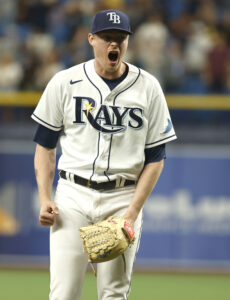
Fairbanks, who turned 32 last week, is coming off a 2.83 ERA in 60 1/3 innings for the Rays in 2025. Tampa held an $11MM club option on his services for 2026, but they instead paid him a $1MM buyout. We at MLBTR ranked him No. 44 on our Top 50 Free Agents list and projected a two-year, $18MM contract. He now heads to the Marlins on a shorter deal with a higher annual salary and figures to be the team’s closer next year.
The right-hander debuted in 2019 and has pitched 265 1/3 innings with a 3.19 ERA in his seven seasons with the Rays. In that time, Fairbanks has struck out 30.0% of hitters against a 9.3% walk rate thanks to an upper-90s fastball and a mid-80s slider which he uses 44.1% of the time. He also gets groundballs at an above-average 45.1% rate and generally keeps the ball in the park, allowing just 0.81 HR/9.
He has also frequently dealt with injuries, making seven trips to the injured list from 2021-24. He had better health luck this year, as he avoided the injured list and set a career high with 60 1/3 innings pitched. When he’s healthy, Fairbanks is a dominant back-end reliever. In 151 innings as the Rays’ closer from 2023-25, he had a 2.98 ERA while posting a 18.9% K-BB rate and earning 75 saves, which was 12th-highest in the league in that span.
That largely continued in 2025, albeit with a drop in Fairbanks’ advanced metrics. After striking out 37.0% of hitters as recently as 2023, that has fallen to 23.8% in 2024 and 24.2% in 2025. That is still plenty effective, especially as he has lowered his walk rate from 10.9% in 2023 to 7.4% this year. However, it has also come with an uptick in average exit velocity. Hitters averaged 85.7 mph off the bat against Fairbanks in 2023, but that rose to 90.2 mph in 2025. Meanwhile, his four-seamer now sits at 97.3 mph after averaging 98.9 mph in 2023.
Nonetheless, the fact that the current version of Fairbanks has better-than-average strikeout and walk rates with 90th-percentile fastball velocity means that he is still an effective reliever. If anything, the move by the Rays to decline his option was financially motivated. Tampa Bay’s payroll usually ranks near the bottom of the league (29th out of 30 in 2025). They previously signed Fairbanks to a three-year, $12MM extension in January 2023. While $4MM was a comfortable price range for the team, $11MM may have simply been too high a price to commit to one reliever, even one as effective as Fairbanks.
Indeed, the club tried to trade Fairbanks after the season ended, but they couldn’t find any takers. That ended up being a moot point, as he garnered plenty of interest from teams around the league. The Marlins, Diamondbacks, White Sox, and Tigers were publicly known to be interested in the right-hander. Miami always seemed like a logical fit, given the connection between Fairbanks and president of baseball operations Peter Bendix from their time with the Rays.
With the addition of Fairbanks, the Marlins have fortified a bullpen which ranked 23rd in the league with a 4.27 ERA and 17th with a 14.1% K-BB rate in 2025. The best performer of the bunch was right-hander Ronny Henriquez. The 25-year-old pitched 73 innings over 69 appearances this year with a 2.22 ERA and a 32.3% strikeout rate. His 1.3 fWAR was a team high for relievers, while his peripheral stats were slightly higher than his ERA but still excellent. He also earned seven saves throughout the season. It was the best possible outcome for the Marlins, who acquired Henriquez as a waiver pickup last offseason. Unfortunately, news broke two days ago that the righty underwent an internal brace procedure on his throwing elbow. As a result, he will miss the entire 2026 season.
Including Henriquez, the team got a good amount of volume from its bullpen in 2025. Seven Marlins relievers pitched at least 50 innings, with Tyler Phillips‘s 77 2/3 innings leading the group. He pitched to a 2.78 ERA and got groundballs at a well-above-average 55.6% rate, albeit with just a 16.6% strikeout rate and middling peripherals. Calvin Faucher and Lake Bachar had ERAs of 3.28 and 3.78, respectively, but with expected values in the mid-4.00s. Meanwhile, Anthony Bender, Cade Gibson, and Valente Bellozo had solid groundball rates but below-average strikeout numbers. The signing of Fairbanks upgrades the group with more velocity, strikeouts, and groundballs while covering for Henriquez’s injury and taking pressure off the younger arms.
According to RosterResource, the signing of Fairbanks brings the Marlins’ projected payroll to $73MM, a slight bump from $70MM in 2025. That figure includes just over $15MM for eight arbitration-eligible players, with $2MM of that going to the recently-signed Christopher Morel (previously non-tendered by the Rays). So far, Morel and Fairbanks have been the club’s only big-league free agent signings, though the club is reportedly willing to spend more than usual this offseason.
Photos courtesy of Nathan Ray Seebeck and Kim Klement, Imagn Images
Reds Acquire Dane Myers
The Reds are acquiring outfielder Dane Myers from the Marlins in exchange for outfield prospect Ethan O’Donnell. The Reds are designating right-hander Lyon Richardson for assignment in a corresponding move, per Gordon Wittenmyer of the Cincinnati Enquirer. The Marlins’ 40-man roster now stands at 39, which opens a spot for the recently-signed Pete Fairbanks. The Marlins have officially announced the trade.
The 29-year-old Myers, a Ballengee Group client, was drafted by the Tigers as a pitcher in 2017. He was converted to a hitter in 2019 and spent a few more seasons in the Tigers’ system before the Marlins selected him in the minor league phase of the 2022 Rule 5 Draft. He made his major-league debut with Miami in July 2023. In 511 plate appearances over 172 games from 2023-25, Myers has batted .245/.299/.354 with a 25.8% strikeout rate against a 6.5% walk rate while providing serviceable outfield defense. However, that has come with a fair amount of injuries. He missed two months with a left ankle fracture in 2024. This year, he made two separate trips to the injured list for right oblique strains and finished the year on the IL with a right knee laceration.
When he was on the field this year, Myers made 333 PA and played 752 2/3 innings across all three outfield spots, mostly in center field. He cut his strikeout rate from 33.3% in 2024 to 23.1% in 2025 while also chipping in 18 stolen bases. However, that coincided with a drop in power. His slugging percentage fell from .442 to just .326, and his ISO similarly declined from .179 to .091. Altogether, Myers batted .235/.291/.326 with six home runs and just a 72 wRC+ this year, a disappointment considering he posted a 113 wRC+ in 2024 (albeit in a limited sample).
Defensively, Myers has improved year over year. He was worth -3 Defensive Runs Saved in 155 1/3 outfield innings in 2023 but 1 DRS in 222 innings in 2024. This year, he played 752 2/3 innings in the field and was worth 3 DRS, as well as 2 Outs Above Average. His arm strength is his true calling card, grading out in the 97th percentile according to Statcast. Myers also has excellent range thanks to his 76th-percentile sprint speed.
The trade for Myers gives the Reds a low cost defensive specialist who could fill a platoon role against left-handed pitching. TJ Friedl is the incumbent in center field. He had a 109 wRC+ this year and was worth 2.9 fWAR despite being a liability in the field (-10 DRS). His offense is enough to keep him as a starter up the middle. Meanwhile, a combination of Noelvi Marte, Will Benson, Gavin Lux, and the recently-signed JJ Bleday will occupy the outfield corners. Notably, Marte is the only one of that bunch who hits right-handed. Myers had a 119 wRC+ in 117 PA against southpaws this year, so he could help balance out the lineup from the right side.
Meanwhile, the 23-year-old O’Donnell was a sixth-round draft pick by the Reds in 2023. He joins the Marlins’ system after a 2025 season spent at the Double-A level. In 503 PA across 125 games for the Reds’ affiliate in Chattanooga, he had a line of .236/.327/.325 with a 90 wRC+. He struck out 25.6% of the time but showed good plate discipline with a 10.7% walk rate. O’Donnell has shown above-average speed and power in prior seasons, so he might improve with another year at Double-A.
As for Richardson, the 25-year-old was a second-round pick by the Reds in 2018. He made his big-league debut in 2023 and has compiled 55 innings with a 6.05 ERA in 39 appearances (four starts) from 2023-25. He got a somewhat bigger look this year, pitching to a 4.54 ERA in 37 2/3 innings out of the Reds’ bullpen. He got groundballs at an above-average 53.8% rate, but that was offset by a lack of strikeouts (only 17.4%) as well as a 46.2% hard-hit rate against him. Richardson has less than one year of service time but is out of options. If he goes unclaimed on waivers, he’ll need his contract to be selected in order to get another look in the majors.
Photo courtesy of Raymond Carlin III, Imagn Images
Several Teams Interested In Yoán Moncada
Infielder Yoán Moncada is currently a free agent after playing out a one year, $5MM deal with the Angels. He was an above-average hitter in 84 games in 2025 but missed time due to right thumb and right knee injuries. According to Francys Romero of Beisbol FR, several teams have expressed early interest in signing Moncada, including the Angels, Pirates, White Sox, and Blue Jays.
The 30-year-old originally signed with the Red Sox out of Cuba for a $31.5MM bonus in February 2015. He made his debut late in 2016 before being traded to the White Sox as their key return for Chris Sale. Moncada had a 105 wRC+ in 231 plate appearances in 2017 but fell below average in his first full season in 2018. He broke out in 2019 with a .315/.367/.548 batting line in 559 PA, along with 25 home runs. Granted, the ball was juiced that year, but Moncada’s output was still 39% better than average by wRC+. The White Sox were confident enough to give him a five-year, $70MM extension in March 2020, which covered the 2020-24 seasons and contained a club option for 2025.
Moncada slumped during the COVID-shortened 2020 season, posting a 94 wRC+ while seeing a drop in power and spending two weeks on the injured list. He rebounded in 2021 with a line of .263/.375/.412 and a 120 wRC+. The power wasn’t quite back to his 2019 levels, though he looked like a more mature hitter overall, dropping his strikeout rate to 25.5% while posting a career-best 13.6% walk rate.
Unfortunately, Moncada has struggled with injuries and inconsistency ever since. From 2022-24, he batted .236/.291/.387 with an 88 wRC+ while playing in just 206 out of 486 possible games. In 2024, he spent most of the season on the 60-day IL with a left abductor strain, making just 45 plate appearances with a 118 wRC+. After the season, the club declined their $25MM club option on Moncada in lieu of a $5MM buyout, making him a free agent.
This year with the Angels, he had a 117 wRC+ in 289 PA over 84 games. His strikeout rate of 26.0% was high, while his 11.1% walk rate was better than average. His .214 ISO was his highest since his 2019 breakout season, as was his .448 slugging percentage. Although he is nominally a switch-hitter, most of his damage came as a lefty facing right-handed pitching. He posted 125 wRC+ in 262 PA against righties, but just a 37 wRC+ in 27 PA against southpaws. Meanwhile, both Defensive Runs Saved and Outs Above Average saw Moncada as a liability at third base. His -13 OAA was worst in the league among third baseman with at least 300 defensive innings.
Altogether, Moncada showed above average offense but was weighed down by injuries and newfound defensive struggles. As a free agent, he is more or less in the same position as last offseason, with a one-year deal being his most likely outcome. The current market has Alex Bregman and Eugenio Suarez as the top options at third base. Kazuma Okamoto is still available, with his posting window closing on January 4. The next-best options after that are utility players, so teams needing an everyday third baseman could look to Moncada as a low-cost flier.
Among the clubs with reported interest, the Angels might be the best fit. Anthony Rendon is expected to retire after an injury-riddled tenure in Los Angeles. After Moncada, Luis Rengifo got the most time at the hot corner in 2025, though he is a now a free agent. The club acquired infielder Vaughn Grissom from the Red Sox earlier this month, and he has not played third base in his big-league career. Another one-year deal with Moncada would fill the third-base vacancy and set Grissom up to compete for second base time, where the incumbent Christian Moore was unimpressive offensively in 2025.
Looking at the Pirates, the team traded Ke’Bryan Hayes to the Reds in July and saw Isiah Kiner-Falefa claimed by the Blue Jays in August. Jared Triolo played 260 1/3 innings at the hot corner, but he is more of a multi-positional player and did not hit as well as Moncada. The club is interested in signing Okamoto, but Moncada could be a fallback option for them.
The White Sox recently signed Munetaka Murakami to play first base and have Miguel Vargas as the projected starter at third. Moncada would be an offensive upgrade over Vargas if the club limits his exposure to left-handed pitching. Meanwhile, the Blue Jays are known to be interested in signing Bregman. Ernie Clement and Addison Barger are already on the roster if he signs elsewhere. Both are average hitters, while Clement is an excellent defender at third (11 DRS in 2025), so they are a more curious fit for Moncada.
Photo courtesy of Steven Bisig, Imagn Images
Details On Matt Strahm Trade
The Phillies traded lefty Matt Strahm to the Royals on Friday in exchange for righty reliever Jonathan Bowlan. Philadelphia has two other solid lefty relievers in Jose Alvarado and Tanner Banks, to say nothing of Jhoan Duran and the recently-signed Brad Keller from the right side. With a strong late-inning mix in those four, it made sense to clear Strahm’s $7.5MM salary for 2026 to help with other additions, such as a J.T. Realmuto reunion.
According to Matt Gelb of the Athletic, Strahm was outspoken in his opinions on how the bullpen and clubhouse were managed, which clashed with coaches and other team officials. Meanwhile, Phillies president of baseball operations Dave Dombrowski framed the matter as a more of a question of contractual control, telling reporters, “(Strahm is) a year away from free agency. We were able to get a guy that we liked who has six years of (club control) and we think can help us right away. So you have to give to get. And we still feel good with our left-handers in the bullpen.”
For his part, Strahm released a statement following the trade in which he spoke positively of the organization and of his now-former teammates. “It was an honor to wear this uniform alongside you and compete every day with a group that truly cared about winning and about each other,” said Strahm. “I’ll miss every single guy in that clubhouse. I’ve never experienced anything like it.” In any case, whether the trade resulted from tension with his teammates or with the coaching staff, the club felt it was the right time to move on.
Strahm came to the Phillies in December 2022 on a two-year, $15MM deal. In March 2024, the two sides agreed on a one-year extension for 2025 at a $7.5MM salary, which contained a $4.5MM club option for 2026. Strahm vested that option at a higher rate of $7.5MM by reaching 60 innings in 2025 (he finished with 62 1/3 innings over 66 appearances) and passing a physical in September. Indeed, while he was injury-prone during his years with the Royals, Padres, and Red Sox, Strahm was healthy from 2023-25 with the Phillies, avoiding the injured list entirely.
The combination of good health and performance made his $7.5MM annual salary an excellent value. In 212 2/3 innings across 188 appearances from 2023-25, Strahm had a 2.71 ERA and struck out 30.5% of hitters against a 6.2% walk rate. Excluding his 33 1/3 innings as a starter in 2023, his 2.46 ERA in 179 1/3 innings was 10th-best among qualified relievers, just ahead of Edwin Diaz and Josh Hader. His 24.1% K-BB rate as a reliever was 12th-best.
His 2025 was more of the same, if a slight step down from his All-Star 2024 season. He pitched to a 2.74 ERA while seeing his strikeout and walk numbers trend slightly in the wrong direction. He struck out 33.3% of hitters in 2024, though that slipped to 27.3% this year. That is still excellent, ranking in the 81st percentile according to Statcast. Similarly, his walk rate increased from 4.6% to 7.8% in 2025, which graded out in the 53rd percentile. Both of those metrics suggest that Strahm is still a capable high-leverage arm. That said, there were some signs of decline under the surface. His four-seam velocity dropped to 92.2 mph this year after sitting at 93.4 mph from 2023-24. His 21.2% groundball rate in 2025 was worst among qualified relievers, while his 59.0% flyball rate was third-worst.
Given these trends and the tension with the coaching staff, the Phillies may have simply been content to move on and enter 2026 with Alvarado and Banks as their lefty relievers. Meanwhile, Strahm will get a fresh start with the Royals, whose bullpen is quite strong heading into 2026. The additions of Strahm and outfielder Lane Thomas bring the club’s projected payroll to $150MM, up from $138MM in 2025, according to RosterResource.
Photo courtesy of Jayne Kamin-Oncea, Imagn Images
Guardians Seeking Right-Handed Hitting Outfielder
So far this offseason, the Guardians have focused on the bullpen by signing free agents Shawn Armstrong, Connor Brogdon, and Colin Holderman. On the offensive side, the only move of significance thus far has been re-signing catcher Austin Hedges. Going forward, the club may look to add a right-handed hitting outfielder, according to Ken Rosenthal of the Athletic. who adds that Cleveland was interested in a reunion with Lane Thomas before he signed with the Royals.
In 2025, the Guardians outfield was led by left-fielder Steven Kwan, who batted .272/.330/.374 with a 99 wRC+ with exceptional defense, including 22 Defensive Runs Saved. That was good for 3.2 WAR according to FanGraphs, but unfortunately for Cleveland, Kwan was the only solid performer among the team’s outfielders, with the rest posting replacement-level numbers on offense. Nolan Jones and Angel Martinez made 384 and 371 plate appearances, respectively, but both only posted a 73 wRC+ and got on base less than 30% of the time. Meanwhile, Kwan and Jones are both left-handed hitters, while Martinez is a switch-hitter who does better from the right side. He posted a 123 wRC+ in 169 PA when facing southpaws this year, compared to just a 48 wRC+ in 315 PA as a lefty facing right-handed pitchers.
At present, nearly every outfielder on the club’s 40-man roster bats from the left side. Apart from the switch-hitting Martinez, the only righty in the group is Johnathan Rodriguez, who batted .197/.260/.366 with a 74 wRC+ in a limited sample of 77 PA this year. He was ranked by MLB.com as the organization’s No. 18 prospect entering 2024 and has upside as a power hitter. He has one option year remaining, so the club may keep him around to see if he can carve out a larger role (or shuffle him to the minors if he can’t).
Still, the club received almost no production from right-handed hitting outfielders in 2025. Out of Martinez, Rodriguez, Thomas, and Jhonkensy Noel, only Martinez’s 123 wRC+ from the right side was above-average. Thomas posted a 48 wRC+ in 142 PA this year and missed significant time with three trips to the injured list. He now plays for the Royals. Noel was even worse with a 28 wRC+ in 153 PA. He struck out 34.0% of the time and walked at a mere 2.6% rate while spending most of the second half in the minors. Cleveland designated him for assignment last week.
As noted by Rosenthal, the club may want to give time to their younger outfielders. Chase DeLauter is the organization’s top outfield prospect and the league’s No. 58 prospect overall, according to MLB.com. He made his debut during the Wild Card Series against the Tigers and will play a larger role in 2026. DeLauter is a left-handed hitter, though, so while he may boost the team’s overall production, he wouldn’t help with the team’s pitfalls from the right side. Three outfield prospects on the Guardian’s Top 30 list – Jaison Chourio, Alfonsin Rosario, and Aaron Walton – are righty or switch-hitters, but they won’t be ready for a few years. The Guardians may simply roll the dice again with their current crop of outfielders, but barring a turnaround from Rodriguez (or more time as a righty hitter for Martinez), that doesn’t leave much room for optimism.
Unsurprisingly, the club may be limited in its options due to payroll considerations. RosterResource estimates their 2026 payroll at $79MM, compared to $102MM in 2025. After winning the AL Central but falling in the first round of the playoffs, the club surely wants to make improvements, though it won’t be a player in the top tier of the market. Harrison Bader is the top righty-hitting option, though he is projected for a two-year, $26MM deal that could be out of Cleveland’s price range. Other free agent options include Miguel Andujar, who had a 125 wRC+ in 341 PA in 2025, as well as Austin Hays and Rob Refsnyder.
Phillies, Mets, Padres, Pirates Interested In Luis Robert Jr.
TODAY: The Phillies also had recent interest in Robert, as per The Athletic’s Ken Rosenthal and Will Sammon, continuing Philadelphia’s explorations in a Robert deal back at the trade deadline. Robert’s right-handed bat would be a nice complement to lefty-swingers Brandon Marsh and Justin Crawford in the Philadelphia outfield, and having an experienced center field option like Robert provides the Phillies cover if Crawford isn’t quite ready for prime time as he makes his MLB debut.
DECEMBER 13: Last month, the White Sox picked up their $20MM option on Luis Robert Jr. General manager Chris Getz signaled that the club planned on Robert being their starting center fielder in 2026. That has not stopped clubs from inquiring on his availability in trade talks, as Francys Romero of Beisbol FR reports that the Mets, Padres, and Pirates have expressed interest in acquiring Robert.
The 28-year-old batted .223/.297/.364 with an 84 wRC+ across 110 games for the White Sox this year. His first half was particularly brutal, as he only hit .185/.270/.313 with a 63 wRC+ in 70 games through June 25, when he incurred a left hamstring strain that would send him to the injured list a few days later. Robert was striking out in 30.9% of his plate appearances, only marginally improved from his 33.2% rate last year. He did have a 10.2% walk rate, but for the most part, he was continuing an offensive decline that started with an 84 wRC+ season in 2024.
His second half was a clear improvement. Robert returned from the IL on July 8 and batted .293/.349/.459 with a 124 wRC+ in his next 146 plate appearances. After experiencing poor batted ball luck in the first half of the season (.245 BABIP), he benefited from positive regression upon his return (.317 BABIP). He also dropped his strikeout rate to 16.4% in the second half, bringing that mark down to 26.0% on the season. His rebound was enough for the White Sox to hold onto Robert at the deadline, despite interest from several clubs. Unfortunately, he suffered another left hamstring strain and was placed on the IL in late August, which ultimately ended his season.
The end result was a season worth 1.3 WAR according to FanGraphs. Looking at the bigger picture, it’s clear that Robert has fallen from the height of his 2023 season, when he posted a 129 wRC+ and hit 38 home runs in a career-high 145 games while earning an All-Star nod. That was the fourth season of a six-year, $50MM extension that Robert had signed in January 2020, which was then a record for a player who had not yet debuted in the majors. Robert’s production from 2020-23 made it look like a good deal, but his drop-off in 2024-25 (second-half rebound notwithstanding) made the $20MM club option for 2026 look a lot more expensive.
In the end, the team picked up the option in lieu of paying Robert a $2MM buyout. On the surface, that $18MM net amount was a lot for an injury-prone player who had posted below-average offense for two years, especially for a rebuilding club. The move may have been motivated by the lack of standout center fielders in free agency. Trent Grisham had a strong year in 2025 but accepted the qualifying offer rather than test the market. Cody Bellinger is still available, but he is a corner outfielder at this stage of his career. Harrison Bader is an exceptional defender and will do well on a multi-year deal, although his career-best offensive showing in 2025 was partly the product of good batted ball fortune (.359).
The club is hoping that Robert will have a decent offensive showing in 2026, which would make him a solid trade candidate at next year’s deadline. Still, it’s not surprising to see teams doing their due diligence now, despite Getz’s earlier comments. Eight teams were interested in Robert at this year’s deadline, including the Mets and Padres. The Mets mostly used Tyrone Taylor in center in 2025, but he only posted a 70 wRC+ in 341 plate appearances. They attempted to upgrade by trading for Cedric Mullins, but he himself posted a 66 wRC+ in 143 plate appearances and departed for the Rays in free agency. The club has prospect Carson Benge knocking on the door. A trade for Robert would be affordable for a high-payroll club and would give them an everyday center fielder if they want to ease Benge into the majors.
The Padres and Pirates are more curious fits. The former has Jackson Merrill firmly entrenched in center. He is coming off a 3.0 fWAR season and signed an extension in April that will guarantee him $135MM through 2034. Robert could be an upgrade at DH, but that wouldn’t be the best use of him since he is still a solid defender, posting 7 OAA in center in 2025. RosterResource currently pegs San Diego for a $201MM payroll in 2026, compared to $211MM this year. Team chairman John Seidler recently indicated that the team will operate at around the same level of payroll. They would need the White Sox to cover at least half of Robert’s salary to facilitate an offseason trade, and that’s before leaving room for other additions.
Meanwhile, the Pirates have shown an increased willingness to spend this offseason. They made an $80MM offer to Josh Naylor and were willing to pay Kyle Schwarber $120-$125MM before he re-upped with the Phillies. That said, Robert is obviously not on the same level as Naylor or Schwarber. Pittsburgh also has Oneil Cruz under control through 2028. Like Robert, Cruz had a below-average offensive showing in 2025 (86 wRC+), but Cruz is much more affordable, with a projected $3.6MM salary in his first turn through arbitration compared to Robert’s guaranteed $20MM. Pittsburgh may just be doing their due diligence, though the likeliest outcome is that Robert stays put in Chicago through the offseason.
Photo courtesy of Matt Marton, Imagn Images
Dodgers Re-Sign Nick Frasso To Minor League Deal
The Dodgers have re-signed right-hander Nick Frasso to a minor league contract, per Aram Leighton of Just Baseball. Frasso was non-tendered by the club in November but now returns on a new deal.
The 27-year-old was a fourth round draft pick by the Blue Jays in 2020 and has not yet made his big-league debut. He was traded to the Dodgers in August 2022 and pitched the end of that season and most of 2023 in Double-A before reaching Triple-A in August 2023. In 93 innings across two levels in 2023, Frasso had a 3.77 ERA while striking out 26.8% of hitters and allowing just 0.38 home runs per nine innings. He was added to the 40-man roster in November 2023 and ranked as the Dodgers’ No. 2 prospect entering 2024, according to MLB.com. Unfortunately, Frasso underwent labrum surgery on his shoulder that same month, plus a clean-up procedure on his right hip. He ended up missing the entire 2024 season.
He returned to Triple-A in 2025 and posted diminished results. In 77 innings across 43 appearances (five starts), Frasso had a 5.49 ERA and struck out 19.7% of hitters while walking 12.1%. He also allowed 10 home runs after previously allowing no more than four in a season. Meanwhile, his average exit velocity allowed was 88.3 mph after sitting at 85.0 mph at Triple-A in 2023. Injuries have not been uncommon for Frasso. Before the two surgeries in 2024, he underwent an internal brace procedure in 2021 to fix a partially torn UCL. In 2025, he ended the year on the major league 60-day injured list with an undisclosed injury. The Dodgers non-tendered him on November 21.
Frasso’s prospect pedigree and solid stuff make him a decent, low-cost depth option. He averaged 94.6 mph on his four-seamer this year, using the pitch 53.5% of the time. He mixed in his changeup and upper-80s slider 26.2% and 19.5% of the time, respectively. Both the fastball and changeup have graded as plus pitches in the past. Altogether, Frasso has a 3.81 ERA in 229 career minor-league innings with a 26.5% strikeout rate and 0.6 HR/9 allowed. He has accrued just two days of big-league service time and has one option year remaining.
Photo courtesy of Mark J. Rebilas, Imagn Images