
Blue Jays Avoid Arbitration With Darwin Barney, Ezequiel Carrera
6:24pm: Outfielder Ezequiel Carrera has also settled with the Jays, per Heyman (via Twitter). He’ll receive $1,162,500 — just shy of his $1.2MM projection.
6:08pm: The Blue Jays have settled on a contract figure with infielder Darwin Barney, per Jon Heyman of Fan Rag (Twitter link). He’ll earn $2.8875MM in 2017.
Once the regular second baseman for the Cubs, Barney had steadily seen his MLB opportunities fall over the last 2014 and 2015 seasons. But after a pit stop with the Dodgers, the 31-year-old has found a home with Toronto after re-signing with the organization for one year and $1.05MM last winter. He appeared in over 100 games in 2016, slashing .369/.322/.373 over 306 plate appearances while providing value with the glove.
Now in his final year of arbitration eligibility, Barney will earn quite a bit more than the $1.6MM that MLBTR’s arbitration model projected. That’s likely because his camp could have argued for a higher starting point — namely, his $2.525MM arb salary from 2015 — upon which to add a raise.
Phillies Avoid Arbitration With Freddy Galvis
The Phillies have avoided arbitration with infielder Freddy Galvis, per MLB.com’s Todd Zolecki (via Twitter). He’ll earn $4.35MM, per Jim Salisbury of CSNPhilly.com (Twitter link).
MLBTR and contributor Matt Swartz had projected a $4.4MM payday for Galvis, who’s eligible for the second time. In his age-26 season, the versatile fielder hit .241/.274/.399. That represented typically below-average production, albeit in a different way than usual for the diminutive ballplayer.
Galvis hit twenty home runs on the year — matching the cumulative tally over his prior four MLB seasons — and also contributed 17 stolen bases. The dingers, in particular, helped boost his arb value. But it is the glove that largely drives Galvis’s real-world value; he drew strong ratings in the field in his second season as Philadelphia’s regular shortstop.
MLBTR Chat Transcript: 1/12/17
Click here to read a transcript of today’s chat with host Jeff Todd.
Mariners Acquire Drew Smyly For Mallex Smith, Two Prospects
The Mariners have struck yet another two-deal day, as Seattle has announced the acquisition of lefty Drew Smyly from the Rays. Tampa Bay will pick up center fielder Mallex Smith — who was just added by Seattle in a trade with the Braves — along with minor league infielder Carlos Vargas and minor league lefty Ryan Yarbrough.

This move represents a continuation of an immensely active offseason for the Jerry Dipoto-led Mariners front office. The club will surely install Smyly in its rotation, hoping that the 27-year-old southpaw can regain the form that he showed prior to a disappointing 2016 campaign. He’ll slot in alongside fellow newcomer Yovani Gallardo — acquired last week in a straight-up swap that sent Seth Smith to Baltimore — and holdovers Felix Hernandez, Hisashi Iwakuma and James Paxton.
Despite carrying an ugly 4.88 ERA in 2016, Smyly did post career highs in both starts (30) and innings (175 1/3). And he managed to post a solid 8.6 K/9 against 2.5 BB/9, though his groundball rate sat at just 31.3% and he allowed 1.6 home runs per nine innings. If he can tamp down the long balls and remain healthy, perhaps there’s reason to think that Smyly will return to being a solid mid-rotation piece for Seattle, particularly given the excellent defensive trio that figures to roam the outfield at Safeco Field. Leonys Martin will return in center field and be flanked by trade acquisitions Jarrod Dyson and Mitch Haniger to to provide a strong defensive unit. Another pair of strong defenders, Ben Gamel and Guillermo Heredia, are also present beyond that presumptive starting trio.
[Related: Updated Mariners Depth Chart and Mariners Payroll Info]
The M’s will only control Smyly for two years, as the second-time arb-eligible hurler is set to reach the open market after the 2018 campaign. MLBTR and contributor Matt Swartz project him to earn $6.9MM via arbitration for the coming season — his second trip through the arb process as a Super Two player.
Dipoto tells Ryan Divish of the Seattle Times (Twitter link) that he “probably spent more time through the course of the offseason trying to acquire Drew Smyly than any other player.” Clearly, then, the M’s had targeted the lefty all along, though it took another deal to get the assets needed to make it happen.
When Seattle picked up Smith earlier today (along with Shae Simmons) in a trade that cost the team prospects Luiz Gohara and Thomas Burrows, it obviously did so with intentions to flip Smith. He was evidently targeted by the Rays, despite the continued presence of Kevin Kiermaier in center and the recent signing of Colby Rasmus.
It’s certainly plausible to imagine those players co-existing on the MLB roster, though the presence of Steven Souza, Corey Dickerson, and others could complicate maters. Alternatively, Smith might simply start the year in Triple-A, unless the Rays find yet another deal that shifts some assets.
[Related: Updated Tampa Bay Rays Depth Chart and Rays Payroll Info]
Smith is primarily valued for his defense and baserunning, though he has put up strong numbers at the plate during much of his minor-league career. He’s most valuable playing up the middle but could also presumably function in a corner spot while occasionally spelling Kiermaier in center. Though Smith is generally regarded as a strong defender, Kiermaier is one of the game’s premier defenders in center field and doesn’t figure to be displaced anytime soon.
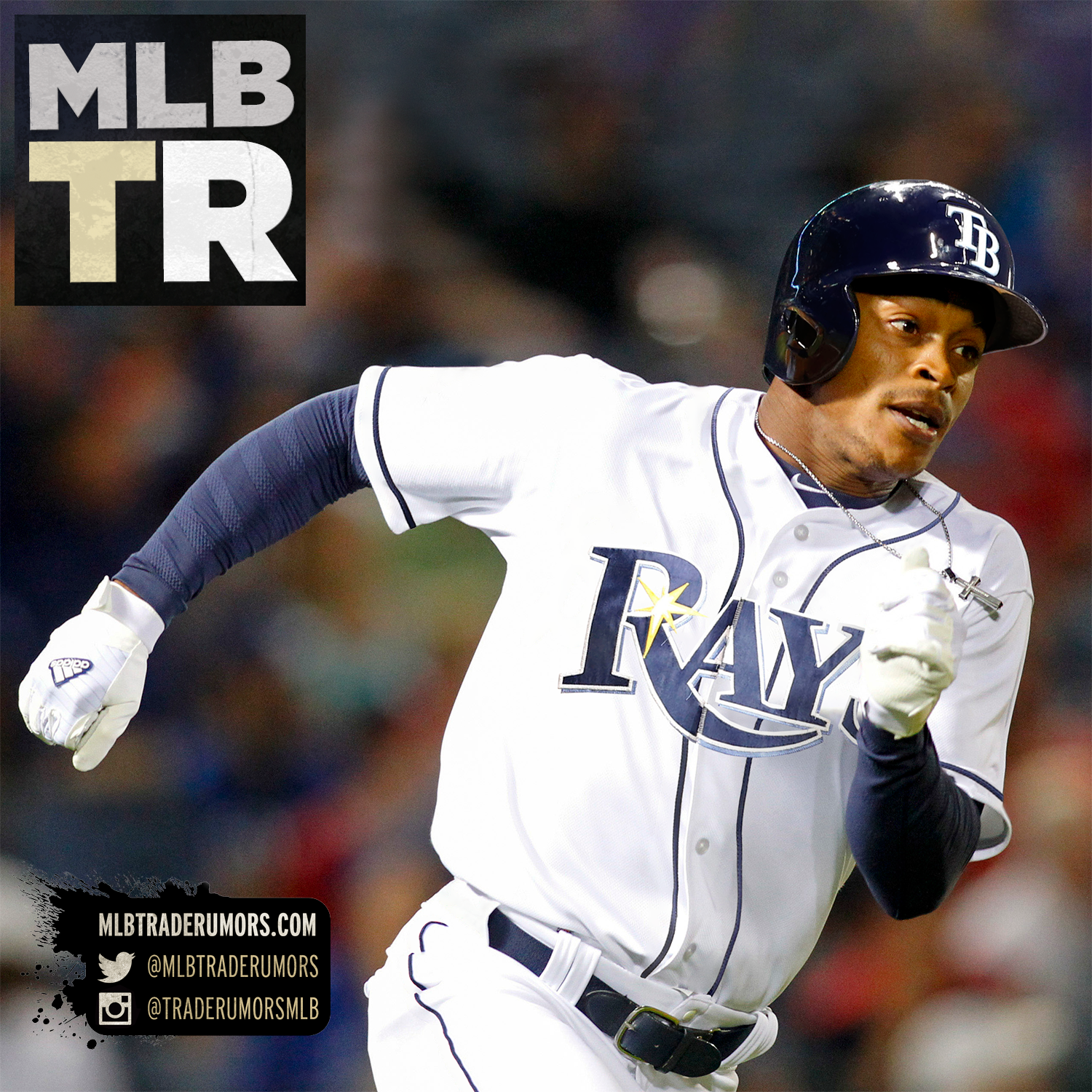
In making this deal, Tampa Bay is acquiring at least five years of Smith’s services. The 23-year-old (24 in May) logged exactly one year of service time in the Majors last year. Another full year would put him on track to be arbitration-eligible following the 2019 season and eligible for free agency following the completion of the 2021 campaign, although if he spends even three to four weeks in the minors to open the season, Tampa Bay would gain another year of club control (while also putting Smith on track for Super Two status).
Smith’s big league debut last year was born out of necessity, as he was called up to the Majors when Ender Inciarte hit the disabled list early in the year. Smith didn’t hit much early on, but the Braves liked his speed and glovework enough to keep him around even when Inciarte returned. A fractured thumb would ultimately cost Smith roughly three months of the season. He batted a lackluster .238/.316/.365 in 215 plate appearances on the season as a whole, though he’d rebounded from a poor start to hit .272/.338/.440 in 43 games from late April until the time of his injury in mid-June. Paired with his 80-grade speed, that type of production would likely elate the Rays, though his defensive prowess would allow Smith to deliver value even if he can’t replicate that output over the course of a full season.
Yarbrough, who turned 25 on New Year’s Eve, rated as the Mariners’ No. 11 prospect per MLB.com, and Baseball America’s J.J. Cooper tweets that he’d have placed 12th on BA’s soon-to-be-released list of the Mariners’ top 30 prospects. Per Jonathan Mayo and Jim Callis of MLB.com, Yarbrough’s fastball sits 91-93 mph and scrapes the mid-90s at times, and he also has an above-average changeup. The MLB.com duo praises Yarbrough’s “oustanding” command and strong ground-ball tendencies, adding that improvement on his breaking ball could ultimately make him a mid-rotation starter. If not, he projects as a quality lefty relief piece due to his fastball, slider and command.
Vargas is still just 17 years of age — he’ll turn 18 in March — and ranked as one of the top available international prospects on the market a couple of years ago. Cooper tweets that he was set to rank 26th on Seattle’s forthcoming top 30 prospect list, and there’s reason to believe he could carry even more upside than that most ranking would suggest. Fangraphs’ Eric Longenhagen, for instance, tweets that there’s “sneaky” value in Vargas, whom he tabs as eventual third baseman with “big pull power projection” and a good approach.
In writing about Vargas last spring, BA’s Ben Badler noted that he has too many moving parts in his swing but has displayed a strong baseball IQ and an impressive ability to make adjustments at the behest of the Mariners’ staff. Badler also credited Vargas with above-average raw power, an ability to hit the ball the opposite way, and an above-average arm with a quick release. In 62 games/256 plate appearances in the Dominican Summer League last year, Vargas batted .242/.344/.391 with seven homers, 11 doubles and nearly as many walks (32) as strikeouts (35).
Rays Claim Jason Coats, Designate Dylan Floro
The Rays have claimed outfielder Jason Coats off waivers from the White Sox. In a corresponding move, the team designated righty Dylan Floro for assignment.
Coats, 27 next month, was designated for assignment by the White Sox recently when they claimed fellow outfielder Willy Garcia off waivers from the Pirates. A former 29th-round selection by Chicago, Coats made his Major League debut with the ChiSox in 2016, batting .200/.298/.340 in a tiny sample of 58 plate appearances. Coats has spent more time in right field than any other outfield spot (by a wide margin) in his minor league career, but he does have 350 innings of work or more at all three positions. He’s also coming off a monster year in Triple-A Charlotte, where he batted .330/.394/.519 with 10 homers, 22 doubles and a pair of triples in just 332 plate appearances.
Floro recently turned 26 and, like Coats, made his big league debut in 2016. He picked up 15 innings out of the Tampa Bay bullpen and allowed seven earned runs (4.20 ERA) with 14 strikeouts against four unintentional walks to go along with a 54.7 percent ground-ball rate. Floro averaged a respectable 92.5 mph on his fastball and enjoyed a successful season at the Triple-A level, logging 50 innings with a 2.88 ERA, 7.2 K/9, 1.6 BB/9 and a 56.5 percent ground-ball rate. Given his excellent control (career 1.3 BB/9 in the minors) and strong ground-ball tendencies, it seems as though he could be a candidate to be claimed if the Rays ultimately expose him to outright waivers.
Mariners Working On Another Trade, Possibly Involving Just-Acquired Mallex Smith
2:47pm: Smith “appears bound for Tampa,” Crasnick adds on Twitter.
2:11pm: The Rays are a possible landing spot for Smith, per Crasnick, who tweets that the teams have held trade talks. That connection opens up all kinds of intriguing theoretical possibilities. Tampa Bay already employs top-notch defender Kevin Kiermaier in center — a reported target of other organizations — and just signed another left-handed hitter capable of playing up the middle in Colby Rasmus. The team has also reportedly dangled a variety of its starters in trade talks, some of whom might well interest the Mariners (as well as other teams). It’s certainly impossible to guess what might be in the works, but any move on Smith could conceivably come with a corresponding swap from the Rays’ perspective.
2:00pm: The Mariners just added outfielder Mallex Smith and righty Shae Simmons in a swap with the Braves, but may not be done with their work for the day, according to ESPN.com’s Jerry Crasnick (via Twitter). Seattle could flip Smith to another organization, Crasnick suggests.
That does make some sense at first glance, as Smith joins a long list of center-field-capable players on the Seattle roster. The club just dealt for Jarrod Dyson, who joins Leonys Martin, Mitch Haniger, Guillermo Heredia, and Ben Gamel in a highly athletic outfield mix.
It’s not immediately clear what organization might constitute a trade partner, or what Seattle might be pursuing in return, if it is indeed Smith who’s back on the block. Teams like the Tigers, White Sox, and perhaps the Indians could all conceivably make some degree of sense as teams that might utilize Smith in their respective center field mixes in the near term.
Braves Acquire Luiz Gohara & Thomas Burrows From Mariners For Mallex Smith & Shae Simmons
The Braves and Mariners have announced a trade involving younger assets. Atlanta will receive lefties Luiz Gohara and Thomas Burrows, while Seattle will pick up outfielder Mallex Smith and righty Shae Simmons. Seattle has designated righty Cody Martin to clear roster space.
The 20-year-old Gohara has only reached the Class A level, but is considered a high-quality pitching prospect. He worked to a 1.81 ERA over 69 2/3 total minor league frames in 2016, with 10.5 K/9 against 3.0 BB/9. MLB.com rated him Seattle’s fifth-best prospect, while Baseball America placed him third among the organization’s pre-MLB assets.
A rare Brazilian pitching prospect, Gohara impresses with a mid-nineties heater, promising slider, and still-developing change that give him the promise of a useful three-pitch mix that could work in a starting role at the game’s highest level.
Burrows also checked in on MLB.com’s ranking of the M’s prospects, placing 25th. The collegiate closer is a two-pitch hurler who was taken in the fourth round of the 2016 draft. He showed well at the low-A level in his first taste of professional ball, allowing just seven earned runs with 37 strikeouts against 11 walks over his 24 2/3 innings. The 22-year-old figures to move rather quickly through the system given his collegiate pedigree.
[RELATED: Updated Braves & Mariners Depth Charts]
For the Mariners, Smith represents yet another fleet-footed outfielder. He’s still optionable, and may not have much daylight to crack the MLB roster to start the 2016 season, but could figure as a near-term piece who also comes with five full seasons of control. Smith had been viewed as a key prospect for the Braves, but was somewhat expendable with the team locking up Ender Inciarte for the foreseeable future and fellow youngster Dustin Peterson also rising through the system.
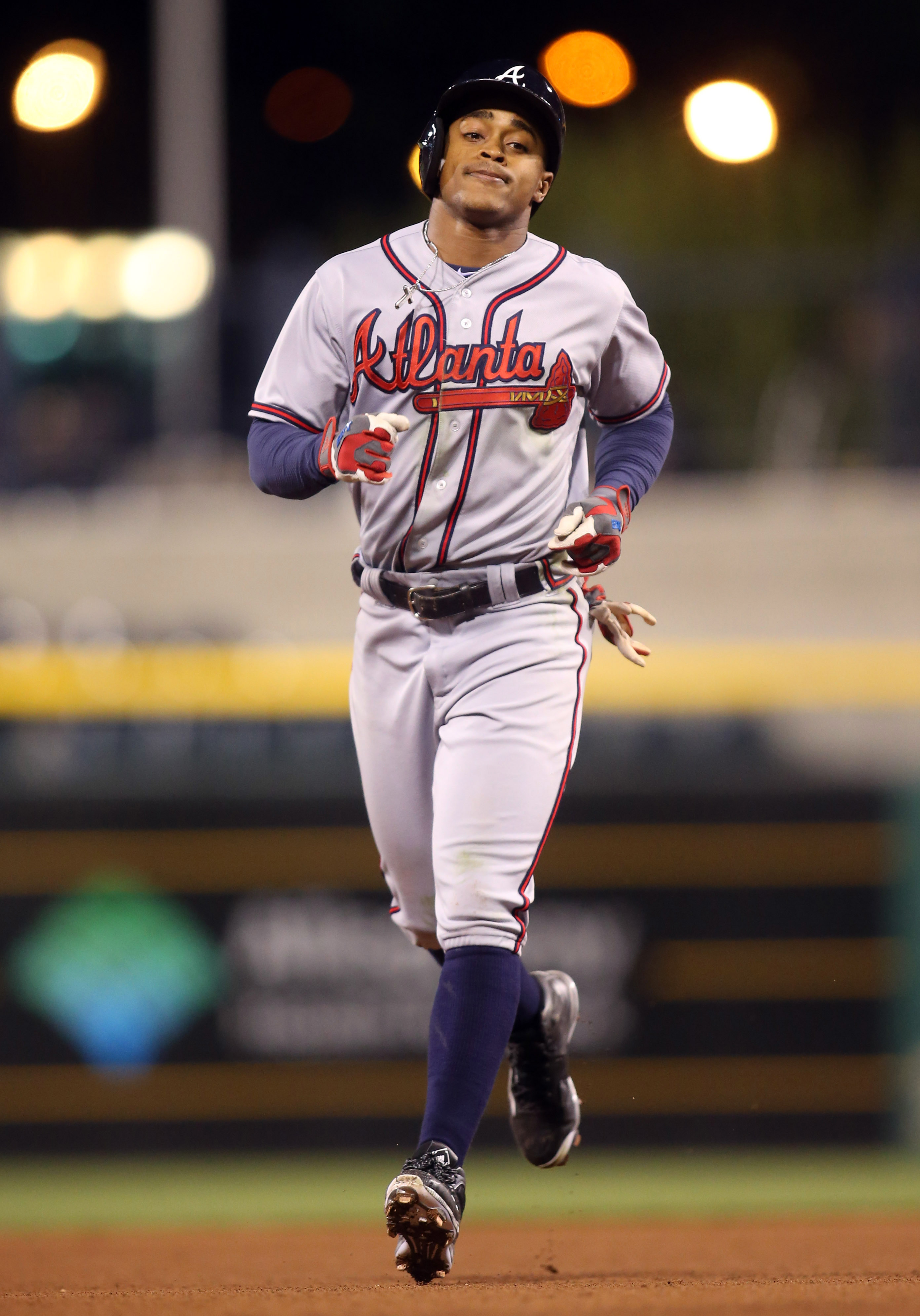
Smith, 23, missed time last year with a thumb injury, but got his first taste of the big leagues in a fairly extended stretch. Over 215 plate appearances, he slashed .238/.316/.365 and swiped 16 bases while drawing strong defensive ratings. He has long been a major stolen-base threat in the minors, and could yet turn into a semi-regular major leaguer if he’s able to drive up his batting average. Smith posted a roughly average .302 BABIP last year, but has traditionally carried much higher marks in the minors thanks to his speed.
The 26-year-old Simmons, meanwhile, comes with four years of remaining control. He has thrown 28 1/3 total major league innings, wrapped around a Tommy John procedure, with a 2.54 ERA and 8.3 K/9 against 3.5 BB/9. The high-octane reliever also showed well at Triple-A in 2016 and has a history of lofty strikeout totals in the minors, though he has also struggled at times with command.
Adding two 40-man players led to the move to bump Martin, a 27-year-old who has seen action in each of the past two major league seasons with three organizations (including the Braves, Athletics, and Mariners). He was hit hard in his first go-round, but posted a 3.86 ERA over 25 2/3 innings last year. Still, Martin managed only 15 strikeouts to go with nine walks while surrendering five long balls in that stretch. He was much better at Triple-A, where he worked mostly as a starter. At the highest level of the minors in 2016, Martin posted a 3.62 ERA with 9.0 K/9 and 2.6 BB/9 across 114 1/3 frames.
Photo courtesy of USA Today Sports Images.
Padres Avoid Arbitration With Carter Capps
The Padres have agreed to a $987.5K salary to avoid arbitration with righty Carter Capps, according to Jon Heyman of Fan Rag (via Twitter). That’s a repeat of Capps’s first-year arb salary, owing to the fact that he missed the entirety of the 2016 season due to Tommy John surgery.
Capps, 26, landed in San Diego as part of the deadline deal that sent Andrew Cashner and Colin Rea to the Marlins. (Rea ended up being shipped back to Miami owing to health disclosure issues, though that didn’t impact Capps.) He continued to rehab his surgically replaced ulnar collateral ligament — the procedure occurred in early March of 2016 — and will be expected make his way back to the majors at some point in the 2017 season.
While the injury obviously put a big dent in his value, Capps brings plenty of intriguing upside with him to the Padres. He was absurdly dominant in 2015, pitching to a 1.16 ERA over 31 frames while racking up 58 strikeouts against just seven walks. While he had never before been nearly as successful at keeping runs off the board, Capps had run up impressive impressive peripherals in several prior seasons. It remains to be seen, perhaps, whether he’ll be able to maintain his elbow health in the long run while still employing the unorthodox, hopping delivery that drove his success (and also generated some controversy).
Rangers To Sign Luis Yander La O
The Rangers have struck a minor-league deal with Cuban free-agent infielder Luis Yander La O, according to MLB.com’s Jesse Sanchez (via Twitter). He’ll receive a $110K bonus in the contract.
This arrangement finally brings an end to La O’s lengthy time on the open market. Though he has always been free of any international signing limitations, it has been nearly a year since he was cleared to sign. It surely did not help that he was originally represented by Bart Hernandez, who has since been indicted on federal trafficking charges.
Now 25, La O once drew praise as one of his home island’s best prospects. Last we checked in, though, he had failed to impress scouts in a workout. Still, La O has a solid track record of high-contact hitting in Cuba’s Serie Nacional, where he owns a .329/.388/.406 slash over 1,338 plate appearances.
It seems likely, given his age and experience, that La O will report to the upper levels of the Texas farm. There, he’ll need to prove that he can reach base enough to offset a notable lack of power, as Baseball America’s Ben Badler explained in a full writeup when La O left Cuba. While he typically lines up at third base, where he’s said to be a quality defender, it’s also possible that he might be able to transition to second with more dedicated time at that position.
Could Seth Maness’s Elbow Surgery Represent A Tommy John Alternative?
Former Cardinals reliever Seth Maness underwent elbow surgery in mid-August; he was ultimately non-tendered and remains a free agent. But there’s more to the story, as Derrick Goold of the St. Louis Post-Dispatch reports in a piece that demands a full read.
As Goold documents, Maness underwent a somewhat experimental “primary repair” procedure to his ulnar collateral ligament that could allow him to return by the start of the 2017 season. If it works, the surgery will potentially save Maness from the lengthy and uncertain process of rehabbing from a UCL replacement — what’s commonly known as Tommy John surgery.
Maness, 28, became the first current MLB pitcher to undergo this particular procedure. Doctors cannot determine whether the less-demanding approach is feasible until they have opened the patient’s elbow. But if the UCL is in good enough shape, and the location of the tear is appropriate, then the “UCL repair with internal brace construction” can be attempted in lieu of utilizing a donor ligament for a full replacement.
If it’s achievable, the repair effort has the potential to shave significant time off of the rehab process for a pitcher. In Maness’s case, he’s on track to take the mound later this week (within five months of his surgery) and perhaps return to major league action by Opening Day (i.e., about seven and a half months from the date of the procedure). That’s well short of the year-plus rehabilitation timeline required for a typical, first-time TJ patient.
“It has that potential to be big,” said Dr. George Paletta, the surgeon who worked on Maness’s elbow. Other medical and industry figures who spoke with Goold — including Dr. Jeffrey Dugas, who also performs this surgery — similarly described the primary repair procedure in those guardedly optimistic terms. While there’s still a need for sufficient observable data, initial results from lower-level pitchers have been promising. (In other words, Maness isn’t exactly serving as a guinea pig.)
Goold details the current findings, and you’ll want to read his exhaustive piece for the full scope. The takeaway, though, is that pitchers who have qualified for and received this TJ alternative have generally shown a strong track record of returning to competitive action in about six and a half months, with none requiring subsequent re-repairs or TJ procedures.
Needless to say, the possibility of a new approach for at least some pitchers with UCL tears — an all-too-common problem in today’s game — holds out significant hope. While the legendary TJ procedure offers a path back for hurlers who once would’ve seen their careers fully derailed, it continues to be a long road that can’t be completed by all who take it.
There have been other efforts, too, that are also worth following. Angels starter Garrett Richards is perhaps the primary example of therapy attempts being undertaking to stave off surgery of any kind. He is currently slated to report for a full Spring Training after receiving platelet-rich plasma and stem-cell treatments on his injured right elbow.
All eyes will be on both Maness and Richards — among others — as they seek both to resume their own careers and provide a new way forward for injured pitchers. Assessing the efficacy of these approaches, refining the methods, and determining when to deploy each of the possible strategies will no doubt continue to be a work in progress. But adding less-drastic alternatives to the classic Tommy John surgery could potentially go a long way toward allowing players to maintain their career paths while protecting teams’ personnel investments.
Beyond the obvious, these new approaches also present the possibility of creating more proactive ways of dealing with elbow problems. Indeed, as Paletta tells Goold, the primary repair surgery might allow for greater confidence in “moving to surgery early on,” and the same might well hold of the treatment approaches. Rather than pitching through pain, or just resting and hoping, at least some pitchers may one day be able to turn to these new techniques — if they’re proven to work — before it becomes necessary to undergo a full UCL replacement.
Of course, it’s still preferable to forestall the necessity of these less-invasive approaches, even if they are shown to be effective. With so many valuable pitchers succumbing to Tommy John surgery, MLBTR and contributor Bradley Woodrum undertook a study last winter to assess the statistical likelihood of future UCL replacement. Though the identified risk factors account for only a small portion of the risk for a given pitcher, that study (and future efforts) may also help organizations and their medical staffs seek ways to maintain elbow health.