
Offseason In Review: Atlanta Braves
Newly installed president of baseball operations John Hart wasted little time in aggressively turning over a roster that disappointed last year, adding loads of young pitching and reshaping the team’s offensive profile.
Major League Signings
- OF Nick Markakis: four years, $44MM
- RP Jason Grilli: two years, $8MM
- OF Dian Toscano: four years, $7.5MM
- OF Jonny Gomes: one year, $4MM
- IF Alberto Callaspo: one year, $3MM
- C A.J. Pierzynski: one year, $2MM
- RP Jim Johnson: one year, $1.6MM
- RP Josh Outman: one year, $925K
- OF Zoilo Almonte: one year, unknown (presumably, the league minimum)
- Total spend: ~$71.5MM
Notable Minor League Signings
- John Buck (since retired), Matt Capps, David Carpenter, Pedro Ciriaco, Todd Coffey (since released), Kelly Johnson, Michael Kohn, Peter Moylan, Wandy Rodriguez (since released), Gus Schlosser, Eric Stults, Donnie Veal, Jose Veras (since released), Chien-Ming Wang, Eric Young
Trades And Claims
- Acquired SP Shelby Miller, SP Tyrell Jenkins from Cardinals in exchange for OF Jason Heyward, RP Jordan Walden
- Acquired SP Max Fried, IF Jace Peterson, 3B Dustin Peterson, OF Mallex Smith, international bonus pool money from Padres in exchange for OF Justin Upton, SP Aaron Northcraft
- Acquired SP Michael Foltynewicz, SP/RP Andrew Thurman, 3B Rio Ruiz from Astros in exchange for C/OF Evan Gattis, RP James Hoyt
- Acquired OF Cameron Maybin, OF Carlos Quentin, SP Matt Wisler, OF Jordan Paroubeck, competitive balance round A pick (41st overall) from Padres in exchange for RP Craig Kimbrel, OF Melvin Upton Jr.
- Acquired SP Trevor Cahill, competitive balance round B pick (75th overall), $6.5MM from Diamondbacks in exchange for OF Josh Elander and OF Victor Reyes
- Acquired SP Ricardo Sanchez from Angels in exchange for 3B Kyle Kubitza, RP Nate Hyatt
- Acquired C Jose Briceno, C Chris O’Dowd from Rockies in exchange for SP David Hale, RP Gus Schlosser
- Acquired SP Manny Banuelos from Yankees in exchange for RP David Carpenter, RP Chasen Shreve
- Acquired RP Arodys Vizcaino, international bonus pool money from Cubs in exchange for IF Tommy La Stella
- Acquired RP Aaron Kurcz, cash from Red Sox in exchange for RP Anthony Varvaro
- Acquired SP/RP Zach Quintana from Brewers in exchange for OF Kyle Wren
- Acquired RP Bryton Trepagnier from Pirates in exchange for IF Edward Salcedo
- Claimed OF Eury Perez from Yankees
- Claimed SP Daniel Winkler from Rockies in Rule 5 draft
Extensions
- None
Notable Losses
- Brandon Beachy, Emilio Bonifacio, Jose Constanza, Ryan Doumit, Gavin Floyd, Cory Gearrin, J.R. Graham (Rule 5), Gerald Laird, Kris Medlen, Tyler Pastornicky, Ramiro Pena, James Russell, Ervin Santana, Jonny Venters
Needs Addressed
The Braves spent last winter locking up young talent for the long run, but changed course swiftly after the club’s first losing campaign since 2008. Moving into the driver’s seat was former Indians/Rangers GM John Hart, who will be accompanied by well-regarded young executive John Coppolella. With the former taking on the title of president of baseball operations and the latter remaining the assistant GM, the club technically has no general manager. Expectations are that Coppolella will eventually ascend to that position, but for now at least he’ll work under Hart.
Club president John Schuerholz has explained that Wren’s sacking was motivated not by the club’s failure to contend in 2014, but rather by the overall lack of organizational strength that he perceived. The new leadership promptly set out to trade in many of its best big league pieces for young talent, transforming a lagging farm into a system that many now rank in the top ten league-wide.
It all started with the departures of Heyward and Upton, a pair of corner outfielders who will hit the open market after the season — arguably as the best two available free agents. The cumulative return was highlighted by Shelby Miller, who once looked to be the future staff ace of the Cardinals but will seek to get back on track after a relatively disappointing 2014. Tyrell Jenkins and Max Fried represent some younger, high-upside arms, while Jace Peterson surprised this spring and has opened the year in Atlanta’s everyday lineup. As always, evaluating the quality of a prospect haul requires time, but there is an argument to be made that Atlanta could have squeezed more value had it waited for the trade deadline.
At the time, it was not out of the question that the club would stop there in terms of major moves. That proved not to be the case. The Braves proceeded to deal two key players who carried plenty of team control in Evan Gattis and, most controversially — among the fanbase, at least — star closer Craig Kimbrel.
Gattis always made more sense in the American League, particularly for a club that has a young catcher (Christian Bethancourt) who it expects to provide a level of defense that Gattis cannot. But he was affordable and useful, so it took an impressive haul for the Astros to pry him away. Atlanta netted two highly-regarded prospects in righty Michael Foltynewicz and third baseman Rio Ruiz.
As if that were not enough, the Braves and Padres stunned the baseball world once again on the eve of Opening Day. Kimbrel, one of the team’s longest-tenured and most marketable players, was traded to San Diego along with Melvin Upton Jr. and his ball-and-chain of a contract. Atlanta took back some salary commitments by adding Cameron Maybin and Carlos Quentin (since released), but Maybin still has some value and fills an immediate need in center. In addition to financial relief, of course, the Braves picked up another top-100 pitching prospect in Matt Wisler along with the 41st pick in this year’s draft.
A series of smaller deals brought back other young arms, including former top prospects Manny Banuelos and Arodys Vizcaino. Cuban outfielder Dian Toscano was added on a lower-profile, but still fairly significant, international deal. And more young talent will be coming: in addition to adding a sandwich pick in the Kimbrel deal, Atlanta picked up some international pool money and the 75th overall pick through other trades.
That last draft choice came as part of the deal that brought starter Trevor Cahill to Atlanta. Still just 27, Cahill will fill some frames in the near term but also comes with upside. He managed a 3.89 FIP in spite of awful results last year, and comes with a history of throwing a high number of solid innings. While it would take quite a turnaround for his two options ($13MM, $13.5MM) to become attractive, Cahill could theoretically become a summer trade chip. Alternatively, the Braves could simply hold onto him in the event of a rebound, content to have a solid contributor at a reasonable price. Given the relatively meager cost to acquire him (in terms of cash and prospects) and the fact that Atlanta also ultimately added extra bonus pool flexibility with the draft pick, it looks like a solid gamble, even if a resurgence seems unlikely.
All of those moves filled long-term needs, but obviously also functioned to open up holes in the current big league roster. The club opted to fill them with veteran free agents who figure to hold down the fort as the team transitions. While some teams have foregone such spending in rebuilding years, relying more heavily on organizational depth and minor league free agents, the Braves have made clear that they intend to field a competitive team and quickly ramp up with a new park set to open in 2017.
Jason Grilli and Jim Johnson head to the back of the bullpen, Jonny Gomes to the corner outfield, Alberto Callaspo to a utility infield role, and A.J. Pierzynski to the backup catcher slot, all for a total commitment of just over $18MM. Of course, the Braves did make one much more significant outlay: outfielder Nick Markakis, whose signing we’ll look at more closely below.
Questions Remaining
The re-made staff, fronted by Julio Teheran and Alex Wood, is cheaper, younger, and perhaps more talented than last year’s unit (which went without the since-departed Kris Medlen and Brandon Beachy), but it remains to be seen if it will be more productive. Miller and Cahill have plenty of upside, but each needs to re-establish himself in his new environs. Behind them, Eric Stults (and, perhaps, Chien Ming-Wang) will eat innings and try to hold off Foltynewicz, Wisler, and Banuelos. Atlanta will presumably hope that at least two-thirds of the young trio can force the issue and head into 2016 prepared to take over full-time jobs.
The biggest rotation question of all, however, is 27-year-old lefty Mike Minor, who has struggled with health and consistency. He is owed $5.6MM in his second year of arbitration eligibility (as a Super Two player) and will once again start the year on the DL with shoulder problems. Minor struggled last year after an outstanding 2013, and if his shoulder problems are severe enough, he could conceivably become a non-tender candidate given his growing cost. That, of course, is somewhat of a worst-case scenario, though.
Suddenly lacking not only Kimbrel but also top setup man Jordan Walden and middle relievers David Carpenter and Anthony Varvaro, among others, the Braves’ bullpen is a new-look affair. Indeed, Atlanta’s pen will feature just one player — southpaw Luis Avilan — who made more than twenty appearances for the team last year. Grilli will need to show that his improved second half of 2014 is sustainable at an advanced age, Johnson will look to re-establish himself, and newcomers like Cody Martin and Brandon Cunniff will try to take advantage of an opportunity. (Promising righty Shae Simmons is a notable absentee after undergoing Tommy John surgery prior to the season.)
As for the lineup, the Braves made clear that they wanted to move away from an all-or-nothing, high-strikeout approach, and certainly have angled to do so. But it remains to be seen what kind of offensive output the new group will provide. Beyond the excellent bat of first baseman Freddie Freeman and the solid production of Nick Markakis, the lineup is full of questions at the plate.
Behind the plate, Bethancourt looks to be a reliable defender but has much to prove offensively after a .248/.274/.274 line in 117 plate appearances last year. The veteran Pierzynski was not much better last year, though he has long provided a serviceable bat behind the dish.
In the middle infield, Andrelton Simmons is a generational glove man but has seen his productivity on the other side of the ball decline steadily over the last three years. Second base is wide open: Peterson has the first crack at the job, while Kelly Johnson joins Callaspo as established options who have been slightly below average at the plate and in the field over recent seasons. Likewise, third base could be manned at times by either of those veterans or Chris Johnson, who failed to live up to his extension in his second season in Atlanta.
And that, finally, brings us to Markakis.
Deal Of Note
A four-year, $44MM free agent deal for a franchise right fielder? That’s a bargain. The question, of course, is whether Markakis really fits that mold. He gets on base, is said to be an excellent clubhouse presence, and has a sterling defensive reputation. But he has meager power for his position, is only a slightly above-average overall offensive player, and does not score particularly well in terms of defensive metrics, despite the facts that plenty of scouts seem to vouch for his glove. And then there’s the fact that Markakis is already 31 and just underwent neck surgery.
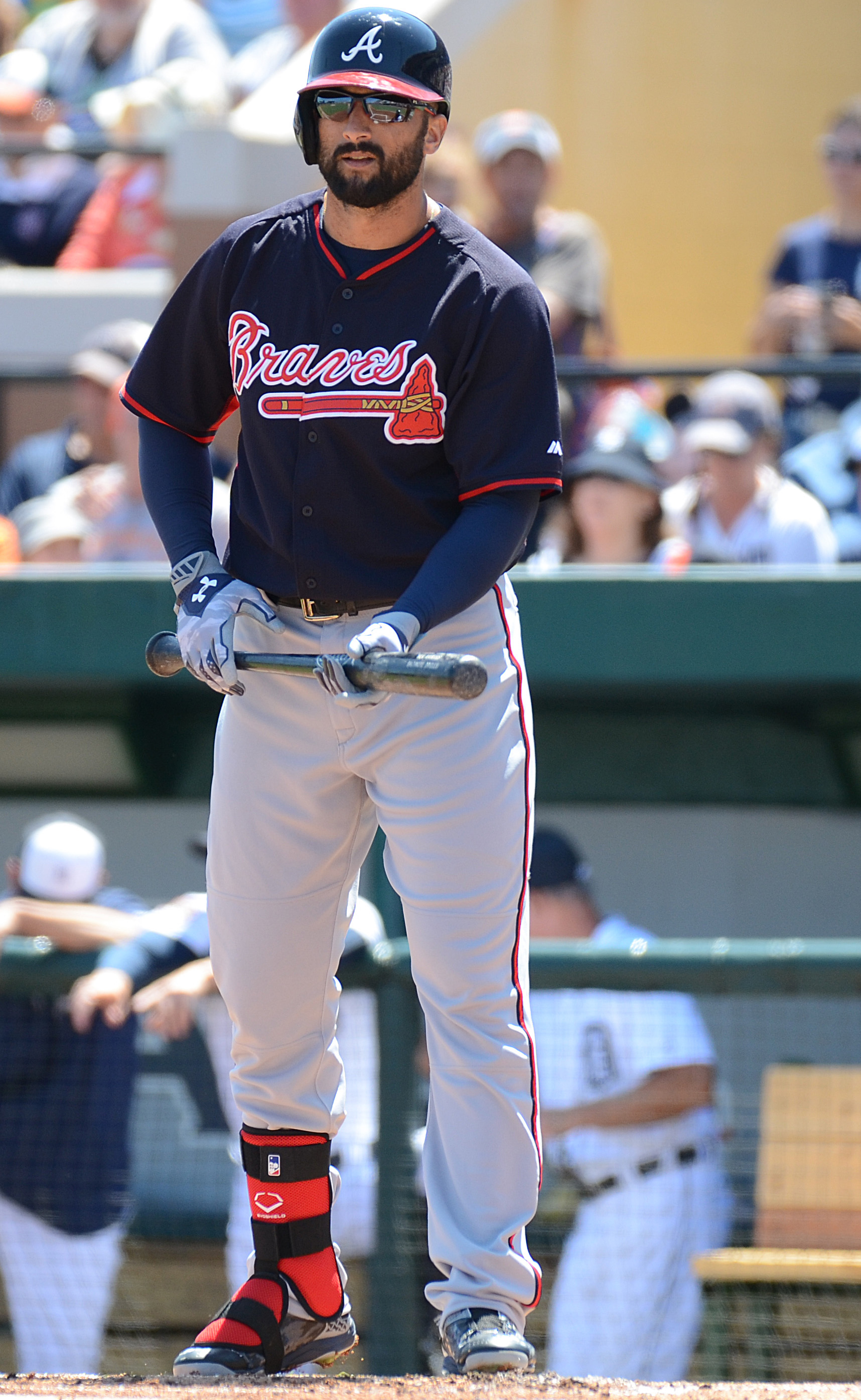
By wins above replacement, Markakis has generally been worth about two or two-and-a-half wins per season over the last several campaigns (excepting a rough 2013). If you accept that he is a significantly better outfielder than the metrics suggest, and buy into the idea that he’ll age well, then you can see some merit in a contract that pays him more or less what the Indians gave Michael Bourn, who was probably a 3 to 4 win player, depending upon which formula you prefer.
But there is risk here, and not a lot of upside. And there is a rather significant loss of flexibility for an Atlanta club that has fairly limited payroll (at least until it sees how revenues look upon the new park opening) and many needs. Notably, the Braves took on about the same overall commitment as they shed when they eventually traded away Melvin Upton Jr.
As always, it remains to be seen. Markakis could be a steady presence that helps make a bridge to the future and supports a pennant-winning club in the not-too-distant future. Or, he could be an expensive (albeit probably not crippling) mistake.
Overview
In the aggregate, the Braves managed to reduce their future (2016 and beyond) payroll commitments by just $7.55MM over the offseason. And that includes the savings achieved by moving Kimbrel himself, not just the Upton side of the deal. This is why the Markakis signing drew some quizzical reactions: as much turnover as Atlanta achieved, it did not substantially reduce its long-term cash on the books.
Of course, that is but one element of what the front office set out to do. By cashing in on expiring assets while they could, rather than extending players at all costs or trying to win one more time with the old core intact, Atlanta sought to cut off the downside scenario bypassed a potentially painful rebuilding process. Most of that future cash is owed to Freeman and Simmons, which is hardly a bad thing; each is still approaching his prime. And, the Braves will be free of Dan Uggla‘s salary after the year.
Whether or not one agrees with the Markakis move, he seems likely to be a useful player over the life of his deal. And the overall health of the franchise seems to have ticked upward after an immensely active winter.
Photo courtesy of USA Today Sports Images.
Diamondbacks Promote Yasmany Tomas
The Diamondbacks have called up recent Cuban signee Yasmany Tomas from Triple-A, the club announced. Tomas had opened the season in the upper minors despite inking a six-year, $68.5MM contract to join Arizona over the offseason.
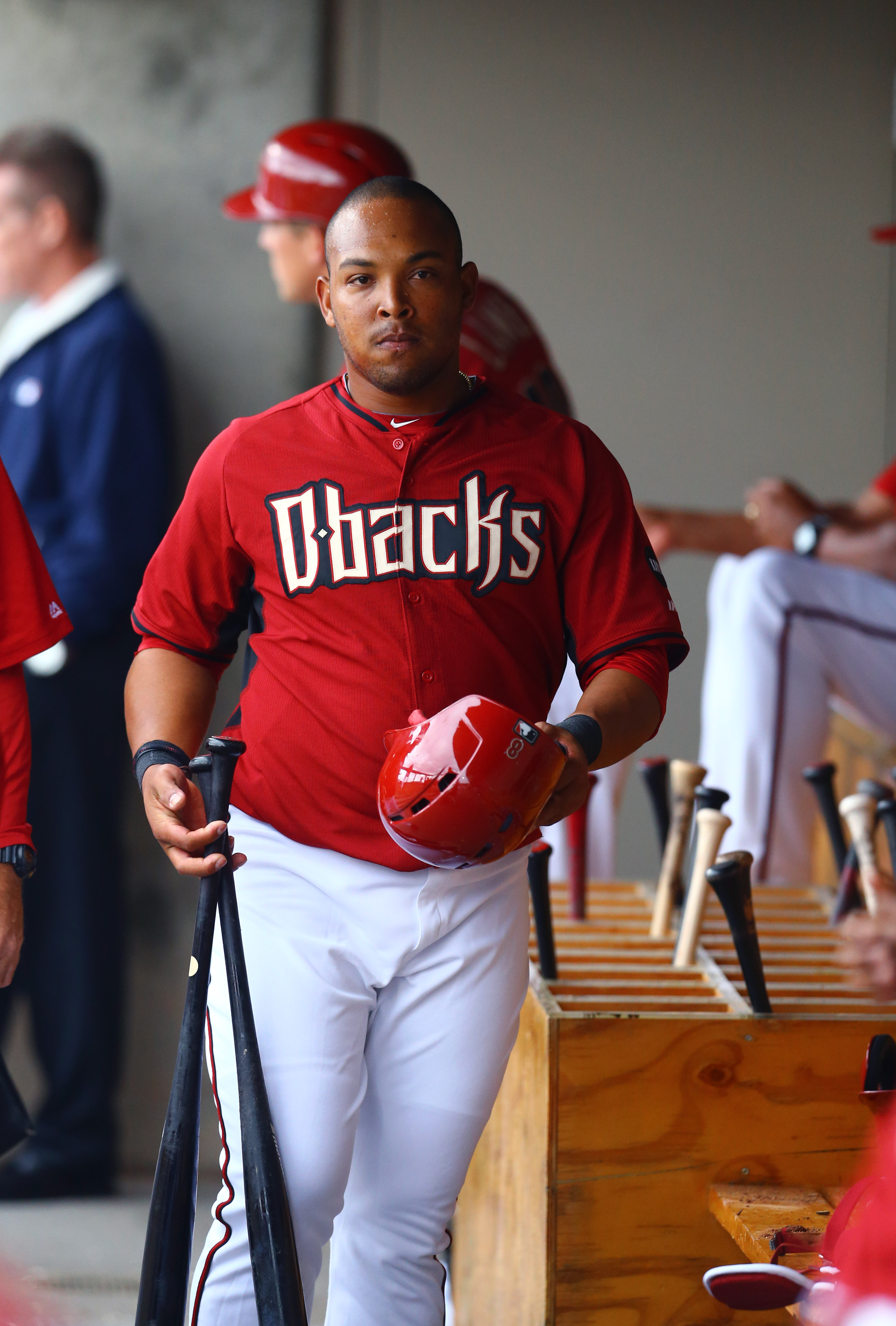
Of course, Tomas is just 24 years of age and never really settled on a defensive position over the spring, making his early-season demotion more than understandable. While he did not do much with the 23 plate appearances he saw at the Triple-A level, Tomas also got over 70 plate appearances in the spring to prepare him for the season.
Tomas has shown largely the skillset that was expected: he has immense power, but may not reach base at a productive clip. He seems to be capable of hitting big league pitching, though precisely how well remains to be seen. Baseball America listed him as the game’s 57th overall prospect based largely on his bat, noting the possibility that he’ll strike out a lot, though BA is also fairly bullish on his ability to be an average player in other respects.
The real question, it would seem, is defense. An experimental effort to play him at third did not look very promising over the spring, and fellow youngster Jake Lamb has hit his way into playing time there. First base is a non-starter with Paul Goldschmidt installed. The likeliest scenario, then, is that Tomas will play in the corner outfield, though it remains to be seen how much time he’ll get there with Mark Trumbo, David Peralta, and Ender Inciarte all in the mix.
With the move, Tomas’s service clock will start in time for him to compile a full year of MLB service in 2015. Of course, that likely will not mean much to him. Tomas is under contract through at least 2018 and possibly through 2020, as his contract contains an opt-out clause after four seasons. It’s theoretically possible, then, that Tomas could end up in an arbitration scenario, though it does seem rather unlikely.
Regardless, the timing of the move seems odd, as the D-Backs have said that they would prefer Tomas see regular playing time in the upper minors before ascending. Though it is possible that he will see consistent action in the big leagues, that will send someone else to the bench — presumably Peralta or Inciarte.
For the Diamondbacks, the allure of a lineup including the right-handed power of Tomas, Trumbo and Goldschmidt is easy to understand, but that lineup would likely lead to a defensive alignment featuring Trumbo and Tomas manning the outfield corners. A.J. Pollock‘s defensive wizardry in center field notwithstanding, that outfield defense would likely serve as a significant hindrance to an already questionable pitching staff.
Photo courtesy of USA Today Sports Images.
Dodgers Claim Ryan Dennick, Designate David Huff
The Dodgers have claimed lefty Ryan Dennick off waivers from the Reds, Ken Gurnick of MLB.com tweets. Los Angeles has designated David Huff to clear roster space for the move.
Dennick, 28, has only minimal experience at the big league level. He struggled through the 4 2/3 innings he saw last season, allowing six earned runs, including two long balls, and walking four batters while only retiring three by way of strikeout. But Dennick was solid last year at Triple-A. Over 50 frames, he put up a 2.34 ERA while striking out 7.2 and walking 3.2 batters per nine.
Huff, meanwhile, is a 30-year-old southpaw who received a spot start for Los Angeles last night. He lasted four innings, allowing four earned on seven hits and a walk while striking out a pair of Mariners hitters. Huff was actually quite effective last year after signing with the Yankees in the middle of the season, tossing 39 innings of 1.85 ERA ball for New York out of the pen.
Minor Moves: Rodriguez, Marcum, Davies, Freeman
Here are the day’s minor moves:
- Yankees farmhand Wilking Rodriguez, a right-handed pitcher, has been suspended for eighty games after testing positive for a PED (Furosemide). Rodriguez made two appearances last year for the Royals in the only major league action in his career. The 25-year-old has not yet appeared for the club’s Triple-A affiliate, though he did get a few frames in big league camp this spring.
- The Indians outrighted Shaun Marcum to Triple-A, the club announced. Marcum, a veteran righty, had one outing with Cleveland before losing his roster spot. He had a nice run of success in the bigs a few years back, but has dealt with injuries in recent seasons.
- Righty Kyle Davies has been outrighted by the Yankees, the club announced. The veteran returned to the big leagues after a long absence recently, but New York dropped him from the roster after just one outing.
- The Rangers have outrighted lefty Sam Freeman, as Stefan Stevenson of the Fort Worth Star-Tribune tweets. Freeman was designated by Texas not long after he was acquired from the Cardinals. It could be that the Rangers had this scenario in mind all along, as Freeman will now be on stand by to provide cheap and accessible depth if and when the need arises.
International Notes: Alvarez, Fox, July 2
Kiley McDaniel of Fangraphs has an extensive update on the upcoming amateur international market, including some familiar and some new names. Be sure to give the piece a full read for details, but we’ll run through some of the key notes here:
- Word is that young Cuban righty Yadier Alvarez will wait until after July 2 to sign, even if he gets a waiver to do so sooner, in large part because of chatter suggesting that the Dodgers will be major players in the market at that time. Los Angeles is widely tabbed as the likeliest team to land Alvarez, with some believing that a $16MM deal is already in place.
- One interesting name to watch is shortstop Lucius Fox, who was born in the Bahamas, played high school ball in the states, and then moved back to his home country while asking MLB to declare him an international free agent. He would likely land over a million dollars and wait til July 2 to sign if, as expected, MLB grants his request. If not, McDaniel says Fox could be a top-50 selection in the draft.
- McDaniel also breaks down the latest on this year’s crop of more traditional July 2 prospects. Among those expected to crack the $4MM bonus barrier include Vladimir Guerrero Jr. (expected to sign with the Blue Jays), Jhailyn Ortiz (Phillies), and Wander Javier (Twins).
- There are a whole host of July 2 players discussed beyond that group, most all of whom are documented by video.
5 Upcoming Free Agents Who Have Dug An Early Hole
It’s not too early to identify pending free agents who have already dug something of a hole that they’ll need to climb out of before hitting the open market after the year. And no, I’m not talking about every free agent who has put up middling stats in their first eight games.
This is more akin to what Dave Cameron of Fangraphs discussed recently with regard to the impact of small samples on rest-of-season projections. When context is considered, rough starts for some players mean more than for others in terms of the reasonably plausible outcomes we can expect.
With that in mind, let’s take a look at some players whose discouraging starts are particular cause for concern as regards their future earning capacity:
1B Chris Davis, Orioles: 12 strikeouts and one home run in 28 plate appearances is not the way you want to start the year when you’re trying to convince the league that you’re a fearsome slugger, rather than an all-or-nothing part-time player. That’s all the more true for Davis given that he started the season by finishing off his 25-game suspension. We’ve seen both versions of him in the last two seasons, and his unimpressive start opens the door to a pretty significant downside scenario.
SS Ian Desmond, Nationals: Desmond has traditionally started slow and has a higher market floor than Davis because of his position and more consistent track record, so his fairly unimpressive batting line is not enough to raise a red flag at this stage. But Desmond has looked extremely shaky in the field, committing six errors at inopportune times, and already has a history of misplays despite generally above-average glovework. There’s plenty of time for him to position himself as a truly premium free agent, and he’ll get paid well regardless, but his rather lofty salary ceiling coming into the year looks increasingly hard to reach.
CF Austin Jackson, Mariners: Somewhat like the Davis situation, a bad 2014 has bled into an awful 2015 thus far for Jackson. His ISO dropped below .100 last year, and currently sits at a non-existent .032. Jackson already has shown progressively declining defensive metrics coming into the year. Like Desmond, Jackson’s appeal was in his profile as a strong defender with pop up the middle; the onus is now firmly on him to re-establish both of those pillars. As things stand, he looks to have fallen behind Dexter Fowler and Denard Span (and perhaps also Colby Rasmus) in the pecking order among 2015-16 free agent center fielders.
SP Mat Latos, Marlins: Latos, who is still just 27, has had excellent results in recent years but has been dogged by health issues and a velocity drop, with ERA estimators suggesting he had outperformed his peripherals somewhat. It’s only been two starts, but the regression has been swift. Latos has hung on for just 4 2/3 innings, allowing nine earned while walking as many batters (5) as he has struck out. While he has age on his side, Latos will need to show a lot to score the kind of contract he once seemed destined to warrant.
RP Fernando Rodney, Mariners: Rodney is 38 and has had his share of volatility over the years. If he hopes to emulate Joe Nathan in picking up another multi-year guarantee at a high AAV, he’ll need to throw more like the 2012 Nathan and less like the more recent version. The velo checks out, but Rodney has managed to K just one batter (while walking four) in his 3 1/3 frames thus far. Given his advanced age, Rodney needs to show up steadily for much of the rest of the way if he hopes to get a another closer’s contract.
AL East Notes: Jays, Sox, Holt, Sabathia
If the Blue Jays are in position at the trade deadline, the team may well have some extra cash to use. According to the math of Shi Davidi of Sportsnet.ca, Toronto might reasonably expect to have $5MM to $8MM in free 2015 salary available to work with.
Here’s more from the AL East:
- The Red Sox held their breath last night as the left side of their infield was evaluated for injuries that appeared to have at least some possibility of being worse than they first looked. As Jason Mastrodonato of the Boston Herald reports, however, both Xander Bogaerts and Pablo Sandoval are dealing with nothing more than bumps and bruises at this point.
- Had either of those players gone down, of course, Brock Holt would have been a crucial component of the Red Sox‘ reaction. As Bryan Grosnick of Baseball Prospectus explores, Holt has (rather surprisingly) turned into an extremely versatile, useful big league player who makes it possible for Boston to carry an unusual bench arrangement.
- The Yankees remain encouraged by how C.C. Sabathia is throwing the ball, even if the results have not yet been there, as MLB.com’s Bryan Hoch reports. His right knee has felt good, and manager Joe Girardi sees a difference. “I’m just seeing better movement on his fastball,” Girardi said. “I’m seeing consistency in his changeup, it’s not cutting. His slider is better. I just think he’s locating a lot better and I think it’s because he’s healthy. It’s hard when you’re dealing with nagging injuries to go out there and perform at a high level.”
Poll: Rating The Rick Porcello Extension
It’s a quiet morning around the game, so let’s conduct a quick poll.
The Red Sox just agreed to rather an unusual contract with starter Rick Porcello, who had been set to hit the open market after this season. Still just 26 years old, the righty has been a steady presence for several years. But while he has shown some signs of breaking out, and did put up a career-best 3.43 ERA while topping 200 innings last season, Porcello has yet to establish himself as more than a solid, middle-of-the-rotation arm.
Nevertheless, Boston bet on Porcello’s ability to deliver value through his late twenties, buying four free agent years for a $82.5MM guarantee. That’s quite a significant average annual value for a pitcher with Porcello’s track record, but is offset by the fact that the team bought his age-27 through age-30 campaigns.
That trade-off is not often seen, as most pitchers look to score the lengthiest contracts they can, and Porcello almost certainly could have found more years. But it also makes sense: the deal’s structure means that the Red Sox will be relieved of obligations into Porcello’s decline phase, while he in turn will have a chance to hit the market at a reasonably young age.
Somewhat notably, James Shields signed with the Padres for four years and $75MM earlier in the offseason. That’s not insignificantly lower than Porcello’s guarantee, but is still in the same ballpark. Shields, of course, has been one of the game’s best and most durable arms for some time. But he also signed that deal to run through his age-36 season.
Had the Red Sox preferred, perhaps they could have signed Shields to approximately the same deal they gave Porcello, which would have had the added benefit of inserting the former into their rotation this year. Obviously, Boston did not believe that to be a wise investment, in part due to their assessment of Shields’ fit at Fenway and his ability to produce as he ages.
So, will the club regret betting on an arguably less-talented, inarguably much younger arm? Was the Porcello extension a wise investment of the club’s resources?
Was The Rick Porcello Extension A Good Investment?
-
No 55% (5,017)
-
Yes 45% (4,122)
Total votes: 9,139
Angels May Seek Contract Action Against Josh Hamilton
APRIL 14: Ken Rosenthal of FOX Sports reports that Hamilton’s contract does indeed contain language that would allow the Angels to terminate or convert the deal if he is physically/mentally incapacitated due to alcohol and drugs (specifically, if he is less than “first-class condition”), though the clause is not unique to his deal. However, Hamilton and the union would still be able to argue that the JDA supersedes contractual clauses of this nature, so it remains unclear if the Angels would be able to take any form of action. If they were eventually able to attempt such action, they can only target Hamilton’s $30MM salaries in 2016 and 2017, as his 2015 salary of $23MM became fully guaranteed on Opening Day.
APRIL 10, 9:44pm: The union has issued a statement rejecting the idea that the Angels would have any basis to pursue Hamilton (h/t Ken Rosenthal):
“The MLBPA emphatically denies Los Angeles Angels owner Arte Moreno’s assertions from earlier today that the Angels had requested and received the approval of the Union to insert language into Josh Hamilton’s contract that would supersede the provisions of the Joint Drug Agreement and/or the Basic Agreement. To the contrary, the collectively bargained provisions of the JDA and the Basic Agreement supersede all other player contract provisions and explicitly prevent Clubs from exactly the type of action Mr. Moreno alluded to in his press comments today.”
7:38pm: Angels owner Arte Moreno told reporters today that his club may seek to enforce provisions of the team’s contract with Josh Hamilton relating to the use of alcohol or drugs, Bill Shaikin of the Los Angeles Times was among those to report (Twitter links). Pedro Moura of the Orange County Register reports further details.
Hamilton was recently determined not to have violated his treatment program by an arbitrator, despite apparently admitting a relapse of some kind. (His early career was, of course, marred by numerous drug-related suspensions.) That led to a rather firm rebuke from the club.
The the precise language that the Angels might rely upon remains unknown, as does the remedy they could theoretically seek. “It’s not about money, nothing about money,” Moreno said. “In our contract, there’s language that he signed and that his agent approved that said he cannot drink and use drugs. So, we have specific language in the agreement. We have a couple other players who have the same language.” While the language may not be unique, Moreno did say that it was a point that the team specifically negotiated: “When we started talking to him, we went through his history. We felt it was important for us to have language in our agreement.”
Underlying the matter at this point is the fact that Hamilton not only has apparently relapsed, but that he is starting the year on the DL after two rough seasons to start his career with the Halos. The club owes Hamilton $83MM from this season through 2017 under his deal, and at this point would certainly welcome a chance to avoid some or all of that obligation (though Moreno says “it’s not about money”).
Moreno’s statements (coming on the back of the strong words from GM Jerry Dipoto) certainly seem to indicate that the team is serious about pursuing some action. Asked if he could say that Hamilton would again play in an Angels uniform, Moreno replied: “I will not say that.”
But one major issue with any attempt to pursue action under Hamilton’s contract is the collectively-bargained Joint Drug Prevention and Treatment Program (JDA). As Jeff Fletcher of the Orange County Register tweets, the prevailing wisdom holds that the JDA — which outlines punishment for PEDs and recreational drugs — precludes resort to contract terms to punish players for violating the league’s drug rules. There may be some arguments around the JDA’s bar on other means of enforcing violations of its terms, but they seem to face an uphill battle.
Nationals Designate Xavier Cedeno For Assignment
The Nationals have designated lefty reliever Xavier Cedeno for assignment, SB Nation’s Chris Cotillo tweets. Dan Kolko of MASNsports.com tweeted earlier that Cedeno was not on the club’s lineup card.
Cedeno earned a spot on the team out of camp when fellow southpaw Jerry Blevins was surprisingly dealt away late this spring. The 28-year-old has made five appearances already in 2015, allowing two earned runs over three innings while striking out four and walking two batters. He has filled some temporary pen shortages over the last two years in D.C., but was out of options this season and so had to be added to the active roster heading out of camp. That seemed unlikely until the team traded Blevins.
Righty Rafael Martin will take his place on the active roster for the time being. Martin, 30, is a veteran minor leaguer who has yet to see any MLB action. The Nationals signed Martin out of the Mexican League in 2010, before his age-26 season, and he has bounced up and down the system since. He turned a corner in the upper minors last year, when he worked to a 1.39 ERA over 58 1/3 innings with 10.2 K/9 against 1.9 BB/9. He was particularly nasty in 33 2/3 Triple-A frames, allowing just three earned runs and striking out more batters (42) than he allowed on base (27) by hit or walk.
Of course, the move will leave the Nats’ pen with just one lefty, Matt Thornton. The team does have veteran Rich Hill and well-regarded youngster Matt Grace available at Triple-A, however, and apparently feels comfortable with those options.