
Royals Prioritizing Bullpen Help Over Outfield Bat
The Royals have been linked to both bullpen and outfield help in recent weeks. General manager J.J. Picollo has gone so far as to publicly acknowledge a desire to improve in both areas in advance of next month’s trade deadline. At the moment, however, it seems the two needs are not viewed as equally necessary. Ken Rosenthal of The Athletic reports that Kansas City is currently prioritizing relief help over its search for additional outfield talent.
Royals relievers currently rank 21st in the majors with a 4.37 earned run average but sit last in baseball with a well below-average 17.7% strikeout rate from their bullpen. Kansas City’s 10% walk rate from the ‘pen is also the seventh-worst mark in MLB, and their 93.6 mph average fastball this season is tied for 28th overall. Based on Picollo’s prior comments in an appearance on Jayson Stark’s podcast, adding the type of power arm they’re lacking could be of particular interest (though that’s just my own inference/speculation, to be clear). “I’ve talked in the past about strikeouts,” Picollo said at the time. “We’re more of a matchup bullpen without necessarily the big power.”
Things have been particularly dicey of late. As the Royals have fallen in the AL Central standings in the midst of a 3-11 swoon, their bullpen has been a key culprit. Kansas City relievers are lugging an ugly 5.31 ERA over the past 14 days while punching out just 15.7% of their opponents and surrendering a woeful 1.99 homers per nine innings pitched (far and away the highest mark in the sport, leading 29th-ranked San Diego’s 1.75 HR/9 in that span).
The Royals had hoped that offseason additions Chris Stratton and Will Smith would join righty James McArthur, who was one of MLB’s most dominant relievers over the final few weeks of the 2023 season, in bolstering the 2024 bullpen. That hasn’t panned out.
Smith has pitched better of late, helping to nudge his ERA just under 5.00, but he’s been working in lower-leverage spots since late April. It’s a similar story with Stratton, who began the year working the seventh and eighth innings with regularity before dropping to the fifth, sixth and seventh amid a handful of rough meltdowns. He’s recently been throwing well and returned to some setup work, however. McArthur has rattled off four straight scoreless outings but still has a 6.35 ERA dating back to May 1 and a 4.70 earned run average overall.
With that group struggling, Kansas City has been linked to a handful of relievers known to be available — Chicago’s Michael Kopech and Miami’s Tanner Scott among them. They’re also tinkering with some in-house options in an effort to see if they can upgrade the ‘pen internally. Starter Kris Bubic is on a rehab assignment working his way back from last year’s Tommy John surgery but will work in a relief capacity once he completes is rehab window.
It’s still early in trade season, although that doesn’t rule out a deal coming together. The Padres already acquired Luis Arraez back in early May, clearly illustrating the Marlins’ willingness to sell at any point. We’re also coming up on the one-year anniversary (June 30) of the Royals themselves trading Aroldis Chapman to the Rangers in a deal that netted them current top starter Cole Ragans.
While the Royals’ more immediate priority may be adding a reliever (or multiple relievers), it bears repeating that Picollo has been candid about his desire to add a bat — ideally one that can handle both the infield and the outfield. A left-handed bat, specifically, seems prudent for the righty-heavy Royals. Kansas City’s outfield, led by the trio of MJ Melendez, Kyle Isbel and Hunter Renfroe, has been the least productive unit in baseball this season. In addition to placing Renfroe on the injured list, the Royals just yesterday optioned struggling corner outfielder/DH Nelson Velazquez to Triple-A Omaha.
A trade for an outfielder feels almost inevitable, and adding one who’s controlled beyond the current season would be particularly helpful. As I explored here in greater depth last month, the Royals have struggled immensely to develop outfielders internally; they’ve received little to no production from homegrown outfielders since the departures of now-retired former All-Stars Lorenzo Cain and Alex Gordon.
Elieser Hernandez Elects Free Agency
Right-hander Elieser Hernandez rejected an outright assignment from the Brewers after clearing waivers and is now a free agent, per the transaction log at MiLB.com. Milwaukee had designated him for assignment last week.
The 29-year-old Hernandez allowed a pair of runs in six innings with the Brew Crew and also tossed 9 2/3 innings for the Dodgers earlier in the year. He was tagged for nine runs in his time with L.A. and is currently sitting on an unsightly 6.32 ERA in this season’s 15 2/3 frames. That’s near-identical match with the 6.35 ERA he logged in 62 1/3 innings with the Marlins during his most recent MLB stint, in 2022. Hernandez spent the bulk of the 2023 season on the minor league injured list with the Mets.
While the past few years have been tough, Hernandez looked like an interesting arm with Miami as recently as 2020-21, when he pitched a combined 159 2/3 innings with a 4.45 ERA (4.10 SIERA), a 25.1% strikeout rate and a 6.6% walk rate. Home runs have long been an issue though, as is often the case with relatively undersized right-handers. The 6’0″ Hernandez sits in the low 90s with a four-seamer that doesn’t offer premium spin, leaving his primary quite susceptible to extra-base damage. He’s surrendered 73 homers in 303 1/3 career innings (2.17 HR/9);
Hernandez has good command and has regularly missed bats at a high clip with his slider (and, to a lesser extent, his changeup). Opponents have posted a bleak .189/.226/.436 slash against his slider and a .204/.268/.409 line against his changeup in his career. His heater, however, has been pummeled for a .299/.375/.562 line.
Though he’s struggled in the big leagues, Hernandez touts a career 2.87 ERA, 31.7% strikeout rate and 6.9% walk rate in parts of six Triple-A seasons. That track record, plus his interesting blend of secondary pitches, could get him another look from a club seeking some additional pitching depth. Hernandez has a starter’s background and made five starts with the Dodgers’ Triple-A affiliate this season, though it’s fair to wonder what his repertoire would look like in a full-time bullpen role where his pedestrian fastball velocity might tick up a bit.
Latest On Rockies’ Deadline Outlook
The Rockies enter this year’s trade deadline season in a familiar place. They’re sitting at the bottom of the NL West, 20.5 games out of first place and even a whopping nine games out of fourth place. Their 27-51 record has dipped behind the Marlins for the worst in the National League. Only the White Sox (21-58) have a worse record among MLB teams. They’re staring up at a 12-game deficit in the Wild Card race. Colorado isn’t mathematically eliminated from the postseason yet, of course, but the final nail on any faint playoff aspirations they may have harbored has long since been driven into the coffin.
Normally, this would set up a team to consider itself a pure seller at the deadline. The Rockies surely view themselves in that light to an extent, but not to the same extent as onlookers might expect. Reports more than a month ago indicated the team was quite unlikely to trade third baseman Ryan McMahon, for instance, and Patrick Saunders of the Denver Post doubles down on that sentiment in his latest look at the Rockies and the trade deadline, writing that there’s “nearly zero” chance McMahon will move. Specifically, he lists McMahon as a favorite of owner Dick Monfort, suggesting that even if GM Bill Schmidt and his crew wanted to field offers on the potential All-Star infielder, a deal wouldn’t necessarily be in the cards.
On a similar note, Jon Morosi of MLB Network reports that the Rockies have yet to hold any trade discussions surrounding right-hander Cal Quantrill. The team’s decision to buy low on the righty after the Guardians designated him for assignment last November — effectively a non-tender — has paid off in spades. Quantrill is sporting a 3.50 ERA in 90 innings out of manager Bud Black’s rotation. His 17% strikeout rate and 9% walk rate are both worse than average, but Quantrill’s 46.9% grounder rate is a career-best mark. His move to Coors Field also hasn’t dampened his characteristic knack for keeping the ball in the yard; Quantrill’s 0.90 HR/9 mark is not only better than the 1.06 mark he carried into the season — it’s a career-best rate for the former No. 8 overall draft pick.
Quantrill’s success is one of the best developments for the Rox this season, but he’s also not far from free agency. The righty is being paid $6.55MM in 2024 and has just one year of team control remaining. He could command around $10MM in arbitration this winter and would be a free agent following the 2025 season. Given his 2024 rebound, dwindling club control and mounting price tag, that would make him a logical trade candidate for most clubs.
The Rockies, however, have a history of extending just this sort of veteran. They’ve done so with Daniel Bard, C.J. Cron and Elias Diaz when all had previously stood as logical deadline trade candidates. Colorado has been particularly aggressive in extending pitchers, locking up Kyle Freeland, Antonio Senzatela and German Marquez to long-term deals. Of those three starting pitcher extensions, only the Marquez pact worked out in their favor. The Rockies weren’t successful in completing an extension with Jon Gray but still held onto him at the deadline three years ago (despite trade interest) in hopes of working out a long-term deal.
While there’s no firm word yet that the Rockies have approached or plan to approach Quantrill about an extension, it’s a logical conclusion to draw based both on their operating history and the lack of trade talks to date. Add in that Quantrill has spoken previously about being motivated by pitching at Coors Field, and it’s even easier to see Rockies brass being warm to the idea.
Indeed, Saunders writes in that same weekend piece that both Quantrill and teammate Austin Gomber could be candidates for such a deal. Gomber, like Quantrill, is enjoying a rebound campaign and is arbitration-eligible through the 2025 season. The 30-year-old southpaw has a spottier track record and lesser results but also a lower price tag (both on a contract and in a trade) as a result. It bears emphasizing that there’s no firm indication yet that the Rockies will steadfastly refuse to listen to offers on either pitcher, but history tells us it’s less than likely.
All of that raises the question as to which players the Rockies might actually consider moving. Saunders notes that one of Elias Diaz or Jacob Stallings is a fair bet to change hands, as is the case with reliever Jalen Beeks and outfielder Jake Cave. Diaz, Stallings and Beeks can become free agents this winter. Cave is controlled through 2025.
The two veteran catchers are having strong years at the plate — Diaz is hitting .303/.352/.439 (107 wRC+), Stallings is at .293/.371/.466 (123 wRC+) — though Diaz is currently on the shelf with a hamstring injury. Diaz is earning $6MM to Stallings’ $1.5MM. Stallings once graded as one of the game’s premier defensive catchers, but his glovework has deteriorated a bit in recent years and it’s actually Diaz who draws more favorable marks at this point.
Beeks, 30, has stepped up as the de facto closer in Black’s bullpen after much of the relief corps has struggled at large. He’s pitched to a 3.76 ERA and saved six games in 38 1/3 innings but has done so with a subpar strikeout and walk rates (18.8% and 10%, respectively). Beeks has a $1.675MM salary that’s plenty affordable and a nice track record outside of last year’s anomalous 5.95 ERA, but it’s unlikely other clubs would look at him as an option for the same type of high-leverage role he’s currently holding down for the Rockies. The 31-year-old Cave, meanwhile, is a career backup who’s hitting .258/.312/.336 (68 wRC+). He can play all three outfield spots and first base, but he hasn’t turned in even an average offensive season since 2019 with the Twins. It’s doubtful he’d fetch much in a swap, but Beeks could draw a marginal prospect from a club seeking left-handed bullpen help.
Astros Notes: France, Bloss, Caratini, Graveman
Rotation depth has been an issue for the Astros throughout the season, and they’re still getting unwelcome updates on that front. General manager Dana Brown said yesterday in an appearance on SportsTalk 790 AM that righty J.P. France, who’s on the minor league injured list due to a shoulder injury, had a recent setback after building up to long-tossing (X link via Brian McTaggart of MLB.com). There’s presently no timetable for France’s return to the mound.
The 29-year-old France was an out-of-the-blue rotation savior in Houston for much of the 2023 season. He started 23 games for the ‘Stros, posted a sharp 3.83 ERA, and wound up finishing fourth on the team in innings pitched (136 1/3) as Houston navigated several injuries. France appeared to fade down the stretch, however, yielding five or more runs in three of his final six starts — including a 10-run drubbing at the hands of the Red Sox in late August. He also turned in an ERA north of 7.00 in his first five starts of the current season, bringing his overall ERA in his past 11 big league starts to 7.71.
That rocky stretch notwithstanding, the ongoing injury trouble for France is a notable hit to Houston’s rotation depth. He was quite strong through his first 17 starts last season, and for a club that entered the year with Justin Verlander, Luis Garcia and Lance McCullers Jr. all on the injured list, France represented an important fifth or sixth option on the staff. Instead, he’s been limited to just 29 innings between the majors and minors combined, and it’s not clear when or whether he’ll pitch his way back into the team’s plans.
There’s better news on right-hander Jake Bloss, who exited his major league debut this weekend after 3 2/3 innings and was subsequently placed on the injured list with discomfort in his right shoulder. Manager Joe Espada said yesterday in his pregame media session that an MRI revealed only inflammation in the young right-hander’s shoulder (video link via SportsTalk 790). He’ll go “a few” days without throwing, but the absence of any structural damage is a welcome relief for the organization.
The 23-year-old Bloss was Houston’s third-round pick just last summer and raced through the minors — in part because of the team’s litany of rotation injuries but also because of outstanding performance. In a dozen minor league starts between High-A (four starts) and Double-A (eight starts) prior to his promotion, Bloss posted a 1.74 ERA through 62 innings.
Bloss’ placement on the injured list brings Houston back down to four healthy starting pitchers on the 40-man roster, however. He joins Verlander, Garcia, McCullers, Cristian Javier and Jose Urquidy on the major league injured list (plus France in Triple-A). Framber Valdez, Hunter Brown, Ronel Blanco and Spencer Arrighetti are locked into spots for the moment, but the Astros will still need to stretch further to bring up another arm or rely on a bullpen game or two while Bloss and Verlander mend. Verlander, Espada noted yesterday, has yet to resume throwing. There’s no firm timetable for when he might begin a throwing program or return to the Houston roster.
Elsewhere on the injury front, it seems backup catcher Victor Caratini will be out at least three to four weeks (per Brown in that same SportsTalk 790 appearance). He hit the injured list with a left hip flexor strain last week, which prompted the Astros to bring up catcher Cesar Salazar from Triple-A Sugar Land. That timeline from Brown could put Caratini roughly in line with the All-Star break, barring any setbacks.
Caratini has quietly been a solid option backing up young Yainer Diaz. His .248/.287/.400 batting line is right in line with the league average after weighting for his home park (by measure of wRC+). That level of production outpaces even most starting catchers around the league, leaving Caratini looking like a nice pickup on the two-year, $12MM contract he signed over the winter.
Lastly, righty Kendall Graveman tells Matt Kawahara of the Houston Chronicle that he’s not giving up hope of a late-season return following his January shoulder surgery. While Graveman acknowledged the possibility is “remote,” he’s midway through a throwing program and could begin throwing off a mound sometime in early August. He’s currently throwing on flat ground from a distance of 90 feet.
Graveman, 33, also offered further specifics on the nature of his surgery. (The team did not provide any details at the time of their announcement.) The right-hander had a pair of anchors installed in his labrum in addition to a cleanup of his rotator cuff. Graveman provides further details and offers plenty of quotes on his outlook and mindset that Astros fans, in particular, will want to check out in full.
In 66 1/3 innings between the White Sox and Astros last season, Graveman pitched to a combined 3.12 ERA with a 23.4% strikeout rate, 12.8% walk rate, 13 holds and eight saves. While Brown suggested at the time of the surgery that Graveman’s likely season-ending injury wouldn’t intensify his team’s bullpen pursuit in free agency, the Astros signed Josh Hader to a five-year contract just three days after announcing that Graveman had undergone his procedure.
Marlins Outright Kent Emanuel
TODAY: The Marlins have outrighted Emanuel to Triple-A after he cleared waivers, as per Emanuel’s MLB.com profile page. There isn’t yet any word as to whether or not Emanuel has accepted the assignment.
JUNE 19: The Marlins announced Wednesday morning that left-hander Kent Emanuel has been designated for assignment. His spot on the roster will go to right-hander Yonny Chirinos, whose previously announced promotion to the big league roster is now official. Chirinos will start today’s game for the Fish.
Emanuel, 32, was selected to the Marlins’ big league roster for a second time this season over the weekend. He tossed 2 1/3 shutout innings across two appearances during this most recent stint. The former Astros, Phillies and Pirates farmhand made two more appearances with Miami back in April and was hit hard. Overall, he’s surrendered seven earned runs in 8 1/3 major league innings this season. That’s a far cry from the 2.55 ERA he notched in a 17 2/3-inning big league debut with the 2021 Astros (the team that originally selected him in the third round of the 2013 draft).
Things haven’t gone much better for Emanuel in Triple-A Jacksonville. He’s made nine appearances, four of them starts, and totaled 30 innings of 6.60 ERA ball. The 6’4″ UNC product has fanned 19% of his opponents against a tidy 5.8% walk rate in that time. It’s the sixth season in which Emanuel has logged time at the Triple-A level. Overall, he owns a 5.18 ERA, a 20% strikeout rate and a 6.1% walk rate in 391 frames there.
Within the next week, Emanuel will either be traded, placed on outright waivers or released. He’s been outrighted in the past, so if he goes unclaimed on waivers he’d have the right to reject an outright assignment in favor of free agency.
Mariners Outright Seby Zavala
TODAY: Zavala cleared waivers and has been outrighted to Triple-A Tacoma, the Mariners announced.
JUNE 18: The Mariners have designated catcher Seby Zavala for assignment, per a team announcement. His spot on the roster will go to first baseman Ty France, who’s been reinstated from the 10-day injured list. Seattle’s 40-man roster is now down to 37 players.
Acquired alongside flamethrowing relief prospect Carlos Vargas in the offseason trade sending Eugenio Suarez and his remaining salary to the D-backs, Zavala entered the 2024 season as the primary backup to catcher Cal Raleigh. He’s only appeared in 18 games and taken 43 plate appearances, however, in part due to Raleigh’s iron-man workload — his 503 innings behind the dish rank second in MLB to William Contreras — and also due to some pronounced struggles in that limited playing time. Zavala is batting just .154/.214/.282 with a 37.2% strikeout rate thus far.
The Mariners signed former Twins and Rangers catcher/designated hitter Mitch Garver to a two-year pact over the winter, with the idea that Garver would serve as the full-time designated hitter. But as Garver has begun to heat up after a dreadful start at the plate (.229/.413/.571 over his past 46 plate appearances), the Mariners have begun using him at catcher more frequently. He’s still only made four appearances at the position, but they’ve all come in the past two weeks. And whether it’s coincidence or not, Garver’s turnaround at the plate has dovetailed with the team’s decision to begin plugging him back into the catcher’s spot on occasion.
With Garver now factoring into the catching equation, Zavala’s grip on a roster spot appeared increasingly tenuous. He’s a glove-first, light-hitting backup who’s always been prone to whiffs, as evidenced by a career 35.9% strikeout rate. The Mariners have been seeking ways to inject some life into a lackluster offense that has thus far been supported by a dominant pitching staff. Plugging Garver into that backup catcher role is one logical way to do that.
Though Zavala is highly prone to punchouts and carries an unsightly .205/.271/.342 batting line in 557 big league plate appearances, he’s a premium defender with particularly strong marks for his framing and ability to block balls in the dirt. Zavala is out of minor league options, so the Mariners didn’t have the ability to simply send him to the minors.
As such, Zavala will now be traded or placed on outright waivers within the next five days. Waivers themselves would be a 48-hour process. Within a week’s time, Zavala will know whether he’s cleared waivers or is headed to another team, either via trade or claim. He’s been outrighted previously, so if he goes unclaimed he’d have the right to reject a minor league assignment in favor of free agency.
MLB Mailbag: Astros, Cubs, Mariners, Cardinals, Nats, Chisholm
I’m pinch-hitting for MLBTR owner Tim Dierkes for this week’s edition of the MLBTR Mailbag. This week, we'll look at Houston's dreadful first base situation, the Cubs' recent struggles, the Mariners' recent surge, the Cardinals' needs, the Nationals' deadline outlook, Jazz Chisholm Jr.'s trade value, and more!
Reynold asks:
There are a number of first basemen on the discard pile. If you were [Astros GM] Dana Brown, do you pick any of those suspects over Jon Singleton? J.D. Davis, Garrett Cooper, etc?
Singleton is a pretty remarkable comeback story, and for him to even make it to the majors at all after such a lengthy hiatus -- let alone find himself in a regular role -- is commendable. Sentimentality doesn't win games, however, and Singleton is a 32-year-old subpar defender whose .219/.319/.331 batting line is below average and nowhere near strong enough to offset his lack of value with the glove. I'm as surprised as most Astros fans that the team is still trotting him out there.

Unlock Subscriber-Exclusive Articles Like This One With a Trade Rumors Front Office Subscription
- Access weekly subscriber-only articles by Tim Dierkes, Steve Adams, and Anthony Franco.
- Join exclusive weekly live chats with Anthony.
- Remove ads and support our writers.
- Access GM-caliber tools like our MLB Contract Tracker
Cubs Sign Tomas Nido, Designate Yan Gomes For Assignment
10:20am: The Cubs have made the moves official.
9:55am: The Cubs are making a change behind the plate, signing veteran catcher Tomas Nido to a big league contract and designating Yan Gomes for assignment, as first reported by Bleacher Nation’s Michael Cerami. Nido, an ACES client, was released by the Mets on Monday after being designated for assignment last week. The Mets are on the hook for the majority of this year’s $2.1MM salary. The Cubs will only owe Nido the prorated league minimum for any time spent on the roster.
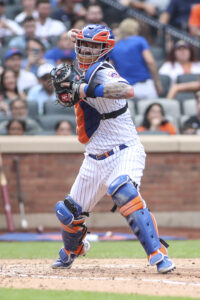
The 30-year-old Nido inked a two-year, $3.7MM contract prior to the 2023 season, buying out his final two seasons of arbitration eligibility. He was outrighted off the 40-man roster last season following a dismal .125/.153/.125 start through 61 plate appearances but chose to accept a Triple-A assignment due to the fact that electing free agency would’ve required him to forfeit the remainder of the guaranteed money on his contract.
Nido was selected back to the big leagues this season when Francisco Alvarez hit the injured list with a thumb injury that required surgery. During his most recent stint with the Mets, Nido surpassed five years of MLB service time, which allowed him to reject his latest outright assignment in favor of free agency while still retaining the remainder of his salary. He batted .229/.261/.361 through 90 plate appearances with the Mets this season.
That level of production is par for the course for Nido, a career .214/.251/.313 hitter in 895 trips to the plate at the big league level. Offense has never been the focal point of Nido’s game, however. He’s an high-end defensive backstop who draws plus grades for his framing and pitch-blocking, coupling those skills with a career 21% caught-stealing rate that’s right in line with this year’s league average.
Even Nido’s lackluster 2024 output at the plate or his similarly uninspiring career batting line would be an upgrade over what the 36-year-old Gomes has mustered this season. Gomes was near league-average at the plate just last season (.267/.315/.408, 10 homers, 95 wRC+) but has cratered with a career-worst .157/.179/.242 batting line in 96 plate appearances this season. Gomes fanned in just 18% of his plate appearances with the 2022-23 Cubs and entered 2024 with a career 23.1% mark in the majors, but he’s whiffed a massive 36 times this season (37.5%).
Like Nido, Gomes has a strong defensive reputation, but the numbers don’t bear that out this year. He’s thwarted just three of the 24 runners who’ve attempted to steal against him (12.5%) — well shy of his excellent 32% career mark. The Brazilian-born backstop’s once-premium framing numbers are below-average for a second straight season, meanwhile, and Statcast also pegs him below-average at blocking pitches in the dirt in 2024.
As is the case with Nido, Gomes is playing out the final season of a guaranteed contract. Chicago signed him to a two-year, $13MM pact in the 2021-22 offseason. Gomes’ performance last year made it a straightforward call for the team to exercise a $6MM club option (a net $5MM decision, given the option’s $1MM buyout). Even Gomes’ detractors couldn’t have reasonably predicted a decline of this magnitude, however. Gomes’ struggles are a major reason that Chicago backstops have been the third-worst in all of baseball at the plate, leading only the White Sox and Marlins in that regard.
The Cubs will still be on the hook for the remainder of Gomes’ $6MM salary once he inevitably becomes a free agent. (No team is going to trade for or claim what’s left on the contract). Once he’s released, Gomes will be free to sign with any club. A new team would only owe him the league minimum for any time spent on the big league roster. That sum would be subtracted from what the Cubs owe him through season’s end.
Marlins’ Dillon Head To Undergo Season-Ending Hip Surgery
Marlins outfield prospect Dillon Head will undergo season-ending surgery hip surgery, Isaac Azout of Fish On First reports. More specifically, Christina De Nicola of MLB.com reports that Head will require a left femoral acetabular impingement procedure. He’s expected to resume baseball activities in roughly three months, per Azout, though that mid- or late-September return to baseball activity won’t give him sufficient time to ramp back up to game action before the regular season concludes.
Head, 19, was the centerpiece of the early-season trade that sent Luis Arraez from Miami to San Diego. He appeared in only five games in Miami’s system this year — three shortly after the trade and another two following a lengthy IL stint — and will now lose the remainder of the season rehabbing from this surgery.
In 104 plate appearances with the Padres’ Class-A club prior to the trade, Head slashed .237/.317/.366 with a homer and three steals (albeit in seven attempts). He was inactive for ten days following the trade, then appeared in just three Class-A games with the Fish before landing on the injured list. Head went 4-for-12 with a triple and two steals in that brief look.
A first-round pick (No. 25 overall) out of Illinois’ Homewood-Flossmoor Community High School just last summer, Head is viewed as a speed- and contact-oriented outfielder whose wheels could help him develop into a plus center field defender as he continues to hone his reads. MLB.com ranks him fifth among Miami farmhands and credits him with true 80-grade speed. FanGraphs lists him third in Miami’s system behind Max Meyer and 2023 first-rounder Noble Meyer (who was selected 15 picks prior to Head in that draft).
Head was already viewed as a long-term development play at the time of the trade given his youth, and the loss of virtually his entire age-19 season will only further that likelihood. He’ll turn 20 in October and will enter the 2024 season with just 37 career games and 177 plate appearances at the Class-A level. Presumably, he’ll head back to Class-A Jupiter to open the 2024 season (health permitting) and work his way up the minor league ladder. A big league debut in 2025 doesn’t feel realistic, but late in the 2026 season or some point in the 2027 season he could feasibly be ready for a look in the majors.
Tigers, Eli Villalobos Agree To Minor League Deal
The Tigers have agreed to a minor league pact with free agent right-hander Eli Villalobos, per the team’s transaction log at MLB.com. He was designated for assignment by the Marlins last month and rejected what would’ve been his second career outright assignment in favor of free agency. Villalobos hasn’t pitched in nearly a month now, so Detroit assigned him to their Rookie-level minor league affiliate to ramp back up before presumably heading to their Triple-A club in Toledo.
Villalobos, 27 next week, made his big league debut with the Fish earlier this season and tossed 4 1/3 innings. He allowed one run on three hits and a pair of walks with three strikeouts in that generally sharp first MLB effort. He’s also logged 18 innings in Triple-A Jacksonville, recording a 4.50 ERA with a strong 26.5% strikeout rate but ugly 13.3% walk rate. Statcast measured his average fastball at 93.3 mph during that brief MLB run, and he also worked off a low-80s splitter and mid-80s slider.
While Villalobos has never ranked as a high-end prospect in Miami’s system, the former 14th-rounder was selected to the 40-man roster to shield him from the Rule 5 Draft on the heels of a 2022 season in which he posted a 2.86 ERA with a 32.7% strikeout rate (101 punchouts overall) against a 9.4% walk rate in 78 2/3 innings between Double-A and Triple-A. He’s since bounced to the Pirates organization and then right back to the Marlins via a pair of DFAs and waiver claims.
Lack of prospect pedigree notwithstanding, Villalobos has sub-4.00 earned run averages and strikeout rates north of 25% in two seasons of action at the Double-A and Triple-A levels. He walked a calamitous 18% of his opponents in Triple-A last season but has dished out a free pass to a less-alarming (but still too high) 12.8% of his opponents between Triple-A and the big leagues this season. He’ll be a project for the Tigers but could be a near-term bullpen option for them if he can continue to move past last year’s career-worst command issues.