
Mets Sign Jake Diekman
The Mets announced the signing of free agent lefty Jake Diekman to a one-year contract. The veteran reliever, a client of the Beverly Hills Sports Council, is reportedly guaranteed $4MM. There’s a matching club option for the 2025 season, which Diekman would vest if he appears in 58 games this year.
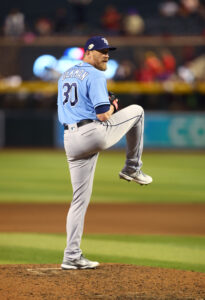
Diekman, 37, is a veteran of 12 major league seasons. The Mets would be the southpaw’s ninth club. He’s never had even average command of the strike zone (career 13.3% walk rate), but he’s a power-armed lefty who misses bats in droves and has managed to overcome his penchant for walks more often than not.
The 2023 season was an uneven one for Diekman, who opened the year with an ugly 11 1/3 innings in the White Sox bullpen before (like so many pitchers before him) making a 180-degree turnaround upon signing with the Rays. Diekman was rocked for 10 runs on 11 hits and 13 walks with the ChiSox but gave the Rays 45 1/3 frames of 2.18 ERA ball with a 28.6% strikeout rate and 13.5% walk rate. He averaged 95.7 mph on his heater during his time with Tampa Bay — right in line with the 95.6 mph he averaged over the seven seasons prior.
While Diekman has had some rough seasons interspersed throughout his mostly solid career, he’s never posted an ERA of 5.00 or higher and has kept his earned run average south of 4.00 in eight of his dozen MLB campaigns. On the whole, he sports a lifetime 3.82 ERA in 570 1/3 MLB innings, including a 3.67 ERA over the past four years.
Tampa Bay changed up his pitch usage a bit, as Diekman threw his changeup at a career-high 15.8% clip as a Ray. He’d previously never thrown the pitch at more than a 7% clip in any full season. In fact, Diekman entered the season with just 149 total changeups thrown in his career … before throwing 137 of them in 2023 alone. The results were strong: opponents batted just .176/.222/.294 in the 36 plate appearances that Diekman finished off with a changeup. His slider and four-seamer remained effective as ever; opponents hit just .161 and .175 while slugging .290 and .228 against that pair of offerings, respectively.
Lack of command has been the primary flaw holding Diekman back from standing as one of the game’s elite lefties. At age 37, that’s unlikely to change. But even with a bloated walk rate, the quality of Diekman’s pitches should continue to produce plenty of whiffs and a deluge of weak contact. Opponents have averaged a below-average 87.8 mph off the bat against him in his MLB career and hit just 33.6% of batted balls at 95 mph or greater. In 2023, opponents mustered a pitiful 84.6 mph average exit velocity and similarly feeble 26.4% hard-hit rate against him.
The Mets signed a quartet of free agent relievers to major league contracts before talks with Diekman gained traction, adding Jorge Lopez, Michael Tonkin, Austin Adams and, most recently, Adam Ottavino on one-year deals. That group figures to join returning veterans Edwin Diaz, Brooks Raley and Drew Smith in a revamped Mets bullpen.
One thing the Mets lack in the bullpen, following that slate of veteran additions, is flexibility. None of Diaz, Raley, Smith, Ottavino, Diekman, Lopez, Tonkin or Adams can be optioned to the minors, nor can Sean Reid-Foley or Phil Bickford. That sets the stage for the Mets to further shake up the relief mix, either by designating someone like Reid-Foley or Bickford for assignment or perhaps finding a trade partner for one or both of those holdovers.
The Mets are already in the highest tier of luxury taxation and are entering their third straight season exceeding the tax threshold. As such, every dollar they spend at this stage of the offseason is taxed at a 110% rate. Effectively, they’ll pay just over double whatever Diekman’s salary is in order to add him to the bullpen for the upcoming season. The Mets had a projected $309MM payroll and $322MM of luxury obligations even without Diekman, per Roster Resource. Both numbers jump even further north by $4MM.
Will Sammon and Ken Rosenthal of the Athletic first reported the Mets and Diekman were nearing an agreement. SNY’s Andy Martino reported the Mets had offered a one-year deal with a vesting option at around $4-5MM annually. Martino confirmed the sides had an agreement. MLB.com’s Anthony DiComo reported the $4MM guarantee, while Joel Sherman of the New York Post reported the $4MM option that vested with 58 appearances.
Twins Claim Daniel Duarte, Designate Ryan Jensen
The Twins claimed right-hander Daniel Duarte off waivers from the Rangers, per announcements from both clubs. In order to open a spot on the 40-man roster, Minnesota designated fellow righty and fellow waiver claim Ryan Jensen for assignment.
Duarte, 27, made his big league debut with the 2022 Reds but pitched only 2 2/3 innings that year due to inflammation in his elbow. He was healthier and posted generally solid run-prevention numbers in 2023, totaling 31 2/3 innings of 3.69 ERA ball for Cincinnati. That earned run average masks some much shakier K/BB numbers, however. Duarte has fanned a well below-average 16.7% of his MLB opponents and walked an unsightly 15.3% of them. He’ll need to improve one or both of those areas in order to stick in the big leagues.
That said, there’s reason to hope for improvement. Duarte has fanned 26.8% of his opponents at the Triple-A level, and while his 11.6% walk rate there is still too high, it’s a far sight better than his big league mark to date. He’s averaged a strong 95.7 mph on his heater, and scouting reports on the right-hander tout his plus slider. Duarte has a minor league option remaining, so he can be an up-and-down arm for the Twins this season if they hang onto him for the remainder of the offseason and into the 2024 campaign.
Jensen, 26, was the No. 27 overall pick by the Cubs back in 2019 but hasn’t made his big league debut. The Twins claimed him off waivers in early January. Command issues have plagued him throughout his minor league tenure, and Chicago placed him on waivers shortly after the trade deadline, surely hopeful of sneaking him through in order to retain him without committing a 40-man roster spot. That didn’t happen, as Seattle claimed him on waivers. He’s since bounced to the Marlins and Twins via the waiver wire, and he’ll now spend no more than a week waiting to learn his next stop. The Twins have seven days to trade Jensen or attempt to pass him through outright waivers.
In 2023, Jensen split the year between Double-A and Triple-A, working to a combined 5.32 earned run average in 64 1/3 innings of work. He operated primarily out of the bullpen, his first season doing so after spending the first few years of his career as a starting pitcher. He sports an overall 4.42 ERA with an above-average 26% strikeout rate and ugly 14.5% walk rate in his minor league career.
Jensen has a mid-90s heater, plus ground-ball rates, above-average strikeout rates and a pair of minor league options remaining, so the Twins would surely be glad if they’re able to pass him through waivers and keep him in the organization. But he’s also been designated for assignment thrice in the past six months and claimed by a new club each time, so there’s a decent chance another team will scoop him up in hopes of tapping into some of the former first-rounder’s latent potential.
Giants Trade Ross Stripling To Athletics
The A’s announced Friday that they’ve acquired right-hander Ross Stripling and cash from the Giants in exchange for minor league outfielder Jonah Cox. In order to clear a spot on the 40-man roster, infielder Jonah Bride was designated for assignment. Oakland also confirmed its previously reported one-year deal with lefty Alex Wood.

It’s a rare swap of players between the two Bay Area clubs — one that will add some direly needed pitching to an Athletics roster that’s largely devoid of proven big league arms. The 34-year-old Stripling is coming off a tough first season after signing a two-year, $25MM deal with San Francisco, though he did pitch quite a bit better as the season wore on. The veteran swingman opened the season with 32 1/3 innings of 7.24 ERA ball between the rotation and bullpen before hitting the injured list with a back strain for the next six weeks.
Perhaps Stripling was never at full strength to begin the year, because upon returning from the injured list he pitched much more like his typical self. Over the course of his final 56 2/3 frames, the right-hander notched a 4.29 earned run average with a pedestrian 18.7% strikeout rate and an elite 2.6% walk rate. That lines up far more nicely with Stripling’s broader track record; from 2016-22, he logged a 3.78 ERA in 672 innings split between the Dodgers and Blue Jays.
Stripling is owed $12.5MM this coming season. He had an opt-out opportunity following year one of his contract but unsurprisingly decided to forgo that right after his uneven showing with the Giants. Andrew Baggarly of The Athletic reports that the Giants are paying down $3.25MM of Stripling’s salary; the A’s will be on the hook for the remaining $9.25MM.
The A’s could opt to use Stripling in the rotation or in the bullpen. He has ample experience in both roles and has had success in each as well. Certainly, Oakland brass had hoped that by now, several of the young arms acquired in the trades of Matt Olson, Matt Chapman, Chris Bassitt, Sean Manaea, Frankie Montas, Sean Murphy, Lou Trivino and others would have yielded some controllable cornerstone pieces in the starting rotation.
That hasn’t happened, however. Left-hander JP Sears, who posted a 4.54 ERA in 32 starts and 172 1/3 innings out of the rotation last year, is the lone pitcher acquired in that fire sale who’s had any semblance of sustained success with the A’s. Others such as Ken Waldichuk, Kyle Muller, Adrian Martinez, Luis Medina, Zach Logue and Adam Oller (among others) have struggled. Medina did pitch fairly well in the second half of the 2023 season and is likely ticketed for a rotation spot in ’24, but that’s a sample of only 50 innings (4.32 ERA, 21.3% strikeout rate, 11.1% walk rate).
As such, it seems likely that Stripling and Wood will be reunited as not only teammates but rotation-mates. Stripling’s experience oscillating between a starting and relief role could mean he ends up in the bullpen at various points while the A’s take a look at younger arms. His familiarity with that role is a benefit to a team in the Athletics’ situation. If either Stripling or Wood can rebound after posting shaky results with the 2023 Giants, it’s quite likely that a non-contending A’s team will flip them both for younger talent prior to this summer’s trade deadline.
Stripling’s acquisition comes at the cost of the 28-year-old Bride’s roster spot. Bride, a versatile infielder/outfielder who’s played just about every position on the diamond, has appeared in each of the past two big league seasons. He’s batted just .192/.296/.232 in 293 trips to the plate, but he carries a stout .322/.450/.533 line in 401 plate appearances in Triple-A, where he’s walked more often than he’s struck out. The A’s will have a week to trade Bride or attempt to pass him through outright waivers. He still has a minor league option remaining. Between that, his plus hit tool and defensive versatility, he’s a candidate to be claimed or flipped to another club in a separate, minor trade.
As for the Giants, they’ll acquire Oakland’s sixth-round selection from just this past summer’s draft. Cox, 22, batted .287/.366/.403 with a 28.3% strikeout rate and 6.2% walk rate in 145 plate appearances split between the Athletics’ Rookie-level Arizona Complex League and Low-A clubs. Baseball America ranked him 29th among A’s farmhands heading into the 2024 season, touting him as a plus-plus runner who can handle center field. Cox is years away from being a potential big league factor, but despite struggling with strikeouts in his debut season, BA praised his strong bat-to-ball skills and credited him with an above-average hit tool.
For San Francisco, the money saved in the trade is every bit as important as the player side of the return. Moving the bulk of Stripling’s contract dropped the Giants’ payroll to a projected $154MM, per Roster Resource, and they’re now just under $200MM in luxury tax obligations. That gives them $37MM worth of AAV to work with before they come against even the first luxury threshold.
There are any number of ways for Giants president of baseball operations Farhan Zaidi to reallocate those funds. The Giants have been linked to Matt Chapman throughout the offseason, and signing him would bolster the infield defense while adding some pop (but also quite a few strikeouts) to the lineup. Cody Bellinger looks like less of a fit than he did prior to the Giants’ signing of Jung Hoo Lee on a six-year deal, but it could conceivably work out if the Giants push Michael Conforto into more of a DH role (or trade Conforto or another outfielder such as Mike Yastrzemski). San Francisco also reportedly made a late offer to Rhys Hoskins before he signed in Milwaukee, so it seems there’s the possibility of adding a bat to the first base/designated hitter mix.
Just as notable is San Francisco’s lack of rotation stability. Ace Logan Webb is one of the game’s best arms, but the trade of Stripling leaves the Giants with zero established arms beyond him. Top prospect Kyle Harrison was solid in last year’s MLB debut, but that amounted to all of 34 2/3 innings. The Giants signed oft-injured reliever Jordan Hicks and plan to plug him into the rotation — a dicey proposition that would be more befitting of a team with only one rotation hole and several workhorse arms ahead of him. Younger righties like Keaton Winn and Tristan Beck could factor into things as well, but it was obvious even before trading Stripling that the Giants needed at least one more starting pitcher.
The Giants have the resources to pursue top-of-the-market arms like Blake Snell and Jordan Montgomery, though doing so would require deviating from the front office’s prior aversion to long-term deals for pitchers. Other yet-unsigned options include Michael Lorenzen, Mike Clevinger and Hyun Jin Ryu. The trade market features names like Dylan Cease, Shane Bieber and any number of Marlins hurlers (Edward Cabrera, Braxton Garrett and Jesus Luzardo among them).
Stripling becomes the second pitcher and third free-agent signing from last offseason that the Giants will pay to pitch elsewhere in 2024. San Francisco paid the Mariners $6MM in the trade sending Anthony DeSclafani and Mitch Haniger to Seattle. (DeSclafani has since been flipped to Minnesota along with a bit of additional cash kicked in from the M’s.) They’ll have to hope for better results in this winter’s crop of signees if they hope to avoid a fifth playoff miss in six seasons under the current front office.
Braves Sign Ken Giles To Minor League Deal
The Braves announced their slate of non-roster invitees to spring training Friday, and while the majority of names within have already been reported or announced over the course of the offseason, there are a few notable names revealed within today’s release. Former Astros and Blue Jays closer Ken Giles, who recently worked out for teams, will be in camp after inking a minor league pact. Former Reds infielder Alejo Lopez and former Royals catcher Sebastian Rivero have also signed minor league contracts with non-roster invitations.
Now 33 years old, Giles was one of the game’s best relievers at his peak. He debuted with the 2014 Phillies and delivered consecutive sub-2.00 ERA seasons. From 2014-19, Giles racked up 114 saves between Philadelphia, Houston and Toronto while pitching to a 2.67 ERA and striking out one-third of his opponents against a 7.5% walk rate. Injuries have derailed that excellent start to his career; he underwent Tommy John surgery in 2020, which wiped out his 2021 season entirely.
Giles inked a two-year deal with the Mariners spanning the 2021-22 seasons, with Seattle hoping he’d be healthy for the second year of that arrangement. A strained tendon in his pitching hand pushed back his debut, however, and Giles only wound up pitching 4 1/3 innings with the M’s over the course of that two-year contract. Seattle declined a club option for the 2023 season. He pitched 20 innings in the Dodgers’ minor league ranks last year and fanned 32 hitters but also walked 19 while recording an 8.55 ERA.
Four full seasons have now been completed since Giles was last a dominant big league reliever. It’s perhaps a long shot for him to ever recapture that form, but there’s also little harm in the Braves taking what amounts to a no-risk look at him during spring training. Jon Heyman of the New York Post reports that the Rowley Sports Management client would earn at a $1.75MM rate if he’s added to the big league roster at any point.
Lopez, 27, has seen MLB time in each of the past three seasons with Cincinnati. He’s played second base, third base and all three outfield positions while posting a .265/.309/.329 batting line over the course of 181 plate appearances. The versatile Lopez has excellent bat-to-ball skills, evidenced by a 14.9% strikeout rate in the big leagues. In Triple-A, he’s walked at a 12.5% clip against a tiny 11.4% strikeout rate while batting .289/.384/.412 in 1030 plate appearances.
The 25-year-old Rivero appeared with the Royals in 2021-22, appearing in 34 games and batting .167/.236/.197 in 73 plate appearances. Rivero spent the 2023 season in the White Sox minor league system, splitting time between Double-A and Triple-A. He slashed .219/.273/.326 in that one-year stint with Chicago and is a career .247/.297/.369 hitter in parts of three Triple-A seasons. Rivero is touted as a plus defender behind the plate and sports strong framing marks in the minors in addition to a solid 27% caught-stealing rate across all levels in his professional career.
Theo Epstein Joins Fenway Sports Group As Partial Owner, Senior Advisor
Former Red Sox general manager Theo Epstein will have a role with the team once again, as Sportico’s Brendan Coffey reports that Epstein is set to join Fenway Sports Group as a partial owner and senior advisor. Red Sox principal owner John Henry and chairman Tom Werner hold those same respective titles with the FSG conglomerate, which owns the Red Sox, Pittsburgh Penguins, Liverpool F.C., RFK Racing, NESN and several other sports holdings.
“It’s a great honor, something I’m really excited about,” Epstein tells Coffey. “It’s just exciting to be joining such a dynamic, groundbreaking company across multiple sports, doing so many innovative things at the cutting edge of everything going on in sports these days. For me, it’s perfect, I was looking for a pathway into ownership.”
While Epstein won’t be resuming his role as head of baseball operations, he does have a strong relationship with newly hired Red Sox chief baseball officer Craig Breslow. Epstein was the Cubs’ president of baseball operations when he hired Breslow as the team’s director of strategic initiatives. Breslow was eventually named the Cubs’ organization-wide director of pitching before being promoted to assistant general manager.
“I’m a full believer in him and what he and his team are going to mean for the Red Sox,” Epstein said of Breslow.
Per Coffey, Epstein will serve as a “sounding board and executive coach” to the Red Sox baseball operations staff when needed but doesn’t have a formal role within the baseball ops ranks in his return to the organization. According to FSG’s press release announcing the hiring, Epstein will advise Henry, Werner, CEO Sam Kennedy and president Mike Gordon “on the company’s sporting operations across the portfolio and consult on strategic growth and investment initiatives.”
“There is no question that Theo left an indelible mark on our history that represented a transformative era,” Henry said in a statement within FSG’s press release. “Welcoming him as a member of our ownership group and in the role of Senior Advisor to the broader company brings with it a sense of completion. With his strategic mind, leadership, and unwavering passion for sports, Theo brings invaluable assets that will drive us forward across our diverse enterprises, especially in our sporting operations across hockey, EPL football, and baseball. We take great pride in welcoming him to the FSG family and eagerly anticipate the insights and contributions he will bring as we continue to build on the legacy of success he played a pivotal role in helping us shape.”
Epstein, 50, was the Red Sox’ general manager from 2003-11, during which time he oversaw the construction of a 2004 Red Sox club that broke the organization’s 86-year World Series drought and quickly added a second championship four years later, in 2007. The Cubs hired Epstein away and gave him the new title of president of baseball operations following the 2011 season. As was the case in Boston, he broke a historic championship drought when the 2016 Cubs won the World Series for the first time since 1908.
Epstein stepped away from the Cubs following the 2020 season, ceding his president of baseball operations title to longtime general manager Jed Hoyer. Months later, Epstein was named a consultant to Major League Baseball commissioner Rob Manfred — a role in which he’s credited with helping to implement MLB’s pitch clock and several other newer rule changes. He’s held until present day but will now step away from the commissioner’s office as he begins his next venture. Epstein will still serve the league’s Competition Committee and On-Field Committee “on an informal basis,’ per FSG’s press release, and he’ll be able to continue as the Operating Partner for Arctos Partners, a private sports equity firm that Epstein joined back in Feb. 2021.
Picollo On Roles For Massey, Frazier
The latest move in a busy Royals offseason brought veteran second baseman/left fielder Adam Frazier to Kansas City on a one-year deal. Though Frazier has a long track record as an everyday player, Kansas City general manager J.J. Picollo suggested following the signing that Michael Massey will still be the regular second baseman, with Frazier operating in more of a utility role (link via Jaylon Thompson of the Kansas City Star).
“[Massey] needs to be a big part of our team, and we shared that with [Frazier] last week,” Picollo stated. The second-year K.C. GM stressed the importance of being up-front with a veteran like Frazier about the role he’d likely be stepping into. That, it seems, won’t be an everyday one. Picollo noted that with his defensive versatility, Frazier “can protect us, so to speak, in a lot of ways.”
Massey, who’ll turn 26 in March, has logged significant big league time in each of the past two seasons but has yet to solidify himself as a productive big league hitter. Selected by the Royals in the fourth round of the 2019 draft, Massey breezed through the minors. He’s a .293/.355/.503 hitter in the minors overall, and he slashed an impressive .312/.371/.532 between Double-A and Triple-A in 2022 before getting his first call to the big leagues.
Unfortunately for both Massey and the Royals, that level of output hasn’t carried over to the big leagues. The lefty-swinging second baseman has appeared in 181 games over the past two seasons and turned in a middling .233/.284/.379 slash. Massey didn’t walk at prolific rates in the minors, but his 5.2% walk rate in 655 MLB plate appearances is clearly lacking. He’s popped 19 home runs and struck out at a slightly lower-than-average 21.5% clip, but his 88.8 mph exit velocity and 38.7% hard-hit rate are both a bit shy of league average.
To his credit, Massey improved down the stretch in 2023. His second-half batting line of .237/.271/.434 still sits well below average, but he cut his strikeout rate from a glaring 28.2% in 200 first-half plate appearances to 15.4% in 228 second-half trips to the plate. Massey reduced his chase rate on pitches off the plate, greatly improved his contact rate on pitches within the zone and generally swung through fewer pitches. The overall quality of his contact didn’t improve much, but the frequency of it did. Were it not for a .238 average on balls in play in that stretch of 228 plate appearances, the second half of his season would likely look a whole lot better.
The 2024 season will be an important one for Massey. He’s still relatively young, heading into his age-26 season, but with another year of comparable production to what he’s already displayed at the MLB level, it’ll be far more difficult for the Royals to continue with him in a prominent role. To that end, that’s one of the areas in which Frazier affords the team some of the “protection” mentioned by Picollo. Frazier’s own production has dropped off since his Pirates days, but last year’s .240/.300/.396 is better across the board than Massey’s was.
Frazier also offers some protection against an uncertain outfield group. MJ Melendez is another once-promising Royals farmhand who’s yet to hit in the big leagues. Free agent signee Hunter Renfroe hits lefties far better than righties. The hope is surely for him to patrol right field on an everyday basis, but if Renfroe struggles, Frazier does have nearly 400 career innings in right field. He also provides the Royals with injury depth for each of Massey, Melendez and Renfroe.
Diamondbacks Sign Brandon Hughes To Minor League Deal
The Diamondbacks announced Thursday that they’ve signed left-hander Brandon Hughes to a minor league contract. The former Cubs reliever will be in camp with the D-backs as a non-roster invitee this spring.
Hughes, 28, was a key reliever for Chicago in 2022 but missed the majority of the 2023 season owing to a left knee injury that required a debridement procedure back in June. He pitched just 13 2/3 innings this past season and was non-tendered in November.
While Hughes was tagged for a 7.24 ERA in his tiny sample of 2023 work, his 2022 season was excellent. He pitched 57 2/3 frames for the Cubs, working to a 3.12 earned run average with a sharp 28.5% strikeout rate against a respectable 8.8% walk rate. The Cubs put him in the ninth inning late in the season, and he recorded eight saves in that tole. Home runs were an issue for the southpaw (1.72 HR/9), but he also saw a disproportionate number of his fly-balls (17.8%) turn into long balls; the league average that season was 11.4%.
Beyond his strong work in the 2022 season, Hughes has a terrific minor league track record. His Triple-A numbers are a bit skewed by this year’s performance, most of which came as he made his way back from the aforementioned knee surgery. But even with the 11 runs he yielded in 11 frames this season, Hughes has a career 4.64 ERA in Triple-A and a 2.72 mark across all minor league levels. Prior to making his debut in 2022, he pitched 16 2/3 shutout innings with 22 strikeouts and three walks between Double-A and Triple-A.
The Diamondbacks have lefties Andrew Saalfrank and Joe Mantiply likely ticketed for spots in the big league bullpen, and Kyle Nelson is also on the 40-man roster as an option. A healthy Hughes could challenge any of that trio for a spot, however, and there’s enough uncertainty regarding the final spot in Torey Lovullo’s relief corps that carrying three southpaws is a possibility. As it stands, the Snakes will have Paul Sewald, Kevin Ginkel, Miguel Castro, Ryan Thompson, Scott McGough, Saalfrank and Mantiply likely penciled into spots. Out-of-options righty Luis Frias and righty Peter Strzelecki could both compete for that final spot, but spring injuries and performances could open up additional opportunities for Hughes and other non-roster invitees.
If Hughes is eventually added to the roster, he’ll offer the D-backs plenty of flexibility and long-term control. He has all three minor league option years remaining, and with just a one-plus year of MLB service, he can be controlled all the way through 2028 season.
Blue Jays Turning Away Trade Interest In Alek Manoah, Expect Him To Be In 2024 Rotation
The Blue Jays have heard from teams looking to buy low on right-hander Alek Manoah following a disastrous 2023 season throughout the winter, but Jon Morosi of MLB Network tweets that the Jays have been telling interested parties they expect Manoah to be in the 2024 rotation and do not plan to move him.
By now, the highs and lows of Manoah’s 2022-23 campaigns are well-documented. The right-hander finished third in American League Cy Young voting as recently as 2022, pitching to a pristine 2.24 earned run average while fanning 22.9% of his opponents against a 6.5% walk rate. He made 31 starts, totaled 196 2/3 innings, and was named to his first All-Star team that year. The 2023 season was the polar opposite; Manoah’s velocity, strikeout rate and walk rate all went in the wrong direction. His home run rate doubled. His opponents’ average exit velocity jumped by two miles per hour, while their hard-hit rate spiked from 31.5% to 44.4%.
Manoah was optioned to the minors multiple times throughout the 2023 season — a notion that would’ve been unthinkable entering the year. The right-hander underwent a slate of medical exams after being optioned for the final time, but no major injury was uncovered. He wound up finishing out the season with a grisly 5.87 ERA in just 87 1/3 frames. Manoah’s final big league start came on Aug. 10.
Throughout the offseason, Manoah’s name has popped up in various trade rumors. That’s plenty understandable, as even if the 2023 season represents a clear rock-bottom for the talented righty, he’s only a year removed from being on the opposite end of that spectrum. Manoah also just turned 26 years old in January, and he’s controllable for another four years before he can become a free agent. Even if the Jays (or a trade partner) never get him back to that peak 2022 form, there’s an appealing middle ground where Manoah could be a strong mid-rotation arm at an affordable rate for several years.
For the Blue Jays, the upside of keeping Manoah has clearly outweighed the temptation to pursue a change of scenery. That’s likely due both to belief in the pitcher himself and the offers and names discussed with other clubs in trade talks. Interested parties were undoubtedly trying to acquire Manoah at something of a discounted rate in light of last year’s struggles. The Jays, presumably, retained a lofty asking price given the affordability, remaining club control and ceiling of the pitcher.
Beyond the general difficulty of lining up on asking price in such a volatile buy-low situation, the Jays simply aren’t teeming with rotation depth. Assuming Manoah is in the starting five to begin the season, he’ll join Kevin Gausman, Jose Berrios, Chris Bassitt and Yusei Kikuchi to round out the group.
It’s a solid quintet but one with its own question marks even beyond Manoah. Berrios’ 2022 season was similar to Manoah’s 2023 campaign; in 32 starts he was tagged for an uncharacteristic 5.23 ERA with the highest home-run rate and lowest strikeout rate of his career. He bounced back in ’23 (3.65 ERA in 189 2/3 innings), but his ’22 struggles are surely still in the back of the Jays’ minds. Meanwhile, Kikuchi is something of a wild card. The 32-year-old lefty is clearly a talented arm but has had a roller-coaster MLB tenure. At his best, he’s looked like a borderline top-of-the-rotation arm, but there have been low points where he’s pitched his way out of a rotation spot entirely. Between Manoah, Berrios and Kikuchi, there’s a volatile, broad-reaching range of potential outcomes.
The depth behind that group is also somewhat lacking. Left-hander Ricky Tiedemann is one of the top pitching prospects in the sport but tossed just 44 innings during the 2023 regular season — only four of which came in Triple-A. He tacked on another 18 innings in the Arizona Fall League, but he’s lacking upper-minors experience and will be on an innings cap to some extent in 2024. Righty Yariel Rodriguez, who agreed to a four-year, $32MM deal might be an eventual rotation option for Toronto, but he didn’t pitch in 2023 outside of a brief showing in the World Baseball Classic, and he was primarily a reliever during his most recent run with the Chunichi Dragons of Japan’s Nippon Professional Baseball.
The Jays have a trio of other right-handers on the 40-man roster who could conceivably serve as depth: Mitch White, Bowden Francis and Wes Parsons. But White’s roster spot could be in jeopardy this spring after he posted a 5.50 ERA in Triple-A last season and a 7.11 ERA in 12 2/3 MLB frames. He’s out of minor league options, so he’ll need to make the Opening Day club, likely as a long reliever/swingman, or else be designated for assignment. Francis, 28 in April, posted a sparkling 1.73 ERA with Toronto last year but worked exclusively out of the bullpen in the big leagues and made only seven minor league starts. He pitched a total of 66 1/3 innings in ’23. Parsons, 31, joined the Jays on a minor league deal after a two-year run in the KBO and posted a 4.52 ERA in 17 Triple-A starts before being rocked for nine runs in four innings during his lone MLB start.
Given the shaky nature of the team’s depth and the fact that 60 percent of the current MLB rotation has struggled to an ERA north of 5.00 in one of the past two seasons, it’s understandable if the Jays want to retain as much depth as possible. Couple that with what one can imagine have been lackluster offers from teams hoping to secure a bargain acquisition of Manoah, and it becomes all the easier to see why the Jays prefer to hang onto him. Any trade situation is fluid, of course, and it takes all of one phone call or text message with the right player’s name(s) to get earnest trade talks rolling. For now, however, it seems likely to anticipate Manoah will open the season in Toronto and look to reestablish himself as a viable cog in a talented but mercurial rotation.
Orioles Confirm Agreement To Sell Control Stake Of Franchise To Group Led By David Rubenstein
The Orioles have confirmed yesterday’s reports on a sale of the team, announcing Wednesday that a group of investors led by billionaire David Rubenstein of the Carlyle Group private equity firm has purchased the control stake of the team from the Angelos family for $1.725 billion. Notably, former control person John Angelos will remain a “major investor” in the club and will serve as a senior advisor to Rubenstein in his new role. The transaction values the Orioles franchise and assets at $1.725 billion dollars, per the team’s press release on the ownership shakeup.
“I am grateful to the Angelos family for the opportunity to join the team I have been a fan of my entire life,” Rubenstein said in a statement within today’s press release. “I look forward to working with all the Orioles owners, players and staff to build upon the incredible success the team has achieved in recent seasons. Our collective goal will be to bring a World Series Trophy back to the City of Baltimore. To the fans I say: we do it for you and can’t do it without you. Thank you for your support. Importantly, the impact of the Orioles extends far beyond the baseball diamond. The opportunity for the team to catalyze development around Camden Yards and in downtown Baltimore will provide generations of fans with lifelong memories and create additional economic opportunities for our community.”
The sale of the majority share in the Orioles is still subject to review and approval from the remaining 29 owners in Major League Baseball. A formal vote is expected to take place next week at the quarterly MLB owners meetings. Among the more recognizable names in the Rubenstein-led group are Orioles icon Cal Ripken Jr., NBA Hall of Famer Grant Hill and Michael Bloomberg. Any concerns about a potential relocation following the sale should quelled; Rubenstein is a Baltimore native who’s already voiced his desire to keep the team in Baltimore long-term, and the recent 30-year lease extension at Camden Yards transfers to new ownership as well, per Danielle Allentuck of the Baltimore Banner.
“When I took on the role of Chair and CEO of the Orioles, we had the objective of restoring the franchise to elite status in major league sports, keeping the team in Baltimore for years to come, and revitalizing our partnership group,” Angelos said in his own statement. “This relationship with David Rubenstein and his partners validates that we have not only met but exceeded our goals.”
The Angelos family has owned the Orioles franchise since Peter purchased the team for $173MM. He served as the club’s control person into his 90s but eventually ceded that post to his sons, John and Louis. In the years that followed, a contentious battle for control of the organization emerged. Louis Angelos filed a lawsuit alleging that John took steps to seize sole control of the club against his father’s wishes and that his mother, Georgia, was making it a priority to sell and possibly even relocate the team. Georgia countersued, alleging that Louis had fabricated his claims in something of a powerplay of his own. The suits were dropped in 2023, nearly one year ago to the day, with the parties settling outside of court.
Between the infighting among the Angelos family and the long-running television rights fees drama with the Nationals, the Orioles have been embroiled in litigation for years. The Angelos family owned the majority stake in the Mid-Atlantic Sports Network, which broadcasts both Orioles and Nationals games, and the two franchises have been at odds for more than a decade over unpaid rights fees to the Nationals. An arbitration panel eventually ruled that the O’s owed the Nats $105MM in fees, which the Orioles appealed. An appellate court upheld the ruling last April. Now, Jeff Barker of the Baltimore Sun reports that Rubenstein’s group is also purchasing the control stake in MASN. Whether that will have significant ramifications regarding the arrangement between the Orioles and Nationals remain unclear.
As with any ownership change, the possibility for a major departure from baseball operations norms exists under new ownership. Since John Angelos was named control person in place of his ailing father, Peter, the Orioles have essentially sat out the free-agent market entirely. General manager Mike Elias has never signed a free agent to a guaranteed multi-year deal and hasn’t committed more than Craig Kimbrel‘s $13MM to any individual player. That’s been in part due to the fact that the Orioles have been mired in a rebuilding process that spanned more than four years, but even on the heels of last year’s AL East title, they’ve been surprisingly quiet (much to the chagrin of Baltimore fans).
That rebuilding effort, of course, led the Orioles to develop one of the more enviable young cores in all of baseball. Catcher Adley Rutschman has already emerged as a superstar, and young infielder Gunnar Henderson isn’t far behind. Right-hander Grayson Rodriguez and top prospects like Jackson Holliday, Jordan Westburg, Joey Ortiz, Connor Norby, Heston Kjerstad, Colton Cowser, Samuel Basallo and many more create a favorable long-term outlook.
However, even as Orioles fans celebrated the emergence of their young core after so many noncompetitive years, Angelos put a damper on matters by casting doubt on the organization’s ability to sign anyone from that bunch to long-term deals. The now-outgoing Orioles control person told the New York Times in 2022 that in order to sign players like Rutschman and Henderson to the type of extensions they could rightly seek based on market precedent, the Orioles would need to “massively” raise prices for fans. Comments like that, paired with the general inertia that has embodied previous Orioles offseasons has led to frustration among the fan base.
Whether a change in ownership will bring about aggressive levels of spending remains to be seen. It’d be unwise to expect the Orioles to act with the same level of brazen aggression as, say, the Mets in the wake of the Wilpon family’s sale to current owner Steve Cohen. At the same time, the current levels of spending is practically the lowest of bars to be cleared. The Orioles ended the 2023 season with a $66MM payroll and project to open the 2024 season with just an $81MM payroll. Felix Bautista, the Orioles’ All-Star closer who is recovering from Tommy John surgery, is the only player who’s guaranteed even a single dollar in salary beyond the 2024 campaign. He’s promised all of $1MM for the 2025 campaign.
Time will tell the extent to which the Orioles’ recent market inactivity was colored by ongoing efforts to orchestrate this sale and whether Rubenstein’s group will be more willing to spend than the team has been under the watch of John Angelos. For the time being, the pending sale looms as a beacon of hope for an Orioles fan base that has become increasingly frustrated with the team’s ostensible unwillingness to supplement one of the brightest young cores of talent in the sport.
Joe Smith Announces Retirement
Veteran reliever Joe Smith announced his retirement on Wednesday, calling it a career after spending parts of 15 seasons in the Major Leagues. Via his representatives at Excel Sports Management, Smith issued a lengthy statement thanking the Mets, Guardians, Angels, Cubs, Blue Jays, Astros, Mariners and Twins organizations in addition to his coaches, teammates, trainers and family for supporting him throughout his career.
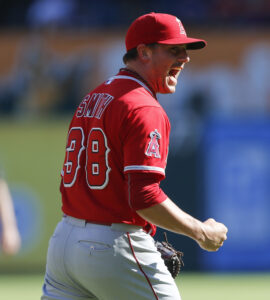
Selected by the Mets in the third round of the 2006 draft, the now-39-year-old Smith was in the majors less than one year later and practically never looked back. That’s in large part thanks to the fact that Smith established himself as a quality big league reliever right out of the gate, pitching 44 1/3 innings of 3.45 ERA ball with a 22% strikeout rate and 10.1% walk rate as a rookie.
That set off a remarkable run of 13 straight seasons with an ERA of 3.83 or better for Smith — including five years with a sub-3.00 mark and two with a sub-2.00. While the sidearming Smith was rarely thrust into the ninth-inning spotlight (30 career saves), he’s one of the most consistent and prolific setup men in the game’s history. Since holds began being tracked, Smith’s 228 rank him in the top five all-time. His blend of durability and consistently strong performance kept him in leverage spots for more than a decade.
Smith wasn’t on the 2016 Cubs’ World Series roster after missing most of the final month of the season due to injury, but he did take home a ring that year and pitched in parts of five other postseasons (including in 2019, when he pitched in the World Series as the Astros finished runner-up to the Nationals). As was the case during his regular-season performances, he remained quite strong in October. In 14 career playoff innings, Smith yielded only four earned runs on eight hits and three walks with 13 strikeouts (2.57 ERA).
All told, Smith will walk away from the game with 762 1/3 innings of 3.14 ERA ball under his belt. In his career, he pitched for eight MLB clubs, notching a 55-34 record with 30 saves, 228 holds, a 21.1% strikeout rate and an 8.1% walk rate. Smith didn’t post an ERA over 4.00 until his age-37 season in 2021, and in 15 MLB seasons he never had a single year where he ERA climbed to 5.00 or higher. He picked up more than 13 years of Major League service time and earned more than $51MM in salary over the course of a quietly excellent career. Best wishes to Smith and his family in whatever lies in store for his post-playing days.