
Extension Candidate: Neil Walker
With Andrew McCutchen's extension completed, the Pirates will focus their attention on second baseman Neil Walker, according to Rob Biertempfel of the Pittsburgh Tribune-Review. Biertempfel believes a Walker extension may be "pricier than they originally expected," but the team will still pony up. What would be a fair deal for the 26-year-old Walker?

Walker currently has one year and 166 days of big league service, meaning he'll be arbitration eligible as a Super Two player after the 2012 season. A direct comparable for Walker may be difficult to find, as few infielders with less than two years of service have signed extensions in recent years. Walker is only six days shy of two years of service. If we look at second basemen who signed extensions with between two and three years of service, we get Ben Zobrist, Dustin Pedroia, Aaron Hill, Ian Kinsler, and Robinson Cano. Their contracts ranged from four to six years, guaranteed $12-40.5MM, and had at least one club option.
Walker owns a .280/.338/.423 line in 1171 plate appearances across 286 games, with 24 home runs, 149 RBI, 138 runs, and 12 steals. Kinsler's numbers through '07 are better, aside from RBI, but not wildly different. Kinsler signed a five-year, $22MM contract that paid $13MM for his three arbitration years and $7MM for a free agent year, plus a club option on another. The contract is four years old, however. Zobrist seems another decent comparable. He had much more service time than Walker, but a similar number of career plate appearances. Zobrist trumps Walker's home run total and platform year but was similar career-wise. But even coming off an MVP-caliber year, Zobrist signed a four-year deal worth $18MM with a pair of club options. He received $14.5MM for his three arbitration years.
Neither Kinsler nor Zobrist was a Super Two player. Walker must be compensated for four arbitration years, perhaps at $18-20MM total. If the contract is to include one free agent season it'd probably be around $8MM. A five-year, $27MM deal beginning with the 2013 season could be fair for Walker. From the Pirates' point of view, Walker doesn't have the power or service time of Kinsler of Zobrist, perhaps justifying the inclusion of two club options for the Hendricks Sports client.
Photo courtesy of Icon SMI.
iPhone App Testers Wanted
1:05pm: Our testing group is full, thanks for the emails. Testers will receive an email this week.
11:37am: We have fixed a couple of issues in our Baseball Trade Rumors iPhone app, including the commenting one. If you currently own the app and would like to help us test the latest version before we make it publicly available, please email mlbtriphoneapp@gmail.com with your UDID. Instructions on how to find your phone's UDID in iTunes can be found here.
The Next Frontier Of Baseball Analysis
The Sloan Sports Analytics Conference assembled an excellent baseball panel this year in Boston. Host Rob Neyer asked participants their thoughts on the next frontier in baseball analysis, and a few highlights follow.
Red Sox senior advisor of baseball operations Bill James gave a two-part answer. First, James feels "one of the things we most need to understand better is how levels of competition fit together so that the information we get from one level can be interpreted at another level in a way that is more helpful." James says "we really don't have a clue" how levels such as college, Double-A, and Japan fit together. Second, James believes that teams and players act in their best interest, even if it's not beneficial for the game as a whole. He gave an example of a player stepping out of the box to regain his focus. That 30 second break helps the player perform his best, but delays of this nature are bad for baseball in general, because they cause many to consider the game boring to watch.
Astros GM Jeff Luhnow wasn't actually answering Neyer's question at the time, but he volunteered his thoughts, saying, "The frontier from my perspective is really turning that player evaluation into player valuation. When Scott [Boras] and I have a conversation about a player, this player may be 12 runs above average and another player might be 10 runs above average, but there's so many other factors that go into whether I'm going to be willing to pay more or less for that player. For example, we always talk about the most likely outcome for this player, but what's the distribution look like? Is there a 10% chance that he's below replacement level, is there a 10% chance that he's above superstar level?"
Indians president Mark Shapiro spoke of an "infinite number of things that I don't know," but mentioned during the conference that "medical is an absolute separator." Agent Scott Boras focused on psychology, as a means to increasing the chances of players reaching their potential. Rays baseball operations special assistant Rocco Baldelli wonders why some players develop the ability to hit, and some do not.
The panel provided a wide array of answers, but Luhnow's resonated most with me. We often apply straightforward methods to determine what constitutes a good free agent signing, but projecting a player's WAR and multiplying by the price of a win is just a starting point. Both Luhnow and Shapiro lamented the inability to tell fans all the factors that went into a decision, so unfortunately there will always be missing information for those outside the front office.
No Discount For Padres On Maybin’s Arbitration Years
There are two reasons to sign a player to a multiyear contract extension before he's arbitration eligible. One is to get a discount on the player's arbitration years as a tradeoff for guaranteeing them, and the other is to secure free agent seasons. The Padres accomplished only one of these in signing center fielder Cameron Maybin to a five-year, $25MM extension on Saturday.
Arbitration hearings lag well behind the times in terms of the statistics argued by teams and agencies. Arbitration panels consist of three base-level baseball people, and it's generally considered too risky to attempt to educate them about an advanced metric, prove its validity, and a present a strong case for the player within an hour. That's why it wasn't surprising when Matt Swartz's arbitration model for MLB Trade Rumors proved that playing time and power matter most in arbitration salaries for position players, and even batting average and steals "pale in importance to the almighty HR and RBI." Matt demonstrated that position doesn't affect salary much either.
MLBTR's Ben Nicholson-Smith zeroed in on this point in his January Maybin extension candidate article. Maybin was quite valuable in 2011, tallying 4.7 wins above replacement according to FanGraphs. However, he accumulated this value almost entirely through skills that are rarely recognized in arbitration salaries, such as defense, baserunning, and playing a difficult position. Assuming Maybin were to just keep repeating his 2011 season – a generous playing time assumption – Matt Swartz projects arbitration salaries of $2.4MM in 2013, $3.8MM in 2014, and $5.2MM in 2015, for a total of $11.4MM. As part of the new five-year deal, Maybin will receive $15MM for that stretch of his career.
Maybin's 140 pro games in 2011 marked a career-best; he's always battled injuries. Playing time is a significant factor in arbitration salaries. Not only did the Padres lose the chance to pay Maybin less during his arbitration years if he misses significant time due to injury, but they overpaid him by an estimated $3.6MM even if good health is assumed. Perhaps Maybin's contract was modeled off Franklin Gutierrez's January 2010 deal with the Mariners, itself a clear overpay at the time for the same reasons. One key difference is that the 24-year-old Maybin has plenty of offensive upside remaining, and if the former first-rounder realizes what was once considered "wicked raw power" by Baseball America, he could justify arbitration earnings in excess of $15MM.
As I mentioned, Padres GM Josh Byrnes received another benefit by locking up Maybin: the center fielder's first free agent year at $8MM and a club option for another at $9MM. Even if Maybin does not take another leap forward with the bat, those 2016 and '17 salaries will still be considered good value relative to free agent prices. With today's savvy front offices, free agency will likely continue to appreciate defense and position scarcity more and more. As of right now, though, Maybin's agent Brian Goldberg is the winner, having secured $25MM for a player coming off a 137-game season in which he batted .264 with nine home runs and 40 RBI.
Luhnow On Myers, Draft, Astros
New Astros GM Jeff Luhnow participated on the baseball analytics panel today at the Sloan Sports Analytics Conference. A few highlights:
- After the panel, I mentioned to Luhnow that his decision to move Brett Myers to the Astros' closer role has raised a few eyebrows. I asked if he thought Myers will have more impact in the bullpen than the rotation, and the GM replied, "I think for our team, right now, where we are and what we need, Myers in the bullpen is going to help us. We've got some options in the rotation and we really didn't have good options for that [closer] role. He's excited about it, and I'm excited to see how it works out. If it doesn't work out, we can always go back to the other way." As to whether the two parties would "re-restructure" the contract in that case, Luhnow said that would not be necessary because it's currently structured so it can go either way.
- During the panel, Luhnow explained what it's like to make a move that is not well-received. "It's frustrating, because you wish you could tell the fans everything that went into the decision. You go on FanGraphs and you read stuff about the player, and if that's all the information you had, you might make a different decision. But you've got a lot of information from the clubhouse, medical information, you have a lot of other pieces that are relevant that you really can't discuss. You're going to be second-guessed no matter what, so you just have to take it and move on."
- "You can't go wrong" with the first overall pick in the draft, Luhnow told me. He's never picked higher than Brett Wallace at #13 in 2008 for the Cardinals. He says there's already a short list of candidates for the Astros' 1-1 pick in 2012. I mentioned the huge expectations for such a pick, and Luhnow replied, "No question about it, there have been 1-1s that have not worked out well and we hope that we're one of the 1-1s that turns out to be a franchise player. That's the
expectation, that's the goal. There's risk in any player you select in the draft, but hopefully we'll take one that will move quickly and be an impact player." - "There's no question that sports analytics helped the St. Louis Cardinals win the World Series last year," said Luhnow on the panel. He said the Cardinals didn't have much with respect to analytics when he arrived in 2003, and the Astros are similar nine years later. He considers a blank slate "a huge opportunity to gain an edge." Luhnow says he's hired ten people since being named Astros GM, and "four of them were geeks, nerds, computer guys."
- Luhnow says the Dominican amateur market is almost inverted from the bargains of 10-15 years ago, and likes the limitations imposed in the new collective bargaining agreement.
Boras On Edwin Jackson, Damon, Mike Gonzalez
I had a chance to catch up with super agent and MLBTR reader Scott Boras after today's baseball analytics panel at the Sloan Sports Analytics Conference in Boston. A few highlights:
- Asked what led Edwin Jackson to take a one-year deal with the Nationals, Boras said, "In Edwin's case, it was choice. We had multiyear deals, a number of them. We really felt that it was best for him, at his age, to be with a particular team at a particular time and then go into the free agent market next year." I was curious as to whether Boras thought Jackson would improve his market position with a better 2012 performance, and the agent explained, "Our metrics, our analysis, we felt that his evolution as a pitcher is coming. I think he was developing certain pitches as his season went on. We really felt it was best for him to do a one-year contract rather than a three-year deal."
- Speaking of the agency's analytical tools, Boras has internal metrics he does not share with teams in negotiations, he noted during the panel. These analytics instead help determine how the agency values the player as a starting point. Sabermetric guru and Red Sox employee Bill James jumped in to question Boras on what he does when a GM places a significantly higher value on a player than Boras does, "other than celebrate." The agent replied that he will, for the most part, guard against poor fits for his clients, unless the client dictates his destination due to family concerns.
- Johnny Damon is "home, working out, waiting for the right team," Boras told me. I asked if Damon was expected a Major League deal, and Boras said, "Johnny Damon was about the third-best DH in the AL. I'm sure there's a lot of clubs that are looking at youth, and by the time spring training ends they may be looking at it differently."
- Lefty reliever Mike Gonzalez is "in play with a lot of teams right now," according to Boras. He elaborated, "A lot of it has to do with situational needs and clubs. In these markets, sometimes late doesn't mean demand, it just means choice."
MLB Announces Expanded Playoffs For 2012
FRIDAY, 1:15pm: MLB has officially announced the expanded format. For 2012 only the Division Series will open with two home games for lower ranked teams, and continue with three home games for top ranked teams. This will cut down on travel time and make the Wild Card play-in game possible.
THURSDAY, 6:19 pm: The new playoff system will not be announced today, reports ESPN's Jayson Stark (on Twitter). MLB.com's Barry M. Bloom says talks are still ongoing, with the biggest logistical problem being the time between the end of the regular season and the start of the LDS round. At the moment they only have two days for potential tie-breakers, travel, weather delays, and the Wild Card play-in games.
WEDNESDAY, 3:32pm: MLBPA executive director Michael Weiner told Bob Nightengale of USA Today that "we'll have an answer in the next couple of days." Nightengale confirms that players and owners have agreed to expand the postseason for 2012.
1:26pm: The agreement isn't final but will happen, adds Rosenthal. He says the announcement for tomorrow isn't certain, but is possible. Rosenthal's full story is here.
1:13pm: The MLB playoffs will expand from eight to ten teams for 2012, tweets Ken Rosenthal of FOX Sports, with an announcement coming tomorrow.
The non-division winners in each league with the two best records will be the wild card teams, meaning it is now possible for a third-place team to reach the postseason. Each's league's wild card pair will face off in a one-game playoff.
Free $400 Fantasy Basketball Contest (Sponsored Post)
Looking to show off your fantasy basketball genius this week? Try DraftStreet, where you can put together a new fantasy team each week and compete against other users for real money.
Right now DraftStreet has an NBA freeroll for MLB Trade Rumors readers, meaning you can take a shot at a chunk of the $400 prize pool for free, with no strings attached. Here's how it works.
The NBA freeroll begins Friday at 7:00pm eastern time, so you have until then to create your team. You're given a $100K salary cap, and each player is assigned a price by DraftStreet. For example, I took Kobe Bryant for $16K, as I think he'll come up big even after Dwyane Wade broke his nose during the All-Star game. Your roster will cover these positions: 2 forwards, 2 guards, 2 centers, and 2 utility players. You get points based on how your team performs through Friday night's games. The teams with the most points get the prize money. Below is a screenshot of a sample roster:
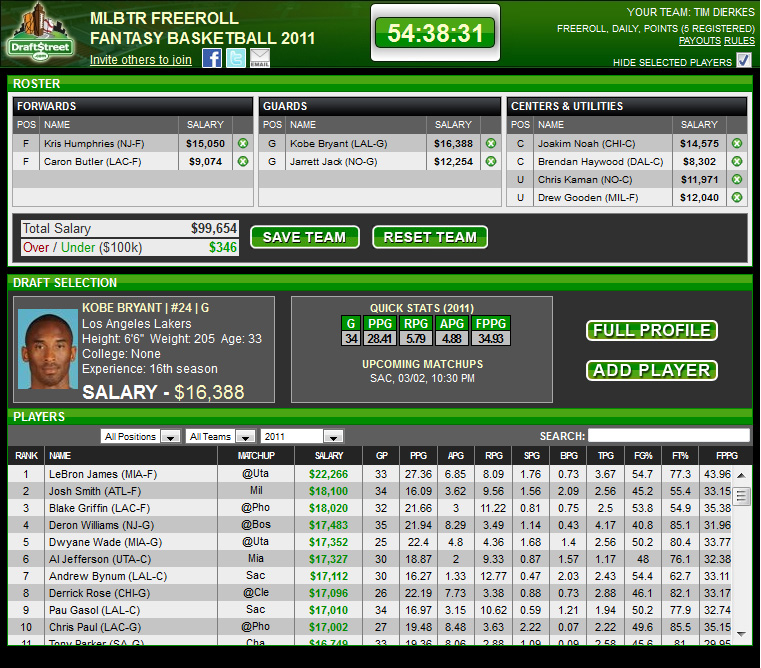
If you're interested, sign up and create a roster prior to Friday's games (7:00pm eastern time). It's quick, easy, fun, and the MLBTR league gives you a free chance to win some of the $400 prize pool. If you enjoy the competition you can try other leagues for free and earn credits, or deposit real money.
Cardinals Extend Yadier Molina
The Cardinals announced a five-year, $75MM contract extension with catcher Yadier Molina this afternoon. The deal includes a no-trade clause and a mutual option for 2018 that's worth an additional $15MM. Molina is represented by Melvin Roman of MDR Sports Management.
Molina, 29, is considered by many to be the game's best defensive catcher. His offense took a leap forward in 2011, as he posted a .305/.349/.465 line in 518 plate appearances. Molina has been durable, averaging 145 games over the last three years including the postseason. The $15MM salary and five-year term probably represents market value for Molina, but it may have been more difficult for GM John Mozeliak to hammer out a deal after the season.
Molina's contract is the third-largest in baseball history for a backstop, behind Joe Mauer's $184MM and Mike Piazza's $91MM. On the Cardinals, Molina is second only to Matt Holliday in average annual value. This is Molina's second multiyear deal with the Cardinals, as they locked him up affordably four years ago.
The 2012-13 free agent class for catchers remains deep with Molina off the board, with Miguel Montero, Mike Napoli, Russell Martin, and Chris Iannetta.
Jon Heyman of CBS Sports first tweeted the news and added existence of the vesting option later on. Ken Rosenthal of FOX Sports reported the value of the contract. Joe Strauss of the St. Louis Post-Dispatch first said the deal was all but done and Derrick Goold of the Post-Dispatch first reported the mutual option.
Rangers Sign Jairo Beras
3:38pm: MLB and competing executives believe Beras is 16, Passan writes. Beras has been presenting himself as a 16-year-old, Ben Badler of Baseball America reports. If he's using a new date of birth, he could be in trouble beyond MLB, according to Badler.
12:56pm: MLB was under the impression Beras is 16 and therefore ineligible to be signed, tweets Passan, and will immediately investigate the signing.
10:57am: Teams will be furious if MLB approves the Rangers' reported contract with Beras, tweets Badler. Still, a source who has spoken with the Rangers told Yahoo's Jeff Passan the team thinks MLB will approve the signing, because other clubs knew of Beras' revised age.
9:09am: The Rangers signed 17-year-old Dominican outfielder Jairo Beras for $4.5MM, tweets Dionisio Soldevila. For more on Beras, check out this article from Yahoo's Tim Brown and this brief Twitter scouting report from ESPN's Keith Law.
Law notes that a lot of team executives are unhappy with the signing, because they were under the impression Beras was not eligible until July 2nd. With a listed birth date of December 25th, 1995, Beras wasn't thought to be 17 yet, adds Baseball America's Ben Badler.
The Rangers are known for spending big internationally, an opportunity that will end with a $2.9MM cap for each team this summer. GM Jon Daniels indicated yesterday he isn't a fan of that part of the new collective bargaining agreement.