
NL Central Links: Votto, Reds, Nova, Schoop, Brewers
By Joey Votto‘s lofty standards, batting .284/.417/.419 counts as a down year, and the Reds first baseman tells MLB.com’s Mark Sheldon that he is aiming for a return to form in 2019. Votto plans to refocus on his hitting during his offseason preparations, while also putting a greater emphasis on conditioning. “It’s not like I dogged it or anything, but there are levels to it,” Votto said. “If I was 99 percent ready, to be at your very best you need to be at 99.9 percent. I would never have once come into Spring Training and a Major League season without feeling like I’m ready. There are really extremes. I do feel like that’s something I fell short on.” While Votto still led the league in his OBP, his power dropoff was pronounced, as he posted the lowest full-season slugging percentage, isolated power, and home run numbers of his career. Votto has been a remarkably productive and consistent player over his career, though since he did just turn 35 in September, so some manner of decline wouldn’t be a surprise going forward, assuming Votto doesn’t get things figured out this winter.
More from around the NL Central…
- The Reds have some extra payroll to spend and they’ve been linked to several available pitchers this winter, though president of baseball operations Dick Williams threw a bit of cold water on the many rumors swirling around this team thus far in the offseason. Speaking to John Fay of the Cincinnati Enquirer and other reporters at the Redsfest fan event, Williams said that “the reports as a whole I’ve been surprised by how inaccurate they’ve been. They’ve taken us by surprise because they were so off base. I’m not going to comment on which ones they were. I’ll just caution that in general that those statements on a guy we’re in on or not in on….I just don’t know where that comes from.” Free agents and trade targets ranging from Dallas Keuchel, J.A. Happ, Patrick Corbin, Sonny Gray, and (before he was dealt to the Yankees) James Paxton have all reportedly drawn some interest from Cincinnati.
- Pirates right-hander Ivan Nova has changed agents and is now being represented by the Wasserman agency, The Athletic’s Robert Murray tweets. Nova is entering the last season of a three-year, $26MM free agent deal he signed in the 2016-17 offseason, and the righty has been solid over the first two-thirds of that contract, posting a 4.16 ERA, 6.3 K/9, and 3.45 K/BB rate over 348 innings for the Bucs. Similar numbers in 2019 would put Nova in line for another multi-year deal, though he will be 33 years old by Opening Day 2020.
- The Brewers‘ ill-fated midseason acquisition of Jonathan Schoop was summed up by GM David Stearns “as a bad deal and that’s on me,” as Stearns said during a phone call with reporters (including Tom Haudricourt of the Milwaukee Journal Sentinel) on Friday. Stearns surrendered some notable talent to the Orioles in order to land Schoop, who hit just .202/.246/.331 with four home runs over 134 PA as a Brewer, plus an 0-for-8 showing in the postseason. Between this poor performance and Schoop’s projected $10.1MM salary in 2019 through the arbitration process, the Brewers chose to non-tender the second baseman on Friday. Milwaukee did reach agreements with infielders Tyler Saladino and Hernan Perez, each of whom Stearns mentions as possible options for second base, though the team will no doubt explore external options via trades and free agency in the coming weeks. Travis Shaw played some second base down the stretch once the Brewers acquired Mike Moustakas, and while Stearns noted that Shaw’s versatility “is a nice asset to have” in regards to the team’s offseason options, reinstalling Shaw as the everyday third baseman is the team’s “default scenario.”
Pitching Market Notes: Eovaldi, Yankees, Happ, Kikuchi, Gray, MadBum
After a busy day of arbitration decisions, it’s worth taking stock of some recent developments in the broader market. We’ve already touched upon some major storylines today, with looks at Patrick Corbin (link), Zack Greinke (link), and Carlos Carrasco (link). Here’s more …
- Though Corbin seems to be captivating the market at present, chatter on Nathan Eovaldi is also “heating up,” per MLB.com’s Mark Feinsand (Twitter link). Unsurprisingly, the Red Sox and Astros are presently seen as prime contenders to land him. With the American League shaping up to be another clash of titans, those organizations are positioned t stake some dough on Eovaldi’s upside.
- The Yankees are a major player on Corbin, of course, but also some other arms — and not just as a backup plan. Indeed, per Jayson Stark of The Athletic (via Twitter), the club could even add another significant starter if it does get Corbin. That’d be quite a surprise, given that the team would appear to have a clear starting five if Corbin signs, but perhaps there’s a way to pull something off that would still make sense and leave the club with immense rotation depth.
- Meanwhile, southpaw J.A. Happ is said to have “ten teams chasing” him at this point, per Jon Heyman of Fancred. One of those is the Brewers, who’d presumably like to bolster their rotation but also don’t appear to have an immense amount of money to use. Of course, giving up on Jonathan Schoop clears a big piece of payroll, so long as the club finds a way to address its infield needs without using all the savings.
- There’s also a “strong” market for Japanese hurler Yusei Kikuchi, Heyman tweets. Unsurprisingly, west coast clubs — the Dodgers, Padres, Giants, and Mariners, at least — appear to be lining up for the 27-year-old. It’s still hard to know what kind of salary and duration he’ll be able to command. But as this particular list of clubs shows, Kikuchi’s unusual youth will play a major role in his market by opening the door to quite a few organizations to pursue him.
- Elsewhere, the Yankees are still trying to offload an asset in Sonny Gray. Per Ken Davidoff of the New York Post, with GM Brian Cashman saying he has discussed a multitude of different scenarios involving Gray, including some larger deals. That suggests that the Yanks are comfortable hanging onto Gray for a while as they sort through the possibilities, rather than putting him on the market and taking the best deal then available.
- Gray is as good as gone from the team’s perspective, but that’s clearly not the same situation for Giants ace Madison Bumgarner. The burly southpaw is reportedly on the table. But that doesn’t mean he’ll be priced at a level that will lead to a deal. Indeed one organizational source tells Heyman (Twitter link) they “don’t see [Bumgarner] going anywhere this winter.” Certainly, the Giants have little need to dump Bumgarner if they aren’t getting something worthwhile in return. Teams with interest, though, will remain wary of a big price for one season of a player with recent shoulder woes and some performance questions.
Players Avoiding Arbitration Prior To Non-Tender Deadline
Tonight marks the deadline for MLB clubs to tender contracts to arbitration-eligible players. As such, there’ll be a slew of pre-tender agreements announced today — particularly for arbitration-eligible players who might have otherwise been non-tender candidates. As we saw yesterday (and frequently in previous seasons), players agreeing to terms before the tender deadline will often sign for less than they’re projected, as the alternative in some cases may simply be to be cut loose into a crowded free-agent market.
We’ll track today’s pre-tender agreements here, with all referenced projections coming courtesy of MLBTR contributor Matt Swartz…
- Giants infielder Joe Panik settled at a $3.8MM price tag, per Heyman (via Twitter). That’ll represent a savings as against the $4.2MM projected salary. Many had wondered whether the new San Francisco front office would move on from Panik, who has one more year of arb eligibility remaining. Meanwhile, Heyman tweets that reliever Sam Dyson has agreed to a $5MM pact. That also comes in $400K below his projection.
- The Padres settled with righty Bryan Mitchell for $900K, Heyman tweets. Mitchell had been a non-tender candidate at a projected $1.2MM sum.
- Newly acquired first baseman C.J. Cron has agreed to a $4.8MM contract, the Twins announced. He projected to a $5.2MM salary; this becomes the latest of many indications of the unstable market position of defensively limited slugger types.
- The Indians have settled with righty Danny Salazar for $4.5MM, Jon Heyman of Fancred tweets. He was projected at $5MM, with some wondering whether the Cleveland organization might non-tender him. The talented hurler missed the entire 2018 season. Meanwhile, righty Nick Goody is slated to earn $675K, Heyman tweets.
- Southpaw Jonny Venters avoided arb with the Braves, David O’Brien of The Athletic tweets. It’s a $2.25MM deal, sitting well over the $1.5MM projection, though certainly his unusual career path could have led to some additional arguments for a stronger raise.
- The Cardinals announced an agreement with lefty Chasen Shreve. Terms aren’t yet known. The 28-year-old had projected to take home $1.2MM for the 2019 campaign, but will settle at $900K per Heyman (via Twitter).
- Pirates righty Michael Feliz has avoided arbitration with the club, Rob Biertempfel of The Athletic was among those to report on Twitter. Feliz projected at a $900K salary and will get $850K, Jeff Passan of Yahoo Sports tweets. It’s a split agreement that promises $375K in the minors, per Bill Brink of the Pittsburgh Post-Gazette (via Twitter).
- Infielder Tyler Saladino has agreed to a $887,500 salary with the Brewers, Jon Heyman of Fancred tweets. That comes in below the $1MM he projected to earn.
- The Athletics settled at $2.15MM with Liam Hendriks, per Jeff Passan of Yahoo Sports (via Twitter), all of which is guaranteed. That’s just where he projected ($2.1MM) on the heels of a fascinating 2018 season. Hendriks was dropped from the MLB roster in the middle of the season but returned late in the year in dominant fashion as the A’s “opener.”
- Lefty Sammy Solis agreed to terms with the Nationals to avoid arbitration, the club announced. He profiled as a potential non-tender candidate, so it seems likely the organization pushed to get something done before the deadline. Solis, who has an intriguing power arsenal but struggled through a homer-prone 2018, projected at $900K. He’ll earn $850K, per Chelsea Janes of the Washington Post (Twitter link).
- The Athletics announced that they’ve agreed to a one-year deal with righty Ryan Dull in advance of tonight’s deadline. He’ll get $860K, Fancred’s Jon Heyman tweets, which checks in pretty closely with his $900K projection. Dull, 29, posted a 4.26 ERA with 21 strikeouts and seven walks in 25 1/3 innings of relief in 2018.
- Heyman also tweets that the Padres and Greg Garcia, whom they claimed off waivers earlier this offseason, settled on a one-year deal worth $910K that aligns with his $900K projection. Garcia hit .221/.309/.304 in 208 plate appearances with St. Louis last season and is a career .248/.356/.339 hitter in 860 plate appearances.
Earlier Agreements
- The Brewers and Hernan Perez avoided arbitration by agreeing to a one-year deal worth $2.5MM, as first reported by Heyman. He’ll check in a bit shy of his $2.7MM projection but remain on hand as a versatile utility option in Milwaukee.
- Left-hander Tony Cingrani and the Dodgers avoided arb with a one-year deal worth $2.65MM. That checks in just south of the lefty’s $2.7MM projection. Cingrani turned in a brilliant 36-to-6 K/BB ratio in 22 1/3 innings but was also tagged for a considerably less palatable 4.76 earned run average.
- The Red Sox announced that they’ve agreed to terms on a one-year contract for the 2019 season with right-hander Tyler Thornburg. They’ve also tendered contracts to the remainder of their arbitration-eligible players, though the terms of those deals will be negotiated in the coming weeks. Evan Drellich of NBC Sports Boston tweets that Thornburg will earn $1.75MM i 2019 and can earn another $400K via incentives. I’m told that includes $100K for reaching each of 45, 50, 55 and 60 appearances. Thornburg, 30, was roughed up to the tune of a 5.63 ERA in 24 innings for the Sox this season — his first action for Boston since being acquired prior to the 2017 season. His Boston tenure has been utterly derailed by thoracic outlet syndrome and the ensuing surgery. Thornburg was excellent for the 2016 Brewers, and Boston parted with Travis Shaw in order to acquire him, so the Sox will surely hope that a regular offseason of rest and further removing himself from TOS surgery will get the righty back on track. This will be Thornburg’s final season of club control. He’d been projected to earn $2.3MM.
Brewers Non-Tender Jonathan Schoop, Xavier Cedeno, Dan Jennings
The Brewers announced this evening that they have non-tendered three players. Infielder Jonathan Schoop is the most notable name who’ll be sent onto the open market; he’ll be joined by veteran lefties Xavier Cedeno and Dan Jennings.
[RELATED: Projecting Payrolls: Milwaukee Brewers]
Schoop was picked up last summer with intentions of installing him as a key figure in the infield for the 2019 season as well. As GM David Stearns acknowledged today, though, that deal simply did not work out.
Ultimately, the Brewers felt they could put the projected $10.1MM Schoop would have earned through arbitration to better use through other investments. There are indeed loads of possibilities on the second base market. Schoop, meanwhile, will join a crowded group — but will stand out from may owing to his power ceiling and young age.
Otherwise, Stearns and co. were obviously uninterested in continuing to commit roster space to a pair of lefty specialists who did not project for much of a payroll hit ($1.6MM for Jennings; $1.5MM for Cedeno). It seems likely the Brewers will end up looking at other southpaws on the market this winter, as ace reliever Josh Hader is the lone lefty remaining in the pen.
Brewers Avoid Arbitration With Hernan Perez
The Brewers have settled on a 2019 salary with infielder Hernan Perez, per Jon Heyman of Fancred (via Twitter). He’ll earn $2.5MM, just a bit under the $2.7MM that MLBTR and contributor Matt Swartz had projected.
More to come …
Latest On Noah Syndergaard
While other major rumors swirl, the Mets appear to have a line open with other organizations regarding power righty Noah Syndergaard. Chatter on Thor has been percolating for some time now, but there’s increasing indication that the Mets actually prefer to move the franchise cornerstone.
Indeed, the New York org is “motivated” to move on from Syndergaard, according to Kiley McDaniel of Fangraphs (Twitter link), with the organization said to be reaching out to rivals to gauge interest. As others have suggested, the Mets would then anticipate turning around and bringing in another starter via free agency.
It remains somewhat unclear precisely why the Mets have determined that trading Syndergaard is the right course, but new GM Brodie Van Wagenen is clearly out to re-shape the roster. That the big righty is a former Van Wagenen client only adds to the intrigue. In any event, there’ll be no shortage of suitors. When healthy, Syndergaard is a monster on the mound and a rather marketable asset to boot.
The rival club most frequently tied to Syndergaard of late is the Padres. As Jon Heyman of Fancred tweets, though, the San Diego outfit is not only unwilling to part with top prospect Fernando Tatis Jr., but won’t part with MacKenzie Gore or Luis Urias, either. It seems that the Friars are more amenable to discussing other prospects, though it’s arguable there are a few others who are or ought to be just as untouchable as that trio.
Otherwise, the Brewers are now a team to watch on Syndergaard, according to Andy Martino of SNY.tv. Their level of interest isn’t clear, but it’s obviously not hard to imagine the Milwaukee org liking the idea of placing Thor atop their rotation. The Reds and Yankees, however, are not involved in the pursuit.
As for the Mets’ apparent plan to add another arm if they move Syndergaard, it’s anyone’s guess how that’ll play out. Certainly, with other moves afoot that’d add salary, this approach would indicate a real willingness to boost the payroll. Just how far, though, remains to be seen. The top-available pitchers would require significant contracts. Other, lesser hurlers are obviously under consideration — Mike Puma of the New York Post cites Gio Gonzalez on Twitter — but assuredly will not bring Syndergaard’s upside and will still out-earn him in 2019 (he’s projected at just $5.9MM).
“Strong Possibility” Brewers Non-Tender Jonathan Schoop
With the non-tender deadline looming tomorrow, there’s a “strong possibility” the Brewers will non-tender infielder Jonathan Schoop, according to Ken Rosenthal of The Athletic (via Twitter). A trade route is also possible, per the report; the takeaway, regardless, is that the Milwaukee organization seems to be preparing to move on.
That’d be a tough pill to swallow, given that the Brewers acquired Schoop just last summer in anticipation of a turnaround. That did not come to pass late in 2018, and evidently the organization isn’t all that optimistic that the bounce back will occur in the season to come. Or, at least, it’s not willing to pay what it’ll take to find out.
[RELATED: Projecting Payrolls: Milwaukee Brewers]
In his final season of arbitration eligibility, MLBTR and contributor Matt Swartz project, Schoop will take down something on the order of $10.1MM. That’s an easy payday to commit to for the 2017 version of Schoop. He slashed a robust .293/.338/.503 with 32 long balls and turned in solid defensive work, making him a comfortably above-average regular.
Last year, though, the bottom dropped out. While he continued his solid glovework, and even showed that he can handle shortstop, Schoop’s bat fell apart. He still had good power, but ended the season with only a .233/.266/.416 slash.
The difference on the stat sheet primarily comes down to quality of contact. Schoop’s batting average on balls in play plummeted from .330 in 2017 to .261 last year. Since he rarely walk, that devastated his on-base percentage. And it’s hard to chalk it up to bad luck, as Statcast actually suggests he enjoyed good fortune (.290 wOBA vs. .266 xwOBA).
If the Brewers do indeed pull the plug, it’ll reflect not only their feelings about Schoop, but also of the remainder of the market. The organization may anticipate better opportunities to improve its infield mix; after all, at second base especially, there are numerous open-market and trade options. With other needs to address as well, and perhaps not a lot of available money to work with, there certainly could be an opportunity for the Brewers to add a solid second base asset at a lower price — or even to pursue other, more creative roster tweaks.
Projecting Payrolls: Milwaukee Brewers
As we kick off the ninth installment of this series, here are links to the previous team payroll projections:
Philadelphia Phillies
Los Angeles Dodgers
Los Angeles Angels
Atlanta Braves
New York Yankees
Chicago White Sox
Boston Red Sox
Minnesota Twins
If you have questions about financial information made available to the public and the assumptions used in this series, please refer to the Phillies piece linked above.
Today, we examine a club whose rebuild exploded in 2018, propelling them to a surprising division championship and baseball’s final four: the Milwaukee Brewers.
Team Leadership
As many longtime baseball fans know, the predecessor to current Commissioner Rob Manfred, Bud Selig, spent 28 years as owner of the Brewers franchise prior to ascending to the commissioner gig. Formed in 1969, the franchise spent one disastrous season in the Pacific Northwest as the Seattle Pilots before Selig purchased the team out of bankruptcy and moved them to Milwaukee. Selig’s daughter, Wendy, became the team owner in 1998 when Selig became the full-time commissioner. In September 2004, Wendy sold the team to businessman Mark Attanasio, the club’s current owner. After making just two playoff appearances in the 36 years from 1969-04, the team has made three postseason trips during Attanasio’s ownership, including two trips to the National League Championship Series in 2011 and 2018.
The team’s front office is headed by general manager David Stearns, who took the job in September 2015 at age 30. The franchise has enjoyed tremendous growth under Stearns, winning 68 games before he arrived in 2015, then 73, 86, and finally 96 in the three seasons that followed. Last winter’s acquisitions of Lorenzo Cain, Jhoulys Chacin, and Most Valuable Player Christian Yelich paved the way for greatness in Milwaukee.
Historical Payrolls
Before hitting the numbers, please recall that we use data from Cot’s Baseball Contracts, we’ll use average annual value (“AAV”) on historical deals but actual cash for 2019 and beyond, and deferrals will be reflected where appropriate. And, of course, the value of examining historical payrolls is twofold: they show us either what type of payroll a team’s market can support or how significantly a given ownership group is willing to spend. In the most useful cases, they show us both. We’ll focus on a 15-year span for the Brewers, covering 2005-18 for historical data as a means to understanding year 15: 2019. For the Brewers, this time frame perfectly covers Attansio’s ownership tenure. We’ll also use Opening Day payrolls as those better approximate expected spending by ownership.
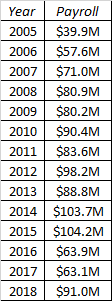
Attanasio inherited some bottom-of-the-barrel payrolls, but quickly increased spending in a big way upon taking over the club. Spending has continued on a relatively clean trajectory without any significant increases.
2016-17 stick out for the opposite reason as spending cratered while Stearns rebuilt the franchise. When the club showed significant (and somewhat unexpected) progress in 2017, Attanasio OK’d a return to something close to pre-rebuild spending levels.
The above chart conveys team spending pretty well as the Brewers haven’t endeavored on significant international acquisitions, either via international amateur bonuses or posting fees for negotiating rights with foreign professionals, and the club has never come close to luxury tax territory.
Future Liabilities
For a small market team, the Brewers have committed a good fit of payroll space moving forward.
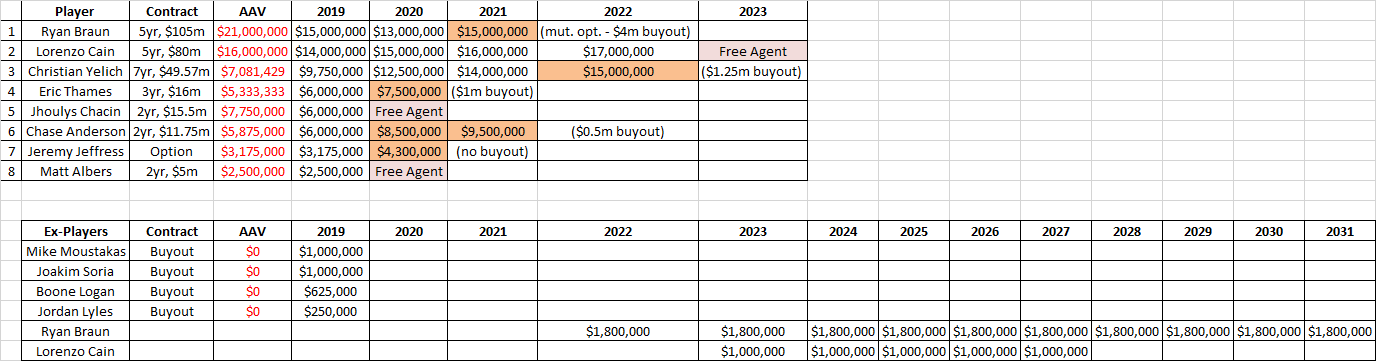
Braun has long been the face of the franchise, though surely he ceded a good bit of that status to the stars that follow him on the team’s payroll chart, Cain and Yelich. Braun will receive $1.8 million per year from 2022-31 in deferred salary, but that amount won’t handcuff the team now or in the future.
The Yelich deal provides some of the greatest value of any contract in all of Major League Baseball. That should help keep the Brewers competitive given the immensity of their savings over Yelich’s market value.
The remaining commitments are all quite safe as the team has only $1.5 million guaranteed beyond 2019 for Thames, Chacin, Anderson, Jeffress, and Albers combined. Thames, Anderson, and Jeffress are all controllable further via bargain-rate club options.
While the guarantees feature much of the Brewers core, the team’s arbitration-eligible players include numerous contributors, a couple of them essential to the team’s renaissance. Here are their arbitration projections (salary projections by MLBTR and Matt Swartz):
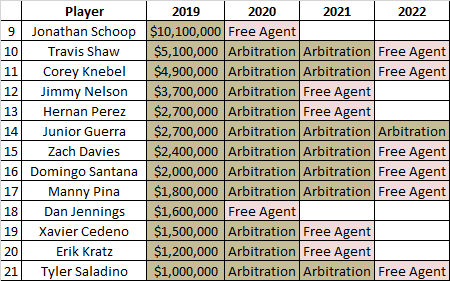
The Brewers feature numerous non-tender candidates. The biggest decision involves Schoop, a 27-year-old second baseman who starred for the Orioles in 2017 with average on-base skills and 32 long balls on the heels of a 25-homer season in 2016. Schoop’s offense cratered in 2018 as his BABIP dropped to .261 after he posted a composite BABIP of .319 from 2015-17. Schoop presumably had a chance to play his way into a big payday with the Brew Crew, but a putrid .202/.246/.331 batting line after his acquisition likely sealed his fate as a non-tender, especially given the presence of near-Major League-ready stud prospect Keston Hiura and fully-Major League-ready prospect Mauricio Dubon, despite his knee injury. The decisions on Kratz, Perez, Jennings, and Saladino are comparatively much less impactful to the budget, even for a team with a smaller spending capability such as Milwaukee. Kratz in particular was one of the great stories of the 2018 postseason. As it turns out, despite the presence of solid prospect Jacob Nottingham ready for a meaningful role and Pina around (discussed below), the team agreed to a $1.2 million deal to avoid arbitration, less than the $1.7 million for which Kratz was projected but a salary figure at which he has a much better chance to stick around.
On the other hand, many of the other names in the arbitration table are of the impact variety. Shaw has proven to be the team’s third-best regular, solidifying the third base spot. Knebel forms an elite bullpen triumvirate with Jeffress and fireballing lefty Josh Hader. Guerra provided 141 roughly average innings in 2018. Santana regressed markedly in 2018, but there’s still significant power in his bat and, if nothing else, he provides a strong bench bat at a cheap rate. Pina is a strong defensive catcher with a bit of power on a bargain deal.
Nelson merits separate mention. He missed all of 2018 with a shoulder injury, but that came on the heels of him making an ace turn in 2017. If Nelson returns at something close to his pre-injury form, the Brewers will enjoy a marquee addition for just $3.7 million. The rich keep getting richer.
Davies merits his own paragraph for largely the same reason. He compiled 5.3 WAR across 2016-17 before being felled by a shoulder injury that cost him most of 2018 and sapped his effectiveness when he did pitch. Nevertheless, Davies is yet another cheap rotation option.
Milwaukee is brimming with cheap, controllable talent that should help them compete into the next decade.
What Does Team Leadership Have to Say?
Following the season, Stearns hinted that spending won’t increase in 2019 to nearly the extent that it did prior to 2018. That doesn’t qualify as much of a surprise given the bare-bones payroll employed in 2017 and the competitive number utilized in 2018. Stearns called a repeat offseason “unrealistic” at the beginning of November.
It doesn’t seem as if management is expecting a huge influx of cash, at least not publicly.
Are the Brewers a Player for Bryce Harper or Manny Machado?
No.
Not in the Milwaukee market. Not with bottom-five payrolls every year. Not with so many big-market clubs competing to sign Harper and Machado.
Milwaukee isn’t going to be in these conversations.
What Will the 2019 Payroll Be?
This is a really important consideration for the Brewers. With so many significant players entering arbitration, they need to find a bit more cash to keep this core together for the coming years or Stearns will need to be especially creative in moving the right arbitration-eligible starting-caliber players for cheaper reinforcements.
Even assuming that the Brewers take the most aggressive non-tender approach that is plausible, cutting ties with Schoop, Perez, Jennings, and Saladino, the team would enter the offseason with $95.1 million committed to the roster, $4.1 million more than last year’s Opening Day payroll. Making any additions will require Stearns to expend some currency.
According to MLB.com, the team’s top seven prospects and 10 of the top 11 are position players. If the club makes a big expenditure, expect to see them focus on pitching.
Given where Milwaukee is on the win curve and how seriously they curbed spending while rebuilding, it’s reasonable to expect Attanasio to authorize a new franchise-high Opening Day payroll. But by how much? I’ll guess that payroll increases enough for everyone to notice but not so much that it stuns the baseball world.
With the projected payroll space below and an entirely right-handed rotation, don’t be surprised if Milwaukee makes a play for a free agent starter like J.A. Happ. If payroll is a bit tighter than expected, perhaps Wade Miley or a reunion with Gio Gonzalez make more sense.
Projected 2019 Payroll: $110 million
Projected 2019 Payroll Space: $14.9 million
Brewers Avoid Arbitration With Erik Kratz
The Brewers announced today that they have avoided arbitration with catcher Erik Kratz. The deal promises him $300K and provides a $1.2MM salary in the majors, per Jon Heyman of Fancred (via Twitter).
Kratz had been projected by MLBTR and contributor Matt Swartz to earn $1.7MM through the arbitration process. The team understandably wasn’t interested in paying quite that amount, so instead worked out an agreement that will provide Kratz more certainty than the standard arb contract (which promises only thirty days of salary as a starting point) but will limit what he can earn if he sticks on the MLB roster.
The 38-year-old Kratz did not even touch the majors until he was already in his age-30 season. He has now appeared in nine-consecutive MLB campaigns, though he also hasn’t generally commanded much of an opportunity to play.
It came somewhat out of the blue, then, when the Brewers acquired Kratz in the middle of the 2018 campaign and installed him as a not-infrequently-used backup. He ended up striding to the plate 219 times, one more than his previous season high (2013, with the Phillies).
Certainly, the results on offense weren’t much different than might have been expected. Kratz produced a meager .236/.280/.355 slash, which maps to a 70 wRC+ — only marginally better than his career 65 wRC+.
Of course, there’s quite a bit more than hitting to the job of a reserve catcher. Kratz excelled at framing pitches and smothering balls in the dirt, while also drawing plaudits from the Milwaukee organization for his game calling, work ethic, and clubhouse presence.
Clearly, the club valued what he brought to the table. After seeing MLB action with seven teams, then, it seems Kratz has found something of a home. Whether he’ll open the season on the active roster, and if so whether he’ll last, remains to be seen. But it’s still a continuation of a great story for a respected veteran grinder.
Giants “Willing To Engage” In Talks On Madison Bumgarner
The Giants are “willing to engage” with rival organizations on trade scenarios involving star lefty Madison Bumgarner, according to a report from Jon Morosi of MLB.com. It’s not yet clear just how likely it is that the San Francisco organization will actually move one of its best-loved and most-accomplished players.
Bumgarner is a living baseball legend, owing less to his years of excellent regular-season service than to his incredible postseason feats. The version of the burly southpaw that owned the 2014 World Series will live on no matter the course of the remainder of his career. But after the two seasons he just endured, with a shoulder injury seeming to sap his strength, it’s at best questionable whether the Giants’ staff ace can still deliver a vintage performance.
While front office opinions on the matter no doubt vary, numerous teams figure at least to check in on the lefty. Three, at a minimum, have done so already, according to Morosi. The Brewers and Phillies “have had at least preliminary dialogue,” he writes, while the Braves “checked in” but do not appear to be engaged at the moment.
It’s said that newly installed Giants president of baseball operations Farhan Zaidi is angling for young pitching in a deal, but it’s fair to wonder whether he’ll be able to get any top-flight arms. After all, the upside here is limited by the fact that Bumgarner is one season away from free agency. His $12MM contract is plenty reasonable despite the questions, and the possibility of a qualifying offer (or even an extension) hold out hope for some future value. But the unanswered questions create significant downside, even on a single-season commitment.
At base, acquiring Bumgarner would mean buying a pitcher who has been a solid, not terribly durable performer over the past two seasons. He certainly did what he could to make it back from a shocking early-2017 dirt bike accident, and has somehow maintained a 3.29 ERA since the start of that ill-fated campaign, but it’s hard to look past the warning signs.
Before the injury, the now-29-year-old hurler had been good for about a strikeout per inning with two or fewer walks per nine innings, and a total of 200+ frames per season. He had run up four-straight sub-4.00 ERA campaigns, with peripherals that largely matched, all before his near-unimaginable playoff heroics. At his best, Bumgarner drew swings and misses at more than an 11 percent clip while allowing hard contact on less than a third of the balls put in play against him.
Operating at less than full capacity last year, Bumgarner’s swinging-strike rate fell to 9.2% and his K%-BB% dropped to 12.0%. (He had once sat at over a 10 percent K%-BB% for three-straight seasons.) And his hard-hit rate ballooned to 41.6% (per Fangraphs) — a massive rise for a pitcher who has averaged below 30 percent for his career.
The physical changes certainly appear to have had a role. While he was never a flamethrower, Bumgarner averaged as much as 93 mph with his fastball. It has now been three seasons since his heater average heater topped 92 mph. As the effectiveness of that table-setting offering declined, he increasingly went away from the four-seamer in 2018, throwing it just 34.2% of the time — well shy of his 45.6% career average. While the remainder of his arsenal was still effective, the heater had been the bread to his cutter’s butter.
Whether Bumgarner can regain some of the lost velocity, or find a way to make up for it, remains to be seen. There’s still reason to believe he’ll be at least a useful starting pitcher regardless, if for no other reasons than because of his undeniable competitive fire and remaining youth. While he gutted out the results last year, his 3.99 FIP, 4.32 xFIP, and 4.42 SIERA tell a different story — though it’s not a tale of an irredeemably lost pitcher. Even if he can’t regain much of his former luster, Bumgarner will bring the promise of some solid innings, at least so long as he’s able to remain healthy.
Of course, the allure of the Bumgarner of yore will no doubt play some role in negotiations. Clubs such as those rumored to have interest aren’t looking only for a useful, back-of-the-rotation piece. They all have designs on the postseason, and no doubt at least entertain dreams of Bumgarner not only helping to get there, but also rising to the occasion when the moment calls for it.
Perhaps, too, some teams’ scouts and analysts have sussed out some reasons to believe in a turnaround. It’s fair to guess that Zaidi is about as well-versed on the subject as anyone. His former club, the Dodgers, no doubt analyzed Bumgarner closely as a division rival. And he’s now privy to all that the Giants know about their own leading pitcher. Whether Bumgarner is dealt, and what he draws in return, will also tell us quite a bit about the San Francisco organization’s views — on the southpaw as well as the rest of the roster. After all, the club has the financial means to hold on to Bumgarner, whether to maintain fan interest and boost his value for the summer trade deadline or to pursue another extension.
The broader market is certainly a factor as well. Zaidi can only market one season of Bumgarner, but in some regards that’s a positive. There are plenty of intriguing lefty starters available in free agency — most notably, Patrick Corbin, Dallas Keuchel, J.A. Happ, and Yusei Kikuchi — but all figure to command significant guarantees over multiple seasons. Giving up some young talent, rather than taking on potentially damaging long-term contract commitments, will surely hold appeal. Of course, it’s also true that the presence of so many alternatives — remember that James Paxton (via trade) and CC Sabathia went off the board already, and there are other talented starters available in trade free agency — will tend to reduce demand.
All said, it’s far from clear that there’ll be sufficient interest to force Zaidi’s hand. But the mere fact that there’s a possibility of a pre-season swap is itself notable, especially given Bumgarner’s special status in franchise lore. It’ll certainly be interesting to see how this situation plays out.