
NL East Notes: Fernandez, Toscano, Braves, Mets
Marlins ace Jose Fernandez and manager Mike Redmond spoke with Anthony Castrovince for a Sports On Earth piece about the 23-year-old Fernandez’s recovery from Tommy John surgery. Fernandez says that he’s become close with NL East rival and fellow Tommy John victim Matt Harvey, who made his season debut for the Mets today (and dominated the Nationals). The two aces have discussed the rehab process, with Fernandez checking in to compare their rehab cycles. Fernandez has replaced a borderline ridiculous offseason cycling program — he used to cycle up to 600 miles per week, Castrovince notes — in favor of bulking up to add muscle and hopefully avoid further injuries to his arm. Redmond is pleased with the amount of time Fernandez is spending on the bench and with his teammates, always looking to learn, improve and ready his mind for the day he returns to the mound.
Elsewhere in the NL East…
- Cuban outfielder Dian Toscano, who signed a four-year, $7.5MM deal with the Braves this winter, has arrived in the U.S. and is working with Major League Baseball to establish residency, reports MLB.com’s Mark Bowman. While there’s no timeline on how long that will take, Bowman notes that it’s one of the final hurdles Toscano needs to clear before beginning his Braves career. Bowman adds that Toscano could emerge as a backup outfield option in Atlanta as soon as this season.
- Ken Rosenthal of FOX Sports feels that the belief that the Braves‘ farm system had become unproductive under the previous front office was misguided. Rosenthal looks at the number of players that had graduated to the Majors, pointing to them as evidence that the system continued to churn out quality talent. Aside from the team’s major trades of Evan Gattis, Jason Heyward, Justin Upton and Craig Kimbrel, Rosenthal finds other player personnel decisions questionable, highlighting the risk involved in acquiring Manny Banuelos and the decision to leave former top prospect J.R. Graham unprotected in this year’s Rule 5 Draft.
- Mets GM Sandy Alderson tells Andy Martino of the New York Daily News that he doesn’t instruct manager Terry Collins on how to construct his lineup, despite recent media speculation that the opposite is true. Alderson said that much like Collins offers input on roster moves but the front office has final say, he will offer input on lineup decisions, but Collins has final say.
Rangers Claim Alex Hassan From Athletics
The Rangers have claimed outfielder Alex Hassan off waivers from the division-rival Athletics, Texas EVP of communications John Blake tweets. To make room on the 40-man roster, left-hander Matt Harrison has been transferred to the 60-day disabled list.
The 27-year-old Hassan has grown accustomed to changing uniforms over the past year, to say the least. Originally with the Red Sox, he was designated for assignment in November and claimed by the A’s, only to be designated and claimed by the Orioles just days later. Hassan believed he was Baltimore-bound until late February, when the Orioles designated him to make room for Everth Cabrera, and the A’s re-claimed him on waivers. Hassan again found himself on waivers after losing his 40-man spot to the recently signed Cody Ross, and he’ll hope to stick with a Rangers organization that is thin on quality outfield options at the moment.
That Hassan is so often claimed isn’t necessarily a surprise when considering the production he’s provided at the upper levels of the Minor Leagues. The former 20th-round pick is a career .282/.387/.411 hitter in 1082 Triple-A plate appearances, and he’s never posted an OBP lower than .377 in a full Minor League season. Hassan has played both corner outfield spots and first base a fair amount, giving him some versatility to go along with that high-OBP approach and his history of strong batting averages. All told, Hassan has walked in nearly 14 percent of his Minor League plate appearances while striking out at a relatively low rate of 17.9 percent in the Minors.
Future Payroll Obligations: Opening Day Update
As I explored back at the start of the offseason, future salary obligations play a huge role in guiding teams as they invest in new acquisitions and in extensions. While expected pay-outs through arbitration must obviously be weighed as well, they are entirely within the control of the team. Guaranteed cash, however, is on the books to stay — unless it can be offloaded.
I thought it would be interesting to take a look at where things stand now, with both the free agent, pre-season trade, and extension seasons pretty much wrapped up. We already know which teams have been aggressive in making upgrades, but how have those moves impacted their future balance sheets?
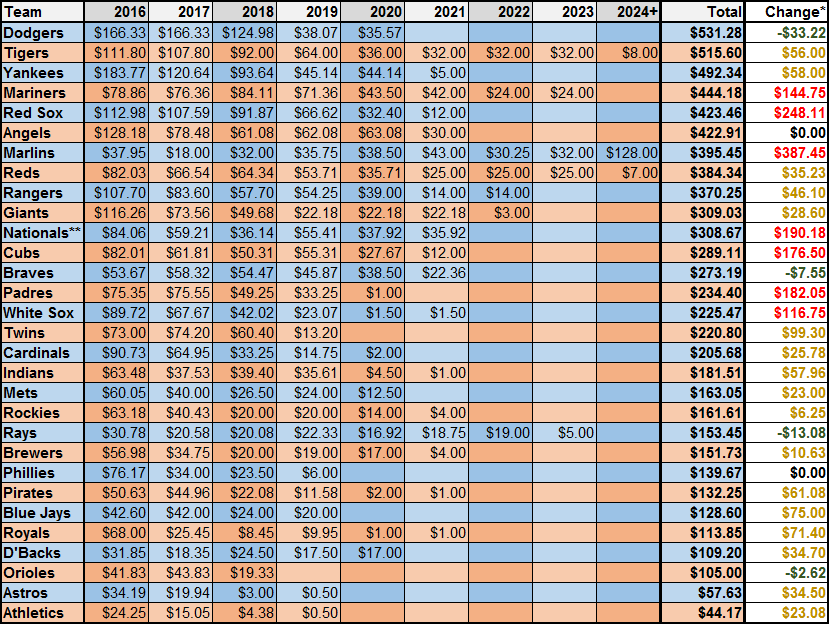
Here are the total commitments, by team and in millions of dollars (note post-2023 obligations merged into one column), courtesy of Cot’s Baseball Contracts:
(Link for app users or for full-size.)
*That last column represents how much in total future obligations (2016-onward) each team has added or taken away since we last looked in mid-November. While factors like discount rate play a role in exactly how you value future cash promises, this provides a rough guide to how much flexibility has been sacrificed down the line. Thus, we see that the Marlins — in large part due to the Giancarlo Stanton extension — have taken on the most of any team in future, leaping from the last-ranked club on the list just five months ago to the number seven team in long-term spending.
**You’ll also note that the Nationals’ heavily-deferred Max Scherzer contract shows up with the salary as allocated during the years he is actually under roster control. That is how Cot’s tabulates things, and I kept it that way in part because there are other purely financial deferral situations that would need to be accounted for.
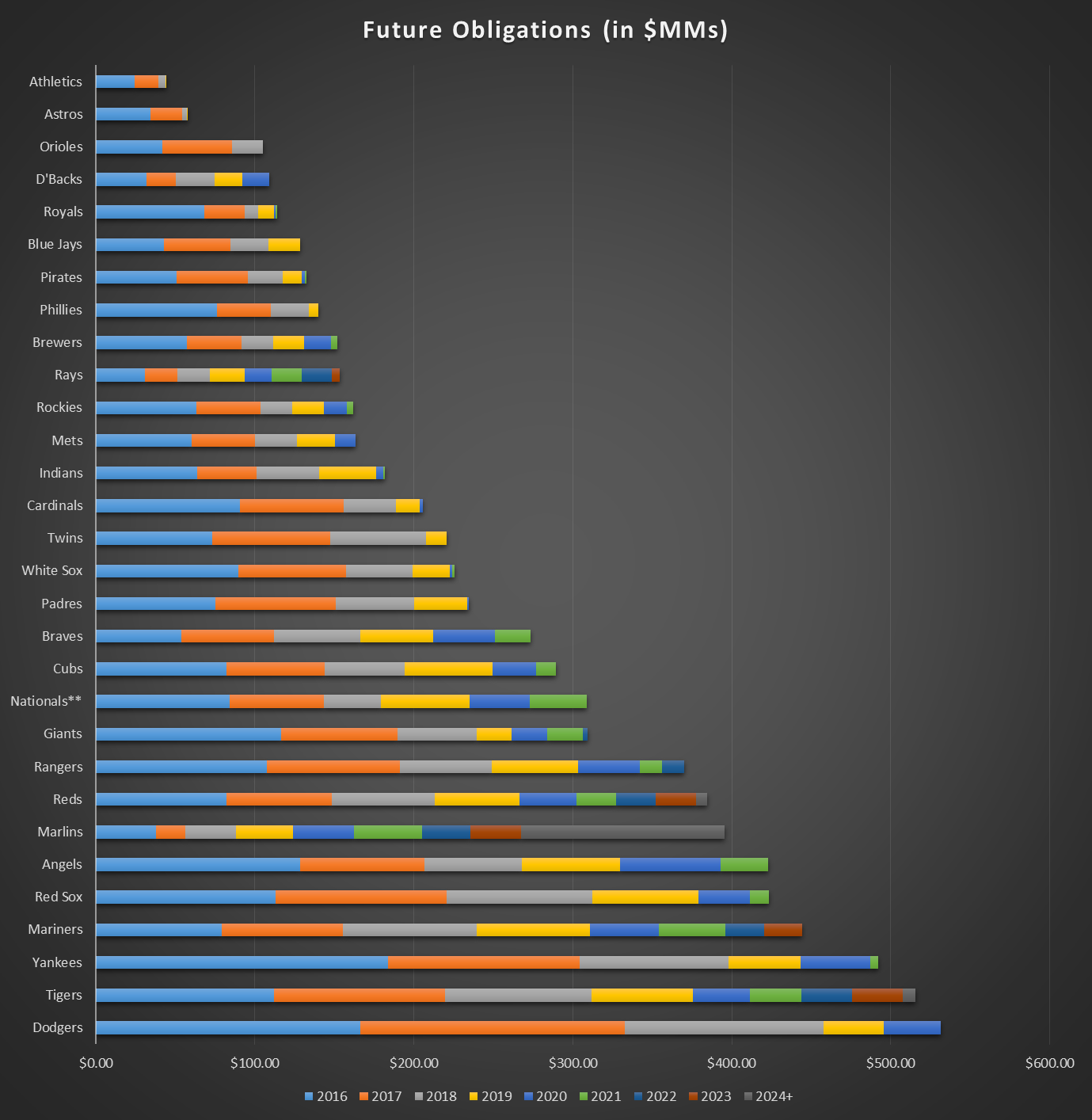
All said, just over $2.1B in new future commitments were added since mid-November. Here it is in a more visually comprehensible form:
NL West Notes: Capellan, D’Backs, Tomas, Dodgers
Former big league reliever Jose Capellan, who last pitched for the Rockies in 2008, died unexpectedly of an apparent heart attack earlier this week, ESPNDeportes.com’s Enrique Rojas reports (Spanish language link). Capellan, just 34 years of age, tossed 123 1/3 big league frames over five years, working to a 4.89 ERA. MLBTR extends its condolences to his family and friends around the game.
Here are some notes out of the NL West:
- The Diamondbacks deserve credit for putting their best team on the field to start the year, regardless of contract status, Nick Piecoro of the Arizona Republic argues. Arizona parted with Trevor Cahill and Cody Ross while moving Aaron Hill to a reserve role (in which it will be harder for him to build trade value). And the team has moved up the timeline of youngsters Jake Lamb and Archie Bradley, while also giving starting roles to Chris Owings and Nick Ahmed, rather than playing the service time game with those players.
- Yasmany Tomas just wrapped up his first spring with the Diamondbacks, but the club has already planned to institute a “weight goal” for the sizable slugger, MLB.com’s Steve Gilbert reports. “I think fitness-wise, he needs to get in better shape,” said manager Chip Hale. “He knows that. He worked really hard all spring. It’s not just working hard, it’s how you eat and learning a new country and all these things. I mean, it hasn’t been easy for him. For me he performed really well for where he was at coming to a new country.”
- The Dodgers are running a significant risk with their rotation, writes Dylan Hernandez of the Los Angeles Times. With Hyun-jin Ryu still very much a subject of concern for skipper Don Mattingly, the team is highly reliant on the health of Zack Greinke‘s right elbow.
Reactions To Recent Starting Pitcher Extensions
Over the past week, we’ve seen multi-year deals signed by Yordano Ventura (five years, $23MM), Carlos Carrasco (four years, $22MM), Corey Kluber (five years, $38.5MM) and Rick Porcello (four years, $82.5MM). As usual, there’s been no shortage of reactions to these contracts, and here are a few reactions/opinions from around the baseball world to each of the deals…
- Signing Ventura to a five-year deal was a necessary risk for the Royals, opines Fangraphs’ Craig Edwards. Ventura has long been seen as a risky commodity due to his smaller stature and a fear that he may be bullpen-bound, and he also produced results that were more good than great in 2014. However, only three Royals starters — Zack Greinke, James Shields and Ervin Santana –have matched Ventura’s modest 2.4 fWAR over the past five seasons. The Royals’ rotation is typically occupied by journeymen starters, and the upside for a mid-rotation or front-line starter at that price makes the risk worth taking, writes Edwards, even if there’s a risk he may not hold up as a starter.
- The Carrasco and Kluber extensions appear to be the latest in a long line of contracts signed with the intent of developing a long-term core. As GM Chris Antonetti said recently on MLB Network Radio (Twitter link): “This nucleus is going to be in place for awhile. Ownership has given us incredible resources.”
- Mutually beneficial extensions have been a key component of successful Indians’ seasons since John Hart began pioneering them in the 1990s, writes MLB.com’s Jordan Bastian. Bastian spoke to other members of that growing core — Michael Brantley, Jason Kipnis and Yan Gomes — each of whom has signed extensions of their own in the past year-plus. The Cleveland core expressed excitement about being able to grow and express excitement together in the coming years as they enter their primes.
- Cleveland.com’s Zack Meisel looks at the financial implications of the latest pair of Indians extensions, and he also spoke with Antonetti about the decision to offer Carrasco a long-term deal based on a relatively small sample of success. “His mix of pitches has always been a strength from the time we acquired him,” said Antonetti. “But we’ve seen the continued development and maturity and improvement in his routines, his consistency and his focus and we saw it translate to his success as a starting pitcher last year. We believe that now, not only does he have the physical attributes, but the other attributes to be a successful starter.”
- Carrasco’s deal may appear team-friendly, but an irregular heartbeat that required offseason surgery and a newborn baby played a role in Carrasco’s decision to accept the contract, writes Ken Rosenthal of FOX Sports.
- Dave Cameron of Fangraphs and FOX Sports writes that Porcello’s age-23 through age-25 seasons mirror those of Justin Masterson, and Masterson experienced a breakout in his age-26 season — the same that Porcello is currently entering. While that certainly doesn’t guarantee a breakout for Porcello, Cameron notes that the Sox are betting on a breakout or step forward of sorts — one that would’ve launched Porcello’s free agent price considerably beyond the $82.5MM figure upon which he agreed. Judging contracts based on average annual value is all too common a mistake, Cameron notes, as the years accompanying that AAV are a critical factor of any deal. Boston is showing a tendency to pay a premium to keep contracts short in an effort to avoid rostering expensive non-performers down the line, with Porcello’s deal and the Hanley Ramirez contract serving as recent examples, he adds.
- Tim Britton of the Providence Journal offers a similar take, using CC Sabathia as an example of the dangers of signing a pitcher into their 30s. As Britton notes, Sabathia would’ve been one of the best free agent signings in history had the Yankees let him walk after he exercised an opt out clause following the third season of his initial contract. However, they re-signed him through age-36, and Sabathia’s contract has become an albatross on the Yankees. While Porcello isn’t as good as prime Sabathia and likely never will be — a fact Britton acknowledges — his situation still aids the argument that it’s better to pay a premium for a pitcher in his prime than commit exorbitant amounts of money to their decline years.
- I’ll echo my thoughts on the Porcello deal that I tweeted out and included in MLBTR’s write-up of his extension and agree with both Cameron and Britton. While Porcello is not now and may never be a front-of-the-rotation arm, the Red Sox clearly believe that he’s capable of taking a step forward from a career year in 2014, and they’re willing to pay what currently seems to be an above-market annual price in order to secure his prime. It’s commonplace for teams to sign older free agents knowing that the final year or two (and sometimes more) will likely be a sunk cost, and yet as observers we accept that as part of free agency. The Red Sox are taking an opposite approach, seemingly making a strong bet that Porcello’s best years are ahead. Paying for an expected outcome that has yet to take place is risky, to be sure, but it’s no riskier than guaranteeing a pitcher north of $20MM in his age-36 season, as we saw with James Shields, Jon Lester and Max Scherzer this winter. The notion that a player must first “prove” that he is worth upper-market dollars over a long-term implicitly requires that those upper-market dollars will be awarded after or at the tail end of his peak, thereby negating much of the logic in committing such a sizable sum. Whether or not the Porcello deal ultimately looks wise or turns into an albatross, the thinking behind the deal is sound: make projections based on scouting and analytic input, and invest. The alternative — wait and see, then pay for the downswing of a player’s career — is hardly a less risky approach.
AL East Notes: Clevenger, Masterson, Sox, Hoffman, Jays
Agent Josh Kusnick, who represents Orioles backstop Steve Clevenger, tells Roch Kubatko of MASNsports.com that he’s unsure why the team elected to select Ryan Lavarnway‘s contract and option Clevenger to Triple-A. The sequence has Kusnick questioning Clevenger’s future in Baltimore, and he went so far as to say, “If Steve is going to lose his job to someone with no options remaining, the same age and same position, then it would be great if he could find a major league opportunity somewhere else if it’s not going to work out in Baltimore.” Kusnick says that he and Clevenger haven’t been told of a specific area that Clevenger needs to improve, and he feels that Clevenger has proven himself at the Triple-A level to the point where he should have a chance to stick in the Majors. The 28-year-old Clevenger has a strong .311/.371/.420 batting line at Triple-A (760 plate appearances) and has nearly identical numbers over the life of his Minor League career as a whole. Both the Diamondbacks and Padres have been linked to catchers in the media of late, though the D-Backs have stated that they’re not interested in adding a catcher at this time.
Here’s more from the AL East…
- With Rick Porcello now signed to a four-year extension, Justin Masterson is the only Red Sox starter not signed beyond 2015. WEEI.com’s Rob Bradford spoke to Masterson about that reality, but the 30-year-old didn’t seem fazed by pitching in a contract year for the second straight season. Masterson spoke about his decision not to take an extension with Cleveland last spring, noting that he disagreed with naysayers stating that he should’ve taken the two-year offer that was on the table. “No,” said Masterson. “I would have actually felt worse if I had taken it because I knew I wasn’t feeling good. I just think it’s based off the person. But for some people it can make it hard to play.” Masterson had physical issues from the onset of Spring Training in 2014, writes Bradford, but he’s feeling healthier this year and more focused on the season than a contract.
- Fangraphs’ David Laurila looks at the parallels between Hanley Ramirez as a 22-year-old and Xander Bogaerts, who is entering his age-22 season. Laurila interviewed Ramirez as a 22-year-old back in 2004 and sees similarities in Ramirez’s approach as an inexperienced hitter and the one presently utilized by Bogaerts. One key difference, Laurila notes, is that while Bogaerts’ .240/.297/.362 line from last year was disappointing, Ramirez batted just .271/.335/.385 at the Double-A level when he was 21 years of age. Laurila opines that we shouldn’t be surprised to see a Bogaerts breakout this summer.
- Blue Jays prospect Jeff Hoffman spoke with Fangraphs’ Kiley McDaniel (audio link) about his return from Tommy John surgery and the progress he’s made since college and pitching in the Cape Cod League. Hoffman, the ninth pick in the 2014 draft, feels that his command is all the way back and is looking forward to getting his Minor League career underway. McDaniel also asked Hoffman about whether or not he followed trade talks in the offseason — Hoffman was prominently mentioned in the Orioles-Blue Jays Dan Duquette talks — to which Hoffman replied that he’s aware of trade discussions but tries not to focus on them. “My agent does a good job of making me aware of what can and can’t happen, and what will happen, because a lot of the stuff out there is kind of crazy,” said Hoffman. (McDaniel also spoke to Twins prospect Nick Gordon — another 2014 draftee — about his transition to pro ball, making for a pair of interesting interviews.)
- The myriad transactions of Blue Jays GM Alex Anthopoulos will be put to the test this year in a season that could very well determine his future with the team, writes Sportsnet’s Shi Davidi. Davidi tracks much of Anthopoulos’ more notable moves, including how he masterfully manipulated the CBA’s former draft pick compensation system. Anthopoulos turned Marco Scutaro, Rod Barajas, Miguel Olivo, Scott Downs, Frank Francisco, Kevin Gregg, John Buck, Jon Rauch and Jose Molina into Aaron Sanchez, Justin Nicolino, Daniel Norris, Asher Wojciechowski, Jacob Anderson, Dwight Smith, Kevin Comer, Joe Musgrove, Matt Smoral, Mitch Nay and Tyler Gonzales — often by acquiring marginal free-agents-to-be and offering them arbitration in order to stockpile draft picks when they rejected. This year is a blend of both trades and scouting/development, and if the team fails to make the playoffs, “someone else may very well get a chance to push this team over the finish line,” Davidi writes.
Phillies’ Mario Hollands Undergoes Tommy John Surgery
The Phillies have announced that left-handed reliever Mario Hollands underwent Tommy John surgery earlier today.
Late last month, it was reported that the 26-year-old Hollands would likely require elbow surgery, but the fact that it was Tommy John surgery wasn’t known until this evening. At the time, it was reported that Hollands had a torn flexor tendon — the same injury as teammate and fellow left-hander Cliff Lee.
Tommy John surgery in early April means that the Phillies will not only be without Hollands for the entirety of the 2015 season, but likely for the early portion of the 2016 campaign as well. Prior to word of his injury, Hollands was expected to be a regular contributor in the Phillies bullpen after pitching to a 4.40 ERA with 6.7 K/9, 4.0 BB/9 and a 51.8 percent ground-ball rate in his rookie campaign last year. Hollands averaged a strong 93 mph on his fastball and was effective, albeit not dominant, against left-handed hitters, yielding a .241/.307/.316 batting line. A poor July tanked Hollands’ overall stats, and his 3.88 FIP, 4.10 xFIP and 3.97 SIERA each suggested that his ERA could’ve been slightly lower.
While on the 60-day disabled list, Holland will accrue Major League service time, meaning he’ll pick up a full year’s worth of service in 2015, bringing his total to exactly two years. That would put him on track to have most of the 2016 season to build a case for his first trip through the arbitration process, if he pitches well enough when healthy. (There’s also no guarantee that he’ll jump right back onto the MLB roster upon completing a theoretical rehab stint.)
With Hollands out for the season, Cesar Jimenez was given the first crack at the opportunity to be the second left-handed option behind Jake Diekman in manager Ryne Sandberg’s bullpen.
Minor Moves: White, Presley, Capps, Perez, Smoker
Here are the day’s minor moves:
- Astros outfielder Alex Presley has cleared waivers and is now deciding whether to accept his outright assignment, Ken Rosenthal of FOX Sports reports (Twitter links). He is expected to accept the assignment in order to retain his $1MM salary, per the report. Righty Alex White has also cleared waivers and has been assigned to Houston’s Triple-A affiliate, MLB.com’s Brian McTaggart tweets.
- Veteran righty Matt Capps has re-signed with the Braves, SB Nation’s Chris Cotillo reports on Twitter. The former Nationals closer had been with the club this spring but was released. Capps, 31, gave up two long balls in his only two innings of work, and has thrown just 12 professional innings over the last two seasons.
- The Mariners have loaned lefty Rafael Perez to Mexico’s Quintana Roo Tigers, Bob Dutton of the Tacoma News Tribune tweets. Perez, 32, was once a mainstay in the Indians’ pen and owns a 3.64 ERA over 329 big league innings. His peripherals declined, however, and he has not pitched in the big leagues since 2012. Perez has put up strong numbers in the upper minors over the last two years, however, and even returned to working as a starter last year.
- Former top draft pick Josh Smoker has signed with the Mets, Adam Rubin of ESPNNewYork.com reports. The 26-year-old, who washed out of the Nationals’ system, is said to be working back into the mid-90s with his fastball.
Athletics Designate Alex Hassan
The Athletics have designated outfielder Alex Hassan for assignment, the club announced. Oakland cleared roster space for the just-signed Cody Ross with this move and an optional assignment for Billy Burns.
Hassan, 27, has only minimal time in the big leagues. But he has slashed .282/.378/.426 in four seasons at the Triple-A level, suggesting that he possesses a high-OBP, relatively low-power bat that could be useful in a reserve role in the bigs.
Hassan bounced around quite a bit over the offseason. In fact, he was claimed by the A’s on two separate occasions, which also means this is the second time he has been designated by the team in the last few months.
Offseason In Review: Washington Nationals
The Nats have enjoyed plenty of success but also plenty of disappointment over the last three years. While the club remains set up to challenge for championships in the future, 2015 is probably the last year it can do so with its current core fully intact.
Major League Signings
- Max Scherzer: seven years, $210MM (subject to complicated bonus/deferral structure; see Cot’s on Contracts for full detail)
- Casey Janssen: one year, $5MM plus club option
- Denard Span: one year, $9MM (exercised club option)
- Total spend: $224MM
Notable Minor League Signings
- Tim Alderson, Heath Bell (since released), Bruce Billings, Emmanuel Burriss, Mike Carp, Manny Delcarmen, Tony Gwynn Jr., Rich Hill, Kila Ka’aihue, Steven Lerud, Mitch Lively, Evan Meek, Mark Minicozzi, Matt Purke, Clint Robinson, Ian Stewart, Dan Uggla
Trades And Claims
- Acquired OF Matt den Dekker from Mets in exchange for RP Jerry Blevins
- Acquired IF Yunel Escobar from Athletics in exchange for RP Tyler Clippard
- Acquired SP Joe Ross, PTBNL (reportedly SS Trea Turner) from Padres in exchange for OF Steven Souza, SP Travis Ott in three-team deal also involving Rays
- Acquired IF Chris Bostick, RP Abel De Los Santos from Rangers in exchange for SP Ross Detwiler
- Acquired C Dan Butler from Red Sox in exchange for SP Daniel Rosenbaum
- Claimed RP Eric Fornataro from Cardinals
Extensions
- None
Notable Losses
- Blevins, Asdrubal Cabrera, Clippard, Kevin Frandsen, Scott Hairston, Reed Johnson, Jeff Kobernus, Adam LaRoche, Ryan Mattheus, Ross Ohlendorf, Nate Schierholtz, Jhonatan Solano, Rafael Soriano
Needs Addressed
This offseason was obviously dominated by the team’s signing of Max Scherzer, who was installed as the Opening Day starter. But it’s hard to say that the move functioned to fill a need, so we’ll take a closer look at it below in the “Deal of Note” section.
Topping off the MLB rotation is not all the club did to bolster its future pitching ranks this offseason. The organization is loaded with arms for the post-Zimmermann era. After dealing away pitchers like Cole, Brad Peacock, Tommy Milone, Alex Meyer, Robbie Ray, and Nate Karns over the last several offseasons, the Nats did not shed any prized young arms this winter. Instead, after signing high upside Tommy John patient Erick Fedde out of the amateur draft, the Nats added well-regarded righty Joe Ross in the Wil Myers trade.
Then again, if the wisdom of the Rays’ front office is to be trusted, perhaps that trade will ultimately become known as the Wil Myers–Steven Souza swap. Or, if Rizzo has his way, the Joe Ross–Trea Turner deal. That last piece, Turner, was the key to the gambit from the Nats’ perspective, even if he remains an as-yet unnamed part of the transaction. The speedy young shortstop figures to be the long-term replacement for Ian Desmond, though he’ll need to show a lot in 2015 at the Double-A level to enter the big league picture for the start of next season.
To bolster things up the middle in the meantime, the Nats shipped one of the game’s most consistent set-up men, Tyler Clippard — yet another organizational stalwart in his final year of control — in exchange for the mercurial Yunel Escobar. The early relationship with Escobar has already seen some rough patches, with some positional consternation and injuries clouding the picture. But things seem to be going smoothly now, with Escobar voluntarily stepping in at third to open the season, and Washington will hope that he can return to being a quality defender and good-enough hitter to occupy one middle infield spot over the next two seasons.
With Clippard gone, the Nats had an opening in the veteran late-inning department, and added former Blue Jays closer Casey Janssen on a deal that reflected his difficulties last year. The Nats will hope there is some gas left in the tank for Janssen, who is currently out with shoulder issues that are hoped to be minor. There are some up-and-coming young arms (Treinen, Aaron Barrett) that could see big innings as well, particularly if Janssen is limited or ineffective.
From the left-handed side, Rizzo continued to tinker. The Nationals will rely upon August claimee Matt Thornton and former minor league signee Xavier Cedeno. Rizzo dealt away Ross Detwiler, who has been a plenty serviceable starter in the past but who did not turn into the dominant reliever the club hoped. And he parted ways with Jerry Blevins after one forgettable year, sending him to the division rival Mets in order to bolster the team’s outfield reserves with Matt den Dekker.
As for den Dekker, he looks to be a useful option with the outfield in need of bolstering early this year and a spot in center clearing after the season. Importantly, he has an option year remaining. While Michael Taylor is the player that the club hopes will become the long-term answer there, den Dekker could represent an affordable backup whose left-handed bat will pair nicely with the right-handed-swinging Taylor. He also looks to be a nice fit with the aging Jayson Werth in left to afford extra rest when matchups or game situations permit.
Questions Remaining
This is one of the most complete lineups in baseball — when healthy. But the Nationals have some injury concerns to start the year, with Werth, Denard Span, and Anthony Rendon all on the DL (along with reserve Nate McLouth). The club will fill the void with players like Taylor, den Dekker, Tyler Moore, Reed Johnson, Dan Uggla, and Danny Espinosa. That is probably fine for a short stretch, but could lead to some consternation if Werth, Span, or (especially) Rendon take longer than is hoped.
Elsewhere, the team will be taking on some risk by shifting players to new positions. Escobar has mostly played short, which he seems likely to do again next year, but will play third until Rendon returns and he is bumped back to second. And longtime hot corner stalwart Ryan Zimmerman will move across the diamond to first to account for his balky shoulder. He has looked comfortable there this spring, but will need to lock down the position defensively — and provide a bat to match — to deliver a return on his big contract.
It is not hard to foresee a need arising behind the plate, though that is hardly what the club expects. Wilson Ramos has dealt with various injury issues over the years, and neither he nor backup Jose Lobaton hit much last year. Most teams would be pleased with this arrangement, so it isn’t exactly a concern, but could be an area to watch. The organization lost some depth when it was forced to part with the out-of-options Sandy Leon and Jhonatan Solano this offseason, but did trade for Dan Butler and sign Steven Lerud to bolster the ranks at Triple-A.
The pitching staff has ample depth, particularly in terms of starters, so there is not much to discuss there. Then again, the ninth inning has been an area of some concern in the not-so-distant past, and Drew Storen is now without the safety net that Clippard once provided. Then there is the fact that there may have been at least some financial motivation behind the departures of Clippard and Blevins. While Rizzo and company probably feel just fine with the club’s options, don’t be surprised to see some hand-wringing if injury or short-term performance problems arise at the back of the pen in the season’s early going.
Deal of Note
 Nationals GM Mike Rizzo does not seem to act out of sentimentality. And neither, apparently, do longtime key players Ian Desmond and Jordan Zimmermann. The clock has likely run on the possibility of extensions for that pair, whose rise to become highly productive big leaguers played an enormous role in the organization’s turnaround. Last year was probably the time to get a deal done, but neither player bit at the sizable numbers being dangled. It is hard to blame them for doing so, or to blame the team for not going as high as might’ve been necessary, with potential nine-figure free agencies beckoning.
If it wasn’t already, the writing was scrawled on the wall when Max Scherzer signed his monster deal to join a loaded Nationals rotation. While deferrals reduce the total cost to the team, the investment in Scherzer is enormous, and made new contracts for Desmond and (especially) Zimmermann seem quite unlikely.
Bold as the Scherzer contract is in the long run, it is all the more stunning in the short. Effectively, Washington has taken baseball’s best rotation from 2014 — every piece of which returns — and added the best pitcher from the league’s second best rotation of last year. If all goes according to plan, the Nats’ pitching will be dominant.
Indeed, looking ahead, if all the arms remain healthy — or, perhaps, if the team completely falls apart — it is not impossible to imagine the Nats dealing Zimmermann or Doug Fister over the summer to address other needs. Washington could still maintain a powerful group of postseason starters while filling in the fifth slot with Tanner Roark (the game’s most eligible sixth starter), Blake Treinen, Taylor Jordan, or A.J. Cole. More likely, one or more of those pitchers will be installed in the rotation next year as the club waits for younger, even higher-ceiling arms (namely, Lucas Giolito, Reynaldo Lopez, and Fedde) to develop.
Overview
This is a win-now team, but not one that is structured to fall apart with its veterans. Washington has run its payroll up to over $160MM, near the top of the league (non-LA/NYC bracket). But its future commitments remain manageable even after signing Scherzer: $84MM next year and no greater than $59MM in the years that follow. The club’s top arb-eligible players for 2016 and beyond (Stephen Strasburg, Bryce Harper, Storen, Ramos, and, potentially, Rendon) have all seen their arbitration earning power suppressed to some extent, leaving additional room.
Likewise, plenty of young talent is filtering up and should soon be ready to plug into the MLB roster or deal away for more established players. By most accounts (including Baseball America) the Nats possess a top-ten farm system, representing a quick replenishing for a system that had lost a ton of well-regarded players to graduation and trade.
While the future still looks bright, it will be a tall order to meet or exceed the organization’s current situation. Not only are the club’s best young players and veterans alike at or near their primes — a difficult nexus to achieve — but the rest of the division seemingly features two still-advancing hopefuls (Mets, Marlins) and a pair of rebuilding outfits (Braves, Phillies). The window will still be open after this year, but probably not as wide.
Photo courtesy of USA Today Sports Images.