
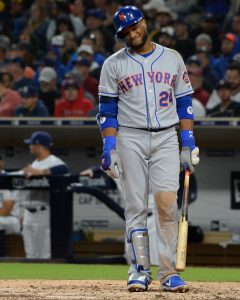
We’re on the eve of Major League Baseball’s All-Star Game, an event second baseman Robinson Cano has received eight invitations to since his career began in 2005. The former Yankee and Mariner is clearly one of the most accomplished second basemen in baseball history. However, in 2019 – his first season as a Met – the 36-year-old Cano has looked nothing like his usual self. His subpar performance played a key part in a miserable first half for the Mets, who’ve endured a chaotic three-plus months and limped to a 40-50 record thus far.
The Cano acquisition was one of many bold offseason moves by first-year Mets general manager Brodie Van Wagenen, the potential Hall of Famer’s former agent. While inexpensive closer Edwin Diaz was likely the real target in the Mets’ return from the Mariners in a blockbuster December trade, it’s obvious there was confidence in Cano on New York’s part. Otherwise, the club wouldn’t have taken on four years and $100MM of Cano to land Diaz. Unfortunately for the Mets, though, neither player has performed to expectations this year.
The sweet-swinging Cano entered the year a lifetime .304/.355/.493 hitter (127 wRC+) with 56.7 fWAR – the sixth-highest total among position players from 2005-18 – as well as 311 home runs in 8,841 plate appearances. He offered similarly excellent production last year, though a fractured right hand and an 80-game performance-enhancing drug suspension cut his season in half.
Cano’s 2018 ban didn’t scare off the Mets, for whom he has batted a weak .240/.287/.360 (74 wRC+) with a mere four HRs in 258 trips to the plate. Cano has also accounted for a ghastly minus-7 Defensive Runs and a minus-3.5 Ultimate Zone Rating at second, a position he has typically handled with aplomb. To make matters worse, the once-durable Cano has endured a pair of stints on the injured list because of quad problems. During the 65 games Cano has taken the field, he has posted minus-0.5 fWAR – a stark fall from grace for someone who logged 2.9 during his shortened 2018 and has exceeded the 3.0 mark in nine seasons.
If you’re looking for causes for Cano’s awful offensive production this season, start with a power outage. His ISO’s at .120, 69 points lower than the mean he recorded coming into this season. It’s also 60 points worse than the league-average figure and 18th from the bottom among 195 hitters who have amassed at least 250 PA. As FanGraphs’ heatmaps indicate (pre-2019, this year), Cano typically showed a solid amount of power on the inner and outer halves of the strike zone before the current campaign. His power this year has been confined to the middle of the plate, though, and it’s not even as strong there anymore.
Cano’s still making plenty of hard contact – he ranks in the majors’ 83rd percentile in that category and its 77th percentile in average exit velocity, according to Statcast. But he’s pulling the ball less than ever, striking out a good amount more than he has in prior seasons and swinging and missing at a career-worst rate. A more aggressive approach – evidenced by a personal-high swing rate – hasn’t panned out, as shown by a career-low contact percentage.
When Cano has put the bat on the ball, he has only registered a .283 batting average on balls in play – down 36 points compared to 2005-18. There may be some poor fortune involved in that. As mentioned, he has hit the ball hard. There’s also a 28-point gap between his weighted on-base average and his expected wOBA. Still, though, Cano’s xwOBA is an underwhelming .307. That ranks in the majors’ 28th percentile, while his sprint speed (15th), expected slugging percentage (36th) and expected batting average (54th) are also mediocre or much worse. None of that’s conducive to a high BABIP or quality overall production, nor is Cano’s sudden uselessness against same-handed pitchers.
Although the lefty-hitting Cano has been much tougher on right-handed pitchers in his career, he has at least posed a threat versus southpaws. A lifetime .282/.333/.429 hitter (106 wRC+) without the platoon advantage, the 2019 version of Cano’s at a putrid .206/.275/.222 (43 wRC+) against lefties. Another look at FanGraphs’ heatmaps (pre-2019, this season) shows lefties have lived much more belt-high middle or on the outer half of the plate against Cano this year compared to prior seasons. He hasn’t found an answer yet.
Answers in general have been hard to come by for this year’s Mets, one of the season’s greatest letdowns to date. There may not be time for a team-wide turnaround in 2019, but if Cano returns to his pre-Mets form in the season’s second half, at least the club would have that to hang its hat on going into the winter. Right now, though, the acquisition of Cano looks like a massive misstep by Van Wagenen, who may have saddled his team with an albatross contract.
Photo courtesy of USA Today Sports Images.
Old mixed with no longer on the PED
With the Mets?
“bold move”? Haha. I’d say a foolish move. 100 million for a washed up second baseman. The idea that Callaway goes and Brodie stays is ridiculous. He’s more responsible for this debacle than anyone except maybe the two clowns who hired him.
$60 mil not 100
Thank you. Someone who understands the Mets stupidity.In the offseason I argued with all the Mets fans who envisioned a 2010 Robinson Cano .Mets management loved the idea they made 20 million off this deal for 2019.The Mets now are ruined for the forseeable future as a result of ownership and Brodies idiocy
What’s wrong with him? He’s old!!!
And off PED’S lol
Nothing is wrong with him. He is 36 now, it’s just who he is. Anyone with common sense knew you should stay far away from him in a trade. But not super GM Brodie.
Not Zachgwest. Boy that was a terrible argument.
Sometimes the answer is so simple. The guy got suspended for PEDs last year.
Van Wagenen…..what a joke.
Only the Mets would hire an unqualified mope like this to oversee the most important aspect of their team. What a pathetic organization from top to bottom…..
Almost 37, had some injuries, probably a bit of league adjustment and just realized he is paying an extra 13% in taxes in NyC compared to Washington state.
How many 36 year olds are thriving in MLB in the post steroid era? Very few. Especially not a dog like Cano.
Well the lack of PED’s might be the obvious thing lol. The combo of age really adds to that
It’s the jersey.
Literally every aspect of this situation
Without the boost from PEDs, much fewer players will be able to play into their late 30’s as in decades past. There’s no secret here.
Plus, the fact that fewer players can/will use PEDs, hopefully, is a direct result of why there will be fewer crazy contracts for players past the traditional “prime years”.
Come on Connor… His numbers were propped up by PED’s. We all knew that.
Now, the majority of the players who have been linked to PED’s came from which ball club?
Really? Only the Yankees had users? Manny Ramirez and David Ortiz say hi.
Really? Did I say “only”? Why did you assume Yankees? Hmmmm?
The answer to this question seems like a no brainer…
When Fisk was 37, he stole 17 bases. When he was 42, he stole 7 bases. Some guys don’t grow old so much, some guys do. Then there’s Nolan Ryan. These guys were rocks. It’s possible. Ted Williams. .388 at 39.
Ted Williams didn’t have to hit sliders.
There are always outliers, but the game is much different these days. Pitchers throw harder and there’s tons of analytical data on players. I don’t think Ted Williams was going against pitchers throwing stuff consistently like they do today. David Ortiz was effective up until he retired (jury still out if he was on anything) but he was also a lifetime DH meaning much less wear and tear versus a guy who played in the field everyday. I suspect it’s a mix of changing leagues and being off the juice. Also no DH which means he either plays the field or he doesn’t play.
xSpecBx
Williams faced Bob Feller often (178 PA) and slashed .357/.483/.692. Some may say so what Feller was a freak of nature. It’s true that he was the fastest pitcher of his generation and the only the second pitcher “measured” (Walter Johnson was the first). Feller was measured at 98.6 mph but…and this is a big but…his pitch was measured as it crossed the plate.
Today’s pitchers are measured shortly after the ball leaves the hand. When you adjust for the distance and loss of speed as the ball travels you find that Rapid Robert’s 98.6 was actually 107.6.
Don’t believe me? Watch the documentary “Fastball” or for a brief synopsis read this thegamehaus.com/nolan-ryans-record-108-mph-fastbal…
Now I am not saying that all pitcher of Feller’s generation threw that kind of heat but I would bet there were a few that pumping in the 90’s just like there was when Ryan’s pitch of 100.4 was clocked in 1974. BTW…Ryan’s pitch was measured 10 feet in front of home plate so when the math is done it was actually 108.5 mph.
I thought you were crazy saying Fisk stole 17 bases, I figured that would cover a decade for him yet alone his age 37 season. But then I looked it up and you’re 100% right. Wow! How on earth did a 37 y/o catcher that wasn’t exactly fast swipe so many?
I found Fisk to be a jerk as a person but a very smart ball player, especially running the bases.
36 years old and take away the steroids and what have you got?
Got paid, doesn’t care.
if he’s actually stopped the PED’s, unlike a lot of guys seem to after caught, (see Cruz, Braun, etc) the i at least have to give him some credit.
Skippy say Robby Rob needs some of that mannish water.
No trade rumor here. Just a half-baked attempt to describe what’s wrong with him using stats and heatmaps… not very in-depth. I’m sure Fangraphs would do it better. But as mentioned, this needn’t be explained by stats. The man is off PEDs. Story ends there. Another miss by MLBTR.
I thought it was a decent article. I was at the very least informed of the degree to which a consistently great career player has regressed.
Also, I have never heard the phrase “half-baked” used to describe a minimal effort. I’ve only heard it used to describe a movie full of pothead comedians.
Also, I’m not sure being off PEDs fully describes the issue of regression. Wouldn’t his exit velocity decrease if he ceased steroids? Maybe amphetamine cessation would account for his lack of connection and ball-placement, but probably not losing strength.
Just a matter of time before Canogets back on peds. That is the difference in his performance. When he gets caught again he gets the lifetime ban hopefully. Cheater.
No roids, no production. Lifetime cheater.
Cano has been in the league for 15 years. I really doubt he could have escaped detection for PEDS for all that time. It’s probably not the PEDS. And he can probably play better. You usually don’t see this steep a drop-off with normal aging curves. Maybe .5 per year. Cano has gone from 3+ to sub replacement. I think he probably has a bit more left in the tank.
Let me summarize. He’s old and lazy and can no longer just get by on talent alone. Hes a great reason to not watch Met games
What’s wrong with cano? Uh he’s not that good anymore. No pets no production.
Peds
Answer: He’s really old. Though it’s worth including in here that he was hit on the hand by a pitch-twice-earlier this year.
He got old…..
I think Robinson Cano will bounce back. Maybe not what he once was; he’s in the twilight of his career. He’s not as bad as he’s been so far this season. His effort must improve, however.
Hahaha.Did you say his effort must improv? .Do you even know who Robinson Cano is? Have you ever seen him play a baseball game?
No more juice boxes before the game
The Mets have been doing this for almost 30 years now. Signing old players looking for a boost. You think they would learn by now…..
This question is a joke right?
So The Network has been featuring the ’95 M’s as the season that saved baseball in Seattle. This would be the trade that has done the same, financially.
Oh, Robby. One of the sweetest swings I’ve ever seen. It always felt like some cosmic mistake that he wouldn’t spend his career in pinstripes, and it’s a shame the way his career has toiled here towards the backend. Productive but forgotten in Seattle. Then the steroid controversy. Now he’s sinking back in NY on the other end of the city. He could be, feels like he should be, a hall of famer. That dream has all but faded.
People killed Dipoto for this trade when it happened. Yeah, look how that turned out.
Unless you watch Mets games on a daily basis – don’t bother commenting. The biggest thing you see is that he looks slow and unmotivated. He gives up on a lot of ground balls defensively and swings half heartedly on offense. Oddly enough, it seems like he can hit the ball hard and make plays defensively when he feels like trying. Very odd to watch. Like different players day-to-day.
Hahaha.Did you say his effort must improve? .Do you even know who Robinson Cano is? Have you ever seen him play a baseball game?
hmm I have 3 letters PED
he can’t cheat and this is the result..plus hes like 36? or is he??
If you were told you’d earn $1,000,000 if you could find an MLB team more inept than the Mets by tomorrow, you’d have the same money you have today by the time midnight comes tomorrow. Man it’s sad lol.
All you guys talking about “PED’s”-laughable indeed. PED’s do not assist your hand eye co-ordination. For sure they may assist with extra power but they’re not going to help you hit the ball in the first instance unless you already have the ability to do so. End of story.
They help your bat speed which will help you hit balls you would normally swing and miss on. They also help you turn routine flyouts into home runs. I would say that means they help you hit.
So I guess in your mind Braun was just as good after PEDs as before PEDs Ryan Brauns average post PEDs at age 30 went from 41 hrs and a 319 ba to 19 hrs and a 261 ba. Explain that if not PEDs
Pay him no mind. He probably used to use PED’s himself for some reason and feels the need to defend others that did. If PED’s didn’t enhance your performance they wouldn’t be called performance enhancing drugs. Furthermore, if they didn’t help, no baseball player would ever risk their career by using them. The funny thing is his screen name is Sid Bream. That guy was a defensive first baseman. Not known for his offense at all. I love the Braves and everything but only Bobby Cox would want a defense first starting first baseman. I don’t think they even make those anymore. Teams are supposed to get a lot of their offense from 1st baseman. Oddly enough, the person with reason in this conversation is named after Willie Mays. Mays is literally the godfather of the PED king (aka Barry Bonds). What is this world coming to when fans of the godfather of the PED king are willing to admit that the drugs help players but fans of defense only first baseman are not? Everything is topsy turvy. Is this the twilight zone? Wait a minute… Is that actually you Sid Bream? Are you just jealous because you didn’t think to use steroids and now you are going to be remembered as one of the worst offensive starting first baseman of your decade? Get outta here Sid!!! It’s too late. You are far too old to start juicing to get back in the league and change your abysmal offensive stats.
C’mon. Are we seriously asking that question of a known PED user???
“… hall of Famer…” and “…80 game ped suspension…” should never be used to describe the same player.
What’s wrong with him? He’s 36, clean (maybe), in a new league and not facing AL West pitching 70 games a year. I’m not even going to question his work ethic or willingness to take instruction because I’m not in the clubhouse. His bat looks slow and he’s getting beat with average fastballs and mediocre breaking pitches. Yet Calloway keeps hitting him third, thus killing any kind of rally that might be in process. With all the home runs Alonso is hitting, Cano is essentially batting with no one on base so pitchers just attack him. Drop him down, bat him 7, 8 or even 9 because Mets’ starting pitchers are more effective. But Calloway won’t do that – which is exactly why he should be fired.
Why is MLB still allowing the Coupons to still own this team. Look what the Dodgers have done since MLB made them sell the team.
I mean just by the dirty fact that BVW has signed most of his old clients is troublesome.
WILPONZI
A little HGH and he would be right back to his old self.