
Mariners Notes: Crawford, Rotation, Castillo
J.P. Crawford has been a key part of the Mariners’ lineup since joining the club in 2019. In over 3,800 plate appearances with Seattle, Crawford has batted .248/.341/.369 with a 107 wRC+ while providing serviceable defense at shortstop, including 9 Defensive Runs Saved as recently as 2024. That said, the recently extended Colt Emerson is Seattle’s shortstop of the future, and Crawford, in his final season of club control, has volunteered to play third base to accommodate Emerson.
Crawford’s willingness to play the hot corner will add to his value in free agency, and it may also help his chances of returning to the Mariners. The Athletic’s Ken Rosenthal reports that Crawford’s agent met with general manager Justin Hollander following Crawford’s asking to try third base, reiterating the latter’s desire to stay in Seattle. Hollander indicated a Crawford reunion is “absolutely” possible. “Obviously we’ll talk about it after the season and see how it goes. But he wants to be here and there’s definitely a place for him,” Hollander said of Crawford.
Those comments are not surprising for a general manager speaking of a long-tenured and well-liked player. That said, Crawford’s willingness to move positions and positive clubhouse reputation make the third base experiment worth exploring before he reaches free agency. Crawford’s work at short has been poor since the start of 2025, adding up to -9 DRS and -19 Outs Above Average. He has 174 2/3 innings of big league experience at third, all coming with the Phillies from 2017-18. To his credit, Crawford was worth 7 DRS and 3 OAA in that sample.
Of course, that’s a small sample from eight years ago. In contrast, a look at Crawford’s Statcast page gives reason for pessimism. His range is in the first percentile, while his arm strength 77.5 MPH arm strength in 2026 falls in just the 17th percentile. In terms of lateral moves, Crawford has been worth -10 OAA since the start of 2025 when moving toward third base. When moving toward first base, that improves slightly to -4 OAA. Playing third base would result in more lateral moves toward first, which could theoretically help to optimize Crawford’s defense as he plays deeper into his 30s.
Time will tell how Crawford fares defensively at the hot corner. In any case, a reunion might help the team’s offense and overall defensive flexibility. Crawford has put up a 114 wRC+ in 180 plate appearances this year. Despite a .204 batting average, he remains a productive hitter thanks to his ability to draw walks, doing so at least 11.3% of the time in every season since 2022. The M’s also have Brendan Donovan under club control through 2027. Donovan has exclusively played third this year but also has experience at second and in left. Retaining Crawford to play third would allow Donovan to be used as a super-utility player while ensuring plenty of at-bats for those two and Emerson.
Turning to the pitching staff, the Mariners’ rotation is in a bit of a crunch with Logan Gilbert, George Kirby, Bryan Woo, Bryce Miller, and Emerson Hancock all performing well. Although Miller had a 5.68 ERA last year and missed the first month and a half of 2026 with an oblique strain, he posted a 3.52 ERA with a strong 17.6% strikeout to walk differential from 2023-24. Going forward, Ryan Divish and Adam Jude of the Seattle Times opine that the Mariners’ best path forward is Miller in the rotation and Luis Castillo in the bullpen full-time.
Castillo made his first career appearance as a reliever on Tuesday, allowing two earned runs in 2 1/3 innings against the White Sox while striking out four. He’s been a reliable starter since joining Seattle midway through the 2022 season, but unfortunately that hasn’t been the case in 2026. Castillo has a 6.34 ERA in 44 innings as a starter, and that’s not the result of one or two blow-ups. He’s allowed four earned runs or more on four separate occasions, and he’s only once completed six innings. Castillo has had some bad luck, as evidenced by a .346 opponents’ average on balls in play, but he’s also getting groundballs at a career-low 35.2% rate.
Castillo’s four-seamer had a run value of +11 last year, according to Statcast. While it hasn’t been as effective in 2026, the pitch is still getting 1.8 inches of horizontal break above league average. As a reliever, Castillo could take advantage of that movement by throwing the four-seamer more often, without having to face hitters multiple times. Then, if one of the starters goes down with an injury, Castillo could slot back into the rotation and revert to his old pitch mix.
Photo courtesy of Jay Biggerstaff, Imagn Images
Dayán Viciedo Retires
Former White Sox outfielder Dayán Viciedo is retiring, according to a post from Yakyu Cosmopolitan. Viciedo is currently with the Yokohama DeNA BayStars of Japan’s Nippon Professional Baseball. He will retire after today’s game.
Viciedo defected from Cuba in March 2008 and was declared a free agent by MLB in November of that year. He signed a four-year, $10MM contract with the White Sox that December. Viciedo spent 2009 at Double-A before progressing to Triple-A and finding himself on the cusp of the Majors. He debuted for the White Sox in June 2010 at the age of 21.
Viciedo only had 106 plate appearances across 38 games that year, but he impressed with a .309 batting average and a 122 wRC+. He regressed in sparse playing time in 2011, posting a 78 wRC+ in 29 games. Viciedo finally earned a starting role in 2012 and posted his best season as a big leaguer. In 543 plate appearances, Viciedo batted .255/.300/.444 with 25 home runs and a 98 wRC+ as the White Sox’ primary left fielder. He also contributed on defense with two Defensive Runs Saved en route to an 0.8 fWAR season.
Viciedo followed that up with a near-identical .265/.304/.426 output in 473 plate appearances in 2013, missing three weeks with a strained left oblique. That was good for another 98 wRC+, although Viciedo’s defense declined slightly (-2 DRS) and tampered his overall value. The 2014 season was a bigger drop-off. Viciedo hit 21 home runs, but his overall line of .231/.281/.405 was good for just a 90 wRC+. In addition, his once serviceable defense had become a liability, with FanGraphs having Viciedo at -15 DRS between the outfield corners.
Chicago avoided arbitration with Viciedo on a $4.4MM deal in January 2015 but designated him for assignment that same month. He split that year with the Blue Jays, Athletics, and White Sox on minor league pacts, posting a 124 wRC+ at Triple-A. However, he did not make it back to the Majors.
That left Viciedo with a career output of .254/.298/.424 and 66 home runs in 483 MLB games. However, his playing career was far from over. Viciedo made the jump to Nippon Professional Baseball by signing a one-year pact with the Chunichi Dragons for the 2016 season. He immediately found success, putting up a .274/.352/.486 line with 22 home runs in 119 games and earning an NPB All-Star nomination. Viciedo followed that up with 18 home runs in 87 games for the Dragons in 2017.
The 2018-19 seasons were the peak of what will end up being an 11-year career in NPB. Viciedo batted .348/.419/.555 with a 165 wRC+ in 2018. His output that year also included 26 home runs and 99 runs batted in, both of which were career highs. Viciedo was recognized as one of the Central League’s Best 9 for his performance that year, earning himself a three-year extension in the process. In 2019, Viciedo had another excellent season, posting a 140 wRC+ and hitting 18 home runs in 143 games.
He wouldn’t quite reach those heights again, but Viciedo remained productive as he played into his 30s. He put up an OPS between .766 and .792 in every season from 2020-22, hitting a total of 48 home runs with 215 RBI in that span. The 2022 season was Viciedo’s last as a productive regular, as he batted 294/.355/.437 with a 136 wRC+ for the Dragons.
From 2023 to the present, Viciedo settled in as a part-time player. He remained with the Dragons from 2023-24 and earned his 1,000th career NPB hit in September 2023. Viciedo was the first foreign-born player in Dragons history to achieve that feat. After only playing 15 games in 2024, Viciedo joined the BayStars in 2025 and put up a 110 wRC+ in 43 games that year. He’s batted .269/.310/.385 thus far in 2026, which will end up as the final season of his career.
Overall, Viciedo ends his NPB career batting .286/.352/.457 with 1,040 hits and 142 home runs in 4,046 plate appearances. His career earnings in MLB totaled $13.3MM, followed by over $11.3MM in Japan. We at MLBTR congratulate Viciedo on a fine playing career and wish him the best in retirement.
Photo courtesy of Jerry Lai, Imagn Images
Diamondbacks Place Lourdes Gurriel Jr. On 10-Day IL, Select Tommy Troy
8:35 pm: Manager Torey Lovullo says that Gurriel’s hamstring injury is minor, according to Nick Piecoro of the Arizona Republic. The hope is he’ll be back from the IL as soon as he’s eligible.
5:59 pm: The Diamondbacks are placing Lourdes Gurriel Jr. on the 10-day injured list with a strained left hamstring, as reported by Alex Weiner of Arizona Sports. The club is also selecting the contract of prospect Tommy Troy. Arizona’s 40-man roster was at 39, so no corresponding move is needed for Troy.
Gurriel, 32, is in the midst of his worst big-league season. He had a delayed start while finishing his recovery from right ACL surgery. Since debuting on April 18th, Gurriel has a line of .228/.284/.304 with a single home run. That’s good for just a 66 wRC+, indicating Gurriel is 34% worse than the average hitter. Granted, he’s only made 102 plate appearances, but Gurriel showed diminished offense last year as well. He had a 95 wRC+ in 129 games while posting an 87.8 MPH average exit velocity, down from 88.4 MPH in 2024. This year, Gurriel’s exit velo is sitting at 87.5 MPH.
Arizona has a 99 wRC+ as a team, which speaks to its top-heavy offense. Corbin Carroll (161 wRC+), Ildemaro Vargas (136), and Nolan Arenado (132) are all hitting very well. Geraldo Perdomo and Ketel Marte are right around league average. In contrast, Gurriel has been one of the team’s worst regulars this year, and since he’s not a good defender, he’s not doing enough to make up for the lack of hitting. Gurriel’s return timeline depends on the severity of the hamstring strain, which could be made clearer in the coming days.
In the meantime, Arizona’s offense could be jolted by Troy, who will be making his major league debut when he gets into a game. Troy was the club’s first-round draft pick in 2023 and rates as their No. 4 prospect according to MLB.com. He reached Triple-A last year at the age of 23 and held his own, batting .295/.381/.429 in 182 plate appearances. Troy has improved to .307/.397/.449 in 205 plate appearances this year, good for a 109 wRC+. His strikeout rate has jumped back to 24.4% after sitting at 16.9% in 2025, but otherwise, there’s plenty to like in Troy’s profile.
Troy came up as a middle infielder but has played 219 innings in the outfield this year, compared to 162 at the keystone. That shift is a testament to Troy’s speed, which is seen as his best tool and allowed him to steal 40 bases from 2024-25. The presence of Perdomo and Marte on the big league roster blocks Troy from his natural positions, so his long-term future with Arizona could be in the outfield. Indeed, this promotion could be seen as a trial run of Troy’s outfield defense while Gurriel is on the IL.
Whether Troy sticks in the Majors this time around also depends on his hitting. Despite Gurriel’s poor performance this year, he has enough of a track record as an average hitter to slide back into left when he returns. Tim Tawa and Jorge Barrosa are both on the roster as backup outfielders, though neither has shown much with the bat in the Majors. That said, Barrosa is out of options whereas Tawa has two option years remaining. If Troy hits enough to stick around, he has the defensive experience to serve as a utility man, with Tawa potentially being optioned in his place.
Photo courtesy of Isaiah J. Downing, Imagn Images
Blue Jays Notes: Scherzer, Bieber, Rotation Depth
41-year-old Max Scherzer has been on the 15-day injured list for about a month with a combination of right forearm tendinitis and left ankle inflammation. The five starts he made for the Blue Jays before landing on the IL were a mixed bag. Scherzer allowed one earned run in six innings in his season debut on March 31st, then two earned runs in another six innings on April 18th. However, Scherzer failed to complete three innings in his other three starts, be it due to injury or ineffectiveness.
Despite his lackluster results this year, Scherzer will be a key piece of rotation depth when he returns from the IL. Arden Zwelling of Sportsnet reports that Scherzer threw around 30 pitches in a bullpen session yesterday. The Jays are considering another bullpen or facing live hitters as the next step, followed by a rehab assignment. Per the team’s injury tracker at MLB.com, Scherzer is in line to return in early- to mid-June. A return on the later side might be realistic if the veteran needs three or four rehab starts.
The depleted state of Toronto’s rotation depth is well-known at this point. Shane Bieber has been on the IL since late March with right elbow inflammation. Cody Ponce‘s return stateside lasted one start before an ACL sprain put him out until next year. More recently, Eric Lauer was traded to the Dodgers and José Berríos underwent Tommy John surgery, putting him out until midway through next year. The fact that Toronto is giving starts to Patrick Corbin, who had a 5.47 ERA from 2021-25, speaks to the Blue Jays’ need for rotation depth.
None of that takes away from the rotation’s performance overall. The group’s 3.86 ERA is ninth-best in the Majors, while their 4.9 fWAR ranks sixth-best. Dylan Cease (2.0 fWAR) and Kevin Gausman (1.8) are in the Top 10 of qualified starters. Trey Yesavage has a 1.07 ERA in five starts since returning from injury and has not yet allowed a home run. Rather, it’s the back of the rotation that needs reinforcement.
Spencer Miles was a Rule 5 pick this offseason. While he has a 2.17 ERA in 14 appearances, there’s inherent risk in anybody with such little minor league experience (14 2/3 innings from 2022-24) and two major injuries (a back injury and Tommy John surgery). Miles has also made just one start in the Majors and has maxed out at 4 1/3 innings and 63 pitches in any appearance.
As for Corbin, he has a 3.86 ERA in nine starts including today. However, there’s little reason to believe that will be sustained. Corbin has been a below-average pitcher by ERA- in every season since 2020. Excluding his little-used slow curveball, his velocity is down across the board compared to 2025. Meanwhile, opponents’ average exit velocity against Corbin has held constant, and he’s had a 4.2% uptick in hard contact rate and a 6.37 expected ERA thus far.
Scherzer comes with age and injury risks, though it’s hard to argue that someone with his track record and postseason experience won’t at least be a viable depth starter. Bieber is a bit further off from returning, but he’s perhaps even more valuable to the Jays than Scherzer. Bieber had a 3.57 ERA in 40 1/3 innings last year after returning from Tommy John surgery. Although he allowed more home runs than usual, Bieber showed his signature control by walking just 4.4% of hitters. He also induced groundballs at an above-average 48.2% rate, slightly above his career number of 46.4%.
According to a separate post from Zwelling, Bieber will begin a rehab assignment on Monday. He’ll aim for two innings in the Complex League, then progress to three innings in his next outing. Toronto’s injury report has Bieber expected back in late June, which suggests he’s in for a longer rehab assignment than Scherzer. That could mean Bieber only pitches half a season in the Majors, but that would still be Bieber’s largest sample size since 2023, when he made 21 starts for the Guardians.
If everyone were healthy, Cease, Yesavage, and Gausman would occupy the first three rotation spots. They could be followed by Bieber and Scherzer, with Miles continuing as a fireman out of the ‘pen and Corbin as a long reliever. Further injuries could change that picture, of course, but the return of the Jays’ depth starters will go a long way to ensuring they stay in the playoff hunt as the season goes on.
Photo courtesy of Kevin Sousa, Imagn Images
Chris Taylor Changes Mind On Retirement
TODAY: Taylor has reversed his decision to retire, according to Rhett Bollinger of MLB.com. Instead, he’s been placed on the minor league injured list with a left forearm fracture, which he sustained on Wednesday at Triple-A Salt Lake.
May 22nd: Two-time World Series winner Chris Taylor is retiring, according to the MiLB.com transaction log. He had been in Triple-A with the Angels.
Taylor played parts of 12 seasons in the big leagues. The University of Virginia product was a fifth-round pick by Seattle in 2012. He played a bench role with the Mariners for a couple seasons before being traded to the Dodgers for right-hander Zach Lee in June 2016. That seemingly minor trade would haunt the Mariners, as then-GM Jerry Dipoto would call it “the worst deal I ever made” a year later.
Although Taylor wasn’t much of a factor in his first half-season with the Dodgers, that changed following his recall from Triple-A in April ’17. Taylor hit .288/.354/.496 with 21 home runs and 34 doubles over 140 games. He carried that form into the postseason, posting a near-.900 OPS in his first October action. That included a pair of homers in a five-game NLCS victory over the Cubs, in which Taylor was named the co-series MVP with Justin Turner.
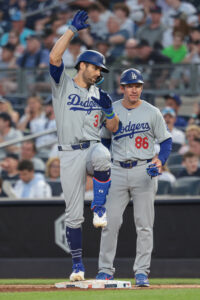
That was the start of a five-year stretch in which Taylor was a key piece of very successful Dodgers teams. He’d hit .258/.340/.450 with 57 homers from 2018-21, earning an All-Star selection in the final of those years. He’d win his first World Series ring when L.A. defeated the Rays in 2020. That was ironically one of the only postseasons in which Taylor didn’t have good numbers, but he’d go on an absolute tear the following October.
Taylor had a signature moment when he hit a walk-off home run against Alex Reyes to knock out the Cardinals in the ’21 Wild Card Game. That was the first of four he’d hit in that postseason despite Dodgers getting bounced by the Braves in the NLCS. Taylor carried that momentum into his first trip to free agency, eventually re-signing on a four-year contract that guaranteed him $60MM.
Although it was an obvious move for the Dodgers at the time, that didn’t work out the way Taylor or the team would’ve hoped. He missed time in each of the first three seasons while his power production dropped. His game always came with a lot of strikeouts, so the declining slugging numbers made him a below-average hitter. He remained a valued clubhouse presence, though, and he’d win another championship when the Dodgers knocked off the Yankees in a five-game World Series in 2024.
Taylor spent the first six weeks of the 2025 season holding a spot on Dave Roberts’ bench. He’d get released in May and joined the Angels on a big league deal. He broke his hand early in his Halos’ tenure and spent most of the year on the injured list. He hit .186 in 58 games between the two clubs, but he’d collect a third ring for his early-season work once the Dodgers repeated as champions. Taylor also achieved the 10-year service milestone last August, albeit while on the injured list.
Taylor re-signed with the Angels but was unable to snag a roster spot out of camp. After 32 games with Triple-A Salt Lake, he evidently decided he was prepared to call it a career. It’s unclear if that’s due to some kind of injury. Taylor played on Wednesday and departed in the sixth inning after being hit by a pitch in what’ll seemingly be his final professional plate appearance.
Over more than a decade in the Majors, Taylor tallied 860 hits and 110 home runs. He had a league average .248/.327/.419 batting line overall, though he was an above-average hitter for five straight seasons at his peak. His .247/.351/.441 postseason slash was superior to his regular season mark despite the higher quality of competition.
Taylor was a part of two World Series winners and four NL pennants in L.A., three of them as an everyday player. He also suited up at six positions — all three outfield spots and the infield positions to the left of first base — as a versatile defender. Baseball Reference and FanGraphs credited him with roughly 16-17 Wins Above Replacement, and he racked up nearly $78MM in earnings. Congratulations to Taylor on an excellent run and all the best in retirement.
Image courtesy of Vincent Carchietta, Imagn Images.
Twins Option Royce Lewis, Select Orlando Arcia, Release Justin Topa
TODAY: Topa has been released, according to Aaron Gleeman of AaronGleeman.com. That indicates he cleared outright waivers after being designated for assignment.
May 19th 11:02am: Right-hander Justin Topa is being designated for assignment to make room for Arcia on the 40-man roster, per MLB.com’s Matthew Leach. It sounds as though there’ll be additional roster juggling for the Twins at some point today, as this sequence leaves them at 25 players and short one arm in the ‘pen.
May 19th 10:58am: Minnesota is selecting the contract of veteran infielder Orlando Arcia to take Lewis’ spot on the big league roster, Hayes further reports. They’ll need to make a corresponding 40-man roster move to get Arcia onto the roster.
May 19th 10:52am: The Twins have optioned third baseman Royce Lewis to Triple-A St. Paul following a dismal start to his 2026 season, Dan Hayes of The Athletic reports. It’s the first time since 2022 that the former No. 1 overall pick has been optioned, and it’s the second member of Minnesota’s Opening Day lineup to be sent down in the past week. The Twins also sent struggling right fielder Matt Wallner out last Thursday — his first time being optioned in two years.
Now 26 years old, Lewis looked bound for stardom when he debuted in 2022-23 with a .307/.364/.549 slash and 17 homers in his first 70 MLB games (280 plate appearances). On top of that performance, he went on to club four homers in 26 plate appearances during Minnesota’s 2023 postseason run. Injuries have taken their toll and derailed the promising slugger’s trajectory. Lewis has twice torn the ACL in his right knee. He’s also had three strains/partial tears of his left hamstring, a quad strain in his right leg and (earlier this year) a mild sprain in his left knee.
In 31 games and 119 plate appearances this season, Lewis is hitting just .163/.261/.279. Strikeouts have never been a prominent issue for him in the past — he posted a 21% strikeout rate from 2022-25 — but he’s fanned in 31.1% of his plate appearances this season. Lewis’ 32.8% chase rate on balls off the plate isn’t egregiously higher than his 31.4% career mark, but it’s way north of the 28.2% mark he showed during that 2022-23 flash of potential stardom. Meanwhile, his contact rate on pitches within the zone has dropped from 83.7% entering the year to just 78.3%. His contact rate when he does chase off the plate has cratered, falling from 59.1% in 2022-25 to only 44% this season.
Because it’s been so long since he was sent down, Lewis is still in the second of three minor league option years. He’s making $2.85MM this season after avoiding arbitration over the winter, and he’s already crossed the four-year threshold in service time this season, so a minor league assignment doesn’t change his potential timeline to free agency. Getting to six years of service and free agency isn’t a guarantee at this point, however. He’ll need to get back on track in the minors or else risk being non-tendered following the season.
With Lewis headed across the Mississippi River for the time being, third base seems likely to be handled by a combination of Arcia and utilityman Ryan Kreidler. Left fielder Austin Martin and shortstop Brooks Lee both have experience at third base, but Martin is enjoying a breakout in the outfield while the Twins are trying to give Lee a long leash to see if he can handle shortstop in the long run. Neither seems all that likely to change positions — at least for now. (Top prospect Kaelen Culpepper could potentially push Lee off shortstop at some point this summer.)
Arcia, the younger brother of former Twins top prospect and outfielder Oswaldo Arcia, has an inconsistent big league track record but has been on a tear in St. Paul this season. Once ranked as one of the sport’s 10 best prospects, the younger Arcia never found his footing with his original organization, the Brewers. Milwaukee wound up trading him to Atlanta in 2021, and Arcia went on a nice two-year run with the Braves, hitting .258/.319/.419 in 767 plate appearances from 2022-23. The same struggles he experienced with the Brewers resurfaced in 2024, however, as Arcia batted just .214/.263/.337 in 816 plate appearances between the Braves and Rockies from 2024-25. Overall, he’s a .239/.292/.369 hitter in 3537 big league plate appearances.
Arcia will get a chance to bounce back with the Twins after hitting .318/.376/.556 with eight homers, 10 doubles, a triple, three steals, an 8.5% walk rate and an 18.8% strikeout rate in 39 games (165 plate appearances) with the Saints to begin the year. He’s accrued well beyond eight years of big league service time, so even if Arcia does put together a rebound effort, he’ll be a free agent at season’s end.
Topa, 35, has spent parts of three seasons with the Twins after coming over from the Mariners alongside prospect Gabriel Gonzalez in the Jorge Polanco trade. He missed nearly all of the 2024 season following a spring knee injury but was a solid middle-relief presence in 2025, tossing 60 innings with a 3.90 ERA, an 18.3% strikeout rate, a 6.7% walk rate and a 47.7% ground-ball rate.
The 2026 season hasn’t been kind to Topa. He’s pitched 19 innings and served up 18 runs (17 earned) on 27 hits and 11 walks. He’s yielded four home runs, struck out only 13% of his opponents and walked 12% of them.
Earlier in his career, Topa was frequently injured but showed premium stuff when healthy, leading to plenty of “what if” speculation about a potentially high-end reliever who simply couldn’t stay healthy. He broke out with the 2023 Mariners, logging a 2.61 ERA, 21.9% strikeout rate, 6.5% walk rate and 56.7% grounder rate in what’s still a career-high 69 innings. The power sinker that Topa showed that season is down from an average of 95 mph to 93.2 mph in 2026, however. Topa isn’t missing bats anywhere close to a league-average level, and his command has worsened.
The Twins are paying Topa $1.225MM this season. Between that salary and his struggles, it’s likely that he’ll either clear outright waivers or be released, though the Twins can spend up to five days looking for a trade partner before going the waiver route.
Reds Activate Caleb Ferguson From 15-Day IL, Recall Zach Maxwell
The Reds have activated reliever Caleb Ferguson from the 15-day injured list, according to Charlie Goldsmith of Charlie’s Chalkboard. Zach Maxwell is being recalled from Triple-A. Connor Phillips and Jose Franco are being optioned in corresponding moves.
Ferguson signed with the Reds on a one-year, $4.5MM deal back in December. He has not yet appeared in 2026, instead beginning the year on the IL with an oblique muscle strain. That was Ferguson’s first IL placement since 2022, so the Reds are likely confident he can return as the durable groundball specialist that he was from 2023-25.
Ferguson had a 3.85 ERA in an even 180 innings in that span, which he split between five teams. His ERA peaked at 4.64 in 2024, although that came with a .340 opponents’ average on balls in play, suggesting Ferguson was due for regression. Indeed, Ferguson lowered his ERA to 3.58 in 2025, albeit with interesting trends in his peripherals. After striking out 26.9% of opponents in 2024, that fell to 18.9% in 2025, well below the league average. On the flip side, Ferguson upped his groundball rate to 48.7% and did very well at keeping the ball in the yard, allowing just two long balls in 65 1/3 innings.
Ferguson’s velocity didn’t change all that much from 2024-25. That said, the lefty decreased his four-seam usage by 11.7% in favor of his sinker, which Ferguson now used 23.2% of the time. That could partly explain the uptick in groundballs, although the drop in strikeouts was more puzzling given Ferguson’s similar velocity to 2024. Coming off his injury, the Reds can probably expect an ERA in the mid- to upper-3.00’s and an above-average groundball rate from Ferguson, ideally with some recovery of the strikeouts. That would be a huge boost to a bullpen whose 4.98 ERA is third-worst in the Majors, behind only the Angels and Astros.
Maxwell returns from Triple-A Louisville after last appearing in the Majors on May 1st. That wasn’t a good day for him, as Maxwell allowed four earned runs on two homers in a single frame of work. A sixth-round draft pick by Cincy in 2022, Maxwell has only thrown 11 innings in the Majors since debuting last year. He has a 7.36 ERA in that small sample. Maxwell’s minor league work is somewhat more promising. He had a 4.17 ERA in 49 2/3 Triple-A innings last year, which he’s decreased to 3.50 so far in 2026. That said, Maxwell has walked over 14% of hitters since reaching the upper minors in 2024.
The promotion is less about rewarding Maxwell and more about giving Phillips a reset at Triple-A. Manager Terry Francona said of Phillips: “He’s just not throwing enough strikes… He can spin it. But until he starts throwing the ball where he wants to, it can be a struggle.” That’s an accurate assessment of Phillips’ performance in 2026. Despite possessing 95th-percentile fastball velocity, Phillips has failed to capitalize by throwing strikes. His 20.5% walk rate is second-worst among qualified relievers this year and has played a big role in the righty’s 5.06 ERA.
Phillips is only 25 and has plenty of club control left, so he’ll surely get more chances in the future. The same is true of Franco, who now joins Phillips at Triple-A. Franco made the big league club out of spring training but has a 4.30 ERA in 14 2/3 innings so far. He has a troubling 16.4% walk rate in that small sample, although Franco was about five points lower in the upper minors last year. He’ll benefit from working on his control at Triple-A and could feasibly return to the Majors when fresh arms are needed.
Photo courtesy of Jayne Kamin-Oncea, Imagn Images
Angels Sign Taijuan Walker To Minor League Deal
The Angels have signed right-hander Taijuan Walker to a minor league deal, according to Jeff Fletcher of the Orange County Register. Walker was released by the Phillies earlier this season. He is a client of CAA Sports.
Walker, 33, certainly made an impact in Philadelphia this year, and not in a good way. In five appearances (four starts), Walker allowed a staggering 23 earned runs and eight home runs in just 22 2/3 innings. Almost nothing was going right for him, with Walker’s strikeout rate, walk rate, and WHIP all trending in the wrong direction from last year. The Phillies, needing a rotation spot for the returning Zack Wheeler, decided to release Walker on April 23rd.
There is no financial risk in the Angels taking a flier on Walker. At the time of his release, Walker was earning $18MM in the final season of a four-year, $72MM pact with the Phillies. The Angels will only owe him the prorated league minimum for any time spent in the Majors, which will be subtracted from the Phillies’ tab. Regardless of Walker’s underwhelming recent track record, at least he won’t cost the Angels a lot of money.
Of course, his being cheap doesn’t inspire confidence in Walker’s ability to help the Angels. The righty had a 7.10 ERA in 83 2/3 innings in 2024 and allowed two and a half home runs per nine innings. Walker split 2025 between the rotation and bullpen, with mediocre results in both roles. His 4.25 ERA as a starter came despite a below average 14.7% strikeout rate. Meanwhile, Walker’s 3.15 ERA as a reliever disguised an ugly 11.8% walk rate, and his 5.14 FIP put his true talent two runs higher than his ERA. Even if Walker improves on his small sample from earlier this year, he’s at best a No. 5 starter now.
On the other hand, the Angels aren’t a bad place for Walker to try to rebuild his value. The club’s rotation is perhaps better than their 4.60 ERA would suggest, but that’s largely due to Jose Soriano‘s breakout and Reid Detmers having a career-best 3.23 expected ERA (well below his actual 5.07 ERA). Walbert Ureña has a 2.70 ERA, but he’s only 22 years old and walks too many hitters. Jack Kochanowicz‘s so-so 4.55 ERA is benefitting from opponents’ .249 average on balls in play, and Grayson Rodriguez has only made two starts since returning from shoulder inflammation.
Walker could conceivably get some starts if one of Ureña, Kochanowicz, or Rodriguez struggles enough or suffers an injury. The signing also harkens back to the Angels’ offseason strategy, which saw low-cost signings of Alek Manoah among others, plus the buy-low trade for Rodriguez. The Angels are currently at 18-34 and have a less than 1% chance of making the playoffs according to FanGraphs, despite manager Kurt Suzuki believing they’re merely in a cold stretch. The club could bring Walker up if the need arises and put him on outright waivers if he does poorly, as was the case with Manoah.
Photo courtesy of Bill Streicher, Imagn Images
Outrighted To Triple-A: Slater, Blach, Brooks
Catching up on some players recently designated for assignment…
- The Mets outrighted outfielder Austin Slater to Triple-A Syracuse, as per Slater’s MLB.com profile page. There isn’t yet any word on whether or not Slater will accept the assignment, as Slater has the ability to elect free agency rather than report to Triple-A and remain in the Mets organization. Since he has more than five years of MLB service time, Slater can become a free agent while still keeping the $1MM he is guaranteed in 2026, as per the teams of the contract he signed with the Marlins just before the season began. Over 49 combined PA with Miami and New York, Slater has hit only .209/.286/.233 with just one extra-base hit.
- Ty Blach cleared waivers and was outrighted to the Cubs‘ Triple-A Iowa affiliate, according to the left-hander’s MLB.com profile page. Chicago selected Blach’s contract to the active roster last weekend but DFA’ed him two days later, after Blach tossed three shutout innings of relief work in the Cubs’ 9-3 loss to the Brewers on Monday. That cup of coffee represented Blach’s first bit of MLB work since 2024, and he now has the option of rejecting the outright assignment in favor of free agency or returning to Iowa. Given the ongoing injury woes on the Cubs’ pitching staff, Blach might prefer to stay put, as another call to the majors might come sooner rather than later.
- Aaron Brooks pitched for Triple-A Durham yesterday, indicating that the right-hander accepted his outright assignment to the Rays‘ top affiliate. Brooks was outrighted last Sunday and he had the ability to elect free agency, but it looks like the righty has opted to stay in Tampa’s organization. Like Blach, Brooks was also making his first MLB appearance since 2024 in his own one-game cameo back in the Show, though Brooks’ lone outing was much rockier. He was charged with three earned runs in one-third of an inning of work in the Rays’ 5-3 loss to the Blue Jays on May 13.
Yankees Sign Peter Strzelecki To Minors Contract
The Yankees have signed right-hander Peter Strzelecki to a minor league deal, Jon Heyman of the New York Post reports. Strzelecki will begin his tenure with his new team at Triple-A Scranton/Wilkes-Barre.
The Brewers signed Strzelecki to a minors deal back in February, and selected that contract to the 26-man roster last Saturday. However, Strzelecki’s return to the big leagues was very brief, as Milwaukee designated him for assignment the very next day, and before the right-hander could get into a game. Strzelecki cleared waivers and, since he has been outrighted in the past, he had the ability to elect free agency rather than accept the outright assignment back to Milwaukee’s Triple-A affiliate.
His time on the open market was brief, and the righty now lands with what is technically one of his hometown teams — Strzelecki was born in Queens, though he grew up in Florida. Strzelecki is still looking for his first MLB action since 2024, when he had a 2.31 ERA over 11 2/3 innings for the Guardians. Over 83 2/3 career innings with the Brewers (in a previous stint in Milwaukee), Diamondbacks, and Guardians, Strzelecki has a 3.44 ERA, 24% strikeout rate, and 8.4% walk rate.
Despite these solid numbers, Strzelecki’s low-90’s velocity may not turn many heads, and he is out of minor league options. If the Yankees were to select his contract to their active roster, they’d have to DFA Strzelecki and expose the 31-year-old to waivers again before trying to send him back down to the minors. The lack of roster flexibility may lead to more trips through DFA limbo for Strzelecki down the road, but for now he’ll stay in SWB as bullpen depth.