
How Will The Market Value Pete Alonso?
There are a few players who are tough to predict during the preparation of the Top 50 free agents every year. Often, they're players whose reputation outpaces their statistical output, especially in their walk year. Pete Alonso is the best example this offseason.
We landed on a five-year, $125MM prediction that ranked him seventh in the class. That seems to be below market consensus. Other estimates of Alonso's earning power have landed in the $140MM to $170MM range.* Those align more closely with the Polar Bear's reputation as a star, putting him in the Freddie Freeman or Matt Olson bucket. Freeman landed a deferred $162MM contract from the Dodgers, while Olson's extension with the Braves guaranteed him $168MM over eight seasons.
Alonso likely expects to be paid similarly. Joel Sherman of the New York Post has reported that Alonso declined a seven-year, $158MM offer from the Mets in June 2023. That would have bought out his final arbitration season and six free agent years. Alonso collected $20.5MM for his last arbitration year, so the extension proposal can be considered akin to $137.5MM over six seasons. As recently as last summer, Alonso and his previous representatives felt he could do better. (He has since hired the Boras Corporation.) He'll need to buck some market trends for that to be the case.

Unlock Subscriber-Exclusive Articles Like This One With a Trade Rumors Front Office Subscription
- Access weekly subscriber-only articles by Tim Dierkes, Steve Adams, and Anthony Franco.
- Join exclusive weekly live chats with Anthony.
- Remove ads and support our writers.
- Access GM-caliber tools like our MLB Contract Tracker
A’s Not Discussing Rotation Move For Mason Miller
Last offseason, the Athletics moved Mason Miller from the rotation to the closing job. General manager David Forst said at the time that the A’s were open to building the right-hander back up as a starter after one season in relief. That doesn’t seem to be on the table for now.
“We’re not talking about moving him back into a starting role,” Forst told John Shea of the San Francisco Chronicle this week. While that doesn’t preclude having the conversation at some point during the offseason, it appears the likelier outcome is that Miller will remain in the ninth inning.
Stretching Miller back out would be a huge risk-reward play for the A’s. A few teams have had success with converted relievers in recent seasons. Garrett Crochet immediately looked like a budding ace when the White Sox gave him a starting job. Seth Lugo and Michael King have gone from setup relievers to borderline top-of-the-rotation starters. Reynaldo López and José Soriano found success but battled injury issues in their returns to starting. Free agent righty Jeff Hoffman has drawn interest as a potential rotation conversion.
Miller is talented enough that a Crochet arc would be within the realistic range of outcomes. The A’s are concerned that a starter’s workload would weigh heavily on his arm, though. Miller has battled shoulder and elbow injuries and pitched fewer than 40 innings in the minor leagues. He started six MLB games as a rookie in 2023. Miller was pitching well but forearm tightness shelved him between mid-May and the start of September. The A’s used him out of the bullpen for the season’s final month and kept him in that capacity this year.
The 26-year-old’s first full season as a closer could hardly have gone better. Miller’s already elite velocity jumped in short stints. His fastball averaged nearly 101 MPH and routinely got into the 103-104 range. Between that kind of life and a wipeout slider, Miller was almost untouchable. He turned in a 2.49 ERA while striking out almost 42% of opposing hitters through 65 innings. Opponents swung and missed at nearly a fifth of his offerings. Among relievers with 50+ innings, only Josh Hader and Braves’ breakout lefty Dylan Lee got swinging strikes more frequently. Miller locked down 28 of 31 save attempts.
Most importantly, Miller’s arm held up. His only injury this year was a three-week absence due to a small fracture in his non-throwing hand. (He reportedly sustained that injury when he struck a training table in frustration after a poor outing.) It took all of a few weeks for Miller to establish himself as an elite late-game weapon.
Relievers aren’t immune to injury, but the A’s clearly feel better about his chances to stay healthy working in 1-2 inning stints. Assuming they don’t reverse course later in the offseason, he’ll project as one of the best closers in baseball. Other teams called on Miller at the deadline and surely will do so again this winter, but a trade would be a surprise. He’s still a year from arbitration and under club control for five seasons. The A’s are no longer aggressively tearing down the roster. They were relatively quiet at the deadline. Forst has already declared they’re keeping Brent Rooker, their best trade chip aside from Miller.
The A’s will need to add multiple starting pitchers. Their rotation is among the thinnest in the league. Players like JP Sears, Mitch Spence and Joey Estes headline the group. They all look like back-of-the-rotation arms at best. With almost nothing on the books for next season, Forst and his staff should be able to take on money via trade and/or a mid-level free agent strike to add innings.
Breslow: Red Sox Looking To “Raise The Ceiling” In Rotation
The Red Sox look to be one of the top suitors for impact starting pitching. As teams laid the groundwork for the offseason at this week’s GM Meetings, chief baseball officer Craig Breslow suggested the Sox are evaluating ways to land a top-flight starter.
“We know we need to raise the ceiling of the rotation,” Breslow said (link via Alex Speier of the Boston Globe). “I think there are a lot of ways to do that, but we’re going to be really, really open-minded.”
The most straightforward solution is through free agency. Corbin Burnes and Blake Snell headline the rotation class. Max Fried and Jack Flaherty aren’t far behind. Nathan Eovaldi, Yusei Kikuchi and Sean Manaea all project as mid-rotation arms and should be available on shorter-term deals based on their ages. Eovaldi is probably looking at a two-year pact with a lofty annual value, while Manaea and Kikuchi should get three or four years.
Snell and Burnes are the unquestioned aces. Fried is a little more of a borderline ace but he’d slot into the top two spots in any rotation. Flaherty has flashed ace-caliber ability, albeit with less consistency. They’d all project as the #1 starter in Boston. The Red Sox have a group of quality mid-rotation starters but don’t have a true #1 arm.
Tanner Houck is the closest thing to an ace among the internal options. He’s coming off an excellent year, turning in a 3.12 ERA through 30 starts. Houck’s profile is built more around huge ground-ball numbers than swinging strikes. Brayan Bello and Kutter Crawford each took 30+ starts with earned run averages narrowly below 4.50. They fit into the middle of a rotation. So does Lucas Giolito, who’ll be back after missing all of 2024 due to elbow surgery. Giolito has performed like a #2 starter at his best, but home run issues led him to post an ERA approaching 5.00 in both 2022 and ’23.
The Sox are awaiting word from Nick Pivetta on whether he’ll return. Boston somewhat surprisingly tagged Pivetta with a $21.05MM qualifying offer. The right-hander has until November 19 to decide whether to accept. (Jon Heyman of the New York Post wrote yesterday that while Pivetta is weighing the QO, he has found a nice market in free agency’s opening days.) As with the rest of the Sox’s in-house options, he projects as more of a third or fourth starter. Pivetta has the strikeout and walk profile of a top-end arm, but he has been very susceptible to the longball over his career. He has been a durable source of innings but doesn’t have a single sub-4.00 ERA showing on his résumé.
Boston has a few interesting depth arms beyond that. Cooper Criswell and Richard Fitts performed well when called upon. Garrett Whitlock could be back from UCL surgery in the second half, though his injury history could point to a return to the bullpen. Quinn Priester is a former top prospect who hasn’t put things together at the MLB level.
The Red Sox have good rotation depth, especially if Pivetta accepts the QO. There’s certainly value in not giving starts to sub-replacement level pitchers. The Sox are well positioned to do that, but it’d be difficult to compete for an AL East title without having a legitimate #1 starter.
Boston should have the payroll capacity to make a run at one of the top starters. They also have the high-end prospect capital to push for any trade candidates. Garrett Crochet could be the prize of the rotation trade market. He flashed ace upside in his first season as a starting pitcher. The White Sox are likely to move him this offseason. Chicago GM Chris Getz said they’ll target position player help in trade returns.
Boston has four hitters who landed among Baseball America’s top 25 prospects. A trade involving top 10 talents Roman Anthony and Marcelo Mayer would be a shock, but catcher Kyle Teel or breakout infielder Kristian Campbell could center a return for a high-end starter. Boston could also deal lefty-hitting outfielder Wilyer Abreu for pitching help if they’re confident Anthony will be a productive MLB player next year.
There’s been some speculation about the Sox moving young first baseman Triston Casas as well, but Breslow shot that notion down this week. “I’m not sure where that’s coming from,” Boston’s front office leader said (X link via Christopher Smith of MassLive). “Casas is a guy that we think has 40-home run potential. He’s young and also has a great strike zone discipline and controls an at-bat. We’re excited he’s on our team.”
In addition to the rotation pursuit, Boston needs to land bullpen help. Kenley Jansen and Chris Martin each hit free agency. While a Martin return is possible, Jansen is almost certainly signing elsewhere. Liam Hendriks should be back from Tommy John surgery and could pitch in the ninth inning behind Rule 5 breakout Justin Slaten. There’s room for another leverage arm, especially one who throws left-handed.
Breslow acknowledged that the Red Sox are looking for lefty bullpen help to add a late-inning arm alongside Cam Booser and Brennan Bernardino (Smith link). Breslow also spoke generally about wanting to add velocity and a swing-and-miss element to the relief group. Boston relievers ranked 23rd in strikeout rate and 26th in swinging strike percentage this year. Free agency’s top reliever, Tanner Scott, is a lefty who throws in the upper 90s and misses bats in bunches. He’s well above the rest of the left-handed class, so he could command a four-year deal that exceeds $50MM.
Cardinals Reach New Broadcast Deal With Diamond Sports Group
The Cardinals announced this afternoon that they’ve reached a new multi-year contract with FanDuel Sports Network to continue carrying in-market broadcasts. The deal includes a streaming partnership that’ll allow consumers in the St. Louis area to access games on the FanDuel app. Hannah Wyman and Derrick Goold of the St. Louis Post-Dispatch write that app subscribers can view the games without a television provider, which should drastically reduce blackouts.
FanDuel Sports Network, which is a property of Diamond Sports Group, is the same TV network that had broadcasting rights to Cardinals games under the previous Bally Sports moniker. Last month, Diamond abandoned its previous deals with the Cards and 11 other teams as it continues to navigate bankruptcy. Diamond expressed openness to renegotiating at least some of those deals at reduced fees.
The Cards were willing to do so despite the associated revenue losses. Wyman and Goold report that they’ll take a 23% reduction next season compared to what they would’ve made on the prior contract. With the previous deal calling for roughly $75MM in rights fees, the Cardinals stand to drop roughly $17.25MM to the $57-58MM range. The team did not specify the length of this contract beyond calling it a multi-year partnership. Evan Drellich and Katie Woo of the Athletic report that the deal does not stretch into the 2030s and affords some measure of flexibility depending on the future state of sports media.
For fans, the streaming addition is the biggest direct news. The deal is indirectly relevant to the fanbase by providing the organization with a bit of clarity on their revenue situation. The expected revenue losses have long pointed to a dip in spending. That was reinforced by the decision to decline a few team options, most notably a $12MM call on Kyle Gibson. They’re not expected to pursue reunions with free agents Paul Goldschmidt and Andrew Kittredge.
That could account for most of the payroll reduction. St. Louis has a little less than $110MM committed. Their arbitration class is projected for something in the $19MM range. That leaves the Cards nearly $50MM south of this past season’s Opening Day spending. The Cardinals are going to get trade interest on a number of veterans as they embrace a retooling effort and evaluate younger players. Speculation about a complete teardown was quieted this week with reports that Willson Contreras and Sonny Gray, both of whom have no-trade clauses, are unlikely to move after suggesting they preferred to stay in St. Louis.
The Cardinals become the second team to negotiate a new deal with Diamond after its previous broadcasting agreement was dropped. The Marlins reportedly reached a contract to stay on FanDuel Sports Network last month, though Miami hasn’t made any official announcement. Diamond is abiding by its original contract with the Braves, so it’ll carry at least three teams next year.
ESPN’s Alden González writes that MLB will carry broadcasts for the Twins, Guardians and Brewers — all of whom were dropped by Diamond. (They join the Padres, Diamondbacks and Rockies in that regard.) The Rangers said they have no plans to renegotiate with Diamond but are still exploring other opportunities. Plans for the other five teams — the Reds, Rays, Tigers, Angels and Royals — are still undetermined.
Giants, Sergio Alcantara Agree To Minor League Contract
The Giants are in agreement with infielder Sergio Alcántara on a minor league deal, reports Francys Romero (X link). The Quality Control Sports client gets an invitation to big league camp.
Alcántara has appeared with four teams at the major league level. He hasn’t played in the big leagues since 2022. The switch-hitting infielder split the ’24 campaign between the Triple-A affiliates of the Pirates and Diamondbacks. His .271/.388/.416 slash is solid on the surface, though that was mostly concentrated in a hitter’s paradise in Reno. Alcántara has played the role of light-hitting utilityman in his MLB career. He’s a .209/.281/.343 hitter over 502 big league plate appearances.
While Alcántara doesn’t provide much at the plate, he has bounced around on the strength of his glove. He has more than 6000 innings of shortstop experience in the minors. Alcátara has upwards of 1000 professional frames at both second and third base. The Giants are likely to add a starting shortstop this winter to push Tyler Fitzgerald to second base. Most of San Francisco’s utility players are stretched at shortstop, so Alcántara is a sensible depth target who’ll likely open the season in Triple-A.
Mets, Rico Garcia Agree To Minor League Deal
The Mets are in agreement with free agent reliever Rico Garcia on a minor league contract, reports Anthony DiComo of MLB.com (X link). The Gaeta Sports Management client gets an invite to big league Spring Training on a deal that would pay him a $900K base salary if he makes the big league roster.
Garcia is trying to work back to the big leagues after spending this year in Triple-A. The righty had a nice year for Washington’s top affiliate. Garcia saved 20 games and turned in a 3.94 ERA through 61 2/3 innings. He struck out a massive 34.1% of opposing hitters. That came with a fair number of free passes, as an 11.5% walk rate is perhaps the biggest reason he didn’t get an MLB look.
The 30-year-old Garcia has pitched in parts of four big league campaigns between five teams. He has struggled to a 7.32 earned run average over 35 2/3 innings. His most recent MLB action came with 10 appearances between the Athletics and Nationals in 2023. Garcia hasn’t carried over much bat-missing ability to the highest level. His 12.4% career strikeout rate is well below average.
New York has made a couple bullpen depth additions since the offseason began. They gave Dylan Covey a major league contract last week. The 40-man spot gives Covey a leg up on Garcia and whichever other relievers the Mets add as non-roster invitees, but there’s likely to be a fair amount of competition for middle relief roles in camp.
Giants, Blue Jays Showing Interest In Ha-Seong Kim
Ha-Seong Kim is finding interest in free agency’s opening days. Mark Feinsand of MLB.com writes that the Giants have identified him as an early target. Ben Nicholson-Smith of Sportsnet reports that the Blue Jays are also showing interest as they evaluate infield possibilities.
While this is the first substantive tie between Kim and the Giants, that fit had been speculated long before he hit free agency. Giants skipper Bob Melvin managed the infielder for two seasons with the Padres. President of baseball operations Buster Posey has called shortstop a target area. Improving defensively seems like a particular priority, as landing a shortstop could allow San Francisco to slide Tyler Fitzgerald to second base.
Willy Adames is the top free agent shortstop. He could land a six- or seven-year contract. Kim seemed to be on track for four or five years as recently as a few months ago. A season-ending shoulder injury and postseason labrum surgery make it likelier he’ll take a short-term deal. The Padres opted not to issue a qualifying offer, which Kim would almost certainly have declined if he were healthy. San Diego president of baseball ops A.J. Preller has floated a nebulous timeline for the 29-year-old’s return, suggesting he could be out between May and July. Kim’s agent Scott Boras has indicated he could be available earlier in the season, potentially before the end of April.
Kim’s value is driven largely by his glove. He has proven to be a plus defender throughout the infield, at least when he’s at full strength. While some teams could be concerned about his arm in the immediate aftermath of a significant shoulder procedure, Kim had shown a sufficient arm before the surgery to play on the left side of the infield. He’s a roughly league average hitter, compensating for middling power with good contact skills and strong walk rates. Kim hit .233/.330/.370 with 11 homers and 22 stolen bases during his platform year.
He’s also a plus defender at second base, where the Jays would ostensibly target him. Nicholson-Smith reported last night that Toronto had also checked in on Gleyber Torres. Toronto has Bo Bichette returning at shortstop. Between second and third base, they have a handful of internal options who are light on MLB experience (e.g. Will Wagner, Davis Schneider, Addison Barger, Orelvis Martinez, Ernie Clement). Toronto also used Vladimir Guerrero Jr. sporadically at the hot corner.
MLBTR predicted Kim for a one-year pillow contract valued around $12MM. His camp could try to secure a two-year guarantee that allows him to opt out after next season, though it’s not clear if teams are willing to take that risk coming off the injury. The Padres have expressed interest in bringing him back, while the Braves and Mariners are speculative possibilities to pursue middle infield help.
Rays Among Teams To Have Reached Out To Soto
The Rays are among the teams that have reached out to Juan Soto’s camp since the opening of free agency last week, writes Jon Heyman of the New York Post. Heyman lists a much less surprising additional six teams that have shown interest: the Yankees, Mets, Dodgers, Giants, Blue Jays and Red Sox.
The mere mention of the Rays as a possible Soto suitor is going to be met with plenty of skepticism. It’d be a shock if they made a legitimate push for the market’s top free agent. The Rays have tried to land an elite free agent at least once before, as they reportedly made an offer in the $150MM range to Freddie Freeman before he signed with the Dodgers. That wasn’t too far off the price Freeman ultimately landed, but any offers to Soto would be in a different stratosphere. He should handily top $500MM and could secure a contract between $600MM and $700MM.
While it’s fair to assume the Rays themselves aren’t optimistic about their chances, this is illustrative that they have some money to at least dabble in the middle of free agency. The Rays opened this past season with a payroll around $98MM, per Cot’s Baseball Contracts. They’ve got a little less than $40MM in guaranteed commitments for next year (assuming Wander Franco remains on the restricted list and is not paid). Their arbitration class is projected around $25MM, though they could knock that to the $15MM range with a few non-tenders. Trades of Brandon Lowe or Yandy Díaz would subtract another $10.5MM or $10MM, respectively.
None of that is to say they should be perceived as a realistic threat to the big-market teams on Soto. They’ll probably be more active in free agency than many fans might expect given their general spending habits, though. Another mid-tier strike akin to the $40MM Zach Eflin deal from two offseasons ago could be on the table. Any free agent pursuits are complicated by their uncertain stadium situation after Tropicana Field was severely damaged by Hurricane Milton.
The other teams known to have some interest in Soto are all expected. The Yankees and Mets are widely perceived as the favorites. The Dodgers are at least tied to virtually every free agent of note. The news that Mookie Betts is likely moving back to the middle infield is going to fuel speculation about L.A. making a run at Soto. Giants baseball operations president Buster Posey has spoken about wanting to land a star. The Blue Jays were in the running for Shohei Ohtani last winter. The Red Sox have indicated they could be more active in free agency than they’ve been over the past few winters, although a splash in the rotation market seems much likelier than them landing Soto.
The New York Post reported last week that 11 teams had been in contact with Soto’s reps at the Boras Corporation on the first day of the offseason. That leaves at least four unknown clubs, though Heyman casts some doubt on the Nationals and Cubs as possibilities. Heyman suggests that Washington is unlikely to spend at the level necessary to bring Soto back. He writes that Chicago’s offseason plans are more geared towards pitching at the moment.
Soto’s free agency should carry for multiple weeks. USA Today’s Bob Nightengale wrote this afternoon that the four-time All-Star plans to have an in-person meeting with the ownership group of each team making a serious pursuit.
Astros Have Internally Discussed Ryan Pressly Trade
The Astros have had internal conversations about the possibility of trading Ryan Pressly, reports Chandler Rome of the Athletic. While that’d be a logical way to clear payroll space, a deal is complicated by the reliever’s full no-trade rights.
Pressly has a decade of MLB service and has spent five-plus seasons in Houston. Players who meet that criteria have full no-trade protection under the collective bargaining agreement. Pressly could quickly halt trade consideration if he has no desire to leave. (Rome notes that the pitcher’s wife Kat is a Houston native.)
If Pressly is amenable to moving, that would go a long way to opening spending room for the team. The Astros are trying to re-sign Alex Bregman. They could look for help at first base and in the outfield. RosterResource already projects next season’s luxury tax number around $234MM. That’s $7MM shy of the lowest threshold. They’d need to go well into tax territory to retain Bregman. Even if they let the star third baseman walk, they’re likely to push above the tax line for what’d be a second straight year. They’d be subject to higher penalties for exceeding the threshold in back-to-back seasons.
General manager Dana Brown admitted last month that the situation could require the Astros to be “creative” with their payroll. The most straightforward solution — subject to the no-trade complications — is a Pressly deal. The righty triggered a $14MM vesting option for his age-36 season. That’s a pricey sum for a pitcher who lost his spot in the ninth inning when the Astros signed Josh Hader last winter. Pressly featured prominently on MLBTR’s list of the top offseason trade candidates as a result.
While the Astros may not be keen on a $14MM salary, another team could assume that to plug Pressly into the ninth inning. He closed in Houston between 2020-23, locking down 30+ saves in each of the latter two seasons. Pressly hasn’t posted a season with an ERA above 4.00 during his six-plus years with the Astros, though his results have trended slightly downward over the last two seasons.
After turning in consecutive sub-3.00 showings in 2021-22, Pressly has allowed an ERA around 3.50 for the past couple years. He allowed 3.49 earned runs per nine over 56 2/3 innings this past season. His 23.3% strikeout percentage and 48.8% grounder rate, while solid, were each below typical levels. Pressly’s strikeout and whiff rates have dropped in consecutive years. His 93.8 MPH average fastball velocity was down a tick compared to last season.
Pressly appears to be on a slight decline, though he remains a quality late-game arm. A $14MM salary is about the range he’d expect as a free agent. The Orioles committed $13MM to Craig Kimbrel last winter, while the Pirates signed Aroldis Chapman for $10.5MM. The Rangers added David Robertson on a deferred $11.5MM deal. Pressly falls into that bucket of one-time star closers who are still effective but not as dominant as they were at their peak. The Astros could probably find a taker for the majority or all of the money, but teams aren’t going to part with significant prospect capital to acquire what is essentially a market value contract.
Hader will be back in the ninth inning. Bryan Abreu remains an excellent setup option. A Pressly trade would put more pressure on the likes of Tayler Scott and potentially Bryan King to prove themselves capable of pitching meaningful innings.
Padres Announce Contract Extension With Manager Mike Shildt
November 6: The Padres made it official today, announcing that they have agreed to a two-year extension with Shildt to keep him through 2027.
November 5: The Padres are finalizing an extension with manager Mike Shildt that’ll keep him in San Diego through 2027, reports Kevin Acee of the San Diego Union-Tribune. President of baseball operations A.J. Preller told reporters last month that the team would look to work out a new deal with their skipper, who signed a two-year contract when he was hired over the 2023-24 offseason.
San Diego tasked Shildt with stabilizing the clubhouse after Bob Melvin’s departure. Tension between Melvin and Preller reportedly played a role in the former’s decision to leave the Padres and take the managerial role in San Francisco. The Padres considered a few external candidates but opted to turn the reins to Shildt, who had been in the player development department for the preceding two seasons.
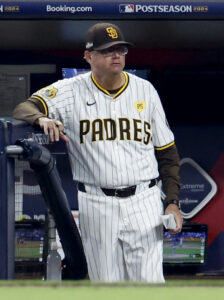
That came on a relatively short two-year commitment. Shildt oversaw an excellent rebound year after the Friars had underperformed during Melvin’s final season. The Padres went 93-69 to secure the top Wild Card spot in the National League. They won 11 more games than they had in ’23 despite trading Juan Soto and losing Blake Snell, Michael Wacha, Seth Lugo and Nick Martinez in free agency.
It’s certainly not all a testament to the managerial change. The front office hit on the Soto return that landed Michael King and indirectly enabled them to acquire Dylan Cease. The Jurickson Profar signing was probably the best value pickup of the offseason. Jackson Merrill had a fantastic rookie year. The Padres also simply played better in one-run and extra-inning contests after faring terribly in those regards during the previous season.
All that said, it’s not hard to see why the Padres are making a longer commitment to Shildt after that season. San Diego played fantastic ball down the stretch and proved the Dodgers’ biggest challenge on their championship run. The Padres pushed L.A. to the brink of elimination in the Division Series after sweeping the Braves in the Wild Card round. Their season ended on a sour note, as Dodger pitching shut them out in consecutive games to win the series, but that was by far the closest anyone came to threatening Los Angeles. Seeing the Dodgers fairly easily knock off the Mets and Yankees to win the World Series hammers home how close the Padres were to fielding a championship-caliber roster in their own right.
Before landing in San Diego, Shildt spent three-plus seasons managing the Cardinals. He led St. Louis to a pair of 90-win campaigns and three straight playoff appearances between 2019-21. The Cards surprisingly moved on from him after the ’21 season, with president of baseball operations John Mozeliak citing philosophical differences between Shildt and the front office. The 56-year-old has been fortunate to work with talented rosters, but his teams have posted excellent results at both stops. Shildt carries a career 345-268 managerial record, resulting in a .563 win percentage that translates to a roughly 91-win pace over a full season.
Image courtesy of Imagn.