
Royals Place Nick Anderson On Release Waivers
The Royals released veteran reliever Nick Anderson, according to the transactions log at MLB.com. Anne Rogers of MLB.com tweets that the right-hander is currently on release waivers. If he goes unclaimed, he’ll hit free agency in the coming days.
Kansas City pushed Anderson out of their bullpen last weekend when they acquired Hunter Harvey. With more than five years of major league service, Anderson had the ability to decline any minor league assignments while retaining his $1.575MM salary. That led the Royals to release him after the DFA.
The Royals took a flier on Anderson in a cash trade with the Braves last offseason. Atlanta evidently wasn’t planning to keep him via arbitration, but K.C. swung a deal to bring him in just before the non-tender deadline. Anderson made 37 appearances and tossed 35 2/3 innings, his heaviest MLB workload since his dominant 2019 rookie year. The 34-year-old posted a reasonable 4.04 earned run average, but his peripherals weren’t great.
Anderson got swinging strikes on a modest 9.8% of his offerings. That resulted in a subpar 19% strikeout rate. His 9.8% walk percentage was a bit higher than average. It’s not great aggregate production, although Anderson’s strikeout and walk numbers had started to come around in recent weeks. He had nearly as many walks (12) as strikeouts (13) through the end of May. Since the calendar flipped to June, Anderson punched out 16 hitters while only issuing a trio of free passes in 15 appearances. That coincided with a home run spike, however, and the front office decided to push him out of a scuffling relief group.
Once an elite late-game weapon for the Rays, Anderson missed most of the 2021-22 seasons to elbow injuries. Tampa Bay cut him loose after the ’22 campaign. Anderson hasn’t been the same force he was back in 2019, but he was an above-average reliever for the Braves as recently as last season. He turned in a 3.04 ERA while striking out more than a quarter of opponents across 35 appearances. A shoulder strain ended his year around the All-Star Break.
If Anderson clears waivers, any team could sign him for the prorated portion of the $740K minimum. Kansas City would be on the hook for the rest of his salary. It’s not out of the question he secures a major league contract and jumps right into another team’s MLB bullpen. If he does find an MLB job, Anderson would remain under arbitration control through 2025.
Reds Sign No. 2 Overall Pick Chase Burns
The Reds announced this evening that they’ve officially signed second overall pick Chase Burns. MLB Pipeline’s Jim Callis reports (on X) the the right-hander received a $9.25MM signing bonus. While that’s a bit shy of the $9.79MM slot value, it’s the largest signing bonus in draft history. Burns edges past the $9.2MM which Paul Skenes secured as last year’s first overall pick.
It’s possible that record will only stand for a few days. Burns is the first player from this year’s top 10 to sign. First overall pick Travis Bazzana (and potentially #3 selection Charlie Condon) could land a loftier bonus in the coming weeks. That won’t be of much concern to Burns, the first pitcher to come off the board last week. While Burns was widely expected to be the top pitcher selected, he was a slightly surprising pick at #2. Condon and West Virginia infielder JJ Wetherholt — who “slipped” to the Cardinals at #7 — were marginally ahead of Burns on most public rankings heading into the draft, largely because of the heightened injury risk for pitchers.
ESPN’s Kiley McDaniel and Keith Law of the Athletic each had Burns as the #5 player in the class. FanGraphs slotted him sixth, while Baseball America ranked him fourth. All four publications had Burns and Arkansas lefty Hagen Smith as the top two pitchers in some order.
Burns was a high-profile draft prospect as a high schooler back in 2021. Teams weren’t willing to meet his asking price at the time, leading the 6’3″ righty to the University of Tennessee. Burns had two strong seasons in Knoxville and transferred to Wake Forest for his draft year. He started 16 times for the Demon Deacons, firing 100 innings with a 2.70 earned run average. Burns fanned nearly half the batters he faced and easily led Division I pitchers with 191 strikeouts. Smith was second in the nation with 161 punchouts. He kept his walk rate to a 7.7% clip and finished his college career with a 40% strikeout rate against a 7.6% walk percentage.
With that level of dominance, it’s not surprising that prospect evaluators suggest Burns has a top-of-the-rotation ceiling. Reports credit him with an upper-90s fastball that can run as high as 100 or 101 MPH. That pitch and his wipeout slider have each gotten 70 or 80 grades on the 20-80 scouting scale. Burns’ curveball and changeup are a bit behind the fastball/slider combination and scouting reports point to some effort in his delivery, but there’s not much question about his ability to stick as a starter. Both Law and McDaniel note that he could move quickly through the minors.
Cincinnati selected another Wake Forest righty, Rhett Lowder, in the top 10 a year ago. They’re hopeful that duo will join Hunter Greene, Nick Lodolo and Andrew Abbott as part of a homegrown starting staff. There’s injury risk with any group of young pitchers and the Reds will need more than five starters on an annual basis, but that quintet could be the nucleus of one of the sport’s best rotations if things break right over the next couple seasons.
A’s To Promote Jacob Wilson
The Athletics are calling up top infield prospect Jacob Wilson, reports Martín Gallegos of MLB.com (X link). Last year’s sixth overall pick has posted incredible numbers through his first full professional season. Oakland has two vacancies on the 40-man roster and optioned Armando Alvarez yesterday to create an active roster spot. No corresponding move is required.
Wilson is the fifth player from the 2023 first round to reach the big leagues. The Angels pushed Nolan Schanuel there last summer, while Wyatt Langford, Paul Skenes and Hurston Waldrep have made their debuts this season. Wilson only needed 72 minor league games to convince the A’s that he is prepared for a look at MLB arms.
The A’s selected the righty-hitting Wilson — the son of former All-Star Jack Wilson — after a standout college career at Grand Canyon University. Wilson hit .412 with 19 walks and a laughable total of five strikeouts over 49 games during his junior season. While he certainly wasn’t facing the caliber of pitching that players like Langford and Dylan Crews saw in the SEC, scouts have never doubted that his contact skills would translate.
Whether Wilson would make enough hard contact to be an impact hitter was more debatable. How well the profile will translate against MLB pitching remains to be seen, but he hasn’t had any problem hitting for power in the minors. Wilson tore through Double-A pitching, connecting on 13 doubles and a trio of homers in 22 games. He hit .455/.473/.705 over 93 plate appearances to earn a bump to Triple-A Las Vegas in May. An injured list stint briefly held him back, but he has continued to rake since returning in June.
Over 19 Triple-A contests, Wilson hit .398/.444/.639 with seven walks and only three strikeouts. He popped another four homers and eight doubles. Between the top two minor league levels and a brief rehab stint in rookie ball, he owns an eye-popping .438/.475/.687 batting line in 200 plate appearances this season.
The A’s have used Wilson exclusively at shortstop. There’s little reason for a rebuilding Oakland team not to give him a shot to stick there. The A’s have been running with 27-year-old rookie Max Schuemann at the position for the last two weeks. Schuemann has a league average .245/.339/.347 slash line. That’s decent production, but the former 20th round draftee isn’t going to stand in Wilson’s way. The A’s could kick Schuemann over to third base while Abraham Toro is on the injured list, cutting into the playing time for Brett Harris in the process.
Wilson’s massive numbers vaulted him up to #19 on Baseball America’s most recent ranking of the sport’s Top 100 prospects. He opened the season in the #76 spot. MLB Pipeline ranked him 68th before Opening Day and has nudged him up to #50 at this point. Wilson meets the prospect criteria to potentially earn a full service year if he manages to finish in the top two in Rookie of the Year balloting, though that’ll be a tough task with less than half the season to play. The A’s would not receive a bonus pick if Wilson were to win Rookie of the Year since they didn’t call him up in time to accrue a full year of service in the traditional manner — spending 172 days on the MLB roster.
Barring a top-two Rookie of the Year finish, Wilson will be under team control for six seasons beyond this one. He’s not likely to qualify for arbitration until the 2027-28 offseason. A future assignment back to the minor leagues could delay that trajectory.
White Sox Release Jared Walsh
The White Sox released Jared Walsh from his minor league contract, according to the MLB.com transaction log. The former All-Star first baseman heads back to free agency.
Walsh broke camp with the Rangers while Nathaniel Lowe was injured. The lefty hitter turned in a .226/.317/.321 line in 60 plate appearances spanning 17 games. Texas designated Walsh for assignment and sent him back to free agency once Lowe was ready for reinstatement. The White Sox signed him a week later and sent him to Triple-A Charlotte.
While it was a sensible depth pickup, Walsh hasn’t produced against minor league pitching over the last couple months. He has gone down on strikes at a 36.9% clip. Even with a robust 12.1% walk rate and eight home runs, the whiffs resulted in a meager .185/.289/.415 slash. That wasn’t going to be enough to earn a look even on a clear rebuilding team.
Walsh was a middle-of-the-order presence for the Angels between 2020-21, connecting on 29 homers in the latter campaign. He hasn’t been the same player over the past three years. That’s largely on account of injury, as Walsh’s ’22 season was cut short by thoracic outlet syndrome. He has struggled to make contact against both MLB and Triple-A pitching since returning. Walsh fanned at a near-35% clip in Triple-A with the Angels last season. He has struck out more than 37% of the time in the majors since the start of last season, hitting .159/.250/.293 over his most recent 176 big league plate appearances.
The Rockies May Have Found A Long-Term Answer In Center Field
The Rockies are headed to another last place finish. Overall, the only sources of intrigue are how active they’ll be as deadline sellers and whether they’ll place below the Marlins as the worst team in the National League. That doesn’t negate the possibility of individual development. For a second straight year, Colorado looks like they’ve developed a regular in the outfield amidst a generally rough season.
Last season’s success story was fourth-place NL Rookie of the Year finisher Nolan Jones. While his follow-up has not gone as planned, Colorado has gotten much better production out of another of his second-year outfield mates. Brenton Doyle seems to be turning the corner from an all-glove center fielder to a balanced, above-average everyday player.
One could argue that Doyle had a successful rookie season in his own right. It didn’t match up to Jones’ debut campaign, but Doyle looked like one of the sport’s 5-10 best outfield defenders from the time he was called up. He posted eye-popping grades (+19 Defensive Runs Saved, 15 runs above average by Statcast measurement) in a little more than 1000 innings. He earned a well-deserved Gold Glove.
Stellar as Doyle was defensively, both FanGraphs and Baseball Reference graded him marginally above replacement in 2023. Among regulars, he was probably the least productive hitter in the majors. Doyle ranked last among 212 hitters (minimum 400 plate appearances) with a .250 on-base percentage. His .203 average was sixth-worst and he was in the bottom-10 in slugging percentage as well.
Unlike other players with similar rate stats, Doyle played half his games at Coors Field. The park-adjusted wRC+ metric rated Doyle 57 percentage points below league average offensively. That was worst in the majors among regulars by a wide margin. Tim Anderson was next closest at 40 points below average.
The Rockies had reason to believe Doyle would take a step forward offensively. He went to Division II Shepherd University. Doyle certainly wasn’t facing many professional-caliber arms at that level. He was nevertheless a generally productive minor league hitter, albeit with significant strikeout issues. Doyle is a good athlete who drew praise from prospect evaluators for plus or better raw power. His approach and pure hit tool have always been the biggest concerns, but he had the kind of profile that could lead a team to believe he’d blossom later than most players.

Doyle seems to have done just that in his age-26 season, likely progressing even beyond Colorado’s expectations. He heads into the season’s unofficial second half with a .276/.343/.471 slash line across 377 plate appearances. His 15 homers are already five more than he managed over 431 trips to the plate last season. Doyle hasn’t merely improved from one of the league’s worst hitters to a competent option in the bottom third of a lineup. His offense has jumped from the bottom of the league to better than average. Bud Black gave him some run at the top of order last month and had him in the middle third of the lineup going into the All-Star Break.
An improved process is arguably even more encouraging than the results themselves are. Doyle hasn’t simply ridden a streak of batted ball luck to good numbers. His .338 average on balls in play is .043 points higher than last year’s mark, but it’s not a number that screams for regression. Doyle is an elite runner who hits the ball fairly hard and plays in the sport’s biggest home park. He should be able to maintain a higher-than-average BABIP.
The much bigger driver has been Doyle’s improved strike zone discipline. The righty hitter has both become more selective and taken a massive step forward with his contact skills. As a rookie, Doyle made contact 79% of the time he swung at a pitch inside the strike zone, a bottom-20 mark in the majors. He’s north of 86% this year, slightly higher than the 85.3% league average. Doyle has dramatically improved his contact rates against breaking stuff and is chasing pitches off the plate less often than he did a year ago.
That translates to a vastly improved strikeout and walk profile. After going down on strikes an untenable 35% of the time last season, he’s punching out at a much more passable 24.9% rate. His walks are up from 5.1% to a decent 8.8% mark. No one would confuse Doyle for Juan Soto, but average strike zone numbers are more than sufficient. There’s never been much question about Doyle’s power or athleticism. He’s a fantastic defender. If he can maintain even a fringe-average hit tool, he has an All-Star ceiling.
As is the case with most Rockies players, Doyle has pronounced home/road splits. He has done an inordinate amount of his offensive damage at Coors Field. He’s hitting .346/.407/.588 with a 20.8% strikeout rate over 173 plate appearances at home. Doyle’s road production (.217/.289/.372 with a 28.4% strikeout percentage across 204 PAs) is mediocre. His road numbers are at least partially weighed down by a modest .267 BABIP, though, and his strikeout and walk profile has improved no matter the setting.
With regard to pitcher handedness, Doyle has been above-average against both lefties (.289/.359/.470) and righties (.272/.338/.472). His walk rate is steady regardless of platoon matchups, though he’s been more strikeout prone against righties (26.7%, compared to 19.6% versus southpaws). Doyle has also hit for more power against right-handers, however, which has helped to mitigate some of the extra swings and misses. Any way you slice it, he’s been a quality hitter regardless of opponent.
Whether Doyle can maintain or build off his early-season promise is one of the biggest second half storylines in Colorado. The Rox may not have much to play for as a team, but they’re looking for players to establish themselves. Colorado has Ezequiel Tovar locked in at shortstop and can keep Ryan McMahon at the hot corner for three more seasons. Doyle is in his first full MLB campaign and can be controlled for five years after this one. He has shown the talent to join Tovar, McMahon and hopefully Jones as part of the position player core. Maintaining this newfound approach would only increase the organization’s confidence that Doyle fits with that group.
Image courtesy of USA Today Sports.
A’s Release Lazaro Armenteros
The A’s released outfielder Lazaro Armenteros, tweets Francys Romero. Oakland had sent Armenteros through outright waivers in May, so the move won’t create a spot on the 40-man roster.
It’s a disappointing conclusion to the Cuban outfielder’s seven-year stint in the A’s system. Armenteros was a high-profile amateur signee back in 2016. He landed a $3MM bonus on the strength of his raw power potential. It didn’t take long for prospect evaluators to express concerns about Armenteros’ defense and pure hitting ability, though. The right-handed hitter never made enough contact to get a major league look in Oakland.
Armenteros has fanned in more than 37% of his professional plate appearances. Even with huge walk rates and double digit home run totals, that’s not viable against minor league pitching. The A’s nevertheless added Armenteros to their 40-man roster at the start of last offseason on the heels of a .248/.380/.464 showing in Double-A. At the time, Oakland’s front office still had some belief that he could translate his physical tools into better results and didn’t want to let him reach minor league free agency.
The A’s gave the 25-year-old Armenteros his first look at Triple-A pitching this season. It didn’t go well, as he struck out nearly 40% of the time en route to a .191/.321/.309 slash over 42 games. The A’s demoted Armenteros back to Double-A last month. While he managed decent results behind a .481 average on balls in play, a 37.5% strikeout rate in 16 Double-A games led the team to move on entirely.
Guardians Re-Sign Zak Kent To Minor League Deal
The Guardians re-signed righty Zak Kent to a minor league contract yesterday, the team announced. Cleveland had released him a couple weeks after designating him for assignment on June 29 as the corresponding move for the Matthew Boyd signing.
Kent has not pitched in Triple-A since April 14. The team announced yesterday that he’s battling a strain in his throwing elbow and is going on the minor league injured list. Players cannot be placed on outright waivers while they’re hurt. The Guardians could only trade or release Kent once they’d designated him for assignment. The injury meant there’d be no trade interest, so Cleveland had to release him. After a couple weeks on the market, the VMI product returns to the organization without occupying a spot on the 40-man roster.
The 26-year-old Kent is trying to reach the big leagues for the first time. He was taken by the Rangers in the ninth round of the 2019 draft. Kent pitched his way to Triple-A by the end of the ’22 campaign and secured a spot on the 40-man roster as Texas decided to keep him out of the Rule 5 draft. That put Kent on the doorstep of the big leagues, but he has spent most of the past two seasons on the injured list. He was limited to 34 innings across 10 starts in Triple-A a year ago and has pitched just three times this season.
Cleveland acquired Kent on Opening Day in a deal that sent international signing bonus space to Texas. While the elbow issue cost him his spot on the 40-man, he remains of interest to the Guards’ front office as a depth starter. Kent has a 3.99 ERA with an above-average 26.7% strikeout percentage over parts of five seasons in the minors.
Jerry Walker Passes Away
The Orioles announced this morning that former All-Star pitcher Jerry Walker passed away over the weekend. He was 85.
Walker, a 6’1″ right-hander, signed with Baltimore out of East Central University in Oklahoma. Even though he was just 18 years old at the time, the O’s sent Walker straight to the big leagues. He remarkably managed a 2.93 ERA over 13 appearances (three starts) down the stretch in 1957. The O’s sent him down the following season and gave him nearly a full year in the minors to build up as a starting pitcher. In 1959, Walker got a shot at Baltimore’s rotation.
During his age-20 season, Walker turned in the best year of his career. He fired 182 innings of 2.92 ERA ball while recording 100 strikeouts. Between 1959-62, MLB hosted two All-Star Games per season. The American League tabbed Walker to open the second All-Star contest in 1959.
At 20 years and 172 days, he remains the youngest starting pitcher in All-Star Game history. (Just behind him on that list are Fernando Valenzuela, Dwight Gooden, Mark Fidrych, Vida Blue, yesterday’s NL starter Paul Skenes, and Denny McLain.) Walker started opposite Don Drysdale and got the win against a National League lineup that included Henry Aaron, Willie Mays, Ernie Banks and Stan Musial.
Walker pitched one more season in Baltimore, working to a 3.74 ERA across 118 innings. The O’s traded him to the then-Kansas City A’s going into the 1961 campaign in a deal that netted them outfielder Dick Williams and reliever Dick Hall. Walker struggled over two seasons in the Kansas City rotation. The A’s eventually swapped him to the Indians for Chuck Essegian (who’d coincidentally gone to K.C. alongside Walker in the 1961 trade before being quickly sold to Cleveland). Walker worked out of the Cleveland bullpen for two seasons. He finished his playing career in the upper minors in 1967.
That preceded a much lengthier second act in various off-field roles. Walker worked as a scout, minor league manager and MLB pitching coach well into the 1980s. He worked his way up to general manager of the Tigers in 1993, leading the front office for one season in which the team went 85-77. Walker held roles in the Cardinals and Reds front offices into the 2010s.
Over parts of eight MLB campaigns, Walker turned in a 4.36 earned run average. He compiled a 37-44 record with 326 strikeouts across 747 innings. Walker tossed 16 complete games, seven of which came during the ’59 season in which he made All-Star history. MLBTR sends our condolences to Walker’s family, loved ones, and various former teammates and colleagues throughout the industry.
The Trade Market Remains Light On Middle Infield Talent
We released our first iteration of the Top 50 trade candidates last week. It was a broadly pitching-heavy list, with 30 of the spots occupied by pitchers. Especially striking is the lack of middle infield talent that'll clearly be available. We listed just four middle infielders among that Top 50.
One of those players, Jazz Chisholm Jr., hadn't actually played an inning in the infield since 2022 at the time of that writing. The Marlins have since begun getting him second base work in an apparent effort to showcase his defensive flexibility for interested teams. Bo Bichette made the back of the Top 50 because he's a marquee name, but the Blue Jays haven't suggested a willingness to deal key players whom they control beyond this season. He's still a long shot to move. The other two middle infielders to make the list: Paul DeJong and Brendan Rodgers, each of whom is at best a low-end regular.

Unlock Subscriber-Exclusive Articles Like This One With a Trade Rumors Front Office Subscription
- Access weekly subscriber-only articles by Tim Dierkes, Steve Adams, and Anthony Franco.
- Join exclusive weekly live chats with Anthony.
- Remove ads and support our writers.
- Access GM-caliber tools like our MLB Contract Tracker
White Sox, Nick Senzel Agree To Major League Deal
The White Sox are reportedly in agreement with free agent infielder Nick Senzel on a major league contract. Senzel, a client of the Boras Corporation, was released by the Nationals last week. Chicago will need to open space on the active and 40-man rosters once the move is finalized, which might not happen until after the All-Star Break.
As MLB’s clearest rebuilding team, the Sox are a sensible fit for Senzel. No team has gotten less from its third basemen this year. Through 371 plate appearances, Sox third basemen are hitting .206/.246/.315 with six home runs and a 4.6% walk rate. That’s in part because Yoán Moncada has been on the injured list since the second week of the season. Yet even with Moncada on a minor league rehab stint and nearing a return, there’s ample opportunity for Senzel around the Chicago infield.
The Sox have turned to Nicky Lopez, Paul DeJong and Lenyn Sosa as their primary options alongside first baseman Andrew Vaughn. DeJong has popped 16 homers and would certainly be dealt if the Sox can drum up any level of trade interest over the next two weeks. Sosa and Lopez have been well below-average hitters.
DeJong and Moncada are impending free agents. (The latter has a $25MM club option that certainly isn’t getting exercised.) Lopez would be due a raise on this year’s $4.3MM salary in his final year of arbitration, so he could be a non-tender candidate. Chicago’s infield could look quite a bit different next year.
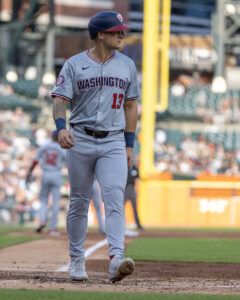
Senzel is a long shot to emerge as a key piece himself, but there’s minimal risk for Chicago in taking a look at the former #2 overall pick. The one-time top prospect hasn’t met expectations on either side of the ball over his five-plus MLB seasons. He’s a career .235/.302/.368 hitter in just over 1600 big league plate appearances. Most of that came in one of the sport’s most favorable home hitting environments in Cincinnati’s Great American Ball Park.
Injuries perhaps played some role in diminishing Senzel’s production. He has never topped 420 plate appearances in a season and battled knee and toe issues during his time with the Reds. Cincinnati also bounced him around the diamond without much success in trying to expand his defensive versatility.
After the Reds non-tendered Senzel last winter, he landed with the Nationals on a $2MM free agent deal. Washington moved him back to his customary third base position in the hope that a more stable defensive setup could allow him to unlock some of his offensive upside. That’s not how things played out. Senzel hit .209/.303/.359 with below-average defensive grades over 64 games. Washington decided to move on and turn third base over to rookie Trey Lipscomb.
The Nationals are on the hook for the majority of Senzel’s contract. The White Sox will only pay him the prorated portion of the $740K minimum for any time he spends in the big leagues (which comes out of Washington’s obligations). Senzel surpassed the five-year service threshold earlier this season. That means he can no longer be sent to the minor leagues without his consent. He would be eligible for arbitration for the 2025 campaign if he plays well enough to hold a roster spot down the stretch.
Jon Heyman of the New York Post first reported Senzel was signing with the White Sox. James Fegan of Sox Machine reported it was a big league deal.
Image courtesy of USA Today Sports.