
West Notes: Padres, Diamondbacks, Coffey
The Padres need to make a great hire when they find a permanent replacement for former GM Josh Byrnes, Matt Calkins of the San Diego Union-Tribune writes. The Padres shouldn’t worry about hiring a big name, which might excite their fans but might not help rectify the organization’s problems. Here are more notes from around the West divisions.
- As they approach this year’s trade deadline as sellers, the Diamondbacks could look for starting pitchers and outfielders, GM Kevin Towers tells FOX Sports Arizona’s Jack Magruder. The club will also look to shed salary, although Towers says that’s not their only consideration. “When a ball club is 15 games under .500, it’s going to affect attendance. The performance affects attendance. It puts us behind what our projections were. Dollars are part of the equation,” says Towers. “That said, it is not all about saving money.” Infielders Aaron Hill and Martin Prado could be trade candidates, as could lefties Oliver Perez and Joe Thatcher.
- Perez and Thatcher are trying to ignore any trade rumors, AZCentral.com’s Zach Buchanan reports. “It’s something that you can’t really prepare for unless you’ve been through it,” says Thatcher. “I’d heard my name a couple years before, but last year was the first I felt like I was getting traded. It takes a toll on you.” Both players have been traded near the July deadline before — Perez went from the Pirates to the Mets in 2006, and Thatcher went from the Brewers to the Padres in 2007 and the Padres to the Diamondbacks in 2013.
- Right-hander Todd Coffey, who signed a minor league deal with the Mariners roughly five weeks ago, has a June 30 opt-out date in his contract, reports Jon Heyman of CBS Sports (on Twitter). The 33-year-old has pitched well in his return from Tommy John surgery, allowing just one run in 9 1/3 innings. Coffey has walked six in that time, but he’s also allowed just four hits and struck out 10 batters. With a number of clubs looking for bullpen help, he figures to generate some interest if the Mariners can’t make room for him in their big league bullpen.
Steve Adams contributed to this post.
Cubs Notes: McLeod, Trades, Wood, Barney
Cubs executive Jason McLeod, who’s also a candidate for the Padres’ open GM job, discusses drafting and player development in a wide-ranging interview with Fangraphs’ David Laurila that also addresses McLeod’s past in the Red Sox organization. McLeod says that one of the biggest challenges in drafting is weighing riskier high-school players against college players who are closer to being finished products. “It was ‘I can’t pass on this toolsy high school upside guy? The risk is big – it’s huge – but how can I pass? If I do, people will say I was too conservative, that I was too scared to make that pick because of the potential downside,‘” McLeod says, saying that he’s still haunted by the Red Sox’ decision to pass on high-schooler Chase Headley in the 2005 draft. Here are more notes out of Chicago.
- The Cubs are open to keeping players like Jeff Samardzija and Jason Hammel if they have a dramatic (and unlikely) season turnaround, Bruce Miles of the Daily Herald writes. “I said the other day, if we want to win 15 in a row, we’d definitely be open to it,” says Theo Epstein. “Sometimes it’s more important why you’re playing well than if you’re playing well.”
- With Samardzija and Hammel likely to be dealt in the near future, the Cubs will likely continue to depend on lefty Travis Wood, Brian Sandalow of the Chicago Sun-Times writes. Wood, who now has a 4.52 ERA with 7.2 K/9 and 3.7 BB/9 in 95 2/3 innings in 2013, suddenly looks like a part of the Cubs’ future, despite arriving in a relatively minor deal in 2011.
- Infielder Darwin Barney hasn’t hit much lately, so his future is murky, but ESPN Chicago’s Jesse Rogers writes that Barney wants to stay in Chicago. “We all hope that our future is here,” says Barney. “We want to be here when things turn around. I think we can see that things slowly are.” Barney has hit .205/.256/.295 in 168 plate appearances this season.
Royals Sign Brandon Finnegan
The Royals have announced that they’ve signed No. 17 overall draft pick Brandon Finnegan. MLB.com’s Jim Callis tweets that Finnegan will receive the full bonus pool allotment of $2,200,600.
Finnegan, a junior lefty from TCU, was ranked the No. 15 draft prospect by MLB.com, No. 18 by Baseball America and No. 24 by ESPN’s Keith Law. MLB.com notes that he throws 93-95 MPH and has what could be a good slider. He also uses a changeup, although he might stop throwing the pitch if he ends up in the bullpen.
Finnegan could end up as a closer in the long term — he’s undersized at 5’11”, and MLB.com notes that there are questions about his durability. Finnegan also missed a few weeks in April and May with shoulder tightness. But he has excellent stuff. The Royals could use him as a starter, but Callis notes that he could make it to the big leagues quickly as a reliever.
Red Sox To Promote Mookie Betts
4:00pm: The Red Sox have officially announced the move. To clear space on their active roster, they’ve optioned pitcher Rubby De La Rosa to Triple-A Pawtucket.
9:13am: The Red Sox are set to promote top prospect Mookie Betts, John Tomase of the Boston Herald tweets. There’s no word yet on a corresponding roster move.
The Red Sox drafted Betts in the fifth round in 2011, and beginning in 2013, he quickly cut his way through the minors, hitting well at each level. The 21-year-old second baseman and outfielder hit .345/.437/.520 in 359 plate appearances in 2014 split between Double-A Portland and Triple-A Pawtucket.
Betts is ranked the No. 51 prospect in the game by MLB.com, No. 61 by ESPN’s Keith Law and No. 75 by Baseball America. BA’s Prospect Handbook 2014 ranked Betts the Red Sox’ seventh-best prospect, praising his speed, athleticism and ability to control the strike zone. With Dustin Pedroia at second base, the Red Sox will likely find playing time for Betts in the outfield, where the team has struggled this season.
Week In Review: 6/22/14 – 6/28/14
Here’s a look back at this week at MLBTR.
Signed / Agreed To Terms
- Reds — signed P Raisel Iglesias to a seven-year deal
Trades
- Pirates — acquired P Ernesto Frieri from Angels for P Jason Grilli
- Giants — acquired OF Adalberto Santos from Pirates
- Tigers — acquired P Daniel Schlereth from Pirates
Claimed
- Padres — UT Irving Falu (from Brewers — link)
Designated For Assignment
- Phillies — OF Zach Collier (link)
- White Sox — P Scott Downs (link)
- Red Sox — P Chris Capuano (link)
- Dodgers — 1B/OF Jamie Romak (link)
- Nationals — 1B/3B Greg Dobbs (link)
- Royals — P Donnie Joseph (link)
- Giants — P Jake Dunning (link)
Designated Off Active Roster
- Cardinals — SS Pete Kozma (link)
Outrighted
- Pirates — OF Jose Tabata (link)
- Blue Jays — INF Jonathan Diaz (link)
- Tigers — P Evan Reed (link)
- Indians — P Josh Outman (link)
- Orioles — OF Francisco Peguero (link)
- Cubs — C Eli Whiteside (link)
Elected Free Agency
- Rangers — 1B/OF Brad Snyder (link)
- Reds — OF Roger Bernadina (link)
- Astros — P Kyle Farnsworth (link)
- Orioles — P Edgmer Escalona (link)
Released
- Angels — OF Raul Ibanez (link)
- Diamondbacks — P J.J. Putz (link)
- Marlins — P Kevin Slowey (link)
Key Draft Signings
- Astros — P Brady Aiken (link)
Key Minor-League Signings
- Phillies — OF Grady Sizemore (link)
Quick Hits: Cardinals, Sizemore, Murphy, Dodgers
The Cardinals are down not one but two pitchers, Michael Wacha and Jaime Garcia, after losing them both to shoulder injuries, MLB.com’s Jen Langosch writes. Wacha has what GM John Mozeliak called a “stress reaction,” and will miss several weeks. “He has been dealing with a little bit of shoulder irritation going back [four to five starts],” said Mozeliak. “Up to this point, we always thought it was manageable.” Garcia could not complete his regular bullpen session Sunday. The Cardinals are placing both pitchers on the disabled list, and they will announce corresponding moves on Monday. Here are more notes from throughout the big leagues.
- Grady Sizemore is likely to decide on a new team early this week, Nick Cafardo of the Boston Globe tweets. Sizemore became a free agent Friday after the Red Sox designated him for assignment. In his first big-league action since 2011, Sizemore hit .216/.288/.324 in 205 plate appearances in Boston.
- The Blue Jays and Giants have had interest in Daniel Murphy, but the most likely outcome is that the Mets keep him, Andy Martino of the New York Daily News writes. In a “mediocre” NL East division, Martino writes, the Mets do not seem to view themselves as sellers. That doesn’t mean the Mets won’t deal Murphy, of course — GM Sandy Alderson sent Marlon Byrd to the Pirates last year soon after indicating the Mets wouldn’t deal him, so his actions can be hard to predict.
- The Yankees need a starting pitcher, but they probably won’t be able to get top trade possibilities like David Price or Jeff Samardzija, Joel Sherman of the New York Post writes. The Rays won’t want to trade Price to a divisional opponent. For Samardzija, the Cubs want a highly-rated young pitcher who’s close to being ready for the big leagues, and the Yankees don’t have that type of player. That means the Yankees could get someone like John Danks of the White Sox, Jason Hammel of the Cubs or Ian Kennedy of the Padres.
- As the trade deadline approaches, the Dodgers‘ greatest need is in their bullpen, but that doesn’t mean they can’t count on improvements from relievers they already have, ESPN Los Angeles’ Mark Saxon writes. Kenley Jansen, in particular, has been working on his mechanics, and he pitched very well on Saturday and Sunday. In any case, Saxon notes that the Dodgers likely won’t let guaranteed contracts for relievers they already have (presumbably, players like Brian Wilson and Chris Perez, who have struggled) prevent them from adding talent on the trade market.
- The Tigers‘ bullpen has an unexpected look recently, with the additions of minor league veterans Pat McCoy, Chad Smith and Blaine Hardy. Hardy, 27, has pitched well in four appearances so far even though he hadn’t pitched in the big leagues before last week. “You’ve got to stick with it, and that’s exactly what I tried to do. Just keep playing, hopefully get the opportunity, and here I am,” the lefty told MLive.com’s Chris Iott. The Royals drafted Hardy in the 22nd round out of college, then released him during spring training in 2013. He pitched three scoreless innings against them in his first two big-league appearances last week.
West Notes: Correa, Ibanez, Hawkins
Top Astros prospect Carlos Correa awaits medical evaluation in Houston after an ankle injury Saturday, as Jose de Jesus Ortiz of the Houston Chronicle notes. “I hit an RBI triple and then my spike got stuck at the bag,” Correa explains. GM Jeff Luhnow says Correa is expected to miss time due to the injury, although it’s not yet clear how much. Correa, the top pick in the 2012 draft, was hitting .325/.416/.510 for Class A+ Lancaster, and the Chronicle guesses he might have been in line for promotion to Double-A Corpus Christi. In any case, losing him to a serious injury would be a significant blow to the Astros, even with their strong farm system. Here are more notes from the West divisions.
- Raul Ibanez is not a good fit for the Mariners, Bob Dutton of the Tacoma News Tribune tweets. Ibanez hit 29 homers for the Mariners in 2013, but the Angels released him yesterday after he hit a mere .157/.258/.265 in 190 plate appearances for them.
- Rockies closer LaTroy Hawkins is 41, but he has no plans to stop playing, Patrick Saunders of the Denver Post writes. “If I stay healthy, I can pitch forever,” says Hawkins. “That’s my thought process. I have been blessed with a right arm that has definitely defeated all of the odds.” The Rockies signed Hawkins last winter to a deal that pays him $2.25MM in 2014, with a $2.25MM option and a $250K buyout for 2015. Hawkins’ 2.77 ERA suggests the Rockies will pick up that very cheap option, although Hawkins’ peripherals have been underwhelming, with 3.8 K/9 and 2.1 BB/9 in 26 innings so far.
Padres Notes: Byrnes, Black, Whitson
It’s been a busy day in San Diego with the firing of GM Josh Byrnes. Here are a few notes on the Padres.
- Byrnes’ firing “begs for an explanation,” Jon Heyman of CBS Sports writes. Byrnes hadn’t been on the job long enough (less than three years) to follow through on a plan, and Heyman notes that the only winning team with a payroll lower than the Padres’ right now is the Athletics. The Padres’ new owners seem to believe that this year’s Friars should have been a top team, Heyman writes. Byrnes has a good record with trades, and while some of the extensions to which he’s signed younger players haven’t worked, he received praise for the Jedd Gyorko deal, in particular, when it happened.
- The Padres do not have any immediate plans to fire manager Bud Black or hitting coach Phil Plantier, Heyman tweets.
- The Padres made the right move in firing Byrnes, MLB.com’s Anthony Castrovince argues. With the trade deadline fast approaching, the Padres needed to act quickly if they had questions about Byrnes. Castrovince says that the Padres’ new interim GM setup, with Omar Minaya, Fred Uhlman Jr. and A.J. Hinch occupying the position jointly, will be interesting, given that the trade deadline could help shape the Padres’ future.
- Karsten Whitson, an 11th-round pick in this year’s draft by the Red Sox, signed recently for $100K, losing out on $2MM after he reportedly rejected a $2.1MM offer when the Padres drafted him in 2010. But Whitson doesn’t regret his decision to attend the University of Florida, Fangraphs’ David Laurila reports. “My time at Florida was great,” Whitson says. “I went to the College World Series, won two SEC championships, and graduated [with a degree in psychology]. It was a very tough decision, but after doing some self reflection I though it was the right choice.” Whitson underwent a shoulder injury during his time at Florida that limited his bonus potential. He says he and the Padres (who were then run by Jed Hoyer, not Byrnes) did not discuss bonus parameters before they drafted him.
Minor Moves: Fisher, Clay, Diaz, Panik, Stinson
Here’s a look at today’s minor moves from around the league.
- The Braves have purchased the contract of Carlos Fisher from the Somerset Patriots and assigned him to Triple-A, tweets Chris Cotillo of MLBDailyDish.com. Fisher, 31, previously spent parts of three seasons with the Reds, most recently in 2011. He posted a 4.74 ERA, 7.84 K/9, and 5.02 BB/9 in 98 2/3 innings.
- The Angels have signed Caleb Clay from the Korean Baseball Organization’s Hanwha Eagles and assigned him to Triple-A, according to Cotillo (via Twitter). Clay was selected 44th overall by the Red Sox during the 2006 amateur draft. He’s since pitched for the Sox and Nationals organizations but never reached the majors. The 26-year-old right-hander struggled in his first season overseas, with a 8.33 ERA, 4.50 K/9, and 5.63 BB/9.
- Once again from Cotillo (on Twitter), the Diamondbacks have signed 27-year-old Argenis Diaz to a minor league deal. Diaz was with the Reds until recently. Interestingly, Arizona’s Triple-A affiliate has only used Didi Gregorius and Nick Ahmed at shortstop to date in 2014. Diaz will presumably provide depth up the middle.
From earlier…
- The Tigers will promote lefty Pat McCoy, Mark Anderson of TigsTown.com tweets. McCoy will have to be added to their 40-man roster. McCoy, 25, has posted a 2.94 ERA with 7.0 K/9 and 2.1 BB/9 in 33 2/3 innings this season divided between Double-A Erie and Triple-A Toledo. The Tigers signed McCoy, a product of the Nationals system, to a minor league deal last fall.
- The Giants will promote prospect Joe Panik, Henry Schulman of the San Francisco Chronicle tweets. Panik, the team’s first-round pick in 2011, will need to be added to the Giants’ 40-man roster. The second baseman was hitting .321/.382/.447 in 326 plate appearances for Triple-A Fresno.
- The Orioles have announced that pitcher Josh Stinson has cleared waivers and been outrighted to Triple-A Norfolk. The Orioles designated Stinson for assignment on Tuesday. He has pitched 13 innings for the Orioles this season, allowing nine runs while striking out six and walking six.
- The Rockies have purchased the contract of pitcher Wilton Lopez, MLB.com’s Thomas Harding tweets. They’ve made space for Lopez by optioning pitching Chris Martin to Triple-A Colorado Springs and moving Michael Cuddyer to the 60-day DL. The Rockies outrighted Lopez last week.
- The Yankees have released 1B/OF Russ Canzler, Donnie Collins of the Scranton Times-Tribune tweets. Canzler last appeared in the big leagues with the Indians in 2012. He hit .263/.332/.389 in 199 plate appearances for Triple-A Scranton/Wilkes-Barre in 2014.
- The Royals have added selected the contract of OF Justin Maxwell, Jeffrey Flanagan of FOX Sports Kansas City tweets. Maxwell will take Norichika Aoki’s place on the active roster as Aoki heads to the disabled list with a groin injury. The Royals outrighted Maxwell in May, and he’s hit .316/.358/.541 in 106 plate appearances since then.
- The Astros will add Jake Buchanan to their 40-man roster to start Saturday, and Evan Drellich of the Houston Chronicle notes (via Twitter) that fellow pitcher Jose Cisnero will head to the 60-day disabled list to make room for Buchanan on the 40-man roster. Buchanan, 24, has posted 5.2 K/9 and 1.2 BB/9 in 76 1/3 innings for Triple-A Oklahoma City this season.
Should The Super Two Designation Be Changed?
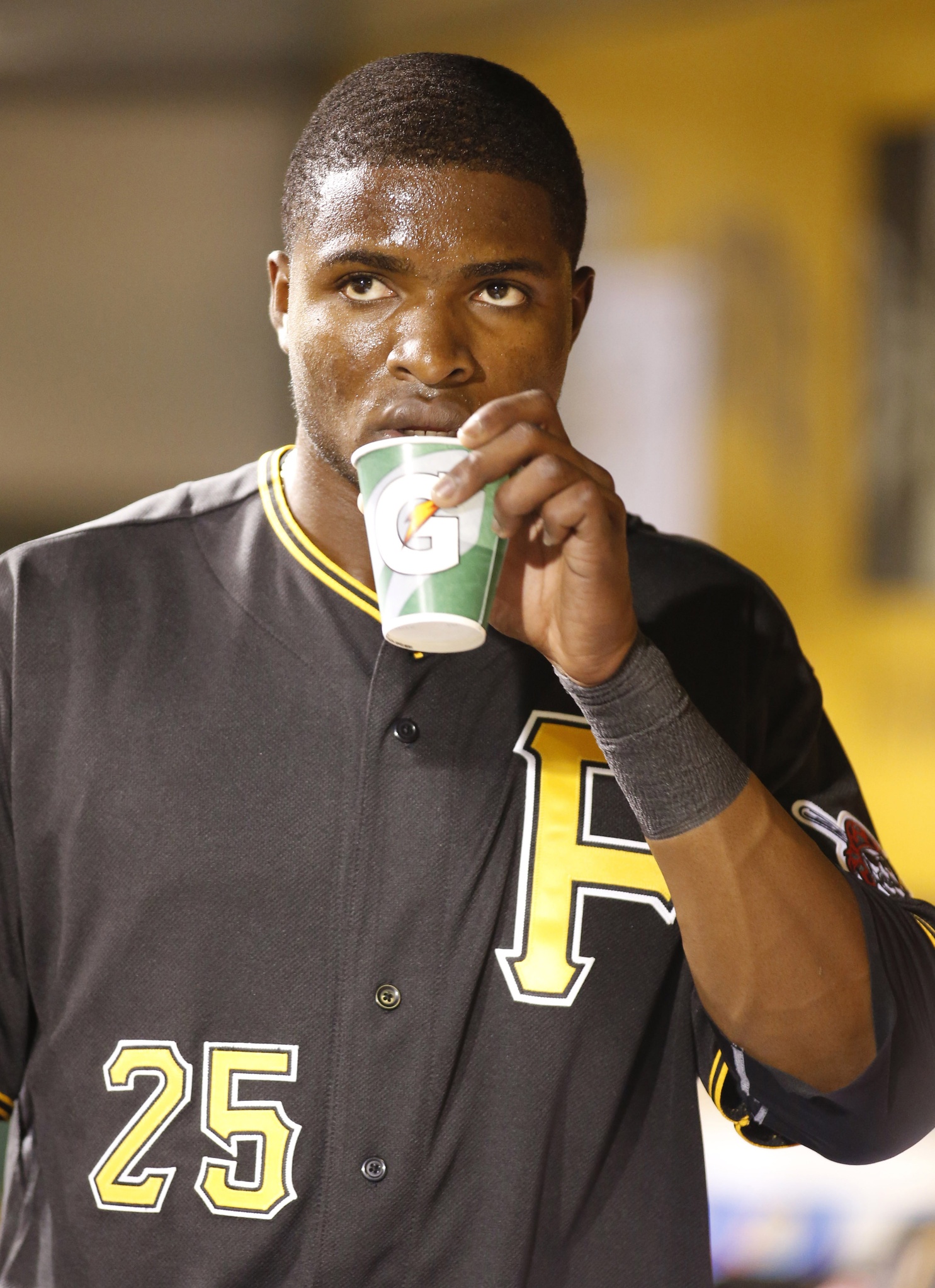 The Pirates’ decision to wait until June 10 to promote top outfield prospect Gregory Polanco set off a new round of debate, both in Pittsburgh and nationally, about the Super Two designation in particular and top prospect promotion timelines in general. The Pirates have said that their decision to wait to promote Polanco was due to developmental reasons, but whatever their motivations, the current system incentivizes waiting to promote top prospects even if they seem to be ready for the big leagues. That’s unfortunate, and MLB perhaps ought to consider reforming the Super Two designation. It’s probably impossible, however, to completely disincentivize manipulation of players’ promotion dates.
Overview
Teams must consider two thresholds when promoting a top prospect. A player is eligible for an extra arbitration season as a Super Two player if he has between 2.086 and three years of service time and he ranks in the top 22 percent in service time among players with between two and three years. The 22 percent clause means that the Super Two threshold is a moving target, but teams can usually feel safe about promoting a player in early to mid-June with the idea that he won’t be a Super Two player three offseasons later. A Super Two player can be eligible for arbitration four times rather than three, which means that a Super Two star player can make millions more in his arbitration seasons than a similar player who does not have that designation.
Teams must also consider a player’s free agency threshold. A player becomes eligible for free agency after six full years of service time, which means teams must consider a separate date in mid-April before which a player can become a free agent a year early.
We’ll leave aside, for now, the question of whether it’s wise for teams to delay promotion of top prospects in order to avoid Super Two status or free agency, and simply observe that the current system provides them at least some incentive to do so. The Pirates promoted Polanco on June 11, after months of criticism from analysts and fans who watched Polanco post great numbers at Triple-A while Jose Tabata and Travis Snider struggled in right field for the Pirates. (Josh Harrison handled the position for about a month before Polanco arrived and played much better.) Major League Baseball received some criticism, too, for creating the rules that made the Pirates’ decision rational (or arguably rational. Few commentators offered viable alternatives to the Super Two system, however, with Baseball Prospectus’ R.J. Anderson (subscription-only) being among the few to make a strong attempt.
If the Pirates held Polanco in the minors for two months longer than they would have without the Super Two system in place, that’s not nearly the tragedy many fans and commentators made it out to be. ESPN’s Dan Szymborski, the creator of the ZiPS projection system, tells MLBTR that based on information available in mid-April, promoting Polanco on June 10 rather than April 15 projected to cost the Pirates about one win. (And the Pirates might well have waited to promote Polanco even without the Super Two rule, given their longstanding record of allowing players time to develop in Triple-A before promoting them.) That’s unfortunate for the Pirates and their fans, but it’s hardly a travesty. A few cases like Polanco’s each year likely do not justify sweeping changes to the existing system.
Many large-scale rules involve thresholds that can be less than ideal on the micro level while producing good results on the macro level. For example, it isn’t ideal, or fair, for an irresponsible 16-year-old to be legally allowed to drive (if he or she can pass a driving test), while a responsible 15-year-old with excellent hand-eye coordination cannot. But the 15-year-old will soon be 16, and so that unfairness will soon be rectified. Meanwhile, the existence of a threshold that permits small-scale unfairness keeps the rules simple and helps prevent charges of arbitrariness.
Preventing teams from manipulating players’ service time is not a simple matter. As long as arbitration eligibility and/or free agency eligibility are tied to service time, and as long as teams control when their players’ service time clocks begin, teams will be able to use players’ promotion dates to manipulate their salaries and/or years of control.
So, for example, even if MLB were to eliminate the Super Two designation while maintaining current rules regarding free agency eligibility, teams could delay the promotion of top prospects who appeared to be ready in August or September and wait instead to promote them in mid-April. We would see fewer mid-June promotions for top prospects, but we would also see fewer mid-August promotions and more mid-April promotions, and the criticism of MLB’s rules would simply take place in August and September rather than April or May. If the goal is to prevent teams from delaying the promotion of top prospects who appear to be ready, simply changing the thresholds of arbitration or free agency eligibility will not work.
Untethering Free Agency, Arbitration Eligibility From Service Time
One solution to eliminate thresholds that can prevent teams from promoting players when they’re ready might be to untether free agency eligibility and arbitration eligibility from MLB service time. If a team were not worried about the number of years it could control a player, or about his salary during his arbitration seasons, it would be free to promote him whenever it deemed him ready.
This would, however, be a radical change with far-reaching consequences. With enormous payroll disparities between teams, MLB depends heavily on young players’ cost-controlled salaries to maintain competitive balance. Without cost control, it would be nearly impossible for smaller-payroll teams like the Athletics, Rays and Pirates to compete. The current rules regarding free agency and arbitration eligibility are the mechanism that allows player salaries to remain cost controlled. So if MLB and the players’ union were to agree to untether free agency and arbitration eligibility from service time, they would need some other mechanism to allow cost control.
One possibility would be to base free agency and arbitration eligibility not on service time, but on when a player was drafted or signed as an amateur, similar to the way Rule 5 Draft eligibility is determined. A player’s eligibility for the Rule 5 Draft in a given year depends upon his age on the June 5 before he signs and the number of Rule 5 Drafts that have passed since then. A similar system could be devised to determine free agency and arbitration eligibility. For example, a player under 19 by the June 5 before he signs might become eligible for arbitration after nine full years and eligible for free agency after 12 full years. A player who is at least 19 by the June 5 before he signs might become arbitration-eligible after eight full years and eligible for free agency after 11 years. (Players posted from Japan would continue to be exempt from these rules.) This system would enable the Pirates, for example, to promote Polanco whenever they deemed him ready, without concern for arbitration or free agency timelines.
Unfortunately, this rule would produce plenty of unintended consequences, and the cure would likely be worse than the disease. This system would be tremendously unfair to players who move quickly through the minors.
For example, the Expos drafted Chad Cordero in 2003 with the idea that he could make it to the big leagues quickly. He did exactly that and was a successful closer for several years before succumbing to injury. Because he was eligible for arbitration after his third full season, he was able to make over $11MM in his career, a total that seems reasonable, given the quality of his pitching. Under a system that connected arbitration eligibility to signing date rather than service time, he likely would have made only about a third that much, since he would have been close to the MLB minimum for his entire career. Meanwhile, a player who struggled in the minors and arrived in the big leagues after many years in Triple-A might become arbitration eligible after just one or two years. Also, such a system would dramatically limit the long-term earning capabilities of top players like Mike Trout who reach the Majors at young ages.
Allowing Neutral Parties To Determine Readiness
Another possibility might be to maintain the basic outline of the current arbitration and free agency timelines but to allow arbitrators to determine when those timelines might begin. So, for example, an arbitrator might have ruled that Polanco was ready May 1, forcing the Pirates to begin his big-league service clock then even if they did not promote him. Clearly, though, this is perverse and heavy-handed, putting the determination of the player’s readiness in the hands of an outside party who would have had far less information about the player’s development than his team did. Such a system would surely also create even more complaints of unfairness than the current one.
The problem here, of course, is the existence of thresholds. When there are thresholds that determine how long a team controls a player and how much they’ll have to pay him, there will be incentives to manipulate those thresholds. One of those thresholds, the one that determines free agency eligibility, probably isn’t going anywhere, since it helps prevent star players from becoming free agents while seasons are in progress. (That is, there could be a system in which a player who is promoted for the first time in August also could become a free agent in August six years later. But that would be chaotic, and the current threshold of six-plus years before free agency eligibility helps prevent that.)
The free agency threshold is probably here to stay, and as long as there’s a threshold, there will be occasional cases like Polanco’s where teams delay promotions of top prospects even when they’re dominating at Triple-A. It’s unfair on the small scale, but reasonable on the larger scale, and that might be as much as MLB can do.
Eliminating The Super Two, Redistributing Super Two Salaries
There are, however, some more modest reforms that MLB might consider to change the Super Two threshold, leaving teams with only one threshold to consider, rather than two. One possibility might be to eliminate the Super Two completely, as Pirates president Frank Coonelly recently suggested in an interview with USA Today’s Bob Nightengale.
The players’ union would, of course, be reluctant to make such a change, given that the existence of Super Two status means more money for them. But MLBTR’s Tim Dierkes suggests that MLB could, instead, calculate the approximate percentage of overall player income Super Two status typically produces and redistribute it as a modest, across-the-board raise for players making the MLB minimum salary. (Dierkes points out, however, that it’s possible the union would still dislike the idea, given that Super Two arbitration salaries for players like David Price help set arbitration salaries for other players.)
Prorating First Year Arbitration Salaries
MLBTR’s Jeff Todd suggests making all players with between two and three years of service time Super Two players, but prorating their first year of arbitration salary based on their service time. So a player with two years and 50 days of service time would receive an arbitration-year salary prorated for those 50 days of MLB service (combined with an MLB minimum salary prorated for the rest of the year), whereas a player with two years and 100 days would receive an arbitration-year salary prorated for 100 days. Players with three or more years of service time would then go through arbitration as they do now.
Either of the last two proposals would effectively eliminate the Super Two threshold. The free agent threshold probably can’t be eliminated, and its existence should continue to provide teams with incentive to manipulate players’ service time. But at least there would only be one threshold, rather than two. Also, either proposal to change the Super Two would eliminate the uncertainty involved in Super Two status, given that there’s currently no way for teams interested in promoting a player to know where exactly the Super Two threshold will fall two and a half years later.
Photo courtesy of USA Today Sports Images.