
Astros Activate Josh Hader
2:25pm: The Astros have now officially announced Hader’s reinstatement. Correa was indeed moved to the 60-day IL to open a 40-man spot. They also placed infielder Braden Shewmake on the 10-day IL, retroactive to May 31st, with a right adductor strain. Outfielder Zach Cole was recalled to replace Shewmake.
12:56pm: The Astros announced yesterday that righty Logan VanWey was being optioned to Triple-A Sugar Land. The team didn’t specify a corresponding move, noting that a transaction would be announced Tuesday. Manager Joe Espada now tells SportsTalk 790’s Matt Thomas that closer Josh Hader will be reinstated from the injured list and active for tonight’s game. Hader is on the 60-day IL, so in addition to VanWey’s option, Houston will need to open a 40-man roster spot. That can be achieved simply by transferring Carlos Correa to the 60-day IL following his season-ending ankle surgery, however.
Hader’s 2025 season ended in mid-August due to a capsule strain in his left shoulder. He didn’t end up requiring surgery and was even hopeful of being able to return at some point during a potential postseason run. The Astros wound up falling shy of the playoffs, so we never found out whether he’d have been able to do so.
The plan for Hader was a mostly normal offseason. General manager Dana Brown said in mid-November that his closer had already thrown off a mound three times. The organization hoped to have the multi-time All-Star back in the Opening Day mix. That might well have been the case based on Hader’s shoulder alone, but he began experiencing biceps pain early in spring training. He was eventually diagnosed with tendinitis, ruled out for Opening Day, and has now missed more than two months of the season.
Hader has pitched well for most of his minor league rehab stint. The 32-year-old breezed through his first seven appearances, allowing just one run on four hits and a walk with 11 punchouts in seven frames. He was roughed up a bit in his final two outings, yielding five runs (three earned) on four hits and a pair of walks without a strikeout. That nudged his minor league ERA up to 4.15, but the bulk of his work between Double-A and Triple-A is reason for encouragement.
It’s worth noting that Hader’s sinker has averaged 93.9 mph in Triple-A — well shy of last year’s 95.5 mph, which was already his lowest mark since 2020. He’s very likely still building up velocity after a long layoff and a pair of fairly notable arm issues, so it’s not a major warning light, but it’ll still be worth keeping an eye on his velocity in the early stages of his return. Hader had no problem missing bats even back in 2017-18, when his sinker was sitting 94.4 mph, but he pushed that average up to 96.4 mph over a four-year period from ’21-’24.
Hader’s return should be a substantial boon for an Astros bullpen that has been pieced together for much of the season. Bryan Abreu was a natural fill-in for Hader in the ninth inning after last year’s dominant performance in a setup role — or so it seemed. Abreu, however, has lost about three miles per hour off his heater this year, dropping from an average of 97.3 mph to 94.8 mph. He stumbled through an abysmal April before getting better results in May, but Abreu’s velocity isn’t any better now than it was in March — and he’s walked nearly 24% of his opponents this season. He doesn’t look close to his former self.
Houston has also seen at least modest steps back from key relievers like Steven Okert and Bryan King. Both have comparable ERAs to last season but with diminished rate stats. Lefty Bennett Sousa, who posted a 2.84 ERA in 50 2/3 frames last year, has pitched 3 1/3 innings this season and is on the injured list due to elbow inflammation.
All of that has conspired to leave Houston relievers with a major league-worst 5.16 ERA on the season. The Astros’ bullpen is tied for the sixth-lowest strikeout rate in baseball (20.5%) and has the third-highest walk rate (12.4%). It’s a major reason the team finds itself seven games under .500. Getting Hader back in the fold should help protect late leads, but he’s only one of several high-end contributors whose absence has helped dig a brutal hole for the ‘Stros to try to escape in the two months leading up to this year’s Aug. 3 trade deadline.
MLBTR Podcast: Patrick Bailey To Cleveland, The Struggling Astros, And Arizona’s Outfield Changes
The latest episode of the MLB Trade Rumors Podcast is now live on Spotify, Apple Podcasts, and wherever you get your podcasts! Make sure you subscribe as well! You can also use the player at this link to listen, if you don’t use Spotify or Apple for podcasts.
This week, host Darragh McDonald is joined by Steve Adams of MLB Trade Rumors to discuss…
- The Giants trading Patrick Bailey to the Guardians (1:25)
- The Astros losing Carlos Correa to season-ending ankle surgery (18:40)
- The Diamondbacks calling up Ryan Waldschmidt and trading Alek Thomas to the Dodgers (28:05)
- The Mets calling up A.J. Ewing (38:25)
- The Marlins calling up Robby Snelling (42:55)
Plus, we answer your questions, including…
- Are the Tigers struggling due to injuries and will be fine as guys get healthy? Or should fans be more worried? (49:30)
- Which starting pitchers can the Cubs pursue? (53:25)
- When will the Yankees realize they need to upgrade on David Bednar as the closer? (58:20)
Check out our past episodes!
- Skubal’s Injury, The Marlins’ Catchers, Eldridge Called Up, And Volpe Sent Down – listen here
- The Alex Cora Situation, Lucas Giolito Signs, And The Phillies Fire Rob Thomson – listen here
- Kevin McGonigle, The Padres’ Franchise Valuation, And Edwin Díaz To Miss Time – listen here
The podcast intro and outro song “So Long” is provided courtesy of the band Showoff. Check out their Facebook page here!
Photo courtesy of David Dermer, Imagn Images
Carlos Correa To Undergo Season-Ending Ankle Surgery
The hits keep coming for the Astros. Brian McTaggart of MLB.com reports that third baseman/shortstop Carlos Correa will require season-ending surgery to repair a left ankle injury. Correa was scratched from last night’s game and subsequently reported to have suffered a potentially major ankle injury. He was in the clubhouse today on crutches.
Correa himself told reporters in Houston that he suffered a torn tendon in his left ankle (video link via McTaggart). The requisite surgery to repair the injury will sideline him for the next six to eight months. (Notably, that’s not the ankle that caused enough medical concern to scuttle a pair of major free agent deals a few offseasons back.) As Correa explains, it was a freak incident:
“I was hitting in the cage — normal day, feeling great. I went through my whole routine, took a swing, and felt a pop. It just completely snapped on me, and then I fell to the ground, couldn’t put weight on it. Just a normal swing, but I felt a loud pop. I heard it. I felt it. I knew right away something was wrong.”
With Correa’s season over, the Astros will entrust shortstop to Nick Allen and Braden Shewmake for the time being. Both are light-hitting defensive specialists, though Shewmake took Shohei Ohtani deep for a go-ahead home run last night. Star shortstop Jeremy Peña is on the mend from a hamstring strain and will reclaim everyday shortstop work once healthy. Peña’s return would have pushed Correa back to third base, but the hot corner will now be manned by Isaac Paredes moving forward, with a resurgent Christian Walker at first base, Jose Altuve at second base and Yordan Alvarez at designated hitter.
Correa is the latest in a dizzying line of major Astros injuries. He joins not only Peña but Hunter Brown (shoulder strain), Josh Hader (biceps tendinitis), Yainer Diaz (oblique strain), Jake Meyers (oblique strain), Tatsuya Imai (arm fatigue), Cristian Javier (shoulder strain), Joey Loperfido (quad strain) and Taylor Trammell (groin strain) as Astros to suffer new injuries this season. The ‘Stros are also still without pitchers Ronel Blanco, Hayden Wesneski and Brandon Walter, all three of whom underwent UCL surgery during the 2025 season.
Suffice it to say, the 2026 season hasn’t gone according to plan. Houston’s 15-22 record is the fifth-worst in Major League Baseball. Long-term absences for key players like Correa, Brown, Hader and Peña have conspired to dig an early hole from which they’ll be hard-pressed to climb out. The pitching, in particular, has been egregiously bad. Houston not only ranks last in the majors with a team-wide 5.65 ERA — they’re 64 points north of the 29th-ranked D-backs, who sit at a collective 5.01. The bullpen’s 6.20 ERA is the highest in MLB by nearly a full run over the 29th-ranked Angels (5.35). The rotation’s 5.13 ERA ranks 29th, narrowly leading Arizona (5.20).
The 2026 trade deadline is still just under three months away, but the mountain of injuries and a dismal pitching performance thus far makes it hard to envision the ‘Stros recovering — even with Alvarez and Walker combining to create one of the more formidable lineup duos in the game. The Astros will face some tough decisions at this year’s deadline, due not only to the current state of affairs but also an increasingly concerning long-term outlook that doesn’t create much optimism.
[Related: The Astros’ Ominous Long-Term Outlook]
As for Correa, he’s still signed for another two seasons beyond the current year. He’ll earn $30.5MM in 2027 and $30MM in 2028, though the Twins are paying $10MM per year (2026-28) as part of the trade that sent Correa and more than $70MM of his remaining contract back to Houston. His six-year, $200MM deal also contains a quartet of vesting club options valued at $25MM, $20MM, $15MM and $10MM, spanning the 2029-32 seasons. Those options can vest based on the total plate appearances Correa logs in the immediately preceding season.
Carlos Correa Believed To Have Suffered Significant Left Ankle Injury
Carlos Correa is believed to have suffered a significant left ankle injury, reports Brian McTaggart of MLB.com. He’ll visit a foot specialist tomorrow to narrow down a diagnosis and recovery timeline. McTaggart writes that he’ll be out indefinitely and could miss weeks or potentially months.
Correa was injured while taking batting practice before Tuesday’s game against the Dodgers. The Astros scratched him, moving Nick Allen from third base to shortstop while drawing utility infielder Braden Shewmake into the lineup at the hot corner. Shewmake wound up hitting a solo home run off Shohei Ohtani that proved the difference in a 2-1 Houston win.
It’s the second consecutive day in which the Astros lost a key player during pregame batting practice. Catcher Yainer Diaz strained his oblique while warming up on Monday and is also going to miss some time. He went on the injured list on Tuesday morning.
The Astros will presumably provide more information on Correa within the next few days. The three-time All-Star has battled injuries in both feet over the past few years. Plantar fasciitis and a muscle strain in his left foot hobbled him in 2023. He missed most of the second half of the ’24 season with plantar fasciitis in his right foot.
Injury concerns famously scuttled two of Correa’s agreements during his 2022-23 free agent trip: both a $350MM deal with the Giants and a subsequent $315MM agreement with the Mets. Those were both related to team medical personnel having concerns about Correa’s right ankle, not the one which he injured tonight.
That’s of little solace to a Houston team dealing with yet another significant injury. Correa becomes their fourth regular position player — alongside Diaz, Jeremy Peña and Jake Meyers — on the injured list. They’re also without starting pitchers Hunter Brown, Cristian Javier and Tatsuya Imai plus closer Josh Hader.
Peña, down since April 12 with a right hamstring strain, could start a minor league rehab assignment this week. Correa had been the regular shortstop in his absence. Allen, a light-hitting defensive specialist, will man the position in the interim. Losing Correa means the Astros will stick with Isaac Paredes as the everyday third baseman. Christian Walker is enjoying a resurgent season at first base, while Yordan Alvarez is mostly at designated hitter.
The infield depth, at least once Peña returns, is the only silver lining. Houston unsuccessfully tried to move Paredes or Walker over the offseason to alleviate the logjam, but they essentially haven’t been at full health for the entire season. Even before the hamstring injury, Peña had battled a fingertip fracture on his right hand that he suffered during the World Baseball Classic.
Houston reacquired Correa from the Twins last summer, taking on a little over $70MM on the remaining three years of his contract. He hit .290/.355/.430 over 51 games down the stretch and was out to a .279/.369/.418 start to this season. Although he’s not the power threat he was at his peak, Correa remains an above-average hitter and quality defender at either position on the left side of the infield when healthy.
Poll: What Can The Astros Expect From Carlos Correa This Year?
It wasn’t too long ago that Carlos Correa was a consensus pick as one of the best shortstops in baseball. He entered the 2023 season as a career 130 wRC+ hitter who appeared to be on something close to a Hall of Fame trajectory. A lot has changed for him since the 2022-23 offseason, however. Now that he’s been reunited with the Astros, he figures to be one of the most important players to the organization as they look to get back into the playoffs. What can they actually expect from the three-time All-Star?
While the first several years of Correa’s career saw him post that aforementioned 130 wRC+ with strong enough defense at shortstop to average around four fWAR per year despite occasional struggles to stay on the field, that’s changed since he signed his second contract in Minnesota. From 2023 to ’25, Correa hit just .266/.338/.428 (113 wRC+). That would still be star level production for an elite defensive shortstop who plays 150-plus games per year, but that’s not who Correa is anymore. He took a step back to the point of being more of an average to above-average shortstop defensively (+1 Outs Above Average at shortstop from 2022 to ’25) and moved to third base upon returning to Houston last summer.
Staying on the field has become increasingly challenging as well. Plantar fasciitis in both feet has cost Correa significant time over the past few years, and he’s taken additional trips to the injured list thanks to oblique issues and a concussion. All that left him to appear in just 365 games over the last three years. If he continues averaging just over 120 games a season as a third baseman and doesn’t see a big uptick in his defensive value, it will be hard for him to maintain star-level production without delivering more consistent offense. The 154 wRC+ he posted during his 86-game 2024 season would be more than enough. The 106 wRC+ he posted in 144 games last year wouldn’t cut it.
It should be noted that with the Twins paying $10MM of Correa’s salary in each of the next three years, Correa doesn’t necessarily need to produce like a star to be a valuable asset. Even a wRC+ in the 115 range, similar to what he’s posted over the last three years, would likely be enough to mostly justify the $62MM the Astros are set to pay him over the next three seasons. Still, an Astros club that is waiting for players like Cam Smith and Brice Matthews to break out while watching veterans like Jose Altuve and Christian Walker start to decline will need everything it can get from Correa as they look to make their way back into the postseason.
The early signs this year are positive. Through seven games, Correa has identical 10.0% strikeout and walk rates with a .296/.367/.444 (133 wRC+) slash line. A sample size that small is mostly meaningless, but if he can produce those sorts of numbers across 400+ plate appearances he’ll be one of Houston’s biggest assets this year. His underlying numbers from recent seasons don’t quite offer that level of optimism, but do indicate that he’s been better than the 2025 season might otherwise indicate.
Correa’s xwOBA over the last three seasons was .339, which is similar to the .338 he posted in that same stat last year. Players who posted a wOBA in that range last year include Wyatt Langford, Gunnar Henderson, and Spencer Torkelson. Looking at fellow third basemen, Manny Machado posted a .341 while Matt Chapman posted a .336. That would be good company for Correa to keep, especially if his defensive metrics at third base tick up from where they were last year (+2 OAA) with additional exposure to the position. There’s reason to believe he can get there; Correa slashed .290/.355/.430 with a wRC+ of 122 and a wOBA of .344 in 51 games after being traded back to Houston.
How do MLBTR readers think Correa will fare in his first full year as an Astro since 2021? Will he post middling numbers like he did last year, return to the form he showed earlier in his career, or fall somewhere in the middle? Have your say in the poll below:
How effective will Carlos Correa be for the Astros in 2026?
-
Correa will play closer to his production after being traded last year. (122 wRC+) 45% (696)
-
Correa will turn in a disappointing season similar to last year. (106 wRC+) 44% (677)
-
Correa will return to form fully and perform at the level he did earlier in his career (130 wRC+ or more) 11% (168)
Total votes: 1,541
Jeremy Pena Dealing With Oblique Strain
Imaging has revealed a left oblique strain for Jeremy Pena, the shortstop told reporters on Thursday. Chandler Rome of The Athletic was among those to relay the update. Pena had been out of the lineup for the past four games. He was initially in Sunday’s starting nine before being scratched due to the injury. Houston was swept at home by Seattle and has dropped the first two games of the series against the Athletics.
Just a few days after GM Dana Brown said Pena’s oblique injury “could be just a two-day thing,” Pena is now facing what could be an extended absence. While no roster move has been made regarding Pena, oblique injury timelines are typically measured in weeks, not days. It’s the second time this season that Pena has dealt with a left side issue, as he missed 27 games with a broken left rib.
It’s brutal news for a Houston team that just lost Yordan Alvarez to an ankle sprain. The Astros ceded their spot atop the AL West over the weekend and are now in danger of missing the postseason altogether. They entered Thursday’s action one game behind the Tigers for the final AL Wild Card spot. Given that the season is hanging by a thread, perhaps there would be some temptation to put Pena out there even when he’s not 100%. However, they are also doing that with Isaac Paredes, who was rushed back from a hamstring injury and is using the designated hitter spot at the moment.
The oblique injury could cut short a breakout 2025 campaign for Pena. The 28-year-old posted a healthy 135 wRC+ while slashing .304/.363/.477. He matched a career high with 20 steals. Pena’s 17 home runs fell short of the 22 he hit as a rookie, but he exceeded his total from 2024 in 107 fewer plate appearances. It was quite the bounce-back season after Pena put up below league-average offensive numbers the past two seasons. He equaled his career-best strikeout rate from 2024 at 17.1%, while pushing his hard-hit rate up over 40% for the first time, per Statcast. Pena was able to combine the improved plate discipline from 2024 with the power he showed in his debut MLB season, turning him into one of Houston’s most potent offensive threats.
The Astros have turned to Mauricio Dubon at shortstop for three of the four games without Pena. Carlos Correa slid over from third base to cover the spot on Wednesday. He certainly has plenty of experience playing up the middle for Houston. The versatile Ramon Urias is also an option at shortstop, though he hasn’t appeared in a big-league game at the position since 2022. It’s hard to imagine any of the potential replacements matching Pena’s offensive prowess, but Dubon is at least a viable defensive fit. While Pena had an excellent defensive season, ranking seventh among shortstops in Outs Above Average, Dubon is actually eighth on that list.
MLBTR Podcast: Sifting Through The Trade Deadline Deals
The latest episode of the MLB Trade Rumors Podcast is now live on Spotify, Apple Podcasts, and wherever you get your podcasts! Make sure you subscribe as well! You can also use the player at this link to listen, if you don’t use Spotify or Apple for podcasts.
This week, host Darragh McDonald is joined by Steve Adams and Anthony Franco of MLB Trade Rumors to go over the various deadline dealings, including…
- The Padres acquiring Mason Miller, JP Sears, Ryan O’Hearn, Ramón Laureano, Nestor Cortes, Freddy Fermin and Will Wagner, while not trading Dylan Cease nor Robert Suarez (1:20)
- The Athletics sending out Miller and Sears, getting a pile of prospects, headlined by Leo De Vries (25:20)
- The Twins trading a bunch of rentals but also Jhoan Durán, Griffin Jax, Louis Varland and Carlos Correa (31:50)
- The Astros taking on Correa despite previously trying to avoid the competitive balance tax (50:05)
- The Phillies’ deadline (58:25)
- The Mariners acquiring Josh Naylor and Eugenio Suárez from the Diamondbacks (1:00:40)
- The Diamondbacks trading Merrill Kelly but not Zac Gallen (1:07:45)
- The Rangers’ deadline (1:16:00)
- The Mets acquiring various relievers, including Tyler Rogers from the Giants (1:19:05)
- The Yankees acquiring Camilo Doval, David Bednar and Jake Bird (1:25:45)
- The Pirates holding several trade candidates but they did trade Ke’Bryan Hayes to the Reds (1:35:15)
- The Blue Jays acquiring Shane Bieber and Varland (1:43:40)
- The Red Sox acquiring Dustin May from the Dodgers (1:54:20)
- The underwhelming deadlines of the Cubs and Tigers (1:59:40)
Check out our past episodes!
- Megapod Trade Deadline Preview – listen here
- David Robertson, Trade Chips For The O’s and A’s, And What The Rangers Could Do – listen here
- Rays’ Ownership, The Phillies Target Bullpen Help, And Bubble Teams – listen here
The podcast intro and outro song “So Long” is provided courtesy of the band Showoff. Check out their Facebook page here!
Photo courtesy of Chadd Cady, Imagn Images
Astros, Twins Reportedly Discussed Christian Walker In Carlos Correa Trade
5:17PM: Nightengale clarified his earlier report, saying that it was the Twins who first floated Walker’s name and the Astros who passed on moving the first baseman.
2:56PM: The Astros and Twins pulled off a shocking move in the final hours before the deadline that brought three-time All-Star infielder Carlos Correa back home to the team that he spent the first seven seasons of his career with. The deal sent Correa to Houston in exchange for pitching prospect Matt Mikulski, with the Twins retaining $33MM of the $103.4MM remaining on Correa’s contract. USA Today’s Bob Nightengale provided additional details on the Correa negotiations this morning.
Most notably, Nightengale writes that the sides talked about including veteran first baseman Christian Walker as part of the return headed to Minnesota in exchange for Correa’s services. He adds that while the Twins “had the opportunity” to acquire Walker as part of the deal, they passed on taking the final two years and $40MM of his contract on. That’s not exactly a shocking decision. Given that Mikulski is a 26-year-old who has not yet even reached the Double-A level, it’s fair to view the Correa deal as a pure salary dump for Minnesota. Previous reporting has indicated that the Twins are more than $400MM in debt, and Nightengale writes that the club has lost $40MM this year.
That would make adding a larger contract like that of Walker counterproductive in most scenarios. Perhaps there was a version of the deal where the Twins retained less of Correa’s salary while taking on Walker’s contract, but given his mediocre 2025 campaign (96 wRC+, 0.6 fWAR) and the fact that he’s already 34 years old it’s understandable that the Twins wouldn’t be too interested in adding him at the beginning of a rebuild that might not end until Walker has already hit free agency.
There’s at least an argument to be made that he would’ve been a worthwhile addition to the club based on their lack of a long-term solution at the position, however. Kody Clemens is currently serving as the club’s first baseman and has blasted 12 homers in 65 games since landing in Minnesota, but is a career 82 wRC+ hitter in 222 big league games who seems unlikely to sustain that sort of production. Edouard Julien and Jose Miranda are both capable of playing the position and have past big league success but poor performance has relegated them to the minors for much of the year.
That could make the veteran consistency Walker could provide quite attractive in theory, especially after the loss of Correa and others from the clubhouse could leave a dearth of veteran leadership in the clubhouse outside of franchise face Byron Buxton. On the other hand, Walker lacks much upside; even his best seasons with the Diamondbacks saw him peak at a wRC+ of around 120, and the Twins could likely find a younger, cheaper alternative who has more of a chance to develop into a middle-of-the-order force if they were interested in doing so this offseason.
While the Twins may not have been a fit for Walker’s services, Nightengale suggests that the veteran might get shopped by the Astros this winter in a bid to make room for infielder Isaac Paredes as first base next year. That’s a sensible assumption based on the composition of the club’s roster. While the idea of Paredes moving to second was briefly floated last offseason, there’s been a great deal of skepticism since then about his viability as a defender at third base. Yordan Alvarez must be penciled in as the club’s DH even after a 2025 season that has been mostly lost to injury, and with a former Gold Glove shortstop in Correa who’s eager to move to third base in deference to fellow Gold Glove shortstop Jeremy Pena there isn’t room for Paredes on the left side of the infield anymore.
At the same time, Paredes’s bat is much too important to lose from the lineup. The two-time All-Star has hit an impressive .259/.359/.470 with 19 homers, 15 doubles, and triple in 96 games for the Astros this year. The third baseman is expected to miss the remainder of the 2025 season at this point, so fitting him into the lineup is not a concern in the short-term. First base seems like by far the most logical fit the slugger for the 2026 season, however. Paredes is under team control through the end of the 2027 season, so he’ll need to find a new long-term home in Houston with Correa set to take over the hot corner.
That will likely make Walker expendable this offseason. He’s certainly not had the season either side was hoping for when he signed with the Astros on a three-year, $60MM deal this past offseason. Back in June, MLBTR’s Mark Polishuk wrote about the lackluster start Walker had to his Astros career. He’s begun to turn things around since then, with a strong .288/.352/.466 (129 wRC+) slash line in 186 plate appearances since that article was published, but the concerns discussed in that piece still ring true. Walker is an aging, pricey veteran on a multi-year contract who has begun to show signs of decline.
It’s not the easiest profile to find a suitor for, but perhaps there will be a team in need of help at first base this winter with whom the club can work out a trade—particularly if they’re willing to pay down some of Walker’s remaining salary. The veteran’s play over the season’s final two months and into the postseason figures to have a major influence over how feasible an offseason trade will end up being and how much money, if any, the Astros would have to retain in order to move him.
If Houston’s front office doesn’t find an offer they deem acceptable for Walker, there are other avenues to working out the infield logjam, though each presents some issues. Perhaps Paredes could see some time at second base despite defensive questions. It’s possible that Walker could get some playing time at DH on days Alvarez plays the outfield, with Jose Altuve at second base. A trade of Paredes could even theoretically be considered, especially if a similarly well-regarded and controllable outfielder was available in return. As the Astros demonstrated for Jose Abreu, they’re also not opposed to simply cutting ties with a struggling veteran who no longer fits the club’s needs, though Walker would surely need to take an extreme turn for the worse in order for that option to be on the table.
Astros Announce Several Roster Moves
The Astros announced a lengthy slate of post-deadline moves Friday. Houston reinstated shortstop Jeremy Pena from the injured list and designated infielder Zack Short for assignment. The Astros also activated newly reacquired Carlos Correa and fellow trade acquisitions Jesus Sanchez and Ramon Urias, adding all three to the active roster.
In corresponding roster moves, Infield prospect Brice Matthews and outfield prospect Jacob Melton were optioned to Triple-A Sugar Land. The ‘Stros also recalled righty Nick Hernandez to take the roster spot of righty Ryan Gusto, who was traded to the Marlins in the Sanchez deal. Finally, right-hander Nick Robertson was outrighted to Triple-A after clearing waivers. He’d been designated for assignment earlier in the week.
Pena wound up missing more than a month due to a fracture in his ribcage. He was in the midst of a breakout, MVP-caliber season prior to landing on the injured list. The 27-year-old has slashed .322/.378/.489 (143 wRC+) with 11 homers, 18 doubles, a triple and 15 steals in 350 plate appearances. He was also playing Gold Glove-caliber defense at shortstop, generating plus marks from Defensive Runs Saved (7) and Outs Above Average (4). He’ll return to his customary shortstop, while the newly reacquired Correa will slide over to third base in deference to the young shortstop who he mentored during the pair’s prior overlap in the Astros organization.
As for Short, he’ll be placed on waivers within the next five days now that the trade deadline has passed. He’s appeared in 22 games and taken 56 plate appearances with just a .220/.291/.380 output to show in that small sample. The 30-year-old Short has appeared in parts of five big league seasons and is a .172/.271/.296 hitter in 594 trips to the plate as a major leaguer. He’s a solid defender at multiple infield positions but is out of minor league options, so he’ll either clear waivers or have to stick on the major league roster of another club that claims him.
Astros Acquire Carlos Correa
Carlos Correa is coming home to play third base. The Twins have agreed to trade Correa to the Astros, according to MLB.com’s Brian McTaggart, and Jon Morosi of MLB Network says he’ll man the hot corner for Houston. Pitching prospect Matt Mikulski is going to Minnesota, according to Chandler Rome of The Athletic. Bob Nightengale of USA Today reports that the Twins are paying down $33MM of the approximate $103.4MM remaining on Correa’s deal. The trade is now official.
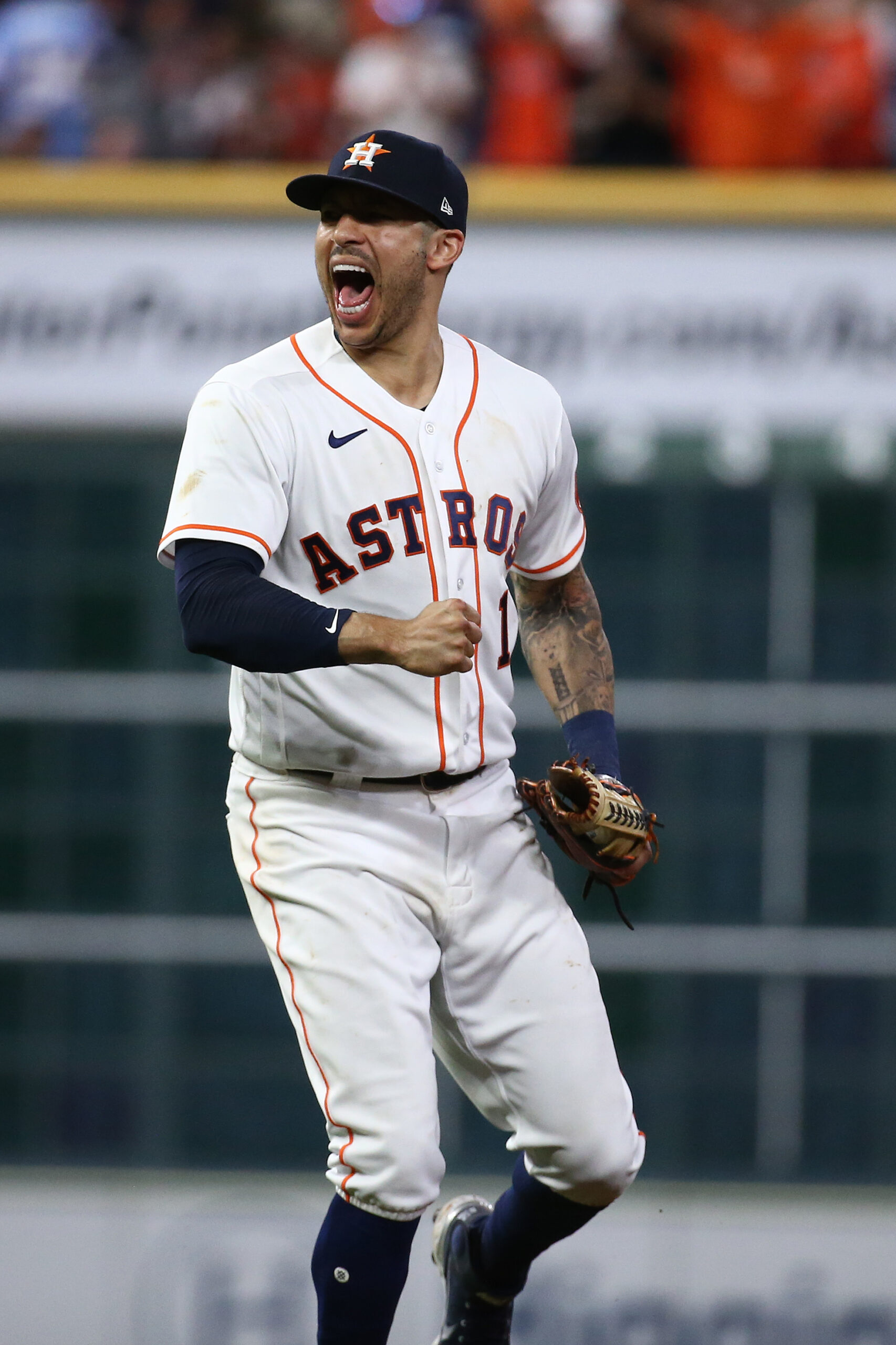
The idea of the Astros bringing Correa back into the fold first surfaced yesterday in a report from Nightengale. Rome and Dan Hayes of The Athletic went on to report that the Astros approached the Twins with the concept of bringing back Correa, a favorite of owner Jim Crane.
With $103.4MM remaining on Correa’s contract through 2028, reporting today suggested that the two clubs were too far apart on dollars to consummate a deal. However, as ESPN’s Jeff Passan reports, the teams bridged their financial gap, Correa waived his no-trade clause, and the deal was resuscitated. As Correa told McTaggart, “I let them know there was only one team I would allow that to happen.”
The Astros and Crane have a history of letting star players depart for longer free agent deals elsewhere. In this case, Correa left after the 2021 season. Nearly three years later third baseman Alex Bregman turned down the Astros’ overtures and landed in Boston, after the club had already landed his replacement in Isaac Paredes (acquired from the Cubs in part because the Astros knew they couldn’t win the bidding on Kyle Tucker). Paredes tore his hamstring on July 19th, which may be season-ending.
Jeremy Peña has flourished in Correa’s absence, making his first All-Star team this year after hitting the IL in late June for a fractured rib. Peña could rejoin the Astros tomorrow in Boston, playing next to his predecessor on the left side of the infield against Bregman and the Red Sox. The Astros had picked up Ramon Urias from Baltimore last night, a move that paled in comparison to the division-rival Mariners adding Eugenio Suarez. Now with Correa, Urias will be pushed into a utility role that could include time at second base.
Correa, 31 in September, owns an uninspiring 97 wRC+ in 364 plate appearances this year for the Twins. His Twins career has been up-and-down in that regard, with a stellar 136 wRC+ in 2022, a down year in ’23, and a career-best 155 mark last year.
Correa played in only 86 games for the Twins in 2024, missing time due to an intercostal strain and plantar fasciitis. He spent time on the seven-day concussion list in May this year, but has otherwise avoided the IL despite some minor injuries.
Injuries have long been part of the story for Correa, who was drafted first overall by the Astros in 2012. He played 110 or fewer games in 2017, 2018, 2019, and 2024, so he had a four-year run of good health encompassing his multiple free agencies.
Despite his injury history, Correa has been worth 3.7 WAR in seven separate seasons. He won the AL Rookie of the Year in 2015, made his first All-Star team and garnered MVP votes in 2017, made another All-Star team and finished fifth in the MVP voting in 2021, and made a third All-Star game with the Twins last year. Certainly Correa’s 2017 performance and the Astros’ championship are tarnished by the sign-stealing scandal, but the star players involved have largely been able to move on with minimal effects aside from perhaps extra boos from certain fanbases.
Correa has been a regular on the pages of MLBTR, perhaps beginning with that sign-stealing scandal in late 2019. Though Correa suffered some reputational damage for cheating at the time, his first run at free agency seemed largely unaffected. Hewing to their organizational philosophy on long-term contracts, the Astros topped out at a five-year, $160MM offer, even though Correa was heading into his age-27 season.
Though some major free agents such as Corey Seager signed before the 99-day 2021-22 lockout, Correa did not. Correa switched to the Boras Corporation during the lockout, and “settled” for a three-year, $105.3MM deal with the Twins in March 2022 with opt-out clauses after each season. After an excellent debut season with the Twins, Correa opted out as expected, but his second run at free agency was anything but easy.
Correa agreed to a 13-year, $350MM deal with the Giants in December 2022, which shockingly fell apart after his physical revealed concerns over his right leg. Correa then agreed to play third base for the Mets on a 12-year, $315MM deal, only to have that deal fall apart for similar reasons. That led to a January 2023 reunion with the Twins on a six-year, $200MM deal, ending one of the wildest free agencies this website has ever seen.
As Rome and Hayes wrote recently, “Though the Twins are enamored with Correa, believing he’s a difference-maker on the field, the team’s financial picture has changed drastically in the 30 months since he signed his six-year deal. The club has been up for sale since October, which is limiting how much the team can spend on players. Correa’s salary represents 25 percent of the Twins’ current $141 million payroll.”
Now, Correa will return to Houston and play a position other than shortstop for the first time in his 11-year MLB career. He told McTaggart, “We were waiting for a shortstop to come in [with Twins] and now that I get to play third base, it will be great for me at this stage of my career.” Whether Paredes moves to the right side of the infield next year or becomes offseason trade bait remains to be seen.
Correa is owed $103.4MM through 2028, which would represent a $31.4MM CBT hit for the Astros. Given the approximate $33MM the Twins are kicking in, we estimate the Astros’ CBT hit to be around $21MM. Future reporting will surely confirm the figure. The Astros’ CBT payroll sits just below the $241MM threshold, so this trade easily vaults Houston into second-time tax payor status. The trade has echoes of one the Astros made two years ago, when they re-acquired Justin Verlander after letting him go to the Mets via free agency.
Known to be seeking a left-handed bat, the Astros nonetheless added Urias and Correa within a short span at the deadline. But shortly after landing Correa, they finally did get a lefty stick in the Marlins’ Jesus Sanchez. Clearly in go-for-it mode, GM Dana Brown pursued the Padres’ Dylan Cease as well, but that did not come to fruition.
While the Astros have added to their first-place team, the 51-57 Twins have conducted a full-on fire sale. Twins president of baseball operations Derek Falvey traded a whopping 10 players off his active roster in July, including both rentals and controllable players.
This post was originally published at 3:05pm central time.