
Offseason In Review: Washington Nationals
The Nats have enjoyed plenty of success but also plenty of disappointment over the last three years. While the club remains set up to challenge for championships in the future, 2015 is probably the last year it can do so with its current core fully intact.
Major League Signings
- Max Scherzer: seven years, $210MM (subject to complicated bonus/deferral structure; see Cot’s on Contracts for full detail)
- Casey Janssen: one year, $5MM plus club option
- Denard Span: one year, $9MM (exercised club option)
- Total spend: $224MM
Notable Minor League Signings
- Tim Alderson, Heath Bell (since released), Bruce Billings, Emmanuel Burriss, Mike Carp, Manny Delcarmen, Tony Gwynn Jr., Rich Hill, Kila Ka’aihue, Steven Lerud, Mitch Lively, Evan Meek, Mark Minicozzi, Matt Purke, Clint Robinson, Ian Stewart, Dan Uggla
Trades And Claims
- Acquired OF Matt den Dekker from Mets in exchange for RP Jerry Blevins
- Acquired IF Yunel Escobar from Athletics in exchange for RP Tyler Clippard
- Acquired SP Joe Ross, PTBNL (reportedly SS Trea Turner) from Padres in exchange for OF Steven Souza, SP Travis Ott in three-team deal also involving Rays
- Acquired IF Chris Bostick, RP Abel De Los Santos from Rangers in exchange for SP Ross Detwiler
- Acquired C Dan Butler from Red Sox in exchange for SP Daniel Rosenbaum
- Claimed RP Eric Fornataro from Cardinals
Extensions
- None
Notable Losses
- Blevins, Asdrubal Cabrera, Clippard, Kevin Frandsen, Scott Hairston, Reed Johnson, Jeff Kobernus, Adam LaRoche, Ryan Mattheus, Ross Ohlendorf, Nate Schierholtz, Jhonatan Solano, Rafael Soriano
Needs Addressed
This offseason was obviously dominated by the team’s signing of Max Scherzer, who was installed as the Opening Day starter. But it’s hard to say that the move functioned to fill a need, so we’ll take a closer look at it below in the “Deal of Note” section.
Topping off the MLB rotation is not all the club did to bolster its future pitching ranks this offseason. The organization is loaded with arms for the post-Zimmermann era. After dealing away pitchers like Cole, Brad Peacock, Tommy Milone, Alex Meyer, Robbie Ray, and Nate Karns over the last several offseasons, the Nats did not shed any prized young arms this winter. Instead, after signing high upside Tommy John patient Erick Fedde out of the amateur draft, the Nats added well-regarded righty Joe Ross in the Wil Myers trade.
Then again, if the wisdom of the Rays’ front office is to be trusted, perhaps that trade will ultimately become known as the Wil Myers–Steven Souza swap. Or, if Rizzo has his way, the Joe Ross–Trea Turner deal. That last piece, Turner, was the key to the gambit from the Nats’ perspective, even if he remains an as-yet unnamed part of the transaction. The speedy young shortstop figures to be the long-term replacement for Ian Desmond, though he’ll need to show a lot in 2015 at the Double-A level to enter the big league picture for the start of next season.
To bolster things up the middle in the meantime, the Nats shipped one of the game’s most consistent set-up men, Tyler Clippard — yet another organizational stalwart in his final year of control — in exchange for the mercurial Yunel Escobar. The early relationship with Escobar has already seen some rough patches, with some positional consternation and injuries clouding the picture. But things seem to be going smoothly now, with Escobar voluntarily stepping in at third to open the season, and Washington will hope that he can return to being a quality defender and good-enough hitter to occupy one middle infield spot over the next two seasons.
With Clippard gone, the Nats had an opening in the veteran late-inning department, and added former Blue Jays closer Casey Janssen on a deal that reflected his difficulties last year. The Nats will hope there is some gas left in the tank for Janssen, who is currently out with shoulder issues that are hoped to be minor. There are some up-and-coming young arms (Treinen, Aaron Barrett) that could see big innings as well, particularly if Janssen is limited or ineffective.
From the left-handed side, Rizzo continued to tinker. The Nationals will rely upon August claimee Matt Thornton and former minor league signee Xavier Cedeno. Rizzo dealt away Ross Detwiler, who has been a plenty serviceable starter in the past but who did not turn into the dominant reliever the club hoped. And he parted ways with Jerry Blevins after one forgettable year, sending him to the division rival Mets in order to bolster the team’s outfield reserves with Matt den Dekker.
As for den Dekker, he looks to be a useful option with the outfield in need of bolstering early this year and a spot in center clearing after the season. Importantly, he has an option year remaining. While Michael Taylor is the player that the club hopes will become the long-term answer there, den Dekker could represent an affordable backup whose left-handed bat will pair nicely with the right-handed-swinging Taylor. He also looks to be a nice fit with the aging Jayson Werth in left to afford extra rest when matchups or game situations permit.
Questions Remaining
This is one of the most complete lineups in baseball — when healthy. But the Nationals have some injury concerns to start the year, with Werth, Denard Span, and Anthony Rendon all on the DL (along with reserve Nate McLouth). The club will fill the void with players like Taylor, den Dekker, Tyler Moore, Reed Johnson, Dan Uggla, and Danny Espinosa. That is probably fine for a short stretch, but could lead to some consternation if Werth, Span, or (especially) Rendon take longer than is hoped.
Elsewhere, the team will be taking on some risk by shifting players to new positions. Escobar has mostly played short, which he seems likely to do again next year, but will play third until Rendon returns and he is bumped back to second. And longtime hot corner stalwart Ryan Zimmerman will move across the diamond to first to account for his balky shoulder. He has looked comfortable there this spring, but will need to lock down the position defensively — and provide a bat to match — to deliver a return on his big contract.
It is not hard to foresee a need arising behind the plate, though that is hardly what the club expects. Wilson Ramos has dealt with various injury issues over the years, and neither he nor backup Jose Lobaton hit much last year. Most teams would be pleased with this arrangement, so it isn’t exactly a concern, but could be an area to watch. The organization lost some depth when it was forced to part with the out-of-options Sandy Leon and Jhonatan Solano this offseason, but did trade for Dan Butler and sign Steven Lerud to bolster the ranks at Triple-A.
The pitching staff has ample depth, particularly in terms of starters, so there is not much to discuss there. Then again, the ninth inning has been an area of some concern in the not-so-distant past, and Drew Storen is now without the safety net that Clippard once provided. Then there is the fact that there may have been at least some financial motivation behind the departures of Clippard and Blevins. While Rizzo and company probably feel just fine with the club’s options, don’t be surprised to see some hand-wringing if injury or short-term performance problems arise at the back of the pen in the season’s early going.
Deal of Note
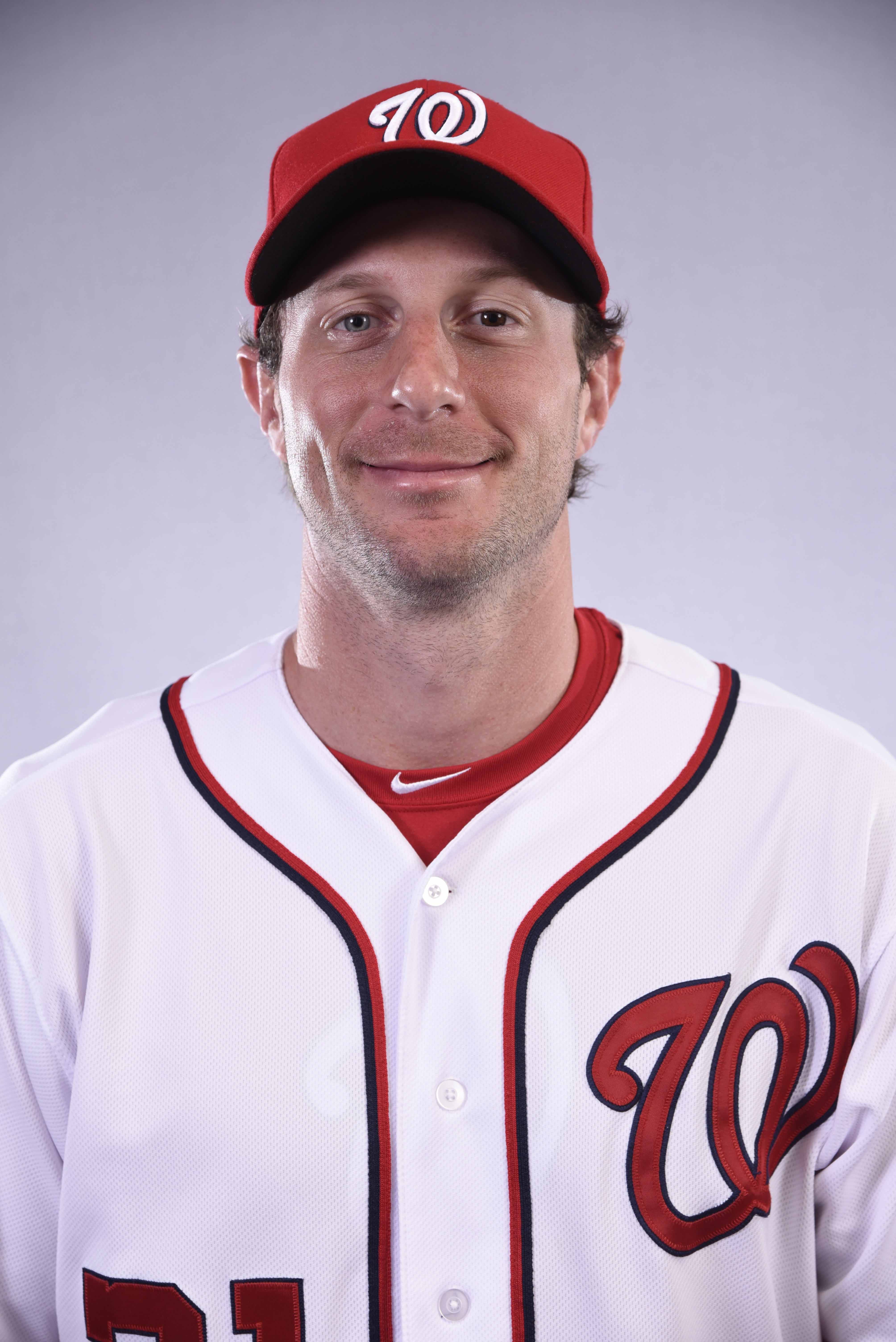 Nationals GM Mike Rizzo does not seem to act out of sentimentality. And neither, apparently, do longtime key players Ian Desmond and Jordan Zimmermann. The clock has likely run on the possibility of extensions for that pair, whose rise to become highly productive big leaguers played an enormous role in the organization’s turnaround. Last year was probably the time to get a deal done, but neither player bit at the sizable numbers being dangled. It is hard to blame them for doing so, or to blame the team for not going as high as might’ve been necessary, with potential nine-figure free agencies beckoning.
If it wasn’t already, the writing was scrawled on the wall when Max Scherzer signed his monster deal to join a loaded Nationals rotation. While deferrals reduce the total cost to the team, the investment in Scherzer is enormous, and made new contracts for Desmond and (especially) Zimmermann seem quite unlikely.
Bold as the Scherzer contract is in the long run, it is all the more stunning in the short. Effectively, Washington has taken baseball’s best rotation from 2014 — every piece of which returns — and added the best pitcher from the league’s second best rotation of last year. If all goes according to plan, the Nats’ pitching will be dominant.
Indeed, looking ahead, if all the arms remain healthy — or, perhaps, if the team completely falls apart — it is not impossible to imagine the Nats dealing Zimmermann or Doug Fister over the summer to address other needs. Washington could still maintain a powerful group of postseason starters while filling in the fifth slot with Tanner Roark (the game’s most eligible sixth starter), Blake Treinen, Taylor Jordan, or A.J. Cole. More likely, one or more of those pitchers will be installed in the rotation next year as the club waits for younger, even higher-ceiling arms (namely, Lucas Giolito, Reynaldo Lopez, and Fedde) to develop.
Overview
This is a win-now team, but not one that is structured to fall apart with its veterans. Washington has run its payroll up to over $160MM, near the top of the league (non-LA/NYC bracket). But its future commitments remain manageable even after signing Scherzer: $84MM next year and no greater than $59MM in the years that follow. The club’s top arb-eligible players for 2016 and beyond (Stephen Strasburg, Bryce Harper, Storen, Ramos, and, potentially, Rendon) have all seen their arbitration earning power suppressed to some extent, leaving additional room.
Likewise, plenty of young talent is filtering up and should soon be ready to plug into the MLB roster or deal away for more established players. By most accounts (including Baseball America) the Nats possess a top-ten farm system, representing a quick replenishing for a system that had lost a ton of well-regarded players to graduation and trade.
While the future still looks bright, it will be a tall order to meet or exceed the organization’s current situation. Not only are the club’s best young players and veterans alike at or near their primes — a difficult nexus to achieve — but the rest of the division seemingly features two still-advancing hopefuls (Mets, Marlins) and a pair of rebuilding outfits (Braves, Phillies). The window will still be open after this year, but probably not as wide.
Photo courtesy of USA Today Sports Images.
MLB Releases Draft Bonus Slots
The league has informed teams of the draft bonus slot allocations that will apply to this year’s amateur draft, as Baseball America reports. With the first overall pick, the Diamondbacks will have just over $8.6MM to spend (or divert to other picks).
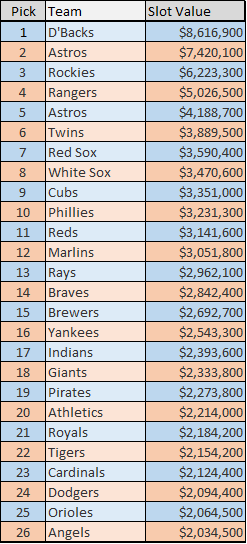
That top choice was given a shade over $7.9MM in value last year. The Astros had agreed to a $6.5MM deal with first overall pick Brady Aiken before a controversial dispute over his physical left that agreement unconsummated. Houston would have been in line to distribute that $1.4MM in savings to other top picks. Particularly with a reportedly weak top of this year’s class, Arizona could well look to do something similar.
The first-round values are presented at right. Obviously, every team started with a first-round pick but not every one ended the winter with one still in its bag due to the signing of qualifying offer-bound free agents. And the Astros — like the Blue Jays last year — have an extra first-rounder (in this case, the second overall pick) for failing to sign the prior year’s draft choice.
Values of the individual picks are, of course, somewhat less important than are the overall spending pools across all picks, which BA updates here. While Arizona has the largest single pick allocation, Houston’s extra first-round choice gives it the greatest overall pool. Indeed, the D’Backs are not even the team with the second-highest total dollars to spend. The Rockies, which also hold the 27th overall choice, hold that distinction.
The reason that Colorado is able to leapfrog their division rival in net draft muscle is, of course, due to the remainder of the first round choices, listed at right. Michael Cuddyer’s surprising decision to turn down the team’s qualifying offer and sign with the Mets left a highly valuable draft slot in his former club’s hands.
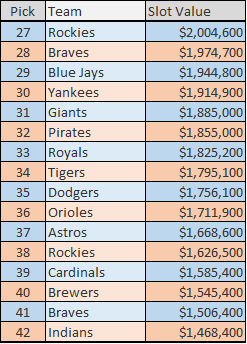
Among these “sandwich” round picks, the first ten (number 27-36) go to teams that lost qualifying offer-declining free agents. The remainder are compensation choices awarded to lower-revenue teams through a lottery.
If you are interested in reviewing all the other bonus limits applicable to the first ten rounds of the summer’s draft, be sure to check out the original link listed at the top of this post. BA has listed the values for each of the draft’s first 315 picks.
Yankees Outright Austin Romine
The Yankees have outrighted catcher Austin Romine to Triple-A, the club announced. Romine had been designated for assignment after losing the backup catching competition.
The 26-year-old, a former top-100 prospect, has struggled in limited action at the big league level. Last year was his worst as a professional, as he slashed just .242/.300/.365 in 313 plate appearances at Triple-A and receive minimal MLB action.
It is at least something of a surprise to see the out-of-options Romine clear waivers, but it seems that no club was interested in adding him to its active roster or trying to pass him through waivers itself. For New York, he represents a nice insurance policy with some upside.
Cubs To Sign James Russell
The Cubs have signed lefty James Russell, Mark Gonzales of the Chicago Tribune reports on Twitter. Russell was released by the Braves earlier this spring.
Of course, Russell spent much of last season (and all of his career before it) with Chicago. Dealt along with Emilio Bonifacio to Atlanta last summer in exchange for catcher Victor Caratini and cash, Russell put up good numbers down the stretch. He ended the year with a career-low 2.97 ERA over 57 2/3 innings between both clubs.
In spite of his solid results last year, a rough spring led to his departure from the Braves, who will be on the hook for about $600K of salary but were able to avoid paying Russell the full $2.4MM he had agreed upon to avoid arbitration. Because Chicago was able to land him with a minor league deal, Russell will represent a free roll for the team if and when he makes it onto the major league roster.
Interestingly, Russell now joins Jason Hammel, Bonifacio, and Jeff Samardzija as players who were dealt away last summer by the Cubs and are back with Chicago organizations — the latter two with the White Sox.
Pirates Extend Josh Harrison
The Pirates have announced a four-year extension for infielder/outfielder Josh Harrison. Pittsburgh will guarantee the super-utility man $27.3MM over the next four seasons and will also hold two club options that could bring the deal’s total value to $50.3MM.
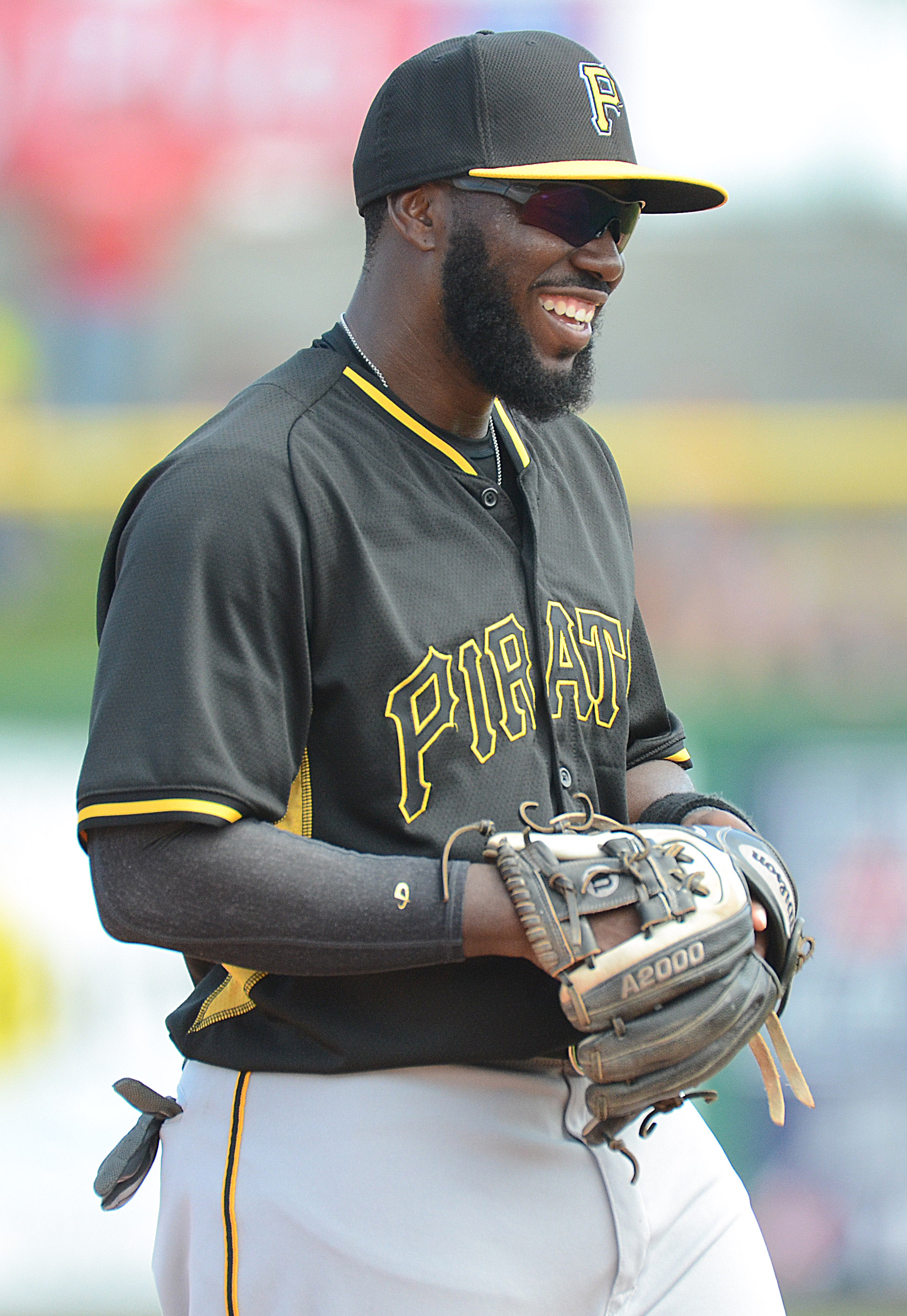
Harrison, who is represented by MSM Sports, will take home a $1MM signing bonus. After earning his previously agreed-upon $2.8MM salary this year, he will earn $5MM (2016), $7.5MM (2017), and $10MM (2018). The options are worth $10.5MM ($1MM buyout) and $11MM ($500K buyout). The options can each increase by up to $1MM depending upon escalators based upon MVP voting, accounting for the rest of the achievable value.
Harrison, 27, broke out last year for the Bucs after several years shuttling between the big leagues and upper minors. Despite previously carrying a sub-.700 OPS, Harrison slashed .315/.347/.490 in 550 plate appearances in 2014, adding 13 home runs and 18 stolen bases.
Playing excellent defense at multiple infield and outfield positions not only helped enhance Harrison’s overall productivity, but makes him a highly versatile piece moving forward. In the aggregate, Harrison posted 5.3 rWAR and 5.0 fWAR last year.
That elite contribution came at an opportune time, as it landed Harrison a $2.8MM contract in his first year of arbitration eligibility. In exchange for promising away the rest of his arbitration years and three seasons of free agent eligibility (two via options), Harrison now pockets an additional $24.5MM in guaranteed money.
MLBTR’s Steve Adams took a look at Harrison as an extension candidate back in September. After a detailed breakdown of his surprising emergence, Steve explained the difficulties that the two sides might encounter in valuing a new contract. A new factor was introduced when the Bucs landed Korean infielder Jung-ho Kang.
But with Harrison showing no signs of slowing down over a solid spring, team and player were able to bridge any differences and find common ground. In the end, Pittsburgh will commit slightly more than the Indians did last year for Michael Brantley but will pick up an additional season of control in the second option. The club will now enjoy the wide flexibility that Harrison offers in planning their next several offseasons, while hoping that his contract pays off as much as Brantley’s has.
Detractors will note that Harrison benefited from a .355 BABIP last year. But he has traditionally carried a high mark in the minors and still would have had plenty of value on offense — to say nothing of the other elements of the game — had that number been lower. If Harrison can remain even a slightly above-average hitter, he ought to justify his contract and then some.
All links to Twitter: Jon Heyman of CBSSports.com first reported the total value of the deal. Ken Rosenthal of FOX Sports reported details while Rob Biertempfel of the Pittsburgh Tribune-Review also reported financial details and Bill Brink of the Pittsburgh Post-Gazette added the deal’s escalator clause.
Photo courtesy of USA Today Sports Images.
Huston Street, Angels Still Open To Extension
APRIL 7: Street is still interested in an extension with the Angels, but he told MLB.com’s Alden Gonzalez (Twitter links) and other reporters that he’s re-hired former agent Alan Hendricks to handle the bulk of the negotiations now that the season has started. “We are close enough that I’m still engaged,” said Street.
APRIL 6: Angels GM Jerry Dipoto tells reporters, including MLB.com’s Alden Gonzalez (Twitter link), that an extension with closer Huston Street is “still possible.” Negotiations have remained “friendly,” he adds,’ noting that “Opening Day was never a deadline.”
Talks have been well-publicized, with the self-represented Street making clear that he knows what kind of deal he wants to give up the right to free agency after this season. The sides have not seemed to be close on numbers this spring, Mike DiGiovanna of the Los Angeles Times tweets.
Street, 31, does not have the kind of obscene strikeout numbers that the game’s best relievers tend to carry. Nevertheless, he has produced impeccable results, even though ERA estimators suggest he has outperformed his true contributions. Since leaving the Rockies for less hitter-friendly environs after the 2011 season, Street has thrown 155 innings of 1.97 ERA ball with 8.7 K/9 against 2.3 BB/9.
Valuing Street as an extension candidate or free agent remains challenging, however. Aging relievers with a fair bit of mileage are notoriously fickle investments, and Street has missed some time over the years with shoulder and lower-leg issues (among other things). Then again, he has never relied on velocity and still throws as hard as ever (high 80s).
Cuba Notes: Iglesias, Gourriel, Sierra, Alvarez
James Schmehl of MLive.com has the fascinating story of Tigers shortstop Jose Iglesias‘s defection from Cuba. Just 18 years old at the time, Iglesias acknowledges being scared — not just of the act of escape, but of the broader uncertainty. As Schmehl explains, the risks of the undertaking extend beyond making it out and not being able to get back in. The fact is, many ballplayers ultimately do not receive significant bonuses and/or do not ultimately make it in professional baseball. You’ll want to give the whole piece a read to learn more about Iglesias.
Here’s more from the Cuban scene:
- Cuban star Yulieski Gourriel, 30, says that he aspires to play in the big leagues (for the Yankees) but will not attempt to defect, Yahoo’s Michael Isikoff reports. Long one of the island’s most coveted players, the infielder has dominated Cuba’s Serie Nacionale with a mix of power and on-base ability. Playing last year in Japan, he slashed .305/.349/.536. “This is the dream of all players — to play at the maximum level of baseball in all the world,” Gourriel said. “… We are ready for the lifting of the blockade. Then we can come play.” Gourriel himself has obviously reached an age where his appeal is waning, though his younger brother Lourdes Gourriel is an intriguing talent whose future could be impacted significantly by changes in the political climate (if any).
- 20-year-old righty Carlos Sierra is one of several Cuban players who will be worth learning about in the months to come, as MLB.com’s Jesse Sanchez reports. Interestingly, Sierra has been permitted to leave Cuba legally to play in Spain, with plans to come stateside, because he was able to achieve Spanish citizenship. Also in the process of looking for a professional deal is 24-year-old righty Jorge Hernandez, who is presently showcasing for teams. And infielder/outfielder Alejandro Ortiz, 25, is also now eligible to sign.
- And, of course, the most prominent names — Yadier Alvarez and Andy Ibanez — remain unsigned at present. The league has yet to act upon Alvarez’s request for a waiver that would allow him to sign in this or the following July 2 signing period.
Padres Looking For Shortstop Upgrade
The Padres are “scouring the shortstop market,” sources from other teams tell Bob Nightengale of USA Today (Twitter link). San Diego has been incredibly busy on the trade market under new GM A.J. Preller, and apparently is not stopping with the season underway.
The Padres currently feature a duo of Alexi Amarista and Clint Barmes at short, which obviously does not represent the most offensively potent pairing. Of course, they do form a strong defensive platoon partnership that could at least conceivably deliver reasonable production, but it is an underwhelming situation for a team that obviously has designs on contending.
As far as possibilities for a trade partner, the report does not give any hints. There are some established players that might be had, though the most obvious candidates are rather pricey. We just heard that the Cubs’ Starlin Castro could still be a trade candidate. The Rangers no longer have a pressing surplus up the middle, but Preller’s former employer is likely quite willing to discuss Elvis Andrus.
San Diego has been rather creative in formulating deals to add established talent, so nothing can be ruled out at this point. Of course, it could be that the team is primarily looking for a more modest upgrade.
NL Notes: Papelbon, Kimbrel, Padres, Castro
The Padres expressed some mild interest in Phillies closer Jonathan Papelbon earlier in the offseason, MLB.com’s Todd Zolecki reports. Obviously, San Diego no longer looks like an even hypothetical landing spot for Papelbon. It seems likely that Papelbon’s greatest appeal will ultimately lie with a club that suffers an injury or wants a chance to add late-inning depth over the summer.
Here’s more from the National League:
- With the Padres having taken on significant salary commitments and given up young talent to acquire Craig Kimbrel from the Braves, reactions to the move have been divided somewhat between front office and uniformed personnel, ESPN.com’s Buster Olney writes (Insider link). Atlanta has the backing of most executives, says Olney, while players and coaches have understandably focused on the impact that Kimbrel could have in San Diego.
- The Padres received immediate trade interest in their bullpen after adding Kimbrel, as Dennis Lin of the San Diego Union-Tribune reports. “Within minutes, probably, of the (Kimbrel) deal, four or five teams have checked in,” said GM A.J. Preller. “So that’s part of making the deal. Hopefully, you add depth and it may help us in another area down the road.” Of course, that depth could be put to use either to fill in the pen or to shore up another area of need via trade.
- The shortstop position is an obvious area to watch for the Cubs, but Olney says (in the above-linked piece) that it may not all be positive. Starlin Castro has proven he can hit, but Olney says there are real concerns about how committed he is to grinding things out on defense. Chicago informed other teams this winter that it was open to trade scenarios involving the 25-year-old.
Astros Place Alex Presley On Outright Waivers
APRIL 7: Houston is seeking outright waivers on Presley, Evan Drellich of the Houston Chronicle tweets. That means that a trade could not be arranged, leaving Presley open for the taking by any club willing to absorb his contract.
If Presley is not claimed, he would likely remain within the Houston organization as Triple-A depth. Though he could elect free agency because he is a Super Two player, Drellich tweets, that would mean giving up his guaranteed salary.
APRIL 1: The Astros have designated outfielder Alex Presley for assignment, MLB.com’s Brian McTaggart reports on Twitter. While the club would like to keep him, they may attempt to work out a trade, McTaggart tweets.
Presley saw 271 plate appearances with Houston last year after being claimed off waivers. He slashed just .244/.281/.346 with six home runs and five steals. Playing mostly in the corner outfield, Presley was unable to stay above the replacement line. His work at the plate showed more of the same this spring.
Presley should draw interest from teams looking for some versatility. He is out of options, of course, meaning that a team would have to give him an active roster spot in claiming him. Presley also comes with a $1MM salary in his first year of arbitration eligibility (as a Super Two).