Mariners Release Scott Baker

The Mariners have released Scott Baker after the starter upon his request, reports Chris Cotillo of MLBDailyDish.com (via Twitter). The veteran righty was an Article XX(B) free agent.

Baker, 32, has not seen substantial MLB action since 2011, when he threw 134 2/3 innings of 3.14 ERA ball for the Twins. He joins a growing list of available starters who will be looking for new homes before the start of the season. It would appear that the Mariners will choose two of Randy Wolf, Roenis Elias, and Blake Beavan to round out the rotation to start the year. 

Geovany Soto Tears Meniscus, Out 10-12 Weeks

Rangers catcher Geovany Soto has torn his lateral meniscus and will miss ten to twelve weeks recovering from surgery, reports Jeff WIlson of the Fort Worth Star-Telegram (via Twitter). He becomes the latest in a series of Rangers to suffer significant injuries.

With Soto on the shelf, free agent signee J.P. Arencibia figures to handle most of the load in the earlygoing, though manager Ron Washington would not commit to giving the starting nod to the former Blue Jay regular. 29-year-old Robinson Chirinos is the only other player that Texas has under contract who comes with MLB experience (just 90 plate appearances).

With roster decisions being finalized in the coming days, it would not be surprising to find Texas in the market for another backstop. As MLBTR's Charlie Wilmoth wrote in reviewing the club's offseason moves, the veteran-laden club is firmly in win-now mode. The group of catchers was already below average, and now looks like it may well need a new addition.

Alex Colome Suspended For 50 Games

Rays pitcher Alex Colome has been placed on the restricted list after being hit with a 50-game PED suspension, the Commissioner's office announced today (story from MLB.com's Bill Chastain). Colome tested positive for the steroid Boldenone.

The 25-year-old righty had been an important part of the Tampa pitching depth. He was expected to open the year at the Triple-A level, but had been considered a candidate for the fifth rotation spot. Colome was strong last year, throwing 70 1/3 innings of 3.07 ERA ball at the Triple-A level and posting a 2.25 ERA in three big league starts before an elbow strain ended his season.

Landing at the fifth slot on Baseball America's ranking of the club's top prospects heading into the season, Colome is said to have made large strides forward in his command and feel. The hurler's durability is the main concern cited by BA.

Offseason In Review: Colorado Rockies

The Rockies made a series of moves this offseason, but seemingly lacked a cohesive strategy and may not be that much better this year than last.

Major League Signings

Notable Minor League Signings 
Extensions
  • None
Trades and Claims 
Notable Losses 

Needs Addressed
 
Coming off of two consecutive last-place finishes, the Rockies had the luxury of looking for upgrades at several areas, choosing those that offered the best fit and value. Both the rotation and pen looked like they could use some quality innings, but of course many viable strategies exist to add arms. And while Helton's retirement left an opening at first, internal options (such as shifting Michael Cuddyer or Wilin Rosario to first base duties) left ample flexibility. Though owner Dick Monfort downplayed the possibility of big spending, he did indicate that the team could bump payroll to the $95MM range to add the right pieces. 
To some extent, the Rockies did fill in some areas of need. Indeed, things got started in a sensible enough manner, as the club picked up the options of De La Rosa and Belisle (the latter representing a rarely exercised mutual option) while adding Hawkins on a modest contract to serve as closer. These moves shored up the back of the pen and seemingly set the team up to open the year with two southpaw options in the excellent Rex Brothers and solid Josh Outman (whose 4.33 ERA last year was not as impressive as his 3.25 FIP, 3.62 xFIP, 3.35 SIERA, and shutdown performance against same-handed batters).
 
Colorado seemingly turned its attention to the catching market at that market, reportedly making runs at both Brian McCann and Carlos Ruiz. It was not terribly surprising that the team missed, with McCann signing for $85MM with the Yankees and Ruiz scoring $26MM from the Phillies, but the Rockies seemingly halted the bid to land a catcher after those two early signings.
 
The next step was somewhat difficult to explain. The Rockies sent out a young, relatively affordable, above-average center fielder in Fowler in exchange for nothing more than the former pitching prospect Lyles and reserve outfielder Barnes. Though Fowler has yet to sustain a break out over a full season, he has shown speed and some pop while getting on base at a solid clip, and has been worth somewhere around a two-and-a-half wins a year over his last three campaigns. While the team avoided Fowler's salary — $7.35MM in 2014 plus a raise through arbitation in 2015 — the return was underwhelming.
 
On the other hand, it could be that Fowler is a less attractive asset than one might expect, particularly given his fairly underwhelming defensive marks and backloaded contract. On the other side, Lyles has reportedly looked good this spring, though he is something of a lottery ticket and already has over two years of MLB service. Does he explain the deal? It certainly is possible that the Rockies targeted him as a good buy-low candidate. He does have a solid prospect pedigree, is still just 23, and may well have been rushed to the bigs in Houston. Moreover, advanced metrics like him better than his results (he has a career 4.25 SIERA and 4.23 xFIP, both more encouraging than the 5.35 ERA he has compiled in 377 MLB innings). And, importantly for Colorado, he has posted above-average groundball rates. With four years of control remaining, and reasonable arb earnings probably on the horizon, there is still time for the deal to work out. Even with that caveat, however, it is difficult to imagine that the club intended the rest of the offseason to be driven by a decision to open a hole in center to take a shot on Lyles.
 
Things got more confusing from there, as the Rockies immediately turned around and promised an aging Justin Morneau two years and $12.5MM to play first base. While someone had to play the position, the signing took up nearly all of the savings achieved by dealing Fowler without adding any likely production. Indeed, if anything, Morneau appears to be a downgrade: Fowler does a passable job at a premium defensive position, while Morneau is not only bound to first but has graded out poorly there in the last two seasons. Fowler is not only much younger and a better baserunner, but is actually a better hitter as well at this point in his career. Consider their respective stat lines over 2011-13: .276/.374/.439 (111 wRC+) with 40 home runs and 43 stolen bases for Fowler; .256/.319/.406 (98 wRC+) with 40 home runs and 1 stolen base for Morneau. To be fair, the team previously made a strong run at acquiring Cuban slugger Jose Abreu, bidding just $5MM less than the ultimate $68MM price tag, but the back-up plan seems to have lacked in creativity.
 
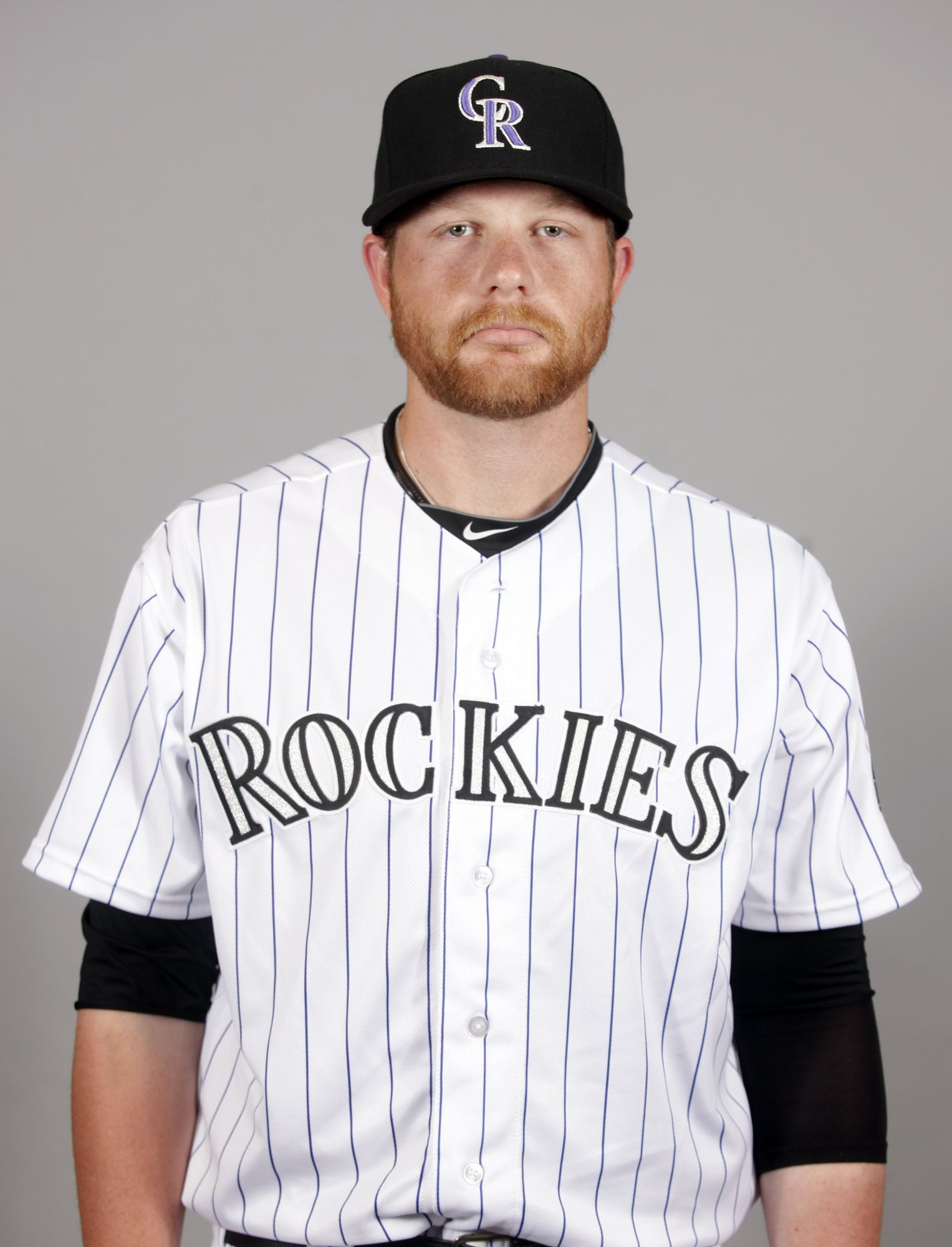
The ensuing trade for Anderson (pictured below) has obvious appeal, as the grounder-inducing lefty looks like a nice fit for Coors Field and was still relatively inexpensive at the tail end of an early-career extension. Of course, given his injury history, taking on the contract ($8MM this year and a $12MM option for next with a $1.5MM buyout, less the $2MM chipped in by the A's) carries some downside. And Colorado had to give up once and for all on its own once-prized prospect in Pomeranz. 
 
Surely, by this point, the Rockies had covered the Fowler savings. Nevertheless, Colorado decided to enter into one of the most eye-popping deals of the offseason, guaranteeing situational lefty Boone Logan a whopping $16.5MM over three years. That fell just shy of the top overall guarantees made to Joe Nathan and Brian Wilson, and easily was the most cash promised to a lefty specialist. Indeed, Logan has consistently been hit by right-handed batters. While he is better against lefties, Outman has been better.
 
Taking things somewhat full circle, the Rockies cleared the sudden left-handed logjam in their pen by shipping Outman to the Indians for center fielding option Drew Stubbs. Of course, Stubbs, who like Fowler comes with two seasons of control before reaching free agency, was significantly more expensive than Outman ($4.1MM versus $1.25MM). While he is probably a better defender than Fowler, Stubbs has struggled to get on base, been over three times more likely to strike out than to draw a walk, and shown an inability to hit righties. Barring a step forward, he could be headed for a non-tender next year; if not, his total cost will be within shouting distance of Fowler's.
 
Questions Remaining
 
Things did not really come full circle, perhaps, until more recently, when a report emerged that the Rockies "remain concerned with their leadoff spot and center field." The team is apparently unsatisfied with the three remaining up-the-middle options: Stubbs, Barnes, and Charlie Blackmon. (Of course, Colorado had already gone through the strange act of naming star Carlos Gonzalez as the new center fielder and then removing him from that post on the eve of Spring Training.) It is somewhat difficult to imagine a problem more clearly of a team's own making than this one. The club now faces a big question mark in center, and will save relatively little cash at the position for its troubles.
 
Worse, while it is true that Fowler did not grade out as a strong defender over his time in Colorado, the team lost an opportunity to pursue an alternative acquisition strategy and move a terrible defender to first base. Despite a stellar year at the plate, Cuddyer rated as the very worst position player in all of baseball last year. Likewise, while his bat delivers good averge and pop, Rosario is an abysmal pitch framer and scored the lowest defensive ratings of all qualified backstops last year. The entire shake out of the Fowler trade and Morneau signing could hover over the team's season.
 
Elsewhere, the Rockies should be able to let the second base battle between DJ LeMahieu and Josh Rutledge work itself out over the course of the year, though neither looks like a sure bet to be an average regular. The rest of the lineup appears set, and the amount of production will simply come down to questions of health (Gonzalez, Troy Tulowitzki), aging (Cuddyer, Morneau), and development (Rosario, Nolan Arenado). 
 
The club still faces some pitching questions too, of course, though generally they are of the wait-and-watch variety as well. Several injury or injury recovery scenarios bear watching, including those of Anderson and Jhouylis Chacin among starters. The watch is on for the arrival of top starting prospects Jonathan Gray and Eddie Butler. And there seems to be almost an implicit expectation that Hawkins will ultimately be usurped as the closer by Brothers.
 
Deal of Note
 
The move to add Anderson could be a worthwhile risk for this ballclub. While Anderson's high established ceiling was intriguing to many clubs, his skill mix seems especially useful for the Rockies, who have clearly prioritized groundball-inducing pitching of late. Anderson has steadily driven his groundball rate up into the high-fifty-percent range, which is about where the top sinkerball starters max out over the course of a season. 
Anderson
 
Though the 26-year-old may never be the kind of guy you simply assume will give you 200 quality innings, due to his injury history, this looks to be a good time to add him. With two years of control, Colorado gets to capture some upside if he succeeds. If he falters, or his body fails him, the 2015 option is also an out for the team to avoid wasting cash. And if Anderson resumes his former trajectory, Colorado will have exclusive negotiating rights and a reasonably valuable trade chip.
 
On the other hand, perhaps too little attention has been paid to the non-monetary return that went to the A's. Though Anderson has drawn strong reviews for his work over the spring, so too has the once-hyped Pomeranz. The key piece in the deal that sent Ubaldo Jimenez to the Indians, Pomeranz has actually logged less than 400 professional innings (more than a third of which have come at the MLB level) since becoming the fifth overall pick in the 2010 amateur draft. He struck out ten batters per nine in 91 minor league innings last year. 
 
As Oakland GM Billy Beane put it: "He's only 25, and a lot of people still think very highly of his abilities, and we felt it was a good time to acquire him." Indeed, Pomeranz shows just one year and 50 days of MLB service on his odometer, meaning he'll play at league minimum until 2016 and remain under team control until 2019. At worst, Pomeranz's power from the left side has been much more effective against same-handed hitters, and he could add plenty of value from the pen. 
 
Conclusion
 
So, did the series of whack-a-mole moves result in a net benefit to the Rockies, by cost savings, production, or both? We'll have to watch to find out, but I suspect not. Even if Fowler warrants a big raise next year (which would mean a strong season), it is hard to imagine he'll cost much more than $17MM over two years, and we know Outman took down a $1.25MM salary for 2014. Compare that with the $33.1MM that Colorado has now guaranteed to Stubbs, Morneau, and Logan, along with the roll of the dice on Lyles. (I'm assuming the team adds Anderson under either scenario.)
 
It is eminently arguable that the Rockies would have fielded a better team and saved some cash had they simply gone after a player like Nate McLouth, David Murphy, or Chris Young – or, for that matter, used an internal option like Corey Dickerson – and shifted Cuddyer to first. Alternatively, the club could have made a somewhat more substantial move at catcher, moving Rosario. Admittedly that market had pretty significant demand, but the 28-year-old, flyball-hitting Jarrod Saltalamacchia signed for just $4.5MM more than the Rockies promised Logan over the same term. Even if the team felt determined to move on from Fowler and add a first baseman, it might have received a better return on investment from someone other than Morneau. Michael Morse and Corey Hart both landed one-year deals at similar annual rates, and .
 
If the division-rival Diamondbacks' multiple swaps left some observers questioning that front office's imperatives of finding power bats and arms, some of the Rockies' moves left a trail of confusion. It is one thing to fault a team for its strategy or value assessment, and quite another not to be able to tell just what the team is hoping to accomplish. 
 
We know that the club was willing to commit some serious cash to land McCann or Abreu, and those misses may have forced a mid-stream adaptation. But the results are hard to explain. If we credit the Rockies for taking a chance on spinning a solid player in Fowler for a post-hype, low-service-time arm in Lyles, then what do we make of the opposing move to deal Pomeranz to take on the short-term upside of Anderson? Perhaps those decisions were driven primarily by the team's scouting assessments, rather than broad roster structuring purposes; in that case, the front office will be judged by the outcome.
 
Of course, the Rockies still probably have enough talent to become a contender this year or next, if things break right. But it is arguable that the club could have had even more talent and even fewer salary commitments on its MLB roster. Owner Dick Monfort says that, with its business model, the team can reasonably aim to qualify for the post-season about "twice every five years." (One of every three clubs make it to the post-season, of course, in any given year.) But it has been four full seasons since that has happened, and the Rockies still seem like one of the least-likely post-season contenders in baseball.
 
If measured spending growth is to be the guiding principle, a more thoughtful allocation of limited resources may be needed to deliver on-field success. Given his statements and the team's actions, Monfort appears to have in mind to create a sort of competition/reload cycle, rather than being a boom-or-bust franchise. But the Rockies are in the fairly rare situation of having two in-prime stars under control at a reasonable price for the foreseeable future. Without decisive action in either direction (present or future production), the organization risks being trapped in a bubble of mediocrity.

Stephen Drew Would Consider One-Year Deal With Tigers

Free agent shortstop Stephen Drew would be willing to negotiate a one-year contract with the Tigers, reports John Lowe of the Detroit Free Press. The belief, according to Lowe, is that Drew would be interested in landing a deal at approximately the same value as the qualifying offer ($14.1MM), but wants to wait to sign until after Opening Day to prevent the possibility of another QO next year.

Of course, speculation about the possibiity of Detroit signing Drew began immediately after the report indicating that incumbent shortstop Jose Iglesias would likely miss most of the season. But Tigers GM Dave Dombrowski has said he intends to rely on internal options, and the club just dealt for Andrew Romine to provide another option or platoon piece. It remains to be seen whether the Tigers would be inclined to sacrifice a pick for Drew if they could limit their commitment to one year, but that possiility certainly is an intriguing option for a talented club that has suffered several important recent injuries.

Quick Hits: SABR, Sandoval, Bedard, Twins, Owings

If you missed the recent SABR Analytics Conference, you are in luck, as Ben Lindbergh of Baseball Prospectus provides an excellent breakdown of the main topics of conversation. Among other things, the conference touched upon injury analytics, team chemistry, tracking technology, and front office personnel trends. Here are a few links from around the game to round out the evening:

  • The Giants have yet to begin discussing a contract extension with third baseman Pablo Sandoval, reports Henry Schulman of the San Francisco Chronicle (via Twitter). With less than two weeks remaining before Opening Day, the sides will have to move quickly if there is any interest in making a run at a new contract before the start of the season. Sandoval is set to become one of the best available free agents following the 2014 season.
  • Rays pitcher Erik Bedard says he will exercise his March 23rd opt-out clause if he does not make the Opening Day roster, tweets Roger Mooney of the Tampa Tribune. Though Bedard has been knocked around somewhat in his 11 1/3 spring innings, he says he would look to find a rotation opening elsewhere.
  • Twins assistant GM Rob Antony said today that the front office has been fielding calls about possible trades as rosters begin to take shape, tweets Phil Miller of the Minneapolis Star Tribune. Antony indicated that out-of-options players are the key topic. As MLBTR's Tim Dierkes recently reported, the Twins have eight out-of-options players of their own, several of whom are still battling for roles. Presumably, the team could also be a landing spot for the out-of-options players from other clubs.
  • Free agent Micah Owings is looking for a job as a pitcher, tweets Chris Cotillo of MLBDailyDIsh.com. After transitioning to the field just last year, the 31-year-old will hold a showcase later this week as he returns to the bump. 

Padres Sign Hector Ambriz

The Padres have signed reliever Hector Ambriz to a minor league deal, reports Corey Brock of MLB.com (Twitter links). Ambriz was one of just a few righties still left on the open market.

The UCLA product will turn 30 early in the 2014 season. He threw 36 1/3 innings last year for the Astros, registering a 5.70 ERA on 6.7 K/9 and 3.5 BB/9. Among advanced metrics, FIP (5.66) and xFIP (4.42) were not big fans of his work, though SIERA (4.04) saw him as a serviceable arm. Ambriz has a career 5.37 mark over 104 innings in parts of three seasons.

Indians Have Yet To Act On Masterson Extension Offer

It has now been a full two weeks since Justin Masterson reportedly offered the Indians a three- or four-year, $40MM to $60MM extension. The club has yet to act on the offer, however, reports Jon Heyman of CBSSports.com.

In fact, says Heyman, Masterson has made two separate proposals, both of which are still on the table and one of which is for only three years. Both offers include less guaranteed years at a slightly lower average annual value than the recent Homer Bailey extension. Bailey got six years and $105MM, earning approximately a $19MM AAV for the five free agent years covered. Masterson and the Indians have already agreed upon a $9.7625MM deal for 2014, so the new contract would cover 2015 and beyond.

Minor Moves: Adam Miller

Here are the day's minor moves:

  • The Indians brought back a familiar name today by signing former top prospect Adam Miller to a minor league deal, Paul Hoynes of the Cleveland Plain Dealer reports (via Twitter). Miller seemed destined for a career at the front of the Cleveland rotation until a curious finger injury — and multiple resulting surgeries — derailed his progress. Now 29, Miller spent last year with the independent Sugar Land Skeeters, throwing 62 innings of 4.79 ERA ball.
  • Though MLBTR's DFA Tracker shows only one player, he is an intriguing one: Javy Guerra, the Dodgers reliever.

Phillies Return Rule 5 Pick Kevin Munson To D’Backs

The Phillies have returned Rule 5 selection Kevin Munson to the Diamondbacks, Philadelphia announced today. Munson, a 25-year-old righty, was the third player taken in this year's Rule 5 draft.

Munson prevented runs but struggled with control during five spring appearances in Phillies camp. While allowing just one earned run and striking out six batters in seven innings, Munson also gave up a troubling eight free passes. 

In 2013 with the Diamondbacks, Munson managed a 4.12 ERA in 54 2/3 innings split between the upper levels of the minors. His ERA climbed upon reaching Triple-A, but Munson did maintain a double-digit strikeout-per-nine mark (as he has for most all of his minor league career) while dropping his walk rate to a solid 2.7 BB/9 level. Nevertheless, with a crowded bullpen shaping up in Arizona, the D'Backs did not see fit to add him to the team's 40-man roster to protect him from the draft.